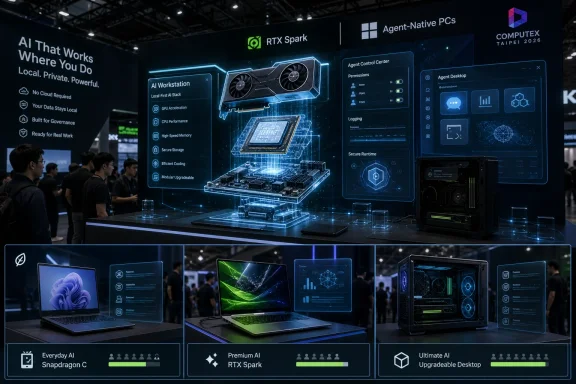
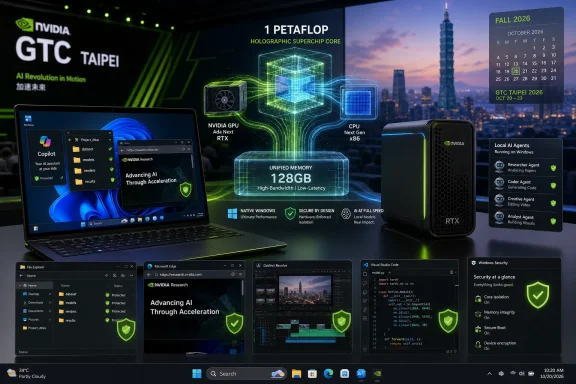
NVIDIA and Microsoft announced RTX Spark on May 31, 2026, at GTC Taipei, pitching a new class of Windows laptops and compact desktops built around a 1-petaflop NVIDIA superchip, up to 128GB of unified memory, and local AI agents arriving from major PC makers this fall. The headline sounds like another round of “AI PC” branding, but the subtext is more consequential: NVIDIA is trying to move from graphics supplier to system-platform owner inside Windows. Microsoft, meanwhile, is trying to make local AI feel less like a Copilot sidebar and more like a native operating-system capability. If the companies deliver, RTX Spark could become the first Windows AI PC platform that feels meaningfully different from a faster laptop with a sticker.
The first wave of AI PCs was defined by the NPU, a low-power accelerator tucked beside the CPU and GPU to satisfy Microsoft’s Copilot+ requirements. That approach made sense for battery life, camera effects, local transcription, and modest model inference. It did not, however, make most Windows users feel as though the personal computer had been reinvented.
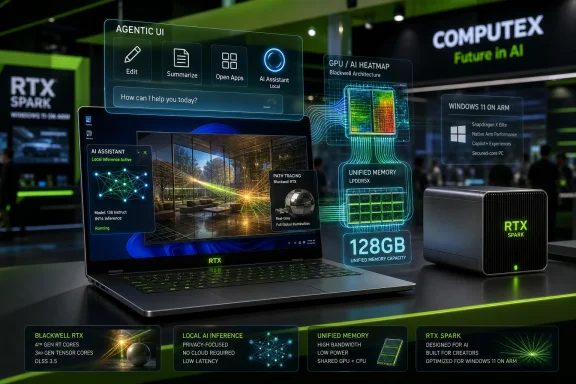
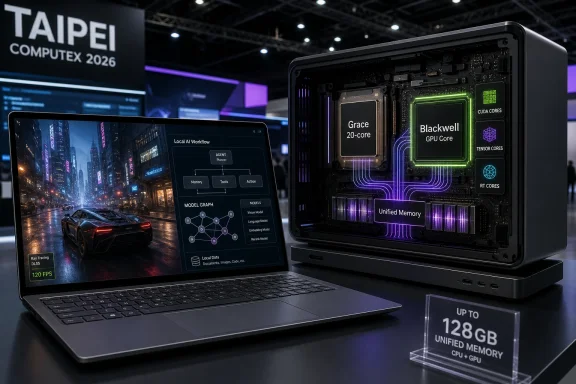
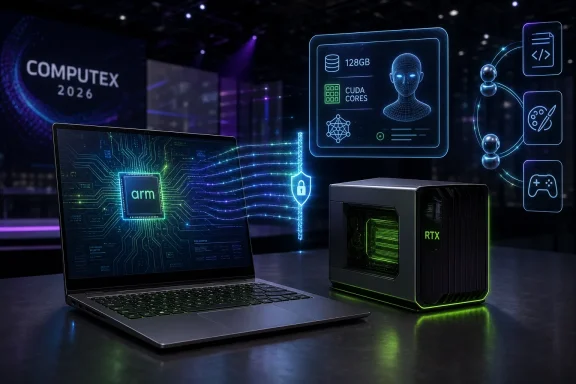
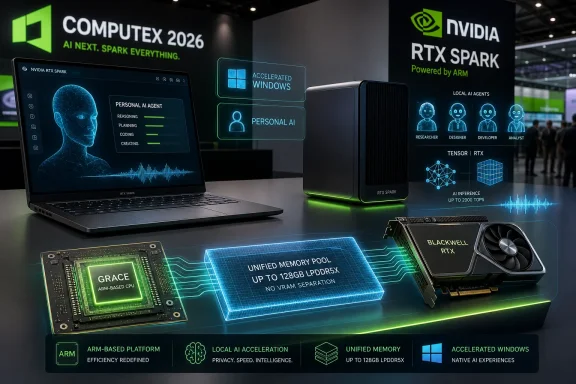
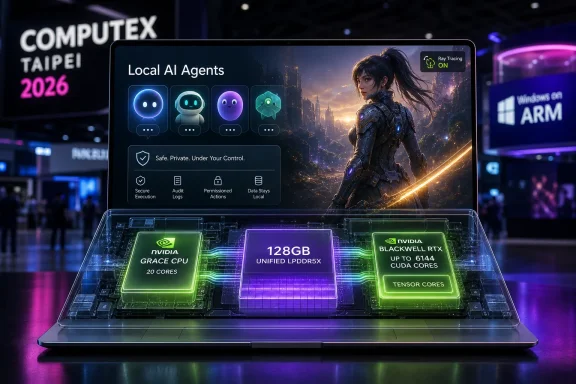
RTX Spark is a more aggressive answer. NVIDIA says the platform combines a Blackwell RTX GPU, fifth-generation Tensor Cores, FP4 support, a 20-core Grace CPU designed with MediaTek, and NVLink-C2C between the CPU and GPU. The pitch is not just “AI acceleration,” but an integrated Windows machine with the memory and compute profile to run large local models, creative pipelines, games, and agentic workflows on the same device.
That matters because NVIDIA’s advantage has never been only silicon. CUDA, TensorRT, OptiX, DLSS, Reflex, RTX Video, and the developer habits built around them are the real moat. RTX Spark tries to bring that stack into the form factor and operating system where most individual professionals still live: a Windows PC.
The announcement also reframes what counts as a premium Windows machine. For two decades, that category was largely about CPU class, discrete GPU tier, screen quality, and chassis design. NVIDIA now wants the key spec to be whether the system can host a private, capable, local agent without punting every serious request to the cloud.
RTX Spark gives Microsoft a different stage. Instead of arguing that every consumer needs an NPU to summarize meetings or blur backgrounds, Microsoft can point to workloads that are easier to understand: local agents that manipulate Windows apps, semantic search across personal files, large-context coding assistants, AI video generation, and high-end creative editing. The difference is not philosophical. It is practical.
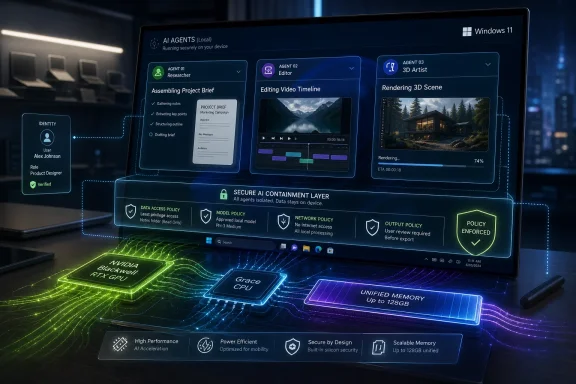
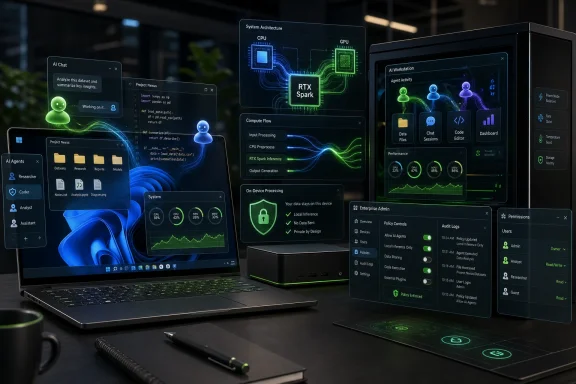
The company is also leaning into security primitives, containment, identity, and policy as part of the announcement. That is not decorative language. If an AI agent can operate across applications, read files, invoke tools, and act on behalf of a user, it becomes a new kind of software actor inside Windows. The operating system needs to know what the agent is, what it is allowed to touch, what it can send outside the machine, and how a user or administrator can stop it.
This is where Microsoft’s involvement becomes more important than the silicon itself. NVIDIA can make a monster local inference box. Microsoft has to make that box safe enough for real Windows desktops, enterprise fleets, regulated environments, and skeptical users who still remember every privacy overreach dressed up as convenience.
Agents are attractive to Microsoft because they offer a way around that fragmentation. Instead of waiting for every application to be rewritten for a new UI paradigm, an agent can theoretically reason across existing interfaces, documents, windows, APIs, and workflows. That is the dream behind the “PC does the work” language.
But that dream is also where the risk lives. A local agent with access to files and applications is not a chatbot. It is closer to a junior operator with hands on the keyboard, memory of your work, and permission to improvise. The value proposition is enormous if the agent can reconcile a spreadsheet, file an expense report, prepare a project folder, edit a video rough cut, or automate a deployment checklist. The failure modes are equally obvious if it hallucinates, leaks data, clicks the wrong thing, or misunderstands intent.
NVIDIA’s OpenShell runtime is meant to provide an additional policy layer, including rules for what agents can do and routing decisions between local and cloud models based on privacy preferences. That is a serious acknowledgment of the problem. It is also an admission that Windows-native agents will need governance from day one, not after the first viral mishap.
Large language models, diffusion models, video models, and agent workflows do not merely need compute. They need room for parameters, context, embeddings, intermediate states, and application data. NVIDIA’s claim that RTX Spark can run 120-billion-parameter models with up to a 1-million-token context is a direct challenge to the idea that serious AI work has to leave the device.
For developers, this could be more meaningful than another benchmark victory. A laptop that can run substantial models locally changes iteration loops. It lets engineers test privacy-sensitive workflows without sending customer data to a hosted API. It gives researchers, students, and small teams a personal machine that looks less like a thin client for cloud AI and more like a workstation.
For IT departments, unified memory also complicates procurement. These machines will not fit neatly into old laptop categories. They may be too powerful and expensive for standard knowledge-worker fleets, but too portable and user-facing to be treated like traditional workstations. Expect RTX Spark systems to land first with developers, creators, data teams, executives, and specialized engineering groups rather than broad office deployments.
Adobe’s commitment to rearchitect Photoshop and Premiere for RTX Spark is more than a logo slide if it materializes as promised. A new Premiere pipeline using unified memory, Blackwell GPU features, and TensorRT could matter for real editors working with heavy timelines and AI-assisted effects. Photoshop optimization for GPU compositing, live filters, HDR, and natural brushing similarly speaks to latency and responsiveness, not just export times.
The creative angle is important because it gives RTX Spark a reason to exist even before the agent story matures. Local agents may take years to become trustworthy and ordinary. Faster AI-assisted editing, high-resolution generative workflows, 12K video handling, and large 3D scenes are immediate pain points for professionals.
That is also why NVIDIA included gaming in the pitch. A platform that can run agents but cannot run games would feel alien to the Windows enthusiast market. A platform that can run large local models, Adobe workflows, and AAA games at 1440p with DLSS and Reflex starts to look less like an appliance and more like the next premium PC template.
If RTX Spark laptops deliver strong battery life, serious GPU performance, and Windows app compatibility good enough for professionals, they could normalize Arm in the premium Windows market faster than Qualcomm alone. Not because users suddenly care about Arm, but because they care about what the machine can do. The architecture becomes a footnote when the experience is compelling.
That is a big “if.” Windows on Arm has improved substantially, but compatibility remains a real-world concern for drivers, utilities, plug-ins, anticheat systems, enterprise agents, VPN clients, niche creative tools, and old line-of-business software. NVIDIA can bring an extraordinary GPU stack, but the Windows ecosystem is still full of sharp edges that only appear when a machine hits messy daily use.
This is where Microsoft must do the unglamorous work. Developers need clear tooling. Enterprises need deployment confidence. Users need apps that simply run. NVIDIA’s brand can get attention; Windows compatibility will determine whether RTX Spark becomes a platform or a curiosity.
That is a more dangerous fight for the incumbents. Intel and AMD can compete in CPUs, integrated graphics, discrete GPUs, NPUs, and platform features. NVIDIA competes from the software ecosystem outward. Developers already optimize for CUDA and NVIDIA inference libraries because the cloud AI world is overwhelmingly NVIDIA-shaped. RTX Spark tries to make the local Windows endpoint resemble that world.
The incumbents still have advantages. x86 compatibility remains a powerful default. Enterprise validation, supply-chain diversity, existing management practices, and price segmentation all favor Intel and AMD in mainstream fleets. Most users do not need a 120-billion-parameter model on a laptop, and many businesses will prefer cheaper systems that handle everyday AI features efficiently.
But the high end matters because it defines aspiration. If the most exciting Windows machines become NVIDIA-led systems, Intel and AMD risk being cast as suppliers of normal PCs while NVIDIA owns the narrative around new PCs. That does not have to be fatal, but it is not a comfortable place to be.
Still, “available this fall” leaves unanswered questions. Pricing will shape everything. A $1,999 RTX Spark laptop is a different market event from a $4,999 mobile workstation with futuristic branding. Battery life claims will need independent testing. Thermals will matter, especially in designs as thin as 14 millimeters and as light as three pounds. So will fan noise, sustained performance, driver maturity, and how much performance survives away from the wall.
The compact desktop versions may be the sleeper category. A small Windows AI workstation with 128GB of unified memory could be more attractive to developers and labs than a thermally constrained laptop. It could also become the local inference box under a desk, serving a team or a power user without the procurement overhead of a rack system or cloud commitment.
The original Tbreak framing around a “fall 2024” chip appears out of step with the actual NVIDIA announcement, which is dated May 31, 2026 and points to fall 2026 availability. That distinction matters because AI hardware roadmaps move quickly, and a wrong year changes the competitive context entirely. RTX Spark is not a lost 2024 curiosity. It is NVIDIA’s 2026 attempt to define the next premium Windows platform.
The question is whether the controls will be understandable and enforceable. Windows users already struggle with permission prompts, startup apps, browser extensions, file sync clients, and background services. If agent permissions become another noisy dialog layer, users will click through. If the controls are too restrictive, agents will be useless. If they are too permissive, attackers will treat them as a new automation surface.
Enterprises will ask harder questions. Can administrators define which agents are allowed? Can actions be logged? Can sensitive data be blocked from cloud escalation? Can an agent be prevented from touching regulated files, production credentials, password managers, source repositories, or financial systems? Can EDR tools see what the agent is doing in a meaningful way?
Microsoft’s answer has to be more than “trust the platform.” The company has spent years hardening Windows against malware that abuses scripting, macros, living-off-the-land binaries, and user tokens. Agents could accidentally recreate some of that automation risk under a friendlier name. The difference between a breakthrough and a security headache will be policy that works before the incident report is written.
But RTX Spark does not mean the cloud goes away. NVIDIA’s own positioning includes intelligent routing between local and cloud models. That hybrid model is likely where the market settles. Small, private, latency-sensitive, and repetitive tasks run locally. Larger reasoning jobs, specialized models, fleet-scale training, and collaborative workflows still use cloud infrastructure.
The change is leverage. If a developer, creator, or business can run meaningful workloads locally, cloud AI becomes a choice rather than an unavoidable meter. That could reshape software pricing as much as hardware. Vendors that charge by remote inference will need to justify why a task cannot run on the user’s own machine.
For Windows enthusiasts, this is the most appealing version of the AI PC: not a machine that forces more subscription services into the shell, but one that gives the owner more compute agency. The PC has always been most interesting when it lets users do powerful things locally. RTX Spark revives that argument with AI as the workload.
The upside is obvious. A successful RTX Spark machine could consolidate roles that currently require a gaming laptop, mobile workstation, cloud AI budget, and local development box. It could make Windows feel newly relevant to AI developers who have drifted toward Linux workstations or cloud notebooks. It could also give creators a portable system that handles AI-heavy media work without constant proxy workflows or remote rendering.
The downside is first-generation platform risk. New silicon, new Windows integrations, new agent security models, new OEM designs, and newly optimized applications create many places for rough edges to hide. The hardware may be ahead of the software for a while. The agents may be impressive in demos and uneven in daily use. The best creative optimizations may roll out gradually rather than all at launch.
That does not make RTX Spark vapor. It makes it a platform transition, and platform transitions are messy by nature. The question is whether NVIDIA and Microsoft can make the mess feel worth it.
 NVIDIA Is Not Selling a Faster Laptop So Much as a New Center of Gravity
The first wave of AI PCs was defined by the NPU, a low-power accelerator tucked beside the CPU and GPU to satisfy Microsoft’s Copilot+ requirements. That approach made sense for battery life, camera effects, local transcription, and modest model inference. It did not, however, make most Windows users feel as though the personal computer had been reinvented.RTX Spark is a more aggressive answer. NVIDIA says the platform combines a Blackwell RTX GPU, fifth-generation Tensor Cores, FP4 support, a 20-core Grace CPU designed with MediaTek, and NVLink-C2C between the CPU and GPU. The pitch is not just “AI acceleration,” but an integrated Windows machine with the memory and compute profile to run large local models, creative pipelines, games, and agentic workflows on the same device.
That matters because NVIDIA’s advantage has never been only silicon. CUDA, TensorRT, OptiX, DLSS, Reflex, RTX Video, and the developer habits built around them are the real moat. RTX Spark tries to bring that stack into the form factor and operating system where most individual professionals still live: a Windows PC.
The announcement also reframes what counts as a premium Windows machine. For two decades, that category was largely about CPU class, discrete GPU tier, screen quality, and chassis design. NVIDIA now wants the key spec to be whether the system can host a private, capable, local agent without punting every serious request to the cloud.
Microsoft Gets a Second Chance at the AI PC Story
Microsoft’s AI PC campaign has had a strange problem: the company has been ahead of most users’ trust and behind NVIDIA’s compute curve. Copilot+ PCs created a useful baseline for local AI hardware, but the initial narrative was swallowed by Recall controversy, unclear app value, and the awkwardness of explaining why a new class of PC was necessary for features that often looked incremental.RTX Spark gives Microsoft a different stage. Instead of arguing that every consumer needs an NPU to summarize meetings or blur backgrounds, Microsoft can point to workloads that are easier to understand: local agents that manipulate Windows apps, semantic search across personal files, large-context coding assistants, AI video generation, and high-end creative editing. The difference is not philosophical. It is practical.
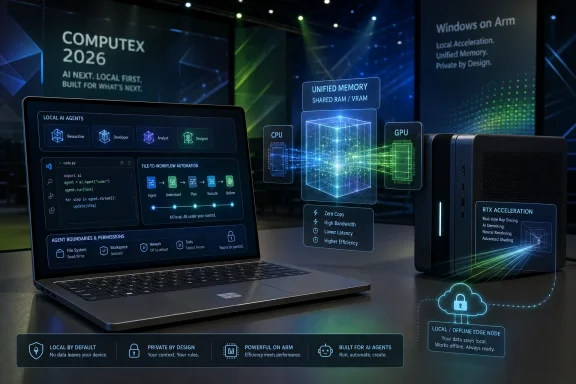
The company is also leaning into security primitives, containment, identity, and policy as part of the announcement. That is not decorative language. If an AI agent can operate across applications, read files, invoke tools, and act on behalf of a user, it becomes a new kind of software actor inside Windows. The operating system needs to know what the agent is, what it is allowed to touch, what it can send outside the machine, and how a user or administrator can stop it.
This is where Microsoft’s involvement becomes more important than the silicon itself. NVIDIA can make a monster local inference box. Microsoft has to make that box safe enough for real Windows desktops, enterprise fleets, regulated environments, and skeptical users who still remember every privacy overreach dressed up as convenience.
The Agent Is the App Model Microsoft Never Managed to Finish
For years, Microsoft has tried to pull Windows developers toward new app models. The Windows Store, UWP, WinUI, Progressive Web Apps, widgets, and Copilot plugins all promised some version of a cleaner, more modern software surface. None displaced the old reality: Windows remains a sprawling ecosystem of Win32 apps, browser tabs, shell extensions, background services, drivers, and line-of-business tools.Agents are attractive to Microsoft because they offer a way around that fragmentation. Instead of waiting for every application to be rewritten for a new UI paradigm, an agent can theoretically reason across existing interfaces, documents, windows, APIs, and workflows. That is the dream behind the “PC does the work” language.
But that dream is also where the risk lives. A local agent with access to files and applications is not a chatbot. It is closer to a junior operator with hands on the keyboard, memory of your work, and permission to improvise. The value proposition is enormous if the agent can reconcile a spreadsheet, file an expense report, prepare a project folder, edit a video rough cut, or automate a deployment checklist. The failure modes are equally obvious if it hallucinates, leaks data, clicks the wrong thing, or misunderstands intent.
NVIDIA’s OpenShell runtime is meant to provide an additional policy layer, including rules for what agents can do and routing decisions between local and cloud models based on privacy preferences. That is a serious acknowledgment of the problem. It is also an admission that Windows-native agents will need governance from day one, not after the first viral mishap.
Unified Memory Is the Spec That Makes the Promise Plausible
The most interesting RTX Spark number may not be 1 petaflop. It may be 128GB of unified memory. AI performance claims are notoriously slippery because they depend on precision, model type, software stack, batching, thermals, and what vendors choose to count. Memory capacity is less glamorous, but it is often the wall that local AI runs into first.Large language models, diffusion models, video models, and agent workflows do not merely need compute. They need room for parameters, context, embeddings, intermediate states, and application data. NVIDIA’s claim that RTX Spark can run 120-billion-parameter models with up to a 1-million-token context is a direct challenge to the idea that serious AI work has to leave the device.
For developers, this could be more meaningful than another benchmark victory. A laptop that can run substantial models locally changes iteration loops. It lets engineers test privacy-sensitive workflows without sending customer data to a hosted API. It gives researchers, students, and small teams a personal machine that looks less like a thin client for cloud AI and more like a workstation.
For IT departments, unified memory also complicates procurement. These machines will not fit neatly into old laptop categories. They may be too powerful and expensive for standard knowledge-worker fleets, but too portable and user-facing to be treated like traditional workstations. Expect RTX Spark systems to land first with developers, creators, data teams, executives, and specialized engineering groups rather than broad office deployments.
Adobe and the Creative Apps Make the Platform Real
Hardware launches often arrive with an impressive list of partners and a thinner list of reasons to buy on day one. NVIDIA avoided some of that problem by putting Adobe near the center of the announcement. Photoshop and Premiere are not niche demos. They are daily tools for the exact customers who already buy expensive Windows laptops with NVIDIA GPUs.Adobe’s commitment to rearchitect Photoshop and Premiere for RTX Spark is more than a logo slide if it materializes as promised. A new Premiere pipeline using unified memory, Blackwell GPU features, and TensorRT could matter for real editors working with heavy timelines and AI-assisted effects. Photoshop optimization for GPU compositing, live filters, HDR, and natural brushing similarly speaks to latency and responsiveness, not just export times.
The creative angle is important because it gives RTX Spark a reason to exist even before the agent story matures. Local agents may take years to become trustworthy and ordinary. Faster AI-assisted editing, high-resolution generative workflows, 12K video handling, and large 3D scenes are immediate pain points for professionals.
That is also why NVIDIA included gaming in the pitch. A platform that can run agents but cannot run games would feel alien to the Windows enthusiast market. A platform that can run large local models, Adobe workflows, and AAA games at 1440p with DLSS and Reflex starts to look less like an appliance and more like the next premium PC template.
Windows on Arm Is No Longer Just Qualcomm’s Argument
RTX Spark’s Grace CPU and MediaTek involvement place the platform squarely in the Arm conversation, even if NVIDIA’s announcement focuses more on AI than instruction-set politics. That matters because Windows on Arm has spent years trying to escape the perception that it is a compatibility compromise for people who value battery life more than performance. NVIDIA’s entrance changes the tone.If RTX Spark laptops deliver strong battery life, serious GPU performance, and Windows app compatibility good enough for professionals, they could normalize Arm in the premium Windows market faster than Qualcomm alone. Not because users suddenly care about Arm, but because they care about what the machine can do. The architecture becomes a footnote when the experience is compelling.
That is a big “if.” Windows on Arm has improved substantially, but compatibility remains a real-world concern for drivers, utilities, plug-ins, anticheat systems, enterprise agents, VPN clients, niche creative tools, and old line-of-business software. NVIDIA can bring an extraordinary GPU stack, but the Windows ecosystem is still full of sharp edges that only appear when a machine hits messy daily use.
This is where Microsoft must do the unglamorous work. Developers need clear tooling. Enterprises need deployment confidence. Users need apps that simply run. NVIDIA’s brand can get attention; Windows compatibility will determine whether RTX Spark becomes a platform or a curiosity.
Intel and AMD Are Suddenly Fighting a Different Battle
Intel and AMD have spent the last few years adapting to the AI PC era by adding NPUs, improving integrated graphics, and refining power efficiency. That work is real and useful. But RTX Spark shifts the competitive framing from “how many TOPS does the NPU deliver?” to “can this machine run frontier-adjacent local workloads with a mature AI software stack?”That is a more dangerous fight for the incumbents. Intel and AMD can compete in CPUs, integrated graphics, discrete GPUs, NPUs, and platform features. NVIDIA competes from the software ecosystem outward. Developers already optimize for CUDA and NVIDIA inference libraries because the cloud AI world is overwhelmingly NVIDIA-shaped. RTX Spark tries to make the local Windows endpoint resemble that world.
The incumbents still have advantages. x86 compatibility remains a powerful default. Enterprise validation, supply-chain diversity, existing management practices, and price segmentation all favor Intel and AMD in mainstream fleets. Most users do not need a 120-billion-parameter model on a laptop, and many businesses will prefer cheaper systems that handle everyday AI features efficiently.
But the high end matters because it defines aspiration. If the most exciting Windows machines become NVIDIA-led systems, Intel and AMD risk being cast as suppliers of normal PCs while NVIDIA owns the narrative around new PCs. That does not have to be fatal, but it is not a comfortable place to be.
The Fall 2026 Launch Window Leaves Plenty of Room for Reality
The timing is ambitious. NVIDIA says RTX Spark laptops and compact desktops will be available this fall from ASUS, Dell, HP, Lenovo, Microsoft Surface, and MSI, with Acer and GIGABYTE to follow. That is a broad OEM lineup for a first-generation platform, and it signals that this is not merely a developer board in premium clothing.Still, “available this fall” leaves unanswered questions. Pricing will shape everything. A $1,999 RTX Spark laptop is a different market event from a $4,999 mobile workstation with futuristic branding. Battery life claims will need independent testing. Thermals will matter, especially in designs as thin as 14 millimeters and as light as three pounds. So will fan noise, sustained performance, driver maturity, and how much performance survives away from the wall.
The compact desktop versions may be the sleeper category. A small Windows AI workstation with 128GB of unified memory could be more attractive to developers and labs than a thermally constrained laptop. It could also become the local inference box under a desk, serving a team or a power user without the procurement overhead of a rack system or cloud commitment.
The original Tbreak framing around a “fall 2024” chip appears out of step with the actual NVIDIA announcement, which is dated May 31, 2026 and points to fall 2026 availability. That distinction matters because AI hardware roadmaps move quickly, and a wrong year changes the competitive context entirely. RTX Spark is not a lost 2024 curiosity. It is NVIDIA’s 2026 attempt to define the next premium Windows platform.
Security Will Decide Whether Agents Stay a Demo
The most credible part of the announcement is that NVIDIA and Microsoft are not pretending agents are only a UX problem. They are talking about identity, containment, policy, end-to-end security, local routing, personal-information masking, and user control. That is the right vocabulary for software that can act across a primary PC.The question is whether the controls will be understandable and enforceable. Windows users already struggle with permission prompts, startup apps, browser extensions, file sync clients, and background services. If agent permissions become another noisy dialog layer, users will click through. If the controls are too restrictive, agents will be useless. If they are too permissive, attackers will treat them as a new automation surface.
Enterprises will ask harder questions. Can administrators define which agents are allowed? Can actions be logged? Can sensitive data be blocked from cloud escalation? Can an agent be prevented from touching regulated files, production credentials, password managers, source repositories, or financial systems? Can EDR tools see what the agent is doing in a meaningful way?
Microsoft’s answer has to be more than “trust the platform.” The company has spent years hardening Windows against malware that abuses scripting, macros, living-off-the-land binaries, and user tokens. Agents could accidentally recreate some of that automation risk under a friendlier name. The difference between a breakthrough and a security headache will be policy that works before the incident report is written.
The Cloud Does Not Disappear; It Gets Repriced
Local AI is often sold as a privacy story, and that is partly true. Keeping prompts, documents, source code, creative assets, and personal context on the device reduces exposure to cloud providers and network intermediaries. It also reduces latency and avoids per-token costs that can make ambitious agent workflows expensive at scale.But RTX Spark does not mean the cloud goes away. NVIDIA’s own positioning includes intelligent routing between local and cloud models. That hybrid model is likely where the market settles. Small, private, latency-sensitive, and repetitive tasks run locally. Larger reasoning jobs, specialized models, fleet-scale training, and collaborative workflows still use cloud infrastructure.
The change is leverage. If a developer, creator, or business can run meaningful workloads locally, cloud AI becomes a choice rather than an unavoidable meter. That could reshape software pricing as much as hardware. Vendors that charge by remote inference will need to justify why a task cannot run on the user’s own machine.
For Windows enthusiasts, this is the most appealing version of the AI PC: not a machine that forces more subscription services into the shell, but one that gives the owner more compute agency. The PC has always been most interesting when it lets users do powerful things locally. RTX Spark revives that argument with AI as the workload.
The First RTX Spark Buyers Are Really Buying an Ecosystem Bet
Early adopters will not simply be buying a fast Windows machine. They will be buying NVIDIA’s claim that the future of personal computing belongs to local agents, large unified memory, GPU-first software stacks, and hybrid AI workflows. That is a bigger bet than buying the next GPU generation.The upside is obvious. A successful RTX Spark machine could consolidate roles that currently require a gaming laptop, mobile workstation, cloud AI budget, and local development box. It could make Windows feel newly relevant to AI developers who have drifted toward Linux workstations or cloud notebooks. It could also give creators a portable system that handles AI-heavy media work without constant proxy workflows or remote rendering.
The downside is first-generation platform risk. New silicon, new Windows integrations, new agent security models, new OEM designs, and newly optimized applications create many places for rough edges to hide. The hardware may be ahead of the software for a while. The agents may be impressive in demos and uneven in daily use. The best creative optimizations may roll out gradually rather than all at launch.
That does not make RTX Spark vapor. It makes it a platform transition, and platform transitions are messy by nature. The question is whether NVIDIA and Microsoft can make the mess feel worth it.
The Spec Sheet Finally Matches the AI PC Sales Pitch
RTX Spark is the first AI PC announcement in a while where the phrase “AI PC” does not feel laughably underspecified. The platform still needs pricing, benchmarks, battery tests, app validation, and real security review, but the pieces are finally large enough to support the rhetoric.- RTX Spark is scheduled for fall 2026 systems from major Windows OEMs, including ASUS, Dell, HP, Lenovo, Microsoft Surface, and MSI.
- The platform pairs a Blackwell RTX GPU with a 20-core Grace CPU, MediaTek design collaboration, NVLink-C2C, and up to 128GB of unified memory.
- NVIDIA is positioning the machines for local agents, large language models, creative workloads, AI video, 3D rendering, and gaming rather than simple Copilot+ features.
- Microsoft’s role is critical because agent containment, identity, policy, and Windows integration will determine whether local agents are trusted or treated as a risk.
- Adobe’s promised Photoshop and Premiere work gives RTX Spark a practical creator-market reason to exist even before agent workflows become mainstream.
- The platform puts new pressure on Intel, AMD, and Qualcomm by shifting the AI PC conversation from NPU checkboxes to full-stack local compute.
References
- Primary source: Tbreak Media
Published: Mon, 01 Jun 2026 04:53:34 GMT
NVIDIA Enters CPU Wars with RTX Spark, Bringing 1 petaflops power to Windows PCs
NVIDIA's new RTX Spark superchip delivers 1 petaflop AI performance with 128GB unified memory, enabling personal AI agents to run locally on Windows PCs. Major manufacturers including Dell, ASUS and Microsoft Surface launch systems this fall.tbreak.com - Independent coverage: NVIDIA Newsroom
Published: Mon, 01 Jun 2026 04:30:43 GMT
NVIDIA and Microsoft Reinvent Windows PCs for the Age of Personal AI | NVIDIA Newsroom
NVIDIA today unveiled NVIDIA RTX Spark™, a new superchip that reinvents Windows PCs for the era of personal AI agents — offering a new class of computer that moves from tool to teammate.nvidianews.nvidia.com - Related coverage: tomshardware.com
Nvidia and Microsoft tease "a new era of PC" ahead of Computex 2026 — coordinated social media posts could indicate that rumored N1X laptops will be Windows on Arm systems | Tom's Hardware
An Nvidia-powered Arm PC running Windows could inspire new local AI experiences beyond Copilot+.www.tomshardware.com - Related coverage: axios.com
Microsoft, Dell to debut Nvidia-powered laptops
The chips will appear in Microsoft Surface computers and PCs from other manufacturers.www.axios.com
- Related coverage: investor.nvidia.com
NVIDIA Corporation - NVIDIA Launches AI Foundation Models for RTX AI PCs
NVIDIA NIM Microservices and AI Blueprints Help Developers and Enthusiasts Build AI Agents and Creative Workflows on PC LAS VEGAS, Jan. 06, 2025 (GLOBE NEWSWIRE) - CES - NVIDIA today announced foundation models running locally on NVIDIA RTX™ AI PCs that supercharge digital humans, content...investor.nvidia.com - Related coverage: blogs.nvidia.com
RTX PCs and DGX Spark Supercomputers Run AI Agents Locally | NVIDIA Blog
Nemotron 3 open models unlock fast, private AI agents like OpenClaw; plus, creativity is accelerated with RTX-optimized NVFP4 and FP8 visual generative AI models.blogs.nvidia.com
- Related coverage: nvidia.com
RTX AI PCs | Next-Level AI Performance
Upgrade to advanced AI with NVIDIA GeForce RTX™ GPUs and accelerate your gaming, creating, productivity, and development.www.nvidia.com - Related coverage: globenewswire.com
NVIDIA Announces DGX Spark and DGX Station Personal AI
Powered by NVIDIA Grace Blackwell, Desktop Supercomputers Place Accelerated AI in the Hands of Developers, Researchers and Data Scientists; Systems Coming...www.globenewswire.com - Related coverage: newsroom.intel.com
AI Coming to the PC at Scale - Intel Newsroom
 newsroom.intel.com