

Nvidia has begun publishing a native Windows 11 on Arm graphics driver package tied to its upcoming RTX Spark platform, according to Windows Latest. Driver version 616.00 is reportedly currently aimed at Microsoft’s Surface RTX Dev Box rather than retail hardware, but its appearance is another sign that the first systems are moving toward launch.
The package reportedly includes an INF file named
Nvidia has not publicly described those device IDs or confirmed the lower-core configuration. The company’s official RTX Spark announcement on May 31 specified a Blackwell RTX GPU with 6,144 CUDA cores paired with a 20-core Grace CPU and up to 128GB of unified memory. That makes the driver evidence useful as a readiness signal, but not a full specification sheet for future retail machines.
Nvidia and Microsoft announced RTX Spark as a Windows on Arm platform for developers, creators, gamers and local AI workloads. Nvidia said laptops and compact desktops from Surface, ASUS, Dell, HP, Lenovo and MSI are due this fall, with Acer and Gigabyte models following later.
Microsoft has also said Windows is being tuned for the platform’s heterogeneous CPU, GPU and AI hardware. Its work includes Workload Profile Scheduling, intended to distribute jobs more effectively across RTX Spark’s 20 CPU cores, plus Microsoft Power and Thermal Framework support for platform-level performance and power management.
Windows 11 version 26H1 is central to that rollout. Microsoft’s support documentation says 26H1 is limited to new PCs with selected 2026 silicon and will not be offered as an in-place update to existing Windows 11 installations. In other words, current Arm PCs will not gain RTX Spark-specific platform support merely by updating Windows.
For IT pros and enthusiasts, the immediate implication is mostly administrative: native Arm64 Nvidia display drivers are no longer an abstract requirement for RTX Spark systems. OEM validation, firmware integration and application testing still have to follow, especially for organizations relying on specialist GPU software, older peripherals or anti-cheat-protected games.
There is nothing for existing Windows 11 users to install yet; retail RTX Spark driver support should arrive alongside the first hardware later in 2026.
NVIDIA’s guidance calls for auditing third-party dependencies for Arm64 compatibility, choosing an Arm64 or Arm64EC porting approach, then testing application installation, updates, performance and CUDA paths ahead of RTX Spark deployment. Beginning with CUDA 13.4, the driver is no longer bundled with the toolkit; it is delivered separately through NVIDIA Developer Driver releases starting with R616.
The preview also comes with important caveats for early adopters and IT teams. NVIDIA warns that pageable-memory CUDA transfers may perform below expectations, recommends page-locked host memory where possible, and says the built-in display can remain blank for about two minutes during driver installation. PyTorch CI/CD builds may also trigger GPU timeouts or system instability, while Nsight Copilot is unavailable for Windows Arm64 in this developer preview.
For organizations evaluating RTX Spark, the new documentation shifts the immediate task from merely waiting for hardware to validating Arm64 application stacks and GPU workflows now.
The package reportedly includes an INF file named
nv_surface_woa.inf, a standard Windows driver manifest used to match hardware IDs and installation settings. Windows Latest found entries identifying two RTX Spark N1X GPU configurations: one with a 6,144-core Blackwell RTX GPU and another with 5,120 cores. It also found references to an unspecified “NVIDIA Desktop Device” and Nvidia NPU entries associated with the company’s Deep Learning Accelerator architecture.Nvidia has not publicly described those device IDs or confirmed the lower-core configuration. The company’s official RTX Spark announcement on May 31 specified a Blackwell RTX GPU with 6,144 CUDA cores paired with a 20-core Grace CPU and up to 128GB of unified memory. That makes the driver evidence useful as a readiness signal, but not a full specification sheet for future retail machines.
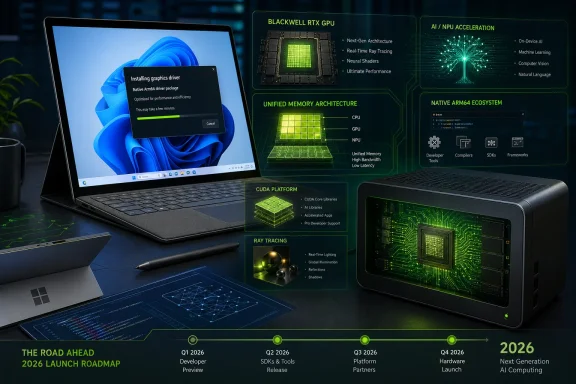 Windows on Arm support is becoming concrete
Nvidia and Microsoft announced RTX Spark as a Windows on Arm platform for developers, creators, gamers and local AI workloads. Nvidia said laptops and compact desktops from Surface, ASUS, Dell, HP, Lenovo and MSI are due this fall, with Acer and Gigabyte models following later.Microsoft has also said Windows is being tuned for the platform’s heterogeneous CPU, GPU and AI hardware. Its work includes Workload Profile Scheduling, intended to distribute jobs more effectively across RTX Spark’s 20 CPU cores, plus Microsoft Power and Thermal Framework support for platform-level performance and power management.
Windows 11 version 26H1 is central to that rollout. Microsoft’s support documentation says 26H1 is limited to new PCs with selected 2026 silicon and will not be offered as an in-place update to existing Windows 11 installations. In other words, current Arm PCs will not gain RTX Spark-specific platform support merely by updating Windows.
What it does — and does not — prove
The driver does not establish final performance, battery life, price or game compatibility. Nvidia has made ambitious claims around CUDA, RTX, local AI and 1440p gaming, but independent testing of shipping laptops and desktops remains the meaningful benchmark.For IT pros and enthusiasts, the immediate implication is mostly administrative: native Arm64 Nvidia display drivers are no longer an abstract requirement for RTX Spark systems. OEM validation, firmware integration and application testing still have to follow, especially for organizations relying on specialist GPU software, older peripherals or anti-cheat-protected games.
There is nothing for existing Windows 11 users to install yet; retail RTX Spark driver support should arrive alongside the first hardware later in 2026.
Update: CUDA 13.4 documentation outlines RTX Spark Arm64 porting path and preview limitations (July 19, 2026)
Wccftech reports that NVIDIA’s CUDA 13.4 Toolkit now formally labels RTX Spark support as a Windows on Arm preview and gives developers a concrete route to prepare software before compatible hardware ships. Developers can build native Arm64 CUDA applications or cross-compile Windows Arm64 CUDA software from the x64 toolkit.NVIDIA’s guidance calls for auditing third-party dependencies for Arm64 compatibility, choosing an Arm64 or Arm64EC porting approach, then testing application installation, updates, performance and CUDA paths ahead of RTX Spark deployment. Beginning with CUDA 13.4, the driver is no longer bundled with the toolkit; it is delivered separately through NVIDIA Developer Driver releases starting with R616.
The preview also comes with important caveats for early adopters and IT teams. NVIDIA warns that pageable-memory CUDA transfers may perform below expectations, recommends page-locked host memory where possible, and says the built-in display can remain blank for about two minutes during driver installation. PyTorch CI/CD builds may also trigger GPU timeouts or system instability, while Nsight Copilot is unavailable for Windows Arm64 in this developer preview.
For organizations evaluating RTX Spark, the new documentation shifts the immediate task from merely waiting for hardware to validating Arm64 application stacks and GPU workflows now.
References
- Primary source: Windows Latest
Published: 2026-07-18T13:31:17+00:00
Nvidia begins preparing N1X Windows 11 GPU drivers ahead of RTX Spark Arm PCs launch
Nvidia has started publishing N1X Windows GPU drivers, but the first release is optimized specifically for the Surface RTX Dev Box. www.windowslatest.com
- Related coverage: nvidianews.nvidia.com
NVIDIA and Microsoft Reinvent Windows PCs for the Age of Personal AI | NVIDIA Newsroom
NVIDIA today unveiled NVIDIA RTX Spark™, a new superchip that reinvents Windows PCs for the era of personal AI agents — offering a new class of computer that moves from tool to teammate.nvidianews.nvidia.com - Related coverage: forums.developer.nvidia.com
DGX Spark: Could Windows on ARM Support Be Possible, Like RTX Spark, N1X? - DGX Spark / GB10 - NVIDIA Developer Forums
Hello, Recently, I feel like I’ve been seeing a lot of articles about the N1/N1X series. What particularly stood out to me is that they seem to support Windows on ARM. I think I read somewhere that the N1 series and DG… forums.developer.nvidia.com
- Related coverage: developer.nvidia.com
Build Personal AI Agents on Windows PCs with New Tools from Microsoft and NVIDIA | NVIDIA Technical Blog
AI agents are changing how you interact with your PC. Creators, developers, and AI enthusiasts are already using these agents extensively to assist with day-to…developer.nvidia.com
- Official source: news.microsoft.com
- Related coverage: investor.nvidia.com
NVIDIA Corporation - NVIDIA and Microsoft Reinvent Windows PCs for the Age of Personal AI
RTX Spark — a 1-Petaflop Superchip, the Full CUDA and RTX Ecosystem, and Windows-Native Agents — a New Beginning for Personal Computers News Summary: NVIDIA RTX Spark powers the world’s first Windows PCs purpose-built for personal agents, featuring 1 petaflop of AI performance, industry-leading...investor.nvidia.com

Last edited:

