

On June 1, 2026, NVIDIA announced RTX Spark, a new Windows PC superchip developed with Microsoft and MediaTek that combines a Blackwell RTX GPU, a 20-core Grace CPU, up to 128GB of unified memory, and claimed 1-petaflop AI performance for local personal agents. The pitch is not simply faster laptops. It is a bid to make the PC feel less like a launcher for applications and more like a local workstation for autonomous software. That ambition is exciting, disruptive, and full of security and compatibility questions Windows users should not treat as marketing footnotes.
For decades, NVIDIA’s role in the Windows ecosystem has been easy to understand: it made the graphics hardware that gamers wanted, creators needed, and workstation buyers justified to finance departments. RTX Spark changes that relationship. NVIDIA is moving from component supplier to platform architect, and Microsoft is giving it a prominent place in the Windows story.
The RTX Spark announcement is built around a familiar Computex flourish: huge numbers, big OEM names, CEO quotes, and a promise that personal computing is being reinvented. But the strategic shift underneath is more important than the performance headline. NVIDIA wants CUDA, RTX, TensorRT, DLSS, OptiX, Reflex, G-SYNC, and its agent runtime layer to travel together into a new class of premium Windows machines.
That matters because Windows has always been an ecosystem of many silicon agendas. Intel defined the default PC for decades, AMD applied pressure where it could, Qualcomm has pushed Windows on Arm into thin-and-light territory, and Apple’s departure from Intel rewired expectations for unified memory and battery life. RTX Spark is NVIDIA saying that the next premium Windows PC should be judged by how well it runs local AI models, creative pipelines, and games on one integrated platform.
The company’s claim of up to 1 petaflop of AI performance is tied to FP4 precision, a format useful for squeezing more throughput from AI inference workloads. That is not the same thing as saying every task a buyer cares about will feel petaflop-fast. But it does show the axis on which NVIDIA wants this market measured: not CPU benchmarks, not integrated graphics scores, but whether a laptop can run large models and agent workflows locally without constantly calling the cloud.
That is the key distinction. A local summarizer, image generator, or transcription feature is useful, but it does not redefine the PC. A system that can run a 120-billion-parameter model, keep a large context window, interact with applications, search local files semantically, and execute multi-step workflows begins to resemble the “computer as assistant” idea the industry has been circling for years.
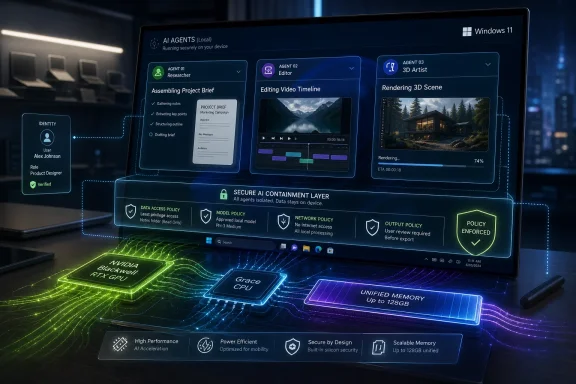
Microsoft’s role here is as important as NVIDIA’s silicon. The announcement describes new Windows primitives for identity, containment, policy, and end-to-end security. In plain English, Microsoft is acknowledging that agents cannot be treated like ordinary desktop applications. Software that reads files, controls apps, interprets user intent, and takes actions needs a permission model with more nuance than “installed” or “blocked.”
This is where the announcement becomes more than a hardware launch. Microsoft is effectively preparing Windows for software that behaves less like Word or Photoshop and more like a junior employee sitting at your keyboard. That employee needs credentials, boundaries, audit trails, revocation, and a way for the user or administrator to say: you may search this folder, but you may not email its contents; you may control this app, but you may not spend money; you may use the cloud for generic queries, but not for personal data.
The catch is that Microsoft has been here before in spirit, if not in implementation. Every new Windows automation layer eventually becomes a security boundary argument. COM, macros, PowerShell, WMI, browser extensions, and remote management tools all began as ways to make computers more capable. Attackers learned to love them because capability is also leverage. Agents will be no different.
The word runtime is doing a lot of work here. If OpenShell becomes a common execution environment for Windows agents, NVIDIA is not merely accelerating AI workloads; it is shaping how agents are packaged, governed, and integrated with Windows applications. That would give the company influence at a higher layer of the stack than drivers and graphics APIs.
For Windows administrators, this should trigger both interest and skepticism. A consistent runtime with policy hooks is vastly preferable to a sprawl of agents each inventing their own permissions, memory handling, cloud routing, and plug-in systems. But another runtime also means another thing to patch, monitor, configure, and explain to auditors.
The announcement says OpenShell will sit alongside new Windows security primitives. That sounds like the right architecture: Microsoft supplies OS-enforced identity and containment, while NVIDIA provides an agent-aware policy and execution layer. The danger is any ambiguity between the two. If users and admins cannot easily understand which layer is responsible for a decision, troubleshooting and trust will suffer.
The more successful RTX Spark becomes, the more OpenShell will matter. A niche runtime used by enthusiasts is one thing. A runtime embedded in premium Surface, Dell, Lenovo, HP, ASUS, and MSI systems is another. The first is a developer curiosity; the second is infrastructure.
RTX Spark attacks that bottleneck directly with up to 128GB of unified memory. That is the figure many developers will notice before the petaflop claim. Large language models and diffusion workflows are often constrained less by theoretical compute than by where the model, context, intermediate data, and application workload can actually fit.
Unified memory is not a magic wand, but it changes the ergonomics of local AI. Traditional Windows PCs often split system RAM and GPU VRAM in ways that force developers and creators to plan around the smaller pool. A large unified memory architecture lets the CPU and GPU work from a shared capacity budget, which is especially attractive for large models, high-resolution video, complex 3D scenes, and multimodal workflows.
NVIDIA says RTX Spark systems can run 120-billion-parameter large language models with up to a 1 million token context. That is an extraordinary claim for a laptop-class device, and it will need independent testing under real software conditions. Model quantization, context handling, thermals, power limits, and sustained performance will determine whether this is a daily-driver capability or a carefully framed demo.
Still, the direction is obvious. NVIDIA is trying to make the premium Windows laptop competitive not only with gaming rigs and mobile workstations, but with the small local AI servers that developers have been building under desks. If RTX Spark can deliver credible performance in a three-pound or compact desktop form factor, it will collapse several product categories into one.
NVIDIA’s examples are carefully chosen: ultralarge 90GB 3D scenes, 12K 4:2:2 video, 4K AI video generation, diffusion workflows, and GPU-accelerated compositing. These are not typical office workloads. They are the kinds of jobs where a unified high-memory GPU platform could genuinely change what is practical on a portable computer.
Adobe’s involvement is especially important. Photoshop and Premiere remain default tools in many professional workflows, and NVIDIA says Adobe is rearchitecting them for RTX Spark with up to 2x faster AI and graphics performance. If that holds in real projects, RTX Spark could become attractive even to users who do not care about agents at all.
The phrase “AI-native creative experiences” deserves scrutiny, though. Adobe and NVIDIA both benefit from making creative software sound newly intelligent, but artists care less about slogans than responsiveness, color fidelity, export times, plug-in compatibility, and whether the machine sounds like a jet engine after ten minutes. The best outcome for RTX Spark would be boringly practical: timelines scrub smoothly, masks generate faster, renders finish sooner, and mobile workstations last longer away from the wall.
The same logic applies to Blender, Blackmagic Design, OTOY, ComfyUI, and other creative tools named in the announcement. NVIDIA does not need every artist to embrace autonomous agents. It only needs enough of the creative software stack to make RTX Spark feel like the obvious premium Windows choice.
Those numbers will need the usual dose of context. Which games? Which settings? What power mode? Native rendering or DLSS-assisted output? Laptop performance claims are especially sensitive to chassis design, cooling, firmware, and vendor tuning.
Even so, gaming may be what keeps RTX Spark from becoming another AI-branded workstation niche. NVIDIA’s advantage is that it can offer a familiar value proposition alongside the new one. Buyers already understand RTX, DLSS, Reflex, ray tracing, and G-SYNC. They may be less certain about personal agents, but they know what a smooth game looks like.
The announcement also mentions DLSS 4.5 Ray Reconstruction with a second-generation transformer model and RTX Video with 4x Frame Generation. That suggests NVIDIA sees RTX Spark as a launchpad for its broader neural rendering roadmap, not merely as a PC chip. The future of graphics and the future of local AI are converging in NVIDIA’s strategy because both rely on the same underlying competence: accelerating tensor-heavy workloads at scale.
For Windows gamers, the bigger question is compatibility. RTX Spark is built around an Arm-based Grace CPU paired with NVIDIA graphics technology. Windows on Arm has improved dramatically, but PC gaming remains one of the most demanding compatibility ecosystems in computing. Anti-cheat systems, launchers, legacy dependencies, drivers, mods, and obscure middleware can matter as much as raw performance.
If NVIDIA and Microsoft can make the gaming story seamless, RTX Spark becomes much more credible. If users encounter asterisks around game support, the platform risks feeling like a powerful machine trapped between ecosystems.
That does not mean x86 is doomed, and it certainly does not mean Intel and AMD will disappear from enthusiast desktops or enterprise fleets. But it does mean the default assumptions are changing. Apple proved that a tightly integrated Arm-based architecture with unified memory could redefine performance-per-watt expectations. Qualcomm has pushed Microsoft to make Windows on Arm more credible. NVIDIA now brings the strongest GPU and AI ecosystem into that same architectural contest.
For Microsoft, this is both an opportunity and a risk. More silicon diversity makes Windows more resilient and competitive. It also complicates the message to customers who simply want applications to work. Windows has thrived because it runs nearly everything; any premium platform that introduces compatibility uncertainty has to compensate with dramatic advantages.
RTX Spark’s full CUDA support is a major differentiator. CUDA is the lingua franca of much of the AI and accelerated computing world. If developers can take code and workflows that already target NVIDIA GPUs and run them locally on a Windows laptop with large unified memory, that is a real advantage over generic “AI PC” hardware.
This is where NVIDIA’s platform leverage becomes visible. Intel, AMD, Qualcomm, and Apple can all tell compelling stories about processors. NVIDIA can tell a story about an ecosystem that stretches from data centers to workstations to gaming laptops to local agent machines. RTX Spark is an attempt to make the PC the edge node of that ecosystem.
Agents differ from chatbots because they take action. They do not merely answer questions; they click, call tools, open files, generate code, move data, and chain tasks together. That creates a new attack surface at the intersection of user intent, application authority, model behavior, and external content.
Prompt injection is the obvious example. If an agent reads an email, a web page, a document, or a code comment that contains malicious instructions, can it be tricked into ignoring the user’s policy? If it can access local files, can it be coaxed into exfiltrating them? If it can operate applications, can it perform actions the user never intended? These are not theoretical concerns; they are the natural consequence of giving software more agency.
Microsoft’s Windows primitives will therefore be judged by how enforceable they are. A permission prompt is not enough. Users habituate to prompts. Administrators need policy. Developers need clear APIs. Security teams need logging. Enterprises need ways to disable, scope, or broker agent access across managed fleets.
OpenShell’s promise to route queries based on privacy policy and disguise personal information before cloud calls is useful, but it will also invite hard questions. What counts as personal information? How is masking verified? Can a model infer sensitive data from context even after obvious identifiers are removed? How do users know when a local model handed work to a cloud model?
The industry has a habit of describing privacy as a feature and then implementing it as a setting. RTX Spark will require something stronger. If the PC is becoming a teammate, the teammate needs a badge, a rulebook, and a supervisor.
The appeal is obvious. Local AI workstations can reduce dependence on cloud inference for sensitive data, accelerate prototyping, and give teams more control over models and workflows. A developer testing agents against local repositories may prefer a machine that keeps code on device. A media team working with unreleased footage may prefer local generation and editing. A security team may want agentic analysis tools that do not ship telemetry to a third-party service by default.
But these systems will not be ordinary laptops. A machine capable of running powerful local models and agents can also process large amounts of confidential material outside centralized controls. It may blur the line between endpoint, workstation, and AI server. Asset management, data loss prevention, endpoint detection, and acceptable-use policies will all need updates.
There is also a procurement question. RTX Spark devices are being framed as premium systems, with slim laptops and compact desktops from major OEMs arriving in the fall. That suggests high prices, constrained initial availability, and a likely focus on flagship configurations. Organizations that standardized on “AI PCs” with modest NPUs may find themselves explaining why those machines are not enough for agentic workloads.
The more interesting enterprise scenario is deskside AI. NVIDIA mentions DGX Station for Windows as the larger sibling of the personal RTX Spark idea, scaling Blackwell architecture for enterprise developers. That points to a continuum: laptop for individual local agents, compact desktop for persistent personal workflows, deskside supercomputer for teams, data center for frontier workloads.
If Microsoft can manage that continuum through Windows and familiar enterprise tools, RTX Spark could become part of a broader managed AI endpoint strategy. If not, it risks becoming another powerful device class that central IT discovers only after developers expense it.
Still, the OEM parade does not guarantee execution. Thin laptops with powerful AI GPUs, large unified memory, premium displays, and all-day battery life are difficult products to build. Thermals will decide whether RTX Spark feels miraculous or merely ambitious. Battery claims will matter most under mixed real workloads, not idle demos or light productivity loops.
The announcement describes laptops as slim as 14 millimeters and as light as three pounds, with 14- to 16-inch designs, aluminum chassis, tandem OLED displays, and G-SYNC. That sounds like a direct shot at premium creator laptops and MacBook Pro-class machines. But the Windows OEM ecosystem has often struggled to combine performance, battery life, build quality, sleep reliability, display calibration, fan behavior, and driver polish in one coherent product.
Microsoft’s own Surface Laptop Ultra may become the reference point. If Surface can demonstrate a polished RTX Spark experience, it will help validate the platform. If the first wave is fragmented across OEM utilities, inconsistent firmware, and uneven app readiness, the “new PC” story will become harder to sell.
Availability is also vague by design. “This fall” is a launch window, not a product plan. Pricing, exact configurations, regional availability, repairability, Linux support, enterprise management details, and real-world battery performance remain open questions. Enthusiasts should be excited, but not pre-order blind.
That skepticism is healthy. The tech industry has spent several years attaching AI to products faster than it has explained the user benefit. Windows users, in particular, remember feature pushes that arrived before the trust model was fully persuasive. A local agent that can help with real work is valuable; an intrusive layer that guesses, nags, or consumes resources is not.
RTX Spark’s saving grace is that it is not only an AI branding exercise. The hardware capabilities are useful beyond agents. Large unified memory helps creators and developers. NVIDIA graphics help games and rendering. CUDA support helps AI research and engineering. A premium display helps everyone. The platform can succeed even if the first generation of personal agents underwhelms.
But the agent vision will shape the software experience. Microsoft wants Windows to become a place where agents are native actors, not browser tabs. NVIDIA wants those agents to run on its accelerated stack. Developers want access to local models and user context. The user is being placed at the center of a powerful new loop, and the industry must prove that control remains with the person, not the platform.
The best version of this future is compelling. You ask your PC to assemble a project brief from local notes, generate a Blender preview, clean up a Premiere timeline, check a codebase for a breaking API change, and draft a response without uploading everything to a cloud service. The worst version is a permission-confused automation layer that leaks data, misfires across apps, and becomes one more thing administrators disable.
Independent benchmarks will matter, but they will not be enough. Reviewers will need to test local model performance, memory behavior, thermals, battery life, Windows on Arm compatibility, game support, creative app acceleration, agent permissions, and cloud handoff transparency. A conventional laptop review template will miss the point.
Developers will also decide whether this platform becomes sticky. If OpenShell gives them a reliable way to build agents that can act safely across Windows apps, RTX Spark gains momentum. If the APIs are confusing, policies are brittle, or users distrust the experience, developers will retreat to cloud-first agents and cross-platform abstractions.
The most immediate winners may be the users who already live at the intersection of AI, media, and code. They are the ones most likely to understand why 128GB of unified memory and full CUDA in a portable Windows machine matters. Mainstream buyers will follow only if the agent experience becomes obviously useful and reliably safe.
 NVIDIA Is Not Just Selling a Faster GPU This Time
For decades, NVIDIA’s role in the Windows ecosystem has been easy to understand: it made the graphics hardware that gamers wanted, creators needed, and workstation buyers justified to finance departments. RTX Spark changes that relationship. NVIDIA is moving from component supplier to platform architect, and Microsoft is giving it a prominent place in the Windows story.The RTX Spark announcement is built around a familiar Computex flourish: huge numbers, big OEM names, CEO quotes, and a promise that personal computing is being reinvented. But the strategic shift underneath is more important than the performance headline. NVIDIA wants CUDA, RTX, TensorRT, DLSS, OptiX, Reflex, G-SYNC, and its agent runtime layer to travel together into a new class of premium Windows machines.
That matters because Windows has always been an ecosystem of many silicon agendas. Intel defined the default PC for decades, AMD applied pressure where it could, Qualcomm has pushed Windows on Arm into thin-and-light territory, and Apple’s departure from Intel rewired expectations for unified memory and battery life. RTX Spark is NVIDIA saying that the next premium Windows PC should be judged by how well it runs local AI models, creative pipelines, and games on one integrated platform.
The company’s claim of up to 1 petaflop of AI performance is tied to FP4 precision, a format useful for squeezing more throughput from AI inference workloads. That is not the same thing as saying every task a buyer cares about will feel petaflop-fast. But it does show the axis on which NVIDIA wants this market measured: not CPU benchmarks, not integrated graphics scores, but whether a laptop can run large models and agent workflows locally without constantly calling the cloud.
Microsoft Gets the AI PC It Has Been Trying to Describe
Microsoft has spent the last few years trying to make “AI PC” mean something more substantial than a laptop with a neural processing unit and a Copilot key. The phrase has often sounded like a branding wrapper for features that could just as easily live in the cloud. RTX Spark gives Microsoft a more forceful hardware story: machines with enough local memory, GPU acceleration, and agent plumbing to make on-device AI feel technically plausible.That is the key distinction. A local summarizer, image generator, or transcription feature is useful, but it does not redefine the PC. A system that can run a 120-billion-parameter model, keep a large context window, interact with applications, search local files semantically, and execute multi-step workflows begins to resemble the “computer as assistant” idea the industry has been circling for years.
Microsoft’s role here is as important as NVIDIA’s silicon. The announcement describes new Windows primitives for identity, containment, policy, and end-to-end security. In plain English, Microsoft is acknowledging that agents cannot be treated like ordinary desktop applications. Software that reads files, controls apps, interprets user intent, and takes actions needs a permission model with more nuance than “installed” or “blocked.”
This is where the announcement becomes more than a hardware launch. Microsoft is effectively preparing Windows for software that behaves less like Word or Photoshop and more like a junior employee sitting at your keyboard. That employee needs credentials, boundaries, audit trails, revocation, and a way for the user or administrator to say: you may search this folder, but you may not email its contents; you may control this app, but you may not spend money; you may use the cloud for generic queries, but not for personal data.
The catch is that Microsoft has been here before in spirit, if not in implementation. Every new Windows automation layer eventually becomes a security boundary argument. COM, macros, PowerShell, WMI, browser extensions, and remote management tools all began as ways to make computers more capable. Attackers learned to love them because capability is also leverage. Agents will be no different.
OpenShell Is the Most Interesting Part of the Announcement
NVIDIA OpenShell could easily be lost beneath the chip specifications, but it may be the announcement’s most consequential software component. NVIDIA describes it as a runtime that helps agents run securely, apply policy, route queries between local and cloud models, and disguise personal information before anything leaves the device. That is precisely the layer the AI PC concept has been missing.The word runtime is doing a lot of work here. If OpenShell becomes a common execution environment for Windows agents, NVIDIA is not merely accelerating AI workloads; it is shaping how agents are packaged, governed, and integrated with Windows applications. That would give the company influence at a higher layer of the stack than drivers and graphics APIs.
For Windows administrators, this should trigger both interest and skepticism. A consistent runtime with policy hooks is vastly preferable to a sprawl of agents each inventing their own permissions, memory handling, cloud routing, and plug-in systems. But another runtime also means another thing to patch, monitor, configure, and explain to auditors.
The announcement says OpenShell will sit alongside new Windows security primitives. That sounds like the right architecture: Microsoft supplies OS-enforced identity and containment, while NVIDIA provides an agent-aware policy and execution layer. The danger is any ambiguity between the two. If users and admins cannot easily understand which layer is responsible for a decision, troubleshooting and trust will suffer.
The more successful RTX Spark becomes, the more OpenShell will matter. A niche runtime used by enthusiasts is one thing. A runtime embedded in premium Surface, Dell, Lenovo, HP, ASUS, and MSI systems is another. The first is a developer curiosity; the second is infrastructure.
The Local AI Argument Is Finally Getting Real Hardware
The case for local AI has always been strong in theory. Running models on the device can reduce latency, keep sensitive data closer to the user, lower cloud costs, and make AI features available when connectivity is poor or unavailable. The practical problem has been that most personal computers lack the memory, bandwidth, and acceleration required for serious local workloads.RTX Spark attacks that bottleneck directly with up to 128GB of unified memory. That is the figure many developers will notice before the petaflop claim. Large language models and diffusion workflows are often constrained less by theoretical compute than by where the model, context, intermediate data, and application workload can actually fit.
Unified memory is not a magic wand, but it changes the ergonomics of local AI. Traditional Windows PCs often split system RAM and GPU VRAM in ways that force developers and creators to plan around the smaller pool. A large unified memory architecture lets the CPU and GPU work from a shared capacity budget, which is especially attractive for large models, high-resolution video, complex 3D scenes, and multimodal workflows.
NVIDIA says RTX Spark systems can run 120-billion-parameter large language models with up to a 1 million token context. That is an extraordinary claim for a laptop-class device, and it will need independent testing under real software conditions. Model quantization, context handling, thermals, power limits, and sustained performance will determine whether this is a daily-driver capability or a carefully framed demo.
Still, the direction is obvious. NVIDIA is trying to make the premium Windows laptop competitive not only with gaming rigs and mobile workstations, but with the small local AI servers that developers have been building under desks. If RTX Spark can deliver credible performance in a three-pound or compact desktop form factor, it will collapse several product categories into one.
Creators Are the Bridge Between AI Hype and Real Work
The creator pitch is where RTX Spark may find its most immediate audience. Video editors, 3D artists, motion designers, and AI image-generation users already understand the pain of waiting on hardware. They also tend to adopt expensive machines when the time saved is visible.NVIDIA’s examples are carefully chosen: ultralarge 90GB 3D scenes, 12K 4:2:2 video, 4K AI video generation, diffusion workflows, and GPU-accelerated compositing. These are not typical office workloads. They are the kinds of jobs where a unified high-memory GPU platform could genuinely change what is practical on a portable computer.
Adobe’s involvement is especially important. Photoshop and Premiere remain default tools in many professional workflows, and NVIDIA says Adobe is rearchitecting them for RTX Spark with up to 2x faster AI and graphics performance. If that holds in real projects, RTX Spark could become attractive even to users who do not care about agents at all.
The phrase “AI-native creative experiences” deserves scrutiny, though. Adobe and NVIDIA both benefit from making creative software sound newly intelligent, but artists care less about slogans than responsiveness, color fidelity, export times, plug-in compatibility, and whether the machine sounds like a jet engine after ten minutes. The best outcome for RTX Spark would be boringly practical: timelines scrub smoothly, masks generate faster, renders finish sooner, and mobile workstations last longer away from the wall.
The same logic applies to Blender, Blackmagic Design, OTOY, ComfyUI, and other creative tools named in the announcement. NVIDIA does not need every artist to embrace autonomous agents. It only needs enough of the creative software stack to make RTX Spark feel like the obvious premium Windows choice.
Gaming Is the Familiar Hook for a Stranger Machine
NVIDIA wisely keeps gaming in the frame. A Windows laptop that can run local agents but cannot play modern games well would feel like a developer appliance, not a mainstream premium PC. RTX Spark is being positioned as a machine that can run AAA games at 1440p and above 100 frames per second with ray tracing, DLSS, and Reflex.Those numbers will need the usual dose of context. Which games? Which settings? What power mode? Native rendering or DLSS-assisted output? Laptop performance claims are especially sensitive to chassis design, cooling, firmware, and vendor tuning.
Even so, gaming may be what keeps RTX Spark from becoming another AI-branded workstation niche. NVIDIA’s advantage is that it can offer a familiar value proposition alongside the new one. Buyers already understand RTX, DLSS, Reflex, ray tracing, and G-SYNC. They may be less certain about personal agents, but they know what a smooth game looks like.
The announcement also mentions DLSS 4.5 Ray Reconstruction with a second-generation transformer model and RTX Video with 4x Frame Generation. That suggests NVIDIA sees RTX Spark as a launchpad for its broader neural rendering roadmap, not merely as a PC chip. The future of graphics and the future of local AI are converging in NVIDIA’s strategy because both rely on the same underlying competence: accelerating tensor-heavy workloads at scale.
For Windows gamers, the bigger question is compatibility. RTX Spark is built around an Arm-based Grace CPU paired with NVIDIA graphics technology. Windows on Arm has improved dramatically, but PC gaming remains one of the most demanding compatibility ecosystems in computing. Anti-cheat systems, launchers, legacy dependencies, drivers, mods, and obscure middleware can matter as much as raw performance.
If NVIDIA and Microsoft can make the gaming story seamless, RTX Spark becomes much more credible. If users encounter asterisks around game support, the platform risks feeling like a powerful machine trapped between ecosystems.
Arm Comes for the Premium Windows Desk
The RTX Spark CPU story is easy to underplay because NVIDIA’s brand gravity pulls attention toward the GPU. But the 20-core Grace CPU, designed with MediaTek’s help, is central to the platform. This is another sign that the premium Windows PC is no longer synonymous with x86.That does not mean x86 is doomed, and it certainly does not mean Intel and AMD will disappear from enthusiast desktops or enterprise fleets. But it does mean the default assumptions are changing. Apple proved that a tightly integrated Arm-based architecture with unified memory could redefine performance-per-watt expectations. Qualcomm has pushed Microsoft to make Windows on Arm more credible. NVIDIA now brings the strongest GPU and AI ecosystem into that same architectural contest.
For Microsoft, this is both an opportunity and a risk. More silicon diversity makes Windows more resilient and competitive. It also complicates the message to customers who simply want applications to work. Windows has thrived because it runs nearly everything; any premium platform that introduces compatibility uncertainty has to compensate with dramatic advantages.
RTX Spark’s full CUDA support is a major differentiator. CUDA is the lingua franca of much of the AI and accelerated computing world. If developers can take code and workflows that already target NVIDIA GPUs and run them locally on a Windows laptop with large unified memory, that is a real advantage over generic “AI PC” hardware.
This is where NVIDIA’s platform leverage becomes visible. Intel, AMD, Qualcomm, and Apple can all tell compelling stories about processors. NVIDIA can tell a story about an ecosystem that stretches from data centers to workstations to gaming laptops to local agent machines. RTX Spark is an attempt to make the PC the edge node of that ecosystem.
The Security Story Has to Survive Contact With Real Users
The most important sentence in the announcement may be the implicit one: local agents are too dangerous to deploy casually on primary PCs. NVIDIA and Microsoft are not saying that in those words, but the emphasis on identity, containment, policy, privacy routing, and secure runtimes amounts to an admission.Agents differ from chatbots because they take action. They do not merely answer questions; they click, call tools, open files, generate code, move data, and chain tasks together. That creates a new attack surface at the intersection of user intent, application authority, model behavior, and external content.
Prompt injection is the obvious example. If an agent reads an email, a web page, a document, or a code comment that contains malicious instructions, can it be tricked into ignoring the user’s policy? If it can access local files, can it be coaxed into exfiltrating them? If it can operate applications, can it perform actions the user never intended? These are not theoretical concerns; they are the natural consequence of giving software more agency.
Microsoft’s Windows primitives will therefore be judged by how enforceable they are. A permission prompt is not enough. Users habituate to prompts. Administrators need policy. Developers need clear APIs. Security teams need logging. Enterprises need ways to disable, scope, or broker agent access across managed fleets.
OpenShell’s promise to route queries based on privacy policy and disguise personal information before cloud calls is useful, but it will also invite hard questions. What counts as personal information? How is masking verified? Can a model infer sensitive data from context even after obvious identifiers are removed? How do users know when a local model handed work to a cloud model?
The industry has a habit of describing privacy as a feature and then implementing it as a setting. RTX Spark will require something stronger. If the PC is becoming a teammate, the teammate needs a badge, a rulebook, and a supervisor.
Enterprise IT Will See a Workstation, a Risk, and a Budget Fight
For enterprises, RTX Spark lands in an awkward but familiar place. Developers, data scientists, security researchers, and creative teams will want the machines immediately. IT departments will ask what they cost, how they are managed, how they are secured, and whether they create a new class of shadow infrastructure.The appeal is obvious. Local AI workstations can reduce dependence on cloud inference for sensitive data, accelerate prototyping, and give teams more control over models and workflows. A developer testing agents against local repositories may prefer a machine that keeps code on device. A media team working with unreleased footage may prefer local generation and editing. A security team may want agentic analysis tools that do not ship telemetry to a third-party service by default.
But these systems will not be ordinary laptops. A machine capable of running powerful local models and agents can also process large amounts of confidential material outside centralized controls. It may blur the line between endpoint, workstation, and AI server. Asset management, data loss prevention, endpoint detection, and acceptable-use policies will all need updates.
There is also a procurement question. RTX Spark devices are being framed as premium systems, with slim laptops and compact desktops from major OEMs arriving in the fall. That suggests high prices, constrained initial availability, and a likely focus on flagship configurations. Organizations that standardized on “AI PCs” with modest NPUs may find themselves explaining why those machines are not enough for agentic workloads.
The more interesting enterprise scenario is deskside AI. NVIDIA mentions DGX Station for Windows as the larger sibling of the personal RTX Spark idea, scaling Blackwell architecture for enterprise developers. That points to a continuum: laptop for individual local agents, compact desktop for persistent personal workflows, deskside supercomputer for teams, data center for frontier workloads.
If Microsoft can manage that continuum through Windows and familiar enterprise tools, RTX Spark could become part of a broader managed AI endpoint strategy. If not, it risks becoming another powerful device class that central IT discovers only after developers expense it.
The OEM Parade Hides the Hardest Execution Problem
The list of hardware partners is impressive: ASUS, Dell, HP, Lenovo, Microsoft Surface, and MSI first, with Acer and GIGABYTE to follow. That breadth matters because new PC platforms often fail not from bad silicon but from lack of distribution, design variety, and software confidence.Still, the OEM parade does not guarantee execution. Thin laptops with powerful AI GPUs, large unified memory, premium displays, and all-day battery life are difficult products to build. Thermals will decide whether RTX Spark feels miraculous or merely ambitious. Battery claims will matter most under mixed real workloads, not idle demos or light productivity loops.
The announcement describes laptops as slim as 14 millimeters and as light as three pounds, with 14- to 16-inch designs, aluminum chassis, tandem OLED displays, and G-SYNC. That sounds like a direct shot at premium creator laptops and MacBook Pro-class machines. But the Windows OEM ecosystem has often struggled to combine performance, battery life, build quality, sleep reliability, display calibration, fan behavior, and driver polish in one coherent product.
Microsoft’s own Surface Laptop Ultra may become the reference point. If Surface can demonstrate a polished RTX Spark experience, it will help validate the platform. If the first wave is fragmented across OEM utilities, inconsistent firmware, and uneven app readiness, the “new PC” story will become harder to sell.
Availability is also vague by design. “This fall” is a launch window, not a product plan. Pricing, exact configurations, regional availability, repairability, Linux support, enterprise management details, and real-world battery performance remain open questions. Enthusiasts should be excited, but not pre-order blind.
The Windows PC Is Becoming an AI Appliance, Whether Users Asked or Not
There is a deeper cultural tension in this announcement. NVIDIA and Microsoft describe the PC moving from tool to teammate. Many users still want a tool. They want a machine that launches apps quickly, respects privacy, runs games, edits videos, compiles code, and does not turn every interaction into a conversation with a synthetic assistant.That skepticism is healthy. The tech industry has spent several years attaching AI to products faster than it has explained the user benefit. Windows users, in particular, remember feature pushes that arrived before the trust model was fully persuasive. A local agent that can help with real work is valuable; an intrusive layer that guesses, nags, or consumes resources is not.
RTX Spark’s saving grace is that it is not only an AI branding exercise. The hardware capabilities are useful beyond agents. Large unified memory helps creators and developers. NVIDIA graphics help games and rendering. CUDA support helps AI research and engineering. A premium display helps everyone. The platform can succeed even if the first generation of personal agents underwhelms.
But the agent vision will shape the software experience. Microsoft wants Windows to become a place where agents are native actors, not browser tabs. NVIDIA wants those agents to run on its accelerated stack. Developers want access to local models and user context. The user is being placed at the center of a powerful new loop, and the industry must prove that control remains with the person, not the platform.
The best version of this future is compelling. You ask your PC to assemble a project brief from local notes, generate a Blender preview, clean up a Premiere timeline, check a codebase for a breaking API change, and draft a response without uploading everything to a cloud service. The worst version is a permission-confused automation layer that leaks data, misfires across apps, and becomes one more thing administrators disable.
The Fall Launch Will Test the Difference Between a Platform and a Demo
The next few months will determine whether RTX Spark is a genuine platform shift or an impressive announcement waiting for software to catch up. Microsoft Build should clarify the developer model for Windows agents, especially the promised identity, containment, and manageability primitives. OEM launches this fall should reveal whether the hardware can sustain NVIDIA’s claims in real chassis.Independent benchmarks will matter, but they will not be enough. Reviewers will need to test local model performance, memory behavior, thermals, battery life, Windows on Arm compatibility, game support, creative app acceleration, agent permissions, and cloud handoff transparency. A conventional laptop review template will miss the point.
Developers will also decide whether this platform becomes sticky. If OpenShell gives them a reliable way to build agents that can act safely across Windows apps, RTX Spark gains momentum. If the APIs are confusing, policies are brittle, or users distrust the experience, developers will retreat to cloud-first agents and cross-platform abstractions.
The most immediate winners may be the users who already live at the intersection of AI, media, and code. They are the ones most likely to understand why 128GB of unified memory and full CUDA in a portable Windows machine matters. Mainstream buyers will follow only if the agent experience becomes obviously useful and reliably safe.
The Practical Shape of NVIDIA’s New Windows Bet
RTX Spark is not just another chip announcement, and treating it as one misses the point. It is NVIDIA’s attempt to make the Windows PC an endpoint for its full AI and graphics stack, with Microsoft supplying the operating-system scaffolding for agents that can act locally.- RTX Spark’s most important specification may be its up to 128GB of unified memory, because local AI and creative workloads often fail at the memory wall before they fail at raw compute.
- Microsoft’s new Windows agent primitives will matter more than the Copilot branding, because autonomous software needs identity, containment, policy, and manageability to be trusted.
- NVIDIA OpenShell could become a significant new layer in the Windows software stack if developers adopt it as a common runtime for secure agents.
- Creative professionals may see the first practical benefits through Adobe, Blender, Blackmagic, OTOY, ComfyUI, and other GPU-heavy workflows before personal agents become mainstream.
- Gaming performance will help sell RTX Spark, but Windows on Arm compatibility and anti-cheat support will need close scrutiny.
- Enterprises should treat RTX Spark systems as a new class of AI-capable endpoint, not merely as expensive laptops with better graphics.
References
- Primary source: NVIDIA Investor Relations
Published: 2026-06-01T08:52:16.103726

NVIDIA and Microsoft Reinvent Windows PCs for the Age of Personal AI
RTX Spark — a 1-Petaflop Superchip, the Full CUDA and RTX Ecosystem, and Windows-Native Agents — a New Beginning for Personal Computers News Summary: NVIDIA RTX Spark powers the world’s first Windows PCs purpose-built for personal agents, featuring 1 petaflop of AI performance, industry-leading...investor.nvidia.com
- Related coverage: axios.com

Microsoft debuts Nvidia-powered Microsoft Surface Ultra laptop
Microsoft is trying again to redefine the PC for the AI era.www.axios.com
- Related coverage: windowscentral.com
Microsoft and NVIDIA’s Surface Laptop Ultra pushes Windows on Arm into high‑performance territory
Microsoft and NVIDIA unveil the Surface Laptop Ultra, a 128GB RAM beast with Blackwell graphics and a mini-LED display that redefines performance for Windows on Arm. www.windowscentral.com
- Related coverage: blogs.nvidia.com

How Autonomous AI Agents Become Secure by Design With NVIDIA OpenShell
NVIDIA OpenShell provides tools for controlling autonomous agents in a trusted infrastructure policy layer.blogs.nvidia.com - Official source: microsoft.com

Defense at AI speed: Microsoft’s new multi-model agentic security system tops leading industry benchmark | Microsoft Security Blog
Today Microsoft is announcing a major step forward in AI-powered cyber defense: a new multi-model agentic scanning harness (codenamed MDASH).www.microsoft.com - Related coverage: nvidia.com

NVIDIA RTX Spark — Slim Laptops & Small Desktops
The fusion of NVIDIA AI and RTX graphics.www.nvidia.com
- Related coverage: developer.nvidia.com

Run Autonomous, Self-Evolving Agents More Safely with NVIDIA OpenShell | NVIDIA Technical Blog
AI has evolved from assistants following your directions to agents that act independently. Called claws, these agents can take a goal, figure out how to achieve it, and execute indefinitely—while…developer.nvidia.com
- Official source: blogs.windows.com

Introducing a powerful new chapter for Windows PCs, accelerated by NVIDIA RTX Spark
Today at NVIDIA GTC, Microsoft and NVIDIA announced the world’s most powerful and efficient thin-and-light Windows PCs ever. Accelerated by NVIDIA RTX Spark blogs.windows.com
- Related coverage: forbes.com

Nvidia Has Best Trading Day In Months
The new line of Windows laptops and desktops will be the first ever to run solely on an Nvidia-made chip, the RTX Spark, as the AI giant looks to take on rivals Intel and AMD. www.forbes.com
- Related coverage: nvidianews.nvidia.com

NVIDIA and Microsoft Reinvent Windows PCs for the Age of Personal AI
NVIDIA today unveiled NVIDIA RTX Spark™, a new superchip that reinvents Windows PCs for the era of personal AI agents — offering a new class of computer that moves from tool to teammate.nvidianews.nvidia.com
- Related coverage: techrepublic.com

Nvidia, Microsoft Launch RTX Spark PCs for AI Agents
Nvidia and Microsoft unveiled RTX Spark Windows PCs built for local AI agents, with systems expected from major PC makers this fall.www.techrepublic.com
- Related coverage: techtimes.com

Nvidia RTX Spark Superchip: Windows PC Chip With Full CUDA Stack Targets Dell, Microsoft This Fall
Nvidia RTX Spark Superchip launched at Computex 2026 as Nvidia’s first Windows PC processor, co-developed with Microsoft, pairing a Blackwell GPU with 6,144 CUDA cores and 128 GB unified memory in a thin Windows on Arm laptop. Devices from Dell, HP, ASUS, Lenovo, MSI, and Microsoft Surface are www.techtimes.com
- Related coverage: elpais.com
- Related coverage: assets.beyondtrust.com
