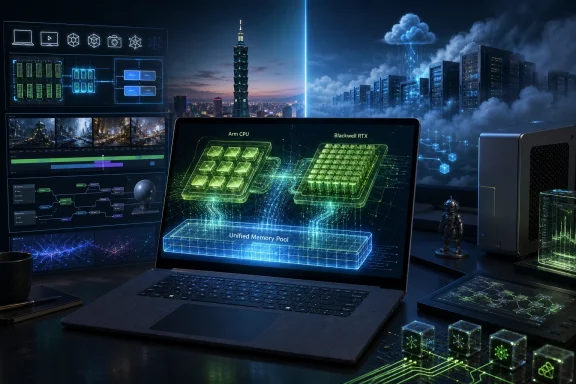
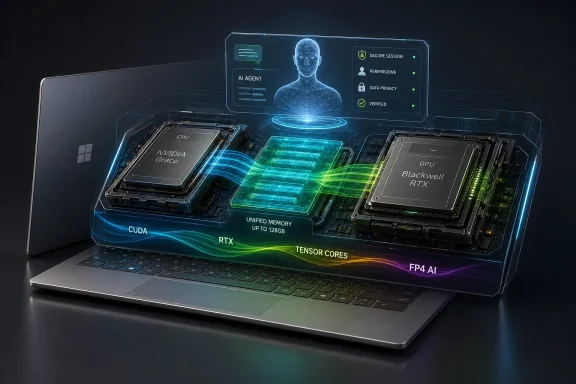
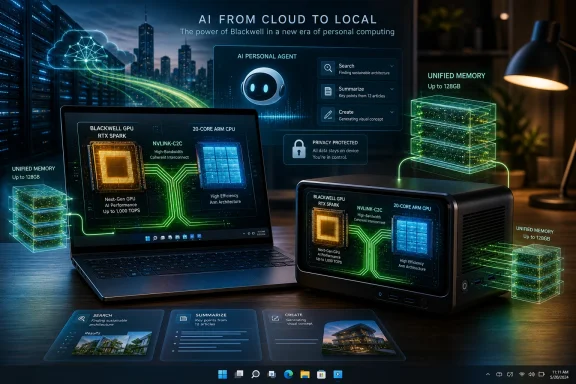
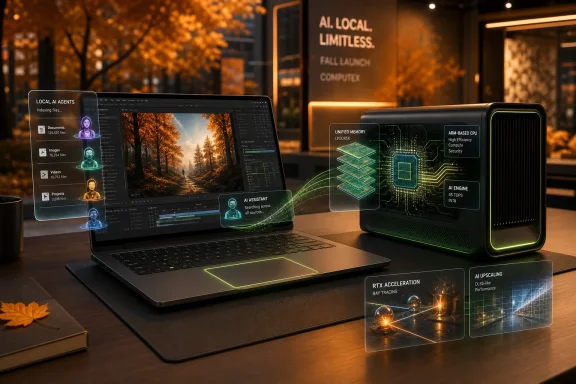
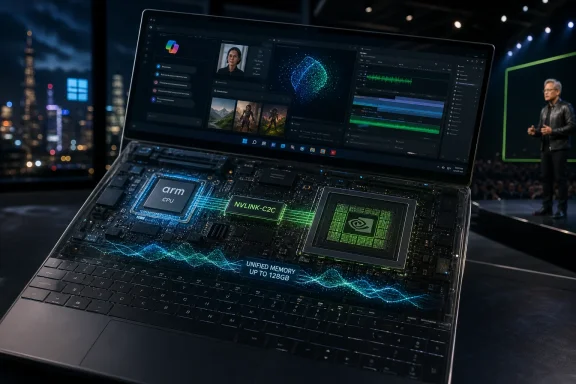
Microsoft and Nvidia announced on May 31, 2026, that a new class of thin-and-light Windows PCs will use Nvidia’s Arm-based RTX Spark platform, with Jensen Huang set to expand the pitch at GTC Taipei on June 1. That is the plain version of the news; the strategic version is much larger. Nvidia is no longer content to be the graphics company inside the PC. It wants to become one of the companies that defines what a Windows PC is.
That should make Intel, AMD, Qualcomm, and every Windows OEM sit up straight. For three decades, the PC’s center of gravity has been the x86 CPU, with the GPU treated as an accelerator, an add-in, or a gaming luxury. Nvidia is now trying to flip that hierarchy: the processor, GPU, NPU, developer stack, and AI runtime all become one vertically coordinated proposition, with Microsoft providing the Windows layer that makes the bet credible.
The modern PC industry has always had room for Nvidia, but mostly in a supporting role. The company’s GeForce and RTX GPUs shaped gaming laptops, creator workstations, and high-end desktops, but the main processor belonged to Intel or AMD. Even when Nvidia was the part people bragged about, Windows still booted around someone else’s CPU.
The RTX Spark announcement changes the posture. Nvidia is not merely accelerating a Windows machine; it is helping define the machine’s primary compute platform. That makes this a direct incursion into the territory that Intel built, AMD revived, and Qualcomm has been trying to enter through Windows on Arm.
The user-facing pitch is simple enough: powerful thin-and-light PCs with local AI performance, Copilot+ PC support, Arm efficiency, and Nvidia-class graphics. The industry-facing pitch is sharper. Nvidia wants the PC to become another endpoint in its AI platform strategy, not an isolated consumer hardware category.
That is why this is more than a chip story. The company is bringing its old superpower — the software ecosystem around CUDA, TensorRT, PyTorch acceleration, and developer tools — into a Windows client market that has historically been allergic to platform fragmentation. If Nvidia can make local AI development feel native on a laptop, it gains a new beachhead in the most familiar computing device in the world.
That is where Nvidia’s arrival matters. Microsoft can sell Windows on Arm as efficient and modern, but Nvidia can sell it as powerful. That distinction is not cosmetic. The PC market has repeatedly shown that battery life alone is not enough to break entrenched buying habits, especially among enthusiasts and professionals who remember the compromises of earlier Arm Windows devices.
The official language around Prism, Microsoft’s emulator for 32-bit and 64-bit x86 apps on Windows on Arm, is especially important. Compatibility is the tax every non-x86 Windows platform must pay. If Prism is fast enough, transparent enough, and broadly tested enough on Nvidia-powered machines, then the architecture becomes less of a warning label and more of an implementation detail.
But this is also where Microsoft’s risk is concentrated. A Windows PC that carries the Nvidia brand will be judged not only against other Arm laptops, but against the accumulated expectations of the Windows ecosystem: Steam libraries, Adobe workflows, Visual Studio workloads, old peripherals, corporate endpoint tools, VPN clients, printer drivers, accessibility utilities, and the long tail of software nobody remembers until it breaks.
That matters because “three-year partnership” sounds like a product roadmap, while “multi-year collaboration” can mean a looser strategic alignment. Microsoft and Nvidia have been working together for years across cloud AI infrastructure, gaming APIs, and developer tooling. The new piece is not that the companies suddenly discovered each other; it is that their collaboration has moved from the data center and graphics stack into the heart of the Windows laptop.
The distinction is not pedantry. Windows history is littered with grand platform initiatives that were real, well-funded, and short-lived. Windows RT was real. Windows 10 on Arm was real. The first wave of always-connected PCs was real. What separates a durable platform from a keynote moment is not the adjective attached to the partnership, but the shipping cadence, OEM breadth, app compatibility, driver support, and user satisfaction after the first wave of reviews.
Nvidia and Microsoft can afford a long game. But Windows buyers have little patience for being early adopters of someone else’s strategic transition.
Nvidia’s contribution is to make that local AI pitch feel less like a feature checklist and more like a compute platform. NPUs matter because they can run efficient on-device models, but Nvidia’s GPU software stack matters because developers already know it, trust it, and deploy around it. If RTX Spark laptops can bridge the NPU world of consumer AI features with the GPU world of serious AI development, they could occupy a useful middle ground.
That middle ground is strategically valuable. Data-center AI is expensive, capacity-constrained, and increasingly political. Local AI is cheaper to invoke, more private by design, and better suited to low-latency personal workflows. A Windows laptop that can run meaningful models locally does not replace the cloud, but it changes the default assumption that every useful AI task must round-trip through a remote service.
For sysadmins and security teams, that cuts both ways. Local AI creates opportunities for privacy-preserving workflows, but it also creates new governance questions. What data is processed locally? What telemetry leaves the device? How are models updated? How do endpoint protection tools inspect AI-assisted workflows? A more capable PC is not automatically a more manageable one.
AMD faces a different version of the same threat. Ryzen AI has given AMD a credible position in premium laptops, and its integrated graphics have long been a strength. But Nvidia’s brand in AI acceleration is almost unfairly strong. If consumers start associating “AI PC” with Nvidia in the same way they associate “gaming PC” with Nvidia, AMD will have to fight on messaging as well as silicon.
Qualcomm may feel the pressure most immediately. Snapdragon X systems helped reset expectations for Windows on Arm, but Nvidia brings a GPU heritage and developer ecosystem Qualcomm cannot easily duplicate. Qualcomm’s advantage is that it arrived first in the current wave. Nvidia’s advantage is that the market already believes it can make difficult compute workloads fast.
This is the kind of competitive pressure Windows has needed. The PC industry became too comfortable describing incremental improvements as revolutions. A serious Nvidia Windows platform forces every chip vendor to answer a sharper question: not “how many TOPS does your NPU deliver,” but “what new work can this machine do that last year’s machine could not?”
OEM execution will matter more than keynote demos. Thermals, fan noise, battery life, display choices, docking reliability, firmware updates, and sleep behavior will define user perception. Windows users have seen too many “next-generation” laptops undermined by ordinary laptop problems.
Commercial buyers will be even more conservative. Enterprises do not merely ask whether a machine is fast. They ask whether it can be imaged, secured, serviced, audited, enrolled, remotely managed, and supported for years. They ask whether their endpoint agents run cleanly and whether line-of-business apps behave under emulation.
That is why Dell’s role, if confirmed in shipping systems, may be more important than Surface’s. Surface can set the aspiration. Dell can tell IT departments whether this platform belongs in procurement discussions.
Bringing that stack to Windows laptops changes the developer conversation. A student, researcher, indie developer, or enterprise prototyper could build locally on a portable machine that behaves more like the Nvidia environments they later deploy to in the cloud. That does not require the laptop to match a data-center GPU. It only requires the workflow to feel coherent.
Microsoft benefits from that coherence. Windows has often been the most widely used developer desktop while not always being the most loved AI development environment. If RTX Spark machines make CUDA-accelerated PyTorch, TensorRT, llama.cpp, Hugging Face tooling, and related frameworks easier to use locally, Microsoft gets a stronger answer to macOS and Linux workstations.
The danger is that Windows could become more stratified. A Copilot+ PC with Qualcomm silicon, an RTX Spark PC with Nvidia silicon, and an x86 AI PC from Intel or AMD may all carry similar stickers while behaving differently under real workloads. Microsoft will need to police the user experience carefully, or “AI PC” will become another marketing phrase that hides too many incompatibilities.
The catch is that Windows gaming on Arm remains a complicated proposition. Some games will run well through emulation. Some will need native Arm builds. Some anti-cheat systems, launchers, overlays, mods, and drivers may become friction points. The GPU can be excellent and the experience can still be uneven if the surrounding ecosystem is not ready.
Microsoft has been making moves here, including improving Xbox app support on Arm-based Windows PCs. That matters, but the PC gaming universe is larger than Microsoft’s storefront. Steam, Epic, Battle.net, Riot, Ubisoft, EA, indie launchers, mod managers, and years of legacy DirectX behavior all become part of the practical test.
If Nvidia can make gaming feel ordinary on Arm Windows, the platform’s credibility jumps. If gaming feels like a compatibility lottery, RTX Spark risks being perceived as an AI workstation niche rather than a mainstream PC breakthrough.
That openness is both Windows’ weakness and its strength. Apple could force transitions in ways Microsoft cannot. Microsoft must carry decades of backward compatibility and OEM variation. Nvidia must fit into a platform where it does not own the operating system, the app store, the hardware brand, or the enterprise management stack.
But Windows has advantages Apple does not. It dominates many corporate environments, remains central to PC gaming, and supports a vast range of hardware configurations. If Nvidia can thrive inside that complexity, the payoff could be larger than a single polished product line.
The lesson from Apple is not simply “Arm is good.” The lesson is that architecture transitions work when users stop thinking about architecture. Nvidia and Microsoft’s job is to make an Arm-based Windows PC feel like a better Windows PC, not like a science project with impressive benchmarks.
The PC market is lower margin, more seasonal, more fragmented, and more exposed to consumer replacement cycles. Winning laptops is not the same as selling constrained AI accelerators into hyperscale demand. Nvidia can build a meaningful business here without it becoming the next data-center-scale revenue engine.
The strategic value may be greater than the near-term revenue. A successful Windows PC platform gives Nvidia influence over developers earlier in the workflow, places its AI stack on more desks, and extends its brand into everyday computing. It also gives the company leverage against any future world in which cloud AI growth normalizes and investors ask where the next frontier lies.
Crypto investors should be especially careful not to overread the announcement. This is not a blockchain story, and there is no token angle. Nvidia’s GPUs remain relevant to parts of the crypto and AI infrastructure world, but RTX Spark is fundamentally about Windows PCs, local AI, and platform control.
Prism is Microsoft’s answer, and it may be good enough for many users. But “many” is not “all,” and Windows buyers are famously unforgiving when a new platform fails at a task their old laptop handled without ceremony. The first reviews will obsess over benchmarks; the second wave of user reports will decide whether compatibility anxiety sticks.
This is why Microsoft must be disciplined with branding. If every AI-capable Windows PC is marketed as equivalent, users will be confused when software behaves differently across Arm and x86 systems. If the differences are explained too aggressively, Arm machines risk looking risky. The message must thread a narrow needle: modern and compatible, different but not troublesome.
Nvidia can help by making the upside obvious. If RTX Spark systems deliver genuinely better local AI workflows, strong graphics, and excellent battery life, users may tolerate some edge-case friction. If the upside is mostly theoretical, compatibility concerns will dominate the narrative.
Nvidia’s entrance gives that story teeth. A Windows PC with serious local AI acceleration, Nvidia graphics, Arm efficiency, and a tuned Microsoft software layer is at least a plausible break from the past. It suggests a laptop that is not merely a browser-and-Office terminal, but a local inference device, development workstation, creative machine, and gaming system in one.
That promise is also why expectations should be high. Nvidia and Microsoft are not startups asking for patience. They are two of the most powerful companies in computing. If they are going to declare a new era of the PC, they should be judged by new-era standards.
The first generation does not need to be perfect. It does need to be coherent. Buyers can forgive rough edges; they are less forgiving of confused positioning, missing software, inconsistent performance, and vendor overpromising.
That should make Intel, AMD, Qualcomm, and every Windows OEM sit up straight. For three decades, the PC’s center of gravity has been the x86 CPU, with the GPU treated as an accelerator, an add-in, or a gaming luxury. Nvidia is now trying to flip that hierarchy: the processor, GPU, NPU, developer stack, and AI runtime all become one vertically coordinated proposition, with Microsoft providing the Windows layer that makes the bet credible.
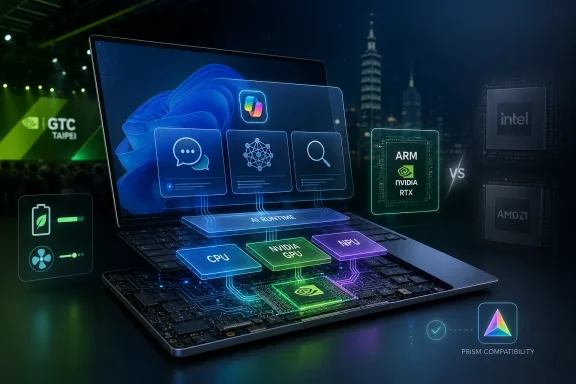 Nvidia Is Moving From Attachment to Architecture
The modern PC industry has always had room for Nvidia, but mostly in a supporting role. The company’s GeForce and RTX GPUs shaped gaming laptops, creator workstations, and high-end desktops, but the main processor belonged to Intel or AMD. Even when Nvidia was the part people bragged about, Windows still booted around someone else’s CPU.The RTX Spark announcement changes the posture. Nvidia is not merely accelerating a Windows machine; it is helping define the machine’s primary compute platform. That makes this a direct incursion into the territory that Intel built, AMD revived, and Qualcomm has been trying to enter through Windows on Arm.
The user-facing pitch is simple enough: powerful thin-and-light PCs with local AI performance, Copilot+ PC support, Arm efficiency, and Nvidia-class graphics. The industry-facing pitch is sharper. Nvidia wants the PC to become another endpoint in its AI platform strategy, not an isolated consumer hardware category.
That is why this is more than a chip story. The company is bringing its old superpower — the software ecosystem around CUDA, TensorRT, PyTorch acceleration, and developer tools — into a Windows client market that has historically been allergic to platform fragmentation. If Nvidia can make local AI development feel native on a laptop, it gains a new beachhead in the most familiar computing device in the world.
Microsoft Needs a Stronger Windows on Arm Story Than Battery Life
Microsoft has spent years trying to make Windows on Arm feel inevitable. The problem is that inevitability has always arrived next year. Qualcomm’s Snapdragon X line finally gave the platform a serious consumer push, but the core challenge remains the same: Windows users do not buy architectures; they buy compatibility, performance, and confidence.That is where Nvidia’s arrival matters. Microsoft can sell Windows on Arm as efficient and modern, but Nvidia can sell it as powerful. That distinction is not cosmetic. The PC market has repeatedly shown that battery life alone is not enough to break entrenched buying habits, especially among enthusiasts and professionals who remember the compromises of earlier Arm Windows devices.
The official language around Prism, Microsoft’s emulator for 32-bit and 64-bit x86 apps on Windows on Arm, is especially important. Compatibility is the tax every non-x86 Windows platform must pay. If Prism is fast enough, transparent enough, and broadly tested enough on Nvidia-powered machines, then the architecture becomes less of a warning label and more of an implementation detail.
But this is also where Microsoft’s risk is concentrated. A Windows PC that carries the Nvidia brand will be judged not only against other Arm laptops, but against the accumulated expectations of the Windows ecosystem: Steam libraries, Adobe workflows, Visual Studio workloads, old peripherals, corporate endpoint tools, VPN clients, printer drivers, accessibility utilities, and the long tail of software nobody remembers until it breaks.
The Three-Year Partnership Claim Deserves Caution
Some early reporting has framed the Microsoft-Nvidia effort as a three-year partnership to reinvent the PC. The public record is more careful. Microsoft has described a multi-year, full-stack collaboration spanning gaming, AI, cloud, DirectX, RTX, Azure workloads, and now client PCs, but the precise commercial terms and duration have not been publicly nailed down in the way investors might prefer.That matters because “three-year partnership” sounds like a product roadmap, while “multi-year collaboration” can mean a looser strategic alignment. Microsoft and Nvidia have been working together for years across cloud AI infrastructure, gaming APIs, and developer tooling. The new piece is not that the companies suddenly discovered each other; it is that their collaboration has moved from the data center and graphics stack into the heart of the Windows laptop.
The distinction is not pedantry. Windows history is littered with grand platform initiatives that were real, well-funded, and short-lived. Windows RT was real. Windows 10 on Arm was real. The first wave of always-connected PCs was real. What separates a durable platform from a keynote moment is not the adjective attached to the partnership, but the shipping cadence, OEM breadth, app compatibility, driver support, and user satisfaction after the first wave of reviews.
Nvidia and Microsoft can afford a long game. But Windows buyers have little patience for being early adopters of someone else’s strategic transition.
The PC Is Becoming an AI Endpoint, Not Just a Client Device
The Copilot+ PC category already told us where Microsoft wants Windows to go. The operating system is being reimagined around local AI inference, background assistance, search, summarization, generation, and increasingly agent-like workflows. The missing piece has been a hardware story compelling enough to make users care.Nvidia’s contribution is to make that local AI pitch feel less like a feature checklist and more like a compute platform. NPUs matter because they can run efficient on-device models, but Nvidia’s GPU software stack matters because developers already know it, trust it, and deploy around it. If RTX Spark laptops can bridge the NPU world of consumer AI features with the GPU world of serious AI development, they could occupy a useful middle ground.
That middle ground is strategically valuable. Data-center AI is expensive, capacity-constrained, and increasingly political. Local AI is cheaper to invoke, more private by design, and better suited to low-latency personal workflows. A Windows laptop that can run meaningful models locally does not replace the cloud, but it changes the default assumption that every useful AI task must round-trip through a remote service.
For sysadmins and security teams, that cuts both ways. Local AI creates opportunities for privacy-preserving workflows, but it also creates new governance questions. What data is processed locally? What telemetry leaves the device? How are models updated? How do endpoint protection tools inspect AI-assisted workflows? A more capable PC is not automatically a more manageable one.
Intel and AMD Are Being Challenged on Their Home Field
Intel’s problem is not that Nvidia will instantly take the PC market. It will not. The problem is that Nvidia’s entrance attacks the story Intel has been trying to rebuild: that the AI PC era belongs to x86 incumbents with better NPUs, better power efficiency, and decades of Windows compatibility.AMD faces a different version of the same threat. Ryzen AI has given AMD a credible position in premium laptops, and its integrated graphics have long been a strength. But Nvidia’s brand in AI acceleration is almost unfairly strong. If consumers start associating “AI PC” with Nvidia in the same way they associate “gaming PC” with Nvidia, AMD will have to fight on messaging as well as silicon.
Qualcomm may feel the pressure most immediately. Snapdragon X systems helped reset expectations for Windows on Arm, but Nvidia brings a GPU heritage and developer ecosystem Qualcomm cannot easily duplicate. Qualcomm’s advantage is that it arrived first in the current wave. Nvidia’s advantage is that the market already believes it can make difficult compute workloads fast.
This is the kind of competitive pressure Windows has needed. The PC industry became too comfortable describing incremental improvements as revolutions. A serious Nvidia Windows platform forces every chip vendor to answer a sharper question: not “how many TOPS does your NPU deliver,” but “what new work can this machine do that last year’s machine could not?”
OEMs Will Decide Whether This Is a Platform or a Showcase
The reported involvement of Surface and Dell is significant because Windows hardware transitions need flagship systems. Microsoft can use Surface to define the ideal implementation, while Dell can test whether the platform works in the broader commercial and prosumer market. If HP, Lenovo, Asus, Acer, and others follow, RTX Spark becomes a category. If not, it risks becoming a boutique experiment.OEM execution will matter more than keynote demos. Thermals, fan noise, battery life, display choices, docking reliability, firmware updates, and sleep behavior will define user perception. Windows users have seen too many “next-generation” laptops undermined by ordinary laptop problems.
Commercial buyers will be even more conservative. Enterprises do not merely ask whether a machine is fast. They ask whether it can be imaged, secured, serviced, audited, enrolled, remotely managed, and supported for years. They ask whether their endpoint agents run cleanly and whether line-of-business apps behave under emulation.
That is why Dell’s role, if confirmed in shipping systems, may be more important than Surface’s. Surface can set the aspiration. Dell can tell IT departments whether this platform belongs in procurement discussions.
The Software Stack Is the Real Moat
Nvidia’s greatest asset is not just silicon. It is the layer cake of software that makes its silicon useful. CUDA’s dominance in AI and scientific computing has trained a generation of developers to treat Nvidia hardware as the default target for accelerated workloads.Bringing that stack to Windows laptops changes the developer conversation. A student, researcher, indie developer, or enterprise prototyper could build locally on a portable machine that behaves more like the Nvidia environments they later deploy to in the cloud. That does not require the laptop to match a data-center GPU. It only requires the workflow to feel coherent.
Microsoft benefits from that coherence. Windows has often been the most widely used developer desktop while not always being the most loved AI development environment. If RTX Spark machines make CUDA-accelerated PyTorch, TensorRT, llama.cpp, Hugging Face tooling, and related frameworks easier to use locally, Microsoft gets a stronger answer to macOS and Linux workstations.
The danger is that Windows could become more stratified. A Copilot+ PC with Qualcomm silicon, an RTX Spark PC with Nvidia silicon, and an x86 AI PC from Intel or AMD may all carry similar stickers while behaving differently under real workloads. Microsoft will need to police the user experience carefully, or “AI PC” will become another marketing phrase that hides too many incompatibilities.
Gaming Is the Unspoken Stress Test
Nvidia and Microsoft will understandably lead with AI, but Windows users will judge these machines through games whether the companies like it or not. Gaming is where Windows compatibility issues become visible, emotional, and brutally benchmarked. It is also where Nvidia’s brand promise is strongest.The catch is that Windows gaming on Arm remains a complicated proposition. Some games will run well through emulation. Some will need native Arm builds. Some anti-cheat systems, launchers, overlays, mods, and drivers may become friction points. The GPU can be excellent and the experience can still be uneven if the surrounding ecosystem is not ready.
Microsoft has been making moves here, including improving Xbox app support on Arm-based Windows PCs. That matters, but the PC gaming universe is larger than Microsoft’s storefront. Steam, Epic, Battle.net, Riot, Ubisoft, EA, indie launchers, mod managers, and years of legacy DirectX behavior all become part of the practical test.
If Nvidia can make gaming feel ordinary on Arm Windows, the platform’s credibility jumps. If gaming feels like a compatibility lottery, RTX Spark risks being perceived as an AI workstation niche rather than a mainstream PC breakthrough.
Apple Is the Benchmark Nobody Wants to Name
The obvious comparison is Apple Silicon. Apple proved that Arm-based personal computers could be fast, efficient, quiet, and desirable when hardware, operating system, developer tools, and app migration were coordinated tightly enough. Microsoft and Nvidia are trying to create a version of that story inside the messier, more open, more diverse Windows ecosystem.That openness is both Windows’ weakness and its strength. Apple could force transitions in ways Microsoft cannot. Microsoft must carry decades of backward compatibility and OEM variation. Nvidia must fit into a platform where it does not own the operating system, the app store, the hardware brand, or the enterprise management stack.
But Windows has advantages Apple does not. It dominates many corporate environments, remains central to PC gaming, and supports a vast range of hardware configurations. If Nvidia can thrive inside that complexity, the payoff could be larger than a single polished product line.
The lesson from Apple is not simply “Arm is good.” The lesson is that architecture transitions work when users stop thinking about architecture. Nvidia and Microsoft’s job is to make an Arm-based Windows PC feel like a better Windows PC, not like a science project with impressive benchmarks.
Investors Should Separate PC Ambition From AI Euphoria
For investors, the temptation is to treat any Nvidia expansion as another leg of the AI boom. That is understandable. Nvidia’s data-center business has become one of the defining financial stories in technology, and any new market with Microsoft attached will attract attention. But PCs are not data-center accelerators.The PC market is lower margin, more seasonal, more fragmented, and more exposed to consumer replacement cycles. Winning laptops is not the same as selling constrained AI accelerators into hyperscale demand. Nvidia can build a meaningful business here without it becoming the next data-center-scale revenue engine.
The strategic value may be greater than the near-term revenue. A successful Windows PC platform gives Nvidia influence over developers earlier in the workflow, places its AI stack on more desks, and extends its brand into everyday computing. It also gives the company leverage against any future world in which cloud AI growth normalizes and investors ask where the next frontier lies.
Crypto investors should be especially careful not to overread the announcement. This is not a blockchain story, and there is no token angle. Nvidia’s GPUs remain relevant to parts of the crypto and AI infrastructure world, but RTX Spark is fundamentally about Windows PCs, local AI, and platform control.
The Compatibility Tax Has Not Been Repealed
Every Windows architecture transition eventually meets the same villain: the old app that must work. It may be a 15-year-old accounting package, a device configuration utility, a scanner driver, a CAD plug-in, a game anti-cheat module, or a custom enterprise app maintained by someone who retired during the Windows 7 era. That is the real Windows ecosystem.Prism is Microsoft’s answer, and it may be good enough for many users. But “many” is not “all,” and Windows buyers are famously unforgiving when a new platform fails at a task their old laptop handled without ceremony. The first reviews will obsess over benchmarks; the second wave of user reports will decide whether compatibility anxiety sticks.
This is why Microsoft must be disciplined with branding. If every AI-capable Windows PC is marketed as equivalent, users will be confused when software behaves differently across Arm and x86 systems. If the differences are explained too aggressively, Arm machines risk looking risky. The message must thread a narrow needle: modern and compatible, different but not troublesome.
Nvidia can help by making the upside obvious. If RTX Spark systems deliver genuinely better local AI workflows, strong graphics, and excellent battery life, users may tolerate some edge-case friction. If the upside is mostly theoretical, compatibility concerns will dominate the narrative.
The Windows PC Finally Has a Reason to Change
The traditional PC upgrade cycle has been exhausted for years. Faster CPU, slightly better screen, thinner chassis, longer battery life — useful, but rarely transformative. AI gives the industry a new story, but only if the hardware enables new behavior rather than new stickers.Nvidia’s entrance gives that story teeth. A Windows PC with serious local AI acceleration, Nvidia graphics, Arm efficiency, and a tuned Microsoft software layer is at least a plausible break from the past. It suggests a laptop that is not merely a browser-and-Office terminal, but a local inference device, development workstation, creative machine, and gaming system in one.
That promise is also why expectations should be high. Nvidia and Microsoft are not startups asking for patience. They are two of the most powerful companies in computing. If they are going to declare a new era of the PC, they should be judged by new-era standards.
The first generation does not need to be perfect. It does need to be coherent. Buyers can forgive rough edges; they are less forgiving of confused positioning, missing software, inconsistent performance, and vendor overpromising.
The Fine Print Behind the “New Era of PC” Slogan
The announcement is best understood as a platform bet with practical consequences rather than a single product reveal. The details that matter most are not the slogan, but the shipping systems, developer support, and the way Windows handles the transition.- Nvidia is moving into the role of primary Windows PC processor supplier, not merely discrete GPU vendor.
- Microsoft is using the partnership to strengthen Windows on Arm and the Copilot+ PC category.
- The exact commercial duration and terms of the partnership remain less clear than some early framing suggests.
- Surface and Dell systems would give the platform credibility with both consumers and enterprise buyers if they ship as expected.
- Compatibility, gaming behavior, driver support, and enterprise manageability will determine whether RTX Spark becomes mainstream.
- The strategic prize is not just laptop sales, but control over the local AI developer and user experience on Windows.
References
- Primary source: Crypto Briefing
Published: 2026-06-01T05:30:33.810646
Nvidia CEO Jensen Huang announces three-year partnership with Microsoft to reinvent the PC
Nvidia CEO Jensen Huang announced a three-year partnership with Microsoft to reinvent the PC using an Arm-based N1X platform, challenging Intel and AMD.cryptobriefing.com - Related coverage: tomshardware.com
Nvidia and Microsoft tease "a new era of PC" ahead of Computex 2026 — coordinated social media posts could indicate that rumored N1X laptops will be Windows on Arm systems | Tom's Hardware
An Nvidia-powered Arm PC running Windows could inspire new local AI experiences beyond Copilot+.www.tomshardware.com - Related coverage: windowscentral.com
"A new era of PC": Microsoft and NVIDIA tease major announcement experts predict to be the fabled N1X chip | Windows Central
Microsoft and NVIDIA just hinted at major announcements at Computex and Build 2026.www.windowscentral.com - Related coverage: tomsguide.com
Nvidia N1X and N1 CPU: Everything we know so far | Tom's Guide
Nvidia has confirmed it's releasing its own CPU in collaboration with MediaTek, including a desktop-level N1X Arm chip and the N1 for gaming laptops, and now a surprise Intel x86 RTX silicon from an Nvidia and Intel partnership means another chip will be on the way. Find out everything we know...www.tomsguide.com - Related coverage: axios.com
Microsoft, Dell to debut Nvidia-powered laptops
The chips will appear in Microsoft Surface computers and PCs from other manufacturers.www.axios.com
- Official source: blogs.windows.com
Introducing a powerful new chapter for Windows PCs, accelerated by NVIDIA RTX Spark
Today at NVIDIA GTC, Microsoft and NVIDIA announced the world’s most powerful and efficient thin-and-light Windows PCs ever. Accelerated by NVIDIA RTX Sparkblogs.windows.com
- Related coverage: windowslatest.com
Report: Nvidia prepares multiple Arm-based chips for 2026 and 2027, first-gen could debut with Windows 11 26H1
NVIDIA is still planning a Windows on Arm chip, with N1X-based laptops expected as early as Q1 2026. More CPUs are planned. www.windowslatest.com
- Related coverage: manifold.markets
Will Nvidia announce an N1/N1X Windows-on-Arm PC chip at its June 1 Computex keynote? | Manifold
Resolved YES. NVIDIA CEO Jensen Huang is scheduled to give the NVIDIA GTC Taipei / Computex keynote on June 1, 2026. Recent reporting says the long-rumored NVIDIA/MediaTek N1 or N1X Arm PC chip could debut around Computex, but NVIDIA has not officially announced a Windows-on-Arm PC/laptop chip...manifold.markets - Related coverage: nvidia.com
Keynote at NVIDIA GTC Taipei
Rewatch NVIDIA CEO Jensen Huang’s GTC Taipei 2026 keynote on-demand, where he unveiled the latest innovations in AI, robotics & accelerated computing.www.nvidia.com - Related coverage: windowsforum.com
Microsoft x NVIDIA “New Era of PC” Tease: Arm N1X Rumor Heads to Computex | Windows Forum
Microsoft and NVIDIA jointly teased “a new era of PC” on May 29, 2026, using matching social posts that point toward Computex in Taipei and have intensified...windowsforum.com - Related coverage: gigazine.net
NVIDIA may have announced new Arm-based chips for laptops, 'N1' and 'N1X,' targeting low-cost and gaming laptops. - GIGAZINE
The official X accounts for NVIDIA, Windows, and Arm posted the message 'A new era of PC. 25.0528, 121.5990' on May 30, 2026. This has led to speculation that NVIDIA may finally be announcing new Arm-based PC chips, 'N1' and 'N1X.' Nvidia, Microsoft, and Arm are all teasing Nvidia's new...gigazine.net - Related coverage: pcgameshardware.de
Microsoft bestätigt: Kein Windows 12, aber "etwas Neues"
Microsoft schließt ein eigenes Windows 12 vorerst aus und stellt zur Computex 2026 stattdessen "etwas Neues" in Aussicht: Nvidias N1X für Windows on ARM.www.pcgameshardware.de
- Related coverage: chatforest.com
NVIDIA GTC Taipei 2026 Preview: N1X Reveal, Vera Rubin Updates, and the Five-Layer Cake — ChatForest
Jensen Huang keynotes GTC Taipei on June 1, 2026, one day before Computex opens. Here's what to expect: the first formal N1X ARM laptop chip reveal, Vera Rubin NVL72 partner news, Physical AI Days, DLSS 5, and NVIDIA's full-stack AI factory strategy.chatforest.com - Related coverage: nvidianews.nvidia.com
- Related coverage: investor.nvidia.com