

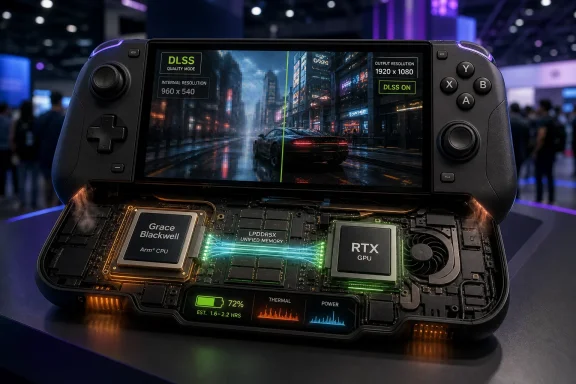
NVIDIA used Computex 2026 to introduce RTX Spark, a Grace Blackwell-based Arm superchip for slim Windows laptops and small desktops, pairing a 20-core Grace CPU with a Blackwell RTX GPU, unified LPDDR5X memory, and NVLink-C2C interconnect. That does not make it a Steam Deck 2 chip, and NVIDIA has not announced a handheld design. But it does put the missing piece of the handheld PC argument on the table: what happens when DLSS-class graphics, Arm CPUs, unified memory, and PC gaming software all start moving toward the same thermal envelope?
The most important thing about RTX Spark is not that it exists. NVIDIA has been building increasingly exotic chiplets, interconnects, and AI-focused systems for years. The important thing is that the company is now packaging a version of that strategy for PCs, not just datacenters, workstations, or developer boxes.
That matters because handheld gaming PCs have been living in a strangely narrow hardware lane. The Steam Deck, ASUS ROG Ally family, Lenovo Legion Go, MSI Claw, and the smaller boutique machines all vary in screen, ergonomics, battery size, cooling, and software polish, but the market’s center of gravity has been AMD-style x86 APUs. CPU and GPU share a power budget, share memory, and rely heavily on smart scaling to make modern games tolerable at portable wattages.
RTX Spark points at a different future. NVIDIA is not merely saying, “Here is a faster iGPU.” It is saying that a Windows PC can be built around an Arm CPU, an RTX GPU block, unified memory, and a high-bandwidth chip-to-chip fabric. That is much closer philosophically to Apple Silicon than to the conventional handheld PC formula.
For now, NVIDIA’s public positioning is about AI, creator workloads, agentic Windows experiences, and compact desktop-class acceleration. Gaming is present, but it is not the whole pitch. Still, when a company with NVIDIA’s gaming stack introduces a power-efficient Arm-and-RTX platform for PCs, handheld makers and Valve watchers are right to pay attention.
That formula has held up remarkably well. The Deck’s limitations are equally obvious in 2026: modern AAA games increasingly lean on upscaling, aggressive dynamic resolution, frame generation, and heavy CPU scheduling. The hardware is efficient, but it is now visibly old. The LCD model was already modest in 2022, and even the OLED refresh was a refinement rather than a generational leap.
The Windows handhelds answered with higher clocks, higher TDP limits, sharper displays, and broader game compatibility. They also inherited the parts of Windows that make handheld use feel like a negotiation. A ROG Ally or Legion Go can run games the Deck cannot, but it often does so with more fan noise, more battery anxiety, more launcher friction, and more “why is this dialog box here?” moments.
That is the central tension of the category. Handheld PC gaming wants console-like behavior from PC-class silicon and PC-class software. Every new chip is judged not just by frames per second, but by whether it makes that contradiction easier to live with.
The more interesting idea is architectural. Traditional handheld APUs live or die by a single integrated die and a shared memory pool. RTX Spark instead leans on a multi-chip module in which separate compute engines behave more like parts of one tightly coupled system. That lets NVIDIA bring a bigger GPU design philosophy into devices that are not full desktop towers.
For gaming, the obvious carrot is DLSS. AMD’s FSR has been indispensable on existing handhelds because it is hardware-agnostic and available across the ecosystem, but NVIDIA’s proprietary stack remains a major advantage where supported. DLSS upscaling, frame generation, Reflex, mature ray tracing acceleration, and NVIDIA’s developer relationships are the kind of software leverage handheld vendors cannot copy by bolting a faster display onto an x86 APU.
That does not mean RTX Spark would automatically flatten AMD in handhelds. In a portable device, the winner is rarely the chip with the most theoretical performance. The winner is the design that can hold useful clocks, feed memory efficiently, avoid cooking the user’s hands, and stretch a battery past the first act of a modern RPG.
Valve’s work around Proton and Arm support is the other half of the story. Proton began as a compatibility layer that made Windows games viable on Linux-based SteamOS devices. Its expansion toward Arm64 testing suggests Valve is at least preparing for a world where x86 is not the only target worth caring about.
That is not the same as saying your Steam library will simply run perfectly on an Arm handheld next year. Game compatibility is not a single switch. Anti-cheat systems, launchers, DRM, middleware, shader compilation, CPU instruction translation, GPU drivers, and platform assumptions all have to cooperate.
But the direction of travel is clear. The old assumption that PC gaming equals x86 forever is weakening. The new assumption may be that the PC gaming platform is defined less by instruction set and more by the compatibility stack wrapped around it.
For handhelds, that is both useful and awkward. Windows compatibility is still the easiest answer to the “will my game run?” question. It is also the reason so many Windows handhelds feel like tiny laptops wearing console costumes.
SteamOS solves a different problem. It gives Valve control over the interface, update cadence, input model, power behavior, and store integration. It turns a chaotic PC into a device. That is why the Steam Deck can feel smoother than faster handhelds in everyday use.
The catch is that SteamOS benefits today from AMD’s Linux driver position. AMD’s open-source graphics stack and Valve’s Linux investments have reinforced each other. NVIDIA has improved its Linux posture over time, but a hypothetical RTX Spark SteamOS handheld would still require a level of platform alignment that cannot be assumed from a Computex keynote.
Even if RTX Spark can be scaled down, the bill of materials matters. Unified high-capacity LPDDR5X memory is not free. Advanced packaging is not free. Cooling a dense CPU-GPU module is not free. Neither is licensing, validation, chassis design, battery capacity, display quality, or the retail margin demanded by hardware partners.
Handheld gaming is price-sensitive in a way premium AI laptops are not. Valve could sell the Steam Deck aggressively because the hardware was part of a larger Steam ecosystem strategy. ASUS, Lenovo, MSI, and others need healthier device margins. NVIDIA, meanwhile, has spent the AI boom learning that its silicon can command enormous premiums in markets with urgent enterprise demand.
That is why the first RTX Spark devices are more likely to be laptops, mini PCs, creator machines, and “AI PC” showpieces than anything shaped like a Deck. A handheld based on this concept may arrive only after the platform is cheaper, cooler, and boring enough to mass-produce.
NVIDIA has reason to be confident about efficiency. Blackwell is designed around modern power management, tensor acceleration, and AI-heavy workloads, and Arm CPU cores can be attractive in mixed-performance scenarios. NVIDIA also has the advantage of DLSS, which can let a system render fewer native pixels while presenting a sharper or smoother image.
Still, handheld gaming is a brutal workload. Games are spiky, engines vary wildly, and users notice when clocks drop, fans surge, or battery projections collapse. A chip’s AI inference efficiency does not automatically translate into three hours of Cyberpunk on the couch.
The handheld version of the RTX Spark argument, if it ever arrives, will need measured answers: sustained wattage, frame-time consistency, battery capacity, thermals, noise, and behavior on real shipping games. Until then, “more efficient than previous RTX laptops” is interesting, but not enough.
On a handheld, that stack could matter disproportionately. Small screens are forgiving of reconstruction artifacts. Lower internal resolutions are easier to hide. A 7- or 8-inch display does not need native 1440p rendering to look crisp in the user’s hands. That plays directly into the strengths of sophisticated temporal upscaling.
This is why the Nintendo Switch 2’s NVIDIA lineage is so important to the broader PC handheld discussion. It shows the commercial logic of pairing portable hardware with NVIDIA reconstruction technology. The PC market is messier than a closed console, but the appeal is the same: squeeze a console-like output from a device that cannot behave like a console-sized power supply.
AMD is not standing still, and FSR remains important because it works across vendors. But vendor-neutral also means less vertically optimized. NVIDIA’s temptation is to make handheld gaming less about generic raster performance and more about the whole RTX stack.
Handheld gaming is not only a silicon race. It is an input race, a suspend/resume race, a firmware race, and a compatibility race. Valve’s advantage has been the willingness to grind away at these details long after the hardware sale.
The Steam Controller changes are especially telling because they sit at the intersection of living-room PC, handheld PC, and whatever Valve plans next. Better dead zones, cleaner Remote Play input, firmware fixes, and LED behavior are not glamorous. They are the vocabulary of a company still trying to make PC gaming fit nontraditional devices.
The Legion Go-specific fixes are just as interesting. Valve does not sell the Legion Go, yet Steam increasingly has to behave well on it. That suggests Steam’s role in handhelds may be less about one device and more about becoming the common software layer across many odd-shaped PCs.
The first Steam Machines failed because they tried to sell a console-like Linux PC before the software foundation was ready. Proton did not exist in its modern form. Linux gaming was fragmented. Controller support was less mature. The Windows game library remained stubbornly Windows-bound.
Today, Valve has a proven handheld, a functioning compatibility layer, an operating system users actually like, and a much more serious hardware partner ecosystem. If the company ever revisits the living room, it would not be starting from a slogan. It would be extending an ecosystem that already runs on millions of devices.
RTX Spark complicates that picture in a productive way. It gives the industry a plausible high-performance Arm-and-RTX PC platform to think with. Whether Valve uses NVIDIA, AMD, or something else, the ceiling of what a nontraditional Steam device could be has moved.
AMD APUs offer a familiar developer target. They run the existing PC library without CPU architecture translation. They benefit from open-source graphics drivers that fit Valve’s SteamOS strategy. They are available in configurations that handheld vendors can actually ship at consumer prices.
That practical advantage should not be underrated. The best chip for a concept device is not always the best chip for a product line. Handheld makers need predictable supply, manageable thermals, firmware support, driver stability, and a price that leaves room for batteries and screens.
NVIDIA’s challenge is not proving that it can build exciting silicon. It is proving that it can meet the handheld market where it lives. That means not just high-end performance, but platform humility: good drivers, good Linux behavior if SteamOS is in play, reasonable pricing, and a willingness to support devices that do not look like flagship laptops.
NVIDIA’s possible contribution is a vertically integrated performance stack: RTX graphics, DLSS, Reflex, AI acceleration, and a tightly coupled Arm CPU-GPU design. Valve’s contribution is a platform layer that hides the ugly parts of PC gaming. AMD’s contribution is the shipping reality of efficient APUs and Linux compatibility. Microsoft’s contribution, if it can deliver, is making Windows on Arm and Windows handheld UX less awkward.
The company that wins may not be the one with the single fastest part. It may be the one that makes a game install, launch, scale, suspend, resume, and control properly without demanding that the user become a sysadmin between boss fights.
That is why RTX Spark is exciting even if it never appears in a handheld under that exact name. It changes the design space. It tells OEMs that Arm plus serious RTX graphics is no longer just a console or laptop curiosity. It is a PC platform NVIDIA wants taken seriously.
 NVIDIA Is Not Selling a Handheld Chip, Yet It Just Changed the Handheld Conversation
The most important thing about RTX Spark is not that it exists. NVIDIA has been building increasingly exotic chiplets, interconnects, and AI-focused systems for years. The important thing is that the company is now packaging a version of that strategy for PCs, not just datacenters, workstations, or developer boxes.That matters because handheld gaming PCs have been living in a strangely narrow hardware lane. The Steam Deck, ASUS ROG Ally family, Lenovo Legion Go, MSI Claw, and the smaller boutique machines all vary in screen, ergonomics, battery size, cooling, and software polish, but the market’s center of gravity has been AMD-style x86 APUs. CPU and GPU share a power budget, share memory, and rely heavily on smart scaling to make modern games tolerable at portable wattages.
RTX Spark points at a different future. NVIDIA is not merely saying, “Here is a faster iGPU.” It is saying that a Windows PC can be built around an Arm CPU, an RTX GPU block, unified memory, and a high-bandwidth chip-to-chip fabric. That is much closer philosophically to Apple Silicon than to the conventional handheld PC formula.
For now, NVIDIA’s public positioning is about AI, creator workloads, agentic Windows experiences, and compact desktop-class acceleration. Gaming is present, but it is not the whole pitch. Still, when a company with NVIDIA’s gaming stack introduces a power-efficient Arm-and-RTX platform for PCs, handheld makers and Valve watchers are right to pay attention.
The Steam Deck Proved the Market, But Also Exposed the Ceiling
Valve’s Steam Deck was not the first handheld gaming PC, but it was the first to make the category feel coherent. Its real breakthrough was not raw performance. It was the combination of a custom AMD APU, SteamOS, Proton, controller-first UX, suspend/resume behavior, shader management, and a price that made sense to people who were not already handheld PC hobbyists.That formula has held up remarkably well. The Deck’s limitations are equally obvious in 2026: modern AAA games increasingly lean on upscaling, aggressive dynamic resolution, frame generation, and heavy CPU scheduling. The hardware is efficient, but it is now visibly old. The LCD model was already modest in 2022, and even the OLED refresh was a refinement rather than a generational leap.
The Windows handhelds answered with higher clocks, higher TDP limits, sharper displays, and broader game compatibility. They also inherited the parts of Windows that make handheld use feel like a negotiation. A ROG Ally or Legion Go can run games the Deck cannot, but it often does so with more fan noise, more battery anxiety, more launcher friction, and more “why is this dialog box here?” moments.
That is the central tension of the category. Handheld PC gaming wants console-like behavior from PC-class silicon and PC-class software. Every new chip is judged not just by frames per second, but by whether it makes that contradiction easier to live with.
RTX Spark’s Real Weapon Is Not CUDA Core Count
The headline specifications are easy to recite: Blackwell-class RTX graphics, thousands of CUDA cores, a 20-core Grace CPU, unified LPDDR5X memory, and NVLink-C2C tying the pieces together. Those numbers sound comically oversized beside the low-wattage APUs used in today’s handhelds. They are also not, by themselves, evidence that a Spark handheld is imminent.The more interesting idea is architectural. Traditional handheld APUs live or die by a single integrated die and a shared memory pool. RTX Spark instead leans on a multi-chip module in which separate compute engines behave more like parts of one tightly coupled system. That lets NVIDIA bring a bigger GPU design philosophy into devices that are not full desktop towers.
For gaming, the obvious carrot is DLSS. AMD’s FSR has been indispensable on existing handhelds because it is hardware-agnostic and available across the ecosystem, but NVIDIA’s proprietary stack remains a major advantage where supported. DLSS upscaling, frame generation, Reflex, mature ray tracing acceleration, and NVIDIA’s developer relationships are the kind of software leverage handheld vendors cannot copy by bolting a faster display onto an x86 APU.
That does not mean RTX Spark would automatically flatten AMD in handhelds. In a portable device, the winner is rarely the chip with the most theoretical performance. The winner is the design that can hold useful clocks, feed memory efficiently, avoid cooking the user’s hands, and stretch a battery past the first act of a modern RPG.
Arm Is No Longer the Weird Part of This Story
A few years ago, the phrase “Arm gaming PC” would have sounded like a contradiction. In 2026, it sounds like an engineering problem that multiple companies are actively trying to solve. Apple normalized Arm laptops with serious GPU performance. Qualcomm pushed Windows on Arm back into mainstream discussion. Nintendo’s Switch line made Arm-based gaming hardware feel ordinary to hundreds of millions of players.Valve’s work around Proton and Arm support is the other half of the story. Proton began as a compatibility layer that made Windows games viable on Linux-based SteamOS devices. Its expansion toward Arm64 testing suggests Valve is at least preparing for a world where x86 is not the only target worth caring about.
That is not the same as saying your Steam library will simply run perfectly on an Arm handheld next year. Game compatibility is not a single switch. Anti-cheat systems, launchers, DRM, middleware, shader compilation, CPU instruction translation, GPU drivers, and platform assumptions all have to cooperate.
But the direction of travel is clear. The old assumption that PC gaming equals x86 forever is weakening. The new assumption may be that the PC gaming platform is defined less by instruction set and more by the compatibility stack wrapped around it.
Windows Gives NVIDIA a Shortcut, But SteamOS Gives Valve the Leverage
NVIDIA’s RTX Spark pitch is, for now, a Windows PC pitch. That makes sense. Windows remains the default home of PC gaming, NVIDIA’s driver stack is strongest there, and Microsoft has its own reasons to make Windows on Arm look less like a compromise. If NVIDIA wants RTX Spark systems to feel premium on day one, Windows is the least surprising route.For handhelds, that is both useful and awkward. Windows compatibility is still the easiest answer to the “will my game run?” question. It is also the reason so many Windows handhelds feel like tiny laptops wearing console costumes.
SteamOS solves a different problem. It gives Valve control over the interface, update cadence, input model, power behavior, and store integration. It turns a chaotic PC into a device. That is why the Steam Deck can feel smoother than faster handhelds in everyday use.
The catch is that SteamOS benefits today from AMD’s Linux driver position. AMD’s open-source graphics stack and Valve’s Linux investments have reinforced each other. NVIDIA has improved its Linux posture over time, but a hypothetical RTX Spark SteamOS handheld would still require a level of platform alignment that cannot be assumed from a Computex keynote.
The $5,000 Shadow Hanging Over the Dream
The fastest way to overhype RTX Spark for handhelds is to ignore cost. NVIDIA’s DGX Spark-class systems and related Grace Blackwell hardware sit in a world of developer workstations, AI experimentation, and premium compact computing. That is not the same world as a $399 or $549 handheld game console.Even if RTX Spark can be scaled down, the bill of materials matters. Unified high-capacity LPDDR5X memory is not free. Advanced packaging is not free. Cooling a dense CPU-GPU module is not free. Neither is licensing, validation, chassis design, battery capacity, display quality, or the retail margin demanded by hardware partners.
Handheld gaming is price-sensitive in a way premium AI laptops are not. Valve could sell the Steam Deck aggressively because the hardware was part of a larger Steam ecosystem strategy. ASUS, Lenovo, MSI, and others need healthier device margins. NVIDIA, meanwhile, has spent the AI boom learning that its silicon can command enormous premiums in markets with urgent enterprise demand.
That is why the first RTX Spark devices are more likely to be laptops, mini PCs, creator machines, and “AI PC” showpieces than anything shaped like a Deck. A handheld based on this concept may arrive only after the platform is cheaper, cooler, and boring enough to mass-produce.
Battery Life Is the Place Where Marketing Goes to Die
Every handheld generation promises more performance. The question users actually live with is how much performance survives unplugged. A chip that looks revolutionary at 45 watts may be irrelevant in a handheld that needs to operate convincingly at 12 to 20 watts.NVIDIA has reason to be confident about efficiency. Blackwell is designed around modern power management, tensor acceleration, and AI-heavy workloads, and Arm CPU cores can be attractive in mixed-performance scenarios. NVIDIA also has the advantage of DLSS, which can let a system render fewer native pixels while presenting a sharper or smoother image.
Still, handheld gaming is a brutal workload. Games are spiky, engines vary wildly, and users notice when clocks drop, fans surge, or battery projections collapse. A chip’s AI inference efficiency does not automatically translate into three hours of Cyberpunk on the couch.
The handheld version of the RTX Spark argument, if it ever arrives, will need measured answers: sustained wattage, frame-time consistency, battery capacity, thermals, noise, and behavior on real shipping games. Until then, “more efficient than previous RTX laptops” is interesting, but not enough.
DLSS on a Handheld Would Be a Platform Event
If RTX Spark or a derivative eventually reaches handhelds, the most immediate consumer-facing difference would be NVIDIA’s gaming software stack. DLSS has become more than an upscaler. It is now a bundle of assumptions about image reconstruction, frame generation, latency mitigation, ray tracing viability, and developer optimization.On a handheld, that stack could matter disproportionately. Small screens are forgiving of reconstruction artifacts. Lower internal resolutions are easier to hide. A 7- or 8-inch display does not need native 1440p rendering to look crisp in the user’s hands. That plays directly into the strengths of sophisticated temporal upscaling.
This is why the Nintendo Switch 2’s NVIDIA lineage is so important to the broader PC handheld discussion. It shows the commercial logic of pairing portable hardware with NVIDIA reconstruction technology. The PC market is messier than a closed console, but the appeal is the same: squeeze a console-like output from a device that cannot behave like a console-sized power supply.
AMD is not standing still, and FSR remains important because it works across vendors. But vendor-neutral also means less vertically optimized. NVIDIA’s temptation is to make handheld gaming less about generic raster performance and more about the whole RTX stack.
Valve’s Small Steam Updates Are Bigger Than They Look
The recent Steam client changes around Steam Controller firmware, LED controls, trigger dead zones, Remote Play input behavior, Linux gamepad emulation, device pairing, and Legion Go joystick LEDs do not sound like industry-shaking news. They are the kind of patch notes most users skim. But they point to the boring work that determines whether a platform feels finished.Handheld gaming is not only a silicon race. It is an input race, a suspend/resume race, a firmware race, and a compatibility race. Valve’s advantage has been the willingness to grind away at these details long after the hardware sale.
The Steam Controller changes are especially telling because they sit at the intersection of living-room PC, handheld PC, and whatever Valve plans next. Better dead zones, cleaner Remote Play input, firmware fixes, and LED behavior are not glamorous. They are the vocabulary of a company still trying to make PC gaming fit nontraditional devices.
The Legion Go-specific fixes are just as interesting. Valve does not sell the Legion Go, yet Steam increasingly has to behave well on it. That suggests Steam’s role in handhelds may be less about one device and more about becoming the common software layer across many odd-shaped PCs.
The Steam Machine Rumor Mill Now Has Better Hardware to Imagine
Every cycle of Valve hardware speculation eventually returns to the same ghosts: Steam Machine, Steam Controller, Steam Deck 2, living-room box, VR headset, console competitor. Most of those rumors run ahead of evidence. But the ecosystem conditions are different now than they were during the original Steam Machine era.The first Steam Machines failed because they tried to sell a console-like Linux PC before the software foundation was ready. Proton did not exist in its modern form. Linux gaming was fragmented. Controller support was less mature. The Windows game library remained stubbornly Windows-bound.
Today, Valve has a proven handheld, a functioning compatibility layer, an operating system users actually like, and a much more serious hardware partner ecosystem. If the company ever revisits the living room, it would not be starting from a slogan. It would be extending an ecosystem that already runs on millions of devices.
RTX Spark complicates that picture in a productive way. It gives the industry a plausible high-performance Arm-and-RTX PC platform to think with. Whether Valve uses NVIDIA, AMD, or something else, the ceiling of what a nontraditional Steam device could be has moved.
AMD Still Owns the Practical Handheld Present
The danger in all this speculation is treating AMD as yesterday’s answer. It is not. AMD is still the supplier most closely associated with shipping x86 handheld PCs, and its strengths are precisely the ones that matter when hardware has to be affordable and Linux-friendly.AMD APUs offer a familiar developer target. They run the existing PC library without CPU architecture translation. They benefit from open-source graphics drivers that fit Valve’s SteamOS strategy. They are available in configurations that handheld vendors can actually ship at consumer prices.
That practical advantage should not be underrated. The best chip for a concept device is not always the best chip for a product line. Handheld makers need predictable supply, manageable thermals, firmware support, driver stability, and a price that leaves room for batteries and screens.
NVIDIA’s challenge is not proving that it can build exciting silicon. It is proving that it can meet the handheld market where it lives. That means not just high-end performance, but platform humility: good drivers, good Linux behavior if SteamOS is in play, reasonable pricing, and a willingness to support devices that do not look like flagship laptops.
The Next Handheld War Will Be Fought Above the Chip
The current handheld market often gets described through processor names, but the next phase will be defined by ecosystems. A portable gaming PC is a bundle of compromises, and software determines how many of those compromises the user notices.NVIDIA’s possible contribution is a vertically integrated performance stack: RTX graphics, DLSS, Reflex, AI acceleration, and a tightly coupled Arm CPU-GPU design. Valve’s contribution is a platform layer that hides the ugly parts of PC gaming. AMD’s contribution is the shipping reality of efficient APUs and Linux compatibility. Microsoft’s contribution, if it can deliver, is making Windows on Arm and Windows handheld UX less awkward.
The company that wins may not be the one with the single fastest part. It may be the one that makes a game install, launch, scale, suspend, resume, and control properly without demanding that the user become a sysadmin between boss fights.
That is why RTX Spark is exciting even if it never appears in a handheld under that exact name. It changes the design space. It tells OEMs that Arm plus serious RTX graphics is no longer just a console or laptop curiosity. It is a PC platform NVIDIA wants taken seriously.
The Handheld Future Is Starting to Look Less Like a Shrunk Laptop
The most concrete lesson from RTX Spark is not that buyers should wait for an NVIDIA Steam Deck. They should not. The lesson is that the handheld PC category is moving from its first act, where AMD x86 APUs proved the market, into a messier second act where architecture, compatibility, and reconstruction technology all compete at once.- NVIDIA has introduced RTX Spark as a Grace Blackwell-based Windows PC platform, not as a handheld gaming chip.
- The architecture is relevant to handhelds because it combines Arm CPU cores, Blackwell RTX graphics, unified memory, and a high-speed chip-to-chip interconnect.
- DLSS support would be a major differentiator for future handheld PCs, especially on small displays where reconstructed images can look convincing at lower internal resolutions.
- Valve’s Proton and Steam client work suggest the company is preparing Steam for a broader range of hardware and input devices, even if no specific Steam Deck successor has been announced.
- Cost, battery life, thermals, Linux driver maturity, and game compatibility remain the barriers between an impressive Computex platform and a practical portable gaming device.
- AMD remains the most practical incumbent for today’s handheld PCs because its x86 APUs and Linux-friendly driver stack already fit the devices people can buy.
References
- Primary source: NoobFeed
Published: 2026-06-07T04:22:07.002093
NVIDIA RTX Spark Could Transform Future Gaming Handhelds | NoobFeed
At Computex, NVIDIA recently launched its NVIDIA RTX Spark chip. The conversation about the chip has revolved around AI and laptop software, but another...www.noobfeed.com - Related coverage: tomshardware.com
Computex 2026 Day Zero Wrap-Up: Nvidia launches RTX Spark Superchip assault on laptop and desktop markets, Intel readies Xeon 6+ | Tom's Hardware
Computex 2026 is off to a strong startwww.tomshardware.com - Related coverage: techradar.com
Watch out, Apple — Nvidia just unveiled its RTX Spark Arm 'superchip' to take on the M5 at Computex 2026 | TechRadar
Things are hotting up in Taiwanwww.techradar.com - Related coverage: pcgamer.com
Nvidia sets out roadmap for RTX Spark, its new PC platform, which also gives us a better idea of when to expect next-gen RTX GPUs | PC Gamer
Rubin in 2028, Feynman in 2030.www.pcgamer.com - Related coverage: nvidia.com
NVIDIA DGX Spark: AI Supercomputer on Your Desk
Build and run autonomous AI agents securely and locally with up to 200 billion parameters. 128GB of unified system memory. Preloaded with the NVIDIA AI software stack. On your desktop.www.nvidia.com - Related coverage: techspot.com
Nvidia RTX Spark CPU is now official: "superchip" will power Windows laptops and desktops | TechSpot
Ryan Shrout is a longtime technology analyst and industry veteran who has spent over two decades covering PC hardware, graphics, and semiconductors. He previously led technical marketing...www.techspot.com
- Related coverage: marketplace.nvidia.com
- Related coverage: tdsynnex.com
- Related coverage: signal65.com
