

Nvidia and Microsoft used the first week of June 2026 to sketch two competing futures for AI-agent hardware, with Nvidia unveiling RTX Spark for Windows PCs at GTC Taipei on June 1 and Microsoft introducing Project Solara for agent-first devices at Build on June 2. The announcements are not just another round of “AI PC” branding. They mark the moment when the industry’s agent obsession stopped being a software demo and became a purchasing problem for CIOs. The new question for enterprise IT is no longer whether AI agents will run inside the workplace, but where the expensive, risky, and increasingly consequential computation behind them should live.
That distinction matters because agents are not chatbots with better manners. They are supposed to observe context, plan work, call tools, manipulate files, summarize communications, and complete tasks with less human steering. If that vision is real, then the endpoint becomes more than a screen attached to cloud services. It becomes either a local worker with serious silicon under the keyboard, or a thin portal into a cloud agent estate controlled by identity, policy, and metered infrastructure.
Nvidia’s RTX Spark pitch is the more familiar one for Windows enthusiasts: make the machine powerful enough that the future arrives locally. The company describes RTX Spark as a new superchip for Windows laptops and desktops built around an Arm-based Grace CPU, a Blackwell RTX GPU, high-speed chip-to-chip links, and up to 128GB of unified memory. In Nvidia’s telling, this is not a marginal NPU upgrade bolted onto a conventional productivity laptop. It is an attempt to give the Windows PC enough local memory and GPU horsepower to host serious AI workloads without round-tripping every request through a data center.
The headline numbers explain why the announcement landed differently from previous AI PC marketing. Nvidia says RTX Spark systems can run 120-billion-parameter large language models locally with context windows reaching one million tokens. That is the kind of capacity vendors usually discuss in relation to servers, not deskside systems or mobile workstations. It also changes the psychology of local AI: instead of asking whether a laptop can summarize a meeting, Nvidia is asking whether it can hold an entire corporate knowledge base in working context and let agents operate over it.
That is an audacious claim, and buyers should treat it as a vendor claim until independent systems ship and workloads can be tested. But the direction is unmistakable. Nvidia is not merely selling acceleration for Windows; it is trying to make the Windows PC credible again as the center of personal computing at a time when the most interesting software has migrated to browsers, cloud runtimes, and SaaS dashboards. The agent becomes a reason to care about the local machine again.
The company’s framing is also strategically convenient. If AI agents become the next workplace interface, the vendor that supplies the endpoint silicon gains leverage over OEMs, developers, and enterprise refresh cycles. Nvidia already dominates data-center AI acceleration. RTX Spark is the company’s attempt to carry some of that gravity down into the personal computer, where the unit economics are different but the installed base is enormous.
For Windows users, the implication is plain: the AI PC category may finally be escaping the narrow confines of “has an NPU, can run a few local models.” RTX Spark imagines something more aggressive. It imagines a Windows endpoint that can run large agents, keep sensitive context nearby, and remain useful even when network access is limited or cloud costs become politically radioactive inside the finance department.
The most interesting part is not merely that Solara exists. It is that Microsoft built the platform on the Android Open Source Project through its Microsoft Device Ecosystem Platform rather than on Windows. For a company that spent decades defending Windows as the default shell for work, that is not a small architectural footnote. It is a quiet admission that the next wave of devices may not look like PCs, may not behave like app launchers, and may not need the Windows desktop at all.
This is where Microsoft’s pitch becomes both more pragmatic and more radical than Nvidia’s. Solara devices are meant to generate just-in-time interfaces for tasks, hand off heavier inference to Azure, and sit inside Microsoft’s enterprise stack for identity, management, and security. Instead of buying every employee a monster local AI machine, an organization could deploy lightweight agent endpoints in the places where work actually happens: retail floors, clinics, warehouses, conference rooms, field environments, and front desks.
That makes Solara a workplace device story more than a PC story. It is not aimed first at the power user who wants to run a giant model on a laptop. It is aimed at the enterprise that wants a badge to answer policy questions, a desk hub to coordinate workflows, or a shared device that invokes an agent without asking a worker to open Outlook, Teams, Edge, Copilot, and three line-of-business applications.
The strategic bet is unmistakably Microsoftian. The device can be cheap, but the cloud, identity layer, agent runtime, management plane, and developer ecosystem are where the durable value lives. If Nvidia wants the endpoint to be powerful enough to host the agent, Microsoft wants the endpoint to be thin enough that Azure and Microsoft 365 remain the gravitational center.
The hardware question is harder because agents are still immature. Enterprises have not yet proven that autonomous assistants can consistently reduce errors, cut handling time, or navigate messy business processes without creating new supervision burdens. A chatbot that gives a bad answer is annoying. An agent that updates a record, sends a message, orders inventory, or applies a discount incorrectly is an operational incident.
That gap between promise and proof is why Microsoft’s early enterprise pilots matter. AccuWeather, Best Buy, CVS Health, Levi Strauss, and Target represent the kinds of organizations where agent devices might make sense: environments with repetitive workflows, high labor costs, lots of customer interaction, and heavy procedural knowledge. If agents can reduce friction in those settings, the hardware argument becomes easier. If they merely add another device to manage, the category will look like yet another expensive experiment in ambient computing.
Nvidia’s path faces a different burden of proof. RTX Spark systems will have to show that local execution is worth the likely premium over conventional PCs and cloud-backed AI tools. That means more than benchmark slides. It means lower latency in real workflows, reduced cloud spend, stronger data-control posture, and enough developer support that local agents do not become bespoke demos stranded on expensive machines.
The two approaches also point to different buyers. Nvidia’s first natural audience is developers, creators, engineers, analysts, security teams, and executives with sensitive or compute-heavy workflows. Microsoft’s Solara audience is operations-heavy enterprises that want agents embedded into physical workflows rather than traditional desktop computing. Both can be true at the same time, but they imply very different procurement strategies.
That argument is especially powerful in sectors where the cloud is allowed but politically fraught. Legal teams, healthcare organizations, financial institutions, defense contractors, and companies operating across strict data jurisdictions all have reasons to prefer local processing for certain classes of work. A one-million-token context window on a local machine is not just a technical flex; it is a promise that huge amounts of sensitive context can remain under local administrative control.
But local does not automatically mean secure. A powerful AI workstation that can read large stores of corporate data, call tools, generate code, and act on behalf of a user is also a more valuable target. Endpoint compromise becomes more dangerous when the endpoint hosts not just files but a capable agent with access to memory, credentials, business systems, and local models. The security perimeter does not disappear; it moves closer to the user.
That creates a management burden Windows administrators will recognize immediately. Local agents will need policy boundaries, audit trails, model update controls, prompt and tool restrictions, data-loss prevention hooks, and ways to revoke or quarantine behavior when something goes wrong. The more autonomy the agent gets, the more the endpoint starts to resemble a privileged automation host.
Microsoft’s cloud-centric model has its own risks, but they are risks enterprises already know how to discuss. Identity, conditional access, logging, compliance tooling, tenant controls, and centralized governance are familiar parts of the Microsoft estate. Solara’s security appeal is that the lightweight device can be managed as part of a cloud-controlled platform. Its weakness is that sensitive interaction and inference may still depend on networked services, raising familiar questions about data handling, residency, service availability, and lock-in.
In practice, serious enterprises will probably end up with both patterns. Highly sensitive or latency-critical workflows will push toward local or hybrid execution. Broad workforce assistance, shared devices, and standardized operational agents will lean toward cloud orchestration. The fantasy of a single winning architecture is less plausible than a messy split by workload, risk profile, and budget.
That is why skepticism about purpose-built AI hardware is rational. For many office workers, the best machine may still be a fast, reliable laptop with good battery life, a decent CPU, enough RAM, and access to cloud-hosted models. The marginal value of running a huge local model may be small if the work is email triage, meeting summaries, document drafting, and CRM updates. In those cases, the network is good enough and the cloud model may be better maintained.
Cloud agents also improve faster from the user’s perspective. The endpoint does not need a hardware refresh to gain access to a new model family, better tool orchestration, or improved reasoning. That matters in a field where model capability curves can make last year’s expensive local stack look strangely ordinary. Buying specialized hardware too early is a classic way to turn enthusiasm into depreciation.
But cloud economics can change quickly when usage scales. If agents become persistent workers rather than occasional assistants, inference costs may become a material operating expense. Long-context workflows, multimodal processing, code generation, document analysis, and autonomous task loops can all generate far more compute demand than today’s chat-based usage patterns. At that point, local hardware starts to look less like a luxury and more like a hedge.
There is also the question of availability. A cloud agent that cannot operate when connectivity is degraded is a poor fit for field work, emergency operations, manufacturing floors, remote sites, and regulated facilities with strict network segmentation. Local inference does not solve every problem, but it changes the failure mode. For some organizations, that alone will justify a premium tier of agent-capable endpoints.
That tension has been building for years. Microsoft wants Windows to remain central, but its most important business is no longer the sale of Windows licenses. Azure, Microsoft 365, security, developer tooling, GitHub, and Copilot give the company many ways to win even if the endpoint becomes less Windows-shaped. Solara is a logical expression of that reality: Microsoft would rather own the agent platform than insist every agent live behind a Start menu.
For WindowsForum readers, this is the part worth watching. Windows is not vanishing, and the PC is not dead. But the operating system is becoming one surface among many for Microsoft’s agent strategy. The company can push Copilot deeper into Windows while also building Android-based agent devices that treat Windows as optional in some workflows.
Nvidia, meanwhile, has an interest in making Windows feel newly essential. If RTX Spark systems can turn Windows machines into capable local AI workstations, the PC gains a new premium rationale. OEMs get a new refresh story. Developers get a local target. Nvidia gets to sell high-value silicon outside the server rack.
The result is not a clean platform war. It is a split personality. Windows may become both the high-end local agent workbench and merely one client in a wider agent mesh. Microsoft can live with that ambiguity because its services span both worlds. Traditional PC vendors may find it more threatening, because a badge, desk puck, or shared agent appliance is not necessarily a laptop replacement cycle.
That matters because AI could be unusually useful in emerging technology hubs. Startups, banks, logistics firms, healthcare networks, public-sector agencies, and small businesses all stand to benefit from automation that compresses administrative work and expands access to expertise. But if the best agent experiences require expensive local machines, the productivity gains may concentrate in regions and companies that can afford frequent hardware refreshes.
Cloud delivery partially equalizes access. A modest device with reliable connectivity can reach a powerful model hosted elsewhere. That model fits the economic reality of many organizations that would rather pay per use than buy specialized endpoints upfront. It also lets local developers build services without waiting for the newest workstation class to become affordable.
The trade-off is dependency. Cloud-first AI can mean higher latency, recurring foreign-denominated costs, exposure to service availability constraints, and complicated data-sovereignty questions. For African enterprises and governments, the choice between local AI and cloud AI is not simply technical. It is tied to infrastructure, currency, regulation, procurement cycles, and the availability of regional data centers.
This is where the agent hardware race could either widen or narrow the global compute gap. If Nvidia-class local hardware becomes the de facto standard for advanced AI work, poorer markets may lag. If Microsoft-style chip-to-cloud platforms and smaller purpose-built devices make agents cheaper to deploy, the category could spread faster. The deciding factor will be not keynote ambition, but price, connectivity, support, and whether vendors treat emerging markets as first-class deployment environments rather than future growth slides.
Microsoft’s Solara makes that inversion explicit. A device that generates the interface it needs for the task is not just a smaller PC. It is an argument that fixed apps are too rigid for agent-mediated work. The agent does not need a full application suite visible to the user; it needs access to tools, permissions, context, and a way to present decisions or exceptions.
Nvidia’s RTX Spark attacks the same problem from the other side. If an agent can hold a million-token context locally, the interface can become less about opening individual files and more about reasoning across a body of work. A developer might ask an agent to inspect a repository, compare documentation, trace a regression, and prepare a patch. A lawyer might ask it to analyze a contract set. A security analyst might ask it to correlate incidents, logs, and playbooks.
In each case, the point is not that the user gets another app. The point is that the endpoint or device becomes an execution environment for an agent that uses many tools. That has profound consequences for software vendors. If the agent becomes the primary interface, applications risk becoming back-end capabilities exposed through APIs and permissions rather than destinations users consciously visit.
This is why the hardware announcements feel bigger than normal device news. They are part of a broader attempt to redraw the boundary between user, operating system, application, and cloud. The winner may not be the company with the prettiest gadget. It may be the company that defines how agents discover tools, request authority, show their work, and recover from mistakes.
The first spreadsheet will be cost. RTX Spark systems with high-end unified memory and Blackwell-class GPU capability are unlikely to be bargain endpoints. Solara devices may be cheaper per unit, but cloud inference, management, integration, and support costs can accumulate quickly. A device that seems inexpensive at purchase can become costly if it creates a new service dependency for every workflow.
The second spreadsheet will be productivity. Enterprises will want measured reductions in task time, ticket volume, error rates, training overhead, and customer wait times. They will not buy at scale because an agent can perform well on a scripted demo. They will buy when the device survives messy shifts, partial information, impatient users, and legacy systems that were never designed for autonomous software.
The third spreadsheet will be risk. Agents need permissions, and permissions create accountability problems. If a human follows bad AI advice, that is one kind of governance issue. If an agent acts directly, the audit trail must explain what happened, why it happened, what data was used, which policy allowed it, and who is responsible for the outcome.
That accountability layer is still the least glamorous and most important part of the agent stack. Hardware can make agents faster or more available. It cannot by itself make them trustworthy. The market will not mature until vendors can show not only that agents can act, but that enterprises can constrain, inspect, and correct those actions at scale.
That distinction matters because agents are not chatbots with better manners. They are supposed to observe context, plan work, call tools, manipulate files, summarize communications, and complete tasks with less human steering. If that vision is real, then the endpoint becomes more than a screen attached to cloud services. It becomes either a local worker with serious silicon under the keyboard, or a thin portal into a cloud agent estate controlled by identity, policy, and metered infrastructure.
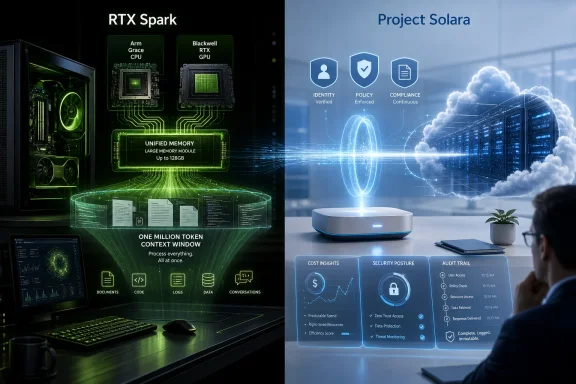 Nvidia Wants the PC to Become the Agent’s Workbench
Nvidia’s RTX Spark pitch is the more familiar one for Windows enthusiasts: make the machine powerful enough that the future arrives locally. The company describes RTX Spark as a new superchip for Windows laptops and desktops built around an Arm-based Grace CPU, a Blackwell RTX GPU, high-speed chip-to-chip links, and up to 128GB of unified memory. In Nvidia’s telling, this is not a marginal NPU upgrade bolted onto a conventional productivity laptop. It is an attempt to give the Windows PC enough local memory and GPU horsepower to host serious AI workloads without round-tripping every request through a data center.The headline numbers explain why the announcement landed differently from previous AI PC marketing. Nvidia says RTX Spark systems can run 120-billion-parameter large language models locally with context windows reaching one million tokens. That is the kind of capacity vendors usually discuss in relation to servers, not deskside systems or mobile workstations. It also changes the psychology of local AI: instead of asking whether a laptop can summarize a meeting, Nvidia is asking whether it can hold an entire corporate knowledge base in working context and let agents operate over it.
That is an audacious claim, and buyers should treat it as a vendor claim until independent systems ship and workloads can be tested. But the direction is unmistakable. Nvidia is not merely selling acceleration for Windows; it is trying to make the Windows PC credible again as the center of personal computing at a time when the most interesting software has migrated to browsers, cloud runtimes, and SaaS dashboards. The agent becomes a reason to care about the local machine again.
The company’s framing is also strategically convenient. If AI agents become the next workplace interface, the vendor that supplies the endpoint silicon gains leverage over OEMs, developers, and enterprise refresh cycles. Nvidia already dominates data-center AI acceleration. RTX Spark is the company’s attempt to carry some of that gravity down into the personal computer, where the unit economics are different but the installed base is enormous.
For Windows users, the implication is plain: the AI PC category may finally be escaping the narrow confines of “has an NPU, can run a few local models.” RTX Spark imagines something more aggressive. It imagines a Windows endpoint that can run large agents, keep sensitive context nearby, and remain useful even when network access is limited or cloud costs become politically radioactive inside the finance department.
Microsoft’s Solara Is an Escape Hatch From the PC It Built
Microsoft’s Project Solara heads in the opposite direction. Rather than making the Windows PC the unquestioned home of the agent, Solara treats the device as a situational interface: a desk companion, badge, shared workplace object, or other purpose-built form factor that can surface the agent only when needed. It is a chip-to-cloud platform rather than a brute-force local workstation.The most interesting part is not merely that Solara exists. It is that Microsoft built the platform on the Android Open Source Project through its Microsoft Device Ecosystem Platform rather than on Windows. For a company that spent decades defending Windows as the default shell for work, that is not a small architectural footnote. It is a quiet admission that the next wave of devices may not look like PCs, may not behave like app launchers, and may not need the Windows desktop at all.
This is where Microsoft’s pitch becomes both more pragmatic and more radical than Nvidia’s. Solara devices are meant to generate just-in-time interfaces for tasks, hand off heavier inference to Azure, and sit inside Microsoft’s enterprise stack for identity, management, and security. Instead of buying every employee a monster local AI machine, an organization could deploy lightweight agent endpoints in the places where work actually happens: retail floors, clinics, warehouses, conference rooms, field environments, and front desks.
That makes Solara a workplace device story more than a PC story. It is not aimed first at the power user who wants to run a giant model on a laptop. It is aimed at the enterprise that wants a badge to answer policy questions, a desk hub to coordinate workflows, or a shared device that invokes an agent without asking a worker to open Outlook, Teams, Edge, Copilot, and three line-of-business applications.
The strategic bet is unmistakably Microsoftian. The device can be cheap, but the cloud, identity layer, agent runtime, management plane, and developer ecosystem are where the durable value lives. If Nvidia wants the endpoint to be powerful enough to host the agent, Microsoft wants the endpoint to be thin enough that Azure and Microsoft 365 remain the gravitational center.
The Agent Is Becoming a Hardware Buyer’s Problem
For years, AI in the enterprise has been sold as a subscription, an API line item, or a feature upgrade in existing software. These announcements drag the conversation back into the hardware budget. That is uncomfortable for CIOs because endpoint decisions last longer than software enthusiasms. A laptop refresh, a device-management standard, or a field-hardware deployment can shape operations for five years.The hardware question is harder because agents are still immature. Enterprises have not yet proven that autonomous assistants can consistently reduce errors, cut handling time, or navigate messy business processes without creating new supervision burdens. A chatbot that gives a bad answer is annoying. An agent that updates a record, sends a message, orders inventory, or applies a discount incorrectly is an operational incident.
That gap between promise and proof is why Microsoft’s early enterprise pilots matter. AccuWeather, Best Buy, CVS Health, Levi Strauss, and Target represent the kinds of organizations where agent devices might make sense: environments with repetitive workflows, high labor costs, lots of customer interaction, and heavy procedural knowledge. If agents can reduce friction in those settings, the hardware argument becomes easier. If they merely add another device to manage, the category will look like yet another expensive experiment in ambient computing.
Nvidia’s path faces a different burden of proof. RTX Spark systems will have to show that local execution is worth the likely premium over conventional PCs and cloud-backed AI tools. That means more than benchmark slides. It means lower latency in real workflows, reduced cloud spend, stronger data-control posture, and enough developer support that local agents do not become bespoke demos stranded on expensive machines.
The two approaches also point to different buyers. Nvidia’s first natural audience is developers, creators, engineers, analysts, security teams, and executives with sensitive or compute-heavy workflows. Microsoft’s Solara audience is operations-heavy enterprises that want agents embedded into physical workflows rather than traditional desktop computing. Both can be true at the same time, but they imply very different procurement strategies.
Local AI Has the Strongest Privacy Story, but Not the Simplest Security Story
The most compelling case for RTX Spark-style local AI is data gravity. Sensitive information already lives on endpoints, file shares, local repositories, and internal systems. If an agent can work over that information without shipping prompts, documents, embeddings, or intermediate reasoning to a third-party cloud, it becomes easier to satisfy some privacy, sovereignty, and regulatory concerns.That argument is especially powerful in sectors where the cloud is allowed but politically fraught. Legal teams, healthcare organizations, financial institutions, defense contractors, and companies operating across strict data jurisdictions all have reasons to prefer local processing for certain classes of work. A one-million-token context window on a local machine is not just a technical flex; it is a promise that huge amounts of sensitive context can remain under local administrative control.
But local does not automatically mean secure. A powerful AI workstation that can read large stores of corporate data, call tools, generate code, and act on behalf of a user is also a more valuable target. Endpoint compromise becomes more dangerous when the endpoint hosts not just files but a capable agent with access to memory, credentials, business systems, and local models. The security perimeter does not disappear; it moves closer to the user.
That creates a management burden Windows administrators will recognize immediately. Local agents will need policy boundaries, audit trails, model update controls, prompt and tool restrictions, data-loss prevention hooks, and ways to revoke or quarantine behavior when something goes wrong. The more autonomy the agent gets, the more the endpoint starts to resemble a privileged automation host.
Microsoft’s cloud-centric model has its own risks, but they are risks enterprises already know how to discuss. Identity, conditional access, logging, compliance tooling, tenant controls, and centralized governance are familiar parts of the Microsoft estate. Solara’s security appeal is that the lightweight device can be managed as part of a cloud-controlled platform. Its weakness is that sensitive interaction and inference may still depend on networked services, raising familiar questions about data handling, residency, service availability, and lock-in.
In practice, serious enterprises will probably end up with both patterns. Highly sensitive or latency-critical workflows will push toward local or hybrid execution. Broad workforce assistance, shared devices, and standardized operational agents will lean toward cloud orchestration. The fantasy of a single winning architecture is less plausible than a messy split by workload, risk profile, and budget.
The Cloud Still Has the Better Economics Until It Doesn’t
The cloud has a simple advantage: most companies do not want to buy peak compute for every worker. Centralized infrastructure can be pooled, metered, upgraded, patched, and amortized across many users. If an employee needs a burst of inference for a few minutes a day, it is hard to justify a premium endpoint that sits mostly idle.That is why skepticism about purpose-built AI hardware is rational. For many office workers, the best machine may still be a fast, reliable laptop with good battery life, a decent CPU, enough RAM, and access to cloud-hosted models. The marginal value of running a huge local model may be small if the work is email triage, meeting summaries, document drafting, and CRM updates. In those cases, the network is good enough and the cloud model may be better maintained.
Cloud agents also improve faster from the user’s perspective. The endpoint does not need a hardware refresh to gain access to a new model family, better tool orchestration, or improved reasoning. That matters in a field where model capability curves can make last year’s expensive local stack look strangely ordinary. Buying specialized hardware too early is a classic way to turn enthusiasm into depreciation.
But cloud economics can change quickly when usage scales. If agents become persistent workers rather than occasional assistants, inference costs may become a material operating expense. Long-context workflows, multimodal processing, code generation, document analysis, and autonomous task loops can all generate far more compute demand than today’s chat-based usage patterns. At that point, local hardware starts to look less like a luxury and more like a hedge.
There is also the question of availability. A cloud agent that cannot operate when connectivity is degraded is a poor fit for field work, emergency operations, manufacturing floors, remote sites, and regulated facilities with strict network segmentation. Local inference does not solve every problem, but it changes the failure mode. For some organizations, that alone will justify a premium tier of agent-capable endpoints.
Windows Is Being Pulled in Two Directions at Once
The irony of this week’s announcements is that both are adjacent to Windows, but only one is really about Windows. Nvidia’s RTX Spark reinforces the PC as the local center of gravity. Microsoft’s Solara suggests the future may spill out of the PC into a constellation of agent devices that use Microsoft services without needing Microsoft’s desktop OS.That tension has been building for years. Microsoft wants Windows to remain central, but its most important business is no longer the sale of Windows licenses. Azure, Microsoft 365, security, developer tooling, GitHub, and Copilot give the company many ways to win even if the endpoint becomes less Windows-shaped. Solara is a logical expression of that reality: Microsoft would rather own the agent platform than insist every agent live behind a Start menu.
For WindowsForum readers, this is the part worth watching. Windows is not vanishing, and the PC is not dead. But the operating system is becoming one surface among many for Microsoft’s agent strategy. The company can push Copilot deeper into Windows while also building Android-based agent devices that treat Windows as optional in some workflows.
Nvidia, meanwhile, has an interest in making Windows feel newly essential. If RTX Spark systems can turn Windows machines into capable local AI workstations, the PC gains a new premium rationale. OEMs get a new refresh story. Developers get a local target. Nvidia gets to sell high-value silicon outside the server rack.
The result is not a clean platform war. It is a split personality. Windows may become both the high-end local agent workbench and merely one client in a wider agent mesh. Microsoft can live with that ambiguity because its services span both worlds. Traditional PC vendors may find it more threatening, because a badge, desk puck, or shared agent appliance is not necessarily a laptop replacement cycle.
Emerging Markets May Get the Agent Revolution Last
The global implications are not evenly distributed. In markets such as Kenya, where Nairobi’s Silicon Savannah has become a serious center for African digital innovation, the promise of agentic computing collides with hardware affordability. Local AI sounds empowering until the entry ticket becomes premium silicon, large unified memory, and specialized endpoints priced for multinational buyers.That matters because AI could be unusually useful in emerging technology hubs. Startups, banks, logistics firms, healthcare networks, public-sector agencies, and small businesses all stand to benefit from automation that compresses administrative work and expands access to expertise. But if the best agent experiences require expensive local machines, the productivity gains may concentrate in regions and companies that can afford frequent hardware refreshes.
Cloud delivery partially equalizes access. A modest device with reliable connectivity can reach a powerful model hosted elsewhere. That model fits the economic reality of many organizations that would rather pay per use than buy specialized endpoints upfront. It also lets local developers build services without waiting for the newest workstation class to become affordable.
The trade-off is dependency. Cloud-first AI can mean higher latency, recurring foreign-denominated costs, exposure to service availability constraints, and complicated data-sovereignty questions. For African enterprises and governments, the choice between local AI and cloud AI is not simply technical. It is tied to infrastructure, currency, regulation, procurement cycles, and the availability of regional data centers.
This is where the agent hardware race could either widen or narrow the global compute gap. If Nvidia-class local hardware becomes the de facto standard for advanced AI work, poorer markets may lag. If Microsoft-style chip-to-cloud platforms and smaller purpose-built devices make agents cheaper to deploy, the category could spread faster. The deciding factor will be not keynote ambition, but price, connectivity, support, and whether vendors treat emerging markets as first-class deployment environments rather than future growth slides.
The App Model Is the Real Target
Both announcements point beyond hardware. The deeper target is the app model itself. For decades, computing has been organized around users choosing applications, learning interfaces, switching windows, and manually transferring context between tools. Agents promise to invert that arrangement: the user states intent, and software assembles the workflow.Microsoft’s Solara makes that inversion explicit. A device that generates the interface it needs for the task is not just a smaller PC. It is an argument that fixed apps are too rigid for agent-mediated work. The agent does not need a full application suite visible to the user; it needs access to tools, permissions, context, and a way to present decisions or exceptions.
Nvidia’s RTX Spark attacks the same problem from the other side. If an agent can hold a million-token context locally, the interface can become less about opening individual files and more about reasoning across a body of work. A developer might ask an agent to inspect a repository, compare documentation, trace a regression, and prepare a patch. A lawyer might ask it to analyze a contract set. A security analyst might ask it to correlate incidents, logs, and playbooks.
In each case, the point is not that the user gets another app. The point is that the endpoint or device becomes an execution environment for an agent that uses many tools. That has profound consequences for software vendors. If the agent becomes the primary interface, applications risk becoming back-end capabilities exposed through APIs and permissions rather than destinations users consciously visit.
This is why the hardware announcements feel bigger than normal device news. They are part of a broader attempt to redraw the boundary between user, operating system, application, and cloud. The winner may not be the company with the prettiest gadget. It may be the company that defines how agents discover tools, request authority, show their work, and recover from mistakes.
Enterprise IT Will Demand Proof, Not Poetry
The agent hardware story is currently rich in metaphors. Devices are “teammates.” Interfaces are “ambient.” Work becomes “agent-first.” That language is useful for launches, but enterprise IT eventually turns poetry into spreadsheets.The first spreadsheet will be cost. RTX Spark systems with high-end unified memory and Blackwell-class GPU capability are unlikely to be bargain endpoints. Solara devices may be cheaper per unit, but cloud inference, management, integration, and support costs can accumulate quickly. A device that seems inexpensive at purchase can become costly if it creates a new service dependency for every workflow.
The second spreadsheet will be productivity. Enterprises will want measured reductions in task time, ticket volume, error rates, training overhead, and customer wait times. They will not buy at scale because an agent can perform well on a scripted demo. They will buy when the device survives messy shifts, partial information, impatient users, and legacy systems that were never designed for autonomous software.
The third spreadsheet will be risk. Agents need permissions, and permissions create accountability problems. If a human follows bad AI advice, that is one kind of governance issue. If an agent acts directly, the audit trail must explain what happened, why it happened, what data was used, which policy allowed it, and who is responsible for the outcome.
That accountability layer is still the least glamorous and most important part of the agent stack. Hardware can make agents faster or more available. It cannot by itself make them trustworthy. The market will not mature until vendors can show not only that agents can act, but that enterprises can constrain, inspect, and correct those actions at scale.
The June 2026 Agent Hardware Bet Comes Down to Five Practical Tests
For all the architectural drama, the immediate lesson for buyers is restraint. Nvidia and Microsoft have each described plausible futures, but neither has repealed the basic rules of enterprise deployment. Pilot carefully, measure actual workflows, and avoid turning a platform bet into a fleet-wide assumption too early.- RTX Spark makes the strongest case where local model execution, long context, low latency, and data control are worth paying for on the endpoint.
- Project Solara makes the strongest case where agent access needs to appear in physical workflows without forcing every worker into a full PC interface.
- Cloud-hosted agents will remain the default for many organizations until usage costs, privacy constraints, or connectivity requirements make local execution more attractive.
- Security teams should treat local agents as privileged automation running near sensitive data, not as harmless productivity features.
- Emerging markets may benefit more from affordable cloud-linked agent devices than from premium local AI workstations, unless hardware prices fall quickly.
- The real enterprise winner will be the platform that proves measurable return on investment and governable behavior, not the one with the most impressive launch demo.
References
- Primary source: streamlinefeed.co.ke
Published: 2026-06-09T06:30:08.738703
Nvidia and Microsoft Unveil Purpose-Built Hardware for AI Agents | Streamline
Nvidia and Microsoft have unveiled dedicated computing hardware designed specifically for AI agents, sparking a massive shift from cloud to edge computing.streamlinefeed.co.ke - Related coverage: tomshardware.com
Microsoft unveils Project Solara AI, a chip-to-cloud platform built to power a new generation of 'agent-first' enterprise devices — hardware designed to run AI agents instead of traditional apps | Tom's Hardware
Microsoft ditches Windows to build OS on Androidwww.tomshardware.com - Related coverage: windowscentral.com
Microsoft outlines its vision for “the next computer” with Project Solara, an agentic platform that exists liminally in your pocket and on your desk | Windows Central
After Windows Phone, Microsoft is eager to get ahead of the next paradigm shift in computing, and it's betting big on an agentic hardware and software future.www.windowscentral.com - Related coverage: itpro.com
‘This is the new PC. The personal AI computer’: Nvidia wants its RTX Spark ‘superchip’ to fuel the AI PC boom | IT Pro
The new RTX Spark chip is designed to keep AI inference local for security and safetywww.itpro.com - Related coverage: techradar.com
HP announces the most powerful Windows AI PC ever built — Nvidia GB300 workstation can handle one trillion parameters thanks to its 784GB unified memory, but it won't be cheap | TechRadar
Server-grade power, now on your desk.www.techradar.com - Related coverage: tomsguide.com
Biggest Microsoft Build 2026 announcements — agentic AI, RTX Spark Dev Box, GitHub Copilot app, new MAI models, and more | Tom's Guide
All the big news from Microsoft's AI-focused eventwww.tomsguide.com
- Related coverage: investor.nvidia.com
NVIDIA Corporation - NVIDIA and Microsoft Reinvent Windows PCs for the Age of Personal AI
RTX Spark — a 1-Petaflop Superchip, the Full CUDA and RTX Ecosystem, and Windows-Native Agents — a New Beginning for Personal Computers News Summary: NVIDIA RTX Spark powers the world’s first Windows PCs purpose-built for personal agents, featuring 1 petaflop of AI performance, industry-leading...investor.nvidia.com - Official source: commandline.microsoft.com
Composing a new platform for agent-first devices - Command Line
New interaction technology enables new types of computers. Learn more about Microsoft’s Project Solara.commandline.microsoft.com - Related coverage: arstechnica.com
Microsoft's Project Solara is an Android OS designed for agents instead of apps - Ars Technica
Microsoft missed the boat on apps, so get ready for agents.arstechnica.com - Related coverage: bruno.digital
Microsoft Unveils Project Solara, an Android Based OS Built for AI Agents Instead of Apps | Bruno Digital
Microsoft used Build 2026 to introduce Project Solara, an AOSP based operating system that lets AI agents generate device specific interfaces on demand instead of relying on traditional installed applications.bruno.digital - Related coverage: winbuzzer.com
Microsoft's Project Solara Turns Android Devices Into AI Agent Hubs
Microsoft is developing Project Solara as an Android-based platform for devices organized around AI agents rather than traditional apps.winbuzzer.com - Related coverage: techrepublic.com
Microsoft Project Solara Brings AI Agents to Enterprise Devices - TechRepublic
Microsoft Project Solara previews agent-first enterprise devices built on MDEP, with badge and desk concepts that raise IT questions around identity, privacy, and management.www.techrepublic.com
- Related coverage: techadvisor.com
Microsoft Project Solara AI Assistant OS Announced - Tech Advisor
The new Microsoft Project Solara OS will run AI assistant devices, where it will take on Gemini for Home and Alexawww.techadvisor.com - Related coverage: smhn.info
カード型AIデバイス!マイクロソフトがAndroid OSベース新基盤、AIエージェント端末向け「Project Solara」発表 - すまほん!!
アプリを探す日常は終わるのか。Microsoftは現地時間6月2日、開発者会議「Build 2026」で、AIエージェント向けの新しいデバイス基盤「Project Solara」を発表しました。狙いは明快で、同社は次のプラットフォーム転換を「apps to agents(開くソフ... smhn.info
- Related coverage: hardware.slashdot.org
Microsoft's Project Solara Is an OS For Devices That Run AI Agents Instead of Apps - Slashdot
An anonymous reader quotes a report from GeekWire: A team inside Microsoft has been quietly building a platform for devices that run AI agents instead of apps, based on Android instead of Windows, with two working hardware designs so far, and an initial set of big-name companies lined up to run...hardware.slashdot.org - Related coverage: techbuzz.ai
Microsoft Unveils Project Solara OS for AI Agent Gadgets | The Tech Buzz
Microsoft launches Android-based Project Solara at Build 2026 to power AI agent hardwarewww.techbuzz.ai - Related coverage: techspot.com
Nvidia RTX Spark CPU is now official: "superchip" will power Windows laptops and desktops | TechSpot
Ryan Shrout is a longtime technology analyst and industry veteran who has spent over two decades covering PC hardware, graphics, and semiconductors. He previously led technical marketing...www.techspot.com - Related coverage: techmymoney.com
Microsoft Project Solara Is Built for Agent-First Devices
Microsoft Project Solara is a Build 2026 platform for agent-first devices, starting with enterprise desk and badge concepts. techmymoney.com
- Related coverage: nvidianews.nvidia.com
