

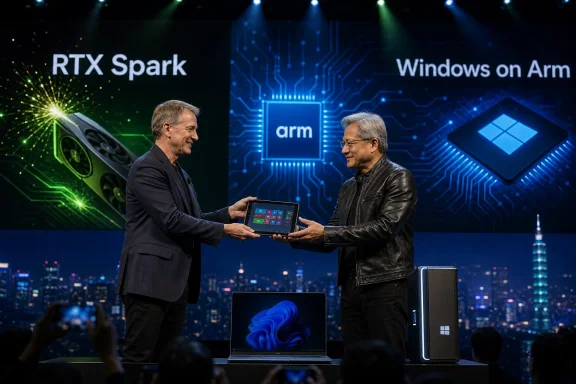
Arm CEO Rene Haas handed Nvidia CEO Jensen Huang a Microsoft Surface RT onstage at Computex 2026 in Taipei, reviving a 2012 Windows-on-Arm symbol just as Nvidia and Microsoft pitch a new RTX Spark generation of Arm-based Windows PCs. The gift was small theater, but it landed because it compressed 14 years of Microsoft hardware ambition, Arm ecosystem frustration, and Nvidia’s renewed PC strategy into one obsolete tablet. Surface RT was once the cautionary tale; now it is being reframed as the awkward first draft of a market Nvidia thinks is finally ready.
The Surface RT was never merely a failed tablet. It was Microsoft’s first serious attempt to tell the Windows world that the PC did not have to mean x86, that battery life and thinness could matter as much as legacy compatibility, and that the company was willing to build its own hardware when partners moved too slowly.
That message was radical in 2012 and commercially disastrous soon after. Microsoft launched Surface RT with Nvidia’s Tegra 3, Windows RT, a clever kickstand, a magnetic keyboard cover, and a promise that Windows could be made into something more like an iPad without becoming an iPad. What customers got instead was a device that looked like Windows, behaved like Windows in some corners, and then refused to run the Windows programs people actually owned.
That is why Haas giving Huang a Surface RT at Computex was more than nostalgia. It was an admission that the first Windows-on-Arm consumer push failed for reasons everyone in the room remembers, and an argument that those reasons no longer apply in the same way. The object was a joke, a trophy, and a warning label.
For Nvidia, the callback is especially useful. The company was not just a bystander in the Surface RT story; it supplied the Tegra silicon inside Microsoft’s first Surface tablet. Now Nvidia is not asking to be remembered as the chip vendor in a flop. It is asking the PC industry to see Surface RT as the prehistory of a computing transition that finally has enough software, enough AI demand, and enough GPU gravity to matter.
The problem was that Microsoft wrapped that simplicity in the visual language of desktop Windows. Users saw the Start screen, the desktop, File Explorer, Control Panel, Office, and a familiar Windows brand. Then they discovered that the old software contract had been revoked. Traditional desktop applications would not install unless they came from Microsoft itself, and the young Windows Store was nowhere near strong enough to replace decades of Win32 gravity.
That mismatch was fatal. Apple could sell the iPad as a new category because it did not pretend to be a Mac. Microsoft sold Surface RT as a Surface running Windows, and then had to explain why Windows did not mean Windows. The product was not just technically constrained; it was semantically booby-trapped.
The result was a kind of uncanny-valley PC. Surface RT was too Windows-like to be judged as a pure tablet and too restricted to be judged as a normal Windows computer. The hardware could be admired, the keyboard cover could be clever, and the battery life could be decent, but none of that solved the central betrayal: the box said Windows, while the software said “not that Windows.”
Microsoft’s later Surface history reflects that correction. Surface Pro, with Intel inside, became the mainstream version of the idea because it preserved the old Windows bargain. It might have been thicker, hotter, and more expensive, but it ran the software people expected. That mattered more than theoretical elegance.
The company eventually returned to Arm through a slower, less theatrical path: Qualcomm-powered Windows devices, improving emulation, native Arm64 apps, and most recently the Copilot+ PC push. This time, Microsoft did not pitch Arm as a tablet-only off-ramp from Windows history. It pitched Arm as a way to make Windows laptops more efficient while keeping the broader PC model intact.
That distinction matters. Windows RT asked users to live inside a new software economy that did not yet exist. Modern Windows on Arm tries to make the processor change disappear behind compatibility layers, native recompilation, cloud services, and AI workloads. Whether it fully succeeds is still contested, but the strategy is no longer to tell users that their old apps are out of scope.
That is the real significance of RTX Spark. The branding is not just about Arm CPUs. It is about grafting Nvidia’s GPU software stack onto the Windows PC in a way that makes the processor architecture feel secondary. If the selling point is local AI agents, CUDA-adjacent workflows, RTX graphics, DLSS, creator acceleration, and unified memory, then the user may care less about whether the CPU cores descend from Arm rather than x86.
This is also why the Surface RT prop worked so well. In 2012, Nvidia’s role in Windows on Arm was mostly about low-power mobility. In 2026, Nvidia’s pitch is about AI-era compute density. The company is no longer trying to help Microsoft make a lighter tablet; it is trying to make the Windows PC a local AI workstation that happens to be thin enough to carry.
That is a very different battlefield. Intel and AMD can compete aggressively on CPUs, NPUs, and discrete GPUs, but Nvidia’s advantage is the software stack around accelerated computing. If Windows on Arm finally gets traction through Nvidia, it may not be because Arm won the laptop efficiency argument. It may be because Nvidia made the GPU the center of the PC again.
That promise should be read carefully. The Windows ecosystem is vast, old, weird, and full of edge cases. Line-of-business applications, kernel-level drivers, anti-cheat systems, VPN clients, plug-ins, legacy installers, specialized peripherals, and abandoned utilities are where compatibility claims go to suffer. A machine can run “Windows apps” beautifully in the mainstream sense and still frustrate the very users most likely to buy expensive hardware for specialized work.
This is where Surface RT remains useful as a warning. Users do not judge compatibility by architecture diagrams. They judge it by whether the thing they need on Tuesday morning works without drama. If Nvidia, Microsoft, and OEM partners want RTX Spark PCs to be more than premium curiosities, they have to make the compatibility story boring.
The good news is that the industry is no longer starting from zero. Windows has years of Arm64 work behind it, Microsoft’s emulation has improved, and developers are more accustomed to cross-architecture builds after Apple’s successful Mac transition. The bad news is that Windows is not macOS. Apple controlled the hardware lineup, the operating system cadence, and much of the developer pressure. Microsoft must move a sprawling ecosystem without breaking the premise that Windows runs almost anywhere.
Microsoft cannot pull the same lever. It does not control the PC market in the same way, and it cannot casually strand the long tail of Windows hardware and software. Its strength is breadth; its weakness is also breadth. Every Windows architecture transition must be negotiated with OEMs, chipmakers, enterprise buyers, game studios, peripheral vendors, and independent software developers who may not share Microsoft’s priorities.
Nvidia gives Microsoft a new form of gravity. Developers already optimize for Nvidia hardware because the company dominates important parts of the AI and GPU computing world. If RTX Spark systems become desirable machines for creators, developers, researchers, and AI-heavy workflows, software support may follow demand rather than corporate persuasion.
That is the strategic bet underneath the Computex theater. Microsoft tried to push Windows RT from the operating system outward. Nvidia is trying to pull Windows on Arm from workloads inward. The difference between those verbs may decide whether this generation escapes the fate of the old tablet Haas handed to Huang.
Surface RT normalized Microsoft as a PC maker. That was controversial at the time, when OEM partners worried that Redmond was crossing a line from platform steward to competitor. In hindsight, Surface became a reference point for detachable design, premium Windows hardware, and Microsoft’s willingness to define categories when the partner ecosystem lagged.
It also forced Microsoft to confront a truth that still shapes Windows strategy: the operating system’s value is inseparable from its application inheritance. You can modernize Windows, secure it, sandbox it, and simplify it, but if you do so by breaking the user’s expectation of software continuity, you had better offer something extraordinary in return.
Surface RT did not. RTX Spark might, but only if the AI pitch becomes real utility rather than keynote vapor. The phrase “AI PC” has already been stretched thin by marketing departments. Users have heard enough about neural processors and local models to know that silicon capability does not automatically become daily usefulness.
Nvidia’s version is more credible than most because the company can point to real workloads that already benefit from acceleration. Local inference, coding assistants, image generation, video effects, 3D rendering, simulation, and model experimentation are not imaginary. The question is whether those workloads belong on mainstream laptops, high-end mobile workstations, compact desktops, or mostly in the cloud.
RTX Spark appears aimed at collapsing some of those boundaries. A Windows PC with a powerful Arm CPU, a Blackwell-class GPU, unified memory, and Nvidia’s software stack is not just a battery-life play. It is a claim that personal computers should become local AI appliances, able to run models and agents privately, responsively, and without renting every burst of intelligence from a data center.
That claim will appeal to developers and privacy-minded users, but enterprise IT will be more skeptical. Local AI means local data movement, local model governance, local endpoint risk, and new management demands. The same machine that can summarize internal documents without sending them to the cloud can also become a new place where sensitive data is processed, cached, and potentially exposed.
That is not cynicism. It is how businesses avoid turning exciting hardware into expensive exceptions. A device that delights a developer evangelist can still become a headache if the VPN client fails, the printer stack is odd, endpoint detection behaves inconsistently, or a critical finance application runs through emulation with subtle bugs.
Microsoft and Nvidia therefore need to win two audiences at once. They need consumers and creators to believe that RTX Spark machines are powerful, modern, and differentiated. They need IT departments to believe that they are still manageable Windows PCs, not exotic science projects with a premium price tag.
This is where Windows RT’s ghost is most useful. The old Surface was safe in the narrow sense that users could not easily damage it with random desktop software. But it was also limited in ways that made it unsuitable for many normal Windows environments. The new machines must invert that equation: modern and secure without feeling fenced off from the Windows estate.
But Qualcomm’s challenge has always been that the PC market is not the smartphone market. In phones, Qualcomm sells into an ecosystem where Arm is the default and app compatibility is assumed. In PCs, Qualcomm has had to sell against decades of x86 expectation, Intel and AMD incumbency, and a gaming and creator culture that often looks first to GPU capability.
Nvidia enters through that side door. It does not need to persuade the world that it understands high-performance Windows users. It already owns mindshare among gamers, creators, AI developers, and workstation buyers. If it can pair that credibility with acceptable CPU performance and strong battery life, it changes Windows on Arm from a compromise story into a performance story.
That is a problem for Qualcomm, but also for Intel and AMD. The PC CPU market has already become more heterogeneous, with NPUs, hybrid cores, chiplets, and integrated graphics reshaping old comparisons. Nvidia’s arrival threatens to make the central question less “Which CPU is fastest?” and more “Which platform runs the AI and graphics software stack users actually want?”
But Surface is not the same brand it was in 2012. Back then, it was a provocation aimed at both Apple and Microsoft’s own OEM partners. Today, Surface is more of a signal: a place where Microsoft demonstrates what it thinks Windows hardware should become. The volume may come from Dell, HP, Lenovo, Asus, MSI, and others, but Surface still gives Microsoft a way to set the tone.
That tone matters because the Windows PC market has often struggled to explain new categories clearly. Ultrabooks, 2-in-1s, always-connected PCs, creator laptops, Copilot+ PCs, AI PCs — each wave arrives with stickers, badges, and promises. Some stick. Many blur together in retail aisles.
A Nvidia-powered Windows-on-Arm Surface would need a sharper message. It cannot simply be “thin, light, and AI-ready,” because that phrase now applies to half the premium laptop shelf. It must be the machine that proves local accelerated AI on Windows is useful enough to justify a new platform alignment. Otherwise, Surface RT’s return as a stage prop will feel less like closure and more like foreshadowing.
For years, the technology industry has trained users and businesses to treat heavy computation as something that happens elsewhere. AI accelerated that trend. The most impressive models live in data centers, the most flexible scaling happens through cloud APIs, and the fastest path for software companies is often to ship a service rather than depend on local hardware capability.
Nvidia’s PC push complicates that direction. The company has profited enormously from cloud AI infrastructure, but it also understands that a world where every intelligent interaction requires a remote call is incomplete. Latency, privacy, cost, offline access, and personalization all create reasons to bring some AI work back to the endpoint.
Windows is a logical target for that return because it remains central to business computing. If local AI agents are going to manipulate spreadsheets, summarize documents, inspect code, search file systems, automate workflows, and interact with enterprise applications, the Windows PC is still prime real estate. Nvidia wants its silicon to own that real estate before the definition of the AI endpoint hardens.
That honesty is useful. The PC industry has a habit of announcing revolutions without accounting for the last failed revolution. By putting Surface RT back under the lights, Arm and Nvidia implicitly acknowledged that architecture transitions are not won by elegance alone. They are won by software, timing, incentives, and enough practical advantage to overcome user inertia.
The risk is that the industry learns only the flattering half of the lesson. Yes, Surface RT was early. Yes, Arm laptops now have better tools, better emulation, better native app prospects, and a far stronger AI rationale. But “too early” is not the same as “right all along.” Some ideas fail because the market is immature; others fail because the product contract is wrong.
RTX Spark must avoid both mistakes. It must not arrive before the software is ready, and it must not ask users to reinterpret Windows in a way that benefits vendors more than customers. The Surface RT in Huang’s hands was funny because it was obsolete. It was also heavy with evidence.
 The Old Tablet Was the Point, Not the Prop
The Surface RT was never merely a failed tablet. It was Microsoft’s first serious attempt to tell the Windows world that the PC did not have to mean x86, that battery life and thinness could matter as much as legacy compatibility, and that the company was willing to build its own hardware when partners moved too slowly.That message was radical in 2012 and commercially disastrous soon after. Microsoft launched Surface RT with Nvidia’s Tegra 3, Windows RT, a clever kickstand, a magnetic keyboard cover, and a promise that Windows could be made into something more like an iPad without becoming an iPad. What customers got instead was a device that looked like Windows, behaved like Windows in some corners, and then refused to run the Windows programs people actually owned.
That is why Haas giving Huang a Surface RT at Computex was more than nostalgia. It was an admission that the first Windows-on-Arm consumer push failed for reasons everyone in the room remembers, and an argument that those reasons no longer apply in the same way. The object was a joke, a trophy, and a warning label.
For Nvidia, the callback is especially useful. The company was not just a bystander in the Surface RT story; it supplied the Tegra silicon inside Microsoft’s first Surface tablet. Now Nvidia is not asking to be remembered as the chip vendor in a flop. It is asking the PC industry to see Surface RT as the prehistory of a computing transition that finally has enough software, enough AI demand, and enough GPU gravity to matter.
Windows RT Failed Because It Looked Familiar and Behaved Foreign
The defining problem with Windows RT was not that it was simple. In some ways, simplicity was the selling point. A locked-down Windows tablet that could not easily accumulate toolbars, malware, abandoned Win32 installers, or mysterious startup utilities had an obvious appeal for schools, families, and support-weary relatives.The problem was that Microsoft wrapped that simplicity in the visual language of desktop Windows. Users saw the Start screen, the desktop, File Explorer, Control Panel, Office, and a familiar Windows brand. Then they discovered that the old software contract had been revoked. Traditional desktop applications would not install unless they came from Microsoft itself, and the young Windows Store was nowhere near strong enough to replace decades of Win32 gravity.
That mismatch was fatal. Apple could sell the iPad as a new category because it did not pretend to be a Mac. Microsoft sold Surface RT as a Surface running Windows, and then had to explain why Windows did not mean Windows. The product was not just technically constrained; it was semantically booby-trapped.
The result was a kind of uncanny-valley PC. Surface RT was too Windows-like to be judged as a pure tablet and too restricted to be judged as a normal Windows computer. The hardware could be admired, the keyboard cover could be clever, and the battery life could be decent, but none of that solved the central betrayal: the box said Windows, while the software said “not that Windows.”
Microsoft Learned the Wrong Lesson Before It Learned the Right One
The immediate lesson many observers drew from Surface RT was that Windows on Arm was doomed. That was too simple. The more precise lesson was that Windows on Arm could not succeed if it asked users to abandon compatibility before giving them a new capability compelling enough to compensate.Microsoft’s later Surface history reflects that correction. Surface Pro, with Intel inside, became the mainstream version of the idea because it preserved the old Windows bargain. It might have been thicker, hotter, and more expensive, but it ran the software people expected. That mattered more than theoretical elegance.
The company eventually returned to Arm through a slower, less theatrical path: Qualcomm-powered Windows devices, improving emulation, native Arm64 apps, and most recently the Copilot+ PC push. This time, Microsoft did not pitch Arm as a tablet-only off-ramp from Windows history. It pitched Arm as a way to make Windows laptops more efficient while keeping the broader PC model intact.
That distinction matters. Windows RT asked users to live inside a new software economy that did not yet exist. Modern Windows on Arm tries to make the processor change disappear behind compatibility layers, native recompilation, cloud services, and AI workloads. Whether it fully succeeds is still contested, but the strategy is no longer to tell users that their old apps are out of scope.
Nvidia’s Return Changes the Windows-on-Arm Argument
Qualcomm has carried the public Windows-on-Arm story for years, especially with Snapdragon X-class PCs. Nvidia entering the conversation changes the stakes because Nvidia brings something Qualcomm never fully possessed in the Windows market: a developer ecosystem that is already synonymous with high-performance computing, creative workloads, gaming features, and AI acceleration.That is the real significance of RTX Spark. The branding is not just about Arm CPUs. It is about grafting Nvidia’s GPU software stack onto the Windows PC in a way that makes the processor architecture feel secondary. If the selling point is local AI agents, CUDA-adjacent workflows, RTX graphics, DLSS, creator acceleration, and unified memory, then the user may care less about whether the CPU cores descend from Arm rather than x86.
This is also why the Surface RT prop worked so well. In 2012, Nvidia’s role in Windows on Arm was mostly about low-power mobility. In 2026, Nvidia’s pitch is about AI-era compute density. The company is no longer trying to help Microsoft make a lighter tablet; it is trying to make the Windows PC a local AI workstation that happens to be thin enough to carry.
That is a very different battlefield. Intel and AMD can compete aggressively on CPUs, NPUs, and discrete GPUs, but Nvidia’s advantage is the software stack around accelerated computing. If Windows on Arm finally gets traction through Nvidia, it may not be because Arm won the laptop efficiency argument. It may be because Nvidia made the GPU the center of the PC again.
Compatibility Is Still the Ghost in the Room
Huang’s most important claim is not that RTX Spark will be powerful. Nvidia is expected to say that. The more consequential claim is that these machines will run the Windows software people expect.That promise should be read carefully. The Windows ecosystem is vast, old, weird, and full of edge cases. Line-of-business applications, kernel-level drivers, anti-cheat systems, VPN clients, plug-ins, legacy installers, specialized peripherals, and abandoned utilities are where compatibility claims go to suffer. A machine can run “Windows apps” beautifully in the mainstream sense and still frustrate the very users most likely to buy expensive hardware for specialized work.
This is where Surface RT remains useful as a warning. Users do not judge compatibility by architecture diagrams. They judge it by whether the thing they need on Tuesday morning works without drama. If Nvidia, Microsoft, and OEM partners want RTX Spark PCs to be more than premium curiosities, they have to make the compatibility story boring.
The good news is that the industry is no longer starting from zero. Windows has years of Arm64 work behind it, Microsoft’s emulation has improved, and developers are more accustomed to cross-architecture builds after Apple’s successful Mac transition. The bad news is that Windows is not macOS. Apple controlled the hardware lineup, the operating system cadence, and much of the developer pressure. Microsoft must move a sprawling ecosystem without breaking the premise that Windows runs almost anywhere.
Apple Solved This With Control; Microsoft Has to Solve It With Gravity
The obvious comparison is Apple Silicon, but it can mislead as much as it clarifies. Apple’s transition worked because the company combined strong Arm-based chips, Rosetta translation, ruthless platform control, and a customer base accustomed to following Apple’s hardware direction. Developers did not necessarily have to like the transition; they had to live with it.Microsoft cannot pull the same lever. It does not control the PC market in the same way, and it cannot casually strand the long tail of Windows hardware and software. Its strength is breadth; its weakness is also breadth. Every Windows architecture transition must be negotiated with OEMs, chipmakers, enterprise buyers, game studios, peripheral vendors, and independent software developers who may not share Microsoft’s priorities.
Nvidia gives Microsoft a new form of gravity. Developers already optimize for Nvidia hardware because the company dominates important parts of the AI and GPU computing world. If RTX Spark systems become desirable machines for creators, developers, researchers, and AI-heavy workflows, software support may follow demand rather than corporate persuasion.
That is the strategic bet underneath the Computex theater. Microsoft tried to push Windows RT from the operating system outward. Nvidia is trying to pull Windows on Arm from workloads inward. The difference between those verbs may decide whether this generation escapes the fate of the old tablet Haas handed to Huang.
Surface RT Was a Consumer Flop, but a Strategic Prototype
It is easy to mock Surface RT because the commercial failure was so visible. Microsoft took a major inventory charge tied to the device, the Windows RT ecosystem withered, and the Surface brand survived only after the Intel-based Pro line became the version people understood. But failed products often leave useful residue.Surface RT normalized Microsoft as a PC maker. That was controversial at the time, when OEM partners worried that Redmond was crossing a line from platform steward to competitor. In hindsight, Surface became a reference point for detachable design, premium Windows hardware, and Microsoft’s willingness to define categories when the partner ecosystem lagged.
It also forced Microsoft to confront a truth that still shapes Windows strategy: the operating system’s value is inseparable from its application inheritance. You can modernize Windows, secure it, sandbox it, and simplify it, but if you do so by breaking the user’s expectation of software continuity, you had better offer something extraordinary in return.
Surface RT did not. RTX Spark might, but only if the AI pitch becomes real utility rather than keynote vapor. The phrase “AI PC” has already been stretched thin by marketing departments. Users have heard enough about neural processors and local models to know that silicon capability does not automatically become daily usefulness.
The AI PC Needs a Reason to Exist Beyond the Sticker
The PC industry badly wants an upgrade cycle. After the pandemic hardware surge and the long hangover that followed, vendors have searched for a story that makes new machines feel necessary rather than merely nicer. AI has become that story, but it remains unevenly translated into buyer value.Nvidia’s version is more credible than most because the company can point to real workloads that already benefit from acceleration. Local inference, coding assistants, image generation, video effects, 3D rendering, simulation, and model experimentation are not imaginary. The question is whether those workloads belong on mainstream laptops, high-end mobile workstations, compact desktops, or mostly in the cloud.
RTX Spark appears aimed at collapsing some of those boundaries. A Windows PC with a powerful Arm CPU, a Blackwell-class GPU, unified memory, and Nvidia’s software stack is not just a battery-life play. It is a claim that personal computers should become local AI appliances, able to run models and agents privately, responsively, and without renting every burst of intelligence from a data center.
That claim will appeal to developers and privacy-minded users, but enterprise IT will be more skeptical. Local AI means local data movement, local model governance, local endpoint risk, and new management demands. The same machine that can summarize internal documents without sending them to the cloud can also become a new place where sensitive data is processed, cached, and potentially exposed.
Enterprise IT Will Ask the Boring Questions First
For sysadmins, the Surface RT callback lands differently than it does for keynote audiences. They remember not only the product failure, but the support implications of Windows variants that behave differently from user expectations. A new class of Windows-on-Arm AI PCs will be judged by deployment tooling, driver reliability, security baselines, update behavior, repairability, and application certification.That is not cynicism. It is how businesses avoid turning exciting hardware into expensive exceptions. A device that delights a developer evangelist can still become a headache if the VPN client fails, the printer stack is odd, endpoint detection behaves inconsistently, or a critical finance application runs through emulation with subtle bugs.
Microsoft and Nvidia therefore need to win two audiences at once. They need consumers and creators to believe that RTX Spark machines are powerful, modern, and differentiated. They need IT departments to believe that they are still manageable Windows PCs, not exotic science projects with a premium price tag.
This is where Windows RT’s ghost is most useful. The old Surface was safe in the narrow sense that users could not easily damage it with random desktop software. But it was also limited in ways that made it unsuitable for many normal Windows environments. The new machines must invert that equation: modern and secure without feeling fenced off from the Windows estate.
Qualcomm’s Head Start Becomes Nvidia’s Opening
Qualcomm deserves credit for keeping Windows on Arm alive long enough for this moment to exist. Its Snapdragon Windows efforts pushed Microsoft to improve emulation, encouraged native Arm64 development, and proved that battery-efficient Windows laptops could be credible. The Snapdragon X generation in particular made Windows on Arm feel less like a curiosity and more like a plausible mainstream branch.But Qualcomm’s challenge has always been that the PC market is not the smartphone market. In phones, Qualcomm sells into an ecosystem where Arm is the default and app compatibility is assumed. In PCs, Qualcomm has had to sell against decades of x86 expectation, Intel and AMD incumbency, and a gaming and creator culture that often looks first to GPU capability.
Nvidia enters through that side door. It does not need to persuade the world that it understands high-performance Windows users. It already owns mindshare among gamers, creators, AI developers, and workstation buyers. If it can pair that credibility with acceptable CPU performance and strong battery life, it changes Windows on Arm from a compromise story into a performance story.
That is a problem for Qualcomm, but also for Intel and AMD. The PC CPU market has already become more heterogeneous, with NPUs, hybrid cores, chiplets, and integrated graphics reshaping old comparisons. Nvidia’s arrival threatens to make the central question less “Which CPU is fastest?” and more “Which platform runs the AI and graphics software stack users actually want?”
The Surface Brand Comes Full Circle
There is a tidy symmetry in Microsoft reportedly putting Surface back near the center of this push. Surface RT was the first Surface PC and the first great Windows-on-Arm consumer misfire. A new Nvidia-powered Surface-class machine would turn that history into a redemption arc, or at least a very expensive act of revision.But Surface is not the same brand it was in 2012. Back then, it was a provocation aimed at both Apple and Microsoft’s own OEM partners. Today, Surface is more of a signal: a place where Microsoft demonstrates what it thinks Windows hardware should become. The volume may come from Dell, HP, Lenovo, Asus, MSI, and others, but Surface still gives Microsoft a way to set the tone.
That tone matters because the Windows PC market has often struggled to explain new categories clearly. Ultrabooks, 2-in-1s, always-connected PCs, creator laptops, Copilot+ PCs, AI PCs — each wave arrives with stickers, badges, and promises. Some stick. Many blur together in retail aisles.
A Nvidia-powered Windows-on-Arm Surface would need a sharper message. It cannot simply be “thin, light, and AI-ready,” because that phrase now applies to half the premium laptop shelf. It must be the machine that proves local accelerated AI on Windows is useful enough to justify a new platform alignment. Otherwise, Surface RT’s return as a stage prop will feel less like closure and more like foreshadowing.
The Real Competition Is the Cloud
The most interesting rival for RTX Spark may not be Intel, AMD, or Qualcomm. It may be the cloud.For years, the technology industry has trained users and businesses to treat heavy computation as something that happens elsewhere. AI accelerated that trend. The most impressive models live in data centers, the most flexible scaling happens through cloud APIs, and the fastest path for software companies is often to ship a service rather than depend on local hardware capability.
Nvidia’s PC push complicates that direction. The company has profited enormously from cloud AI infrastructure, but it also understands that a world where every intelligent interaction requires a remote call is incomplete. Latency, privacy, cost, offline access, and personalization all create reasons to bring some AI work back to the endpoint.
Windows is a logical target for that return because it remains central to business computing. If local AI agents are going to manipulate spreadsheets, summarize documents, inspect code, search file systems, automate workflows, and interact with enterprise applications, the Windows PC is still prime real estate. Nvidia wants its silicon to own that real estate before the definition of the AI endpoint hardens.
The Gift Worked Because Everyone Knows How Bad the First Try Was
Corporate stagecraft often collapses under its own sentimentality. This one worked because it did not pretend Surface RT was secretly a success. The humor depended on shared memory: the restricted OS, the thin app catalog, the confusion, the write-down, the sense that Microsoft had built a beautiful answer to a question customers were not asking.That honesty is useful. The PC industry has a habit of announcing revolutions without accounting for the last failed revolution. By putting Surface RT back under the lights, Arm and Nvidia implicitly acknowledged that architecture transitions are not won by elegance alone. They are won by software, timing, incentives, and enough practical advantage to overcome user inertia.
The risk is that the industry learns only the flattering half of the lesson. Yes, Surface RT was early. Yes, Arm laptops now have better tools, better emulation, better native app prospects, and a far stronger AI rationale. But “too early” is not the same as “right all along.” Some ideas fail because the market is immature; others fail because the product contract is wrong.
RTX Spark must avoid both mistakes. It must not arrive before the software is ready, and it must not ask users to reinterpret Windows in a way that benefits vendors more than customers. The Surface RT in Huang’s hands was funny because it was obsolete. It was also heavy with evidence.
The Computex Keepsake Carries Five Uncomfortable Lessons
The Surface RT handoff was a clever moment, but its value is in the pressure it puts on the new Windows-on-Arm campaign. If Nvidia and Microsoft want this to be remembered as the beginning of a durable PC shift rather than a keynote flourish, the next steps have to be more concrete than slogans about AI agents.- Surface RT failed because it broke the expected Windows software bargain faster than Microsoft could build a replacement ecosystem.
- Nvidia’s RTX Spark pitch is stronger because it leads with accelerated AI and GPU workloads rather than architecture purity.
- Compatibility remains the decisive issue, especially for games, drivers, enterprise tools, plug-ins, and legacy line-of-business software.
- Surface can legitimize a new Windows hardware category, but OEM breadth will determine whether the category becomes a market.
- The AI PC will need everyday local use cases that are faster, cheaper, more private, or more reliable than sending the same work to the cloud.
References
- Primary source: Notebookcheck
Published: Tue, 02 Jun 2026 15:11:00 GMT
ARM CEO gifts Nvidia CEO Huang with historic Windows-ARM device - Notebookcheck News
Using Microsoft's Surface RT, ARM and Nvidia originally attempted to establish ARM-based Windows for consumers. Windows RT was born as a heavily restricted operating system for tablets. Now, the two partners have brought it back into the spotlight. www.notebookcheck.net
- Related coverage: axios.com
Microsoft debuts Nvidia-powered Microsoft Surface Ultra laptop
Microsoft is trying again to redefine the PC for the AI era.www.axios.com
- Related coverage: tomshardware.com
Nvidia unveils RTX Spark Superchip for laptops and desktop PCs at Computex 2026 – new platform promises to turn Windows into an agentic AI OS with Arm CPU, Blackwell GPU, and 128GB unified memory | Tom's Hardware
Over 30 laptops and 10 desktops coming this fall with "the most efficent platform ever built"www.tomshardware.com - Related coverage: windowscentral.com
NVIDIA CEO Jensen Huang promises new 'RTX Spark' Windows on Arm chips will run every Windows app ever made | Windows Central
In an attempt to quell people's concerns around app compatibility with Windows on Arm, NVIDIA's CEO says that its new RTX Spark chips won't have any app compatibility problems.www.windowscentral.com - Related coverage: investor.nvidia.com
NVIDIA Corporation - NVIDIA and Microsoft Reinvent Windows PCs for the Age of Personal AI
RTX Spark — a 1-Petaflop Superchip, the Full CUDA and RTX Ecosystem, and Windows-Native Agents — a New Beginning for Personal Computers News Summary: NVIDIA RTX Spark powers the world’s first Windows PCs purpose-built for personal agents, featuring 1 petaflop of AI performance, industry-leading...investor.nvidia.com - Related coverage: techcrunch.com
Nvidia chases $200B CPU market with AI agent PCs from Microsoft, Dell, and HP | TechCrunch
If Nvidia has cracked a way to bring AI agents easily, safely, and usefully to the masses, it could — and should — be big.techcrunch.com
- Related coverage: forbes.com
Nvidia Has Best Trading Day In Months
The new line of Windows laptops and desktops will be the first ever to run solely on an Nvidia-made chip, the RTX Spark, as the AI giant looks to take on rivals Intel and AMD.www.forbes.com - Related coverage: techtimes.com
Nvidia RTX Spark Superchip: Windows PC Chip With Full CUDA Stack Targets Dell, Microsoft This Fall
Nvidia RTX Spark Superchip launched at Computex 2026 as Nvidia’s first Windows PC processor, co-developed with Microsoft, pairing a Blackwell GPU with 6,144 CUDA cores and 128 GB unified memory in awww.techtimes.com - Related coverage: moneycontrol.com
Computex 2026: From new Windows ARM PCs with Nvidia RTX Spark to DLSS 4.5, everything Nvidia announced at the event
Nvidia unveiled RTX Spark-powered Windows ARM PCs, DLSS 4.5 upgrades, new RTX 50 Series hardware, and AI gaming tools at Computex 2026 alongside expanded RTX ecosystem support.www.moneycontrol.com - Related coverage: japantimes.co.jp
Nvidia enters Windows PC market, taking on Intel and AMD - The Japan Times
Its new RTX Spark Superchip will debut this fall in laptops and desktops running the Windows for Arm operating system from brands including Dell and Lenovo.www.japantimes.co.jp
- Related coverage: theguardian.com
Nvidia launches ‘superchip’ putting AI power into laptops and PCs | Nvidia | The Guardian
Firm says its RTX Spark PC chip for Microsoft Windows will let AI agents replace the mouse and keyboardwww.theguardian.com - Related coverage: nvidianews.nvidia.com
