

NVIDIA’s Vera Rubin NVL72 platform is now moving from launch-stage promises into cloud-provider validation, with CoreWeave and Oracle among the first operators publicly showing rack-scale systems in June 2026 for next-generation AI infrastructure testing. That matters less because one more accelerator rack has arrived, and more because the cloud business is being reorganized around entire liquid-cooled machines rather than rentable GPUs. Vera Rubin is NVIDIA’s next attempt to make the data center itself the product. For WindowsForum readers, the headline is not just faster AI; it is the continuing shift of enterprise computing toward systems so specialized, expensive, and power-hungry that only a handful of cloud operators can plausibly run them at scale.
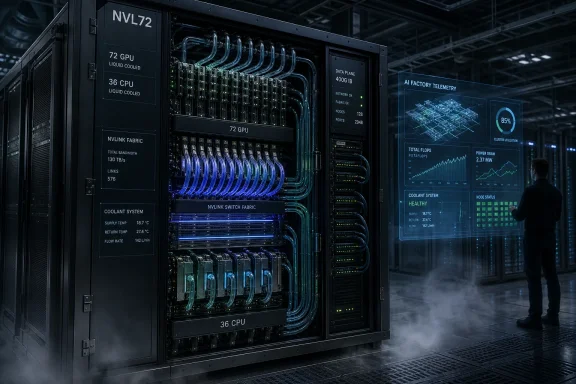
The old GPU launch rhythm was easy to understand. NVIDIA announced a card, OEMs built servers around it, cloud providers carved those servers into instances, and developers eventually got access to the new silicon through familiar abstractions. Vera Rubin NVL72 breaks that mental model because the meaningful unit is not a GPU. It is a 72-GPU, 36-CPU rack-scale machine designed to behave like one giant AI computer.
That is why the CoreWeave and Oracle validation news is more important than the usual “first customer receives hardware” milestone. A rack like this is not simply plugged into an existing server room. It needs liquid cooling, high-density power delivery, fabric validation, fleet telemetry, firmware coordination, and software that can keep a tightly coupled accelerator domain from becoming a very expensive science project.
NVIDIA’s pitch is that Vera Rubin brings together the Vera CPU, Rubin GPU, NVLink 6, ConnectX networking, BlueField DPUs, Spectrum networking, and a broader software stack into a full platform. The company has been saying this for years in different forms, but each generation makes the point harder to ignore. The competitive moat is no longer CUDA alone. It is CUDA plus the rack, the network, the thermals, the storage path, the orchestration layer, and the operational playbook.
That is also why cloud-provider validation has become part of the product launch. NVIDIA can publish performance claims, but customers buying frontier AI capacity want proof that the systems can be installed, managed, debugged, and monetized. The first racks are not just trophies. They are the dress rehearsal for a new class of cloud infrastructure.
Oracle’s early visibility around the platform tells a slightly different story. Oracle Cloud Infrastructure has spent years trying to position itself as a serious AI infrastructure provider despite competing against larger public-cloud incumbents. Showing an early Vera Rubin NVL72 rack is a way of saying that OCI is no longer a secondary venue for accelerated computing. It wants to be part of the first wave.
Both companies are pursuing the same strategic prize. The next generation of AI workloads will not be satisfied by renting a few accelerator instances for bursty training jobs. The frontier market increasingly wants enormous contiguous pools of compute, fast networking, predictable availability, and the ability to train or serve models whose memory and communication demands overwhelm conventional cluster designs.
This is where the term AI factory stops being pure NVIDIA theater and starts describing a real operating model. In a factory, the output is not steel or chips but tokens, embeddings, simulations, and model updates. The raw materials are data, electricity, capital, and cooling water. The bottlenecks are less about whether a single GPU is fast and more about whether an entire facility can run as a coordinated production line.
But the deeper story is the type of workload NVIDIA is optimizing for. The industry’s center of gravity has moved from dense transformer training toward reasoning-heavy, agentic, retrieval-augmented, tool-using systems that keep more state alive for longer. These systems care about raw tensor throughput, but they also punish weak memory bandwidth, slow interconnects, poor scheduling, and inefficient token generation.
That is why NVIDIA’s rack-scale approach matters. If a workload needs to move model state, activations, key-value caches, and intermediate outputs across many accelerators, the fabric becomes part of the compute engine. NVLink, networking, DPUs, and CPU memory are not supporting actors. They are the difference between a theoretical benchmark and a usable production system.
This also explains the prominent role of the Vera CPU. In older GPU-centric narratives, the CPU often appeared as a necessary host for the accelerator. In Vera Rubin, NVIDIA is presenting the CPU as part of a balanced platform, with large memory pools and tight integration intended to feed the GPUs and support increasingly complex inference patterns. The result is a system aimed at the next wave of AI services, not merely the last generation’s training runs.
The racks being shown by CoreWeave and Oracle are physically massive, operationally demanding machines. They require specialized facilities, careful logistics, and coordinated installation. The mere act of moving a rack into place has become part of the public narrative because the physical reality of AI infrastructure has become impossible to hide.
This is a subtle but important change for enterprise IT. When compute was mostly general-purpose, cloud buyers could compare regions, instance families, storage tiers, and network options with some confidence that capacity was fungible. AI infrastructure is different. A customer may care not only whether a provider has “Rubin” available, but whether it has contiguous NVL72 capacity, which networking tier connects it, what storage fabric feeds it, and how mature the provider’s failure-handling systems are.
That makes cloud procurement more like high-performance computing procurement. Buyers will ask about topology, availability windows, supply allocation, reserved capacity, and workload placement. They will also need to understand how much of their AI roadmap depends on one vendor’s hardware cadence and one cloud provider’s operational competence.
The cloud is not going away, but the fantasy of perfectly interchangeable compute is weakening. For advanced AI, the physical plant is back in the conversation.
Microsoft 365 Copilot, Azure AI services, GitHub Copilot, endpoint security tools, observability platforms, IT service-management products, and developer assistants all depend on accelerated cloud infrastructure somewhere upstream. As inference gets cheaper or more capable, vendors will push more AI functionality into routine enterprise workflows. That means Windows environments will become heavier consumers of AI-backed cloud services even when the local estate remains familiar.
The practical effects will be uneven. Some features will improve quietly: faster document summarization, more capable incident triage, better code suggestions, richer security investigation. Other changes will create new governance problems: more data leaving the tenant boundary, more automated actions proposed by opaque systems, more licensing tiers built around AI consumption, and more pressure to accept vendor defaults because they are bundled into existing platforms.
The irony is that the most advanced AI hardware may make itself visible to ordinary IT teams mainly through policy work. Admins will need to decide who can use AI features, what data they can process, how prompts and outputs are logged, how retention policies apply, and whether model-assisted actions need approval. Vera Rubin may live in a hyperscale data center, but its output will show up in Outlook, Teams, PowerShell workflows, SOC consoles, and developer environments.
That is the Windows angle hiding inside a data-center hardware story. The endpoint may still run Windows 11 or Windows Server, but the intelligence increasingly comes from a cloud factory most organizations do not control.
A single NVL72 rack represents a dense concentration of compute and heat. Multiply that by thousands of racks, and the limiting factors quickly become regional power availability, grid interconnection queues, water or liquid-cooling strategy, data-center construction timelines, and the financial appetite to commit billions before customer demand is fully proven. The AI industry talks about model scaling as if it were mostly a technical problem, but infrastructure scaling is now a civic and industrial problem too.
This is where the cloud providers differ from traditional enterprise IT. CoreWeave, Oracle, Microsoft, Google, Amazon, and others can finance huge buildouts because they believe demand for AI compute will remain strong enough to absorb the capacity. Smaller companies cannot play that game directly. They will rent the output and accept the pricing, scarcity, and contractual terms that come with it.
That creates a strange market dynamic. AI developers want rapid access to the newest systems because model economics can change dramatically with each generation. Cloud providers want early hardware because being first lets them attract high-value customers. NVIDIA wants rack-scale adoption because it raises switching costs and expands the addressable sale from chips to systems. Everyone’s incentives point toward faster buildout, even as the physical constraints become harder to ignore.
The result is a race that may reward operational discipline more than press-release bravado. The winners will not simply be the providers that receive the first racks. They will be the ones that can keep large fleets online, utilized, cooled, secured, and profitably allocated.
When a platform includes the accelerator, CPU, interconnect, DPU, switch, storage path, and management assumptions, competition becomes more complicated. A rival chip can be faster in a narrow benchmark and still struggle if customers must rebuild software, networking, scheduling, and operations around it. The problem is not merely porting code. It is recreating the confidence that a cluster can run expensive workloads predictably.
This is why AMD, custom silicon vendors, and cloud-native accelerators face a dual challenge. They must offer compelling performance per dollar or performance per watt, but they must also convince customers that their platforms can scale operationally. For large AI buyers, theoretical openness is attractive only if it does not become a support burden.
NVIDIA’s risk is the opposite. The tighter the platform becomes, the more customers may worry about lock-in, pricing power, and supply dependence. Enterprises already learned this lesson in other forms from databases, virtualization platforms, cloud APIs, and productivity suites. Once an organization builds workflows around a dominant stack, technical superiority and commercial leverage become difficult to separate.
Vera Rubin therefore strengthens NVIDIA’s position while making the stakes of that position more obvious. The company is not just selling speed. It is selling a default architecture for the AI industrial base.
Early racks are usually used to prove system behavior, qualify facilities, integrate management tooling, test firmware and drivers, validate thermals, and prepare operational runbooks. Cloud providers may also use them with selected customers or internal workloads before opening wider access. The phrase “first to validate” sounds like the finish line, but in infrastructure terms it is closer to the end of the first lap.
This distinction matters because AI hardware launches increasingly blur announcement, production, shipment, validation, and commercial availability. A platform can be “in production” while most customers still cannot rent it. A provider can “bring up” a system while capacity remains tiny compared with demand. A benchmark can show impressive gains while real-world economics depend on utilization, queueing, software maturity, and workload fit.
Enterprise buyers should therefore treat this moment as a signal, not a procurement guarantee. Vera Rubin is real enough to be in early cloud-provider hands, but the practical question is when customers can get stable access, under what terms, in which regions, and with what support. That timeline will vary by provider and by customer importance.
In AI infrastructure, being early often means being selective. The first capacity goes to strategic partners, model labs, large committed spenders, and customers whose workloads help validate the platform. Everyone else watches the marketing and waits for the instance catalog to catch up.
If Vera Rubin delivers meaningfully lower cost per token and higher throughput per watt, it could make more ambitious AI services economically viable. A model that is impressive but too costly to run becomes a demo. A model that can be served profitably becomes a product. The entire AI software market is waiting for that conversion to become easier.
But agentic AI is not guaranteed to justify every infrastructure bet. Enterprises remain cautious about reliability, auditability, security, and legal exposure. A more capable agent can also make a more consequential mistake. Lower inference cost helps, but it does not solve governance, trust, or integration.
This is where Windows and enterprise administrators will become an important reality check. It is one thing for a vendor to show an AI agent navigating a polished workflow. It is another for that agent to operate inside a messy enterprise full of legacy file shares, conditional access policies, custom line-of-business applications, brittle scripts, privileged accounts, and compliance obligations. The hardware can make agentic systems faster and cheaper. It cannot make them automatically safe.
The next phase of AI adoption will be decided by that gap between capability and trust. Vera Rubin improves the supply side of intelligence. Customers still have to decide where intelligence belongs.
CoreWeave wants to prove that specialization beats hyperscale generalism. Oracle wants to prove that it can compete at the frontier despite not being one of the traditional cloud leaders. Microsoft, Amazon, and Google have their own enormous AI infrastructure strategies, including both NVIDIA systems and in-house silicon. The result is not a simple NVIDIA-versus-everyone story. It is a scramble among cloud providers to control the scarce layer between model ambition and physical compute.
For customers, that may create opportunity and risk at the same time. More providers chasing AI workloads could mean more capacity, more architectural options, and better commercial leverage. But the newest systems may still be concentrated among a small number of vendors, with long commitments and opaque pricing. Scarcity gives cloud providers power.
It also changes how enterprises think about portability. Moving a web application between clouds is difficult but familiar. Moving a frontier AI training pipeline optimized around a particular rack-scale topology is much harder. The more the workload depends on specific interconnect behavior, memory hierarchy, and scheduling assumptions, the less portable it becomes in practice.
This is why the first Vera Rubin racks are not just hardware news. They are early markers in a cloud power struggle that will shape AI pricing, availability, and lock-in for years.
 NVIDIA Is Selling the Rack, Not the Chip
The old GPU launch rhythm was easy to understand. NVIDIA announced a card, OEMs built servers around it, cloud providers carved those servers into instances, and developers eventually got access to the new silicon through familiar abstractions. Vera Rubin NVL72 breaks that mental model because the meaningful unit is not a GPU. It is a 72-GPU, 36-CPU rack-scale machine designed to behave like one giant AI computer.That is why the CoreWeave and Oracle validation news is more important than the usual “first customer receives hardware” milestone. A rack like this is not simply plugged into an existing server room. It needs liquid cooling, high-density power delivery, fabric validation, fleet telemetry, firmware coordination, and software that can keep a tightly coupled accelerator domain from becoming a very expensive science project.
NVIDIA’s pitch is that Vera Rubin brings together the Vera CPU, Rubin GPU, NVLink 6, ConnectX networking, BlueField DPUs, Spectrum networking, and a broader software stack into a full platform. The company has been saying this for years in different forms, but each generation makes the point harder to ignore. The competitive moat is no longer CUDA alone. It is CUDA plus the rack, the network, the thermals, the storage path, the orchestration layer, and the operational playbook.
That is also why cloud-provider validation has become part of the product launch. NVIDIA can publish performance claims, but customers buying frontier AI capacity want proof that the systems can be installed, managed, debugged, and monetized. The first racks are not just trophies. They are the dress rehearsal for a new class of cloud infrastructure.
CoreWeave and Oracle Are Auditioning for the AI Factory Era
CoreWeave’s claim to have brought up and validated Vera Rubin NVL72 first fits neatly into its broader identity: a cloud provider built around NVIDIA infrastructure rather than a general-purpose hyperscaler that happens to offer GPUs. The company’s public messaging around the platform emphasized not only the hardware, but its own operational machinery, including rack control and software-defined liquid cooling. That is not incidental branding. It is the argument CoreWeave needs to make to enterprise buyers: the differentiator is not access to GPUs, but the ability to keep racks of them productive.Oracle’s early visibility around the platform tells a slightly different story. Oracle Cloud Infrastructure has spent years trying to position itself as a serious AI infrastructure provider despite competing against larger public-cloud incumbents. Showing an early Vera Rubin NVL72 rack is a way of saying that OCI is no longer a secondary venue for accelerated computing. It wants to be part of the first wave.
Both companies are pursuing the same strategic prize. The next generation of AI workloads will not be satisfied by renting a few accelerator instances for bursty training jobs. The frontier market increasingly wants enormous contiguous pools of compute, fast networking, predictable availability, and the ability to train or serve models whose memory and communication demands overwhelm conventional cluster designs.
This is where the term AI factory stops being pure NVIDIA theater and starts describing a real operating model. In a factory, the output is not steel or chips but tokens, embeddings, simulations, and model updates. The raw materials are data, electricity, capital, and cooling water. The bottlenecks are less about whether a single GPU is fast and more about whether an entire facility can run as a coordinated production line.
The Performance Claims Are Huge, but the Architecture Is the Real Bet
NVIDIA says Vera Rubin NVL72 integrates 72 Rubin GPUs and 36 Vera CPUs into a unified rack-scale system. The company has also claimed dramatic gains over Blackwell, including training large mixture-of-experts models with far fewer GPUs and cutting inference cost per token substantially. Those numbers will draw the eye, as they are meant to.But the deeper story is the type of workload NVIDIA is optimizing for. The industry’s center of gravity has moved from dense transformer training toward reasoning-heavy, agentic, retrieval-augmented, tool-using systems that keep more state alive for longer. These systems care about raw tensor throughput, but they also punish weak memory bandwidth, slow interconnects, poor scheduling, and inefficient token generation.
That is why NVIDIA’s rack-scale approach matters. If a workload needs to move model state, activations, key-value caches, and intermediate outputs across many accelerators, the fabric becomes part of the compute engine. NVLink, networking, DPUs, and CPU memory are not supporting actors. They are the difference between a theoretical benchmark and a usable production system.
This also explains the prominent role of the Vera CPU. In older GPU-centric narratives, the CPU often appeared as a necessary host for the accelerator. In Vera Rubin, NVIDIA is presenting the CPU as part of a balanced platform, with large memory pools and tight integration intended to feed the GPUs and support increasingly complex inference patterns. The result is a system aimed at the next wave of AI services, not merely the last generation’s training runs.
The Cloud Is Becoming Less Abstract
For years, cloud computing sold customers a comforting abstraction: you did not need to care where the servers were, what they looked like, or how they were cooled. You clicked a button, provisioned capacity, and treated infrastructure as an API. Vera Rubin makes that abstraction harder to sustain.The racks being shown by CoreWeave and Oracle are physically massive, operationally demanding machines. They require specialized facilities, careful logistics, and coordinated installation. The mere act of moving a rack into place has become part of the public narrative because the physical reality of AI infrastructure has become impossible to hide.
This is a subtle but important change for enterprise IT. When compute was mostly general-purpose, cloud buyers could compare regions, instance families, storage tiers, and network options with some confidence that capacity was fungible. AI infrastructure is different. A customer may care not only whether a provider has “Rubin” available, but whether it has contiguous NVL72 capacity, which networking tier connects it, what storage fabric feeds it, and how mature the provider’s failure-handling systems are.
That makes cloud procurement more like high-performance computing procurement. Buyers will ask about topology, availability windows, supply allocation, reserved capacity, and workload placement. They will also need to understand how much of their AI roadmap depends on one vendor’s hardware cadence and one cloud provider’s operational competence.
The cloud is not going away, but the fantasy of perfectly interchangeable compute is weakening. For advanced AI, the physical plant is back in the conversation.
Windows Shops Will Feel This Through the Services They Buy
Most Windows administrators will never touch a Vera Rubin rack. They may never log into a system with direct Rubin access, and they certainly will not be installing one beside a row of Hyper-V hosts. But the consequences will still arrive through the software stack they manage every day.Microsoft 365 Copilot, Azure AI services, GitHub Copilot, endpoint security tools, observability platforms, IT service-management products, and developer assistants all depend on accelerated cloud infrastructure somewhere upstream. As inference gets cheaper or more capable, vendors will push more AI functionality into routine enterprise workflows. That means Windows environments will become heavier consumers of AI-backed cloud services even when the local estate remains familiar.
The practical effects will be uneven. Some features will improve quietly: faster document summarization, more capable incident triage, better code suggestions, richer security investigation. Other changes will create new governance problems: more data leaving the tenant boundary, more automated actions proposed by opaque systems, more licensing tiers built around AI consumption, and more pressure to accept vendor defaults because they are bundled into existing platforms.
The irony is that the most advanced AI hardware may make itself visible to ordinary IT teams mainly through policy work. Admins will need to decide who can use AI features, what data they can process, how prompts and outputs are logged, how retention policies apply, and whether model-assisted actions need approval. Vera Rubin may live in a hyperscale data center, but its output will show up in Outlook, Teams, PowerShell workflows, SOC consoles, and developer environments.
That is the Windows angle hiding inside a data-center hardware story. The endpoint may still run Windows 11 or Windows Server, but the intelligence increasingly comes from a cloud factory most organizations do not control.
The Bottleneck Moves From Silicon to Power, Cooling, and Capital
The most important constraint on Vera Rubin adoption may not be whether NVIDIA can design faster chips. It may be whether the rest of the world can supply the power, cooling, financing, land, transformers, networking gear, and operational expertise required to deploy them.A single NVL72 rack represents a dense concentration of compute and heat. Multiply that by thousands of racks, and the limiting factors quickly become regional power availability, grid interconnection queues, water or liquid-cooling strategy, data-center construction timelines, and the financial appetite to commit billions before customer demand is fully proven. The AI industry talks about model scaling as if it were mostly a technical problem, but infrastructure scaling is now a civic and industrial problem too.
This is where the cloud providers differ from traditional enterprise IT. CoreWeave, Oracle, Microsoft, Google, Amazon, and others can finance huge buildouts because they believe demand for AI compute will remain strong enough to absorb the capacity. Smaller companies cannot play that game directly. They will rent the output and accept the pricing, scarcity, and contractual terms that come with it.
That creates a strange market dynamic. AI developers want rapid access to the newest systems because model economics can change dramatically with each generation. Cloud providers want early hardware because being first lets them attract high-value customers. NVIDIA wants rack-scale adoption because it raises switching costs and expands the addressable sale from chips to systems. Everyone’s incentives point toward faster buildout, even as the physical constraints become harder to ignore.
The result is a race that may reward operational discipline more than press-release bravado. The winners will not simply be the providers that receive the first racks. They will be the ones that can keep large fleets online, utilized, cooled, secured, and profitably allocated.
CUDA’s Moat Is Now Surrounded by Plumbing
It is fashionable to describe NVIDIA’s advantage as a software ecosystem, and that remains true. CUDA, libraries, frameworks, developer familiarity, and years of optimization give NVIDIA a lead that rivals continue to chip away at but have not erased. Vera Rubin, however, shows how that moat has expanded into the physical layer.When a platform includes the accelerator, CPU, interconnect, DPU, switch, storage path, and management assumptions, competition becomes more complicated. A rival chip can be faster in a narrow benchmark and still struggle if customers must rebuild software, networking, scheduling, and operations around it. The problem is not merely porting code. It is recreating the confidence that a cluster can run expensive workloads predictably.
This is why AMD, custom silicon vendors, and cloud-native accelerators face a dual challenge. They must offer compelling performance per dollar or performance per watt, but they must also convince customers that their platforms can scale operationally. For large AI buyers, theoretical openness is attractive only if it does not become a support burden.
NVIDIA’s risk is the opposite. The tighter the platform becomes, the more customers may worry about lock-in, pricing power, and supply dependence. Enterprises already learned this lesson in other forms from databases, virtualization platforms, cloud APIs, and productivity suites. Once an organization builds workflows around a dominant stack, technical superiority and commercial leverage become difficult to separate.
Vera Rubin therefore strengthens NVIDIA’s position while making the stakes of that position more obvious. The company is not just selling speed. It is selling a default architecture for the AI industrial base.
Validation Is Not Availability
There is a temptation to read the CoreWeave and Oracle news as meaning Vera Rubin capacity is broadly available. That would be premature. Validation is an essential milestone, but it is not the same as general customer access, mature regional availability, or predictable pricing.Early racks are usually used to prove system behavior, qualify facilities, integrate management tooling, test firmware and drivers, validate thermals, and prepare operational runbooks. Cloud providers may also use them with selected customers or internal workloads before opening wider access. The phrase “first to validate” sounds like the finish line, but in infrastructure terms it is closer to the end of the first lap.
This distinction matters because AI hardware launches increasingly blur announcement, production, shipment, validation, and commercial availability. A platform can be “in production” while most customers still cannot rent it. A provider can “bring up” a system while capacity remains tiny compared with demand. A benchmark can show impressive gains while real-world economics depend on utilization, queueing, software maturity, and workload fit.
Enterprise buyers should therefore treat this moment as a signal, not a procurement guarantee. Vera Rubin is real enough to be in early cloud-provider hands, but the practical question is when customers can get stable access, under what terms, in which regions, and with what support. That timeline will vary by provider and by customer importance.
In AI infrastructure, being early often means being selective. The first capacity goes to strategic partners, model labs, large committed spenders, and customers whose workloads help validate the platform. Everyone else watches the marketing and waits for the instance catalog to catch up.
Agentic AI Is the Justification, but Economics Will Decide
NVIDIA and its partners are framing Vera Rubin around agentic AI: systems that reason, call tools, maintain context, coordinate steps, and operate with more autonomy than a conventional chatbot. The hardware case is straightforward. Agentic workloads can require long context windows, repeated inference passes, retrieval, planning, code execution, and multimodal processing. That makes token generation and memory movement enormously expensive at scale.If Vera Rubin delivers meaningfully lower cost per token and higher throughput per watt, it could make more ambitious AI services economically viable. A model that is impressive but too costly to run becomes a demo. A model that can be served profitably becomes a product. The entire AI software market is waiting for that conversion to become easier.
But agentic AI is not guaranteed to justify every infrastructure bet. Enterprises remain cautious about reliability, auditability, security, and legal exposure. A more capable agent can also make a more consequential mistake. Lower inference cost helps, but it does not solve governance, trust, or integration.
This is where Windows and enterprise administrators will become an important reality check. It is one thing for a vendor to show an AI agent navigating a polished workflow. It is another for that agent to operate inside a messy enterprise full of legacy file shares, conditional access policies, custom line-of-business applications, brittle scripts, privileged accounts, and compliance obligations. The hardware can make agentic systems faster and cheaper. It cannot make them automatically safe.
The next phase of AI adoption will be decided by that gap between capability and trust. Vera Rubin improves the supply side of intelligence. Customers still have to decide where intelligence belongs.
The First Racks Reveal the Shape of the Next Cloud War
The cloud market used to be fought on breadth: compute, storage, databases, developer tools, identity, analytics, and global regions. AI has added a new axis of competition: who can secure the newest accelerator platforms and turn them into reliable capacity quickly. That is why a rack validation milestone now carries strategic weight.CoreWeave wants to prove that specialization beats hyperscale generalism. Oracle wants to prove that it can compete at the frontier despite not being one of the traditional cloud leaders. Microsoft, Amazon, and Google have their own enormous AI infrastructure strategies, including both NVIDIA systems and in-house silicon. The result is not a simple NVIDIA-versus-everyone story. It is a scramble among cloud providers to control the scarce layer between model ambition and physical compute.
For customers, that may create opportunity and risk at the same time. More providers chasing AI workloads could mean more capacity, more architectural options, and better commercial leverage. But the newest systems may still be concentrated among a small number of vendors, with long commitments and opaque pricing. Scarcity gives cloud providers power.
It also changes how enterprises think about portability. Moving a web application between clouds is difficult but familiar. Moving a frontier AI training pipeline optimized around a particular rack-scale topology is much harder. The more the workload depends on specific interconnect behavior, memory hierarchy, and scheduling assumptions, the less portable it becomes in practice.
This is why the first Vera Rubin racks are not just hardware news. They are early markers in a cloud power struggle that will shape AI pricing, availability, and lock-in for years.
The Rack Arrival That Matters More Than the Press Release
The lesson from Vera Rubin’s early cloud validation is not that every organization should rush to the newest NVIDIA platform. It is that AI infrastructure is becoming more vertically integrated, more physically constrained, and more strategically concentrated. The flashy performance claims matter, but the operational consequences matter more.- CoreWeave and Oracle showing Vera Rubin NVL72 systems signals that NVIDIA’s next-generation AI platform has moved into real cloud-provider validation, not merely slideware.
- The meaningful product is the rack-scale system, including CPUs, GPUs, interconnects, DPUs, networking, cooling, and management software.
- Broad customer access will depend on provider rollout schedules, regional capacity, pricing, and validation maturity rather than on NVIDIA’s production claims alone.
- Windows and enterprise IT teams will mostly experience Vera Rubin indirectly through AI-powered cloud services, Copilots, developer tools, security platforms, and automation features.
- The biggest constraints on the next AI buildout may be power, cooling, capital, and operational skill rather than accelerator performance alone.
- The more AI workloads depend on rack-scale topology and NVIDIA’s full stack, the more enterprises will need to weigh performance gains against portability and lock-in.
References
- Primary source: Wccftech
Published: Wed, 17 Jun 2026 23:00:00 GMT
The World's Top Cloud Providers Are Now Getting NVIDIA's Vera Rubin NVL72, The World's Fastest AI Platform
The era of Vera Rubin is upon us, as not only NVIDIA's but the world's fastest AI platform is now being delivered to top cloud providers.wccftech.com
- Related coverage: nvidia.com
NVIDIA Vera Rubin NVL72
NVIDIA Vera Rubin NVL72 is a rack-scale AI supercomputer unifying 72 Rubin GPUs and 36 Vera CPUs to power agentic reasoning AI and the AI industrial revolution.www.nvidia.com - Related coverage: nasdaq.com
CoreWeave Completes Industry-First Bring-Up and Validation of NVIDIA Vera Rubin NVL72 | Nasdaq
Leveraging its purpose-built software and engineering solutions, CoreWeave is the first AI cloud provider to bring up Vera Rubin, extending the CoreWeave platform’ s support for NVIDIA hardware. With Vera Rubin, CoreWeave will deliver better results for customers. "Their ability to deliver...www.nasdaq.com - Related coverage: investor.nvidia.com
NVIDIA Corporation - NVIDIA Vera Rubin Opens Agentic AI Frontier
Seven New Chips in Full Production to Scale the World’s Largest AI Factories With Configurable AI Infrastructure Optimized for Every Phase of AI, From Pretraining, Post-Training and Test-Time Scaling to Agentic Inference News Summary: The NVIDIA Vera Rubin platform is opening the next AI...investor.nvidia.com - Related coverage: nvidianews.nvidia.com
NVIDIA Vera Rubin Opens Agentic AI Frontier | NVIDIA Newsroom
NVIDIA today announced the NVIDIA Vera Rubin platform is opening the next frontier of agentic AI, with seven new chips now in full production to scale the world’s largest AI factories.nvidianews.nvidia.com - Related coverage: insidermonkey.com
CoreWeave (CRWV) Deploys NVIDIA (NVDA) Vera Rubin NVL72, First to Validate at Rack Scale - Insider Monkey
CoreWeave Inc. (NASDAQ:CRWV) is one of the best young stocks with the highest upside potential. www.insidermonkey.com
- Related coverage: harianbasis.co
CoreWeave Validates First Nvidia Vera Rubin AI Server Rack
CoreWeave successfully deploys and validates the first Nvidia Vera Rubin NVL72 server rack to expand its artificial intelligence cloud infrastructure.www.harianbasis.co - Related coverage: tomshardware.com
Nvidia CEO confirms Vera Rubin NVL72 is now in production — Jensen Huang uses CES keynote to announce the milestone | Tom's Hardware
Blackwell's successor is expected to arrive in the second half of 2026www.tomshardware.com - Related coverage: techradar.com
Nvidia’s Rubin-powered DGX SuperPOD challenges Huawei’s AI dominance with fewer GPUs while delivering unmatched Exaflops performance at industrial scale | TechRadar
DGX racks integrate 600TB fast memory and NVMe storage per systemwww.techradar.com - Related coverage: s22.q4cdn.com
- Related coverage: gigabyte.com
