

OpenAI engineers reportedly told colleagues in June 2026 that they had found a software-based optimization capable of cutting the inference cost of some existing models by more than half, according to reporting first surfaced by The Information and amplified by DigiTimes on July 1. The claim is narrow, unconfirmed in public technical detail, and potentially enormous. If it holds up at production scale, the story is not simply that ChatGPT gets cheaper to run. It is that the economics of AI may be shifting from “who can buy the most GPUs” to “who can keep those GPUs busiest.”
For most of the generative AI boom, the public has been trained to think of cost in terms of spectacular training runs: giant clusters, weeks of computation, eye-watering electricity bills, and frontier models that require industrial-scale capital just to be born. That picture is not wrong, but it is increasingly incomplete. Once a model is trained, the meter starts running every time a user asks it to summarize a document, write code, generate an image prompt, or operate as an agent across a workflow.
That second phase is inference, and it is where AI companies now live or die at consumer scale. Training is a capital event; inference is a utility bill. The more successful ChatGPT, Copilot, Claude, Gemini, and enterprise AI agents become, the more every marginal interaction turns into a cost-management problem.
That is why a reported 50 percent reduction matters even before OpenAI explains how it works. A halving of inference cost is not a tidy engineering improvement tucked away in a release note. It potentially changes pricing, usage caps, product strategy, GPU procurement, and the competitive posture of every company trying to turn AI from an expensive demo into a durable business.
The reported detail that makes this especially interesting is that the improvement is said to come from better use of existing servers rather than a new chip. That distinction matters. New silicon is slow, capital-intensive, and constrained by supply chains; software optimizations can sometimes spread faster, especially inside a company that controls the model, runtime, serving stack, and product demand curve.
But a software optimization is a different kind of weapon. Hardware shifts the cost curve only after procurement, fabrication, deployment, and software integration. A scheduling, batching, caching, routing, quantization, memory-management, or utilization breakthrough can bite into the cost base on hardware that is already installed.
The public reporting does not disclose the technique, so the honest answer is that we do not yet know whether this is a general breakthrough or a targeted win. “Inference costs” can mean several things: the number of GPUs required to serve a tier, the cost per token for a particular model, the marginal cost of a class of queries, or the blended operational expense of a product surface. A company can truthfully describe a dramatic reduction in one slice of the workload without transforming the entire business overnight.
Still, the reported example involving ChatGPT’s logged-out tier is revealing. Logged-out users are not the highest-paying customers; they are the wide mouth of the funnel. If OpenAI found a way to serve that traffic with far fewer GPUs at some point, the company did not merely save money. It created room to keep the free product generous, capture casual users, and preserve the habit-forming role of ChatGPT without lighting as much cash on fire.
That matters because consumer AI is not a normal SaaS business. Each additional user is not just another account row in a database. Each additional prompt may invoke expensive accelerators, memory bandwidth, networking, safety systems, tool calls, and sometimes multi-step reasoning. A cheaper logged-out tier is therefore not charity; it is customer acquisition with better unit economics.
A GPU cluster serving interactive chat cannot behave like a batch-render farm. Users expect low latency, models generate tokens sequentially, context windows vary wildly, and some requests require short answers while others demand long chains of reasoning. The hard problem is not only acquiring accelerators; it is filling them efficiently without making users wait.
That is why “better utilization” is such a powerful phrase. If OpenAI can pack more inference work onto the same fleet, the company effectively manufactures capacity from software. It can absorb demand that would otherwise require new servers, or it can redirect the freed capacity toward more expensive products such as coding agents, research tools, voice, image generation, or enterprise features.
This is also where the story intersects with Windows users and IT departments more directly than it may first appear. Copilot experiences across Windows, Microsoft 365, GitHub, Azure, and enterprise workflows all depend on inference economics somewhere in the chain. Even when Microsoft, not OpenAI, is the visible vendor, the cost of model serving influences what features can be offered broadly, which ones remain premium, and how aggressively AI assistance gets embedded into everyday software.
If inference stays expensive, AI features become rationed. If inference gets cheaper, they become ambient. That is the strategic difference between “click this button to use AI” and “AI is quietly woven into every document, terminal, meeting, ticket, and search box.”
But the more likely first effect is expansion. When the cost of an AI action falls, product teams do not simply keep the same product and pocket the difference. They add more AI actions.
That has been the story of computing for decades. Cheaper CPU cycles enabled richer interfaces. Cheaper storage enabled photo libraries, logs, telemetry, and backups at scale. Cheaper bandwidth enabled streaming and cloud sync. Cheaper inference will enable agents that retry, verify, search, simulate, summarize, critique, and keep working after the first answer.
This is particularly important for reasoning models and coding agents. The industry’s recent gains have not come only from larger models; they have also come from spending more compute at answer time. A model that thinks longer, samples alternatives, checks its own work, or calls tools repeatedly may deliver better results, but it also burns more inference budget.
Halving the cost of a simple response is useful. Halving the cost of a multi-step agent is more disruptive. It means the same subscription fee can buy more background work, more attempts, more validation, and more autonomy before the vendor hits the margin wall.
That is also where administrators should be cautious. Cheaper inference can mean more pervasive AI logging, more automated data movement, and more background processing of corporate content. The budget case may improve before the governance case does.
Microsoft has spent the last few years trying to convince organizations that AI belongs inside Office documents, Teams meetings, Windows surfaces, security consoles, developer tools, and cloud management workflows. That ambition is expensive. Every “summarize this meeting,” “draft this proposal,” “explain this PowerShell error,” or “review this pull request” becomes an inference event, and enterprise software is full of repetitive, low-margin moments where cost matters.
A significant cost reduction gives Microsoft and OpenAI more room to maneuver. They can increase limits without announcing a price cut, move features from premium tiers into broader plans, improve latency by using stronger models more often, or defend margins while competitors race downward on price.
But this leverage cuts both ways. Once customers believe inference costs are falling quickly, they will push back against static AI add-on pricing. CIOs who were told that AI seats are expensive because model serving is expensive will eventually ask why those seats remain expensive after the underlying serving costs improve.
That conversation will not happen overnight. Enterprise pricing trails engineering reality because contracts, support, compliance, and product packaging all add friction. But the direction is clear: the more AI vendors brag about cost breakthroughs, the harder it becomes to justify treating every AI feature as a scarce luxury.
This is the Jevons paradox version of AI infrastructure. Make inference cheaper, and people will use more inference. Make agents cheaper, and software will ask models to do more steps. Make coding assistance cheaper, and developers will run it continuously rather than selectively.
Nvidia’s risk is not that demand disappears. The risk is that the value shifts upward in the stack. If the most important gains come from model-serving software, kernel-level optimization, memory management, routing, and workload orchestration, then owning the accelerator is only part of the story. The winners are the companies that can co-design models, runtime, hardware, and product demand.
That is why OpenAI’s reported software win and its custom-chip ambitions are not separate stories. They are two halves of the same strategy. One extracts more from the current fleet; the other tries to shape the next fleet around the company’s own workloads.
Nvidia remains deeply entrenched because its hardware, software ecosystem, developer support, and availability make it the default platform for serious AI work. But defaults can erode at the margins. The more OpenAI understands its own serving patterns, the more it can decide which parts of the stack should be bought, rented, optimized, or replaced.
There are many plausible mechanisms, and they have different implications. Better batching can improve throughput but may affect latency if handled poorly. Quantization can reduce memory and compute needs but may introduce quality trade-offs. Speculative decoding can accelerate generation but depends on model behavior and workload shape. Smarter routing can send easier queries to cheaper models, but users may notice when routing misfires.
Caching can be extremely powerful for repeated or common queries, especially in consumer products, but it is less transformative for bespoke enterprise prompts. Memory and KV-cache optimizations can matter enormously for long-context workloads, but their benefits vary by model architecture and serving pattern. Even a breakthrough scheduler can be spectacular in one tier and less impressive elsewhere.
That uncertainty does not make the report unimportant. It makes it more important to parse carefully. The phrase “more than half” may describe a measured internal result, not a universal law of AI economics.
The market, however, rarely waits for perfect technical disclosure. Competitors will assume there is something worth chasing. Investors will ask whether other labs can replicate it. Enterprise buyers will ask vendors when savings show up in pricing. And infrastructure teams will ask whether their own inference clusters are leaving similar efficiency gains on the table.
A real step-change in inference efficiency complicates that planning. If API prices fall, applications that looked marginal can become viable. If limits rise, developers can use stronger prompts, longer context, or more verification. If prices do not fall but model quality improves within the same price envelope, the calculus changes in a different way.
The practical lesson is that developers should avoid hard-coding today’s economics into tomorrow’s architecture. Systems that can route between models, measure token usage, cache safely, degrade gracefully, and compare vendors will benefit most from a moving cost curve. Systems that assume one model, one price, and one latency profile will age badly.
This is especially relevant for Windows and enterprise developers integrating AI into internal tools. A helpdesk bot, code review assistant, document classifier, or PowerShell remediation agent may be cheap in a pilot and expensive in production. Conversely, a workload that seemed too costly in 2025 may become ordinary in 2026 if inference efficiency keeps improving.
The mistake would be to treat vendor price cards as destiny. The underlying cost structure is still in motion. Good architecture should assume that models will get cheaper, stronger, more specialized, and more aggressively bundled — but not always in ways that reduce your total bill if usage expands faster than unit prices fall.
When AI was expensive, scarcity imposed discipline. Teams had to choose where to use it, which workflows justified it, and which users received access. If inference costs fall sharply, that brake weakens. Product managers will add AI to workflows where it was previously too costly, and employees will expect assistance everywhere.
The enterprise problem is that governance does not automatically scale with affordability. More AI summaries mean more corporate content processed by models. More agents mean more delegated authority. More retries and background tasks mean more logs, intermediate outputs, and tool interactions to audit.
This does not argue against cheaper inference. It argues against confusing lower cost with lower risk. IT leaders should treat efficiency gains as a reason to accelerate controls, not postpone them.
For Windows-heavy organizations, that means paying close attention to identity, data boundaries, endpoint telemetry, tenant configuration, retention settings, plug-in permissions, and whether AI features operate inside the same compliance envelope as the rest of the Microsoft stack. The cost curve may be falling, but the accountability curve is not.
If OpenAI can serve that tier more cheaply, it can keep the front door open wider. That matters in a market where consumer attention feeds developer mindshare, enterprise familiarity, and cultural default. The AI assistant people casually use at home often becomes the tool they ask for at work.
This is the same platform dynamic that shaped browsers, search engines, email, maps, and cloud storage. The free product is not merely a sample; it is the battlefield for default behavior. In AI, however, the free product carries a heavier marginal cost than a search box or a static web app.
That is why infrastructure optimization becomes product strategy. A more efficient serving stack lets OpenAI tolerate more casual usage, more experimentation, and more global demand without immediately forcing users into paid tiers. It can also make the product feel faster and more available, which may matter as much as raw model quality for everyday adoption.
Competitors will not ignore this. If OpenAI can lower the cost of broad access, Anthropic, Google, Meta, xAI, Mistral, and others will face pressure to match either on price, availability, or perceived intelligence. The consumer may see “more free AI.” The industry will see a margin fight.
Loops are expensive. An agent may plan, call a tool, inspect output, revise the plan, call another tool, write a draft, critique the draft, run a check, and then ask for approval. Each step adds tokens, latency, and failure points. The result may be valuable, but the economics can deteriorate quickly.
A 50 percent inference-cost reduction therefore lands directly in the path of agent adoption. It lowers the cost of iteration, and iteration is the essence of agentic work. The better agents become, the more they will spend compute not on final prose, but on invisible intermediate reasoning and verification.
That is why the phrase “cost cut” undersells the strategic impact. The question is not only whether OpenAI can serve today’s ChatGPT traffic more cheaply. The question is whether it can afford the next product category: assistants that do not wait for a single prompt, but carry work across time.
Microsoft’s ambitions for Copilot fit that pattern. So do GitHub’s coding agents, security copilots, and AI-enhanced admin tools. The bottleneck for these products is not just model intelligence; it is whether the vendor can afford to run enough intelligence often enough to be useful.
That is a subtle but important shift. A company can have an impressive model and still lose if it serves that model inefficiently. Another company can have a slightly weaker model and win certain workloads through lower latency, lower cost, better routing, and tighter integration.
This is familiar territory for enterprise IT. The best database is not always the one with the flashiest benchmark; it is the one that performs predictably under real workloads, fits the budget, integrates with the stack, and can be operated safely. AI models are moving toward the same reality.
OpenAI has an advantage because it sees enormous production traffic across consumer, developer, and enterprise surfaces. That traffic is not just revenue; it is instrumentation. It tells engineers where latency hurts, where tokens are wasted, where prompts repeat, where small models suffice, and where expensive reasoning is actually worth it.
That feedback loop is difficult for smaller competitors to replicate. But it is also not magic. Cloud providers, model labs, and large enterprises running internal AI platforms will all chase the same class of gains. Inference optimization is becoming table stakes.
Some savings may be reinvested into better models. Some may fund free-tier expansion. Some may defend margins. Some may appear as higher rate limits, lower latency, or more generous context windows rather than lower sticker prices. Some may be reserved for enterprise deals where procurement teams have the leverage to demand it.
Developers may see lower effective costs before they see lower official prices. A model might answer faster, require fewer retries, or perform better at a cheaper tier. Enterprise customers may see more AI features included in existing plans, while standalone API customers continue to pay according to published token rates.
This is why buyers should measure outcomes rather than headlines. If a vendor claims inference efficiency has improved, ask where that improvement appears: price, throughput, latency, availability, model quality, or usage limits. Those are not interchangeable.
For organizations negotiating AI contracts, the reported OpenAI development is a useful data point. It strengthens the argument that AI pricing should include flexibility, benchmarking, and periodic review. A three-year commitment based on today’s cost assumptions may look stale quickly.
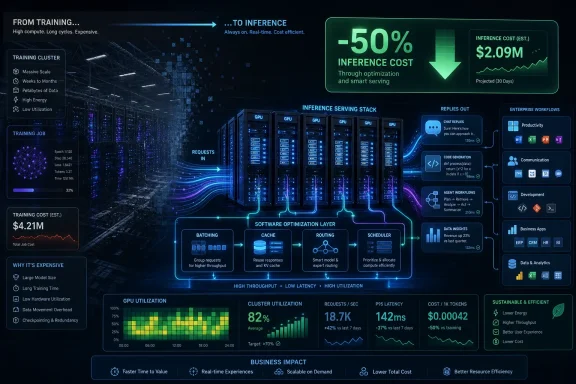 The Real AI Arms Race Has Moved From Training Runs to Every Reply
For most of the generative AI boom, the public has been trained to think of cost in terms of spectacular training runs: giant clusters, weeks of computation, eye-watering electricity bills, and frontier models that require industrial-scale capital just to be born. That picture is not wrong, but it is increasingly incomplete. Once a model is trained, the meter starts running every time a user asks it to summarize a document, write code, generate an image prompt, or operate as an agent across a workflow.That second phase is inference, and it is where AI companies now live or die at consumer scale. Training is a capital event; inference is a utility bill. The more successful ChatGPT, Copilot, Claude, Gemini, and enterprise AI agents become, the more every marginal interaction turns into a cost-management problem.
That is why a reported 50 percent reduction matters even before OpenAI explains how it works. A halving of inference cost is not a tidy engineering improvement tucked away in a release note. It potentially changes pricing, usage caps, product strategy, GPU procurement, and the competitive posture of every company trying to turn AI from an expensive demo into a durable business.
The reported detail that makes this especially interesting is that the improvement is said to come from better use of existing servers rather than a new chip. That distinction matters. New silicon is slow, capital-intensive, and constrained by supply chains; software optimizations can sometimes spread faster, especially inside a company that controls the model, runtime, serving stack, and product demand curve.
A Cost Cut Without a Chip Is the Most Dangerous Kind for Rivals
OpenAI has already been moving toward custom hardware. Its recently reported work with Broadcom on an inference-focused processor fits the broader industry pattern: if Nvidia GPUs are the toll road, the largest AI labs want private lanes. Microsoft has pursued its own AI silicon, Google has long had TPUs, Amazon has Trainium and Inferentia, and Meta has been building internal accelerators for recommendation and AI workloads.But a software optimization is a different kind of weapon. Hardware shifts the cost curve only after procurement, fabrication, deployment, and software integration. A scheduling, batching, caching, routing, quantization, memory-management, or utilization breakthrough can bite into the cost base on hardware that is already installed.
The public reporting does not disclose the technique, so the honest answer is that we do not yet know whether this is a general breakthrough or a targeted win. “Inference costs” can mean several things: the number of GPUs required to serve a tier, the cost per token for a particular model, the marginal cost of a class of queries, or the blended operational expense of a product surface. A company can truthfully describe a dramatic reduction in one slice of the workload without transforming the entire business overnight.
Still, the reported example involving ChatGPT’s logged-out tier is revealing. Logged-out users are not the highest-paying customers; they are the wide mouth of the funnel. If OpenAI found a way to serve that traffic with far fewer GPUs at some point, the company did not merely save money. It created room to keep the free product generous, capture casual users, and preserve the habit-forming role of ChatGPT without lighting as much cash on fire.
That matters because consumer AI is not a normal SaaS business. Each additional user is not just another account row in a database. Each additional prompt may invoke expensive accelerators, memory bandwidth, networking, safety systems, tool calls, and sometimes multi-step reasoning. A cheaper logged-out tier is therefore not charity; it is customer acquisition with better unit economics.
The Bottleneck Was Never Just the Number of GPUs
The first-order reading of AI infrastructure is simple: more GPUs equals more capacity. The second-order reality is messier. Accelerators are only valuable when they are doing useful work, and inference workloads can be spiky, memory-bound, latency-sensitive, and uneven across models and product surfaces.A GPU cluster serving interactive chat cannot behave like a batch-render farm. Users expect low latency, models generate tokens sequentially, context windows vary wildly, and some requests require short answers while others demand long chains of reasoning. The hard problem is not only acquiring accelerators; it is filling them efficiently without making users wait.
That is why “better utilization” is such a powerful phrase. If OpenAI can pack more inference work onto the same fleet, the company effectively manufactures capacity from software. It can absorb demand that would otherwise require new servers, or it can redirect the freed capacity toward more expensive products such as coding agents, research tools, voice, image generation, or enterprise features.
This is also where the story intersects with Windows users and IT departments more directly than it may first appear. Copilot experiences across Windows, Microsoft 365, GitHub, Azure, and enterprise workflows all depend on inference economics somewhere in the chain. Even when Microsoft, not OpenAI, is the visible vendor, the cost of model serving influences what features can be offered broadly, which ones remain premium, and how aggressively AI assistance gets embedded into everyday software.
If inference stays expensive, AI features become rationed. If inference gets cheaper, they become ambient. That is the strategic difference between “click this button to use AI” and “AI is quietly woven into every document, terminal, meeting, ticket, and search box.”
Cheaper Tokens Could Make AI More Aggressive, Not Merely More Affordable
The most comforting interpretation of a 50 percent inference-cost cut is that customers will pay less. Developers want lower API prices, subscribers want higher limits, and enterprise buyers want AI features that do not require a separate budget ceremony every quarter. Some of that may happen, especially where competition forces vendors to pass savings along.But the more likely first effect is expansion. When the cost of an AI action falls, product teams do not simply keep the same product and pocket the difference. They add more AI actions.
That has been the story of computing for decades. Cheaper CPU cycles enabled richer interfaces. Cheaper storage enabled photo libraries, logs, telemetry, and backups at scale. Cheaper bandwidth enabled streaming and cloud sync. Cheaper inference will enable agents that retry, verify, search, simulate, summarize, critique, and keep working after the first answer.
This is particularly important for reasoning models and coding agents. The industry’s recent gains have not come only from larger models; they have also come from spending more compute at answer time. A model that thinks longer, samples alternatives, checks its own work, or calls tools repeatedly may deliver better results, but it also burns more inference budget.
Halving the cost of a simple response is useful. Halving the cost of a multi-step agent is more disruptive. It means the same subscription fee can buy more background work, more attempts, more validation, and more autonomy before the vendor hits the margin wall.
That is also where administrators should be cautious. Cheaper inference can mean more pervasive AI logging, more automated data movement, and more background processing of corporate content. The budget case may improve before the governance case does.
OpenAI’s Pricing Leverage Is Also Microsoft’s Platform Problem
For WindowsForum readers, the OpenAI story is inevitably also a Microsoft story. Microsoft’s products are among the most important distribution channels for generative AI at work, and OpenAI’s models have been central to Microsoft’s Copilot push. If OpenAI changes its cost structure, the implications ripple into Redmond’s pricing, bundling, infrastructure planning, and customer expectations.Microsoft has spent the last few years trying to convince organizations that AI belongs inside Office documents, Teams meetings, Windows surfaces, security consoles, developer tools, and cloud management workflows. That ambition is expensive. Every “summarize this meeting,” “draft this proposal,” “explain this PowerShell error,” or “review this pull request” becomes an inference event, and enterprise software is full of repetitive, low-margin moments where cost matters.
A significant cost reduction gives Microsoft and OpenAI more room to maneuver. They can increase limits without announcing a price cut, move features from premium tiers into broader plans, improve latency by using stronger models more often, or defend margins while competitors race downward on price.
But this leverage cuts both ways. Once customers believe inference costs are falling quickly, they will push back against static AI add-on pricing. CIOs who were told that AI seats are expensive because model serving is expensive will eventually ask why those seats remain expensive after the underlying serving costs improve.
That conversation will not happen overnight. Enterprise pricing trails engineering reality because contracts, support, compliance, and product packaging all add friction. But the direction is clear: the more AI vendors brag about cost breakthroughs, the harder it becomes to justify treating every AI feature as a scarce luxury.
Nvidia Is Still Safe, but the Moat Looks Different
It would be tempting to frame this as bad news for Nvidia. That would be too simple. If OpenAI can serve more inference on the same hardware, it may need fewer GPUs for a given workload. But if lower cost unlocks more demand, the total appetite for accelerators can still rise.This is the Jevons paradox version of AI infrastructure. Make inference cheaper, and people will use more inference. Make agents cheaper, and software will ask models to do more steps. Make coding assistance cheaper, and developers will run it continuously rather than selectively.
Nvidia’s risk is not that demand disappears. The risk is that the value shifts upward in the stack. If the most important gains come from model-serving software, kernel-level optimization, memory management, routing, and workload orchestration, then owning the accelerator is only part of the story. The winners are the companies that can co-design models, runtime, hardware, and product demand.
That is why OpenAI’s reported software win and its custom-chip ambitions are not separate stories. They are two halves of the same strategy. One extracts more from the current fleet; the other tries to shape the next fleet around the company’s own workloads.
Nvidia remains deeply entrenched because its hardware, software ecosystem, developer support, and availability make it the default platform for serious AI work. But defaults can erode at the margins. The more OpenAI understands its own serving patterns, the more it can decide which parts of the stack should be bought, rented, optimized, or replaced.
The Missing Technical Detail Is the Story’s Biggest Caveat
The responsible reading of this report starts with restraint. OpenAI has not publicly documented the optimization, explained which models it applies to, stated whether quality or latency changed, or said whether the savings are durable under real-world load. Without those details, “cut inference costs in half” is a headline-sized claim sitting on an engineering-shaped fog bank.There are many plausible mechanisms, and they have different implications. Better batching can improve throughput but may affect latency if handled poorly. Quantization can reduce memory and compute needs but may introduce quality trade-offs. Speculative decoding can accelerate generation but depends on model behavior and workload shape. Smarter routing can send easier queries to cheaper models, but users may notice when routing misfires.
Caching can be extremely powerful for repeated or common queries, especially in consumer products, but it is less transformative for bespoke enterprise prompts. Memory and KV-cache optimizations can matter enormously for long-context workloads, but their benefits vary by model architecture and serving pattern. Even a breakthrough scheduler can be spectacular in one tier and less impressive elsewhere.
That uncertainty does not make the report unimportant. It makes it more important to parse carefully. The phrase “more than half” may describe a measured internal result, not a universal law of AI economics.
The market, however, rarely waits for perfect technical disclosure. Competitors will assume there is something worth chasing. Investors will ask whether other labs can replicate it. Enterprise buyers will ask vendors when savings show up in pricing. And infrastructure teams will ask whether their own inference clusters are leaving similar efficiency gains on the table.
For Developers, the Cost Floor Just Became a Moving Target
Developers building on AI APIs have spent the past two years learning a new kind of performance engineering. It is not enough to make an application work; the application must manage tokens, context windows, retries, tool calls, latency, and model selection. AI cost is a product-design constraint.A real step-change in inference efficiency complicates that planning. If API prices fall, applications that looked marginal can become viable. If limits rise, developers can use stronger prompts, longer context, or more verification. If prices do not fall but model quality improves within the same price envelope, the calculus changes in a different way.
The practical lesson is that developers should avoid hard-coding today’s economics into tomorrow’s architecture. Systems that can route between models, measure token usage, cache safely, degrade gracefully, and compare vendors will benefit most from a moving cost curve. Systems that assume one model, one price, and one latency profile will age badly.
This is especially relevant for Windows and enterprise developers integrating AI into internal tools. A helpdesk bot, code review assistant, document classifier, or PowerShell remediation agent may be cheap in a pilot and expensive in production. Conversely, a workload that seemed too costly in 2025 may become ordinary in 2026 if inference efficiency keeps improving.
The mistake would be to treat vendor price cards as destiny. The underlying cost structure is still in motion. Good architecture should assume that models will get cheaper, stronger, more specialized, and more aggressively bundled — but not always in ways that reduce your total bill if usage expands faster than unit prices fall.
Security Teams Should Expect More AI, Not Less Risk
There is a security angle here that should not be buried under cloud-economics talk. Cheaper inference means AI systems can be deployed more broadly and invoked more often. That expands the surface area for data exposure, prompt injection, over-permissioned agents, unsafe automation, and quiet policy drift.When AI was expensive, scarcity imposed discipline. Teams had to choose where to use it, which workflows justified it, and which users received access. If inference costs fall sharply, that brake weakens. Product managers will add AI to workflows where it was previously too costly, and employees will expect assistance everywhere.
The enterprise problem is that governance does not automatically scale with affordability. More AI summaries mean more corporate content processed by models. More agents mean more delegated authority. More retries and background tasks mean more logs, intermediate outputs, and tool interactions to audit.
This does not argue against cheaper inference. It argues against confusing lower cost with lower risk. IT leaders should treat efficiency gains as a reason to accelerate controls, not postpone them.
For Windows-heavy organizations, that means paying close attention to identity, data boundaries, endpoint telemetry, tenant configuration, retention settings, plug-in permissions, and whether AI features operate inside the same compliance envelope as the rest of the Microsoft stack. The cost curve may be falling, but the accountability curve is not.
The Free Tier Is Where Strategy Hides in Plain Sight
The mention of ChatGPT’s logged-out tier is more than an anecdote. Free and anonymous usage is where AI companies train user habits, absorb curiosity, and compete for default status. It is also where costs can spiral because the users are not directly paying for each prompt.If OpenAI can serve that tier more cheaply, it can keep the front door open wider. That matters in a market where consumer attention feeds developer mindshare, enterprise familiarity, and cultural default. The AI assistant people casually use at home often becomes the tool they ask for at work.
This is the same platform dynamic that shaped browsers, search engines, email, maps, and cloud storage. The free product is not merely a sample; it is the battlefield for default behavior. In AI, however, the free product carries a heavier marginal cost than a search box or a static web app.
That is why infrastructure optimization becomes product strategy. A more efficient serving stack lets OpenAI tolerate more casual usage, more experimentation, and more global demand without immediately forcing users into paid tiers. It can also make the product feel faster and more available, which may matter as much as raw model quality for everyday adoption.
Competitors will not ignore this. If OpenAI can lower the cost of broad access, Anthropic, Google, Meta, xAI, Mistral, and others will face pressure to match either on price, availability, or perceived intelligence. The consumer may see “more free AI.” The industry will see a margin fight.
The Agent Boom Needs Exactly This Kind of Boring Breakthrough
The most consequential AI products of the next few years may not look like chatbots. They will look like agents that handle software maintenance, spreadsheet cleanup, inbox triage, procurement workflows, incident response, legal review, research synthesis, and customer operations. Those systems need more than one answer; they need loops.Loops are expensive. An agent may plan, call a tool, inspect output, revise the plan, call another tool, write a draft, critique the draft, run a check, and then ask for approval. Each step adds tokens, latency, and failure points. The result may be valuable, but the economics can deteriorate quickly.
A 50 percent inference-cost reduction therefore lands directly in the path of agent adoption. It lowers the cost of iteration, and iteration is the essence of agentic work. The better agents become, the more they will spend compute not on final prose, but on invisible intermediate reasoning and verification.
That is why the phrase “cost cut” undersells the strategic impact. The question is not only whether OpenAI can serve today’s ChatGPT traffic more cheaply. The question is whether it can afford the next product category: assistants that do not wait for a single prompt, but carry work across time.
Microsoft’s ambitions for Copilot fit that pattern. So do GitHub’s coding agents, security copilots, and AI-enhanced admin tools. The bottleneck for these products is not just model intelligence; it is whether the vendor can afford to run enough intelligence often enough to be useful.
The Winners Will Be the Companies That Treat Inference as a Discipline
The AI industry’s first phase rewarded access to frontier models. The next phase will reward operational excellence. Running inference well is becoming its own discipline, somewhere between distributed systems engineering, compiler work, database query planning, cloud economics, and product analytics.That is a subtle but important shift. A company can have an impressive model and still lose if it serves that model inefficiently. Another company can have a slightly weaker model and win certain workloads through lower latency, lower cost, better routing, and tighter integration.
This is familiar territory for enterprise IT. The best database is not always the one with the flashiest benchmark; it is the one that performs predictably under real workloads, fits the budget, integrates with the stack, and can be operated safely. AI models are moving toward the same reality.
OpenAI has an advantage because it sees enormous production traffic across consumer, developer, and enterprise surfaces. That traffic is not just revenue; it is instrumentation. It tells engineers where latency hurts, where tokens are wasted, where prompts repeat, where small models suffice, and where expensive reasoning is actually worth it.
That feedback loop is difficult for smaller competitors to replicate. But it is also not magic. Cloud providers, model labs, and large enterprises running internal AI platforms will all chase the same class of gains. Inference optimization is becoming table stakes.
The Savings Will Not Flow Evenly to Everyone
Even if OpenAI’s reported optimization is real and substantial, users should not expect a neat 50 percent price cut across the board. Savings rarely pass through cleanly in platform markets. Vendors use them strategically.Some savings may be reinvested into better models. Some may fund free-tier expansion. Some may defend margins. Some may appear as higher rate limits, lower latency, or more generous context windows rather than lower sticker prices. Some may be reserved for enterprise deals where procurement teams have the leverage to demand it.
Developers may see lower effective costs before they see lower official prices. A model might answer faster, require fewer retries, or perform better at a cheaper tier. Enterprise customers may see more AI features included in existing plans, while standalone API customers continue to pay according to published token rates.
This is why buyers should measure outcomes rather than headlines. If a vendor claims inference efficiency has improved, ask where that improvement appears: price, throughput, latency, availability, model quality, or usage limits. Those are not interchangeable.
For organizations negotiating AI contracts, the reported OpenAI development is a useful data point. It strengthens the argument that AI pricing should include flexibility, benchmarking, and periodic review. A three-year commitment based on today’s cost assumptions may look stale quickly.
The Half-Price Claim Rewrites the Questions IT Should Ask
The immediate temptation is to ask whether OpenAI will lower prices. The better question is how fast inference efficiency will improve across the stack, and which vendors will convert that into dependable products rather than splashy demos. For IT leaders, the lesson is not to wait for perfect clarity; it is to build procurement, governance, and architecture around a rapidly changing cost base.- OpenAI’s reported breakthrough appears to be a software-side inference optimization, not a public launch of new hardware or a documented model release.
- The claim matters most because inference is the recurring cost of AI products, especially chat, coding agents, Copilot-style features, and free consumer access.
- The savings may not translate directly into lower prices, because vendors can spend the efficiency on higher limits, stronger models, faster responses, or wider free-tier availability.
- Microsoft customers should watch closely because OpenAI’s serving economics can influence Copilot packaging, enterprise AI margins, and how broadly AI appears across Windows-adjacent workflows.
- Developers should design AI applications with flexible model routing, cost monitoring, caching, and vendor abstraction because today’s token economics are unlikely to remain stable.
- Security and governance teams should assume cheaper inference will increase AI usage, background automation, and data processing rather than simply reducing bills.
References
- Primary source: digitimes
Published: Wed, 01 Jul 2026 07:58:18 GMT
OpenAI engineers claim to discover way to cut inference costs in half
OpenAI engineers claim to have figured out a way to halve the costs of inference using its models, according to . The development comes as AI model developers are seeking to raise their models' token efficiency during a time when enterprise users are being saddled with enormous AI-usage bills.www.digitimes.com - Independent coverage: The Information
Published: Tue, 30 Jun 2026 14:06:00 GMT
OpenAI Discovers New Way to Cut Inference Costs in Half — The Information
We closely track efforts by Anthropic, Google and OpenAI to get access to more server chips to run their models. But we don’t talk enough about the work these companies are doing to get more juice from the servers they already have.In one previously unreported example, OpenAI engineers earlier ...www.theinformation.com - Related coverage: tomshardware.com
Broadcom and OpenAI unveil custom-built Jalapeño inference processor — OpenAI's first chip is a massive reticle-sized ASIC built in an ultra-fast nine-month development cycle | Tom's Hardware
Firms fail to disclose (m)any details.www.tomshardware.com - Related coverage: techradar.com
Broadcom and OpenAI debut Jalapeño Intelligence Processor, plot an Apple-like move to 'build the full stack' | TechRadar
The AI arms race just got a little bit spicier as Broadcom and OpenAI target Nvidiawww.techradar.com - Related coverage: axios.com
- Related coverage: tomsguide.com
OpenAI just made its biggest move against Nvidia — and it could make ChatGPT cheaper to run | Tom's Guide
OpenAI has unveiled its first custom AI chip, designed to make ChatGPT faster, more efficient and less dependent on Nvidia hardware.www.tomsguide.com
- Related coverage: techcrunch.com
OpenAI unveils its first custom chip, built by Broadcom | TechCrunch
Named Jalapeño, the new processor was designed specifically for the unique needs of OpenAI's inference systems.techcrunch.com - Related coverage: gigazine.net
Reports indicate that OpenAI engineers have found a way to reduce the cost of AI inference by more than half. - GIGAZINE
The news blog specialized in Japanese culture, odd news, gadgets and all other funny stuffs. Updated everyday.gigazine.net - Official source: openai.com
How agents are transforming work | OpenAI
A new OpenAI research paper shows how AI agents are transforming work, enabling longer, more complex tasks and expanding productivity across roles.openai.com - Related coverage: agentmarketcap.ai
Inference Becomes the Main Event: Two-Thirds of 2026 AI Compute, $50B Chip Market, 90 TWh of Power | AgentMarketCap
In 2026 inference becomes two-thirds of AI compute, the chip market clears $50B, and hyperscaler CapEx approaches $700B. Here's what that means for agent economics.agentmarketcap.ai - Related coverage: fourweekmba.com
OpenAI Cuts Inference Costs in Half With Software Alone — and It Changes Everything About the AI Profitability Race - FourWeekMBA
A quiet engineering optimization — no new chips, no new models — just cut OpenAI’s inference bill roughly in half, and it may be the most important business-model event in AI this year. OPENAI INFERENCE SNAPSHOT — LATE JUNE 2026 ~50% Inference cost reduction on optimized models 0 New chips...fourweekmba.com - Related coverage: aihola.com
OpenAI Cuts Inference Costs in Half, Report Says | aiHola
OpenAI reportedly found a system optimization that halves inference costs, running logged-out ChatGPT on a few hundred Nvidia GPUs. What it means for margins.aihola.com - Related coverage: gigagpu.com
AI Inference Cost Trends 2026: What’s Changed (Updated April 2026) GIGAGPU
An analysis of AI inference cost trends through early 2026. Covers API price drops, GPU hosting cost changes, the impact of MoE models, and projections for the rest of 2026.gigagpu.com - Related coverage: provenlabs.ai
OpenAI's Jalapeño Chip: What It Means for AI Costs - Journal - ProvenLabs
OpenAI unveiled Jalapeño, a custom LLM inference chip targeting 50% lower costs. Here's what it means for AI-powered business workflows. provenlabs.ai
- Related coverage: networkworld.com
Nvidia claims 10x cost savings with open-source inference models | Network World
www.networkworld.com
- Related coverage: prnewswire.com
DIGITIMES Report: Enterprise AI Enters Deployment Phase, Shifting Compute Architectures Toward Inference
/PRNewswire/ -- As enterprise adoption of generative AI accelerates, a new phase of infrastructure demand is beginning to take shape. According to a newly... www.prnewswire.com
- Official source: help.openai.com
- Official source: developers.openai.com
GPT-4o Model | OpenAI API
 developers.openai.com
- Related coverage: developer-openai-com.sitemirror.store
Pricing | OpenAI API
Docs Guides and concepts for the OpenAI API API reference Endpoints, parameters, and responses Codex ChatGPT developer-openai-com.sitemirror.store
- Related coverage: api.chat
GPT-4.1 Pricing - OpenAI API Cost | API.chat
GPT-4.1 pricing: $2/1M input tokens, $8/1M output. Compare OpenAI model costs and calculate your API expenses.api.chat - Related coverage: quantacost.com

ChatGPT API Pricing 2026: GPT-5.5, GPT-5.4, GPT-4o Compared | QuantaCost
Every OpenAI model's API price in 2026: GPT-5.5 at $5/M, GPT-5.4 at $2.50/M, GPT-4o mini at $0.15/M. Real cost per request and how prompt caching cuts the bill 90%.
quantacost.com
- Related coverage: theatlantic.com
- Related coverage: pcgamer.com
People with AI partners are looking for a 'new home' as OpenAI announces date to switch off 'overly supportive' older models | PC Gamer
OpenAI says "we know that losing access to GPT\u20114o will feel frustrating for some users, and we didn\u2019t make this decision lightly."www.pcgamer.com - Related coverage: windowscentral.com
OpenAI to launch affordable ChatGPT Go in select regions | Windows Central
OpenAI’s new ChatGPT Go plan offers GPT-5 at around $5/month with limited deep research, but only in select regions.www.windowscentral.com
