

Paul Meade, the Apple vice president who reportedly helped lead Vision Pro hardware engineering and Apple’s smart-glasses work, is leaving Apple for OpenAI’s hardware group in late June 2026, according to Bloomberg-based reporting. That makes his move more than another executive shuffle between wealthy Silicon Valley rivals. It is a signal that the next phase of consumer AI may be fought not in browser tabs or phone apps, but in the space between your eyes, ears, voice, and everyday surroundings. OpenAI is assembling the kind of hardware bench that companies build when they believe software alone is no longer enough.
For most users, ChatGPT still lives in familiar places: a web page, a mobile app, a desktop window, an API endpoint, or an integration inside someone else’s product. That has been OpenAI’s advantage and its limitation. Software can spread quickly, but it inherits the habits, notification systems, cameras, microphones, privacy controls, and battery constraints of platforms owned by Apple, Google, Microsoft, and Meta.
Meade’s move matters because it points toward a different ambition. A company does not hire leaders from Apple’s Vision Pro and smart-glasses programs merely to polish a mobile app. It hires them because it wants people who understand the ugly realities of putting sensors, batteries, displays, thermals, radios, speakers, microphones, cameras, and human comfort into something people might actually wear.
That is where AI gets interesting and uncomfortable. ChatGPT on a laptop waits for a prompt. ChatGPT in a wearable could become a persistent interpreter of the world: listening, seeing, remembering, translating, coaching, summarizing, and nudging. The difference is not cosmetic. It changes AI from a tool you consult into a layer that mediates ordinary life.
OpenAI has been careful not to say exactly what it is building. That restraint is sensible. The graveyard of “post-smartphone” devices is crowded with products that promised to reinvent computing and mostly reinvented the charging cable. But the personnel moves are becoming too specific to dismiss as generic experimentation.
OpenAI’s acquisition of io, the AI-device startup co-founded by Ive, brought it into direct contact with a cluster of Apple alumni. Former Apple design chief Evans Hankey and former iPhone operations executive Tang Tan are the sort of people who understand the distance between an impressive demo and a product that survives factories, regulators, reviewers, repair channels, and customers’ pockets.
Meade adds a different kind of credibility. Vision Pro was not a mass-market success in the way the iPhone was, but it was an engineering statement: a dense, sensor-heavy, display-heavy, spatial-computing headset built around low-latency interaction. Smart glasses, by contrast, demand almost the opposite discipline. They must be lighter, cheaper, socially acceptable, power-efficient, and useful without feeling like a scuba mask for the metaverse.
That combination is rare. The people who understand head-mounted computing at the high end are not automatically qualified to design something normal people will wear all day. But Apple’s internal work on Vision Pro and future glasses sits precisely at the crossroads OpenAI now appears to be approaching: how to make computers that move from the desk and hand to the face and body.
Apple’s first headset was technologically ambitious and commercially constrained. Its price put it outside the normal consumer-electronics curve, its form factor limited casual use, and its killer app remained elusive. Yet it also demonstrated how good passthrough, eye tracking, hand tracking, spatial video, and high-resolution displays could make computing feel when the hardware stopped fighting the user.
For OpenAI, the lesson is not “build a cheaper Vision Pro.” It is almost certainly the opposite. The AI-native device, if it works at all, should not ask users to enter a new world. It should help them deal with this one.
That is why glasses, earbuds, pendants, pins, and other small ambient devices keep returning to the center of the conversation. The winning AI wearable may not need to show you an immersive 3D desktop. It may need to hear a conversation accurately, identify what you are looking at, whisper useful context, remember the name you forgot, translate a sign, summarize a meeting, or warn you that the email you are about to send is a career-limiting event.
The hard part is that these use cases sound obvious until they collide with battery life, latency, privacy, social norms, and trust. A wearable AI assistant that is wrong five percent of the time may be amusing in a browser and intolerable on your face. A device that records too much becomes creepy. A device that records too little becomes useless.
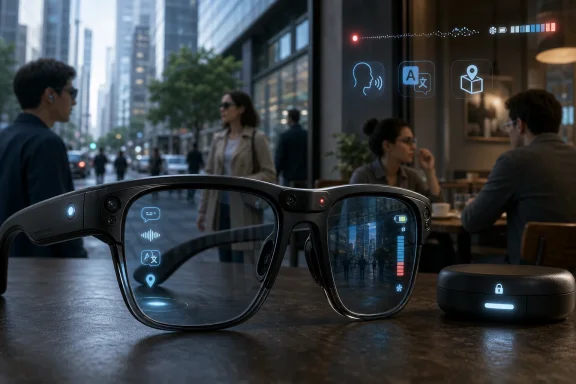
That matters because the first mass-market AI wearable may be less like science fiction and more like a camera-equipped Bluetooth headset disguised as eyewear. The early win is not necessarily holograms. It is convenience. If a device can take a photo, stream video, answer questions about what you are seeing, play audio, take calls, and talk to an AI assistant without requiring you to pull out your phone, it has a plausible reason to exist.
Apple has reportedly been working on smart glasses of its own, and the company’s interest is predictable. The iPhone is still the center of its ecosystem, but Apple knows every dominant computing platform eventually creates anxiety about the next interface. The Mac did not disappear when the iPhone arrived, but the center of gravity moved. Apple does not want the post-phone interface, if there is one, to be owned by Meta or OpenAI.
The strange twist is that OpenAI may be trying to build the platform Apple feared while recruiting from the very teams Apple tasked with preparing for it. That does not mean OpenAI can out-Apple Apple. It does mean the company understands that interface control is strategic, not decorative.
AI wants context. The more an assistant knows about what you are seeing, hearing, doing, and trying to accomplish, the more useful it becomes. Smartphones can provide some of that context, but they are clumsy instruments for continuous perception. They are designed around apps, not ambient understanding.
That is the opening for wearables. Glasses can see roughly what you see. Earbuds can hear what you hear and speak privately back to you. Watches can sense motion and health signals. A pendant or pin can sit at the center of a conversation. None of these replaces the phone outright, but each can make the phone feel like a remote control for a more distributed computer.
OpenAI’s challenge is that the phone also sets expectations. Users expect all-day battery life, reliable connectivity, polished industrial design, strong privacy controls, and a clear reason to upgrade. A clever AI demo is not enough. If the device cannot survive normal life, it becomes another expensive curiosity.
These products failed to settle the category, but they did clarify the standard. Consumers will not buy an AI gadget just because it is philosophically opposed to the smartphone. They will buy it only if it is faster, easier, more reliable, or more delightful than using the phone they already own.
OpenAI has advantages those startups lacked. It has the model brand, the user base, developer gravity, and capital to take bigger swings. It can integrate hardware with the underlying AI stack rather than bolting an assistant onto rented infrastructure. It can also afford to hire people who have shipped products at a scale most startups only gesture toward in pitch decks.
But OpenAI also faces a harsher expectation curve. A startup can be forgiven for rough edges. OpenAI, after spending billions to absorb a hardware team associated with Jony Ive and recruiting senior Apple talent, will not get the benefit of the doubt for a half-baked gadget. If it puts a device on the market, reviewers and customers will judge it against Apple-level fit and finish, ChatGPT-level intelligence, and smartphone-level reliability.
That is a brutal triangle. It is also why Meade’s hiring is significant. OpenAI appears to know that AI hardware cannot be solved by model capability alone.
The problem is timing. Apple’s AI story has been cautious, uneven, and at times visibly behind the market’s expectations. The company has tried to frame intelligence as a system-level feature distributed across devices, apps, and privacy-preserving infrastructure. That may be the right long-term architecture, but it has not produced the same sense of momentum that ChatGPT created.
Hardware magnifies that tension. Apple is excellent at waiting until a category is ready and then arriving with a product that makes earlier attempts look unfinished. But AI is moving on software timelines, not traditional hardware timelines. Models improve, user habits change, and platform expectations shift faster than a conventional consumer-electronics cycle.
If Apple launches smart glasses in late 2027 or beyond, it may still have the best-designed product in the category. The risk is that users’ idea of what AI glasses should do may already be shaped by Meta, OpenAI, or another player. In platform wars, being best is useful. Being the default is better.
Windows has lived through this before. The PC was once the default personal-computing environment. Then smartphones moved huge portions of daily computing into ecosystems controlled by Apple and Google. Microsoft remained central in enterprise, development, gaming, and productivity, but it lost the consumer mobile platform war.
AI wearables are not guaranteed to become the next smartphone. Most new device categories fail or settle into niches. But if an AI wearable becomes a meaningful interface for search, messaging, productivity, navigation, translation, shopping, and media capture, it becomes a platform. Platforms attract developers, subscriptions, identity systems, payment flows, and lock-in.
That should make Microsoft both excited and cautious. A successful OpenAI device could strengthen the broader AI ecosystem Microsoft has bet on. It could also create a consumer AI surface that does not need Windows, does not need Edge, and does not naturally route through Microsoft’s account system or app model.
The practical impact for Windows users may not be immediate. Nobody is replacing a workstation with smart glasses to manage Active Directory, compile code, run Excel models, or play PC games. But the client device that captures user intent matters. If more intent begins on a wearable, the PC becomes one endpoint among many rather than the primary command center.
Companies already struggle with employees pasting sensitive material into consumer AI tools. Wearables raise the stakes because they can capture context before the user has consciously decided to share it. A device that listens to meetings, reads whiteboards, identifies documents, or summarizes conversations may be useful. It may also violate policy, law, contract, or basic trust.
OpenAI and its rivals will have to solve this at the product level, not just in terms-of-service language. Enterprise-friendly AI wearables would need visible recording indicators, strong administrative controls, data residency options, retention settings, audit logs, and integration with identity providers. They would also need modes that make it obvious when capture is disabled.
This is where Apple traditionally has an advantage. Its privacy marketing is not merely decorative; it shapes user expectations. Meta, because of its history, faces a steeper trust hill. OpenAI sits in a more ambiguous position. Users may trust ChatGPT’s usefulness while still worrying about what happens when the assistant is no longer confined to a prompt box.
The company that wins AI wearables may be the one that makes bystanders feel least exploited. That is a social design problem as much as a technical one.
Google Glass learned that lesson early. The technology was interesting, but the social contract was missing. People did not know when they were being recorded, whether they were being analyzed, or whether a conversation had become content. The product became a symbol before it became a platform, and the symbol was not flattering.
Today’s environment is different. AirPods normalized people talking to invisible assistants in public. Smartphones normalized constant photography. Doorbell cameras normalized casual surveillance. Meta’s glasses normalized camera eyewear more than many skeptics expected. The public may be more ready for AI wearables than it was a decade ago, but readiness is not the same as consent.
OpenAI’s product choices will matter enormously. A screenless assistant may feel less intrusive than glasses with cameras, but it may also be less useful. Glasses without displays may be socially acceptable but functionally limited. Full AR glasses may be transformative but expensive, power-hungry, and conspicuous.
The face is prime real estate because it gives AI access to context. It is dangerous for the same reason.
AI hardware needs restraint, but not emptiness. It cannot hide every control in the name of purity. It cannot assume users will tolerate ambiguity because the object is elegant. It cannot prioritize thinness over battery life, or novelty over repairability, or seamlessness over informed consent.
A good AI device may need obvious buttons. It may need a physical privacy shutter. It may need a recording light that cannot be disabled. It may need replaceable parts, prescription support, boring enterprise management, and ugly regulatory labels. These are not failures of design. They are the conditions under which trust becomes possible.
That is the challenge for an Ive-influenced OpenAI device. The product cannot merely be an artifact. It must be a relationship among user, model, environment, and bystander. If design makes that relationship legible, OpenAI has a chance. If design obscures it, the backlash will be swift.
This does not mean the smartphone is doomed. The phone is too useful, too entrenched, and too economically central to disappear. More likely, the phone becomes the hub for a constellation of AI-aware peripherals, some made by platform owners and some made by companies that want to weaken those platforms.
That is where OpenAI’s move becomes strategically sharp. If ChatGPT remains only an app, it depends on the rules of iOS, Android, Windows, and the web. If ChatGPT becomes the organizing intelligence inside a device people wear, OpenAI gains a direct channel to user intent. It moves closer to the beginning of the computing session rather than waiting at the end of an app launch.
The risk is that hardware punishes arrogance. Model companies are used to rapid iteration, abstract infrastructure, and software updates that can paper over mistakes. Consumer hardware requires commitments years in advance. A bad hinge, awkward weight distribution, poor thermal design, or socially tone-deaf camera placement cannot be fixed by a clever prompt.
A few concrete points stand out:
OpenAI’s poaching from Apple does not prove that ChatGPT glasses are imminent, and it certainly does not prove they will be good. It does prove that the company sees hardware as more than a vanity project. The next fight in AI will be about who controls the moment before the prompt is typed, and if OpenAI can turn Apple-grade hardware talent into a trustworthy everyday device, the most important computer in your life may become the one that is listening before you ask.
 OpenAI Is No Longer Pretending ChatGPT Is Just an App
For most users, ChatGPT still lives in familiar places: a web page, a mobile app, a desktop window, an API endpoint, or an integration inside someone else’s product. That has been OpenAI’s advantage and its limitation. Software can spread quickly, but it inherits the habits, notification systems, cameras, microphones, privacy controls, and battery constraints of platforms owned by Apple, Google, Microsoft, and Meta.Meade’s move matters because it points toward a different ambition. A company does not hire leaders from Apple’s Vision Pro and smart-glasses programs merely to polish a mobile app. It hires them because it wants people who understand the ugly realities of putting sensors, batteries, displays, thermals, radios, speakers, microphones, cameras, and human comfort into something people might actually wear.
That is where AI gets interesting and uncomfortable. ChatGPT on a laptop waits for a prompt. ChatGPT in a wearable could become a persistent interpreter of the world: listening, seeing, remembering, translating, coaching, summarizing, and nudging. The difference is not cosmetic. It changes AI from a tool you consult into a layer that mediates ordinary life.
OpenAI has been careful not to say exactly what it is building. That restraint is sensible. The graveyard of “post-smartphone” devices is crowded with products that promised to reinvent computing and mostly reinvented the charging cable. But the personnel moves are becoming too specific to dismiss as generic experimentation.
The Apple Exodus Gives OpenAI More Than Design Cachet
The story is not simply that OpenAI now has Jony Ive’s name attached to a hardware push. Ive brings enormous symbolic weight, but hardware products are not shipped by symbolism. They are shipped by teams that know how to turn fragile prototypes into manufactured objects at scale, and that is why the broader cast of former Apple executives matters.OpenAI’s acquisition of io, the AI-device startup co-founded by Ive, brought it into direct contact with a cluster of Apple alumni. Former Apple design chief Evans Hankey and former iPhone operations executive Tang Tan are the sort of people who understand the distance between an impressive demo and a product that survives factories, regulators, reviewers, repair channels, and customers’ pockets.
Meade adds a different kind of credibility. Vision Pro was not a mass-market success in the way the iPhone was, but it was an engineering statement: a dense, sensor-heavy, display-heavy, spatial-computing headset built around low-latency interaction. Smart glasses, by contrast, demand almost the opposite discipline. They must be lighter, cheaper, socially acceptable, power-efficient, and useful without feeling like a scuba mask for the metaverse.
That combination is rare. The people who understand head-mounted computing at the high end are not automatically qualified to design something normal people will wear all day. But Apple’s internal work on Vision Pro and future glasses sits precisely at the crossroads OpenAI now appears to be approaching: how to make computers that move from the desk and hand to the face and body.
Vision Pro Was a Warning, Not a Failure to Ignore
It is tempting to treat Vision Pro as a cautionary tale that proves consumers do not want face computers. That reading is too easy. Vision Pro proved something narrower and more useful: consumers do not want a heavy, expensive, isolating headset unless the value is overwhelming.Apple’s first headset was technologically ambitious and commercially constrained. Its price put it outside the normal consumer-electronics curve, its form factor limited casual use, and its killer app remained elusive. Yet it also demonstrated how good passthrough, eye tracking, hand tracking, spatial video, and high-resolution displays could make computing feel when the hardware stopped fighting the user.
For OpenAI, the lesson is not “build a cheaper Vision Pro.” It is almost certainly the opposite. The AI-native device, if it works at all, should not ask users to enter a new world. It should help them deal with this one.
That is why glasses, earbuds, pendants, pins, and other small ambient devices keep returning to the center of the conversation. The winning AI wearable may not need to show you an immersive 3D desktop. It may need to hear a conversation accurately, identify what you are looking at, whisper useful context, remember the name you forgot, translate a sign, summarize a meeting, or warn you that the email you are about to send is a career-limiting event.
The hard part is that these use cases sound obvious until they collide with battery life, latency, privacy, social norms, and trust. A wearable AI assistant that is wrong five percent of the time may be amusing in a browser and intolerable on your face. A device that records too much becomes creepy. A device that records too little becomes useless.
Meta Already Found the Beachhead Apple Wanted
OpenAI is not entering a vacuum. Meta’s Ray-Ban smart glasses have done something the VR industry struggled to do for a decade: make a face-worn computer look almost normal. They are not full augmented-reality glasses, and that is partly the point. By avoiding the burden of a true visual AR display, Meta found a simpler product category built around cameras, audio, capture, and AI assistance.That matters because the first mass-market AI wearable may be less like science fiction and more like a camera-equipped Bluetooth headset disguised as eyewear. The early win is not necessarily holograms. It is convenience. If a device can take a photo, stream video, answer questions about what you are seeing, play audio, take calls, and talk to an AI assistant without requiring you to pull out your phone, it has a plausible reason to exist.
Apple has reportedly been working on smart glasses of its own, and the company’s interest is predictable. The iPhone is still the center of its ecosystem, but Apple knows every dominant computing platform eventually creates anxiety about the next interface. The Mac did not disappear when the iPhone arrived, but the center of gravity moved. Apple does not want the post-phone interface, if there is one, to be owned by Meta or OpenAI.
The strange twist is that OpenAI may be trying to build the platform Apple feared while recruiting from the very teams Apple tasked with preparing for it. That does not mean OpenAI can out-Apple Apple. It does mean the company understands that interface control is strategic, not decorative.
The Smartphone Is Becoming AI’s Awkward Middleman
The smartphone is the most successful consumer computer ever made, but it is not an ideal AI device. It is a slab that must be taken out, unlocked, aimed, tapped, spoken to, and put away. It is powerful, but it is episodic. It is always near you, but not always with your attention.AI wants context. The more an assistant knows about what you are seeing, hearing, doing, and trying to accomplish, the more useful it becomes. Smartphones can provide some of that context, but they are clumsy instruments for continuous perception. They are designed around apps, not ambient understanding.
That is the opening for wearables. Glasses can see roughly what you see. Earbuds can hear what you hear and speak privately back to you. Watches can sense motion and health signals. A pendant or pin can sit at the center of a conversation. None of these replaces the phone outright, but each can make the phone feel like a remote control for a more distributed computer.
OpenAI’s challenge is that the phone also sets expectations. Users expect all-day battery life, reliable connectivity, polished industrial design, strong privacy controls, and a clear reason to upgrade. A clever AI demo is not enough. If the device cannot survive normal life, it becomes another expensive curiosity.
The Humane Lesson Still Hangs Over Every AI Gadget
The recent history of AI hardware is not encouraging. Humane’s AI Pin entered the market with a bold story about freeing users from screens, then ran into the brutal physics of battery life, heat, latency, and usefulness. Rabbit’s R1 generated attention by promising a new kind of AI-native interface, then faced scrutiny over how much of the experience really required dedicated hardware.These products failed to settle the category, but they did clarify the standard. Consumers will not buy an AI gadget just because it is philosophically opposed to the smartphone. They will buy it only if it is faster, easier, more reliable, or more delightful than using the phone they already own.
OpenAI has advantages those startups lacked. It has the model brand, the user base, developer gravity, and capital to take bigger swings. It can integrate hardware with the underlying AI stack rather than bolting an assistant onto rented infrastructure. It can also afford to hire people who have shipped products at a scale most startups only gesture toward in pitch decks.
But OpenAI also faces a harsher expectation curve. A startup can be forgiven for rough edges. OpenAI, after spending billions to absorb a hardware team associated with Jony Ive and recruiting senior Apple talent, will not get the benefit of the doubt for a half-baked gadget. If it puts a device on the market, reviewers and customers will judge it against Apple-level fit and finish, ChatGPT-level intelligence, and smartphone-level reliability.
That is a brutal triangle. It is also why Meade’s hiring is significant. OpenAI appears to know that AI hardware cannot be solved by model capability alone.
Apple’s Problem Is Not Talent, It Is Timing
Apple losing senior hardware talent to OpenAI makes for an irresistible narrative, but it would be foolish to write Apple off. The company still has one of the strongest hardware organizations in the world, unmatched retail reach, deep silicon expertise, and a user base trained to buy new categories when Apple makes them feel safe.The problem is timing. Apple’s AI story has been cautious, uneven, and at times visibly behind the market’s expectations. The company has tried to frame intelligence as a system-level feature distributed across devices, apps, and privacy-preserving infrastructure. That may be the right long-term architecture, but it has not produced the same sense of momentum that ChatGPT created.
Hardware magnifies that tension. Apple is excellent at waiting until a category is ready and then arriving with a product that makes earlier attempts look unfinished. But AI is moving on software timelines, not traditional hardware timelines. Models improve, user habits change, and platform expectations shift faster than a conventional consumer-electronics cycle.
If Apple launches smart glasses in late 2027 or beyond, it may still have the best-designed product in the category. The risk is that users’ idea of what AI glasses should do may already be shaped by Meta, OpenAI, or another player. In platform wars, being best is useful. Being the default is better.
Microsoft Should Be Watching the Interface, Not Just the Model
For WindowsForum readers, the obvious question is where Microsoft fits into this. Microsoft is OpenAI’s most important strategic partner and has built Copilot into Windows, Microsoft 365, Edge, GitHub, and Azure. Yet the hardware conversation exposes a tension in that alliance: Microsoft wants AI everywhere inside its platforms, while OpenAI may want a platform of its own.Windows has lived through this before. The PC was once the default personal-computing environment. Then smartphones moved huge portions of daily computing into ecosystems controlled by Apple and Google. Microsoft remained central in enterprise, development, gaming, and productivity, but it lost the consumer mobile platform war.
AI wearables are not guaranteed to become the next smartphone. Most new device categories fail or settle into niches. But if an AI wearable becomes a meaningful interface for search, messaging, productivity, navigation, translation, shopping, and media capture, it becomes a platform. Platforms attract developers, subscriptions, identity systems, payment flows, and lock-in.
That should make Microsoft both excited and cautious. A successful OpenAI device could strengthen the broader AI ecosystem Microsoft has bet on. It could also create a consumer AI surface that does not need Windows, does not need Edge, and does not naturally route through Microsoft’s account system or app model.
The practical impact for Windows users may not be immediate. Nobody is replacing a workstation with smart glasses to manage Active Directory, compile code, run Excel models, or play PC games. But the client device that captures user intent matters. If more intent begins on a wearable, the PC becomes one endpoint among many rather than the primary command center.
Enterprise IT Will See the Privacy Problem Before Consumers Do
Consumer excitement around AI wearables tends to focus on convenience. Enterprise IT will focus on microphones, cameras, retention policies, identity, compliance, and the nightmare phrase “unapproved recording device.” A ChatGPT-powered wearable in a conference room is not just a gadget. It is a governance problem with a battery.Companies already struggle with employees pasting sensitive material into consumer AI tools. Wearables raise the stakes because they can capture context before the user has consciously decided to share it. A device that listens to meetings, reads whiteboards, identifies documents, or summarizes conversations may be useful. It may also violate policy, law, contract, or basic trust.
OpenAI and its rivals will have to solve this at the product level, not just in terms-of-service language. Enterprise-friendly AI wearables would need visible recording indicators, strong administrative controls, data residency options, retention settings, audit logs, and integration with identity providers. They would also need modes that make it obvious when capture is disabled.
This is where Apple traditionally has an advantage. Its privacy marketing is not merely decorative; it shapes user expectations. Meta, because of its history, faces a steeper trust hill. OpenAI sits in a more ambiguous position. Users may trust ChatGPT’s usefulness while still worrying about what happens when the assistant is no longer confined to a prompt box.
The company that wins AI wearables may be the one that makes bystanders feel least exploited. That is a social design problem as much as a technical one.
The Face Is the Most Valuable and Dangerous Screen
There is a reason “coming for your face” sounds more ominous than “coming for your phone.” Phones are intimate, but they can be put down. Glasses sit at the boundary between private perception and public interaction. They change not only what the wearer can do, but how everyone else behaves around the wearer.Google Glass learned that lesson early. The technology was interesting, but the social contract was missing. People did not know when they were being recorded, whether they were being analyzed, or whether a conversation had become content. The product became a symbol before it became a platform, and the symbol was not flattering.
Today’s environment is different. AirPods normalized people talking to invisible assistants in public. Smartphones normalized constant photography. Doorbell cameras normalized casual surveillance. Meta’s glasses normalized camera eyewear more than many skeptics expected. The public may be more ready for AI wearables than it was a decade ago, but readiness is not the same as consent.
OpenAI’s product choices will matter enormously. A screenless assistant may feel less intrusive than glasses with cameras, but it may also be less useful. Glasses without displays may be socially acceptable but functionally limited. Full AR glasses may be transformative but expensive, power-hungry, and conspicuous.
The face is prime real estate because it gives AI access to context. It is dangerous for the same reason.
Jony Ive’s Real Test Is Restraint
The Jony Ive mythology can become a distraction. The lazy version of the story says OpenAI hired Apple’s old design magic and will now produce the iPhone of AI. The more interesting version is that Ive’s team must prove it can avoid the mistakes that often follow from beautiful minimalism.AI hardware needs restraint, but not emptiness. It cannot hide every control in the name of purity. It cannot assume users will tolerate ambiguity because the object is elegant. It cannot prioritize thinness over battery life, or novelty over repairability, or seamlessness over informed consent.
A good AI device may need obvious buttons. It may need a physical privacy shutter. It may need a recording light that cannot be disabled. It may need replaceable parts, prescription support, boring enterprise management, and ugly regulatory labels. These are not failures of design. They are the conditions under which trust becomes possible.
That is the challenge for an Ive-influenced OpenAI device. The product cannot merely be an artifact. It must be a relationship among user, model, environment, and bystander. If design makes that relationship legible, OpenAI has a chance. If design obscures it, the backlash will be swift.
The Calendar Now Belongs to the Hardware Teams
The most revealing part of the current moment is that every major player seems to be converging on the same conclusion. Meta is shipping smart glasses. Apple is reportedly developing glasses and other AI-centric devices. OpenAI is building a hardware team with unusually deep Apple DNA. Google, Samsung, Qualcomm, and others continue to orbit Android XR and ambient computing. The category is not settled, but the direction of travel is clear.This does not mean the smartphone is doomed. The phone is too useful, too entrenched, and too economically central to disappear. More likely, the phone becomes the hub for a constellation of AI-aware peripherals, some made by platform owners and some made by companies that want to weaken those platforms.
That is where OpenAI’s move becomes strategically sharp. If ChatGPT remains only an app, it depends on the rules of iOS, Android, Windows, and the web. If ChatGPT becomes the organizing intelligence inside a device people wear, OpenAI gains a direct channel to user intent. It moves closer to the beginning of the computing session rather than waiting at the end of an app launch.
The risk is that hardware punishes arrogance. Model companies are used to rapid iteration, abstract infrastructure, and software updates that can paper over mistakes. Consumer hardware requires commitments years in advance. A bad hinge, awkward weight distribution, poor thermal design, or socially tone-deaf camera placement cannot be fixed by a clever prompt.
The Signal Hidden in OpenAI’s Apple Shopping Spree
The near-term lesson is not that OpenAI has secretly confirmed AI glasses. It has not. The lesson is that OpenAI is hiring as though the interface to AI is now the strategic problem.A few concrete points stand out:
- Paul Meade’s reported move gives OpenAI hardware leadership with direct experience in Apple’s most advanced head-mounted and glasses-related projects.
- OpenAI’s acquisition of io turned its hardware ambitions from rumor into corporate strategy, backed by one of the largest deals in the company’s history.
- The most plausible first AI devices may emphasize cameras, microphones, audio, and contextual assistance before attempting full augmented-reality displays.
- Apple remains formidable, but its slower AI rollout creates an opening for rivals to define what consumers expect from AI-native hardware.
- Enterprise adoption will depend less on glamour and more on privacy controls, manageability, auditability, and clear capture indicators.
- The winning device will not be the one that merely puts ChatGPT on your face, but the one that makes ambient AI feel useful without making everyone nearby feel watched.
OpenAI’s poaching from Apple does not prove that ChatGPT glasses are imminent, and it certainly does not prove they will be good. It does prove that the company sees hardware as more than a vanity project. The next fight in AI will be about who controls the moment before the prompt is typed, and if OpenAI can turn Apple-grade hardware talent into a trustworthy everyday device, the most important computer in your life may become the one that is listening before you ask.
References
- Primary source: Digital Trends
Published: Sat, 27 Jun 2026 18:00:16 GMT
OpenAI's poaching from Apple hints at ChatGPT-powered wearables coming for your face - Digital Trends
Apple's Vision Pro engineering chief is leaving for OpenAI, hinting that the company's AI hardware ambitions may extend well beyond ChatGPT.www.digitaltrends.com - Related coverage: bloomberg.com
- Related coverage: 9to5mac.com
OpenAI poaches Apple Vision Pro and smart glasses chief - 9to5Mac
According to Bloomberg, OpenAI has hired Paul Meade, who had been in charge of Apple Vision Pro and Apple’s smart glasses initiative.9to5mac.com - Related coverage: macrumors.com
Apple Loses Another Top Executive to OpenAI
Paul Meade, who oversees development on the Vision Pro and Apple's upcoming smart glasses, is leaving Apple for OpenAI, reports Bloomberg. Meade took over leadership of Apple's Vision Products Group when Vision Pro chief Mike Rockwell took over Siri's AI upgrade. He was previously...www.macrumors.com - Related coverage: livemint.com
Apple's Vision Pro hardware chief quits, joins OpenAI to build AI devices: Report | Company Business News
Apple's Paul Meade, head of Vision Pro and smart glasses, is departing to join OpenAI's hardware division. www.livemint.com
- Related coverage: techspot.com
OpenAI bets big on hardware with $6.5 billion acquisition of Jony Ive's startup | TechSpot
OpenAI is making a dramatic leap into the hardware business, announcing a nearly $6.5 billion all-stock acquisition of io, the artificial intelligence device startup co-founded by legendary...www.techspot.com
- Related coverage: theinformation.com
- Related coverage: techtimes.com
Apple Vision Pro Hardware Chief Joins OpenAI as Smart Glasses Deadline Looms
OpenAI hardware team gains Paul Meade, Apple’s VP who spent seven years building the Vision Pro and was leading its smart glasses effort. His departure leaves Apple without its most seasoned ARwww.techtimes.com - Related coverage: mactech.com
Apple is losing another executive, Paul Meade, to OpenAI - MacTech.com
Apple is losing yet another executive to OpenAI, reports Bloomberg‘s Mark Gurman. The exec is Paul Meade, who oversees (oversaw?) development on the Vision Pro and Apple’s upcoming smart glasses (the rumored “Apple Glasses”), is departing next week. He’ll join OpenAI’s hardware unit to work on AIwww.mactech.com
- Related coverage: techcrunch.com
Apple Vision Pro exec is reportedly leaving for OpenAI | TechCrunch
Paul Meade, the Apple vice president in charge of the Vision Pro headset, is reportedly leaving the company to join OpenAI’s hardware team.techcrunch.com - Related coverage: axios.com
Apple vet Jony Ive joins OpenAI in $6.5 billion deal for his hardware startup
Design legend Ive will spearhead a project to develop new AI devices for OpenAI.www.axios.com
- Related coverage: windowscentral.com
OpenAI closes Jony Ive AI hardware startup acquisition deal | Windows Central
OpenAI's $6.5 billion acquisition uniquely positions Sam Altman to develop next-gen computers — designed to make AI "transcendentally good"www.windowscentral.com - Related coverage: lemonde.fr
IA : OpenAI rachète la start-up de l’ex-designer historique d’Apple Jony Ive, pour 6,5 milliards de dollars
L’entreprise de Sam Altman annonce que l’ex-cadre associé au lancement de l’iPhone chez Apple sera responsable du design, notamment d’une « nouvelle génération d’ordinateurs nourris à l’intelligence artificielle ».www.lemonde.fr - Related coverage: tomshardware.com
Apple 'has given up' on Vision Pro, report claims — costly price and weight behind purported failure, but the company continues to hire into its Vision Production Group | Tom's Hardware
No official reports on the fate of the Vision Prowww.tomshardware.com - Related coverage: cincodias.elpais.com
