

At the OpenAI Financial Services Summit on June 8, 2026, OpenAI solutions engineer Lee Spacagna presented “Operationalizing AI in workflows,” a financial-services-focused demonstration of how enterprise AI agents can be built, connected to business systems, and used to automate multi-step work for employees across regulated organizations. The pitch was not that chatbots are getting better at answering questions. It was that AI is moving from a conversational layer into the machinery of office work itself. For Windows-heavy enterprises, that distinction matters because the agent era will be won or lost inside Outlook, Teams, SharePoint, Salesforce, browsers, identity systems, and audit logs.
The most important part of Spacagna’s presentation is the shift in posture. OpenAI is no longer merely asking companies to give employees a smarter text box. It is asking them to let AI agents participate in the workflow graph of the business.
That is a much larger claim. A chatbot can summarize a policy document, draft a customer email, or explain a spreadsheet. An agent is expected to notice context, call tools, gather information from multiple systems, make intermediate judgments, and produce something closer to a finished operational artifact.
In Spacagna’s telling, the evolution runs from simple GPT experimentation to agents that understand business context and execute tasks across applications. That sounds like marketing until you map it onto the daily reality of financial services. Much of the industry runs on human beings copying facts from one regulated system into another, reconciling meetings with inboxes, preparing briefs, documenting decisions, and turning institutional memory into compliant action.
The summit framing matters because finance is the place where productivity demos go to meet governance. If OpenAI can make the agent story credible there, the same model becomes easier to sell into healthcare, legal services, logistics, consulting, and government-adjacent operations.
A chief-of-staff-style agent is not replacing a single role so much as absorbing the connective tissue between roles. It can prepare daily briefs, review emails, summarize meetings, identify action items, and push updates back into the communication stream. The task sounds clerical, but the implications are architectural.
Once an agent can read calendar context, inspect documents, understand CRM records, and send a Teams update, it is no longer just producing prose. It is becoming a process participant. That is the difference between “write me a summary” and “prepare me for the 9 a.m. client call, including what changed since the last meeting and what I need to decide.”
For IT departments, that means the risk boundary moves. The sensitive point is no longer only what a model says. It is what the model can touch, infer, combine, and trigger.
That creates a complicated dynamic. Microsoft is OpenAI’s most important strategic partner, but it is also building its own agent ecosystem through Copilot and Copilot Studio. OpenAI’s message to financial services customers is therefore not simply “use our model.” It is “let our agents operate across the same productivity estate Microsoft wants to make native to Copilot.”
The competition will not look like a traditional application war. It will look like a permissions war, an admin-console war, a connector war, and an auditability war. Whoever gives enterprises the cleanest way to build, govern, monitor, and retire agents will have a stronger claim than whoever wins a benchmark leaderboard.
That is why Spacagna’s emphasis on connecting agents to existing tools is more than a convenience feature. It is the whole enterprise strategy. The model is only valuable when it can see the work, understand the work, and safely act on the work.
Templates are how vendors get departments started. Skills are how organizations encode the messy particulars of their business. A generic agent can summarize a meeting; a useful internal agent knows which risk committee format matters, which Salesforce fields are authoritative, and which escalation path applies when an exception appears.
The danger is that skills can sound softer than they are. In practice, a skill is an operational instruction set. It tells the agent how to behave in a particular business context, what sources to prefer, what outputs to generate, and sometimes what downstream actions to take.
That makes skill design a new form of process engineering. The people writing these instructions are not just prompt hobbyists. They are translating business policy into executable behavior, and if they get it wrong, the agent can scale the mistake.
Spacagna’s examples are polished because demos have to be. A real enterprise rollout is messier. The agent asked to prepare a daily brief may discover that the CRM is stale, the SharePoint taxonomy is incoherent, the meeting notes contradict the email thread, and the “single source of truth” is actually three systems plus a senior analyst’s memory.
That is not a reason to dismiss the technology. It is a reason to understand where the labor moves. AI agents may reduce the amount of routine coordination work humans perform, but they increase the value of clean data, explicit policy, good access control, and well-described workflows.
The companies that benefit first will not necessarily be the ones with the most adventurous AI teams. They will be the ones whose internal systems are boring in the best possible way: consistent, permissioned, documented, and observable.
That makes the sector an ideal proving ground. An AI agent that helps an AML investigation analyst, a CFO chief of staff, or a client-service team cannot simply be clever. It must be governable. It must produce outputs that can be reviewed, justified, and sometimes challenged months later.
The agent story is strongest where work is structured but not fully deterministic. A purely repetitive task may already belong to traditional automation. A purely strategic task may remain stubbornly human. But the middle layer — review, synthesize, route, draft, reconcile, brief, escalate — is exactly where large organizations spend enormous amounts of expensive time.
This is where OpenAI’s operational argument lands. The company is not saying every employee gets replaced by an autonomous digital worker. It is saying that many employees can be surrounded by agents that compress the time between information and action.
Trust in this context is not vibes. It is the confidence that the agent is using the right data, respecting permissions, producing traceable work, and failing safely. An agent that occasionally invents a meeting action item or summarizes the wrong customer record is worse than a slow human process because it creates speed without reliability.
That is why the enterprise AI debate is moving toward observability and control. Admins need to know which tools an agent used, what it retrieved, what it changed, who approved the action, and whether the output entered a system of record. The more useful the agent becomes, the more unacceptable a black box becomes.
OpenAI appears to understand this, at least at the level of product direction. The company’s broader agent push — including tool use, APIs, connectors, and enterprise governance framing — points toward a future where AI systems are judged by their operational envelope, not just their conversational polish.
If an employee uses ChatGPT to draft an email, the admin’s concern is data handling and acceptable use. If an agent can read mail, inspect files, query CRM data, summarize meetings, and post updates to Teams, the admin now has an orchestration problem. The agent becomes a new kind of identity-adjacent actor.
That raises practical questions Windows and Microsoft 365 administrators will have to answer. Which agents can access which mailboxes? Can an agent act on behalf of a user, a team, or a service principal? How are permissions inherited? What happens when an employee leaves? Can an agent’s access be reviewed during quarterly compliance checks?
These are not abstract governance concerns. They are the same operational questions IT already handles for applications, service accounts, scripts, and automation platforms. The difference is that agents introduce probabilistic reasoning into workflows that previously depended on explicit logic.
In a mature deployment, agent instructions will need version control, ownership, testing, review, and rollback. A change to a “daily brief” agent may affect executives’ decisions. A change to an “investigation support” agent may affect compliance workflows. A change to a “customer escalation” agent may alter how quickly a risk reaches management.
That sounds heavy, but it is exactly what happens when software moves from experiment to infrastructure. The lightweight language of AI adoption — prompts, chats, assistants, copilots — obscures the fact that these systems are increasingly shaping operational behavior.
Spacagna’s talk points toward that world. The more agents are customized for business applications, the more they resemble configurable workflow software with a language-model core.
Agent-led workflows invert that rhythm. The system prepares the brief before the user asks. It monitors the inbox, connects meeting context, drafts the update, and nudges the human only when a decision is needed. That is more valuable, but also more intrusive.
The difference matters because adoption curves change when software initiates work. Employees may welcome automation that removes drudgery, but they may resist systems that appear to monitor, prioritize, or reshape their day. Managers may love the visibility; workers may see surveillance wearing a productivity badge.
A serious enterprise rollout will need to distinguish between automation that empowers employees and automation that quietly intensifies the workplace. “Multiply workforce impact” can mean giving analysts better tools. It can also mean expecting the same analysts to process more cases with less slack.
The hard part is integration at scale. A demo agent can show what is possible. A production agent must survive weird calendars, duplicate contacts, permission edge cases, contradictory documents, network outages, retention policies, and users who ask it to do things it should not do.
That is why the next phase of AI adoption will be less glamorous than the last. The headline capability is “agents,” but the implementation work looks like enterprise plumbing. Identity, logging, connectors, data classification, approval flows, exception handling, and user training will decide whether the promise survives contact with the organization.
In that sense, OpenAI’s message is both ambitious and sober. The company is saying the model is ready to leave the chat box. The customer still has to make the workplace ready to receive it.
That means designing agents around real workflows instead of novelty. It means giving them narrow authority before broad autonomy. It means measuring outcomes, not demo quality. It means deciding which work should be automated, which work should be augmented, and which work should remain deliberately human.
It also means admitting that AI agents are not a single product category. Some will be personal assistants. Some will be department-specific workflow tools. Some will be developer-facing automation layers. Some will be compliance-sensitive systems that require the same seriousness as any other regulated platform.
The winners will likely be organizations that build a portfolio of agents rather than a chaos garden of experiments. That is the real operational challenge behind the glossy summit language.
That shift has concrete consequences.
 OpenAI Is Selling the Workflow, Not the Chat Window
The most important part of Spacagna’s presentation is the shift in posture. OpenAI is no longer merely asking companies to give employees a smarter text box. It is asking them to let AI agents participate in the workflow graph of the business.That is a much larger claim. A chatbot can summarize a policy document, draft a customer email, or explain a spreadsheet. An agent is expected to notice context, call tools, gather information from multiple systems, make intermediate judgments, and produce something closer to a finished operational artifact.
In Spacagna’s telling, the evolution runs from simple GPT experimentation to agents that understand business context and execute tasks across applications. That sounds like marketing until you map it onto the daily reality of financial services. Much of the industry runs on human beings copying facts from one regulated system into another, reconciling meetings with inboxes, preparing briefs, documenting decisions, and turning institutional memory into compliant action.
The summit framing matters because finance is the place where productivity demos go to meet governance. If OpenAI can make the agent story credible there, the same model becomes easier to sell into healthcare, legal services, logistics, consulting, and government-adjacent operations.
The Chief of Staff Agent Is a Trojan Horse for Enterprise Automation
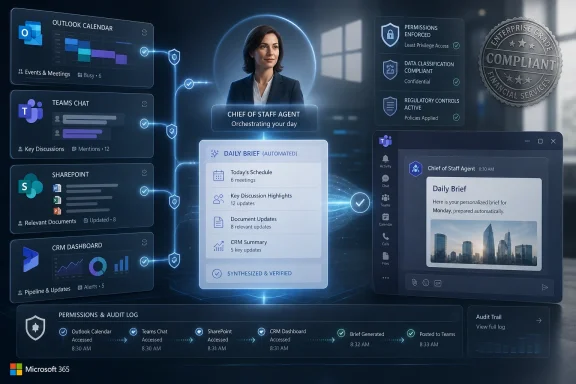
Spacagna reportedly demonstrated a “Chief of Staff Agent” connected to familiar business tools such as Microsoft Outlook Calendar, Microsoft Teams, Salesforce CRM, and SharePoint. That example is deliberately mundane. It avoids science-fiction spectacle and instead targets the coordination tax that consumes modern white-collar work.A chief-of-staff-style agent is not replacing a single role so much as absorbing the connective tissue between roles. It can prepare daily briefs, review emails, summarize meetings, identify action items, and push updates back into the communication stream. The task sounds clerical, but the implications are architectural.
Once an agent can read calendar context, inspect documents, understand CRM records, and send a Teams update, it is no longer just producing prose. It is becoming a process participant. That is the difference between “write me a summary” and “prepare me for the 9 a.m. client call, including what changed since the last meeting and what I need to decide.”
For IT departments, that means the risk boundary moves. The sensitive point is no longer only what a model says. It is what the model can touch, infer, combine, and trigger.
Microsoft’s Collaboration Stack Becomes the Agent Battleground
The WindowsForum audience will recognize the center of gravity here immediately. Enterprise work still lives inside Microsoft 365, even when the AI vendor on stage is OpenAI. Outlook, Teams, SharePoint, OneDrive, Entra ID, and the Office document formats are where agents either become useful or become another abandoned pilot.That creates a complicated dynamic. Microsoft is OpenAI’s most important strategic partner, but it is also building its own agent ecosystem through Copilot and Copilot Studio. OpenAI’s message to financial services customers is therefore not simply “use our model.” It is “let our agents operate across the same productivity estate Microsoft wants to make native to Copilot.”
The competition will not look like a traditional application war. It will look like a permissions war, an admin-console war, a connector war, and an auditability war. Whoever gives enterprises the cleanest way to build, govern, monitor, and retire agents will have a stronger claim than whoever wins a benchmark leaderboard.
That is why Spacagna’s emphasis on connecting agents to existing tools is more than a convenience feature. It is the whole enterprise strategy. The model is only valuable when it can see the work, understand the work, and safely act on the work.
Templates Make Agents Approachable, but Skills Make Them Dangerous
According to the presentation summary, Spacagna described an agent-building process that starts with templates but allows users to define tasks, desired outcomes, and custom “skills.” That is a familiar enterprise software move: lower the barrier to adoption while preserving enough configurability for serious use cases.Templates are how vendors get departments started. Skills are how organizations encode the messy particulars of their business. A generic agent can summarize a meeting; a useful internal agent knows which risk committee format matters, which Salesforce fields are authoritative, and which escalation path applies when an exception appears.
The danger is that skills can sound softer than they are. In practice, a skill is an operational instruction set. It tells the agent how to behave in a particular business context, what sources to prefer, what outputs to generate, and sometimes what downstream actions to take.
That makes skill design a new form of process engineering. The people writing these instructions are not just prompt hobbyists. They are translating business policy into executable behavior, and if they get it wrong, the agent can scale the mistake.
The Automation Layer Will Expose Every Broken Process Beneath It
Every enterprise automation wave has the same uncomfortable property: it does not merely improve processes; it reveals them. Robotic process automation exposed brittle legacy workflows. Cloud migrations exposed undocumented dependencies. AI agents will expose unclear ownership, inconsistent data, and governance rules that only live in people’s heads.Spacagna’s examples are polished because demos have to be. A real enterprise rollout is messier. The agent asked to prepare a daily brief may discover that the CRM is stale, the SharePoint taxonomy is incoherent, the meeting notes contradict the email thread, and the “single source of truth” is actually three systems plus a senior analyst’s memory.
That is not a reason to dismiss the technology. It is a reason to understand where the labor moves. AI agents may reduce the amount of routine coordination work humans perform, but they increase the value of clean data, explicit policy, good access control, and well-described workflows.
The companies that benefit first will not necessarily be the ones with the most adventurous AI teams. They will be the ones whose internal systems are boring in the best possible way: consistent, permissioned, documented, and observable.
Financial Services Is the Right Showcase Because the Constraints Are Real
OpenAI’s choice of a financial services summit is telling. Finance has high-value knowledge work, repetitive operational tasks, and a deep appetite for efficiency. It also has regulators, auditors, data retention obligations, internal controls, and a long institutional memory of technology risk.That makes the sector an ideal proving ground. An AI agent that helps an AML investigation analyst, a CFO chief of staff, or a client-service team cannot simply be clever. It must be governable. It must produce outputs that can be reviewed, justified, and sometimes challenged months later.
The agent story is strongest where work is structured but not fully deterministic. A purely repetitive task may already belong to traditional automation. A purely strategic task may remain stubbornly human. But the middle layer — review, synthesize, route, draft, reconcile, brief, escalate — is exactly where large organizations spend enormous amounts of expensive time.
This is where OpenAI’s operational argument lands. The company is not saying every employee gets replaced by an autonomous digital worker. It is saying that many employees can be surrounded by agents that compress the time between information and action.
The Productivity Claim Depends on Trust More Than Intelligence
The phrase “multiply workforce impact” is doing a lot of work. It suggests productivity gains without requiring a headcount-replacement argument. That is sensible positioning, but the claim depends less on raw model capability than on whether employees and managers trust agents enough to use them repeatedly.Trust in this context is not vibes. It is the confidence that the agent is using the right data, respecting permissions, producing traceable work, and failing safely. An agent that occasionally invents a meeting action item or summarizes the wrong customer record is worse than a slow human process because it creates speed without reliability.
That is why the enterprise AI debate is moving toward observability and control. Admins need to know which tools an agent used, what it retrieved, what it changed, who approved the action, and whether the output entered a system of record. The more useful the agent becomes, the more unacceptable a black box becomes.
OpenAI appears to understand this, at least at the level of product direction. The company’s broader agent push — including tool use, APIs, connectors, and enterprise governance framing — points toward a future where AI systems are judged by their operational envelope, not just their conversational polish.
The Windows Admin’s Problem Is No Longer Installation
For years, deploying AI in the workplace could be framed as a procurement and enablement issue. Buy seats, configure access, train users, monitor adoption. Agents complicate that neat model.If an employee uses ChatGPT to draft an email, the admin’s concern is data handling and acceptable use. If an agent can read mail, inspect files, query CRM data, summarize meetings, and post updates to Teams, the admin now has an orchestration problem. The agent becomes a new kind of identity-adjacent actor.
That raises practical questions Windows and Microsoft 365 administrators will have to answer. Which agents can access which mailboxes? Can an agent act on behalf of a user, a team, or a service principal? How are permissions inherited? What happens when an employee leaves? Can an agent’s access be reviewed during quarterly compliance checks?
These are not abstract governance concerns. They are the same operational questions IT already handles for applications, service accounts, scripts, and automation platforms. The difference is that agents introduce probabilistic reasoning into workflows that previously depended on explicit logic.
The Prompt Is Becoming a Policy Surface
One of the underappreciated consequences of agent adoption is that natural-language instructions become part of the enterprise control plane. A prompt, a skill definition, or an agent template may determine how sensitive work is processed. That deserves more rigor than most organizations currently apply to prompt writing.In a mature deployment, agent instructions will need version control, ownership, testing, review, and rollback. A change to a “daily brief” agent may affect executives’ decisions. A change to an “investigation support” agent may affect compliance workflows. A change to a “customer escalation” agent may alter how quickly a risk reaches management.
That sounds heavy, but it is exactly what happens when software moves from experiment to infrastructure. The lightweight language of AI adoption — prompts, chats, assistants, copilots — obscures the fact that these systems are increasingly shaping operational behavior.
Spacagna’s talk points toward that world. The more agents are customized for business applications, the more they resemble configurable workflow software with a language-model core.
The Real Battle Is Between Human-Led and Agent-Led Workflows
The most interesting tension in OpenAI’s agent pitch is whether agents remain subordinate helpers or become the default organizers of work. Today’s enterprise comfort zone is human-led AI assistance. A person asks, reviews, edits, and decides.Agent-led workflows invert that rhythm. The system prepares the brief before the user asks. It monitors the inbox, connects meeting context, drafts the update, and nudges the human only when a decision is needed. That is more valuable, but also more intrusive.
The difference matters because adoption curves change when software initiates work. Employees may welcome automation that removes drudgery, but they may resist systems that appear to monitor, prioritize, or reshape their day. Managers may love the visibility; workers may see surveillance wearing a productivity badge.
A serious enterprise rollout will need to distinguish between automation that empowers employees and automation that quietly intensifies the workplace. “Multiply workforce impact” can mean giving analysts better tools. It can also mean expecting the same analysts to process more cases with less slack.
OpenAI’s Demonstration Is a Forecast, Not a Finished Reality
It is tempting to treat every AI summit demo as a product announcement, but Spacagna’s presentation is better understood as a forecast of where the enterprise market is heading. The individual components already exist in various forms: models that use tools, APIs for agentic workflows, connectors into business data, meeting summarization, file search, and admin-managed access.The hard part is integration at scale. A demo agent can show what is possible. A production agent must survive weird calendars, duplicate contacts, permission edge cases, contradictory documents, network outages, retention policies, and users who ask it to do things it should not do.
That is why the next phase of AI adoption will be less glamorous than the last. The headline capability is “agents,” but the implementation work looks like enterprise plumbing. Identity, logging, connectors, data classification, approval flows, exception handling, and user training will decide whether the promise survives contact with the organization.
In that sense, OpenAI’s message is both ambitious and sober. The company is saying the model is ready to leave the chat box. The customer still has to make the workplace ready to receive it.
The Agent Era Will Reward the Enterprises That Treat Automation as Architecture
Spacagna’s operational framing points to a useful dividing line. Companies that treat agents as clever macros will get clever macros. Companies that treat agents as part of their enterprise architecture may get something more durable.That means designing agents around real workflows instead of novelty. It means giving them narrow authority before broad autonomy. It means measuring outcomes, not demo quality. It means deciding which work should be automated, which work should be augmented, and which work should remain deliberately human.
It also means admitting that AI agents are not a single product category. Some will be personal assistants. Some will be department-specific workflow tools. Some will be developer-facing automation layers. Some will be compliance-sensitive systems that require the same seriousness as any other regulated platform.
The winners will likely be organizations that build a portfolio of agents rather than a chaos garden of experiments. That is the real operational challenge behind the glossy summit language.
The Practical Lesson Hidden Inside the Summit Demo
Spacagna’s presentation is worth watching not because it proves agents have solved enterprise work, but because it shows how vendors now expect enterprise buyers to think about AI. The question is shifting from “Which model should we use?” to “Which workflows are ready to be partially delegated?”That shift has concrete consequences.
- Organizations should identify workflows that are repetitive, information-heavy, and reviewable before handing agents more sensitive operational authority.
- Microsoft 365 environments will become a primary battleground for agent adoption because email, files, meetings, and chat remain the daily substrate of enterprise work.
- Custom agent skills should be treated as governed business logic, not as disposable prompts written casually by whoever is closest to the demo.
- Financial services deployments will be judged by auditability, permissions, and error handling as much as by productivity gains.
- IT teams should prepare for agents as managed actors in the environment, with lifecycle controls that resemble application governance more than end-user feature enablement.
- The near-term value of agents will come from compressing coordination work, not from fully autonomous decision-making.
References
- Primary source: startuphub.ai
Published: 2026-06-08T09:42:07.199580
OpenAI's Lee Spacagna on Operationalizing AI Workflows | StartupHub.ai
Lee Spacagna from OpenAI demonstrates how AI agents can be built and operationalized to automate tasks and multiply workforce impact in financial services.www.startuphub.ai - Official source: openai.com
New tools for building agents | OpenAI
openai.com
- Official source: help.openai.com
ChatGPT Business - Release Notes | OpenAI Help Center
A changelog of the latest updates for ChatGPT Business plan help.openai.com
- Related coverage: techrepublic.com
ChatGPT Business Features Now Include Gmail/Outlook Connectors
OpenAI's ChatGPT can now draw directly from your work email or company databases.www.techrepublic.com
- Related coverage: venturebeat.com
OpenAI unveils Responses API, open source Agents SDK, letting developers build their own Deep Research and Operator | VentureBeat
OpenAI is also making its web search, file search and computer use tools available directly through the responses API.venturebeat.com - Official source: platform.openai.com
Using tools | OpenAI API
Use powerful tools like remote MCP servers, or built-in tools like web search and file search to extend the model's capabilities. platform.openai.com
- Related coverage: openai.github.io

Tools | OpenAI Agents SDK
Provide your agents with capabilities via hosted tools or custom function tools
openai.github.io
- Related coverage: itpro.com
Latest ChatGPT update lets users record meetings and connect to tools like Dropbox and Google Drive | IT Pro
OpenAI has announced new updates for ChatGPT which allow users to record and transcribe meetings, as well as connectors for cloud tools such as Google Drive.www.itpro.com - Related coverage: windowscentral.com
OpenAI's new agentic AI could seal coding's fate for good | Windows Central
OpenAI recently launched a new AI agent called ChatGPT agent designed to take over complex tasks for users from the bat.www.windowscentral.com - Related coverage: axios.com
OpenAI launches platform to manage AI agents
OpenAI is stepping up its push into enterprise services as rivals gain ground.www.axios.com
- Related coverage: tomsguide.com
OpenAI confirms Mac users are getting a ChatGPT upgrade — with a big disclaimer attached | Tom's Guide
ChatGPT Plus subscribers on Mac can now access Record Mode, letting OpenAI's chatbot transcribe and analyze calls.www.tomsguide.com
