

Opsin said on June 18, 2026, that its enterprise AI security platform is now in production across healthcare, manufacturing, and regulated customers, positioning the San Francisco startup as a governance layer for autonomous AI agents rather than another chatbot-era security tool. The announcement is classic momentum packaging: customer names, analyst mentions, marketplace availability, and product claims arranged to make a category feel inevitable. But the real story is not whether Opsin has won the category. It is that the category now exists because enterprise AI has crossed from answering questions into touching systems, data, and workflows.
For the first wave of generative AI adoption, the security discussion was mostly about leakage. Employees pasted confidential material into public tools, copilots surfaced overshared documents, and legal teams asked whether model providers were training on private data. Those concerns were real, but they still fit a familiar pattern: humans used software, software returned content, and security teams tried to reduce the blast radius.
Agentic AI breaks that bargain. An agent is not merely a text box with better autocomplete; it can call tools, query repositories, update systems, chain decisions, and act on behalf of a user. That makes the security object harder to define. Are you governing the model, the prompt, the plugin, the workflow, the identity, the data source, or the human who approved the automation?
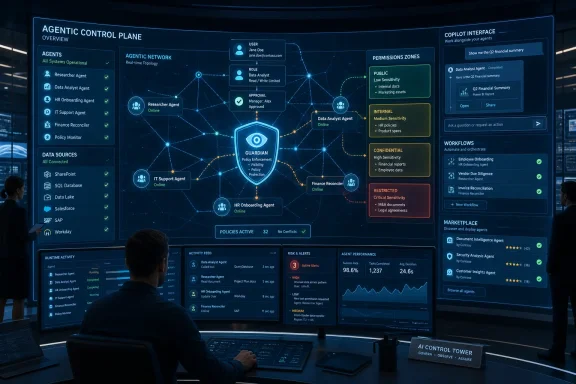
Opsin’s pitch is that the answer is “all of the above, in context.” That is why the company is leaning so heavily on the phrase “agentic control plane.” The phrase may sound vendor-polished, but it captures a practical anxiety inside IT departments: once AI agents are spread across Microsoft Copilot, Copilot Studio, ChatGPT Enterprise, Claude Enterprise, Gemini, and custom workflows, no single application console tells the whole truth.
The danger is not just that an agent might say something wrong. The danger is that it may do something plausible with the wrong authority, the wrong data, or the wrong interpretation of policy. That is a much more familiar nightmare for sysadmins: not science fiction, but identity sprawl with reasoning attached.
The earlier problem was posture: what sensitive content is exposed, where are permissions too loose, and what might Copilot or another assistant retrieve if asked? The newer problem is behavior: what is an agent doing right now, which systems is it touching, which data is it combining, and whose authority is being used to do it? A spreadsheet of permissions is not enough when the software is dynamically deciding what to retrieve and what to trigger next.
That is where Opsin’s “contextual layer” becomes the core of its argument. The company says it maps agent behavior across data, sensitivity, identity, and human involvement. In plain English, Opsin is trying to answer the question every CISO will eventually ask after a failed agent workflow: who let this thing do that?
This is also why the company is careful to contrast itself with “legacy tools” and earlier AI security products. Legacy data loss prevention, classification, and access governance systems were built around relatively static assumptions. Even many AI security startups initially focused on prompts, model interactions, and chatbot guardrails. Opsin is betting that the center of gravity has shifted from monitoring what users type into AI systems to monitoring what AI systems are empowered to do afterward.
The term guardian agent is revealing. It implies not just controls around AI, but AI-enabled supervision of other AI systems. Enterprise software has long had monitors, brokers, policy engines, and security gateways. The new wrinkle is that the systems being monitored may themselves be autonomous, adaptive, and distributed across SaaS applications.
There is an obvious circularity here. If agents are risky because they can act unpredictably, why should enterprises trust another agent-like system to supervise them? The answer, at least in the emerging market view, is separation of duties. The agent that books a supplier meeting, drafts a contract clause, or queries patient-adjacent operational data should not be the same authority that decides whether that behavior is acceptable.
That creates a new layer in the enterprise stack. It is not quite CASB, not quite DLP, not quite identity governance, and not quite observability. It borrows from all of them, then adds runtime interpretation of agent behavior. Opsin’s strategic challenge is to prove that this is a durable platform category rather than a feature that Microsoft, Google, Anthropic, OpenAI, Salesforce, ServiceNow, or the security incumbents will absorb.
If an employee can access a document, Copilot may be able to reason over it. If SharePoint, Teams, OneDrive, or internal sites have accumulated years of permissive sharing, an AI assistant can turn that quiet mess into a highly responsive discovery engine. Security teams that tolerated stale permissions when search was clumsy may feel differently when natural language makes sensitive material easier to surface.
Opsin says Culligan reduced sensitive data with overshared permissions surfacing in Microsoft Copilot queries from 80 percent to under 15 percent after launch. It also says Barry-Wehmiller’s 24-hour risk assessment found that more than 70 percent of AI prompts referenced overshared data, later reduced to less than 20 percent after deployment. These are vendor-reported figures, but they land because they describe a pattern many Microsoft 365 administrators already recognize.
The numbers also illustrate why Copilot security has become a wedge for broader agent governance. Once a company accepts that AI can reveal hidden permission debt, the next question is what happens when AI is not just retrieving information but taking action through Power Automate, Dataverse, custom connectors, service desks, CRM platforms, ERP systems, and developer tooling. The oversharing problem becomes the training ground for the autonomy problem.
Opsin’s Azure Marketplace launch in March 2026 reinforces that Microsoft-centric path. Marketplace availability does not guarantee adoption, but it lowers procurement friction for enterprises already standardized on Azure purchasing channels. In security software, ease of buying often matters almost as much as technical elegance, especially when the problem is urgent and budget owners are scattered across security, data, and AI transformation teams.
Healthcare is an especially potent signal because protected health information changes the stakes. A badly governed agent that retrieves or summarizes sensitive patient-related material is not merely embarrassing. It can create compliance, privacy, and trust consequences that outlast the technical incident.
Manufacturing creates a different risk profile. These companies often have sprawling permissions, long-lived file shares, proprietary process documents, supplier data, engineering material, and operational workflows that were never designed for AI-mediated discovery. An agent that helps knowledge workers find information faster can be valuable, but only if it does not collapse years of access shortcuts into a single conversational interface.
The customer claims also reveal the operational promise Opsin is selling: security without becoming the department of “no.” Pham’s quote frames security as a “throttle for the business,” not an innovation blocker. That language is calculated, but it is also the only politically viable path for AI governance. If security teams simply try to freeze agent adoption, business units will route around them with vendor pilots, shadow workflows, and embedded SaaS assistants.
The winning security products in this wave will not be the ones that merely detect risk. They will be the ones that assign ownership, explain remediation, and let enterprises keep deploying. Opsin’s claim that 98 percent of issues are auto-assigned to a clear owner is therefore more important than it may first appear. In large organizations, discovering a problem is often easier than finding the human responsible for fixing it.
The 24-hour assessment also plays into a powerful emotional dynamic: most organizations suspect they have more AI exposure than they can see. Opsin says its assessments reveal, on average, hundreds of exposed files, more than a hundred sites with excessive access, hundreds of agents, and more than 100 agents with overly broad data access or missing ownership. Even allowing for vendor-selected averages, the picture is credible because it matches the way enterprise systems actually decay.
Permissions sprawl is not a bug introduced by AI. It is the sediment of years of collaboration, reorgs, migrations, contractor access, shared drives, emergency exceptions, and abandoned projects. AI simply makes the sediment searchable and actionable. A fast assessment gives security leaders something they can take to the CIO, the data governance team, and business owners without waiting for a full platform rollout.
There is a risk in this model, too. Rapid assessments can turn into scareware if vendors overstate exposure or flatten nuance into alarming counts. Not every overshared file is equally sensitive; not every agent with broad access is equally dangerous; not every prompt referencing sensitive material is a policy violation. The value of Opsin’s approach will depend on whether its context graph can prioritize risk intelligently rather than merely produce bigger numbers.
That is why the company’s emphasis on root-cause remediation matters. If a platform only says “sensitive data was exposed,” it becomes another alert source. If it says which permission, owner, site, connector, workflow, or agent design caused the exposure, it becomes operationally useful. The difference is the difference between a dashboard and a control plane.
Graphs have become a familiar pattern in security. Attack-path management maps how an intruder could move. Identity graphs map users, roles, and privileges. Data security posture management maps sensitive data stores and exposures. Opsin is applying that logic to AI behavior, where the edges are not only permissions but also prompts, tool calls, knowledge sources, owners, and downstream actions.
If it works, the payoff is obvious. A security analyst could distinguish between an approved HR agent retrieving salary-band policy for an HR manager and an unowned departmental agent pulling compensation files into a generalized workflow. Both events might involve sensitive data. Only one may represent unacceptable agent behavior.
The hard part is maintaining accuracy as environments change. Agents can be created by business users, modified by workflow builders, connected to new data sources, and granted capabilities through SaaS admin consoles that security teams do not watch every day. A context graph that lags behind reality becomes a false comfort. A context graph that updates continuously becomes a new kind of security inventory.
That inventory is increasingly necessary because AI agents blur the boundary between application and identity. An agent may have an owner, a builder, a runtime identity, delegated user permissions, tool credentials, and access to knowledge sources. Traditional IAM was already hard enough with humans, service accounts, and applications. Agents add a layer that is both software and actor.
Both claims can be true. Large vendors have the distribution, telemetry, and customer trust to add AI controls into existing consoles. Startups have the advantage of designing around agent behavior from the beginning rather than grafting it onto human-centric security assumptions. Buyers should expect consolidation, overlap, and terminology inflation.
The phrase “second generation” in Opsin’s announcement is therefore doing real work. It positions earlier AI security as prompt-era tooling and Opsin as part of the runtime agent era. That framing is convenient for Opsin, but it also captures a genuine shift. The first generation asked whether AI systems were safe to use. The second asks whether AI systems are safe to empower.
This distinction will matter most in regulated and high-scale environments. A small company may be able to govern AI usage with policy, training, and a few admin controls. A multinational with thousands of copilots, custom GPTs, Claude projects, Gemini integrations, and workflow agents cannot rely on manual review. At that scale, discovery itself becomes a security function.
Still, the category needs discipline. “Agent security” can become a bucket for everything from prompt filtering to data classification to identity governance to model evaluation. The vendors that survive will be the ones that define narrow, repeatable jobs and integrate with the systems where enterprises already manage risk. Opsin’s focus on visibility, governance, and remediation is a sensible triad; the question is whether it remains sharp as the platform expands.
That is why Opsin’s reported customer outcomes emphasize time-to-value and remediation. The company says customers saw an average 67 percent reduction in prompt-to-root-cause tracing time, a 70 percent average reduction in AI and agent risk within six weeks, and rapid growth in AI adoption after security teams approved deployment. These are company-reported metrics, but they show how Opsin wants to be evaluated: not by abstract governance maturity, but by operational friction removed.
For WindowsForum readers, the Microsoft angle is especially relevant. Many organizations rolling out Copilot are discovering that the preparatory work is less about AI and more about Microsoft 365 hygiene. SharePoint permissions, Teams sprawl, Purview labels, Entra identities, Power Platform connectors, and audit logs all become part of the AI security surface.
A tool like Opsin does not eliminate the need to do that work. If anything, it makes the work more visible and harder to postpone. The difference is that it may help prioritize which messes matter most because an agent is actually using them, not merely because a static scan found a theoretical exposure.
That distinction is crucial. Security teams drown in theoretical risk. The most useful AI governance tools will connect exposure to observed behavior: this agent accessed that sensitive source, under this identity, for this purpose, with this owner, and here is the remediation path. Without that context, agent security will become another compliance dashboard that everyone acknowledges and no one fixes.
A human who approves a well-explained action before execution is one kind of control. A human who receives a notification after an agent has already updated records is another. A human who technically owns an agent but never reviews its tool permissions is barely a control at all.
Agent governance will have to become more precise about these distinctions. Some workflows can tolerate asynchronous review. Others require pre-approval. Still others should never be delegated to an autonomous agent without additional controls. Opsin’s contextual framing suggests it wants to classify not only what agents do, but whether the surrounding human oversight is appropriate for the sensitivity and consequence of the action.
This is where security policy will collide with business impatience. The more capable agents become, the more users will want them to operate without interruption. Every approval step feels like friction. Every friction point becomes a target for removal in the name of productivity.
The job of agent security will be to decide where friction is justified. That requires more than a rule saying “block sensitive data.” It requires understanding whether the agent’s purpose, user, data, action, and approval model align. In mature environments, that will look less like content moderation and more like real-time risk adjudication.
In the pre-agent world, a user might never find a file they technically had permission to access. In the Copilot world, the assistant may surface it in response to a natural-language question. In the agentic world, the system may incorporate it into a workflow, send it to another tool, or use it as the basis for a decision. Each step increases the operational significance of permissions hygiene.
That is why products in this space will increasingly integrate with Microsoft Purview, Entra, Power Automate, Dataverse, and marketplace procurement channels. The governance layer cannot sit off to the side as an AI-only console. It has to connect into the mundane plumbing of enterprise IT.
Opsin says it already integrates across major enterprise AI platforms and with parts of the broader security ecosystem, with more underway. The platform breadth is important because enterprise AI will not standardize on one model provider or one agent framework. A company may use Copilot for productivity, Claude for analysis, Gemini through Google Workspace, ChatGPT Enterprise for knowledge work, and custom agents inside business applications.
That heterogeneity is where independent governance has a plausible opening. Microsoft can govern Microsoft surfaces. Google can govern Google surfaces. Anthropic and OpenAI can secure their enterprise products. But CISOs need a cross-platform view because risk does not respect vendor boundaries. The more fragmented the agent estate becomes, the more valuable a neutral map of agents, data, identity, and behavior becomes.
The strongest version of Opsin’s story is not that legacy tools are useless. It is that they were not designed to interpret autonomous behavior across AI systems. A DLP rule may identify regulated data. An identity platform may know who has access. A SIEM may collect logs. But none of those systems necessarily understands that a specific agent, built for a specific business purpose, is using that access in a way that diverges from its intended role.
That is the gap Opsin is trying to occupy. It wants to be the connective tissue between data sensitivity, identity, agent intent, and runtime behavior. If it can feed meaningful remediation back into existing controls, it becomes a multiplier. If it tries to become yet another isolated console, it risks becoming part of the sprawl it was meant to solve.
The best customers for this kind of platform will likely be those that already have some security maturity. Organizations with chaotic identity, weak ownership, and poor data governance may get alarming assessments but struggle to act on them. A context graph can identify root causes, but someone still has to change permissions, retire agents, tighten connectors, and enforce ownership.
That reality should temper the hype. Agent security platforms can accelerate governance, but they cannot manufacture organizational accountability. If no one owns the data, no one owns the agent, and no one owns the risk, the tool can only point at the vacuum.
That is not accidental. Agentic AI governance sits across traditional budget lines. It is security software, but it enables AI adoption. It is data governance, but the trigger is runtime behavior. It is identity-adjacent, but the actors are partly autonomous. It is compliance-relevant, but the buyer may be trying to unlock productivity rather than satisfy an auditor.
This makes the market both promising and messy. If a breach or compliance incident is tied to an AI agent, the CISO will be accountable. If agent projects stall, the CIO and business leaders will complain that security is slowing transformation. If sensitive data is exposed, legal and privacy teams will want evidence. If the agent acted through a user’s permissions, identity teams will be pulled into the review.
Opsin is effectively selling a shared evidence layer for that argument. Its value is not only blocking bad behavior but giving different stakeholders a common account of what happened. In enterprise governance, that kind of shared truth is often the difference between progress and committee paralysis.
The company’s challenge will be to maintain trust as the stakes rise. Security buyers are skeptical by training, and AI marketing has exhausted much of its goodwill. Opsin’s customer metrics are attention-grabbing, but long-term credibility will come from repeatable deployments, transparent limitations, and integrations that reduce work rather than merely reclassify it.
 The Security Problem Moved From Prompts to Power
For the first wave of generative AI adoption, the security discussion was mostly about leakage. Employees pasted confidential material into public tools, copilots surfaced overshared documents, and legal teams asked whether model providers were training on private data. Those concerns were real, but they still fit a familiar pattern: humans used software, software returned content, and security teams tried to reduce the blast radius.Agentic AI breaks that bargain. An agent is not merely a text box with better autocomplete; it can call tools, query repositories, update systems, chain decisions, and act on behalf of a user. That makes the security object harder to define. Are you governing the model, the prompt, the plugin, the workflow, the identity, the data source, or the human who approved the automation?
Opsin’s pitch is that the answer is “all of the above, in context.” That is why the company is leaning so heavily on the phrase “agentic control plane.” The phrase may sound vendor-polished, but it captures a practical anxiety inside IT departments: once AI agents are spread across Microsoft Copilot, Copilot Studio, ChatGPT Enterprise, Claude Enterprise, Gemini, and custom workflows, no single application console tells the whole truth.
The danger is not just that an agent might say something wrong. The danger is that it may do something plausible with the wrong authority, the wrong data, or the wrong interpretation of policy. That is a much more familiar nightmare for sysadmins: not science fiction, but identity sprawl with reasoning attached.
Opsin Wants to Be the Layer That Watches the Watchers
Opsin was founded in 2024, which matters because it was born after the first corporate shockwave around ChatGPT but before most enterprises had a mature strategy for agents. The company says it began with data oversharing in AI environments and has since expanded into a broader Enterprise Agent Security platform. That evolution mirrors the market’s own pivot.The earlier problem was posture: what sensitive content is exposed, where are permissions too loose, and what might Copilot or another assistant retrieve if asked? The newer problem is behavior: what is an agent doing right now, which systems is it touching, which data is it combining, and whose authority is being used to do it? A spreadsheet of permissions is not enough when the software is dynamically deciding what to retrieve and what to trigger next.
That is where Opsin’s “contextual layer” becomes the core of its argument. The company says it maps agent behavior across data, sensitivity, identity, and human involvement. In plain English, Opsin is trying to answer the question every CISO will eventually ask after a failed agent workflow: who let this thing do that?
This is also why the company is careful to contrast itself with “legacy tools” and earlier AI security products. Legacy data loss prevention, classification, and access governance systems were built around relatively static assumptions. Even many AI security startups initially focused on prompts, model interactions, and chatbot guardrails. Opsin is betting that the center of gravity has shifted from monitoring what users type into AI systems to monitoring what AI systems are empowered to do afterward.
Analyst Recognition Is a Signal, Not a Verdict
Opsin’s announcement leans heavily on 2026 recognition from Gartner, OWASP, the Cloud Security Alliance, and the Global InfoSec Awards. The most important of those claims is Gartner’s Market Guide for Guardian Agents, where Opsin says it was included as a representative vendor in the risk and security specialist category. That matters less as a trophy than as evidence that the analyst world is giving language to a market customers were already starting to invent on their own.The term guardian agent is revealing. It implies not just controls around AI, but AI-enabled supervision of other AI systems. Enterprise software has long had monitors, brokers, policy engines, and security gateways. The new wrinkle is that the systems being monitored may themselves be autonomous, adaptive, and distributed across SaaS applications.
There is an obvious circularity here. If agents are risky because they can act unpredictably, why should enterprises trust another agent-like system to supervise them? The answer, at least in the emerging market view, is separation of duties. The agent that books a supplier meeting, drafts a contract clause, or queries patient-adjacent operational data should not be the same authority that decides whether that behavior is acceptable.
That creates a new layer in the enterprise stack. It is not quite CASB, not quite DLP, not quite identity governance, and not quite observability. It borrows from all of them, then adds runtime interpretation of agent behavior. Opsin’s strategic challenge is to prove that this is a durable platform category rather than a feature that Microsoft, Google, Anthropic, OpenAI, Salesforce, ServiceNow, or the security incumbents will absorb.
Microsoft Copilot Is the Beachhead, Not the Destination
The customer examples in Opsin’s announcement make clear where the company found its opening: Microsoft Copilot and enterprise data oversharing. That is not surprising. Microsoft 365 is where many organizations first discovered that AI does not create a new permissions problem so much as expose the old one with brutal efficiency.If an employee can access a document, Copilot may be able to reason over it. If SharePoint, Teams, OneDrive, or internal sites have accumulated years of permissive sharing, an AI assistant can turn that quiet mess into a highly responsive discovery engine. Security teams that tolerated stale permissions when search was clumsy may feel differently when natural language makes sensitive material easier to surface.
Opsin says Culligan reduced sensitive data with overshared permissions surfacing in Microsoft Copilot queries from 80 percent to under 15 percent after launch. It also says Barry-Wehmiller’s 24-hour risk assessment found that more than 70 percent of AI prompts referenced overshared data, later reduced to less than 20 percent after deployment. These are vendor-reported figures, but they land because they describe a pattern many Microsoft 365 administrators already recognize.
The numbers also illustrate why Copilot security has become a wedge for broader agent governance. Once a company accepts that AI can reveal hidden permission debt, the next question is what happens when AI is not just retrieving information but taking action through Power Automate, Dataverse, custom connectors, service desks, CRM platforms, ERP systems, and developer tooling. The oversharing problem becomes the training ground for the autonomy problem.
Opsin’s Azure Marketplace launch in March 2026 reinforces that Microsoft-centric path. Marketplace availability does not guarantee adoption, but it lowers procurement friction for enterprises already standardized on Azure purchasing channels. In security software, ease of buying often matters almost as much as technical elegance, especially when the problem is urgent and budget owners are scattered across security, data, and AI transformation teams.
The Customer List Is Designed to Reassure Regulated Buyers
Opsin names Wellstar Health System, Barry-Wehmiller, Encore Technologies, UiPath, Cascade, and Culligan among organizations using or associated with its platform. That is not just logo theater. The mix is meant to communicate that agent security is not a Silicon Valley hobbyhorse; it is appearing in healthcare, manufacturing, services, automation, and other operational environments where failure can be expensive.Healthcare is an especially potent signal because protected health information changes the stakes. A badly governed agent that retrieves or summarizes sensitive patient-related material is not merely embarrassing. It can create compliance, privacy, and trust consequences that outlast the technical incident.
Manufacturing creates a different risk profile. These companies often have sprawling permissions, long-lived file shares, proprietary process documents, supplier data, engineering material, and operational workflows that were never designed for AI-mediated discovery. An agent that helps knowledge workers find information faster can be valuable, but only if it does not collapse years of access shortcuts into a single conversational interface.
The customer claims also reveal the operational promise Opsin is selling: security without becoming the department of “no.” Pham’s quote frames security as a “throttle for the business,” not an innovation blocker. That language is calculated, but it is also the only politically viable path for AI governance. If security teams simply try to freeze agent adoption, business units will route around them with vendor pilots, shadow workflows, and embedded SaaS assistants.
The winning security products in this wave will not be the ones that merely detect risk. They will be the ones that assign ownership, explain remediation, and let enterprises keep deploying. Opsin’s claim that 98 percent of issues are auto-assigned to a clear owner is therefore more important than it may first appear. In large organizations, discovering a problem is often easier than finding the human responsible for fixing it.
The 24-Hour Assessment Is a Sales Motion With Technical Teeth
Opsin’s “1-24 promise” — one-click onboarding via API and a full risk assessment within 24 hours — is part product claim and part go-to-market weapon. Enterprise security tools have a reputation for long deployments, noisy dashboards, and months of tuning before value appears. AI risk, by contrast, is moving fast enough that buyers want proof almost immediately.The 24-hour assessment also plays into a powerful emotional dynamic: most organizations suspect they have more AI exposure than they can see. Opsin says its assessments reveal, on average, hundreds of exposed files, more than a hundred sites with excessive access, hundreds of agents, and more than 100 agents with overly broad data access or missing ownership. Even allowing for vendor-selected averages, the picture is credible because it matches the way enterprise systems actually decay.
Permissions sprawl is not a bug introduced by AI. It is the sediment of years of collaboration, reorgs, migrations, contractor access, shared drives, emergency exceptions, and abandoned projects. AI simply makes the sediment searchable and actionable. A fast assessment gives security leaders something they can take to the CIO, the data governance team, and business owners without waiting for a full platform rollout.
There is a risk in this model, too. Rapid assessments can turn into scareware if vendors overstate exposure or flatten nuance into alarming counts. Not every overshared file is equally sensitive; not every agent with broad access is equally dangerous; not every prompt referencing sensitive material is a policy violation. The value of Opsin’s approach will depend on whether its context graph can prioritize risk intelligently rather than merely produce bigger numbers.
That is why the company’s emphasis on root-cause remediation matters. If a platform only says “sensitive data was exposed,” it becomes another alert source. If it says which permission, owner, site, connector, workflow, or agent design caused the exposure, it becomes operationally useful. The difference is the difference between a dashboard and a control plane.
The Context Graph Is Opsin’s Bid for Platform Gravity
Opsin’s AI Context Graph, announced in March 2026, is the company’s most ambitious product claim. The idea is to map relationships between agents, data, and identities in real time so security teams can understand not just isolated events but the web of authority and exposure behind them. In enterprise security terms, that is an attempt to build a graph of intent, access, and action.Graphs have become a familiar pattern in security. Attack-path management maps how an intruder could move. Identity graphs map users, roles, and privileges. Data security posture management maps sensitive data stores and exposures. Opsin is applying that logic to AI behavior, where the edges are not only permissions but also prompts, tool calls, knowledge sources, owners, and downstream actions.
If it works, the payoff is obvious. A security analyst could distinguish between an approved HR agent retrieving salary-band policy for an HR manager and an unowned departmental agent pulling compensation files into a generalized workflow. Both events might involve sensitive data. Only one may represent unacceptable agent behavior.
The hard part is maintaining accuracy as environments change. Agents can be created by business users, modified by workflow builders, connected to new data sources, and granted capabilities through SaaS admin consoles that security teams do not watch every day. A context graph that lags behind reality becomes a false comfort. A context graph that updates continuously becomes a new kind of security inventory.
That inventory is increasingly necessary because AI agents blur the boundary between application and identity. An agent may have an owner, a builder, a runtime identity, delegated user permissions, tool credentials, and access to knowledge sources. Traditional IAM was already hard enough with humans, service accounts, and applications. Agents add a layer that is both software and actor.
The Market Is Crowded Because the Risk Is Real
Opsin is not alone in seeing the opening. The broader security industry is rapidly attaching itself to AI governance, agent security, AI TRiSM, posture management, runtime defense, and data exposure management. Incumbents will argue that agent governance belongs inside existing data security, endpoint, cloud security, identity, or SIEM platforms. Startups will argue that incumbents cannot move fast enough because agents require a purpose-built model.Both claims can be true. Large vendors have the distribution, telemetry, and customer trust to add AI controls into existing consoles. Startups have the advantage of designing around agent behavior from the beginning rather than grafting it onto human-centric security assumptions. Buyers should expect consolidation, overlap, and terminology inflation.
The phrase “second generation” in Opsin’s announcement is therefore doing real work. It positions earlier AI security as prompt-era tooling and Opsin as part of the runtime agent era. That framing is convenient for Opsin, but it also captures a genuine shift. The first generation asked whether AI systems were safe to use. The second asks whether AI systems are safe to empower.
This distinction will matter most in regulated and high-scale environments. A small company may be able to govern AI usage with policy, training, and a few admin controls. A multinational with thousands of copilots, custom GPTs, Claude projects, Gemini integrations, and workflow agents cannot rely on manual review. At that scale, discovery itself becomes a security function.
Still, the category needs discipline. “Agent security” can become a bucket for everything from prompt filtering to data classification to identity governance to model evaluation. The vendors that survive will be the ones that define narrow, repeatable jobs and integrate with the systems where enterprises already manage risk. Opsin’s focus on visibility, governance, and remediation is a sensible triad; the question is whether it remains sharp as the platform expands.
Enterprise IT Will Judge This by Remediation, Not Rhetoric
The practical buyer for Opsin is not looking for a philosophical debate about autonomy. They are looking for answers to painfully concrete questions. Which agents exist? Who owns them? What data can they touch? What actions can they take? Which ones are violating policy? How do we fix the exposure without shutting down the business?That is why Opsin’s reported customer outcomes emphasize time-to-value and remediation. The company says customers saw an average 67 percent reduction in prompt-to-root-cause tracing time, a 70 percent average reduction in AI and agent risk within six weeks, and rapid growth in AI adoption after security teams approved deployment. These are company-reported metrics, but they show how Opsin wants to be evaluated: not by abstract governance maturity, but by operational friction removed.
For WindowsForum readers, the Microsoft angle is especially relevant. Many organizations rolling out Copilot are discovering that the preparatory work is less about AI and more about Microsoft 365 hygiene. SharePoint permissions, Teams sprawl, Purview labels, Entra identities, Power Platform connectors, and audit logs all become part of the AI security surface.
A tool like Opsin does not eliminate the need to do that work. If anything, it makes the work more visible and harder to postpone. The difference is that it may help prioritize which messes matter most because an agent is actually using them, not merely because a static scan found a theoretical exposure.
That distinction is crucial. Security teams drown in theoretical risk. The most useful AI governance tools will connect exposure to observed behavior: this agent accessed that sensitive source, under this identity, for this purpose, with this owner, and here is the remediation path. Without that context, agent security will become another compliance dashboard that everyone acknowledges and no one fixes.
The Human in the Loop Is Becoming a Policy Variable
Opsin’s announcement repeatedly mentions the human in the loop. That phrase has become a comfort blanket in AI governance, suggesting that as long as a person approves the final step, the organization remains in control. But in enterprise systems, “human in the loop” is not a binary property. It is a design choice with timing, authority, and accountability attached.A human who approves a well-explained action before execution is one kind of control. A human who receives a notification after an agent has already updated records is another. A human who technically owns an agent but never reviews its tool permissions is barely a control at all.
Agent governance will have to become more precise about these distinctions. Some workflows can tolerate asynchronous review. Others require pre-approval. Still others should never be delegated to an autonomous agent without additional controls. Opsin’s contextual framing suggests it wants to classify not only what agents do, but whether the surrounding human oversight is appropriate for the sensitivity and consequence of the action.
This is where security policy will collide with business impatience. The more capable agents become, the more users will want them to operate without interruption. Every approval step feels like friction. Every friction point becomes a target for removal in the name of productivity.
The job of agent security will be to decide where friction is justified. That requires more than a rule saying “block sensitive data.” It requires understanding whether the agent’s purpose, user, data, action, and approval model align. In mature environments, that will look less like content moderation and more like real-time risk adjudication.
The Windows Admin’s AI Problem Is Really an Old Permissions Problem With New Speed
For all the novelty around agents, much of the underlying pain will feel familiar to Windows and Microsoft 365 administrators. Over-permissioned file shares, stale groups, inherited access, orphaned owners, undocumented workflows, and service accounts with too much reach have been around for decades. AI did not invent these problems. It compresses the time between exposure and consequence.In the pre-agent world, a user might never find a file they technically had permission to access. In the Copilot world, the assistant may surface it in response to a natural-language question. In the agentic world, the system may incorporate it into a workflow, send it to another tool, or use it as the basis for a decision. Each step increases the operational significance of permissions hygiene.
That is why products in this space will increasingly integrate with Microsoft Purview, Entra, Power Automate, Dataverse, and marketplace procurement channels. The governance layer cannot sit off to the side as an AI-only console. It has to connect into the mundane plumbing of enterprise IT.
Opsin says it already integrates across major enterprise AI platforms and with parts of the broader security ecosystem, with more underway. The platform breadth is important because enterprise AI will not standardize on one model provider or one agent framework. A company may use Copilot for productivity, Claude for analysis, Gemini through Google Workspace, ChatGPT Enterprise for knowledge work, and custom agents inside business applications.
That heterogeneity is where independent governance has a plausible opening. Microsoft can govern Microsoft surfaces. Google can govern Google surfaces. Anthropic and OpenAI can secure their enterprise products. But CISOs need a cross-platform view because risk does not respect vendor boundaries. The more fragmented the agent estate becomes, the more valuable a neutral map of agents, data, identity, and behavior becomes.
The Vendor Story Is Strongest Where It Admits the Old Stack Still Matters
Opsin’s rhetoric draws a bright line between legacy tools and agent-era security. That is understandable positioning, but enterprises should resist the idea that the old stack is obsolete. DLP, CASB, identity governance, EDR, SIEM, SOAR, data classification, and audit logging still matter. The agent layer does not replace them; it changes what they must be able to see.The strongest version of Opsin’s story is not that legacy tools are useless. It is that they were not designed to interpret autonomous behavior across AI systems. A DLP rule may identify regulated data. An identity platform may know who has access. A SIEM may collect logs. But none of those systems necessarily understands that a specific agent, built for a specific business purpose, is using that access in a way that diverges from its intended role.
That is the gap Opsin is trying to occupy. It wants to be the connective tissue between data sensitivity, identity, agent intent, and runtime behavior. If it can feed meaningful remediation back into existing controls, it becomes a multiplier. If it tries to become yet another isolated console, it risks becoming part of the sprawl it was meant to solve.
The best customers for this kind of platform will likely be those that already have some security maturity. Organizations with chaotic identity, weak ownership, and poor data governance may get alarming assessments but struggle to act on them. A context graph can identify root causes, but someone still has to change permissions, retire agents, tighten connectors, and enforce ownership.
That reality should temper the hype. Agent security platforms can accelerate governance, but they cannot manufacture organizational accountability. If no one owns the data, no one owns the agent, and no one owns the risk, the tool can only point at the vacuum.
Opsin’s Momentum Shows Where the Buying Center Is Moving
One of the more interesting aspects of Opsin’s announcement is how many constituencies it tries to address at once. CISOs get visibility and controls. Data owners get remediation instructions. AI teams get a path to production. Procurement gets Azure Marketplace availability. Analysts get a category narrative. Regulated customers get reassurance that peers are already deploying.That is not accidental. Agentic AI governance sits across traditional budget lines. It is security software, but it enables AI adoption. It is data governance, but the trigger is runtime behavior. It is identity-adjacent, but the actors are partly autonomous. It is compliance-relevant, but the buyer may be trying to unlock productivity rather than satisfy an auditor.
This makes the market both promising and messy. If a breach or compliance incident is tied to an AI agent, the CISO will be accountable. If agent projects stall, the CIO and business leaders will complain that security is slowing transformation. If sensitive data is exposed, legal and privacy teams will want evidence. If the agent acted through a user’s permissions, identity teams will be pulled into the review.
Opsin is effectively selling a shared evidence layer for that argument. Its value is not only blocking bad behavior but giving different stakeholders a common account of what happened. In enterprise governance, that kind of shared truth is often the difference between progress and committee paralysis.
The company’s challenge will be to maintain trust as the stakes rise. Security buyers are skeptical by training, and AI marketing has exhausted much of its goodwill. Opsin’s customer metrics are attention-grabbing, but long-term credibility will come from repeatable deployments, transparent limitations, and integrations that reduce work rather than merely reclassify it.
The Opsin Announcement Is Really a Warning About Agent Sprawl
The concrete lesson from Opsin’s 2026 momentum is that enterprises are already accumulating AI agents faster than they can govern them. The product names will change, and the market labels will mutate, but the operational pattern is now visible: discovery, ownership, context, and remediation are becoming the minimum viable controls for production AI.- Enterprises should assume that AI agents already exist outside the security team’s clean inventory.
- Microsoft Copilot deployments expose old permission problems before they create entirely new ones.
- Agent governance requires runtime context because static classification cannot explain what an autonomous workflow is actually doing.
- Cross-platform visibility will matter as companies mix Copilot, custom GPTs, Claude, Gemini, and embedded SaaS agents.
- Remediation ownership is as important as detection because unmanaged findings quickly become another source of alert fatigue.
- Security teams that can govern agent behavior without blocking deployment will have more influence than teams that simply say no.
References
- Primary source: 01net
Published: 2026-06-17T23:50:17.837950
Opsin Leads the Second Generation of Enterprise AI Security as Agents Move from Saying to Doing
Marquee customer wins, analyst recognition, and platform innovation underscore Opsin's leadership in governance for autonomous enterprise agentsSAN FRANCISCO--(BUSINESS WIRE)--Opsin, the Enterprise AI Security company, today reported significant 2026 ... www.01net.it
- Related coverage: opsinsecurity.com
Gartner® Market Guide for Guardian Agents Explained
Learn what the Gartner® Market Guide for Guardian Agents means for enterprise AI security, agent governance, and managing agentic AI risk.www.opsinsecurity.com - Related coverage: gartner.com
Gartner Predicts that Guardian Agents will Capture 10-15% of the Agentic AI Market by 2030
By 2030, guardian agent technologies will account for at least 10 to 15% of agentic AI markets, according to Gartner, Inc.www.gartner.com - Related coverage: info.orchid.security

2026 Market Guide for Guardian Agents
Gartner's Market Guide for Guardian agents defining the emerging requirement for AI agent supervision and runtime controls
info.orchid.security
- Related coverage: kensai.app
Gartner Launches Guardian Agents Market Guide, M-Trends 2026 Reports 22-Second Access Handoff, Oracle & Citrix Ship Emergency Patches | KENSAI Cybersecurity
Gartner publishes first-ever Market Guide for Guardian Agents. Mandiant M-Trends 2026 reveals initial access handoff collapsed to 22 seconds. Oracle and Citrix release critical emergency patches. Dutch Ministry of Finance breached. QualDerm exposes 3.1M records.kensai.app - Related coverage: subagentic.ai
Gartner's First Market Guide for Guardian Agents: 70% of Enterprises Now Running AI Agents | subagentic.ai — Agentic AI News
Gartner's first Market Guide for Guardian Agents finds nearly 70% of enterprises running AI agents, but governance is lagging behind.subagentic.ai
- Related coverage: kontext.security
What Are Guardian Agents? Security Guide | Kontext Articles
Learn what guardian agents are, how Gartner defines the 2026 market, what they should discover and enforce, and where they fit in AI agent security stacks. kontext.security
- Related coverage: 46355935.fs1.hubspotusercontent-na2.net
Opsin quick guide test prompts assessing copilot oversharing risk
PDF document46355935.fs1.hubspotusercontent-na2.net
- Related coverage: airrived.ai
