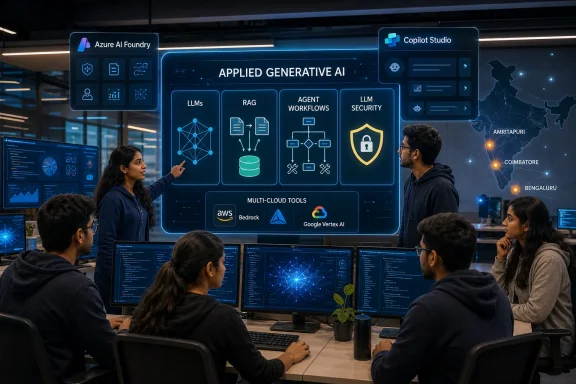
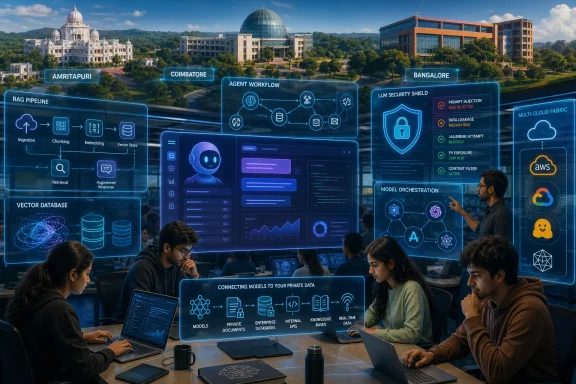
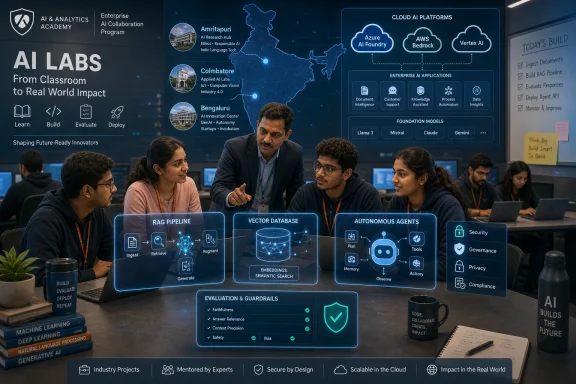
Orion Innovation and Amrita Vishwa Vidyapeetham launched a co-branded Applied Generative AI elective on June 4, 2026, delivering hands-on AI coursework to sixth-semester students across Amrita’s Amritapuri, Coimbatore, and Bengaluru campuses in India. The announcement is modest in scale — a little over 70 students at launch — but it points to a larger shift in how AI skills are being industrialized before graduates ever reach their first job. The real story is not that another university has added “GenAI” to the syllabus. It is that the curriculum reads less like a computer science elective and more like a vendor-aware onboarding track for the new software workplace.
For two years, enterprises have talked about generative AI as if deployment were mainly a tools problem. Buy the platform, connect the data, put a chatbot on top, and productivity will follow. The harder truth has been slower to arrive: companies do not just need AI tools, they need engineers who understand how these systems fail, how they are integrated, and how they behave when placed inside messy real-world workflows.
That is the context in which the Orion-Amrita program matters. The elective is not being positioned as a research seminar or a speculative tour of machine learning theory. It is explicitly framed as applied training: large language models, prompt engineering, retrieval-augmented generation, agentic frameworks, responsible AI, LLM security, fine-tuning, autonomous agents, vector databases, and the commercial platforms that now dominate enterprise AI experimentation.
That list is doing a lot of work. It acknowledges that “AI literacy” is no longer enough for engineering students. A graduate entering a services firm, cloud team, security group, or application modernization project may be expected to know not only what an LLM is, but how to connect one to enterprise documents, constrain its outputs, evaluate its answers, and keep it from becoming a liability.
This is the part of the AI education boom that has matured fastest. Universities are still responsible for fundamentals, but employers increasingly want graduates who have already touched the scaffolding around modern AI systems. Orion’s bet is that a useful AI engineer is not merely someone who can call an API. It is someone who can reason across cloud services, orchestration frameworks, data pipelines, model behavior, and governance constraints.
For WindowsForum readers, the Microsoft pieces are especially notable. Azure AI Foundry and Copilot Studio sit squarely in Microsoft’s attempt to turn generative AI from a feature into an application-development layer. In that world, AI is not just a chatbot embedded in Office or a sidebar inside Windows. It becomes a way to build enterprise agents, connect business data, enforce governance policies, and automate domain-specific workflows.
That makes this kind of elective more than a campus résumé booster. If students are learning how Copilot-style systems are composed — where prompts end and retrieval begins, where connectors matter, where policies need to be enforced — they are being introduced to the same conceptual model Microsoft is selling to its enterprise customers. The university classroom becomes an early training ground for the platform economy.
There is an obvious commercial upside for Orion. As a software engineering services partner, Orion needs people who can arrive prepared for client work involving cloud migration, AI adoption, data modernization, and application integration. A student who has already worked through RAG patterns, prompt evaluation, or agent orchestration is cheaper to ramp than one encountering those concepts for the first time on a billable project.
But there is also an upside for students, provided the program is run with enough rigor. The AI hiring market is crowded with vague claims and shallow credentials. A course that asks students to build, test, and critique working systems has a better chance of producing evidence of competence than a certificate based on vocabulary alone.
The sixth-semester timing is important. These students are far enough into their degree to have programming, data structures, systems, or software engineering foundations, but still early enough for internships and final-year projects to be shaped by the elective. That gives the program more leverage than a last-semester finishing course bolted onto the end of a degree.
The internship pathway is equally important. Orion says high-potential students may be considered for internships, which turns the elective into both a training program and a talent-identification channel. That is not inherently a problem. In fact, industry pipelines can be valuable when they expose students to real project expectations. But universities will need to preserve academic independence, making sure the course does not narrow into a pre-employment funnel for one company’s needs.
This is the tension at the center of industry-academia AI programs. Employers can move quickly, provide real tooling, and clarify what the market actually values. Universities can provide conceptual depth, ethical framing, and long-term intellectual resilience. The best version of this partnership combines those strengths. The weaker version gives students a tour of branded platforms and calls it professional preparation.
A genuinely applied GenAI course should force students to confront the difference between a demo and a system. A demo answers a question in a browser. A system handles missing documents, hostile prompts, bad data, latency constraints, cost limits, security boundaries, model drift, and user expectations. That difference is where most enterprise AI projects either become useful or collapse into theater.
The inclusion of RAG and vector databases suggests the elective is at least pointed in the right direction. RAG has become the standard enterprise compromise between the general knowledge of foundation models and the private knowledge of an organization. It lets developers ground responses in internal documents or structured content without retraining a model from scratch. It also introduces a host of engineering problems students need to understand: chunking, embeddings, retrieval quality, metadata filtering, permissions, and evaluation.
Agentic frameworks and autonomous agents add another layer of ambition. These systems promise software that can plan, call tools, perform multi-step tasks, and interact with external services. They also expand the blast radius when something goes wrong. Teaching agents without teaching observability, permissions, human approval workflows, and failure modes would be irresponsible. Teaching them with those constraints could give students a realistic view of where enterprise AI is headed.
Responsible AI and LLM security belong at the center of the course, not as a lecture at the end. Prompt injection, data leakage, hallucination, insecure tool use, and overreliance on model outputs are not edge cases. They are the conditions under which real AI applications operate. If the Orion-Amrita program treats these as engineering requirements rather than public-relations language, it will be more valuable than many vendor-led training tracks.
Azure AI Foundry and Copilot Studio reflect Microsoft’s broader strategy: make AI development feel like a natural extension of the enterprise stack that organizations already use. For many businesses, especially those standardized on Microsoft 365, Entra ID, Teams, SharePoint, Power Platform, and Azure, the easiest AI adoption path is not a clean-sheet startup architecture. It is incremental augmentation of the systems already embedded in daily work.
That gives Microsoft a distribution advantage in AI education too. If students learn to think in terms of copilots, connectors, identity boundaries, governed data access, and workflow automation, they are learning a model of AI development that maps closely to Microsoft’s commercial environment. This does not mean the curriculum is Microsoft-specific. It means Microsoft has succeeded in making its AI tooling part of the ordinary vocabulary of enterprise readiness.
For Windows administrators and IT pros, this is familiar terrain. Every major shift in Microsoft’s ecosystem eventually becomes a skills question. Active Directory, Group Policy, PowerShell, Intune, Azure AD — now Entra — and Microsoft 365 administration all created labor markets around operational fluency. Generative AI is likely to do the same, but with a messier blend of software development, data governance, security, and business-process analysis.
That is why university-level exposure matters. The future AI administrator or AI application engineer may not be a pure data scientist. They may be someone who understands identity, access, documents, APIs, compliance, and user workflows well enough to make AI systems useful without letting them run wild.
Generative AI creates a sharper challenge. The tools are easy enough to demo but difficult to deploy responsibly. The market is moving quickly, but enterprise clients remain cautious. Services firms need employees who can help clients separate realistic use cases from executive wish lists, while also building the prototypes, integrations, and governance models that make adoption possible.
That is where a co-branded university elective becomes strategically useful. It lets a company like Orion influence the talent pipeline earlier, while giving a university like Amrita a way to advertise practical relevance in a competitive higher-education market. The course becomes part education, part workforce development, part employer branding.
This is not unique to AI, but AI intensifies it. The half-life of platform knowledge is short, and the demand for credible experience is high. Students who graduate with only theory may struggle to stand out. Students trained only on today’s tools may find their skills dated quickly. The challenge is to teach the patterns beneath the products.
That means students should understand why RAG exists, not just how to wire one framework to one vector store. They should understand why model evaluation is hard, not just how to run a benchmark. They should understand why identity and authorization matter in AI agents, not just how to build a flashy workflow. If the elective delivers that, it will age better than the vendor menus inevitably will.
A student can learn LangChain and still not understand distributed systems. A student can use Bedrock or Vertex AI and still not understand data privacy. A student can build a Copilot Studio workflow and still not understand why access control matters. A student can prompt an LLM fluently and still be unable to evaluate whether the output is correct.
This is where universities have to be more than training providers. They must insist on depth: algorithms, databases, software design, security, human-computer interaction, ethics, and empirical evaluation. Generative AI should not become a shortcut around computer science. It should become a new context in which computer science becomes more urgent.
The best applied AI courses will probably look uncomfortable. They will make students build systems and then break them. They will reward careful evaluation over impressive demos. They will treat hallucination as an engineering problem, not a punchline. They will require students to document assumptions, test prompts, measure retrieval quality, and explain security boundaries.
That is harder to market than “learn GenAI tools.” But it is the difference between producing graduates who can survive the next platform cycle and graduates trained for this quarter’s buzzwords.
AI curriculum is now a supply-chain problem. Faculty need updated material, access to platforms, use cases that reflect industry practice, and time to adapt teaching methods. Industry partners need graduates who understand modern delivery models. Students need assignments that do not collapse into copy-pasted chatbot output. Everyone needs a way to keep pace without turning the classroom into a perpetual product demo.
Faculty enablement is therefore not a side benefit. It is the mechanism that determines whether the program can scale beyond the first enthusiastic cohort. If faculty members can internalize the concepts, critique the tools, and update the labs over time, the course can become part of the institution. If the expertise remains mostly outside the university, the program may depend too heavily on Orion’s ongoing involvement.
There is also a governance question. As AI tools become part of coursework, universities need policies for acceptable use, assessment integrity, data handling, and student privacy. Students experimenting with cloud AI platforms may encounter costs, account permissions, data-upload risks, or intellectual-property questions. Practical exposure is valuable, but it needs institutional guardrails.
The announcement does not spell out those details, and it would be unfair to expect a press release to do so. Still, the difference between a strong program and a fragile one will be found in the operational details: how labs are assessed, what data students use, how security is taught, how faculty stay current, and how students demonstrate competence.
An elective with 70-plus students and possible internships is not a mass hiring program. It is a signal. It tells students which skills Orion believes are becoming relevant. It tells Amrita that industry wants more applied AI exposure. It tells the market that generative AI education is moving from optional workshops into formal curriculum.
For students, the practical advice is straightforward: treat the elective as a portfolio opportunity, not merely a credential. The value will come from what they can build and explain. A student who can show a secure RAG prototype, compare retrieval strategies, document evaluation results, and explain failure modes will stand out more than one who simply lists every tool covered in the course.
For employers, the signal is also nuanced. Graduates from programs like this may arrive with better vocabulary and more practical exposure, but they will still need mentoring. Enterprise AI projects involve client politics, legacy systems, compliance constraints, data quality problems, and production reliability demands that no single elective can fully simulate.
The most realistic outcome is not instant job readiness. It is reduced friction. Students who have wrestled with these concepts before will ask better questions sooner. In a fast-moving field, that is not trivial.
That makes applied education more important, not less. If the industry is moving from experimentation to selective deployment, students need to understand why some AI projects succeed and others stall. They need to see that the model is only one component in a larger system of data, identity, workflow, monitoring, governance, and human judgment.
The inclusion of LLM security is particularly welcome because it pushes against the overly cheerful version of AI education. Security-minded readers know the pattern: new capability arrives first, threat modeling arrives later. With generative AI, that delay is especially dangerous because natural-language interfaces can obscure the seriousness of the underlying access being granted.
A chatbot that answers from public documentation is one thing. An agent that can query internal records, summarize confidential files, trigger workflows, or call external APIs is another. Teaching students to build the latter without teaching them to constrain it would be like teaching web development without authentication.
This is where the course could be genuinely useful for the broader ecosystem. It can normalize the idea that AI engineering includes adversarial thinking from the start. That lesson will travel well beyond any single platform.
 The AI Skills Gap Is Moving Upstream
For two years, enterprises have talked about generative AI as if deployment were mainly a tools problem. Buy the platform, connect the data, put a chatbot on top, and productivity will follow. The harder truth has been slower to arrive: companies do not just need AI tools, they need engineers who understand how these systems fail, how they are integrated, and how they behave when placed inside messy real-world workflows.That is the context in which the Orion-Amrita program matters. The elective is not being positioned as a research seminar or a speculative tour of machine learning theory. It is explicitly framed as applied training: large language models, prompt engineering, retrieval-augmented generation, agentic frameworks, responsible AI, LLM security, fine-tuning, autonomous agents, vector databases, and the commercial platforms that now dominate enterprise AI experimentation.
That list is doing a lot of work. It acknowledges that “AI literacy” is no longer enough for engineering students. A graduate entering a services firm, cloud team, security group, or application modernization project may be expected to know not only what an LLM is, but how to connect one to enterprise documents, constrain its outputs, evaluate its answers, and keep it from becoming a liability.
This is the part of the AI education boom that has matured fastest. Universities are still responsible for fundamentals, but employers increasingly want graduates who have already touched the scaffolding around modern AI systems. Orion’s bet is that a useful AI engineer is not merely someone who can call an API. It is someone who can reason across cloud services, orchestration frameworks, data pipelines, model behavior, and governance constraints.
A Press Release With a Very Enterprise Syllabus
The curriculum named in the announcement is revealing because it mirrors the stack that companies are actually testing. Microsoft Azure AI Foundry, AWS Bedrock, Google Gemini and Vertex AI, Microsoft Copilot Studio, Hugging Face, LangChain, Ollama, and vector database technologies are not an abstract survey of AI history. They are the tools showing up in pilots, procurement discussions, internal hackathons, proof-of-concept demos, and, increasingly, production architecture diagrams.For WindowsForum readers, the Microsoft pieces are especially notable. Azure AI Foundry and Copilot Studio sit squarely in Microsoft’s attempt to turn generative AI from a feature into an application-development layer. In that world, AI is not just a chatbot embedded in Office or a sidebar inside Windows. It becomes a way to build enterprise agents, connect business data, enforce governance policies, and automate domain-specific workflows.
That makes this kind of elective more than a campus résumé booster. If students are learning how Copilot-style systems are composed — where prompts end and retrieval begins, where connectors matter, where policies need to be enforced — they are being introduced to the same conceptual model Microsoft is selling to its enterprise customers. The university classroom becomes an early training ground for the platform economy.
There is an obvious commercial upside for Orion. As a software engineering services partner, Orion needs people who can arrive prepared for client work involving cloud migration, AI adoption, data modernization, and application integration. A student who has already worked through RAG patterns, prompt evaluation, or agent orchestration is cheaper to ramp than one encountering those concepts for the first time on a billable project.
But there is also an upside for students, provided the program is run with enough rigor. The AI hiring market is crowded with vague claims and shallow credentials. A course that asks students to build, test, and critique working systems has a better chance of producing evidence of competence than a certificate based on vocabulary alone.
The Three-Campus Rollout Is Small, but the Model Is Scalable
The program currently reaches more than 70 sixth-semester students across Amritapuri, Coimbatore, and Bengaluru. By the standards of Indian higher education, that is a pilot, not a revolution. But pilots are how curriculum changes often begin, particularly when universities are trying to align faculty, industry partners, timetables, assessment methods, and platform access.The sixth-semester timing is important. These students are far enough into their degree to have programming, data structures, systems, or software engineering foundations, but still early enough for internships and final-year projects to be shaped by the elective. That gives the program more leverage than a last-semester finishing course bolted onto the end of a degree.
The internship pathway is equally important. Orion says high-potential students may be considered for internships, which turns the elective into both a training program and a talent-identification channel. That is not inherently a problem. In fact, industry pipelines can be valuable when they expose students to real project expectations. But universities will need to preserve academic independence, making sure the course does not narrow into a pre-employment funnel for one company’s needs.
This is the tension at the center of industry-academia AI programs. Employers can move quickly, provide real tooling, and clarify what the market actually values. Universities can provide conceptual depth, ethical framing, and long-term intellectual resilience. The best version of this partnership combines those strengths. The weaker version gives students a tour of branded platforms and calls it professional preparation.
“Applied” Is the Word Doing the Heavy Lifting
The phrase Applied GenAI is everywhere now, and for good reason. It sounds practical without sounding vocational, modern without sounding unserious. But it also raises the central question for any AI curriculum: applied to what?A genuinely applied GenAI course should force students to confront the difference between a demo and a system. A demo answers a question in a browser. A system handles missing documents, hostile prompts, bad data, latency constraints, cost limits, security boundaries, model drift, and user expectations. That difference is where most enterprise AI projects either become useful or collapse into theater.
The inclusion of RAG and vector databases suggests the elective is at least pointed in the right direction. RAG has become the standard enterprise compromise between the general knowledge of foundation models and the private knowledge of an organization. It lets developers ground responses in internal documents or structured content without retraining a model from scratch. It also introduces a host of engineering problems students need to understand: chunking, embeddings, retrieval quality, metadata filtering, permissions, and evaluation.
Agentic frameworks and autonomous agents add another layer of ambition. These systems promise software that can plan, call tools, perform multi-step tasks, and interact with external services. They also expand the blast radius when something goes wrong. Teaching agents without teaching observability, permissions, human approval workflows, and failure modes would be irresponsible. Teaching them with those constraints could give students a realistic view of where enterprise AI is headed.
Responsible AI and LLM security belong at the center of the course, not as a lecture at the end. Prompt injection, data leakage, hallucination, insecure tool use, and overreliance on model outputs are not edge cases. They are the conditions under which real AI applications operate. If the Orion-Amrita program treats these as engineering requirements rather than public-relations language, it will be more valuable than many vendor-led training tracks.
Microsoft’s Quiet Advantage Is the Enterprise Classroom
The platform list in the announcement is multi-cloud and multi-ecosystem, which is sensible. Students should not graduate thinking AI begins and ends with a single vendor. But Microsoft’s presence in this curriculum carries a particular significance because of where the company sits in enterprise computing.Azure AI Foundry and Copilot Studio reflect Microsoft’s broader strategy: make AI development feel like a natural extension of the enterprise stack that organizations already use. For many businesses, especially those standardized on Microsoft 365, Entra ID, Teams, SharePoint, Power Platform, and Azure, the easiest AI adoption path is not a clean-sheet startup architecture. It is incremental augmentation of the systems already embedded in daily work.
That gives Microsoft a distribution advantage in AI education too. If students learn to think in terms of copilots, connectors, identity boundaries, governed data access, and workflow automation, they are learning a model of AI development that maps closely to Microsoft’s commercial environment. This does not mean the curriculum is Microsoft-specific. It means Microsoft has succeeded in making its AI tooling part of the ordinary vocabulary of enterprise readiness.
For Windows administrators and IT pros, this is familiar terrain. Every major shift in Microsoft’s ecosystem eventually becomes a skills question. Active Directory, Group Policy, PowerShell, Intune, Azure AD — now Entra — and Microsoft 365 administration all created labor markets around operational fluency. Generative AI is likely to do the same, but with a messier blend of software development, data governance, security, and business-process analysis.
That is why university-level exposure matters. The future AI administrator or AI application engineer may not be a pure data scientist. They may be someone who understands identity, access, documents, APIs, compliance, and user workflows well enough to make AI systems useful without letting them run wild.
India’s Engineering Pipeline Meets the AI Services Economy
The Indian context matters as much as the technology. India’s software services industry has long depended on the ability to convert large numbers of engineering graduates into project-ready professionals. That model has survived multiple platform shifts: mainframe modernization, client-server systems, ERP, web development, mobile, cloud, DevOps, and cybersecurity.Generative AI creates a sharper challenge. The tools are easy enough to demo but difficult to deploy responsibly. The market is moving quickly, but enterprise clients remain cautious. Services firms need employees who can help clients separate realistic use cases from executive wish lists, while also building the prototypes, integrations, and governance models that make adoption possible.
That is where a co-branded university elective becomes strategically useful. It lets a company like Orion influence the talent pipeline earlier, while giving a university like Amrita a way to advertise practical relevance in a competitive higher-education market. The course becomes part education, part workforce development, part employer branding.
This is not unique to AI, but AI intensifies it. The half-life of platform knowledge is short, and the demand for credible experience is high. Students who graduate with only theory may struggle to stand out. Students trained only on today’s tools may find their skills dated quickly. The challenge is to teach the patterns beneath the products.
That means students should understand why RAG exists, not just how to wire one framework to one vector store. They should understand why model evaluation is hard, not just how to run a benchmark. They should understand why identity and authorization matter in AI agents, not just how to build a flashy workflow. If the elective delivers that, it will age better than the vendor menus inevitably will.
The Risk Is Producing Tool Operators Instead of Engineers
Every industry-academia partnership carries the risk of narrowing education into employability theater. The danger is not that students learn commercial tools. They should. The danger is that tools become substitutes for principles.A student can learn LangChain and still not understand distributed systems. A student can use Bedrock or Vertex AI and still not understand data privacy. A student can build a Copilot Studio workflow and still not understand why access control matters. A student can prompt an LLM fluently and still be unable to evaluate whether the output is correct.
This is where universities have to be more than training providers. They must insist on depth: algorithms, databases, software design, security, human-computer interaction, ethics, and empirical evaluation. Generative AI should not become a shortcut around computer science. It should become a new context in which computer science becomes more urgent.
The best applied AI courses will probably look uncomfortable. They will make students build systems and then break them. They will reward careful evaluation over impressive demos. They will treat hallucination as an engineering problem, not a punchline. They will require students to document assumptions, test prompts, measure retrieval quality, and explain security boundaries.
That is harder to market than “learn GenAI tools.” But it is the difference between producing graduates who can survive the next platform cycle and graduates trained for this quarter’s buzzwords.
The MoU Is Really a Curriculum Supply Chain
The memorandum of understanding between Orion and Amrita extends beyond the student elective to faculty enablement, knowledge-sharing, and collaboration between academic experts and Orion teams. That may sound like standard partnership language, but it is arguably the most important part of the announcement.AI curriculum is now a supply-chain problem. Faculty need updated material, access to platforms, use cases that reflect industry practice, and time to adapt teaching methods. Industry partners need graduates who understand modern delivery models. Students need assignments that do not collapse into copy-pasted chatbot output. Everyone needs a way to keep pace without turning the classroom into a perpetual product demo.
Faculty enablement is therefore not a side benefit. It is the mechanism that determines whether the program can scale beyond the first enthusiastic cohort. If faculty members can internalize the concepts, critique the tools, and update the labs over time, the course can become part of the institution. If the expertise remains mostly outside the university, the program may depend too heavily on Orion’s ongoing involvement.
There is also a governance question. As AI tools become part of coursework, universities need policies for acceptable use, assessment integrity, data handling, and student privacy. Students experimenting with cloud AI platforms may encounter costs, account permissions, data-upload risks, or intellectual-property questions. Practical exposure is valuable, but it needs institutional guardrails.
The announcement does not spell out those details, and it would be unfair to expect a press release to do so. Still, the difference between a strong program and a fragile one will be found in the operational details: how labs are assessed, what data students use, how security is taught, how faculty stay current, and how students demonstrate competence.
The Hiring Signal Is Useful, but It Is Not a Guarantee
The internship pathway with Orion will catch students’ attention, as it should. In a competitive technology job market, any credible bridge from coursework to industry experience has value. But it is important not to oversell what such a pathway means.An elective with 70-plus students and possible internships is not a mass hiring program. It is a signal. It tells students which skills Orion believes are becoming relevant. It tells Amrita that industry wants more applied AI exposure. It tells the market that generative AI education is moving from optional workshops into formal curriculum.
For students, the practical advice is straightforward: treat the elective as a portfolio opportunity, not merely a credential. The value will come from what they can build and explain. A student who can show a secure RAG prototype, compare retrieval strategies, document evaluation results, and explain failure modes will stand out more than one who simply lists every tool covered in the course.
For employers, the signal is also nuanced. Graduates from programs like this may arrive with better vocabulary and more practical exposure, but they will still need mentoring. Enterprise AI projects involve client politics, legacy systems, compliance constraints, data quality problems, and production reliability demands that no single elective can fully simulate.
The most realistic outcome is not instant job readiness. It is reduced friction. Students who have wrestled with these concepts before will ask better questions sooner. In a fast-moving field, that is not trivial.
The Real Curriculum Is the Distance Between Demo and Deployment
The Orion-Amrita program lands at a moment when generative AI is undergoing a credibility test. The first wave of excitement promised sweeping automation. The second wave is forcing organizations to ask where the technology actually improves work, where it introduces risk, and where it merely adds cost and complexity.That makes applied education more important, not less. If the industry is moving from experimentation to selective deployment, students need to understand why some AI projects succeed and others stall. They need to see that the model is only one component in a larger system of data, identity, workflow, monitoring, governance, and human judgment.
The inclusion of LLM security is particularly welcome because it pushes against the overly cheerful version of AI education. Security-minded readers know the pattern: new capability arrives first, threat modeling arrives later. With generative AI, that delay is especially dangerous because natural-language interfaces can obscure the seriousness of the underlying access being granted.
A chatbot that answers from public documentation is one thing. An agent that can query internal records, summarize confidential files, trigger workflows, or call external APIs is another. Teaching students to build the latter without teaching them to constrain it would be like teaching web development without authentication.
This is where the course could be genuinely useful for the broader ecosystem. It can normalize the idea that AI engineering includes adversarial thinking from the start. That lesson will travel well beyond any single platform.
A Small Elective Shows Where the AI Labor Market Is Heading
The concrete facts are simple, but their implications are broader than the size of the first cohort suggests.- Orion and Amrita have launched a co-branded Applied Generative AI elective across Amritapuri, Coimbatore, and Bengaluru.
- More than 70 sixth-semester students are enrolled in the initial delivery of the program.
- The curriculum includes LLMs, prompt engineering, RAG, agentic frameworks, responsible AI, LLM security, fine-tuning, autonomous agents, and vector database technologies.
- Students will be exposed to major commercial and open ecosystems, including Microsoft Azure AI Foundry, AWS Bedrock, Google Gemini and Vertex AI, Microsoft Copilot Studio, Hugging Face, LangChain, and Ollama.
- High-potential students may be considered for Orion internships, turning the elective into both an educational program and an early talent pipeline.
- The MoU also covers faculty enablement and knowledge-sharing, which will determine whether the program becomes a durable academic capability or remains a one-off industry initiative.
The Next AI Workforce Will Be Trained Before It Is Hired
The Orion-Amrita partnership is not the final form of AI education, and it should not be treated as a blueprint that every university can copy without adaptation. Its success will depend on execution: faculty depth, lab quality, assessment standards, security content, and whether students learn transferable engineering principles beneath the toolchain. But as a signal, it is hard to miss. Generative AI is moving from the extracurricular workshop to the credit-bearing curriculum, from hype sessions to hiring pipelines, and from “learn to prompt” slogans to the messier discipline of building systems that can survive contact with real users. For students, employers, and IT professionals watching the next wave of talent enter the market, that shift may matter more than any single model release.References
- Primary source: irishsun.com
Published: 2026-06-04T02:50:34.049917
Orion, Amrita University Launch Applied GenAI Elective Program
Orion Innovation ("Orion"), a data and AI-enabled software engineering services partner, today announced the launch of a co-branded Applied Generative AI elective program in partnership with Amrita Vishwa Vidyapeetham University ("Amrita"), one of India's top...www.irishsun.com - Related coverage: prnewswire.com
Orion Innovation and Amrita University Launch Applied GenAI Elective Program to Prepare Students for AI-Driven Careers
/PRNewswire/ -- Orion Innovation ("Orion"), a data and AI-enabled software engineering services partner, today announced the launch of a co-branded Applied... www.prnewswire.com
- Related coverage: amrita.edu
About | Amrita Vishwa Vidyapeetham
Amrita Vishwa Vidyapeetham, an 'A++' NAAC accredited university, founded by Sri Mata Amritanandamayi Devi, offers top-ranked research and education.www.amrita.edu
- Related coverage: amritapuri.org
Amrita University leading Indian academic & research university
multi-disciplinary academic & research university, 13000 students, 5 campuses, collaboration in Higher Education with US & Europe universitieswww.amritapuri.org - Related coverage: amrita.irins.org
Amrita Vishwa Vidyapeetham | IRINS
IRINS is a web-based Research Information Management System for institutions to showcase research and academic output.amrita.irins.org
- Related coverage: collnod.com
- Related coverage: ias.amrita.ac.in
- Related coverage: phd.amrita.edu
Philosophy
 phd.amrita.edu
- Related coverage: webfiles.amrita.edu
- Related coverage: aeee.amrita.edu
B.Tech 2025_Handbook on Centralised_Seat Allocation_Process_2025_08.05.2025
PDF documentaeee.amrita.edu
- Related coverage: olp.amrita.edu
- Related coverage: ac.amrita.ac.in