Orion x Amrita Launch Applied GenAI Elective: RAG, Agents, LLM Security

Orion Innovation and Amrita Vishwa Vidyapeetham launched a co-branded Applied Generative AI elective on June 4, 2026, delivering hands-on AI coursework to sixth-semester students across Amrita’s Amritapuri, Coimbatore, and Bengaluru campuses in India. The announcement is modest in scale — a little over 70 students at launch — but it points to a larger shift in how AI skills are being industrialized before graduates ever reach their first job. The real story is not that another university has added “GenAI” to the syllabus. It is that the curriculum reads less like a computer science elective and more like a vendor-aware onboarding track for the new software workplace.

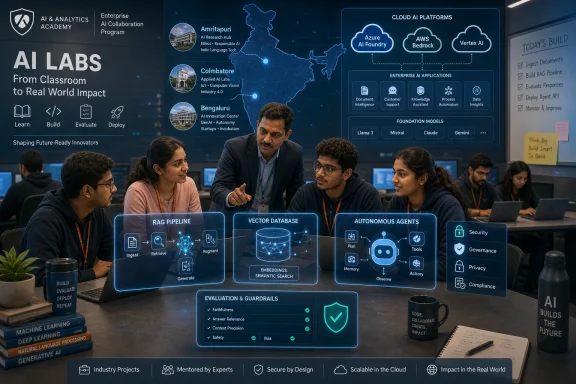
AI labs training scene with students and a large cloud/agent analytics infographic over a classroom screen.The AI Skills Gap Is Moving Upstream​

For two years, enterprises have talked about generative AI as if deployment were mainly a tools problem. Buy the platform, connect the data, put a chatbot on top, and productivity will follow. The harder truth has been slower to arrive: companies do not just need AI tools, they need engineers who understand how these systems fail, how they are integrated, and how they behave when placed inside messy real-world workflows.
That is the context in which the Orion-Amrita program matters. The elective is not being positioned as a research seminar or a speculative tour of machine learning theory. It is explicitly framed as applied training: large language models, prompt engineering, retrieval-augmented generation, agentic frameworks, responsible AI, LLM security, fine-tuning, autonomous agents, vector databases, and the commercial platforms that now dominate enterprise AI experimentation.
That list is doing a lot of work. It acknowledges that “AI literacy” is no longer enough for engineering students. A graduate entering a services firm, cloud team, security group, or application modernization project may be expected to know not only what an LLM is, but how to connect one to enterprise documents, constrain its outputs, evaluate its answers, and keep it from becoming a liability.
This is the part of the AI education boom that has matured fastest. Universities are still responsible for fundamentals, but employers increasingly want graduates who have already touched the scaffolding around modern AI systems. Orion’s bet is that a useful AI engineer is not merely someone who can call an API. It is someone who can reason across cloud services, orchestration frameworks, data pipelines, model behavior, and governance constraints.

A Press Release With a Very Enterprise Syllabus​

The curriculum named in the announcement is revealing because it mirrors the stack that companies are actually testing. Microsoft Azure AI Foundry, AWS Bedrock, Google Gemini and Vertex AI, Microsoft Copilot Studio, Hugging Face, LangChain, Ollama, and vector database technologies are not an abstract survey of AI history. They are the tools showing up in pilots, procurement discussions, internal hackathons, proof-of-concept demos, and, increasingly, production architecture diagrams.
For WindowsForum readers, the Microsoft pieces are especially notable. Azure AI Foundry and Copilot Studio sit squarely in Microsoft’s attempt to turn generative AI from a feature into an application-development layer. In that world, AI is not just a chatbot embedded in Office or a sidebar inside Windows. It becomes a way to build enterprise agents, connect business data, enforce governance policies, and automate domain-specific workflows.
That makes this kind of elective more than a campus résumé booster. If students are learning how Copilot-style systems are composed — where prompts end and retrieval begins, where connectors matter, where policies need to be enforced — they are being introduced to the same conceptual model Microsoft is selling to its enterprise customers. The university classroom becomes an early training ground for the platform economy.
There is an obvious commercial upside for Orion. As a software engineering services partner, Orion needs people who can arrive prepared for client work involving cloud migration, AI adoption, data modernization, and application integration. A student who has already worked through RAG patterns, prompt evaluation, or agent orchestration is cheaper to ramp than one encountering those concepts for the first time on a billable project.
But there is also an upside for students, provided the program is run with enough rigor. The AI hiring market is crowded with vague claims and shallow credentials. A course that asks students to build, test, and critique working systems has a better chance of producing evidence of competence than a certificate based on vocabulary alone.

The Three-Campus Rollout Is Small, but the Model Is Scalable​

The program currently reaches more than 70 sixth-semester students across Amritapuri, Coimbatore, and Bengaluru. By the standards of Indian higher education, that is a pilot, not a revolution. But pilots are how curriculum changes often begin, particularly when universities are trying to align faculty, industry partners, timetables, assessment methods, and platform access.
The sixth-semester timing is important. These students are far enough into their degree to have programming, data structures, systems, or software engineering foundations, but still early enough for internships and final-year projects to be shaped by the elective. That gives the program more leverage than a last-semester finishing course bolted onto the end of a degree.
The internship pathway is equally important. Orion says high-potential students may be considered for internships, which turns the elective into both a training program and a talent-identification channel. That is not inherently a problem. In fact, industry pipelines can be valuable when they expose students to real project expectations. But universities will need to preserve academic independence, making sure the course does not narrow into a pre-employment funnel for one company’s needs.
This is the tension at the center of industry-academia AI programs. Employers can move quickly, provide real tooling, and clarify what the market actually values. Universities can provide conceptual depth, ethical framing, and long-term intellectual resilience. The best version of this partnership combines those strengths. The weaker version gives students a tour of branded platforms and calls it professional preparation.

“Applied” Is the Word Doing the Heavy Lifting​

The phrase Applied GenAI is everywhere now, and for good reason. It sounds practical without sounding vocational, modern without sounding unserious. But it also raises the central question for any AI curriculum: applied to what?
A genuinely applied GenAI course should force students to confront the difference between a demo and a system. A demo answers a question in a browser. A system handles missing documents, hostile prompts, bad data, latency constraints, cost limits, security boundaries, model drift, and user expectations. That difference is where most enterprise AI projects either become useful or collapse into theater.
The inclusion of RAG and vector databases suggests the elective is at least pointed in the right direction. RAG has become the standard enterprise compromise between the general knowledge of foundation models and the private knowledge of an organization. It lets developers ground responses in internal documents or structured content without retraining a model from scratch. It also introduces a host of engineering problems students need to understand: chunking, embeddings, retrieval quality, metadata filtering, permissions, and evaluation.
Agentic frameworks and autonomous agents add another layer of ambition. These systems promise software that can plan, call tools, perform multi-step tasks, and interact with external services. They also expand the blast radius when something goes wrong. Teaching agents without teaching observability, permissions, human approval workflows, and failure modes would be irresponsible. Teaching them with those constraints could give students a realistic view of where enterprise AI is headed.
Responsible AI and LLM security belong at the center of the course, not as a lecture at the end. Prompt injection, data leakage, hallucination, insecure tool use, and overreliance on model outputs are not edge cases. They are the conditions under which real AI applications operate. If the Orion-Amrita program treats these as engineering requirements rather than public-relations language, it will be more valuable than many vendor-led training tracks.

Microsoft’s Quiet Advantage Is the Enterprise Classroom​

The platform list in the announcement is multi-cloud and multi-ecosystem, which is sensible. Students should not graduate thinking AI begins and ends with a single vendor. But Microsoft’s presence in this curriculum carries a particular significance because of where the company sits in enterprise computing.
Azure AI Foundry and Copilot Studio reflect Microsoft’s broader strategy: make AI development feel like a natural extension of the enterprise stack that organizations already use. For many businesses, especially those standardized on Microsoft 365, Entra ID, Teams, SharePoint, Power Platform, and Azure, the easiest AI adoption path is not a clean-sheet startup architecture. It is incremental augmentation of the systems already embedded in daily work.
That gives Microsoft a distribution advantage in AI education too. If students learn to think in terms of copilots, connectors, identity boundaries, governed data access, and workflow automation, they are learning a model of AI development that maps closely to Microsoft’s commercial environment. This does not mean the curriculum is Microsoft-specific. It means Microsoft has succeeded in making its AI tooling part of the ordinary vocabulary of enterprise readiness.
For Windows administrators and IT pros, this is familiar terrain. Every major shift in Microsoft’s ecosystem eventually becomes a skills question. Active Directory, Group Policy, PowerShell, Intune, Azure AD — now Entra — and Microsoft 365 administration all created labor markets around operational fluency. Generative AI is likely to do the same, but with a messier blend of software development, data governance, security, and business-process analysis.
That is why university-level exposure matters. The future AI administrator or AI application engineer may not be a pure data scientist. They may be someone who understands identity, access, documents, APIs, compliance, and user workflows well enough to make AI systems useful without letting them run wild.

India’s Engineering Pipeline Meets the AI Services Economy​

The Indian context matters as much as the technology. India’s software services industry has long depended on the ability to convert large numbers of engineering graduates into project-ready professionals. That model has survived multiple platform shifts: mainframe modernization, client-server systems, ERP, web development, mobile, cloud, DevOps, and cybersecurity.
Generative AI creates a sharper challenge. The tools are easy enough to demo but difficult to deploy responsibly. The market is moving quickly, but enterprise clients remain cautious. Services firms need employees who can help clients separate realistic use cases from executive wish lists, while also building the prototypes, integrations, and governance models that make adoption possible.
That is where a co-branded university elective becomes strategically useful. It lets a company like Orion influence the talent pipeline earlier, while giving a university like Amrita a way to advertise practical relevance in a competitive higher-education market. The course becomes part education, part workforce development, part employer branding.
This is not unique to AI, but AI intensifies it. The half-life of platform knowledge is short, and the demand for credible experience is high. Students who graduate with only theory may struggle to stand out. Students trained only on today’s tools may find their skills dated quickly. The challenge is to teach the patterns beneath the products.
That means students should understand why RAG exists, not just how to wire one framework to one vector store. They should understand why model evaluation is hard, not just how to run a benchmark. They should understand why identity and authorization matter in AI agents, not just how to build a flashy workflow. If the elective delivers that, it will age better than the vendor menus inevitably will.

The Risk Is Producing Tool Operators Instead of Engineers​

Every industry-academia partnership carries the risk of narrowing education into employability theater. The danger is not that students learn commercial tools. They should. The danger is that tools become substitutes for principles.
A student can learn LangChain and still not understand distributed systems. A student can use Bedrock or Vertex AI and still not understand data privacy. A student can build a Copilot Studio workflow and still not understand why access control matters. A student can prompt an LLM fluently and still be unable to evaluate whether the output is correct.
This is where universities have to be more than training providers. They must insist on depth: algorithms, databases, software design, security, human-computer interaction, ethics, and empirical evaluation. Generative AI should not become a shortcut around computer science. It should become a new context in which computer science becomes more urgent.
The best applied AI courses will probably look uncomfortable. They will make students build systems and then break them. They will reward careful evaluation over impressive demos. They will treat hallucination as an engineering problem, not a punchline. They will require students to document assumptions, test prompts, measure retrieval quality, and explain security boundaries.
That is harder to market than “learn GenAI tools.” But it is the difference between producing graduates who can survive the next platform cycle and graduates trained for this quarter’s buzzwords.

The MoU Is Really a Curriculum Supply Chain​

The memorandum of understanding between Orion and Amrita extends beyond the student elective to faculty enablement, knowledge-sharing, and collaboration between academic experts and Orion teams. That may sound like standard partnership language, but it is arguably the most important part of the announcement.
AI curriculum is now a supply-chain problem. Faculty need updated material, access to platforms, use cases that reflect industry practice, and time to adapt teaching methods. Industry partners need graduates who understand modern delivery models. Students need assignments that do not collapse into copy-pasted chatbot output. Everyone needs a way to keep pace without turning the classroom into a perpetual product demo.
Faculty enablement is therefore not a side benefit. It is the mechanism that determines whether the program can scale beyond the first enthusiastic cohort. If faculty members can internalize the concepts, critique the tools, and update the labs over time, the course can become part of the institution. If the expertise remains mostly outside the university, the program may depend too heavily on Orion’s ongoing involvement.
There is also a governance question. As AI tools become part of coursework, universities need policies for acceptable use, assessment integrity, data handling, and student privacy. Students experimenting with cloud AI platforms may encounter costs, account permissions, data-upload risks, or intellectual-property questions. Practical exposure is valuable, but it needs institutional guardrails.
The announcement does not spell out those details, and it would be unfair to expect a press release to do so. Still, the difference between a strong program and a fragile one will be found in the operational details: how labs are assessed, what data students use, how security is taught, how faculty stay current, and how students demonstrate competence.

The Hiring Signal Is Useful, but It Is Not a Guarantee​

The internship pathway with Orion will catch students’ attention, as it should. In a competitive technology job market, any credible bridge from coursework to industry experience has value. But it is important not to oversell what such a pathway means.
An elective with 70-plus students and possible internships is not a mass hiring program. It is a signal. It tells students which skills Orion believes are becoming relevant. It tells Amrita that industry wants more applied AI exposure. It tells the market that generative AI education is moving from optional workshops into formal curriculum.
For students, the practical advice is straightforward: treat the elective as a portfolio opportunity, not merely a credential. The value will come from what they can build and explain. A student who can show a secure RAG prototype, compare retrieval strategies, document evaluation results, and explain failure modes will stand out more than one who simply lists every tool covered in the course.
For employers, the signal is also nuanced. Graduates from programs like this may arrive with better vocabulary and more practical exposure, but they will still need mentoring. Enterprise AI projects involve client politics, legacy systems, compliance constraints, data quality problems, and production reliability demands that no single elective can fully simulate.
The most realistic outcome is not instant job readiness. It is reduced friction. Students who have wrestled with these concepts before will ask better questions sooner. In a fast-moving field, that is not trivial.

The Real Curriculum Is the Distance Between Demo and Deployment​

The Orion-Amrita program lands at a moment when generative AI is undergoing a credibility test. The first wave of excitement promised sweeping automation. The second wave is forcing organizations to ask where the technology actually improves work, where it introduces risk, and where it merely adds cost and complexity.
That makes applied education more important, not less. If the industry is moving from experimentation to selective deployment, students need to understand why some AI projects succeed and others stall. They need to see that the model is only one component in a larger system of data, identity, workflow, monitoring, governance, and human judgment.
The inclusion of LLM security is particularly welcome because it pushes against the overly cheerful version of AI education. Security-minded readers know the pattern: new capability arrives first, threat modeling arrives later. With generative AI, that delay is especially dangerous because natural-language interfaces can obscure the seriousness of the underlying access being granted.
A chatbot that answers from public documentation is one thing. An agent that can query internal records, summarize confidential files, trigger workflows, or call external APIs is another. Teaching students to build the latter without teaching them to constrain it would be like teaching web development without authentication.
This is where the course could be genuinely useful for the broader ecosystem. It can normalize the idea that AI engineering includes adversarial thinking from the start. That lesson will travel well beyond any single platform.
A Small Elective Shows Where the AI Labor Market Is Heading​

The concrete facts are simple, but their implications are broader than the size of the first cohort suggests.
  • Orion and Amrita have launched a co-branded Applied Generative AI elective across Amritapuri, Coimbatore, and Bengaluru.
  • More than 70 sixth-semester students are enrolled in the initial delivery of the program.
  • The curriculum includes LLMs, prompt engineering, RAG, agentic frameworks, responsible AI, LLM security, fine-tuning, autonomous agents, and vector database technologies.
  • Students will be exposed to major commercial and open ecosystems, including Microsoft Azure AI Foundry, AWS Bedrock, Google Gemini and Vertex AI, Microsoft Copilot Studio, Hugging Face, LangChain, and Ollama.
  • High-potential students may be considered for Orion internships, turning the elective into both an educational program and an early talent pipeline.
  • The MoU also covers faculty enablement and knowledge-sharing, which will determine whether the program becomes a durable academic capability or remains a one-off industry initiative.
The important thing is not that every student becomes an AI specialist. The important thing is that applied AI is becoming part of the expected literacy of software engineering, cloud work, enterprise automation, and security-aware development.

The Next AI Workforce Will Be Trained Before It Is Hired​

The Orion-Amrita partnership is not the final form of AI education, and it should not be treated as a blueprint that every university can copy without adaptation. Its success will depend on execution: faculty depth, lab quality, assessment standards, security content, and whether students learn transferable engineering principles beneath the toolchain. But as a signal, it is hard to miss. Generative AI is moving from the extracurricular workshop to the credit-bearing curriculum, from hype sessions to hiring pipelines, and from “learn to prompt” slogans to the messier discipline of building systems that can survive contact with real users. For students, employers, and IT professionals watching the next wave of talent enter the market, that shift may matter more than any single model release.

References​

  1. Primary source: irishsun.com
    Published: 2026-06-04T02:50:34.049917
  2. Related coverage: prnewswire.com
  3. Related coverage: amrita.edu
  4. Related coverage: amritapuri.org
  5. Related coverage: amrita.irins.org
  6. Related coverage: collnod.com
 

Orion Innovation and Amrita Vishwa Vidyapeetham announced on June 4, 2026, a co-branded Applied Generative AI elective for more than 70 sixth-semester students across Amritapuri, Coimbatore, and Bengaluru, with hands-on coursework spanning large language models, RAG, agents, cloud AI platforms, and responsible AI. The announcement is small in enrollment but large in signal: generative AI is moving from extracurricular curiosity into the normal machinery of engineering education. For WindowsForum readers, the Microsoft angle is not incidental; Azure AI Foundry and Copilot Studio are now part of the toolchain universities are expected to teach before graduates ever reach enterprise IT. The real story is not that another university has added an AI elective, but that industry is increasingly writing the missing lab manual for applied AI work.

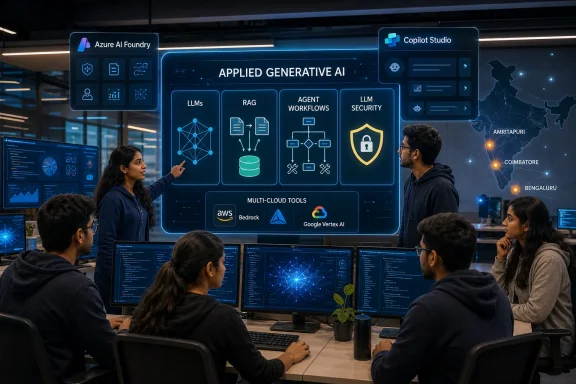
Tech team presenting an “Applied Generative AI” dashboard with multi-cloud tools in a modern office.The AI Skills Gap Has Reached the Semester Timetable​

The launch lands at a moment when every software services company wants to say it is “AI-enabled,” but fewer can show where the next generation of practical AI engineers will come from. Orion’s partnership with Amrita is a direct answer to that problem. Instead of waiting for graduates to arrive with uneven exposure to prompt engineering, vector databases, and LLM security, the company is trying to shape that exposure before hiring begins.
That is not philanthropy dressed in corporate language. It is workforce pipeline design. The elective gives students a structured introduction to the stack enterprises are actually testing: large language models, retrieval-augmented generation, agentic frameworks, responsible AI, fine-tuning, autonomous agents, and cloud-hosted AI development environments.
For students, the promise is obvious. A course that includes Microsoft Azure AI Foundry, AWS Bedrock, Google Gemini and Vertex AI, Copilot Studio, Hugging Face, LangChain, Ollama, and vector database technologies is more likely to resemble modern AI work than a conventional lecture sequence on neural networks alone. The curriculum appears designed less around explaining why transformers matter and more around showing what happens when organizations try to deploy them.
For Orion, the benefit is equally clear. Students who have built with enterprise AI platforms before graduation require less ramp-up, understand more of the vocabulary of client projects, and can be evaluated through internships before becoming full-time hires. In the services economy, talent is not just recruited; it is cultivated, filtered, and aligned to delivery models.

This Is Not a Computer Science Course With AI Branding​

The important detail in the announcement is the word applied. Universities have taught artificial intelligence for decades, but generative AI has exposed the gap between academic AI literacy and operational AI capability. Knowing the theory of language models is useful. Knowing how to design a retrieval pipeline, manage model behavior, evaluate hallucination risk, and secure an LLM-backed workflow is what enterprises now need.
That distinction matters because generative AI is not a single technology. It is a stack of models, orchestration frameworks, cloud services, governance policies, user interfaces, data stores, and security boundaries. A student who learns only prompt writing is underprepared; a student who learns only model theory may also be underprepared.
The Orion-Amrita elective appears to acknowledge that reality. RAG brings students into the messy world of grounding model output in enterprise data. Agentic frameworks introduce orchestration and tool use. Responsible AI and LLM security bring the conversation beyond demos and into risk, compliance, and operational trust.
This is where the program becomes relevant beyond India. The global AI labor market is not merely looking for “AI people.” It is looking for engineers who can turn business processes into safe, maintainable AI systems. That requires fluency across developer tooling, cloud infrastructure, data governance, and user experience.

Microsoft’s Quiet Win Is Being Taught Beside Its Rivals​

The inclusion of Microsoft Azure AI Foundry and Microsoft Copilot Studio is notable because it shows how Microsoft’s AI strategy is entering education through enterprise relevance rather than consumer hype. Students are not just learning about ChatGPT-style interfaces. They are being introduced to the tools Microsoft wants companies to use when building, managing, and customizing AI applications.
Azure AI Foundry has become part of Microsoft’s broader pitch that enterprises need a platform for model selection, evaluation, deployment, safety, and lifecycle management. Copilot Studio, meanwhile, sits closer to business users and low-code customization, giving organizations a way to build agents and copilots tied to their own workflows. For IT pros, those are not abstract products; they are likely to become part of the governance perimeter.
But the curriculum is not Microsoft-only, and that is the more realistic choice. AWS Bedrock, Google Gemini and Vertex AI, Hugging Face, LangChain, Ollama, and vector databases all point to a multi-platform world. Students who learn only one cloud vendor’s AI environment may be employable, but students who understand the trade-offs among platforms are more useful.
That is particularly important for enterprise customers. Few large organizations are betting their entire AI future on a single provider. Procurement, compliance, existing workloads, data residency, pricing, and developer preference all shape platform decisions. A university elective that exposes students to multiple ecosystems better reflects the market they will enter.
For WindowsForum’s audience, this is a reminder that the AI stack is becoming as platform-contested as operating systems, browsers, and cloud infrastructure before it. Microsoft has a strong hand because Windows, Microsoft 365, GitHub, Azure, and Copilot form a deep enterprise surface area. But students entering the field will need to understand the whole competitive landscape, not just the Redmond-approved version of it.

The Internship Hook Turns Education Into Recruitment Infrastructure​

The announcement says high-potential students may be considered for internship opportunities with Orion. That line may sound like a routine perk, but it is central to the model. The elective is not merely a classroom offering; it is a screening and training channel.
This is how applied technology education increasingly works. Companies provide curriculum input, tools, guest instruction, or project framing. Universities provide the academic environment and student access. The best students receive industry exposure, while employers get an early look at talent before the broader market does.
There is a tension here that universities must manage carefully. Industry alignment can make education more relevant, but it can also narrow the intellectual horizon if the course becomes a vendor or employer training program. A strong applied AI elective should teach transferable principles, not just product familiarity.
The Orion-Amrita program appears to have enough breadth to avoid the most obvious trap. By spanning multiple cloud AI services, open-source tooling, responsible AI, and security concepts, it is not merely teaching students to click through one platform. Still, the real measure will be how much students build, how their work is evaluated, and whether they learn to question model behavior rather than simply wrap it in an interface.

India’s Engineering Pipeline Is Being Rewritten in Real Time​

Amrita is a serious venue for this kind of program. The university has ranked among India’s top institutions in national ranking frameworks and operates across multiple campuses and disciplines. Its involvement gives the elective more weight than a one-off workshop or weekend bootcamp.
India’s engineering education system has long supplied global IT services firms, software vendors, and enterprise technology teams. What is changing is the expected baseline. A decade ago, cloud fluency made a graduate stand out. Five years ago, DevOps, containers, and modern web frameworks did. Now, applied AI literacy is becoming part of the entry-level conversation.
That shift will not be evenly distributed. Elite and well-connected universities will move first, often through industry partnerships. Students at institutions without those relationships may be left relying on self-study, online courses, or fragmented exposure to tools. The result could be a new skills divide inside an already competitive graduate market.
Programs like this can help close the gap for participating students, but they also raise the bar for everyone else. Once employers begin seeing graduates with coursework in RAG, LLM security, agentic frameworks, and cloud AI platforms, those concepts start to look less like advanced specialization and more like expected vocabulary.

Responsible AI Is No Longer Optional Coursework​

One of the most encouraging details in the curriculum is the inclusion of Responsible AI and LLM security. Too many generative AI programs still treat safety as an appendix: a lecture near the end, a compliance checkbox, or a vague warning about hallucinations. That is not enough.
Applied generative AI is inherently risky because it connects probabilistic systems to real data, real users, and sometimes real actions. A chatbot that gives a bad answer is one problem. An agent that retrieves sensitive documents, calls tools, or triggers business workflows is another. Students need to learn that model output is not software output in the traditional sense, and that confidence is not correctness.
LLM security is especially important because the attack surface is unfamiliar to many developers. Prompt injection, data leakage, unsafe tool execution, insecure retrieval, and overprivileged agents do not map neatly onto older security mental models. They require new habits and new controls.
If this elective treats those issues seriously, it could produce graduates who are more useful to enterprise IT than students who have only built flashy demos. The market is already crowded with people who can make an AI prototype. It needs more people who can make one that survives contact with users, policies, auditors, and hostile inputs.

The Agent Hype Cycle Has Entered the Classroom​

The curriculum’s reference to agentic frameworks and autonomous agents reflects the current center of gravity in AI development. The industry has moved from chatbots to copilots to agents with remarkable speed, even if the reliability of those agents remains uneven. Teaching students about agents now is sensible, but it also demands discipline.
Agents are seductive because they turn software into something that appears to plan, choose tools, and act. That makes demos feel magical. It also makes failure modes more complex, because the system is no longer just generating text; it may be deciding which steps to take and which external systems to touch.
For students, this is an important lesson in engineering humility. An autonomous agent is not automatically intelligent in the human sense. It is a probabilistic workflow wrapped around model calls, memory, tools, prompts, policies, and sometimes brittle assumptions. The value comes from careful scoping, evaluation, and control.
This is where universities can offer something industry bootcamps often cannot: conceptual distance. Students should learn how agents work, but also when not to use them. They should understand that a deterministic workflow with a small model or even no model may be better than an elaborate agentic architecture. The best AI engineers will not be the ones who use agents everywhere; they will be the ones who know where agents are worth the risk.

The Multi-Cloud Curriculum Mirrors Enterprise Confusion​

The breadth of tools in the elective tells its own story. Microsoft, Amazon, Google, Hugging Face, LangChain, Ollama, and vector database technologies do not represent a tidy stack. They represent an unsettled market in which enterprises are still deciding what belongs in production and what belongs in the lab.
That uncertainty is not a flaw in the curriculum. It is the curriculum. Students entering AI work need to understand that the field is changing too quickly for any static syllabus to remain current for long. The durable skill is not memorizing one product console but learning how to evaluate capabilities, costs, limits, governance models, and integration paths.
For sysadmins and IT pros, this should sound familiar. Every major platform shift begins with tool sprawl. Virtualization, cloud, containers, endpoint management, and identity all went through phases where organizations accumulated overlapping tools before standards emerged. Generative AI is now in that same phase, only faster and with more executive pressure.
A student who has seen multiple AI ecosystems before graduating may be better prepared for that mess than one trained on a single canonical stack. The enterprise world does not care whether a lab assignment was elegant. It cares whether the engineer can make sense of a half-adopted platform, a security review, a skeptical business unit, and a data source nobody documented properly.

The University Is Becoming the First AI Sandbox​

One underappreciated consequence of these partnerships is that universities are becoming safe sandboxes for enterprise AI experimentation. Students can test patterns, build prototypes, and explore tools without the full burden of production responsibility. Companies can observe what learners struggle with and which abstractions make sense.
That feedback loop can improve curriculum, but it can also shape product adoption. If a cohort of students graduates already comfortable with Copilot Studio, Azure AI Foundry, Bedrock, Vertex AI, or LangChain, those tools gain mindshare before procurement ever gets involved. Today’s elective project can become tomorrow’s default recommendation inside a client engagement.
This is why vendor presence in education matters. It is not just branding. It influences habits, mental models, and assumptions about what “normal” development looks like. Microsoft understood this with Windows, Office, Visual Studio, and later Azure. The same logic now applies to AI platforms.
The healthiest version of this model gives students comparative literacy. They should leave knowing not just how to build with a tool, but why one tool differs from another. They should be able to ask whether a managed model service, an open-source model, a local runtime, or a low-code agent builder best fits a particular use case.

The Press Release Understates the Hard Part​

The announcement is understandably upbeat. It emphasizes hands-on learning, real-world exposure, faculty enablement, knowledge sharing, and alignment with industry needs. Those are useful goals, but the hard part is execution.
Applied AI education changes quickly. A syllabus built in January can feel dated by June. Models improve, APIs change, frameworks rise and fade, pricing shifts, and security guidance evolves. Faculty enablement is therefore not a side benefit; it is essential infrastructure.
The memorandum of understanding between Orion and Amrita appears designed to keep the relationship active rather than symbolic. That matters because a one-time curriculum donation will not survive the pace of the field. The course needs continuous refresh, industry feedback, and faculty who are supported rather than left to chase every new model release alone.
There is also the assessment problem. Traditional exams may not capture whether a student can build a robust AI system. Good evaluation should include projects, adversarial testing, documentation, trade-off analysis, and demonstrations of responsible design. In applied AI, the answer is rarely just whether the model responded; it is whether the system behaved reliably under constraints.

The Windows Angle Is Bigger Than Copilot​

It would be easy to reduce this story to Microsoft Copilot Studio appearing in a university elective, but the Windows ecosystem connection runs deeper. Enterprise AI adoption will touch identity, endpoint security, browser policy, data loss prevention, developer environments, and cloud governance. Windows administrators may not build every AI app, but they will inherit many of the consequences.
As AI agents move closer to everyday productivity tools, the boundary between application management and AI governance will blur. Who can create a copilot? Which data can it access? How are prompts and responses logged? What happens when an agent connects to a business system? These are IT administration questions as much as developer questions.
That is why applied AI education should not be reserved for aspiring machine learning specialists. It should reach software engineers, cloud administrators, security analysts, business technologists, and product managers. The technology is too horizontal to remain inside a narrow AI track.
For the Windows and Microsoft 365 world, this transition is already visible. Copilot-branded features are becoming part of productivity software, development tools, security products, and business applications. A workforce that understands only the user-facing magic will be poorly prepared. A workforce that understands the architecture and governance behind it will be far more valuable.

A Small Cohort Points to a Larger Bargain​

The most concrete number in the announcement is modest: more than 70 students enrolled. That is not a national reskilling wave. It is a pilot-sized cohort across three campuses.
But small programs can reveal large shifts. The point is not that 70 students will transform the AI labor market. The point is that industry and academia are converging on a new bargain: universities will provide foundations and legitimacy, while companies help inject current tools, use cases, and hiring pathways.
That bargain will be tested by outcomes. If students produce serious projects, secure internships, and enter the workforce with practical competence, the model will spread. If the course becomes a marketing exercise with shallow demos, it will be one more AI-branded announcement in a crowded news cycle.
The stakes are higher than course design. Generative AI is already reshaping expectations for entry-level developers. Employers increasingly want graduates who can work with AI-assisted coding, integrate models into applications, and understand data governance. Universities that move slowly risk sending students into interviews with yesterday’s skill set.

The Real Curriculum Is Judgment​

The danger in any applied AI program is that it becomes a tour of fashionable tools. Today’s students can easily be marched through prompt engineering, RAG, agents, vector databases, and cloud platforms without developing the judgment needed to use them well. That would be a missed opportunity.
The most valuable lesson is not that LangChain exists, or that Bedrock hosts models, or that Copilot Studio can build agents. It is how to decide when these tools are appropriate. It is how to measure whether a retrieval system improved accuracy. It is how to identify when fine-tuning is unnecessary. It is how to recognize when a local model is preferable for privacy, cost, or latency.
Students also need to learn that AI systems are socio-technical systems. They change workflows, incentives, responsibilities, and risks. A good AI deployment is not only a working pipeline; it is a negotiated arrangement among users, data owners, security teams, compliance staff, and business leaders.
That is where industry-academia collaboration can be powerful. Universities can provide depth and critical thinking. Companies can provide constraints and realism. The best version of this elective will combine both, producing students who can build and challenge AI systems at the same time.

What This Coimbatore Announcement Really Tells IT​

The Orion-Amrita program is not just another campus partnership with a familiar press-release rhythm. It is a snapshot of how fast generative AI is being normalized into the education-to-employment pipeline. The concrete details matter because they show where the market thinks entry-level readiness is heading.
  • More than 70 sixth-semester students are already enrolled across Amrita’s Amritapuri, Coimbatore, and Bengaluru campuses.
  • The curriculum covers practical AI topics including LLMs, prompt engineering, RAG, agentic frameworks, responsible AI, LLM security, fine-tuning, and autonomous agents.
  • The platform mix includes Microsoft Azure AI Foundry, AWS Bedrock, Google Gemini and Vertex AI, Microsoft Copilot Studio, Hugging Face, LangChain, Ollama, and vector database technologies.
  • Orion is using the program not only as an education initiative but also as a potential internship pipeline for high-performing students.
  • The broader partnership includes faculty enablement and knowledge sharing, which will be critical if the curriculum is to keep pace with AI tooling.
  • For enterprise IT, the announcement reinforces that AI literacy is expanding beyond model theory into governance, integration, security, and multi-cloud platform judgment.
The real test will come after the first cohorts leave the classroom. If they arrive in internships able to build grounded AI prototypes, explain their security assumptions, compare platforms intelligently, and resist the temptation to agent-ify every workflow, this program will have done something more important than add an elective. It will have helped define what an applied AI graduate is supposed to be in 2026 and beyond, and that definition is quickly becoming everyone’s problem.

References​

  1. Primary source: malaysiasun.com
    Published: 2026-06-04T02:50:15.288734
  2. Related coverage: prnewswire.com
  3. Related coverage: amrita.edu
  4. Related coverage: hindustantimes.com
  5. Related coverage: buddy4study.com
  6. Related coverage: vidyavision.com
  1. Related coverage: timeshighereducation.com
  2. Related coverage: collegedekho.com
  3. Related coverage: collegedunia.com
  4. Related coverage: getmyuni.com
  5. Related coverage: webfiles.amrita.edu
 

Orion Innovation and Amrita Vishwa Vidyapeetham launched a co-branded Applied Generative AI elective in June 2026 for sixth-semester students across Amritapuri, Coimbatore, and Bengaluru, with more than 70 students already enrolled. The announcement is modest in scale, but it points to a larger shift in how technical education is being forced to adapt. Generative AI is no longer a topic universities can safely confine to a final-year seminar, a research lab, or a guest lecture from industry. It is becoming part of the employability stack.
The interesting part is not that another university has added “GenAI” to the brochure. The interesting part is that the curriculum described by Orion and Amrita looks less like a buzzword survey and more like a map of the new enterprise AI workplace: large language models, prompt engineering, retrieval-augmented generation, agentic frameworks, Responsible AI, LLM security, fine-tuning, autonomous agents, cloud AI platforms, Copilot-style tooling, vector databases, LangChain, Hugging Face, Ollama, and the major hyperscaler ecosystems. That is a revealing list. It says the real race is not to teach students that AI exists, but to teach them how AI systems are assembled, constrained, tested, and made useful.

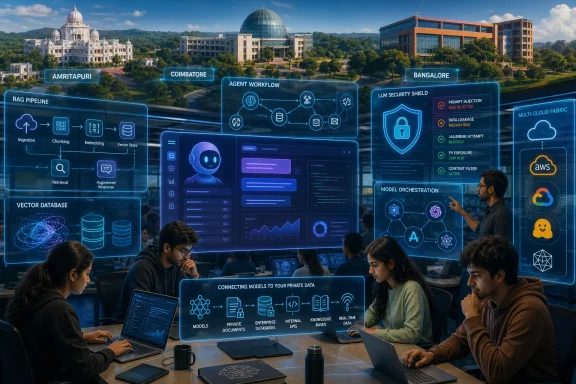
Tech-themed office scene with AI workflow icons, maps of cities, and responsible AI checklist overlays.The Classroom Is Being Pulled Toward the Production Stack​

For years, universities could treat enterprise software engineering as something graduates would learn after hiring. A computer science degree supplied algorithms, operating systems, databases, networks, and theory; the employer supplied toolchains, workflows, cloud platforms, compliance habits, and production discipline. Generative AI has compressed that grace period.
The tools students encounter after graduation are no longer just IDEs, CI/CD pipelines, and issue trackers. They are AI copilots embedded in development environments, retrieval pipelines wired to corporate knowledge stores, model gateways, evaluation harnesses, policy filters, prompt templates, observability dashboards, and security controls that are still changing under everyone’s feet. A graduate who has only used ChatGPT as a study assistant has not really been trained for that world.
That is why this Orion-Amrita elective deserves attention beyond its enrollment count. The program is explicitly pitched as a bridge between classroom learning and industry expectations, and that bridge is now where much of the action is. If generative AI continues to seep into every corner of software delivery, the dividing line between “academic AI” and “applied AI” becomes harder to defend.
The old AI curriculum emphasized machine learning foundations, statistics, neural networks, data preprocessing, and model evaluation. Those foundations still matter. But the daily work of many entry-level AI-adjacent roles is increasingly about orchestration: connecting existing models to data, shaping prompts, grounding responses, reducing hallucinations, securing inputs and outputs, and deciding when automation should stop and a human should intervene.
That is a very different educational challenge. It is less about producing a small number of model researchers and more about producing a broad layer of engineers who understand how to build responsibly with models they did not train, cannot fully inspect, and may have to swap out next quarter.

GenAI Education Is Becoming a Systems Problem​

The curriculum areas named in the program are notable because they acknowledge that generative AI is not a single skill. Prompt engineering alone is not enough. Fine-tuning alone is not enough. Knowing the API syntax for one vendor’s model is not enough. The hard part is the system around the model.
Retrieval-augmented generation, or RAG, is a good example. To a casual user, it sounds like a technique for making a chatbot read documents. In practice, it forces students to confront data ingestion, chunking strategy, embeddings, vector search, ranking, access control, freshness, evaluation, and failure behavior. The model is only one component in a pipeline that can go wrong in surprisingly mundane ways.
Agentic frameworks raise the stakes further. An autonomous or semi-autonomous agent that can call tools, query systems, write code, schedule tasks, or trigger workflows is not merely a chatbot with ambition. It is a software actor with permissions, memory, goals, and failure modes. Teaching students to build agents without teaching them restraint would be like teaching network programming without mentioning authentication.
That is where Responsible AI and LLM security become more than ethical decoration. They are practical engineering concerns. Prompt injection, data leakage, insecure tool use, overbroad permissions, poisoned retrieval sources, and unverified model outputs are not abstract risks for a future policy class. They are the ordinary hazards of putting generative systems near enterprise workflows.
The strongest version of this elective, then, is not a course that celebrates the magic of AI. It is a course that demystifies it. Students should leave understanding that most enterprise GenAI work is not a cinematic encounter with artificial general intelligence. It is plumbing, measurement, integration, governance, and debugging — with probabilistic components that make all of those jobs harder.

The Platform List Tells Its Own Story​

The inclusion of Microsoft Azure AI Foundry, AWS Bedrock, Google Gemini and Vertex AI, Microsoft Copilot Studio, Hugging Face, LangChain, Ollama, and vector database technologies is more than a curriculum inventory. It reflects the fragmented reality enterprises are actually facing. There is no single “GenAI stack” that everyone has standardized on.
That is uncomfortable for educators. Universities prefer stable abstractions because courses must survive longer than a product marketing cycle. But students entering the AI labor market need to recognize the names, capabilities, and trade-offs of the platforms employers are using today. A purely vendor-neutral course can become sterile if it never touches the tools that shape real deployment decisions.
At the same time, platform exposure carries a risk. A university should not become a certification farm for whichever vendor has the loudest enterprise sales motion. Students need transferable mental models: what a managed model service does, how model access is governed, how retrieval is implemented, how evaluation is performed, how latency and cost change architectural choices, and how local or open-weight models alter privacy and deployment assumptions.
The best industry-academia partnerships walk that line carefully. They give students real tools without letting the tools define the education. Orion’s involvement can be useful precisely because services firms live in the messy middle between vendor promise and client reality. They see what breaks when a proof of concept becomes a production request.
For WindowsForum’s audience, this platform spread should feel familiar. Enterprise IT has always lived with heterogeneity. Microsoft may own the desktop and productivity substrate in many organizations, AWS may run major workloads, Google may appear through data and AI teams, and open-source tooling may fill the gaps. GenAI is not simplifying that environment. It is adding another layer of dependency negotiation.

India’s AI Talent Pipeline Is Moving Earlier​

The program is being delivered to sixth-semester students, which matters. By the sixth semester, engineering students are far enough into their degree to have programming, data structures, databases, and software fundamentals behind them, but not so far along that industry exposure arrives too late to shape projects, internships, and placement decisions. That timing makes the elective part of the student’s formation rather than a decorative finishing module.
India’s technology services sector has long depended on training at scale. Employers hire graduates, then invest heavily in onboarding, platform training, domain exposure, and delivery discipline. Generative AI threatens to make that model both more necessary and more expensive. The baseline skills expected of a new engineer are rising, while the tools themselves are changing quickly.
That creates a strong incentive for companies to move upstream. Instead of waiting for graduates to arrive and then discovering how uneven their applied AI exposure is, firms can collaborate with universities to shape electives, labs, projects, and internships. The phrase “co-create talent at the source,” used in the announcement, may sound like HR language, but it accurately describes the strategic logic.
There is an obvious benefit for students. A course connected to enterprise use cases can help them understand what employers actually mean when they ask for AI skills. It can also reduce the gap between personal experimentation and professional implementation. Building a toy chatbot is one thing; building a secure retrieval workflow for a regulated business process is another.
There is also a benefit for universities. Institutions that can credibly offer applied AI exposure become more attractive to students and recruiters. In a market where “AI” is attached to nearly every program description, the differentiator will increasingly be whether students can show working projects, defensible design choices, and some understanding of production risk.

The Internship Hook Is Small but Strategic​

The announcement says high-potential students will be considered for internship opportunities with Orion. That is a cautious formulation, not a guarantee. Still, it is strategically important because internships are where applied courses either prove themselves or collapse into theater.
If the elective produces students who can contribute to internal prototypes, client accelerators, data engineering tasks, evaluation workflows, or AI tooling experiments, the program becomes more than academic branding. It becomes part of Orion’s talent funnel. That matters in a services business where differentiation increasingly depends on how quickly teams can assemble credible AI solutions for clients.
For students, internships also provide a reality check. The enterprise use of generative AI is full of constraints that do not appear in classroom demos. Data may be messy or inaccessible. Security teams may block shortcuts. Legal teams may ask uncomfortable questions. Business users may not know how to specify what they want. Evaluation may be ambiguous because “better answer” is not always a measurable requirement.
That ambiguity is useful educational material. Students who encounter it early are less likely to mistake model fluency for engineering maturity. They learn that the job is often not to chase the newest model but to build a system that works reliably enough for a specific organization, within a specific risk tolerance, at a cost someone will approve.
The danger is that “high-potential” pathways can narrow opportunity if they are not handled carefully. Applied AI education should not become a prestige track for a small group of already-advantaged students. If universities want to prepare a broader generation for AI-shaped careers, they need mechanisms that help late bloomers, interdisciplinary students, and those without prior exposure catch up.

The Windows and Enterprise Angle Is Bigger Than It Looks​

At first glance, an Applied GenAI elective in India may seem distant from the daily concerns of Windows administrators and enterprise IT teams. It is not. The technologies named in the curriculum are the same ones reshaping how organizations manage productivity, development, support, knowledge management, and automation across Microsoft-heavy environments.
Microsoft Copilot Studio, Azure AI Foundry, and the broader Copilot ecosystem are increasingly tied to enterprise workflows that sit on top of Microsoft 365, Entra, Power Platform, Teams, SharePoint, Dynamics, and Windows endpoints. If tomorrow’s developers and consultants learn GenAI through these tools, they will enter organizations with assumptions about how AI should integrate with identity, documents, permissions, and productivity software.
That is both promising and risky. Properly built, AI assistants can help employees search internal knowledge, automate routine tasks, summarize operational data, and reduce friction in support workflows. Poorly built, they can expose sensitive information, amplify bad data, automate mistakes, and create a false sense of control around systems whose behavior is difficult to predict.
Windows admins should care because GenAI adoption often arrives through the productivity layer before it arrives through a formal AI platform team. A department experiments with a Copilot agent. A business unit wants a chatbot over SharePoint documents. A developer uses an AI coding assistant against internal repositories. A help desk wants automated ticket triage. Suddenly, identity governance, data classification, endpoint policy, browser controls, logging, and user training are part of the AI program.
This is why LLM security belongs in the curriculum. The next generation of IT workers needs to understand that AI risk is not limited to model bias or hallucination. It includes permissions, tenant configuration, connector sprawl, unmanaged data sources, shadow AI subscriptions, and the familiar problem of users pasting things where they should not.

The Press Release Is Selling a Partnership, but the Signal Is Real​

Like most industry-academia announcements, this one arrives dressed in optimistic language. It talks about preparing students for the digital economy, aligning with industry needs, and strengthening innovation readiness. Those phrases are easy to skim past because every partnership says some version of them.
But the concrete details are more persuasive than the rhetoric. The program is already being delivered across three campuses. More than 70 students are enrolled. The curriculum names current techniques and tools rather than hiding behind generic “AI awareness.” The memorandum of understanding extends into faculty enablement and knowledge-sharing, which is where sustainability will be tested.
Faculty enablement is particularly important. A course like this cannot depend forever on industry guest lectures or a handful of enthusiastic instructors. Generative AI changes too quickly, and students will quickly detect when a syllabus has gone stale. If Orion and Amrita want the elective to matter beyond the first cohort, faculty need continuing exposure to evolving tools, architectures, risks, and enterprise patterns.
That is hard work. It is also where many similar initiatives fail. A launch announcement is easy. Maintaining labs, updating assignments, revising platform coverage, evaluating student projects, training faculty, and keeping industry examples current is expensive and unglamorous. The true measure of this partnership will not be the first 70 students; it will be whether the elective still feels current after two academic cycles.
There is also the question of assessment. Applied GenAI courses should not be graded primarily on whether a demo appears impressive. They should reward clear problem definition, responsible data handling, evaluation design, security awareness, cost reasoning, and the ability to explain failure cases. A beautiful chatbot that leaks private data or hallucinates policy answers is not a success.

The AI Skills Gap Is Really a Translation Gap​

Employers often say they need AI talent, but that phrase hides several different needs. Some companies need researchers who can train or adapt models. Many more need engineers who can integrate models into applications. Others need analysts, testers, designers, product managers, and security professionals who understand what generative systems can and cannot do.
The most valuable graduates may be those who can translate between these worlds. They do not need to be world-class model builders on day one. They need enough technical grounding to talk to engineers, enough product sense to understand user workflows, enough security awareness to avoid obvious traps, and enough skepticism to test whether the AI feature actually improves anything.
That translation layer is where applied electives can shine. A student who has built a RAG prototype, compared model outputs, handled retrieval errors, configured a vector store, experimented with prompt patterns, and considered responsible AI constraints will ask better questions in an enterprise setting. They will be less dazzled by demos and less dismissive of genuine utility.
The hard part is teaching judgment. Generative AI tools make it easy to produce plausible artifacts: code, summaries, diagrams, emails, reports, test cases, and plans. The educational task is to help students decide when those artifacts are correct, useful, safe, and worth the cost. That is not merely a technical skill. It is a professional habit.
Universities have an advantage here if they use it. They can slow students down. Industry often moves from proof of concept to deployment pressure with alarming speed. A well-designed academic course can force students to document assumptions, compare alternatives, evaluate failure modes, and think about social consequences before the sprint deadline turns everything into “ship it.”

Hype Is the Enemy of Durable AI Education​

The biggest threat to programs like this is not that AI will disappear. It is that the hype cycle will distort what students are taught. If every assignment becomes a chatbot, every project becomes an “agent,” and every success metric becomes demo applause, students will graduate with a brittle understanding of the field.
Durable AI education should include disappointment. Students should see models fail. They should watch retrieval return the wrong context. They should confront prompts that work on Monday and fail on Wednesday. They should learn that fine-tuning is not magic, that bigger models are not always better, and that local deployment may solve one problem while creating three others.
They should also learn that responsible AI is not a slide at the end of the deck. It belongs at the design stage. What data is being used? Who has permission to see it? What happens when the system is wrong? Can users appeal or override the output? How are logs handled? What is the blast radius if a tool-calling agent behaves unexpectedly?
That kind of education is less glamorous than “build your own AI assistant in an afternoon.” It is also far more useful. The enterprise market is already crowded with prototypes. What it needs is people who can turn prototypes into maintainable systems — and know when not to.

A Small Elective Carries a Larger Warning for Universities​

The Orion-Amrita program is not a revolution by itself. More than 70 students across three campuses is a start, not a transformation. But it is a visible marker of where technical education is heading: toward tighter coupling with industry platforms, earlier exposure to production-style AI problems, and more emphasis on applied judgment.
Other universities will face pressure to respond. Some will add AI electives quickly. Some will rebrand existing machine learning courses. Some will sign memoranda of understanding with technology firms and hope the announcement itself carries reputational value. The difference will be in execution.
A serious applied GenAI program needs labs, not just lectures. It needs projects that handle real constraints, not just polished demos. It needs faculty who can update material continuously. It needs industry partners willing to share patterns without turning the classroom into a sales channel. It needs assessment that values reliability, security, and clarity as much as novelty.
It also needs humility. The field is moving too fast for anyone to pretend the 2026 version of a GenAI syllabus will remain definitive. The right goal is not to teach students every tool they will ever need. The goal is to teach them how to learn new tools without losing sight of architecture, evidence, ethics, and operational reality.

The Lesson Hidden in Orion and Amrita’s Syllabus​

The most useful reading of this announcement is not that Orion and Amrita have solved AI education. They have identified the right battleground. The future of employability in AI-heavy sectors will belong to students who can connect theory to platforms, platforms to business problems, and business problems to responsible implementation.
The concrete implications are straightforward:
  • Students who learn generative AI only as a consumer tool will be underprepared for enterprise roles that require integration, evaluation, and governance.
  • Universities that teach AI without production context risk producing graduates who know the vocabulary but not the work.
  • Industry partnerships can improve technical education when they expose students to real constraints rather than merely promoting vendor ecosystems.
  • LLM security and Responsible AI should be treated as engineering requirements, not optional ethics modules.
  • The strongest graduates will be those who can explain why an AI system failed, not just demonstrate when it works.
  • Programs like this will matter most if they remain current after the launch cycle and expand opportunity beyond a narrow high-performing cohort.
The launch of an Applied GenAI elective across Amrita’s Amritapuri, Coimbatore, and Bengaluru campuses is a small event in the global AI race, but it captures the direction of travel. AI education is moving from theory plus hype toward systems, platforms, and consequences. If Orion and Amrita can keep the program grounded in real engineering rather than marketing weather, it may offer a useful model for how universities prepare students for a workplace where AI is not a separate specialty so much as a new layer in everything else.

References​

  1. Primary source: Dailyhunt
    Published: 2026-06-04T06:50:18.610745
  2. Related coverage: amrita.edu
  3. Related coverage: phd.amrita.edu
  4. Related coverage: niit.com
  5. Related coverage: aeee.amrita.edu
  6. Related coverage: olp.amrita.edu
  1. Related coverage: theuniversityguide.com
  2. Related coverage: itpro.com
  3. Related coverage: webfiles.amrita.edu
  4. Related coverage: aoap.amrita.edu
  5. Related coverage: intranet.cb.amrita.edu
  6. Related coverage: ey.com
 

Orion Innovation and Amrita Vishwa Vidyapeetham announced on June 4, 2026, a co-branded Applied Generative AI elective now running for sixth-semester students across Amritapuri, Coimbatore, and Bangalore campuses in India. The program is small in enrollment but large in signal: more than 70 students are being trained not just on AI theory, but on the messy stack enterprises are actually buying. For WindowsForum readers, the Microsoft names in the syllabus — Azure AI Foundry and Copilot Studio — are not decorative. They show how quickly generative AI education is being pulled toward cloud platforms, copilots, retrieval systems, and security practices that IT departments will soon be expected to govern.

Students collaborate in a control room as holographic AI agent workflow and cybersecurity dashboards overlay the skyline.The AI Skills Gap Has Moved From Theory to Deployment​

The most interesting thing about this announcement is not that a university is adding an AI elective. In 2026, that is table stakes. The more important point is that Orion and Amrita are packaging generative AI as an applied, enterprise-facing discipline rather than an abstract computer science module.
That distinction matters because the generative AI labor market has already split in two. On one side are students and professionals who can talk fluently about transformers, prompts, and chatbots. On the other are people who can connect a model to private data, evaluate output quality, manage hallucination risk, secure the workflow, and explain to a business unit why “just use ChatGPT” is not a production architecture.
The Orion-Amrita elective is clearly aimed at the second group. Its curriculum includes large language models, prompt engineering, retrieval-augmented generation, agentic frameworks, responsible AI, LLM security, fine-tuning, and autonomous agents. That is not a random buzzword inventory; it is a map of the enterprise AI adoption curve.
For students, the shift is profound. The old route into software services was based on programming fundamentals, aptitude tests, campus hiring, and months of employer-led training. The new route increasingly asks graduates to arrive with cloud fluency, AI workflow intuition, and a working sense of how modern enterprise stacks are glued together.

Orion Is Recruiting Before the Hiring Process Starts​

Industry-academia partnerships are often described in soft language: collaboration, exposure, knowledge sharing. Underneath that, they are also a form of early talent shaping. Orion is not merely donating guest lectures to Amrita; it is helping define what “job-ready” looks like before students reach the placement pipeline.
That is a rational move for a software engineering services company. Services firms live and die by their ability to staff client work quickly, credibly, and at the right margin. If clients are asking for AI pilots, copilots, workflow automation, RAG systems, and cloud-native modernization, the workforce has to evolve faster than a conventional university syllabus usually can.
The program’s internship pathway makes this especially explicit. High-potential students may be considered for Orion internships, turning the elective into both a classroom experience and a pre-hiring filter. That does not make the arrangement cynical; it makes it honest. Students want practical exposure, universities want industry relevance, and employers want candidates who have already touched the tools clients ask about in meetings.
There is a broader labor-market lesson here. Generative AI has not eliminated the need for junior technical talent, despite the more dramatic predictions of the last few years. But it is changing the entry ticket. A graduate who can build a basic RAG demo, reason about prompt injection, or compare Copilot Studio with a LangChain-based workflow is more useful on day one than someone whose AI knowledge stops at “LLMs generate text.”

Amrita Turns the Elective Into a Platform Bet​

Amrita Vishwa Vidyapeetham is not a small unknown college adding a trendy short course. It is a major Indian multidisciplinary university with a strong national profile, and its decision to run this elective across three campuses gives the program more weight than a one-off workshop. The announcement says the course is being delivered at Amritapuri in Kollam, Coimbatore, and Bangalore, which matters because it distributes exposure across different student communities rather than concentrating it in a single flagship campus.
The sixth-semester timing is also important. Students at that stage are far enough into their degree to have programming, systems, and mathematical foundations, but early enough that the elective can shape internships, final-year projects, and placement decisions. A generative AI course in the final semester can become résumé garnish. A sixth-semester applied elective can become a trajectory.
There is also an institutional strategy at work. Universities are under pressure to prove that their graduates are not being trained for yesterday’s software market. A co-branded elective with an industry partner gives Amrita a concrete story to tell prospective students, parents, recruiters, and ranking bodies: the curriculum is not frozen; it is being updated in conversation with employers.
The risk, of course, is that universities can become too responsive to vendor fashion. If a course becomes a tour of whatever platforms are hot this quarter, students learn menus rather than principles. The stronger version of this model teaches cloud platforms as case studies while still grounding students in architecture, evaluation, security, data governance, and software engineering discipline. The Orion-Amrita syllabus, at least on paper, appears to be trying to straddle that line.

Microsoft’s AI Stack Is Now a Classroom Subject​

For WindowsForum readers, the most notable line in the announcement is the inclusion of Microsoft Azure AI Foundry and Microsoft Copilot Studio alongside AWS Bedrock, Google Gemini and Vertex AI, Hugging Face, LangChain, Ollama, and vector database technologies. That lineup reflects the current reality of enterprise AI: it is not one model, one vendor, or one interface. It is a stack.
Azure AI Foundry sits in the part of Microsoft’s portfolio aimed at building, evaluating, deploying, and managing AI applications and agents. Copilot Studio, meanwhile, is Microsoft’s tool for creating and extending copilots and agent-like business workflows. In a Windows and Microsoft 365-heavy enterprise, those are not fringe products; they are likely to sit near identity, compliance, data access, and productivity workflows that administrators already manage.
That is why classroom exposure matters. If tomorrow’s developers learn generative AI through consumer chatbots alone, they will misunderstand the enterprise problem. Corporate AI is not mainly about typing a clever prompt into a browser. It is about connecting to approved data sources, enforcing permissions, logging interactions, managing risk, and integrating with systems that already exist.
Microsoft has spent the last few years pushing Copilot across Windows, Microsoft 365, GitHub, Dynamics, Power Platform, and Azure. That strategy creates a gravitational field around enterprise AI training. Even courses that are not Microsoft-specific increasingly need to account for Microsoft’s stack because so much business computing already runs through Microsoft identity, productivity, endpoint, and cloud infrastructure.
At the same time, the Orion-Amrita curriculum is not presented as Microsoft-only, and that is a good sign. A student who sees Azure AI Foundry, Bedrock, Vertex AI, open model tooling, LangChain, Ollama, and vector databases in the same educational frame is less likely to confuse one vendor’s product naming with the entire field. In 2026, portability of judgment may be more valuable than loyalty to any single AI platform.

The Real Curriculum Is Retrieval, Agents, and Risk​

The press release uses the phrase “Applied GenAI,” but the details suggest a more specific thesis: the next wave of AI work is about building systems around models. That is where retrieval-augmented generation, agentic frameworks, autonomous agents, and LLM security come in. These topics are not academic luxuries; they are the difference between a demo and a deployable tool.
Retrieval-augmented generation, or RAG, has become the default enterprise answer to a hard problem: large language models know a lot in general but not enough about a company’s private, current, permissioned data. RAG systems attempt to bridge that gap by retrieving relevant documents or records and feeding them into the model’s context. The idea is simple. The implementation is not.
Students who build RAG systems quickly encounter the problems that glossy AI demos hide. Which documents should be indexed? How are they chunked? What happens when retrieved context is stale, contradictory, confidential, or irrelevant? How do you evaluate whether the model answered from the retrieved material or improvised?
Agentic systems raise the stakes further. Once AI is allowed to call tools, trigger workflows, query systems, write code, or take multi-step actions, the question is no longer just whether the answer sounds plausible. The question is whether the system can be trusted to act within boundaries. That is why LLM security belongs in the same syllabus as prompt engineering.
Responsible AI, too, is not merely an ethics lecture bolted to the end. In enterprise settings, responsible AI becomes procurement policy, auditability, privacy review, accessibility, bias testing, incident response, and board-level risk management. If students encounter those issues before they enter the workforce, they may be less likely to treat governance as an obstacle imposed by non-technical people.

The Press Release Is Promotional, but the Trend Is Real​

The announcement comes through PRNewswire and carries the usual advertorial disclaimer in the republished version. That should shape how we read it. Press releases are designed to present partnerships in their best light, and they rarely include uncomfortable details such as assessment rigor, faculty workload, student outcomes, or how much of the course is hands-on versus slideware.
Still, the existence of promotional packaging does not make the underlying trend imaginary. Across the technology industry, employers are asking for AI skills that sit somewhere between software engineering, cloud architecture, data engineering, and product thinking. Universities are trying to respond without rebuilding entire degree programs from scratch. Electives are the fastest institutional mechanism for doing that.
The more interesting question is whether these electives become durable academic infrastructure or remain a wave of AI-branded offerings rushed into catalogs. The answer depends on execution. A strong applied AI elective needs labs, evaluation rubrics, failure analysis, security scenarios, and projects that force students to make trade-offs. A weak one needs only a few vendor demos and a certificate template.
The Orion-Amrita program appears to include faculty enablement and knowledge-sharing, which is essential. If industry partners simply parachute in content, the university becomes a delivery channel. If faculty are trained, curriculum is co-developed, and academic experts can push back on industry assumptions, the partnership has a better chance of producing real learning rather than recruitment theater.

India’s Engineering Pipeline Is Becoming an AI Proving Ground​

India has long been central to global software services, enterprise IT operations, and offshore engineering. That makes Indian universities an especially important venue for applied AI education. If generative AI changes how software is built, tested, documented, supported, and modernized, India’s engineering pipeline will feel the effects early and at scale.
The Orion-Amrita partnership fits that larger pattern. Software services companies need to show clients that they can deliver AI-enabled transformation, not just traditional application development and maintenance. Universities need to show that their graduates can participate in that transformation. Students need evidence that they can do more than recite AI terminology.
This is also why the program’s emphasis on enterprise use cases matters. Consumer AI has dominated public attention, but the more durable spending may come from companies embedding AI into internal tools, customer support, compliance workflows, developer platforms, analytics systems, and industry-specific applications. That work requires engineers who understand boring realities: permissions, latency, cost, reliability, documentation, integration, and support.
For Windows-centric organizations, the same pattern is visible in miniature. AI is entering the environment through Microsoft 365 Copilot, Windows features, Azure services, Power Platform, Teams workflows, security tools, and developer environments. The people asked to implement and govern those systems will need a blend of skills that traditional degree tracks did not always combine.

The Vendor-Neutral Classroom Is Harder Than It Looks​

The Orion-Amrita syllabus name-checks a broad range of platforms, which is wise. But genuine vendor neutrality is difficult in applied technology education because platforms are not just interchangeable teaching aids. They embody different assumptions about identity, deployment, pricing, data control, model access, safety filters, observability, and developer experience.
A course that uses Azure AI Foundry teaches students one view of AI application lifecycle management. A course that uses AWS Bedrock teaches another. Vertex AI brings Google’s cloud and model ecosystem into the picture. Hugging Face introduces students to open models and community tooling. Ollama brings local model experimentation into reach. LangChain represents the framework-driven approach to chaining model calls, tools, and retrieval.
That variety is valuable, but it also creates a pedagogical challenge. Students can drown in interfaces. They may learn where buttons are without learning why architectures differ. The best version of this elective will use platforms comparatively: build the same retrieval workflow in more than one ecosystem, examine cost and governance differences, and ask when a local model is preferable to a managed API.
This is particularly important because enterprise AI decisions are rarely made on technical elegance alone. Procurement, regulatory exposure, existing cloud commitments, data residency, vendor relationships, and internal skill sets all shape the architecture. Students who learn that early will be better prepared for the reality of client work.
The danger is that platform fluency can age quickly. Today’s tool names will change, merge, or be rebranded. But a student who understands embeddings, retrieval quality, permission boundaries, prompt injection, evaluation design, and workflow orchestration will adapt. The platforms are the current classrooms; the underlying problems are the enduring curriculum.

Security Is No Longer an Advanced Topic​

The inclusion of LLM security in an undergraduate elective is one of the strongest signals in the announcement. In older software curricula, security was often an advanced course, a specialization, or a chapter near the end. In generative AI, security has to arrive much earlier because the attack surface is built into the interaction model.
Prompt injection is the obvious example. If an AI system retrieves untrusted content or accepts user instructions that can override system intent, it may leak data, ignore policy, or perform unwanted actions. The problem becomes even more serious when the model is connected to tools, documents, email, tickets, repositories, or business systems.
Then there is data leakage. Students building AI applications need to understand what happens when prompts include confidential information, when logs retain sensitive content, when embeddings encode private material, and when access controls are applied at the wrong layer. These are not hypothetical governance concerns. They are the kinds of mistakes that can turn an exciting prototype into a compliance incident.
For Windows and Microsoft administrators, the security angle is especially familiar. Every new productivity feature eventually becomes an identity, access, endpoint, and data-loss-prevention problem. AI does not escape that pattern. It accelerates it.
Teaching LLM security early helps correct the most dangerous misconception about generative AI: that it is simply a smarter user interface. In reality, AI systems can become intermediaries between users and institutional data. Once that happens, they belong inside the security model, not outside it.

Faculty Enablement Will Decide Whether This Scales​

The press release says the partnership includes faculty enablement programs, knowledge-sharing opportunities, and collaboration between academic experts and Orion teams. That line may sound procedural, but it is central to whether the initiative can outlive the first cohort. AI education cannot scale if it depends entirely on visiting industry staff.
Faculty face a difficult problem. Generative AI tooling changes fast, student expectations are high, and industry vocabulary mutates constantly. A professor who prepared a machine learning course around classical models may now be expected to teach prompt engineering, vector databases, model evaluation, cloud deployment, and AI governance. That is a lot to absorb without institutional support.
Industry partners can help by providing use cases, lab environments, guest lectures, project mentorship, and feedback on employability gaps. But universities must retain academic control over learning outcomes. The goal should not be to train students as operators of one company’s preferred stack. It should be to produce graduates who can reason across stacks.
Faculty enablement also matters because students are increasingly using generative AI inside their own learning process. Assignments, assessments, plagiarism norms, coding exercises, and project documentation all change when students can use AI tools to scaffold their work. Teaching applied AI while assessing genuine student competence is now a design problem in itself.
If Amrita and Orion get this right, the partnership could become a template for other electives. If they get it wrong, it risks becoming another AI-branded course whose marketing outpaces its educational depth. The difference will show up in student projects, internship performance, and whether faculty can keep evolving the course after the first press cycle fades.

The Small Cohort Says More Than the Big Slogan​

More than 70 students have enrolled so far. In a country with India’s engineering education scale, that is a modest number. But modest may be exactly right for a first applied AI elective that involves real tools, industry interaction, and possible internships.
A smaller cohort allows more hands-on work, tighter feedback, and better project review. It also lets the partners test whether the curriculum is appropriately paced. Generative AI courses can easily become too shallow for advanced students and too chaotic for beginners. The sixth-semester audience gives the program a reasonable starting point, but the spread of prior knowledge will still be real.
The next question is what success looks like. Enrollment is not enough. Completion is not enough. Even internship conversion is not enough if the projects are superficial. The strongest evidence would be students building working systems that demonstrate retrieval quality, secure design, responsible AI choices, and deployment awareness.
There is also a social dimension. AI electives can unintentionally privilege students who already have access to powerful laptops, paid cloud credits, strong English-language prompting ability, and informal mentorship. A serious university program has to make sure applied AI education is not just available to the already advantaged. Lab access, structured guidance, and transparent evaluation matter.
The announcement does not provide those operational details, and that is normal for a launch release. But they are the details that will determine whether the program becomes meaningful for students beyond the first 70.

Windows IT Should Watch the Graduates, Not the Press Release​

It would be easy for Windows administrators and IT pros to dismiss this as distant education news from India. That would be a mistake. The students in programs like this are the people who will soon build, integrate, support, and secure the AI systems landing inside global enterprises.
A junior engineer trained on RAG, Copilot Studio, Azure AI Foundry, vector databases, and LLM security may arrive in the workplace with expectations that differ sharply from traditional new hires. They may expect internal knowledge bases to be searchable through AI. They may expect workflow automation to be agent-driven. They may expect security reviews to include prompt injection and model behavior. Those expectations will collide with legacy IT realities, but they will also push organizations forward.
For IT departments, this changes the skills conversation. The future AI workforce will not consist only of PhDs and research scientists. It will include application developers, business analysts, cloud engineers, security specialists, and support staff who understand enough generative AI to build or govern practical systems. That democratization is useful, but it also spreads risk.
Microsoft’s presence in the curriculum should also catch the eye of anyone managing Windows, Microsoft 365, Entra ID, Azure, or Power Platform estates. As Copilot-style tools become normal in business computing, organizations will need people who understand both the user-facing promise and the administrative underside. A student who has already built with Copilot Studio or Azure AI Foundry may be better prepared for that reality than a graduate whose AI exposure is purely theoretical.
The bigger point is that AI readiness is becoming part of general IT readiness. It is no longer a separate innovation track managed by a small experimental team. It is entering the mainstream software and infrastructure talent pool.

The Orion-Amrita Deal Is a Preview of the New Campus-to-Cloud Pipeline​

The old campus-to-corporate pipeline was built around aptitude, coding tests, training batches, and project allocation. The new pipeline is beginning to look more like campus-to-cloud: students learn on the same platforms employers use, build projects that resemble enterprise prototypes, and move into internships with less ramp-up time. Orion and Amrita are not inventing that model, but their Applied GenAI elective is a clear example of it.
That model has advantages. It reduces the distance between academic learning and workplace practice. It gives students a more realistic view of modern software engineering. It helps employers identify talent earlier. It gives universities an answer to the perennial criticism that curricula lag industry.
It also has hazards. If industry needs dominate too strongly, education can become narrow. If vendor platforms dominate too strongly, students may miss fundamentals. If AI hype dominates too strongly, everyone may overestimate what a single elective can accomplish.
The best outcome is a balance: practical enough to matter, broad enough to last, and critical enough to resist marketing gravity. An applied GenAI elective should teach students how to build with today’s tools while also teaching them to distrust easy answers, measure results, and design for failure. That is the difference between producing AI operators and producing engineers.

What This First Cohort Will Carry Into Enterprise AI​

The Orion-Amrita program is still early, and its real value will be proven by student work rather than launch language. But the announcement already offers a useful snapshot of where applied AI education is heading: multi-cloud, tool-heavy, security-aware, and tied directly to employability.
  • The elective is already running for more than 70 sixth-semester students across Amritapuri, Coimbatore, and Bangalore.
  • The curriculum treats generative AI as an applied enterprise discipline, covering LLMs, prompt engineering, RAG, agents, responsible AI, LLM security, fine-tuning, and autonomous systems.
  • Microsoft’s Azure AI Foundry and Copilot Studio appear alongside AWS, Google, Hugging Face, LangChain, Ollama, and vector database tools, reflecting a deliberately multi-platform approach.
  • Orion’s internship pathway turns the course into an early talent channel, not just an academic enrichment exercise.
  • The partnership’s long-term credibility will depend on faculty enablement, rigorous hands-on projects, and whether students learn transferable architecture and security principles rather than temporary product navigation.
The launch of a 70-student elective will not solve the AI skills gap by itself, and no press release should be mistaken for proof of educational transformation. But it does show where the market is moving: toward graduates who can build with models, reason about platforms, and understand that enterprise AI is as much about governance and integration as it is about generation. For Windows shops, cloud teams, and security leaders, the next wave of AI adoption will be shaped not only by what Microsoft, Google, Amazon, and OpenAI ship, but by whether universities can produce people capable of deploying those tools responsibly.

References​

  1. Primary source: India's News.Net
    Published: 2026-06-04T12:50:31.348932
  2. Related coverage: prnewswire.com
  3. Related coverage: amrita.edu
  4. Related coverage: buddy4study.com
  5. Related coverage: vidyavision.com
  6. Related coverage: webfiles.amrita.edu
 

Back
Top