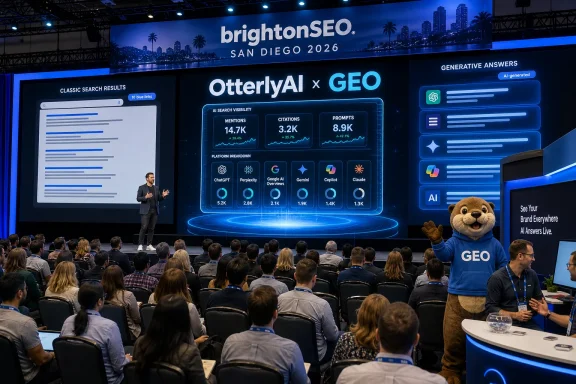
OtterlyAI announced on June 24, 2026, that it will headline sponsor BrightonSEO San Diego 2026, a two-day search marketing conference scheduled for September 15 and 16 at the San Diego Convention Center. The move is not just another vendor logo on another event lanyard. It is a useful signal that the messy discipline once called SEO is being pulled toward AI answer visibility, where ChatGPT, Google AI Mode, Gemini, Copilot, Perplexity, Claude, and the rest are becoming distribution channels in their own right.
The company’s pitch is simple: if brands used to ask where they ranked on Google, they now need to ask whether they appear at all inside generated answers. That is a sharp enough claim to attract marketers, but it should also catch the attention of WindowsForum readers. Microsoft Copilot, Google’s AI surfaces, and browser-integrated assistants are turning search from a page of links into a layer of interpretation sitting between users and the open web.
The headline sponsorship matters because BrightonSEO is not a fringe AI conference hunting for a category. It is one of the search industry’s big rooms, and its San Diego edition gives OtterlyAI a US platform at precisely the moment when marketers are trying to work out whether generative engine optimization is a durable discipline or just a consultancy acronym with better timing than substance.
OtterlyAI says North America already represents 47 percent of its customer base. For an Austrian company selling an AI search visibility platform, that figure explains the San Diego bet better than any slogan about “meeting the market.” The United States is where enterprise SaaS budgets, agency experimentation, and brand panic over disappearing web traffic tend to collide first.
The company also says it now has more than 30,000 users. That number deserves the usual startup caveat: “users” can mean many things, from active paying seats to free accounts and trial signups. Still, the direction is clear. There is now a market for software that watches AI systems the way earlier SEO tools watched blue links, snippets, and keyword rankings.
OtterlyAI’s sponsorship package includes broad event branding, a speaking slot for CEO and co-founder Thomas Peham, 20 complimentary tickets for fans and partners, and a side event for the SEO community. The detail that the company plans to bring its otter costume to San Diego is the sort of conference whimsy that makes the press release easier to remember. The more serious point is that OtterlyAI wants to be physically present where a new budget category is being negotiated.
AI answer engines have complicated that bargain. A user may now ask a question and receive a synthesized answer that cites a handful of sources, paraphrases many more, or cites none at all. In some cases the answer becomes the destination, not the doorway.
That changes the value of visibility. A brand that once cared about ranking third for a commercial keyword may now care whether an AI assistant recommends it in a comparison answer, summarizes its documentation correctly, or omits it entirely. A support forum that once relied on Google traffic may find its hard-won troubleshooting knowledge absorbed into an assistant’s response without the same referral pattern.
This is why the SEO industry is rushing toward new labels: GEO, AEO, AI search optimization, answer visibility, AI search analytics. The vocabulary is unsettled because the underlying interfaces are unsettled. Google AI Overviews and AI Mode, Microsoft Copilot, ChatGPT search features, Perplexity, Gemini, and Claude are not identical products. They differ in source selection, citation behavior, freshness, personalization, and willingness to answer commercial queries.
OtterlyAI’s platform claims to monitor brand mentions, website citations, and prompts across seven AI search engines: ChatGPT, Perplexity, Google AI Overviews, Google AI Mode, Gemini, Microsoft Copilot, and Claude. That breadth is the pitch. If the new search layer is fragmented, the tool that tracks the fragmentation becomes valuable.
When an assistant sits in the operating system, browser, or productivity suite, it changes how users retrieve information. A Windows user troubleshooting a driver issue, comparing laptops, researching endpoint protection, or looking for a PowerShell command may increasingly begin with an AI answer rather than a list of forum threads and documentation pages. The assistant becomes a mediator, and mediation is power.
For sysadmins, the practical risk is not simply that AI answers can be wrong. It is that AI answers can be confidently incomplete. They may compress context, flatten version differences, miss known issues, or treat a consumer workaround as enterprise guidance. In Windows environments, where build numbers, update rings, policy settings, hardware IDs, and licensing boundaries matter, that compression can be dangerous.
For community sites, the risk is economic and cultural. Forums like WindowsForum.com exist because experienced users document edge cases, argue through problems, and leave behind searchable trails. If AI systems consume those trails but reduce the incentive to visit, register, reply, and correct mistakes, the knowledge commons that feeds the models may weaken.
That is the deeper significance of AI search visibility tools. They are not just selling vanity dashboards for brand managers. They are mapping a new gatekeeping layer, one that affects vendors, publishers, communities, and users who may never have heard the phrase “answer engine optimization.”
That makes conference positioning unusually important. By headline sponsoring BrightonSEO San Diego, OtterlyAI is not merely advertising a product. It is trying to associate itself with the vocabulary of the transition. If enough agencies, CMOs, and search leads hear “AI search visibility” and think of OtterlyAI, the sponsorship has done its work.
The company has already been building credibility signals. It says it was named a Cool Vendor in Gartner’s 2025 AI in Marketing research and won Best AI Search Software Solution at the 2026 European Search Awards. Awards and analyst recognition are not proof that a product works, but in a young category they help buyers justify experimentation.
The press release also names customers and agencies including BenQ, Stella Rising, and RDA. Again, this is classic startup validation. The list tells prospective buyers that the tool is not merely a demo for growth hackers; it is being positioned for brands and agencies with real reporting needs.
But the softness of the category cuts both ways. If AI search visibility becomes a mandatory marketing function, OtterlyAI is early. If the platforms clamp down, change output behavior, restrict scraping, or make third-party measurement unreliable, the category could become harder to productize. The company is betting that the need for visibility will outlast the volatility of the interfaces.
AI answers are slipperier. The same prompt can produce different wording across sessions. The answer can change based on model updates, retrieval indexes, user context, safety layers, regional behavior, and the presence or absence of live web access. Even defining whether a brand “appeared” can become ambiguous if it is mentioned in a citation, included in prose, implied through a product category, or buried behind a follow-up.
That creates a methodological challenge for every vendor in this space. Tracking prompts across engines is useful, but the output must be interpreted carefully. A dashboard can show that a brand appeared in 18 percent of sampled prompts, but the buyer still needs to know which prompts mattered, whether the answer was favorable, whether a citation drove traffic, and whether the sample reflected actual user behavior.
There is also the question of actionability. SEO tools became indispensable not because they showed rankings, but because they helped teams decide what to do next. Fix crawl errors. Improve internal links. Rewrite title tags. Build pages for unmet intent. Earn better links. The GEO equivalent is less mature.
OtterlyAI says its platform recommends actions to improve content and discoverability in AI answers. That is where the category will be won or lost. Reporting that a brand is absent from Copilot or ChatGPT is interesting. Explaining which content changes, entity signals, structured data, documentation updates, PR moves, or authority signals actually improve inclusion is the harder business.
That sounds familiar to IT professionals. Admins have long understood that abstractions leak. A cloud dashboard hides infrastructure until latency, permissions, billing, identity, or replication behavior breaks the illusion. AI answer engines are similar. They present a clean conversational layer on top of messy indexes, policies, models, and data pipelines.
For brands, that means “content strategy” now includes machine readability, factual consistency, and authority across multiple sources. A company whose documentation contradicts its support pages, whose product names are inconsistent, or whose third-party profiles are stale may confuse the systems that summarize it. The AI layer rewards clean signals because clean signals are easier to retrieve and recombine.
For IT publishers and communities, the lesson is harsher. High-quality technical content may become even more valuable to users while becoming less visible as a destination. If a Copilot response draws from a support thread but the user never sees the thread, the site’s contribution is real but harder to monetize, moderate, or improve.
That tension will shape the next phase of the web. Search engines once stood between users and sites but still sent traffic in bulk. AI assistants may stand between users and sites while sending less traffic, more qualified traffic, or traffic only when the answer needs backup. Nobody knows the final distribution yet, which is why companies like OtterlyAI are racing to measure it.
That history matters. The SEO community is not naïve about platform dependency. It understands that vendors often sell control over systems they do not control. A tool can observe, infer, and recommend, but it cannot command Google AI Mode, ChatGPT, Gemini, Copilot, Perplexity, or Claude to cite a brand on demand.
The best version of GEO will acknowledge that limit. It will treat AI visibility as a probabilistic discipline: improve the odds of being understood, retrieved, cited, and recommended, while measuring changes over time. The worst version will become superstition with charts.
OtterlyAI’s CEO plans to share findings from two years of measuring AI Search. That session could be more important than the logo placement. If the company brings real comparative data across engines, shows how answer behavior has changed, and explains what actually moved visibility, it can strengthen the case for the category. If the talk collapses into slogans, the sponsorship will look like a land grab.
That does not make the budget irrational. If a consumer asks an AI assistant for “best business laptops for travel,” “best endpoint protection for small business,” or “how to choose a managed service provider,” the answer can influence purchasing behavior. If the assistant omits a brand, the brand may never enter the consideration set.
The same logic applies to software documentation and support. If a developer asks an AI tool how to configure an Azure service from Windows Terminal, or an admin asks about a Group Policy setting, the cited and summarized sources shape the path that user follows. Visibility here is not just marketing; it is operational discoverability.
Still, the US market’s appetite for new categories can create inflated expectations. A board may hear “AI search optimization” and expect the predictability of paid search. A marketing leader may expect a quick fix for lost organic traffic. A startup may imply that tracking alone equals influence. The more money enters the category, the more discipline it will need.
That is why independent scrutiny matters. The industry should ask how prompts are selected, how often tests run, how outputs are normalized, whether citations are weighted differently from mentions, and how vendors handle personalization. These are not academic questions. They determine whether a visibility score reflects reality or merely makes volatility presentable.
A user might see a brand in an AI answer and later visit directly. Another might read a generated summary and never click. A third might ask follow-up questions that refine the recommendation before the brand ever sees a signal. The result is influence without clean attribution.
This is the measurement gap OtterlyAI and its competitors are trying to fill. They are not replacing web analytics; they are trying to create a pre-click visibility layer for AI-mediated discovery. In old search, “rank” was a proxy for opportunity. In AI search, “presence in answer” may become the proxy, but the relationship to business outcomes will be messier.
The risk is that executives will overread the numbers. A brand appearing in an answer is not the same as winning a customer. A citation is not the same as endorsement. A favorable summary is not the same as conversion. Measurement tools can clarify the terrain, but they can also produce new illusions of precision.
The opportunity is that better measurement may improve the quality of public information. If AI systems reward clear, authoritative, well-structured, up-to-date content, then brands and publishers have incentives to clean up their knowledge bases. For Windows users and IT pros, that could mean better documentation, fewer stale support pages, and more consistent technical explanations across the web.
For Microsoft, this plays directly into the Copilot era. The company wants AI to be ambient across work, Windows, Edge, security, and development. That creates convenience, but it also centralizes interpretation. Users may increasingly accept an assistant’s synthesis as the practical answer, especially when it appears inside a trusted workflow.
For Google, the stakes are even more existential because AI answers alter the classic search results page. Google must preserve search revenue, satisfy users who want direct answers, and avoid alienating the publishers whose content makes the answers useful. That triangle is not stable.
For OpenAI, Anthropic, Perplexity, and others, the challenge is trust and sourcing. If their tools become discovery engines, they inherit some of the responsibilities of search engines without necessarily inheriting the same norms around ranking, attribution, and traffic. The market will push them toward better answers; regulators, publishers, and users may push them toward more transparent sourcing.
OtterlyAI is positioning itself inside that pressure system. Its sponsorship of BrightonSEO San Diego is a commercial move, but also a declaration that AI search visibility is no longer a side conversation. The company wants the search industry to treat GEO as a board-level concern, not an experimental tab in a marketer’s spreadsheet.
That is why BrightonSEO San Diego is a useful checkpoint. It gives the industry a place to compare claims, ask hard questions, and separate durable practices from opportunistic jargon. The presence of a headline sponsor does not settle the debate, but it does make the debate harder to ignore.
The strongest case for OtterlyAI is that brands need visibility into systems that increasingly shape user decisions. The weakest case is that the systems are too volatile for clean optimization, making today’s dashboards tomorrow’s historical curiosities. The truth is likely between those poles: AI search visibility will matter, but the tools and tactics will mature unevenly.
For WindowsForum readers, the practical lens should be broader than marketing. If AI assistants become the first stop for troubleshooting, purchasing, documentation, and product comparison, then the quality of what those assistants retrieve matters to everyone. Visibility is not merely about who sells more software. It is about which explanations survive the trip through the machine.
The company’s pitch is simple: if brands used to ask where they ranked on Google, they now need to ask whether they appear at all inside generated answers. That is a sharp enough claim to attract marketers, but it should also catch the attention of WindowsForum readers. Microsoft Copilot, Google’s AI surfaces, and browser-integrated assistants are turning search from a page of links into a layer of interpretation sitting between users and the open web.
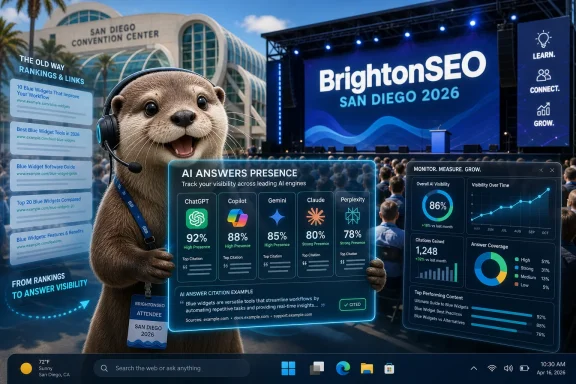 OtterlyAI Is Buying the Main Stage Because AI Search Has Become a Main-Stage Problem
The headline sponsorship matters because BrightonSEO is not a fringe AI conference hunting for a category. It is one of the search industry’s big rooms, and its San Diego edition gives OtterlyAI a US platform at precisely the moment when marketers are trying to work out whether generative engine optimization is a durable discipline or just a consultancy acronym with better timing than substance.OtterlyAI says North America already represents 47 percent of its customer base. For an Austrian company selling an AI search visibility platform, that figure explains the San Diego bet better than any slogan about “meeting the market.” The United States is where enterprise SaaS budgets, agency experimentation, and brand panic over disappearing web traffic tend to collide first.
The company also says it now has more than 30,000 users. That number deserves the usual startup caveat: “users” can mean many things, from active paying seats to free accounts and trial signups. Still, the direction is clear. There is now a market for software that watches AI systems the way earlier SEO tools watched blue links, snippets, and keyword rankings.
OtterlyAI’s sponsorship package includes broad event branding, a speaking slot for CEO and co-founder Thomas Peham, 20 complimentary tickets for fans and partners, and a side event for the SEO community. The detail that the company plans to bring its otter costume to San Diego is the sort of conference whimsy that makes the press release easier to remember. The more serious point is that OtterlyAI wants to be physically present where a new budget category is being negotiated.
The Old Search Contract Is Breaking in Public
For two decades, search marketing was built around a reasonably stable bargain. Search engines crawled the web, ranked pages, displayed links, and sent measurable traffic to publishers, retailers, forums, vendors, and documentation sites. The game was never pure, but it was legible.AI answer engines have complicated that bargain. A user may now ask a question and receive a synthesized answer that cites a handful of sources, paraphrases many more, or cites none at all. In some cases the answer becomes the destination, not the doorway.
That changes the value of visibility. A brand that once cared about ranking third for a commercial keyword may now care whether an AI assistant recommends it in a comparison answer, summarizes its documentation correctly, or omits it entirely. A support forum that once relied on Google traffic may find its hard-won troubleshooting knowledge absorbed into an assistant’s response without the same referral pattern.
This is why the SEO industry is rushing toward new labels: GEO, AEO, AI search optimization, answer visibility, AI search analytics. The vocabulary is unsettled because the underlying interfaces are unsettled. Google AI Overviews and AI Mode, Microsoft Copilot, ChatGPT search features, Perplexity, Gemini, and Claude are not identical products. They differ in source selection, citation behavior, freshness, personalization, and willingness to answer commercial queries.
OtterlyAI’s platform claims to monitor brand mentions, website citations, and prompts across seven AI search engines: ChatGPT, Perplexity, Google AI Overviews, Google AI Mode, Gemini, Microsoft Copilot, and Claude. That breadth is the pitch. If the new search layer is fragmented, the tool that tracks the fragmentation becomes valuable.
The Copilot Angle Makes This More Than a Marketing Story
Windows users may be tempted to file this under “SEO people inventing new SEO.” That would be too easy. Microsoft has spent the last several years embedding Copilot branding into Windows, Edge, Microsoft 365, Bing, developer tooling, and enterprise workflows. Whether every integration sticks is a separate question; the strategy is unmistakable.When an assistant sits in the operating system, browser, or productivity suite, it changes how users retrieve information. A Windows user troubleshooting a driver issue, comparing laptops, researching endpoint protection, or looking for a PowerShell command may increasingly begin with an AI answer rather than a list of forum threads and documentation pages. The assistant becomes a mediator, and mediation is power.
For sysadmins, the practical risk is not simply that AI answers can be wrong. It is that AI answers can be confidently incomplete. They may compress context, flatten version differences, miss known issues, or treat a consumer workaround as enterprise guidance. In Windows environments, where build numbers, update rings, policy settings, hardware IDs, and licensing boundaries matter, that compression can be dangerous.
For community sites, the risk is economic and cultural. Forums like WindowsForum.com exist because experienced users document edge cases, argue through problems, and leave behind searchable trails. If AI systems consume those trails but reduce the incentive to visit, register, reply, and correct mistakes, the knowledge commons that feeds the models may weaken.
That is the deeper significance of AI search visibility tools. They are not just selling vanity dashboards for brand managers. They are mapping a new gatekeeping layer, one that affects vendors, publishers, communities, and users who may never have heard the phrase “answer engine optimization.”
OtterlyAI’s Timing Is Shrewd Because the Category Is Still Soft
The most important thing to understand about GEO is that it is not yet as standardized as SEO. There is no settled equivalent of keyword rank tracking, no single dominant AI answer interface, and no stable reporting convention across engines. The result is a noisy vendor field where everyone is trying to define the metric before someone else defines it for them.That makes conference positioning unusually important. By headline sponsoring BrightonSEO San Diego, OtterlyAI is not merely advertising a product. It is trying to associate itself with the vocabulary of the transition. If enough agencies, CMOs, and search leads hear “AI search visibility” and think of OtterlyAI, the sponsorship has done its work.
The company has already been building credibility signals. It says it was named a Cool Vendor in Gartner’s 2025 AI in Marketing research and won Best AI Search Software Solution at the 2026 European Search Awards. Awards and analyst recognition are not proof that a product works, but in a young category they help buyers justify experimentation.
The press release also names customers and agencies including BenQ, Stella Rising, and RDA. Again, this is classic startup validation. The list tells prospective buyers that the tool is not merely a demo for growth hackers; it is being positioned for brands and agencies with real reporting needs.
But the softness of the category cuts both ways. If AI search visibility becomes a mandatory marketing function, OtterlyAI is early. If the platforms clamp down, change output behavior, restrict scraping, or make third-party measurement unreliable, the category could become harder to productize. The company is betting that the need for visibility will outlast the volatility of the interfaces.
The Hard Part Is Measuring Something That Keeps Moving
Traditional SEO was difficult, but it had anchors. A keyword, a location, a device type, a search engine results page, and a timestamp could produce a ranking snapshot. The snapshot was imperfect, personalized, and volatile, but it was still a recognizable unit of measurement.AI answers are slipperier. The same prompt can produce different wording across sessions. The answer can change based on model updates, retrieval indexes, user context, safety layers, regional behavior, and the presence or absence of live web access. Even defining whether a brand “appeared” can become ambiguous if it is mentioned in a citation, included in prose, implied through a product category, or buried behind a follow-up.
That creates a methodological challenge for every vendor in this space. Tracking prompts across engines is useful, but the output must be interpreted carefully. A dashboard can show that a brand appeared in 18 percent of sampled prompts, but the buyer still needs to know which prompts mattered, whether the answer was favorable, whether a citation drove traffic, and whether the sample reflected actual user behavior.
There is also the question of actionability. SEO tools became indispensable not because they showed rankings, but because they helped teams decide what to do next. Fix crawl errors. Improve internal links. Rewrite title tags. Build pages for unmet intent. Earn better links. The GEO equivalent is less mature.
OtterlyAI says its platform recommends actions to improve content and discoverability in AI answers. That is where the category will be won or lost. Reporting that a brand is absent from Copilot or ChatGPT is interesting. Explaining which content changes, entity signals, structured data, documentation updates, PR moves, or authority signals actually improve inclusion is the harder business.
Google and Microsoft Are Forcing Marketers to Think Like Infrastructure Teams
The most revealing part of this shift is that marketing teams are being forced to care about systems behavior. They cannot treat search as a static advertising surface anymore. They have to think about retrieval, summarization, citations, model updates, source trust, and how platforms decide what counts as a useful answer.That sounds familiar to IT professionals. Admins have long understood that abstractions leak. A cloud dashboard hides infrastructure until latency, permissions, billing, identity, or replication behavior breaks the illusion. AI answer engines are similar. They present a clean conversational layer on top of messy indexes, policies, models, and data pipelines.
For brands, that means “content strategy” now includes machine readability, factual consistency, and authority across multiple sources. A company whose documentation contradicts its support pages, whose product names are inconsistent, or whose third-party profiles are stale may confuse the systems that summarize it. The AI layer rewards clean signals because clean signals are easier to retrieve and recombine.
For IT publishers and communities, the lesson is harsher. High-quality technical content may become even more valuable to users while becoming less visible as a destination. If a Copilot response draws from a support thread but the user never sees the thread, the site’s contribution is real but harder to monetize, moderate, or improve.
That tension will shape the next phase of the web. Search engines once stood between users and sites but still sent traffic in bulk. AI assistants may stand between users and sites while sending less traffic, more qualified traffic, or traffic only when the answer needs backup. Nobody knows the final distribution yet, which is why companies like OtterlyAI are racing to measure it.
BrightonSEO Gives GEO a Legitimacy Test
BrightonSEO’s San Diego stage gives OtterlyAI an audience that is both receptive and skeptical. Search professionals have seen waves of automation hype before. They watched voice search fail to become the predicted commercial revolution, saw “zero-click search” reshape analytics debates, and survived years of algorithm updates that turned certainty into a subscription business.That history matters. The SEO community is not naïve about platform dependency. It understands that vendors often sell control over systems they do not control. A tool can observe, infer, and recommend, but it cannot command Google AI Mode, ChatGPT, Gemini, Copilot, Perplexity, or Claude to cite a brand on demand.
The best version of GEO will acknowledge that limit. It will treat AI visibility as a probabilistic discipline: improve the odds of being understood, retrieved, cited, and recommended, while measuring changes over time. The worst version will become superstition with charts.
OtterlyAI’s CEO plans to share findings from two years of measuring AI Search. That session could be more important than the logo placement. If the company brings real comparative data across engines, shows how answer behavior has changed, and explains what actually moved visibility, it can strengthen the case for the category. If the talk collapses into slogans, the sponsorship will look like a land grab.
The US Market Is Where AI Search Anxiety Becomes Budget
The United States is a natural expansion target because its marketing ecosystem monetizes uncertainty quickly. Agencies need new services. SaaS vendors need differentiation. Enterprises need dashboards for executives asking why organic traffic is changing. In that environment, a new metric can become a new budget line before the underlying science is fully settled.That does not make the budget irrational. If a consumer asks an AI assistant for “best business laptops for travel,” “best endpoint protection for small business,” or “how to choose a managed service provider,” the answer can influence purchasing behavior. If the assistant omits a brand, the brand may never enter the consideration set.
The same logic applies to software documentation and support. If a developer asks an AI tool how to configure an Azure service from Windows Terminal, or an admin asks about a Group Policy setting, the cited and summarized sources shape the path that user follows. Visibility here is not just marketing; it is operational discoverability.
Still, the US market’s appetite for new categories can create inflated expectations. A board may hear “AI search optimization” and expect the predictability of paid search. A marketing leader may expect a quick fix for lost organic traffic. A startup may imply that tracking alone equals influence. The more money enters the category, the more discipline it will need.
That is why independent scrutiny matters. The industry should ask how prompts are selected, how often tests run, how outputs are normalized, whether citations are weighted differently from mentions, and how vendors handle personalization. These are not academic questions. They determine whether a visibility score reflects reality or merely makes volatility presentable.
The Web’s Measurement Layer Is Being Rebuilt in Real Time
Analytics used to be comforting because it turned user behavior into familiar shapes. Sessions, referrals, clicks, impressions, rankings, conversions: each had flaws, but together they gave organizations a sense of causality. AI search disrupts that comfort by reducing the visibility of the journey.A user might see a brand in an AI answer and later visit directly. Another might read a generated summary and never click. A third might ask follow-up questions that refine the recommendation before the brand ever sees a signal. The result is influence without clean attribution.
This is the measurement gap OtterlyAI and its competitors are trying to fill. They are not replacing web analytics; they are trying to create a pre-click visibility layer for AI-mediated discovery. In old search, “rank” was a proxy for opportunity. In AI search, “presence in answer” may become the proxy, but the relationship to business outcomes will be messier.
The risk is that executives will overread the numbers. A brand appearing in an answer is not the same as winning a customer. A citation is not the same as endorsement. A favorable summary is not the same as conversion. Measurement tools can clarify the terrain, but they can also produce new illusions of precision.
The opportunity is that better measurement may improve the quality of public information. If AI systems reward clear, authoritative, well-structured, up-to-date content, then brands and publishers have incentives to clean up their knowledge bases. For Windows users and IT pros, that could mean better documentation, fewer stale support pages, and more consistent technical explanations across the web.
The Otter Costume Is Funny; the Platform Shift Is Not
It is easy to smile at the otter costume line because conference marketing thrives on memorable props. But the platform shift underneath is not cute. AI answer engines are changing who gets seen, who gets credited, and who gets traffic.For Microsoft, this plays directly into the Copilot era. The company wants AI to be ambient across work, Windows, Edge, security, and development. That creates convenience, but it also centralizes interpretation. Users may increasingly accept an assistant’s synthesis as the practical answer, especially when it appears inside a trusted workflow.
For Google, the stakes are even more existential because AI answers alter the classic search results page. Google must preserve search revenue, satisfy users who want direct answers, and avoid alienating the publishers whose content makes the answers useful. That triangle is not stable.
For OpenAI, Anthropic, Perplexity, and others, the challenge is trust and sourcing. If their tools become discovery engines, they inherit some of the responsibilities of search engines without necessarily inheriting the same norms around ranking, attribution, and traffic. The market will push them toward better answers; regulators, publishers, and users may push them toward more transparent sourcing.
OtterlyAI is positioning itself inside that pressure system. Its sponsorship of BrightonSEO San Diego is a commercial move, but also a declaration that AI search visibility is no longer a side conversation. The company wants the search industry to treat GEO as a board-level concern, not an experimental tab in a marketer’s spreadsheet.
San Diego Will Test Whether GEO Can Grow Up in Public
By September, the conversation around AI search will almost certainly have shifted again. Google may adjust AI Mode. Microsoft may change Copilot behavior. OpenAI, Anthropic, and Perplexity may alter search and citation features. The vendors selling measurement will have to keep pace with platforms that do not owe them stability.That is why BrightonSEO San Diego is a useful checkpoint. It gives the industry a place to compare claims, ask hard questions, and separate durable practices from opportunistic jargon. The presence of a headline sponsor does not settle the debate, but it does make the debate harder to ignore.
The strongest case for OtterlyAI is that brands need visibility into systems that increasingly shape user decisions. The weakest case is that the systems are too volatile for clean optimization, making today’s dashboards tomorrow’s historical curiosities. The truth is likely between those poles: AI search visibility will matter, but the tools and tactics will mature unevenly.
For WindowsForum readers, the practical lens should be broader than marketing. If AI assistants become the first stop for troubleshooting, purchasing, documentation, and product comparison, then the quality of what those assistants retrieve matters to everyone. Visibility is not merely about who sells more software. It is about which explanations survive the trip through the machine.
The San Diego Sponsorship Says the Quiet Part Out Loud
OtterlyAI’s announcement is full of conference mechanics, but its larger message is that AI answer visibility has become a commercial battlefield. The particulars are worth keeping straight because they show where the category is headed.- OtterlyAI says it will be the headline sponsor of BrightonSEO San Diego 2026, scheduled for September 15 and 16 at the San Diego Convention Center.
- The company says North America already accounts for 47 percent of its customer base, making the US market central to its expansion story.
- OtterlyAI says its platform now tracks visibility across ChatGPT, Perplexity, Google AI Overviews, Google AI Mode, Gemini, Microsoft Copilot, and Claude.
- The company’s claimed user base of more than 30,000 suggests that AI search monitoring is moving from novelty to budgeted experiment.
- The real test for OtterlyAI and its rivals will be whether they can turn volatile AI answer behavior into reliable guidance, not just attractive dashboards.
References
- Primary source: markets.businessinsider.com
Published: 2026-06-24T14:21:10.482437
OtterlyAI Doubles Down on the US, Becomes Headline Sponsor of BrightonSEO San Diego 2026 | Markets Insider
SAN DIEGO, Calif., June 24, 2026 (GLOBE NEWSWIRE) -- OtterlyAI, the AI Search Optimization platform, today announced it is the headline sponsor ...markets.businessinsider.com - Related coverage: brightonseo.com
brightonSEO San Diego 2026 search marketing conference
The world's biggest search marketing conference is back in the US with search and PPC talks for digital marketers.brightonseo.com - Related coverage: cmswire.com
BrightonSEO San Diego 2026
www.cmswire.com
- Related coverage: globenewswire.com
OtterlyAI Wins European Search Awards 2026, Cementing Its
Bootstrapped platform surpasses +30,000 active users and beats ten finalists to claim top prize in one of the search industry's most competitive new...www.globenewswire.com - Related coverage: alber-marketing.com
brightonSEO San Diego 2026 – Alber Marketing e.K.
 www.alber-marketing.com
- Related coverage: globalseoconferences.com
BrightonSEO San Diego 2026 | Global SEO Conferences
BrightonSEO San Diego is the US edition of the world's largest search marketing conference, held at the San Diego Convention Center and bringing the same energy and format of the Brighton flagship event to the West Coast. The two-day conference covers AI-powered search, Google AI Overviews...globalseoconferences.com
- Related coverage: europeansearchawards.com
OtterlyAI Named Finalist for Best AI Search Software Solution at the 2026 European Search Awards - European Search Awards
OtterlyAI, 2026 European Search Awards finalist. Monitor brand visibility across ChatGPT, Perplexity, and AI Overviews.europeansearchawards.com - Related coverage: paidsearch.org
Hero Conf 2026 - San Diego - Paid Search Association
The must-attend event for PPC and Paid Social professionals is back in the US. Join the sharpest minds in digital advertising, connect with industry leaders, and master the latest strategies…paidsearch.org - Related coverage: ecommercetech.io
brightonSEO San Diego 2026
Interact with search and eCommerce leaders at brightonSEO San Diego, a two-day experience at the San Diego Convention Center offering talks, training, and networking.ecommercetech.io - Related coverage: the-power-of.ai
BrightonSEO San Diego | THE POWER OF AI
BrightonSEO San Diego on Sep 15, 2026 in San Diego Convention Center, 111 Harbor Dr, 92101, San Diego, United Statesthe-power-of.ai