

Pantone’s new Palette Generator brings decades of color expertise into a conversational AI assistant embedded in Pantone Connect, promising to compress hours of trend research and palette ideation into seconds while raising important questions about color fidelity, provenance, licensing and enterprise governance.
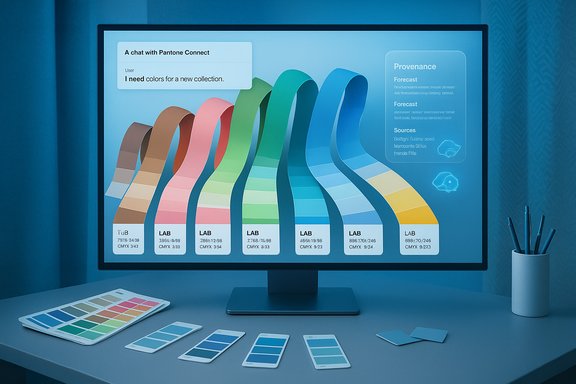
Pantone and Microsoft announced a strategic collaboration on November 5, 2025, to launch the Pantone Palette Generator, a chat-based feature inside Pantone Connect that uses Microsoft’s cloud AI stack to deliver trend-informed color palettes and design concepts. The tool is available in open beta to all Pantone Connect users and initially draws from Pantone’s Fashion, Home & Interiors library. The release explicitly names Azure OpenAI, Azure AI Search, Azure AI Foundry, and Azure Cosmos DB as core technologies underpinning the product, and states the system uses Retrieval-Augmented Generation (RAG) and agentic components to ground outputs in Pantone’s forecasting and Color Institute content.
This announcement marks a notable inflection point: a long-standing standards authority for color is embedding generative AI into the same workflow designers rely on for accurate, reproducible color decisions. The payoff is faster ideation and easier access to Pantone’s forecasting rationale; the trade-offs are technical and governance-related, and they matter to studios, brands and manufacturers that depend on color precision.
2. Require exported provenance: save the retrieval snippets and forecast rationale the assistant used for each palette.
3. Validate physically: convert suggested palettes to LAB/CMYK builds and proof with vendor samples before committing to manufacturing.
4. Archive exports: keep a secure, versioned repository of generated palettes independent of Pantone Connect.
5. Update contracts: clarify licensing and ownership of AI-assisted palettes in supplier and client agreements.
6. Train staff: teach prompt best practices, provenance review, and how to interpret provider confidence.
7. Escalation rules: define who signs off on palette commercialization and how to handle ambiguous provenance or achievability flags.
However, the tool’s success will hinge on three pillars:
Source: Microsoft Source Pantone and Microsoft unite to enhance creative exploration through AI - Source
 Background
Pantone and Microsoft announced a strategic collaboration on November 5, 2025, to launch the Pantone Palette Generator, a chat-based feature inside Pantone Connect that uses Microsoft’s cloud AI stack to deliver trend-informed color palettes and design concepts. The tool is available in open beta to all Pantone Connect users and initially draws from Pantone’s Fashion, Home & Interiors library. The release explicitly names Azure OpenAI, Azure AI Search, Azure AI Foundry, and Azure Cosmos DB as core technologies underpinning the product, and states the system uses Retrieval-Augmented Generation (RAG) and agentic components to ground outputs in Pantone’s forecasting and Color Institute content.This announcement marks a notable inflection point: a long-standing standards authority for color is embedding generative AI into the same workflow designers rely on for accurate, reproducible color decisions. The payoff is faster ideation and easier access to Pantone’s forecasting rationale; the trade-offs are technical and governance-related, and they matter to studios, brands and manufacturers that depend on color precision.
What the Pantone Palette Generator Does
At a glance
- A chat-driven assistant inside Pantone Connect that responds to natural-language prompts (for example, “colors that evoke optimism in Gen Z” or “palettes inspired by 1970s fashion editorials”).
- Generates palettes from thousands of Pantone colors and maps suggestions to proprietary Pantone values.
- Surfaces the forecasting or Color Institute rationale that informed a suggestion, using RAG to attach evidence from Pantone’s trend content.
- Allows generated palettes to be added to Pantone Connect libraries, analyzed, downloaded and shared for collaborative workflows.
- Available in open beta to both free (basic) and paid Pantone Connect users; initial coverage is the Fashion, Home & Interiors library with plans to expand to Pantone’s full library.
Key technical claims (as stated by Pantone and Microsoft)
- The Palette Generator is built on Azure OpenAI for conversational generation, with Azure AI Search and Azure Cosmos DB used for indexing and storing content and assets.
- The system leverages RAG to semantically search Pantone’s Color Insider articles and trend forecasting content, aiming to reduce hallucination and provide traceability for palette recommendations.
- The architecture uses agentic technology to orchestrate retrieval, reasoning and asset packaging steps, enabling the assistant to return palettes along with the supporting forecasting snippets.
Why this matters: practical benefits for designers and teams
Faster ideation, evidence-backed storytelling
Design teams often spend hours assembling mood boards, cross-referencing trend reports and building palette options. The Palette Generator is positioned to:- Produce multiple concept palettes in seconds, accelerating brainstorming and client presentations.
- Embed forecast-driven explanations with each palette so designers can tell a coherent, data-backed story about color choices.
- Democratize access to Pantone-level insight by making the beta available to free users, which lowers the barrier for students, freelancers and small teams.
Workflow integration
Because generated palettes can be imported directly into Pantone Connect and exported to common design workflows (including the Adobe extension improvements Pantone has rolled out), the Generator reduces friction between inspiration and production. This can shorten time-to-concept and enable closer alignment between creative and merchandising teams.Enterprise readiness
By building on Azure’s managed services, Pantone gains scale, observability and enterprise-grade security features that smaller startups might lack. Azure tooling also simplifies multilanguage support and cross-region deployment plans for a global design customer base. That said, relying on a third-party cloud provider also creates dependency — a point enterprises must weigh.Technical deep dive: architecture, RAG and agentic orchestration
Retrieval-Augmented Generation (RAG)
RAG combines a semantic search index with a generative model: when a prompt is received, the system first retrieves relevant documents or passages, then uses those retrieved snippets as context for the generative model, reducing the risk of unsupported assertions. Pantone and Microsoft state the Palette Generator uses RAG to ground palette suggestions in Color Institute assets and trend articles. This is an appropriate design choice for domain-specific outputs where provenance matters.Agentic technology
The announcement references “agentic technology,” which typically means the use of orchestrated micro-agents that perform distinct functions — search, retrieval, color computation, justification generation, and export packaging. An agentic approach helps structure the pipeline so the model’s outputs can be traced back to explicit retrievals, improving explainability compared with a single end-to-end LLM. However, agentic pipelines introduce operational complexity: routing, timeouts, retry policies and state management all become new potential failure modes.Microsoft Azure components
- Azure OpenAI: Hosts the conversational model and provides the LLM inference layer.
- Azure AI Search: Indexes Pantone’s trend content for fast semantic retrieval.
- Azure Cosmos DB: Stores structured assets and possibly the palette metadata for fast cross-region access.
- Azure AI Foundry: Orchestrates model deployments and agent frameworks at scale.
Strengths: where Pantone + Microsoft can add real value
- Domain credibility: Pantone’s Color Institute is the industry benchmark for trend forecasting and color psychology; packaging that expertise into a conversational assistant gives immediate trust advantages over generic palette tools.
- Speed and scale: Generating many Pantone-indexed palettes in seconds can transform early-stage creative sessions and client pitches.
- Actionable provenance: By surfacing the forecasting snippets that informed each palette, teams gain a defensible narrative for design choices — useful in merchandising, retail and licensing contexts.
- Lowered barrier to entry: Beta access for free users expands the pool of designers who can experiment with trend-backed palettes, potentially diversifying design input and education.
Risks, limitations and open questions
1. Color fidelity and the material gap
Pantone’s value rests on reliable translation of a color across substrates and processes. A screen-based palette that looks coherent in a chat session does not guarantee faithful reproduction in printing, dyeing, coating or finishes. Pantone has signaled roadmap work on “achievability” visualization, but these features are not yet available in the initial beta. Until then, designers must validate any AI-generated palette with physical swatches, LAB values and vendor-specific builds. Overreliance on screen suggestions risks costly production surprises.2. Hallucinations and provenance gaps
RAG reduces hallucination risk but does not eliminate it. Models can still generate plausible-sounding rationales or misattribute sources. The announcement promises retrieval-backed outputs, yet the precise evidence export, citation granularity and fallback behavior are not disclosed. Teams should request the raw retrieved snippets and expect to audit them.3. IP, licensing and commercialization
Who owns or may commercialize palettes suggested by an AI built from Pantone’s datasets? The press release frames outputs as Pantone-informed but does not define downstream licensing rules for productization or exclusive brand palettes. Organizations that base product lines on generated palettes should confirm licensing terms with Pantone and update contracts and approval workflows accordingly.4. Data governance, telemetry and confidentiality
The announcement does not publish detailed retention or telemetry policies for user prompts and generated palettes. For teams working on confidential collections, prompts may contain sensitive commercial information; without clear guarantees (e.g., prompt non-retention, private instances, or contractual assurances), treat beta interactions as non-confidential and use separate channels for proprietary work.5. Vendor lock-in and exportability
A cloud-native, platform-integrated tool delivers convenience but increases dependency. Export formats, the fidelity of CMYK/LAB conversions, and integration with third-party color management systems will determine whether teams can avoid vendor lock-in. Maintain local, versioned exports of palette libraries as insurance against subscription changes or service disruptions.6. Cultural bias and trend universality
Trend forecasting and color psychology are inherently interpretive. An assistant trained to surface Pantone’s perspective will amplify Pantone’s worldview and methodological choices. Designers targeting regional or culturally specific audiences should cross-check palettes with local research to avoid misaligned color signaling.Operational checklist: how design teams should adopt the Palette Generator safely
1. Start with a pilot on non-sensitive projects to evaluate quality, provenance and translation to production.2. Require exported provenance: save the retrieval snippets and forecast rationale the assistant used for each palette.
3. Validate physically: convert suggested palettes to LAB/CMYK builds and proof with vendor samples before committing to manufacturing.
4. Archive exports: keep a secure, versioned repository of generated palettes independent of Pantone Connect.
5. Update contracts: clarify licensing and ownership of AI-assisted palettes in supplier and client agreements.
6. Train staff: teach prompt best practices, provenance review, and how to interpret provider confidence.
7. Escalation rules: define who signs off on palette commercialization and how to handle ambiguous provenance or achievability flags.
Roadmap signals and what to watch next
Pantone’s announcement and product notes point to several near-term expansions that will materially change the product’s value and risk profile:- Full library coverage beyond Fashion, Home & Interiors.
- Integration with the Pantone Color of the Year workflows (including Palette Generator prompts tied to the 2026 Color of the Year).
- Achievability visualizers and substrate-aware renderers to predict how a Pantone color appears on different materials — a major technical differentiator if executed with spectral data rather than heuristic approximations.
- More explicit enterprise controls for telemetry, data residency and contractable non-use clauses for model training.
Practical tips for prompts and workflows
- Be specific: include usage context (digital banner, upholstery, print packaging), substrate constraints and contrast or accessibility requirements.
- Ask for evidence: request the forecasting snippets and report names that informed the palette so reviewers can audit claims.
- Use the Generator for ideation and storytelling, not final specifications: treat outputs as starting points that require physical validation.
- Objective (e.g., “create a five-color palette for a spring 2026 womenswear capsule”)
- Audience (e.g., “targeting Gen Z in North America”)
- Constraints (e.g., “must include a washable textile-friendly neutral and meet AA contrast requirements for text")
- Output format (e.g., “return Pantone names and LAB values and list the forecast snippet used”)
Final assessment: pragmatic optimism with caveats
Pantone’s Palette Generator is a logical, well-targeted application of generative AI for creative workflows. By combining the Color Institute’s curated forecasting data with Microsoft’s agentic Azure stack and RAG, the tool can legitimately speed ideation, make trend reasoning more actionable and democratize access to high-quality color insight. For many studios and solo designers, being able to produce Pantone-indexed, forecast-backed palettes in seconds will be a meaningful productivity multiplier.However, the tool’s success will hinge on three pillars:
- Technical fidelity to production: accurate LAB/CMYK conversions and substrate-aware simulations are essential for professional adoption.
- Transparent provenance: downloadable retrieval snippets and traceable rationale reduce litigation and commercial risk.
- Robust governance and licensing: explicit enterprise controls for telemetry, non-use in training and clear licensing around commercialization will reassure brands and manufacturers.
Conclusion
The Pantone–Microsoft partnership illustrates how domain expertise and scale AI platforms can make niche professional knowledge interactive and instantly useful. The Pantone Palette Generator has the potential to reshape early-stage creative workflows by delivering trend-aligned palettes with traceable reasoning inside Pantone Connect. The upside is clear: faster ideation, improved storytelling and wider access to Pantone insights. Equally clear are the responsibilities Pantone and Microsoft now shoulder — ensuring color fidelity across materials, proving provenance, and offering enterprise-grade governance. Designers, buyers and IT leaders should approach the beta with curiosity and rigor: test broadly, validate physically, and insist on provenance and contractual protections before moving AI-suggested palettes into production.Source: Microsoft Source Pantone and Microsoft unite to enhance creative exploration through AI - Source
