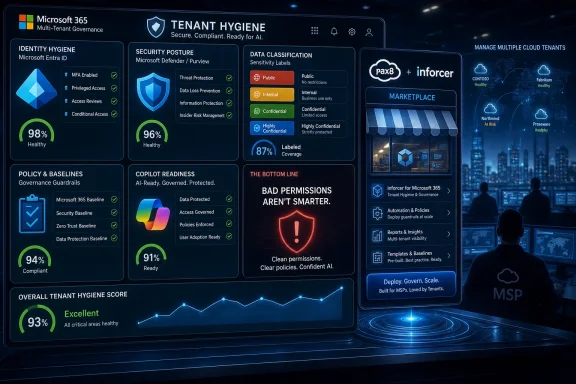
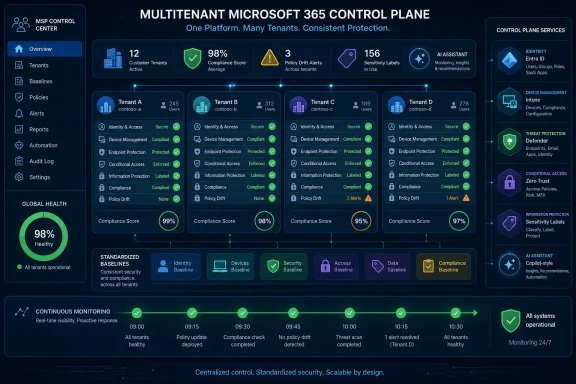
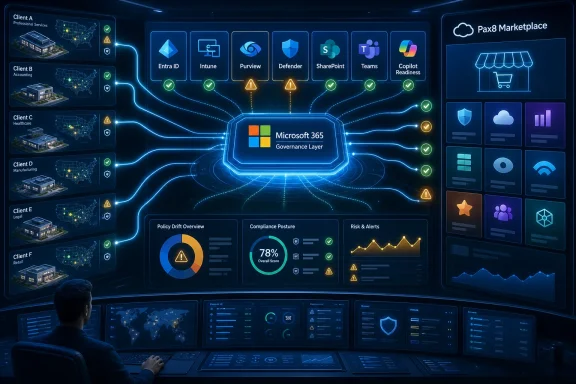
Pax8 said on June 9, 2026, that it will add inforcer to the Pax8 Marketplace this summer, giving managed service providers a new route to buy and deploy Microsoft 365 security, governance, and Copilot-readiness tooling for SMB customers. The announcement is not merely another vendor listing in a crowded channel catalog. It is a sign that Microsoft 365 administration, AI governance, and MSP commercial packaging are collapsing into the same operational problem. Pax8 and inforcer are betting that the MSPs who win the Copilot era will be the ones who can make tenant hygiene repeatable before the AI sales pitch begins.
For years, the MSP business around Microsoft 365 has been built on licensing, migration, support, and the occasional security hardening project. Copilot changes the center of gravity. Once AI can search, summarize, and act across business data, sloppy permissions and inconsistent policy baselines stop being background risk and become the product experience itself.
That is the context for Pax8’s plan to bring inforcer into its marketplace following the Beyond 2026 conference. Pax8 is presenting the move as part of a broader transition from classic managed services to what it calls managed intelligence. Strip away the conference-language gloss, and the message is direct: SMBs want AI, but many are not structurally ready to use it safely.
The reported numbers in Pax8’s own research tell the story the company wants MSPs to hear. Most SMBs are already using AI in some form, but only a much smaller share say they use it deeply across multiple business functions. That gap is exactly where channel businesses look for margin: not in the existence of a tool, but in the messy work of making the tool usable, governable, and billable.
inforcer fits that pitch because it is not selling Copilot itself. It is selling the precondition for Copilot to be less dangerous: standardized Microsoft 365 configuration, identity and device policy enforcement, data governance checks, compliance monitoring, and drift detection across multiple tenants. For an MSP, that is not just a security function. It is packaging infrastructure.
That is why inforcer’s language around standardization matters. MSPs do not need a heroic engineer to manually inspect every client tenant before every Copilot conversation. They need a way to define a baseline, apply it repeatedly, monitor for deviations, and prove that the customer’s environment remains inside an acceptable operating envelope.
Policy drift is a particularly unglamorous phrase, but it is the kind of problem that separates mature MSP operations from ad hoc administration. A tenant may be correctly configured after onboarding, then slowly diverge as users are added, exceptions are granted, integrations appear, and business units improvise. In a pre-AI environment, drift might remain a quiet audit issue. In a Copilot environment, it can shape what the AI can see and surface.
That is the operational insight behind this deal. Pax8 is not only expanding its catalog; it is helping MSPs turn Microsoft 365 governance into a recurring service line. If the marketplace makes inforcer easier to transact, bundle, and deploy, Pax8 partners get a clearer route from “we sell Microsoft 365” to “we continuously govern your Microsoft 365 estate.”
That is the uncomfortable reality behind the industry’s Copilot-readiness boom. Many customers think of readiness as a licensing or training issue: buy the add-on, show users the prompt box, collect productivity gains. MSPs know—or should know—that readiness begins with the tenant. Who can access what? Which data is sensitive? Which apps are sanctioned? Which controls are consistently enforced?
inforcer’s Copilot Readiness Assessments and Copilot Manager are designed for that middle layer between Microsoft’s native admin portals and the MSP’s commercial service catalog. The assessment gives providers a structured way to evaluate whether a tenant is fit for AI deployment. The manager function aims to help providers monitor usage and govern the rollout after the initial sale.
This matters because SMB AI adoption is rarely a clean enterprise program with a central AI office, legal review board, and months of change management. It is often a patchwork of employees using ChatGPT, Copilot, browser extensions, meeting assistants, and line-of-business AI features before leadership has written a policy. MSPs are being asked to retrofit governance onto behavior that has already started.
That gives MSPs both a warning and an opportunity. The warning is that customers may assume their Microsoft 365 or Copilot deployment is the AI strategy, even while workers continue to use a mix of consumer and third-party tools. The opportunity is that MSPs can turn visibility, policy, and safer alternatives into a recurring advisory service.
inforcer’s Shadow AI detection positioning is therefore commercially important. It helps MSPs move the conversation away from “buy Copilot licenses from us” and toward “let us help you understand where AI is already being used, where your data may be exposed, and how Microsoft 365 can become the governed center of gravity.”
That is a stronger sale because it speaks to risk and behavior, not only software entitlement. It also gives MSPs a defensible reason to revisit customers after the initial deployment. AI governance is not a one-time project if the tools, models, integrations, and user habits keep changing.
“Managed intelligence” can sound like branding in search of a product. With inforcer, Pax8 can point to a workflow: assess the Microsoft 365 tenant, standardize policies, detect drift, evaluate Copilot readiness, monitor AI use, and build a recurring managed service around the results. That is still marketing, but it is marketing anchored to operational tasks MSPs already recognize.
The timing also matters. Pax8 says inforcer will arrive in the marketplace this summer, after Beyond 2026. Conferences are where channel narratives are launched; marketplaces are where those narratives either become easy to transact or fade into partner-portal archaeology. If Pax8 wants MSPs to adopt its AI-era language, it needs offerings that make the language actionable.
For inforcer, the marketplace relationship is a distribution accelerator. The company says it has grown to more than 1,200 MSP partners since launching in 2023, with adoption across North America, EMEA, and APAC. Pax8 gives it access to a much larger partner base and the legitimacy that comes from appearing in a marketplace many MSPs already use for procurement and billing.
Entra ID, Intune, Defender, Exchange Online, SharePoint, Teams, Purview, conditional access, external sharing, endpoint compliance, and Copilot all intersect. A change in one area can change the practical exposure in another. That is difficult enough for a single business; it becomes a scaling problem for MSPs managing dozens or hundreds of customers.
This is why multi-tenant governance tooling has become a serious category. The issue is not that Microsoft lacks native controls. It is that MSPs need to apply, compare, report, and remediate those controls across many customer environments without turning every check into a bespoke engineering task.
The more Microsoft adds AI features into the productivity stack, the more this category matters. AI raises the cost of inconsistency. A tenant with poor permissions hygiene is not just messy; it is a tenant where an AI assistant may help users find information they technically have access to but should never have been able to reach so easily.
That is the commercial challenge MSPs face. If they lead with fear, customers may tune out. If they lead with productivity and ignore governance, they inherit the risk. The art is to make governance part of the AI implementation path rather than a separate compliance sermon.
Pax8’s announcement leans into that balance. It frames security and governance as the foundation for “quick and responsible AI adoption,” not as a brake on it. That phrasing matters because the SMB market is impatient. Customers that hear only caution may go around their MSP and adopt whatever tool is easiest.
The MSP who can say “yes, but safely” is in a stronger position. Readiness assessments, baseline enforcement, and ongoing monitoring become the scaffolding that allows an AI rollout to proceed. The customer buys confidence; the MSP sells a managed process rather than a one-off license.
inforcer’s feature set maps cleanly to that pattern. An MSP can build an assessment offer, a remediation package, a monthly governance service, a Copilot readiness program, and an ongoing AI monitoring tier. Those services can be sold to existing Microsoft 365 customers before, during, or after Copilot adoption.
That matters because MSP economics depend on leverage. A service that requires senior engineers to manually inspect every tenant will struggle to scale. A service that uses automation and reporting to turn a messy technical process into a standardized deliverable has a better chance of becoming profitable.
The risk, of course, is that every vendor in the channel now claims to be the bridge from AI anxiety to AI revenue. MSPs will need to evaluate whether the workflows actually reduce labor, whether the reports are meaningful to customers, and whether remediation can be handled without creating a new backlog of exceptions. Marketplace availability lowers procurement friction, but it does not replace technical due diligence.
The reason is simple: AI makes governance visible. A file buried in SharePoint with overly broad permissions is easy to ignore until an assistant makes it discoverable in a conversational interface. A user relying on an unsanctioned AI tool is easy to dismiss until sensitive customer information starts leaving the controlled environment.
This is where MSPs can bring enterprise discipline without enterprise bureaucracy. They can define practical baselines, enforce sensible policies, and give SMB leaders dashboards that translate technical posture into business risk. The winners will avoid burying customers in jargon while still doing the hard technical work underneath.
Pax8 and inforcer are positioning their relationship exactly at that intersection. The announcement is less about a single product SKU and more about the professionalization of AI operations in the SMB market. If Copilot is the front-end story, tenant governance is the back-end reality.
But Microsoft cannot personally remediate every SMB tenant. The channel is the delivery mechanism. Pax8 sits in that channel as a marketplace and enablement layer, while vendors like inforcer provide specialized tooling to make the work repeatable.
This arrangement also reflects a familiar Microsoft ecosystem pattern. Microsoft builds the broad platform and native controls; partners build the connective tissue, reporting layers, packaged services, and operational shortcuts that specific audiences need. MSPs then translate those pieces into something a small business can buy and understand.
That does not absolve Microsoft of responsibility for complexity. If anything, the rise of third-party governance tooling is evidence that the Microsoft 365 admin experience remains difficult to scale across tenants. But in the real world of channel operations, the best answer is often not waiting for perfect native tooling. It is combining Microsoft’s platform with partner systems that solve the job MSPs actually have.
For MSPs, the credibility test will be remediation and ongoing enforcement. Can the provider move from assessment to action? Can it standardize baselines without breaking legitimate customer workflows? Can it detect drift after the project is closed? Can it explain to a business owner why a policy change matters without making the conversation sound like an audit committee meeting?
There is also a trust issue. MSPs asking customers to adopt managed AI services are themselves becoming stewards of sensitive operational data, policy posture, and usage telemetry. The more central the MSP becomes to AI governance, the more customers will scrutinize the MSP’s own security practices.
That is why marketplace convenience should be treated as a starting point, not a seal of perfection. Pax8 adding inforcer may make adoption easier, but MSPs still need to validate fit, permissions, data handling, reporting quality, and operational integration with their existing stack.
inforcer’s value proposition is strongest where MSPs already manage Microsoft-heavy environments and need to normalize configuration across many tenants. The more standardized the MSP’s customer base, the easier it is to turn inforcer-style capabilities into repeatable offerings. The more bespoke and chaotic the base, the more the tool becomes part of a larger operational cleanup.
The announcement also shows how quickly the MSP market is reorganizing around AI. A year or two ago, Copilot readiness was still a specialist conversation. Now it is becoming a marketplace category, a conference theme, and a recurring-revenue pitch.
That does not mean every SMB will adopt Copilot immediately, or that every MSP should build an AI practice overnight. It does mean Microsoft 365 hygiene is becoming harder to postpone. Even customers that delay Copilot will still face shadow AI, data exposure, and pressure from employees who expect AI tools at work.
A mature approach would start with a defined tenant baseline, a standard assessment process, a remediation playbook, and a recurring monitoring service. It would connect Copilot readiness to identity, endpoint, sharing, and data controls. It would give customers a plain-English view of risk without pretending that AI can be made risk-free.
A less mature approach would bolt Copilot assessments onto existing licensing motions and call it strategy. That may produce short-term revenue, but it will not protect customers from the operational reality of AI-enabled data access. It also will not differentiate an MSP for long, because every provider can repeat the same high-level pitch.
The real opportunity is not selling AI enthusiasm. It is selling operational confidence. Pax8 and inforcer are offering MSPs a way to turn that confidence into a service line, but the discipline still has to come from the provider.
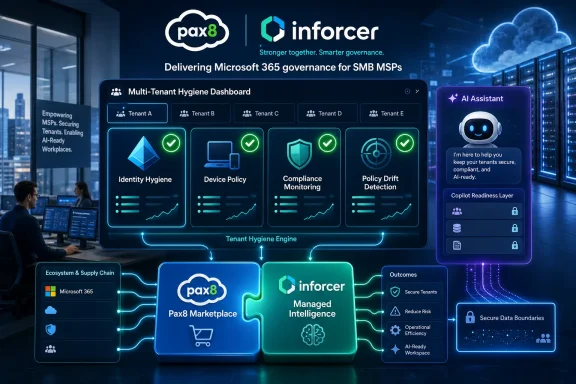 Pax8 Turns Copilot Readiness Into a Marketplace Problem
For years, the MSP business around Microsoft 365 has been built on licensing, migration, support, and the occasional security hardening project. Copilot changes the center of gravity. Once AI can search, summarize, and act across business data, sloppy permissions and inconsistent policy baselines stop being background risk and become the product experience itself.That is the context for Pax8’s plan to bring inforcer into its marketplace following the Beyond 2026 conference. Pax8 is presenting the move as part of a broader transition from classic managed services to what it calls managed intelligence. Strip away the conference-language gloss, and the message is direct: SMBs want AI, but many are not structurally ready to use it safely.
The reported numbers in Pax8’s own research tell the story the company wants MSPs to hear. Most SMBs are already using AI in some form, but only a much smaller share say they use it deeply across multiple business functions. That gap is exactly where channel businesses look for margin: not in the existence of a tool, but in the messy work of making the tool usable, governable, and billable.
inforcer fits that pitch because it is not selling Copilot itself. It is selling the precondition for Copilot to be less dangerous: standardized Microsoft 365 configuration, identity and device policy enforcement, data governance checks, compliance monitoring, and drift detection across multiple tenants. For an MSP, that is not just a security function. It is packaging infrastructure.
The Real Product Is Repeatability, Not Another Security Console
The MSP market has no shortage of dashboards. What it lacks, often painfully, is repeatability across hundreds or thousands of small tenants that were set up at different times, by different technicians, under different assumptions. Microsoft 365 is powerful enough to run a modern small business, but it is also sprawling enough that a misconfigured tenant can quietly become a liability.That is why inforcer’s language around standardization matters. MSPs do not need a heroic engineer to manually inspect every client tenant before every Copilot conversation. They need a way to define a baseline, apply it repeatedly, monitor for deviations, and prove that the customer’s environment remains inside an acceptable operating envelope.
Policy drift is a particularly unglamorous phrase, but it is the kind of problem that separates mature MSP operations from ad hoc administration. A tenant may be correctly configured after onboarding, then slowly diverge as users are added, exceptions are granted, integrations appear, and business units improvise. In a pre-AI environment, drift might remain a quiet audit issue. In a Copilot environment, it can shape what the AI can see and surface.
That is the operational insight behind this deal. Pax8 is not only expanding its catalog; it is helping MSPs turn Microsoft 365 governance into a recurring service line. If the marketplace makes inforcer easier to transact, bundle, and deploy, Pax8 partners get a clearer route from “we sell Microsoft 365” to “we continuously govern your Microsoft 365 estate.”
Copilot Makes Old Tenant Hygiene Problems Newly Urgent
Microsoft 365 Copilot did not invent oversharing, weak governance, guest-access sprawl, or inconsistent security baselines. It did make those problems harder to ignore. AI assistants are only as safe as the permissions, labels, policies, and data boundaries underneath them.That is the uncomfortable reality behind the industry’s Copilot-readiness boom. Many customers think of readiness as a licensing or training issue: buy the add-on, show users the prompt box, collect productivity gains. MSPs know—or should know—that readiness begins with the tenant. Who can access what? Which data is sensitive? Which apps are sanctioned? Which controls are consistently enforced?
inforcer’s Copilot Readiness Assessments and Copilot Manager are designed for that middle layer between Microsoft’s native admin portals and the MSP’s commercial service catalog. The assessment gives providers a structured way to evaluate whether a tenant is fit for AI deployment. The manager function aims to help providers monitor usage and govern the rollout after the initial sale.
This matters because SMB AI adoption is rarely a clean enterprise program with a central AI office, legal review board, and months of change management. It is often a patchwork of employees using ChatGPT, Copilot, browser extensions, meeting assistants, and line-of-business AI features before leadership has written a policy. MSPs are being asked to retrofit governance onto behavior that has already started.
Shadow AI Gives MSPs a New Security Conversation
The phrase shadow AI has quickly become the new channel shorthand for unmanaged AI use. It follows the old shadow IT pattern, but with a sharper edge: employees are not merely adopting unauthorized apps; they may be pasting company data into systems that the business does not control, audit, or understand.That gives MSPs both a warning and an opportunity. The warning is that customers may assume their Microsoft 365 or Copilot deployment is the AI strategy, even while workers continue to use a mix of consumer and third-party tools. The opportunity is that MSPs can turn visibility, policy, and safer alternatives into a recurring advisory service.
inforcer’s Shadow AI detection positioning is therefore commercially important. It helps MSPs move the conversation away from “buy Copilot licenses from us” and toward “let us help you understand where AI is already being used, where your data may be exposed, and how Microsoft 365 can become the governed center of gravity.”
That is a stronger sale because it speaks to risk and behavior, not only software entitlement. It also gives MSPs a defensible reason to revisit customers after the initial deployment. AI governance is not a one-time project if the tools, models, integrations, and user habits keep changing.
Pax8 Is Packaging the Channel’s AI Identity Crisis
Pax8 has spent the last several years positioning itself as more than a distributor. Its marketplace, automation layers, partner education, and event strategy all point toward a broader ambition: to become the operating platform for SMB technology delivery. The inforcer addition fits neatly into that strategy because it gives Pax8 a concrete answer to a vague market phrase.“Managed intelligence” can sound like branding in search of a product. With inforcer, Pax8 can point to a workflow: assess the Microsoft 365 tenant, standardize policies, detect drift, evaluate Copilot readiness, monitor AI use, and build a recurring managed service around the results. That is still marketing, but it is marketing anchored to operational tasks MSPs already recognize.
The timing also matters. Pax8 says inforcer will arrive in the marketplace this summer, after Beyond 2026. Conferences are where channel narratives are launched; marketplaces are where those narratives either become easy to transact or fade into partner-portal archaeology. If Pax8 wants MSPs to adopt its AI-era language, it needs offerings that make the language actionable.
For inforcer, the marketplace relationship is a distribution accelerator. The company says it has grown to more than 1,200 MSP partners since launching in 2023, with adoption across North America, EMEA, and APAC. Pax8 gives it access to a much larger partner base and the legitimacy that comes from appearing in a marketplace many MSPs already use for procurement and billing.
Microsoft 365 Is Becoming Too Important to Administer by Memory
The broader lesson for WindowsForum readers is not that every MSP should immediately buy inforcer. It is that Microsoft 365 has become too central, too complex, and too AI-adjacent to be managed as a loose collection of admin habits. The old model—configure a tenant, document a few settings, revisit only when something breaks—is increasingly mismatched to the risk profile.Entra ID, Intune, Defender, Exchange Online, SharePoint, Teams, Purview, conditional access, external sharing, endpoint compliance, and Copilot all intersect. A change in one area can change the practical exposure in another. That is difficult enough for a single business; it becomes a scaling problem for MSPs managing dozens or hundreds of customers.
This is why multi-tenant governance tooling has become a serious category. The issue is not that Microsoft lacks native controls. It is that MSPs need to apply, compare, report, and remediate those controls across many customer environments without turning every check into a bespoke engineering task.
The more Microsoft adds AI features into the productivity stack, the more this category matters. AI raises the cost of inconsistency. A tenant with poor permissions hygiene is not just messy; it is a tenant where an AI assistant may help users find information they technically have access to but should never have been able to reach so easily.
The SMB Customer Wants AI Outcomes, Not Governance Theory
Small and medium-sized businesses do not usually wake up asking for data governance frameworks. They ask whether AI can help write proposals, summarize meetings, analyze spreadsheets, triage email, draft customer responses, or automate repetitive work. The governance conversation often arrives only after someone asks what data the AI can see.That is the commercial challenge MSPs face. If they lead with fear, customers may tune out. If they lead with productivity and ignore governance, they inherit the risk. The art is to make governance part of the AI implementation path rather than a separate compliance sermon.
Pax8’s announcement leans into that balance. It frames security and governance as the foundation for “quick and responsible AI adoption,” not as a brake on it. That phrasing matters because the SMB market is impatient. Customers that hear only caution may go around their MSP and adopt whatever tool is easiest.
The MSP who can say “yes, but safely” is in a stronger position. Readiness assessments, baseline enforcement, and ongoing monitoring become the scaffolding that allows an AI rollout to proceed. The customer buys confidence; the MSP sells a managed process rather than a one-off license.
The Marketplace Model Rewards Services That Can Be Productized
Pax8’s biggest strategic advantage is not that it lists products. It is that it encourages MSPs to think in repeatable motions. A marketplace is most powerful when it turns a vendor capability into something a partner can package, price, attach, and renew.inforcer’s feature set maps cleanly to that pattern. An MSP can build an assessment offer, a remediation package, a monthly governance service, a Copilot readiness program, and an ongoing AI monitoring tier. Those services can be sold to existing Microsoft 365 customers before, during, or after Copilot adoption.
That matters because MSP economics depend on leverage. A service that requires senior engineers to manually inspect every tenant will struggle to scale. A service that uses automation and reporting to turn a messy technical process into a standardized deliverable has a better chance of becoming profitable.
The risk, of course, is that every vendor in the channel now claims to be the bridge from AI anxiety to AI revenue. MSPs will need to evaluate whether the workflows actually reduce labor, whether the reports are meaningful to customers, and whether remediation can be handled without creating a new backlog of exceptions. Marketplace availability lowers procurement friction, but it does not replace technical due diligence.
Enterprise Lessons Are Arriving in the SMB Channel
Large enterprises have spent years building governance programs around identity, data classification, endpoint compliance, and application control. SMBs often get lighter-weight versions of those practices only when tooling and service providers make them affordable. Copilot may accelerate that trickle-down effect.The reason is simple: AI makes governance visible. A file buried in SharePoint with overly broad permissions is easy to ignore until an assistant makes it discoverable in a conversational interface. A user relying on an unsanctioned AI tool is easy to dismiss until sensitive customer information starts leaving the controlled environment.
This is where MSPs can bring enterprise discipline without enterprise bureaucracy. They can define practical baselines, enforce sensible policies, and give SMB leaders dashboards that translate technical posture into business risk. The winners will avoid burying customers in jargon while still doing the hard technical work underneath.
Pax8 and inforcer are positioning their relationship exactly at that intersection. The announcement is less about a single product SKU and more about the professionalization of AI operations in the SMB market. If Copilot is the front-end story, tenant governance is the back-end reality.
Microsoft Also Benefits When the Channel Cleans Up the Mess
Microsoft has every reason to want MSPs to standardize and secure Microsoft 365 environments. Copilot’s value depends on customers trusting the Microsoft cloud with more of their work, more of their data, and more of their daily decisions. Bad deployments do not merely hurt the customer; they slow adoption and create reputational drag for the platform.But Microsoft cannot personally remediate every SMB tenant. The channel is the delivery mechanism. Pax8 sits in that channel as a marketplace and enablement layer, while vendors like inforcer provide specialized tooling to make the work repeatable.
This arrangement also reflects a familiar Microsoft ecosystem pattern. Microsoft builds the broad platform and native controls; partners build the connective tissue, reporting layers, packaged services, and operational shortcuts that specific audiences need. MSPs then translate those pieces into something a small business can buy and understand.
That does not absolve Microsoft of responsibility for complexity. If anything, the rise of third-party governance tooling is evidence that the Microsoft 365 admin experience remains difficult to scale across tenants. But in the real world of channel operations, the best answer is often not waiting for perfect native tooling. It is combining Microsoft’s platform with partner systems that solve the job MSPs actually have.
The Catch Is That Readiness Can Become Theater
The danger in any readiness category is that it turns into paperwork. A report is generated, risks are color-coded, a customer is told they are “not ready” or “mostly ready,” and everyone moves on without changing the underlying environment. AI governance cannot become another box-checking exercise.For MSPs, the credibility test will be remediation and ongoing enforcement. Can the provider move from assessment to action? Can it standardize baselines without breaking legitimate customer workflows? Can it detect drift after the project is closed? Can it explain to a business owner why a policy change matters without making the conversation sound like an audit committee meeting?
There is also a trust issue. MSPs asking customers to adopt managed AI services are themselves becoming stewards of sensitive operational data, policy posture, and usage telemetry. The more central the MSP becomes to AI governance, the more customers will scrutinize the MSP’s own security practices.
That is why marketplace convenience should be treated as a starting point, not a seal of perfection. Pax8 adding inforcer may make adoption easier, but MSPs still need to validate fit, permissions, data handling, reporting quality, and operational integration with their existing stack.
The Practical Shape of the Pax8-inforcer Bet
The most concrete reading of this announcement is that Pax8 sees Microsoft 365 governance as a prerequisite layer for SMB AI services. That is a defensible bet. Copilot adoption without security and data readiness creates risk; security and data readiness without a commercial package creates unbillable labor.inforcer’s value proposition is strongest where MSPs already manage Microsoft-heavy environments and need to normalize configuration across many tenants. The more standardized the MSP’s customer base, the easier it is to turn inforcer-style capabilities into repeatable offerings. The more bespoke and chaotic the base, the more the tool becomes part of a larger operational cleanup.
The announcement also shows how quickly the MSP market is reorganizing around AI. A year or two ago, Copilot readiness was still a specialist conversation. Now it is becoming a marketplace category, a conference theme, and a recurring-revenue pitch.
That does not mean every SMB will adopt Copilot immediately, or that every MSP should build an AI practice overnight. It does mean Microsoft 365 hygiene is becoming harder to postpone. Even customers that delay Copilot will still face shadow AI, data exposure, and pressure from employees who expect AI tools at work.
The Summer Listing Is Really a Test of MSP Discipline
Pax8’s planned summer availability gives MSPs a useful forcing function. They can treat inforcer as another logo in the marketplace, or they can use the moment to examine whether their Microsoft 365 services are structured for the AI era. The difference will show up in how they package, price, and operate governance.A mature approach would start with a defined tenant baseline, a standard assessment process, a remediation playbook, and a recurring monitoring service. It would connect Copilot readiness to identity, endpoint, sharing, and data controls. It would give customers a plain-English view of risk without pretending that AI can be made risk-free.
A less mature approach would bolt Copilot assessments onto existing licensing motions and call it strategy. That may produce short-term revenue, but it will not protect customers from the operational reality of AI-enabled data access. It also will not differentiate an MSP for long, because every provider can repeat the same high-level pitch.
The real opportunity is not selling AI enthusiasm. It is selling operational confidence. Pax8 and inforcer are offering MSPs a way to turn that confidence into a service line, but the discipline still has to come from the provider.
The Signal Beneath the Channel Noise
The announcement’s most important details are easy to miss because the language is wrapped in familiar channel phrasing: marketplace availability, AI readiness, partner enablement, recurring services, SMB transformation. Underneath that, though, is a sharper signal about where Microsoft 365 management is heading.- Pax8 plans to add inforcer to its marketplace in summer 2026 following Beyond 2026.
- The integration is aimed at MSPs managing Microsoft 365 security, governance, identity, device policy, compliance, and Copilot readiness across multiple SMB tenants.
- inforcer’s pitch centers on standardizing tenant configuration, monitoring compliance, detecting policy drift, and supporting Copilot-related services.
- The move reflects a broader shift from one-time Microsoft 365 deployment work toward recurring governance and AI-readiness services.
- MSPs should treat marketplace availability as a procurement shortcut, not a substitute for validating security, operational fit, and customer-facing service design.
- The larger strategic point is that Copilot makes Microsoft 365 hygiene commercially urgent, because AI exposes the consequences of weak permissions and inconsistent governance.
References
- Primary source: The Manila Times
Published: Tue, 09 Jun 2026 16:28:29 GMT
Pax8 to Launch Relationship with inforcer, Expanding Microsoft 365 Security, Governance and Copilot Readiness for MSPs | The Manila Times
Upcoming Pax8 Marketplace availability helps MSPs standardize and secure Microsoft 365 at scale while creating a clear on-ramp to managed intelligence for SMB customers www.manilatimes.net
- Related coverage: inforcer.com

Microsoft 365 Copilot Manager | inforcer
Assess Shadow AI usage trends across customer environments and gain in-depth visibility into Copilot adoption and usage with inforcer's Copilot Manager.
www.inforcer.com
- Related coverage: msp-channel.com
inforcer launches Copilot Manager for AI service enablement for MSPs | MSP Channel Insights
inforcer introduces Copilot Manager to support MSPs in delivering AI services, including features related to monitoring and managing Shadow AI usage. msp-channel.com
- Related coverage: channelpronetwork.com
Copilot Manager: Addressing Shadow AI Risks for MSPs
MSPs are racing to turn AI into real revenue, and inforcer’s Copilot Manager gives them the visibility and control to finally do it.www.channelpronetwork.com - Related coverage: itpro.com
Inforcer launches new Copilot Manager to help MSPs scale AI services | ChannelPro
The tool aims to give greater visibility into Copilot usage and shadow AI risks across customer environmentswww.itpro.com - Related coverage: pax8.com
Browse Hundreds of Leading Cloud Products in the Pax8 Marketplace | Pax8
Pax8 Marketplace: the trusted destination where MSPs uncover opportunity, design smarter solutions and unlock lasting business growth.www.pax8.com
- Related coverage: getflexpoint.com
Join FlexPoint at Pax8 Beyond 2026
 www.getflexpoint.com
- Related coverage: pax8nebula.com