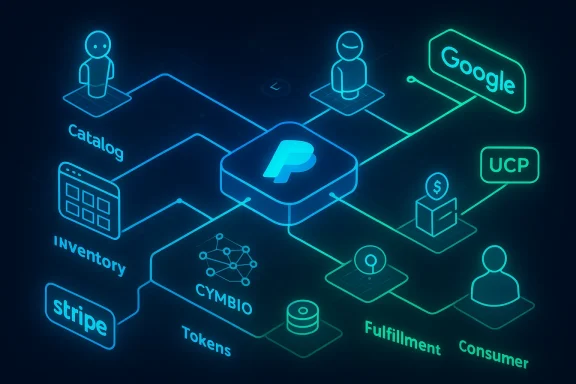
PayPal’s purchase of Cymbio is less a one-off bolt-on and more a deliberate, time‑boxed bet: the company is trying to buy itself a seat in a commerce stack that is quickly reorganizing around AI agents, and the clock on whether that bet will pay off looks to be counted in quarters, not years. rview
The familiar e‑commerce funnel—search, browse, add to cart, checkout—has been compressed into conversational, agent‑driven flows where an AI assistant can discover, compare, decide, and order on a user’s behalf. Industry players have responded by building the plumbing that lets agents interact with merchants and payments systems programmatically: Shopify and Google have pushed a Universal Commerce Protocol (UCP) to standardize routing and discovery; OpenAI and Stripe released an Agentic Commerce Protocol (ACP) alongside Instant Checkout for ChatGPT; card networks have launched agent‑aware initiatives such as Mastercard’s Agent Pay. These moves are remaking the layers of commerce from "UX + button" into protocol, orchestration, and trust layers.
PayPal’s strategic response has two visible strands. Publicly, the company has promoted agentic commerce features—Store Sync, tokenized delegated payments, and branded in‑chat experiences—and announced partnerships powering flows such as Microsoft’s Copilot Checkout. Operationally, PayPal agreed to acquire Cymbio, a multi‑channel orchestration platform that can make merchants’ catalogs machine‑readable and route orders into merchant systems. That combination shifts PayPal’s locus of competition upstream: from being “the thing you click to pay” to being a node inside discovery, routingion. PayPal framed the Cymbio deal as accelerating its “agentic commerce capabilities,” while media coverage has treated the acquisition as a strategic entrance into the new commerce stack.
AI agents cannot reliably buy for users unless product data, price, inventory, and fulfillment information are canonical, accurate, and machine‑readable. Cymbio specializes in exactly those operational capabilities that agents need:
Why this matters strategically: if merchants can “connect once and distribute everywhere,” then whoever controls the easiest and most trusted path for that single integration captures the largest share of incremental GMV flowing from agentic surfaces. Cymbio is PayPal’s attempt to serve as that integration layer for merchants who already rely on PayPal for payments.
Two clarifying data points to :
The structural dynamics of agentic commerce—protocol adoption, developer mindshare, and card‑network governance—mean that PayPal’s window to convert this acquisition into a platform stake is short and measurable. Industry commentary and the deal’s context suggest the next 12–24 months will determine whether PayPal becomes an indispensable orchestration node or is consigned to a commoditized payment lane on someone else’s agentic highway. Execution speed, transparent merchant economics, and active participation in protocol governance will decide the outcome.
For merchants and partners, the immediate takeaway is clear: prepare catalogs and systems to be agent‑ready, instrument experiments with multiple agent platforms, and insist on portability and audited intent records. For PayPal, Cymbio is an expensive and necessary entrance fee—now the company must turn that entry ticket into demonstrable scale and measurable merchant economics, fast.
If PayPal succeeds, the company will have converted a payments network into a commerce platform for the AI era. If it fails, it will still be a large and trusted payments provider—but it may find itself playing the role of toll collector on a highway whose route has already been decided by others. The next several quarters will tell the story.
Source: Binance https://www.binance.com/en/square/post/291823597018705/
The familiar e‑commerce funnel—search, browse, add to cart, checkout—has been compressed into conversational, agent‑driven flows where an AI assistant can discover, compare, decide, and order on a user’s behalf. Industry players have responded by building the plumbing that lets agents interact with merchants and payments systems programmatically: Shopify and Google have pushed a Universal Commerce Protocol (UCP) to standardize routing and discovery; OpenAI and Stripe released an Agentic Commerce Protocol (ACP) alongside Instant Checkout for ChatGPT; card networks have launched agent‑aware initiatives such as Mastercard’s Agent Pay. These moves are remaking the layers of commerce from "UX + button" into protocol, orchestration, and trust layers.
PayPal’s strategic response has two visible strands. Publicly, the company has promoted agentic commerce features—Store Sync, tokenized delegated payments, and branded in‑chat experiences—and announced partnerships powering flows such as Microsoft’s Copilot Checkout. Operationally, PayPal agreed to acquire Cymbio, a multi‑channel orchestration platform that can make merchants’ catalogs machine‑readable and route orders into merchant systems. That combination shifts PayPal’s locus of competition upstream: from being “the thing you click to pay” to being a node inside discovery, routingion. PayPal framed the Cymbio deal as accelerating its “agentic commerce capabilities,” while media coverage has treated the acquisition as a strategic entrance into the new commerce stack.
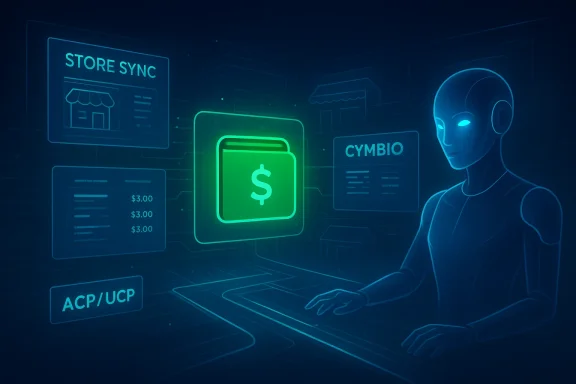 What Cymbio actually gives PayPal
AI agents cannot reliably buy for users unless product data, price, inventory, and fulfillment information are canonical, accurate, and machine‑readable. Cymbio specializes in exactly those operational capabilities that agents need:- Catalog normalization and SKU/GTIN mapping so agents don’t hallucinate products.
- Real‑time inventory and price synchronization to avoid recommending out‑of‑stock items.
- Order routing and dropship orchestration that injects agent‑originated orders into merchants’ OMS/WMS.
- Merchant‑of‑record preservation so brands ret relationships.
Why this matters strategically: if merchants can “connect once and distribute everywhere,” then whoever controls the easiest and most trusted path for that single integration captures the largest share of incremental GMV flowing from agentic surfaces. Cymbio is PayPal’s attempt to serve as that integration layer for merchants who already rely on PayPal for payments.
The protocol war: routing layer vs execution layer
Agentic commerce has split into at least two distinct technical and commercial battlegrounds:- The routing/discovery layer (who sees which catalog, where, and how). Shopify + Google’s UCP is explicitly designed to be a neutral, distributed protocol that helps merchants reach many agents with one integration—Shopify positions UCP as a public primitives layer that negotiates capabilities and payment handlers.
- The agent execution/checkouts layer (who executes purchases inside conversational surfaces). OpenAI and Stripe’s ACP and Instant Checkout put Stripe in the position of issuing payment tokens and handling the delegated authorization model in ChatGPT—effectively enabling agents to initiate payments and have them cleared with the merchant. Stripe calls ACP an open standard co‑developed with OpenAI, enabling direct flows from ChatGPT to merchant backends.
- Payment networks and banks are simultaneously laying rulebooks and trust frameworks (e.g., Mastercard Agent Pay) to preserve issuer visibility, tokenization, and dispute frameworks. Those efforts aim to ensure agent‑initiated payments have the same provenance and consumer protections as today’s card ecosystems.
PayPal’s advantages — and why the clock is short
PayPal is not starting from scratch. It brings several durable assets to the fight:- Scale and trust: in 2024 PayPal processed $1.68 trillion of total payment volume and reported 434 million active accounts, a data/transaction graph that is hard to replicate overnight. Those metrics give PayPal immediate credibility as a large‑scale settlement and buyer protection provider.
- Merchant relationships: tens of millions of merchants already accept PayPal; many brands use PayPal’s checkout and reporting tools today—this reduces the commercial friction of migrating merchant integrations.
- Buyer protections and fraud infrastructure: PayPal’s buyer‑seller dispute and protection mechanisms are a selling point for both consumers and merchants when trust is uncertain in novel agentic flows.
- Ecosystem partnerships: PayPal has already been selected as a payment partner for Microsoft Copilot Checkout and has worked with Mastercard on Agent Pay pilots—these relationships accelerate product launches and regulatory engagement.
- Protocol adoption velocity. UCP and ACP are designed to standardize how agents discover and buy. If merchants and agents standardize quickly on these protocols—and if the major conversational surfaces embed them—merchant integrations will commoditize around whatever protocol is native to the agents themselves, making it harder for third‑party orchestration vendors to extract premium rents.
- Developer and agent mindshare. Stripe’s developer ergonomics and straight‑to‑devame the de‑facto payments API for internet companies. That developer mindshare is a nontrivial advantage when agents and conversational platforms prefer a payment provider that is already integrated into their tooling and workflow. Stripe’s co‑development of ACP with OpenAI is a strategic embodiment of that playbook.
- twork rulemaking. Card networks (Mastercard, Visa) are racing to stamp agentic rules and tokenization frameworks. Whoever shapes these rules early can constrain or favor certain architectureor issuer‑centric tokens and agent registration frameworks (as Mastercard’s Agent Pay suggests), payment providers that aren’t at the table risk being cast as back‑end settleers instead of front‑end enablers.
Measurable signals to watch (the next 6–24 months)
If you want to know whether PayPal bought itself time or merely bought a seat in someone else’s protocol room, watch these concrete, observable indicators:- Merchant onboarding velocity to Store Sync: published milestones (millions of merchants onboarded, countries supported). If PayPal converts its merchant base at scale, it can capture routing economics.
- Conversion and economics proof points: does Cymbio/Store Sync demonstrably improve conversion, Average Order Value (AOV), return rates, or dispute rates? Quantified case studies matter.
- ACP/UCP certification lists and default payment handlers: who signs on as the defa in production pilots across ChatGPT, Copilot, and Gemini? If ACP/UCP rollouts favor Stripe or platform wallets, PayPal’s role becomes defensive. ([ww.shopify.com/ucp)
- Card network rule publications and agent‑token pilots: increased issuer participation or rules that favor issuer tokens will narrow architectural choices and governance seats.
- Regulatory guidance on agent‑initiated payments: KYA (Know Your Agent), auditable intent trails, consumer consent frameworks. Regulatory costs or consumer protections could materially raise compliance bars and favor incumbent banks or networked providers that already own trust flows.
Tactical playbook: what PayPal must do now (and what to watch from competitors)
If PayPal wants to be more than a supported PSP it must act on three fronts—fast.- Product: Ship measurable, merchant‑facing tooling that makes the migration path trivial.
- Offer one‑click or near‑zero‑engineering pipelines for merchants on major e‑commerce platforms.
- Provide transparent SLees for feed sync and order delivery.
- Package fraud, refunds, and dispute resolution as agent‑aware services with clear legal responsibility assignments.
- Commercials: Make the merchant economics clearly superior.
- Short‑term incentives for early adopters (reduced fees, conversion‑linked pricing).
- Case studies that commit to publishing convers in quarterly cadence.
- Governance & alliances: Be at the standard tables—and make them open.
- Aggressively participate in ACP/UCP working groups to ensure PayPal’s tooling interoperates cleanly.
- Deepen ties with card networks and issuers (Mastercard Agent Pay integration is a good start) to preserve issuer visibility. ([newsroom.paypal-corp.com](Mastercard and PayPal Join Forces To Accelerate Secure Global Agentic Commerce to watch:
- Stripe + OpenAI: developer mindshare, early ACP integration, and Instant Checkout in ChatGPT give Stripe a direct line into agent execution.
- Shopify + Google (UCP): distribution to millions of merchants and search integration into Gemini/Search makes UCP a powerful routing layer.
- Card networks (Mastercard, Visa): institutional rulemaking around tokens and agent registration can favor established issuers.
- Big Tech wallets (Google Pay, Apple/others): platform wallets embedded in agent surfaces could be default handlers unless neutral protocol choices prevail.
Banks, fintechs, and crypto: winners and losers in the compression of the funnel
- For banks: the shortfall is technical velocity, not relevance. Banks still control clearing, compliance, and customer credit relationships. But if banks are not at the architectural table (protocol governance, agent registration, KYA), they risk being relegated to settlement rails under terms set by others. The defensive imperative for banks is to partner early and modularly with protocol builders so they retain a governance seat.
- For fintechs (PayPal, Stripe, Adyen): the race is to embed beyond kernel payments into orchestration, discovery, and merchant experience. Those who can bundle orchestration + payments + trust (buyer protections, fraud resolution) have the chance to capture higher margiue. PayPal’s Cymbio purchase is an explicit example of that strategy.
- For crypto firms: current ACP/UCP discussions and agentic pilots have been dominated by traditional rails—credit cards, Google Pay, PayPal, Stripe. Crypto and stablecoins are largely absent from the leading protocol playbooks so far, but they retain a potential opening: programmable money, instant settlement, and global rails could be compelling if integrated natively into agent protocols and merchant flows before standards harden. Missing that window risks permanent exclusion.
How much time does PayPal actually have?
The short answer: months to a few quarters to prove that Cymbio + Store Sync moves the needle at scale; a broader two‑year window to convert that needle‑movement into structural platform advantage. Analysts and industry insiders converged on a similar horizon: if ACP/UCP and platform‑native checkouts standardize merchaly, PayPal’s opportunity to be a system builder shrinks quickly. Conversely, if PayPal can demonstrate rapid merchant onboarding, measurable conversion lifts, and favorable merchant economics, it can convert TPV scale into an orchestration moat. Put bluntly, the next 12–24 months are decisive.Two clarifying data points to :
- Baseline scale: PayPal already processes very large volumes—$1.68 trillion TPV in 2024 and 434 million active accounts—so the company starts from a position of scale that’s meaningful to partners and regulators. But scale alone does not imply protocol leadership.
- Competitor momentum: Stripe’s Instant Checkout and ACP are already live in ChatGPT environments; Shopify’s UCP is publicly available as an open protocol and is co‑developed with Google. That means production‑grade options that bypass bespoke orchestration are already available to agents and developers. The existence of live alternatives accelerates merchant standardization and shortens PayPal’s window.
- 0–6 months: proof‑of‑concept phase. PayPal must publish merchant onboarding metrics, conversion case studies, and playbooks for migrating existing merchants to Cymbio/Store Sync.
- 6–12 months: rapid adoption phase. If market signals show millions of merchants or major retail chains migrating, PayPal can build momentum and lock in preferred routing economics.
- 12–24 months: consolidation phase. Protult execution layers crystallize; late movers get positioned as commodity PSPs or must accept narrow settlement roles.
Risks, regulatory friction, and consumer protection
Agentic commerce introduces new vectors of legal and reputational risk that amplify PayPal’s execution challenge:- Unauthorized agent purchases and disputes: KYA (Know Your Agent) frameworks and auditable intent trails will be regulatory prioritdy signaling expectations for traceability and consent. If PayPal and others cannot embed robust, auditable intent records into agentic flows, regulators may mandate heavier compliance and certification costs.
- Fraud/chargeback dynamics: agent‑initiated orders will create new dispute patterns. Firms that control both discovery and payments may be better positioned to adjudicate disputes fairly; however, if PayPal fails to map responsibilities clearly between agent, merchant, and PSP, dispute costs could rise.
- Market power and concentration: if one protocol (or a small set of players) becomes the de‑facto routing or execution layer, merchants may have less bargaining power. PayPal’s bargaining power depends on being one of the few orchestration vendors that merchants actually use—not just one of many supported PSPs.
Conclusion
PayPal’s acquisition of Cymbio is strategically coherent: it buys operational capabilities that agents need, it strengthens PayPal’s merchant value proposition, and it gives PayPal an actionable product path into agentic commerce. But coherence is not the same as victory.The structural dynamics of agentic commerce—protocol adoption, developer mindshare, and card‑network governance—mean that PayPal’s window to convert this acquisition into a platform stake is short and measurable. Industry commentary and the deal’s context suggest the next 12–24 months will determine whether PayPal becomes an indispensable orchestration node or is consigned to a commoditized payment lane on someone else’s agentic highway. Execution speed, transparent merchant economics, and active participation in protocol governance will decide the outcome.
For merchants and partners, the immediate takeaway is clear: prepare catalogs and systems to be agent‑ready, instrument experiments with multiple agent platforms, and insist on portability and audited intent records. For PayPal, Cymbio is an expensive and necessary entrance fee—now the company must turn that entry ticket into demonstrable scale and measurable merchant economics, fast.
If PayPal succeeds, the company will have converted a payments network into a commerce platform for the AI era. If it fails, it will still be a large and trusted payments provider—but it may find itself playing the role of toll collector on a highway whose route has already been decided by others. The next several quarters will tell the story.
Source: Binance https://www.binance.com/en/square/post/291823597018705/