

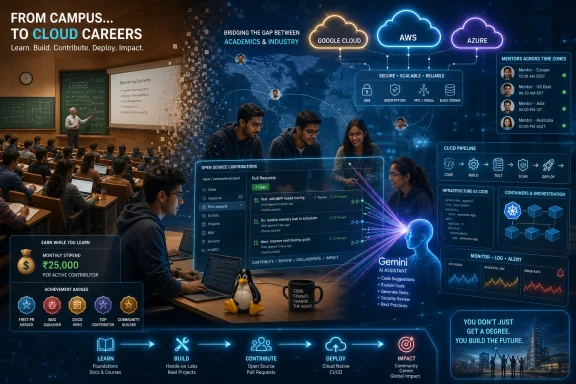
Polaris School of Technology says it has partnered with Google, AWS and Microsoft to embed cloud, AI, certification and infrastructure access into its computer science programmes in India, while students pursue global open-source opportunities including Google Summer of Code 2026 and Linux Foundation mentorships. The claim is not merely that a college has put famous logos on a brochure. It is that the center of gravity in engineering education is moving away from the lecture hall and toward the live production stack. If Polaris is right, the next fight in technical education will not be over who teaches algorithms best, but who can get students into real engineering ecosystems earliest.
For decades, the aspirational arc of Indian engineering education has been brutally simple: survive the entrance exam, endure the syllabus, grind through coding platforms, then hope a marquee employer notices. The dream companies sat at the end of the pipeline, not inside it. Google, Amazon and Microsoft were destinations, not participants in the daily structure of a degree.
Polaris is trying to invert that model. Its pitch is that students should not spend four years rehearsing for the industry from a distance when cloud platforms, AI tools, developer communities and open-source projects can be woven into the learning process from the start. That is a more ambitious claim than a placement partnership, because it asks whether the curriculum itself can become closer to the infrastructure students will eventually operate.
The reported partnerships with Google, AWS and Microsoft sit squarely in that shift. Google Cloud and Gemini access, AWS workshops and credits, and Microsoft Azure ecosystem support are not exotic perks in 2026. They are the operating environment of a modern software career, particularly in a market where even entry-level engineers are expected to understand deployment, observability, data pipelines, security posture and AI-assisted development.
The risk, of course, is that proximity can become theater. A certification is not a substitute for engineering judgment, and cloud credits do not automatically produce cloud fluency. But the Polaris experiment matters because it reflects a broader truth: the old gap between college computer science and production software has become too wide to paper over with final-year projects and campus drives.
The answer depends on whom you ask, but employers have been complaining for years about a mismatch between degree credentials and job readiness. Students can pass exams on operating systems and databases while still having limited exposure to cloud-native deployment, collaborative open-source workflows, secure software supply chains or AI-native product development. The curriculum often trails the market by a full technology cycle, which in modern software can mean three or four generations of tooling.
That mismatch is especially visible in the Windows and enterprise world. The admin who once managed desktops and file shares now confronts identity federation, endpoint telemetry, zero-trust policy, cloud cost controls, container workloads, AI governance and software bills of materials. The developer who once shipped a monolith now inherits CI/CD pipelines, Kubernetes clusters, managed databases, API gateways and security scanners before writing the first user-facing feature.
This is why the Polaris story has resonance beyond India’s education market. It is a case study in how colleges are trying to adapt to an industry where the platform is the classroom. Students who learn only theory risk arriving late to the practical conversation; students who learn only tools risk becoming dependent on whichever vendor sponsored the lab. The hard part is building a degree that does both.
Cloud platforms are sticky because skills are sticky. A student who builds early projects on Google Cloud, AWS or Azure is more likely to understand that platform’s mental model, pricing abstractions, identity patterns and deployment defaults. A founder who receives cloud credits in college may later become a paying customer. An engineer who earns a vendor certification may carry that preference into the enterprise.
Polaris appears to be packaging that logic into the structure of the degree rather than treating it as an extracurricular layer. The reported Google-certified Cloud and Big Data pathway is especially telling. Data engineering, cloud infrastructure and AI systems are no longer niche specializations; they are becoming the common substrate of software work.
Microsoft’s role also deserves attention from a WindowsForum audience. Azure is not just a cloud platform attached to the Windows empire. It is now Microsoft’s connective tissue across developer tooling, identity, security, productivity software, AI services and enterprise management. If students learn Azure alongside GitHub-style collaboration, cloud deployment and startup support, they are being introduced to the same bundled ecosystem many corporate IT departments already inhabit.
AWS, meanwhile, remains the gravitational force in cloud infrastructure. Workshops and cloud credits may sound modest, but for students in smaller towns or lower-resource institutions, the difference between simulating architecture and actually deploying it can be decisive. The cloud bill is often the hidden tuition of modern engineering education.
According to the school’s public claims and corroborating education coverage, 18 Polaris students were selected for Google Summer of Code 2026. Another 13 reportedly secured Linux Foundation LFX Mentorship selections. Those numbers matter because these programmes are not campus activities dressed up as global exposure; they place students inside distributed engineering communities where code review, maintainership, documentation discipline and asynchronous collaboration are part of the work.
That changes the educational unit from the assignment to the contribution. A college project usually dies after evaluation. An open-source contribution lives or fails in public, in front of maintainers who care less about a student’s marks than whether the patch is useful, secure, maintainable and aligned with the project’s architecture.
The reported areas of contribution are also significant: Kubernetes security, software supply-chain security, blockchain infrastructure, distributed systems and RISC-V. These are not toy domains. They are the guts of the modern computing stack, and they increasingly shape the security and reliability posture of organizations that may never know the names of the students contributing code.
For IT pros, this is the interesting wrinkle. The next generation of engineers may not first encounter enterprise-grade complexity inside a corporate graduate trainee programme. They may encounter it while still in college, through a bug in a dependency chain, a container policy issue, a CI failure on a global project, or a mentor in another time zone asking them to justify an implementation choice.
For a student from a major metro and a high-income family, that is a strong internship-style reward. For a first-generation technology student from a smaller town, it can be transformative. It turns software contribution from an abstract merit badge into paid global work.
That matters because opportunity in technology is often gated by unpaid time. Students with financial cushion can spend months building portfolios, contributing to open source, attending hackathons and experimenting with cloud infrastructure. Students without that cushion face pressure to optimize for immediate income, local jobs or credential paths that appear safer.
A stipend does not erase inequality, but it changes the equation. It validates that real engineering work can be done before graduation, outside the geography of the usual tech hubs, and under mentors from the United States, United Kingdom, Japan, Israel and other engineering centers. The psychological effect may be as important as the financial one: a student who has contributed to a global project in the first year no longer has to imagine belonging to the industry. They have evidence.
The quoted experience of Harsh Somankar, a GSoC-selected student from Balaghat, captures that emotional force. He describes growing up without family exposure to technology and seeing the selection as proof that origin does not determine reach. It is the kind of testimony every education startup wants, but it is also the kind that can be true and still require careful scrutiny.
The discipline lies in separating individual breakthroughs from systemic proof. Eighteen GSoC selections and 13 LFX mentorships are meaningful, but they do not by themselves validate an entire educational model. They show that a subset of students is performing at a high level in competitive global programmes. The harder question is whether the model scales across cohorts, across weaker students, across faculty capacity, and across years when the novelty wears off.
That is where Polaris will need more than success stories. It will need completion data, placement quality, retention numbers, independent assessment, project maintainership outcomes and evidence that students can move from guided opportunity to durable engineering competence. The early signal is impressive; the long-term proof will be messier.
The Polaris model will succeed or fail partly on how it handles that tension. Google Cloud, AWS and Azure certifications can give students a map of the terrain. They can help a beginner understand identity and access management, storage classes, compute options, data services, monitoring, networking and cost models. For recruiters and early-career filters, they can signal initiative and baseline familiarity.
But production engineering is not a multiple-choice exam. Real systems fail because requirements change, dependencies rot, budgets collapse, permissions are misconfigured, logs are missing, alerts are noisy, and humans misunderstand the blast radius of small changes. No certification can fully simulate that.
The best version of Polaris uses certification as scaffolding, not as the building. Students should leave with credentials, yes, but also with scar tissue: broken deployments, rejected pull requests, confusing incident reports, difficult code reviews, and the humility that comes from discovering that cloud platforms are easy to start and hard to master.
That concern is real. A student can learn “serverless” as a button in one cloud console rather than as a set of trade-offs around event-driven architecture, cold starts, observability, portability and cost. A student can learn “AI development” as a branded assistant rather than as a stack of model behavior, data quality, evaluation, safety constraints and integration risk. A student can learn “security” as a dashboard score rather than as an adversarial way of thinking.
The answer is not to keep vendors out. That would be absurd in a world where enterprise software is built on their infrastructure. The answer is to teach through vendors while teaching beyond them.
A strong programme should make students compare cloud primitives across providers, read open standards, understand Linux deeply, work with open-source tooling, and see where managed convenience becomes strategic dependence. If Polaris can combine Google Cloud, AWS and Azure exposure with serious fundamentals, the vendor presence becomes an advantage. If it cannot, the degree risks becoming a rotating product demo.
Polaris says students gain access to tools such as Gemini, alongside cloud and product-building experiences. That is sensible, because AI assistants are becoming part of the professional developer’s environment. Pretending otherwise would be like teaching programming without version control.
But AI also makes authentic evaluation harder. If a student can generate a working prototype quickly, the educational challenge shifts toward whether they can reason about correctness, security, maintainability and deployment. The craft moves from typing code to interrogating systems.
This is where open-source contribution may be the best antidote to AI-era superficiality. A maintainer reviewing a patch does not care whether a student used an assistant. The patch still has to fit the project. The tests still have to pass. The design still has to make sense. In that environment, AI can accelerate learning, but it cannot fully fake participation.
If this model works, early-career candidates will arrive with more direct exposure to cloud consoles, AI-assisted coding, open-source collaboration and global mentorship than many mid-career professionals had at the same stage. They may be less intimidated by distributed systems and more comfortable asking questions in public technical communities. They may also have gaps in the older disciplines that enterprise IT still depends on: networking fundamentals, Windows internals, identity architecture, legacy application support and the politics of change management.
That creates an interesting hiring problem. The résumé will look stronger earlier. A first-year student with GSoC experience and cloud certifications may appear unusually polished. But IT leaders will still need to test whether that experience translates into production reliability, secure defaults, documentation habits and support empathy.
The best candidates from this model will not be those who merely touched famous platforms. They will be those who can explain why a system failed, what trade-offs they made, how they responded to review, and what they would do differently. That has always been the difference between exposure and expertise.
What Polaris is exposing is not the irrelevance of traditional colleges, but their latency. Too many institutions respond to industry change by adding electives, hosting a workshop, or signing a memorandum of understanding that produces little daily impact. Students notice the difference between a logo on a banner and a curriculum that forces them to build, deploy, contribute and defend their work.
The competitive pressure will be healthy if it pushes colleges to modernize honestly. That does not mean every institution needs a branded cloud pathway. It does mean computer science programmes must treat cloud, security, open source and AI-assisted development as part of the core environment, not optional enrichment.
India’s engineering system is too large for any one school to become the model. But small experiments can change expectations. Once students see peers earning global stipends, contributing to serious projects and working with international mentors in their first year, the old excuse that “industry exposure comes later” starts to sound like an institutional failure.
 The New Campus Pitch Is Not Placement, But Proximity
For decades, the aspirational arc of Indian engineering education has been brutally simple: survive the entrance exam, endure the syllabus, grind through coding platforms, then hope a marquee employer notices. The dream companies sat at the end of the pipeline, not inside it. Google, Amazon and Microsoft were destinations, not participants in the daily structure of a degree.Polaris is trying to invert that model. Its pitch is that students should not spend four years rehearsing for the industry from a distance when cloud platforms, AI tools, developer communities and open-source projects can be woven into the learning process from the start. That is a more ambitious claim than a placement partnership, because it asks whether the curriculum itself can become closer to the infrastructure students will eventually operate.
The reported partnerships with Google, AWS and Microsoft sit squarely in that shift. Google Cloud and Gemini access, AWS workshops and credits, and Microsoft Azure ecosystem support are not exotic perks in 2026. They are the operating environment of a modern software career, particularly in a market where even entry-level engineers are expected to understand deployment, observability, data pipelines, security posture and AI-assisted development.
The risk, of course, is that proximity can become theater. A certification is not a substitute for engineering judgment, and cloud credits do not automatically produce cloud fluency. But the Polaris experiment matters because it reflects a broader truth: the old gap between college computer science and production software has become too wide to paper over with final-year projects and campus drives.
India’s Engineering Machine Has Scale, But Scale Is No Longer Enough
India’s engineering education system remains one of the world’s great talent factories. The numbers are staggering, with roughly 15 lakh engineering graduates entering the workforce each year. But volume has increasingly collided with a more uncomfortable question: how many graduates are ready for the systems that actually define contemporary software work?The answer depends on whom you ask, but employers have been complaining for years about a mismatch between degree credentials and job readiness. Students can pass exams on operating systems and databases while still having limited exposure to cloud-native deployment, collaborative open-source workflows, secure software supply chains or AI-native product development. The curriculum often trails the market by a full technology cycle, which in modern software can mean three or four generations of tooling.
That mismatch is especially visible in the Windows and enterprise world. The admin who once managed desktops and file shares now confronts identity federation, endpoint telemetry, zero-trust policy, cloud cost controls, container workloads, AI governance and software bills of materials. The developer who once shipped a monolith now inherits CI/CD pipelines, Kubernetes clusters, managed databases, API gateways and security scanners before writing the first user-facing feature.
This is why the Polaris story has resonance beyond India’s education market. It is a case study in how colleges are trying to adapt to an industry where the platform is the classroom. Students who learn only theory risk arriving late to the practical conversation; students who learn only tools risk becoming dependent on whichever vendor sponsored the lab. The hard part is building a degree that does both.
Big Tech Has Found a New Front Door Into the Talent Pipeline
Google, AWS and Microsoft have spent years courting students through developer clubs, free credits, certification discounts, hackathons, startup programmes and university alliances. That is not charity. It is ecosystem strategy.Cloud platforms are sticky because skills are sticky. A student who builds early projects on Google Cloud, AWS or Azure is more likely to understand that platform’s mental model, pricing abstractions, identity patterns and deployment defaults. A founder who receives cloud credits in college may later become a paying customer. An engineer who earns a vendor certification may carry that preference into the enterprise.
Polaris appears to be packaging that logic into the structure of the degree rather than treating it as an extracurricular layer. The reported Google-certified Cloud and Big Data pathway is especially telling. Data engineering, cloud infrastructure and AI systems are no longer niche specializations; they are becoming the common substrate of software work.
Microsoft’s role also deserves attention from a WindowsForum audience. Azure is not just a cloud platform attached to the Windows empire. It is now Microsoft’s connective tissue across developer tooling, identity, security, productivity software, AI services and enterprise management. If students learn Azure alongside GitHub-style collaboration, cloud deployment and startup support, they are being introduced to the same bundled ecosystem many corporate IT departments already inhabit.
AWS, meanwhile, remains the gravitational force in cloud infrastructure. Workshops and cloud credits may sound modest, but for students in smaller towns or lower-resource institutions, the difference between simulating architecture and actually deploying it can be decisive. The cloud bill is often the hidden tuition of modern engineering education.
Open Source Turns the Classroom Inside Out
The strongest evidence in the Polaris story is not the partnership roster. It is the reported student outcomes in global open-source programmes.According to the school’s public claims and corroborating education coverage, 18 Polaris students were selected for Google Summer of Code 2026. Another 13 reportedly secured Linux Foundation LFX Mentorship selections. Those numbers matter because these programmes are not campus activities dressed up as global exposure; they place students inside distributed engineering communities where code review, maintainership, documentation discipline and asynchronous collaboration are part of the work.
That changes the educational unit from the assignment to the contribution. A college project usually dies after evaluation. An open-source contribution lives or fails in public, in front of maintainers who care less about a student’s marks than whether the patch is useful, secure, maintainable and aligned with the project’s architecture.
The reported areas of contribution are also significant: Kubernetes security, software supply-chain security, blockchain infrastructure, distributed systems and RISC-V. These are not toy domains. They are the guts of the modern computing stack, and they increasingly shape the security and reliability posture of organizations that may never know the names of the students contributing code.
For IT pros, this is the interesting wrinkle. The next generation of engineers may not first encounter enterprise-grade complexity inside a corporate graduate trainee programme. They may encounter it while still in college, through a bug in a dependency chain, a container policy issue, a CI failure on a global project, or a mentor in another time zone asking them to justify an implementation choice.
The Stipend Is Small in Silicon Valley Terms, But Large in Student Reality
The financial detail in the Polaris story is easy to underestimate. Students selected for programmes such as Google Summer of Code and Linux Foundation mentorships may receive stipends around US$3,000, while one student selected through an OpenSSF track is reportedly eligible for US$6,000. In Indian rupee terms, that can mean roughly ₹2.85 lakh to ₹5.7 lakh.For a student from a major metro and a high-income family, that is a strong internship-style reward. For a first-generation technology student from a smaller town, it can be transformative. It turns software contribution from an abstract merit badge into paid global work.
That matters because opportunity in technology is often gated by unpaid time. Students with financial cushion can spend months building portfolios, contributing to open source, attending hackathons and experimenting with cloud infrastructure. Students without that cushion face pressure to optimize for immediate income, local jobs or credential paths that appear safer.
A stipend does not erase inequality, but it changes the equation. It validates that real engineering work can be done before graduation, outside the geography of the usual tech hubs, and under mentors from the United States, United Kingdom, Japan, Israel and other engineering centers. The psychological effect may be as important as the financial one: a student who has contributed to a global project in the first year no longer has to imagine belonging to the industry. They have evidence.
The Small-Town Talent Story Is Powerful, But It Needs Discipline
Polaris is leaning into a compelling narrative: students from Balaghat, Jorhat, Puri, Ranaghat and Sadabad working on global infrastructure projects while still early in college. That story lands because it counters the stubborn assumption that elite technical opportunity must route through a handful of metro institutions and social networks.The quoted experience of Harsh Somankar, a GSoC-selected student from Balaghat, captures that emotional force. He describes growing up without family exposure to technology and seeing the selection as proof that origin does not determine reach. It is the kind of testimony every education startup wants, but it is also the kind that can be true and still require careful scrutiny.
The discipline lies in separating individual breakthroughs from systemic proof. Eighteen GSoC selections and 13 LFX mentorships are meaningful, but they do not by themselves validate an entire educational model. They show that a subset of students is performing at a high level in competitive global programmes. The harder question is whether the model scales across cohorts, across weaker students, across faculty capacity, and across years when the novelty wears off.
That is where Polaris will need more than success stories. It will need completion data, placement quality, retention numbers, independent assessment, project maintainership outcomes and evidence that students can move from guided opportunity to durable engineering competence. The early signal is impressive; the long-term proof will be messier.
Certifications Are Useful Only When They Are Not the Curriculum
Vendor certifications occupy a strange place in technology education. They can be genuinely useful for structuring learning, especially in cloud platforms where services multiply faster than traditional textbooks can track. They can also become a shallow proxy for competence, rewarding exam familiarity over design judgment.The Polaris model will succeed or fail partly on how it handles that tension. Google Cloud, AWS and Azure certifications can give students a map of the terrain. They can help a beginner understand identity and access management, storage classes, compute options, data services, monitoring, networking and cost models. For recruiters and early-career filters, they can signal initiative and baseline familiarity.
But production engineering is not a multiple-choice exam. Real systems fail because requirements change, dependencies rot, budgets collapse, permissions are misconfigured, logs are missing, alerts are noisy, and humans misunderstand the blast radius of small changes. No certification can fully simulate that.
The best version of Polaris uses certification as scaffolding, not as the building. Students should leave with credentials, yes, but also with scar tissue: broken deployments, rejected pull requests, confusing incident reports, difficult code reviews, and the humility that comes from discovering that cloud platforms are easy to start and hard to master.
The Vendor Classroom Comes With a Lock-In Problem
There is an obvious critique of Big Tech entering the curriculum: education risks becoming an onboarding funnel for commercial platforms. The more universities rely on vendor credits, vendor training paths and vendor-provided tools, the more students may confuse a product’s interface with the underlying discipline.That concern is real. A student can learn “serverless” as a button in one cloud console rather than as a set of trade-offs around event-driven architecture, cold starts, observability, portability and cost. A student can learn “AI development” as a branded assistant rather than as a stack of model behavior, data quality, evaluation, safety constraints and integration risk. A student can learn “security” as a dashboard score rather than as an adversarial way of thinking.
The answer is not to keep vendors out. That would be absurd in a world where enterprise software is built on their infrastructure. The answer is to teach through vendors while teaching beyond them.
A strong programme should make students compare cloud primitives across providers, read open standards, understand Linux deeply, work with open-source tooling, and see where managed convenience becomes strategic dependence. If Polaris can combine Google Cloud, AWS and Azure exposure with serious fundamentals, the vendor presence becomes an advantage. If it cannot, the degree risks becoming a rotating product demo.
AI Raises the Stakes for Getting Students Into Real Systems Early
The arrival of generative AI has made the old education gap more dangerous. Students can now produce plausible code, documentation and architecture diagrams without fully understanding the systems behind them. That is useful when paired with judgment and hazardous when used as a substitute for it.Polaris says students gain access to tools such as Gemini, alongside cloud and product-building experiences. That is sensible, because AI assistants are becoming part of the professional developer’s environment. Pretending otherwise would be like teaching programming without version control.
But AI also makes authentic evaluation harder. If a student can generate a working prototype quickly, the educational challenge shifts toward whether they can reason about correctness, security, maintainability and deployment. The craft moves from typing code to interrogating systems.
This is where open-source contribution may be the best antidote to AI-era superficiality. A maintainer reviewing a patch does not care whether a student used an assistant. The patch still has to fit the project. The tests still have to pass. The design still has to make sense. In that environment, AI can accelerate learning, but it cannot fully fake participation.
Enterprise IT Should Watch the Model, Not the Marketing
For WindowsForum readers, the Polaris story is not just another education-sector announcement from India. It is a preview of the kind of junior engineer and junior administrator who may enter the workforce over the next few years.If this model works, early-career candidates will arrive with more direct exposure to cloud consoles, AI-assisted coding, open-source collaboration and global mentorship than many mid-career professionals had at the same stage. They may be less intimidated by distributed systems and more comfortable asking questions in public technical communities. They may also have gaps in the older disciplines that enterprise IT still depends on: networking fundamentals, Windows internals, identity architecture, legacy application support and the politics of change management.
That creates an interesting hiring problem. The résumé will look stronger earlier. A first-year student with GSoC experience and cloud certifications may appear unusually polished. But IT leaders will still need to test whether that experience translates into production reliability, secure defaults, documentation habits and support empathy.
The best candidates from this model will not be those who merely touched famous platforms. They will be those who can explain why a system failed, what trade-offs they made, how they responded to review, and what they would do differently. That has always been the difference between exposure and expertise.
Polaris Is Selling a Future That Traditional Colleges Can Still Compete With
It would be easy to frame Polaris as a disruptor and traditional engineering colleges as obsolete. That is too simple. Older institutions still have strengths that matter: deeper faculty benches, alumni networks, research culture, regulatory familiarity and the ability to sustain programmes beyond the charisma of a founding team.What Polaris is exposing is not the irrelevance of traditional colleges, but their latency. Too many institutions respond to industry change by adding electives, hosting a workshop, or signing a memorandum of understanding that produces little daily impact. Students notice the difference between a logo on a banner and a curriculum that forces them to build, deploy, contribute and defend their work.
The competitive pressure will be healthy if it pushes colleges to modernize honestly. That does not mean every institution needs a branded cloud pathway. It does mean computer science programmes must treat cloud, security, open source and AI-assisted development as part of the core environment, not optional enrichment.
India’s engineering system is too large for any one school to become the model. But small experiments can change expectations. Once students see peers earning global stipends, contributing to serious projects and working with international mentors in their first year, the old excuse that “industry exposure comes later” starts to sound like an institutional failure.
The Polaris Bet Comes Down to Proof, Not Partnerships
The most concrete parts of the story point to a real shift in how early engineering talent can be developed.- Polaris says its students are learning through direct exposure to Google Cloud, AWS and Microsoft Azure rather than relying only on conventional classroom tooling.
- The reported 18 Google Summer of Code 2026 selections and 13 Linux Foundation mentorships are stronger signals than ordinary campus partnership announcements.
- The stipends attached to global open-source programmes can materially change the economics of opportunity for first-generation and small-town students.
- The model’s biggest risk is vendor dependence, especially if certifications and platform familiarity are mistaken for deep engineering competence.
- Enterprise employers should value the exposure, but still test candidates for fundamentals, security thinking, reliability habits and the ability to work through ambiguity.
- The real measure will be whether Polaris can repeat these outcomes across cohorts, not whether its first wave of high performers can produce impressive headlines.
References
- Primary source: Republic World
Published: 2026-06-27T13:30:20.450841
Google, AWS and Microsoft Are Helping Build the Next Generation of Engineers at Polaris | Republic World
Every year, nearly 15 lakh engineering students graduate in India. Most spend four years preparing for companies like Google, Amazon and Microsoft, hoping their education will eventually help them land a job at one of these organisations.www.republicworld.com - Related coverage: polaris.edu
- Related coverage: financialexpress.com
- Related coverage: linkedin.com
Polaris Students Contribute to Open Source Projects Globally | Polaris School of Technology posted on the topic | LinkedIn
What is the strongest tangible proof of coding competence in real-world scenarios? Open Source it is. Which is strongly engraved into the culture of Polaris. This year, 18 Polaris students became part of that culture through Google Summer of Code 2026. And they’re not just contributing...www.linkedin.com
- Related coverage: techstory.in
Google Commits $50 Mn to Train America's Next Generation of Skilled Workers - TechStory
As America races to build the infrastructure needed for an AI-driven future, a critical challenge has emerged: there simply aren't enough skilled workers to get the job done.techstory.in
