

When Playmaji first teased the Polymega Remix, it looked like another ambitious retro-gaming promise aimed at a community that has learned to be cautiously optimistic. Now the company says the $199 USB-based device has completed mass production and will begin shipping in May 2026, with a Windows 11-first launch that turns a modern PC or handheld into a hub for installing and playing original retro discs and cartridges via emulation. That matters because it reframes preservation not as a hobbyist science project, but as a more packaged, consumer-friendly product with a clear physical workflow. It also reopens a familiar question around Polymega itself: can Playmaji translate strong ideas into dependable shipping and software support at the scale retro fans need?
The broader appeal of the Polymega Remix is easy to understand. Retro collectors have spent years juggling aging hardware, failing optical drives, dead capacitors, and increasingly fragile ecosystems of adapters, flash cartridges, and modded consoles. A device that can ingest original media and present it through a guided app on a Windows 11-compatible PC sounds like the cleanest possible answer for people who want to keep using the games they legally own without maintaining a museum of old plastic.
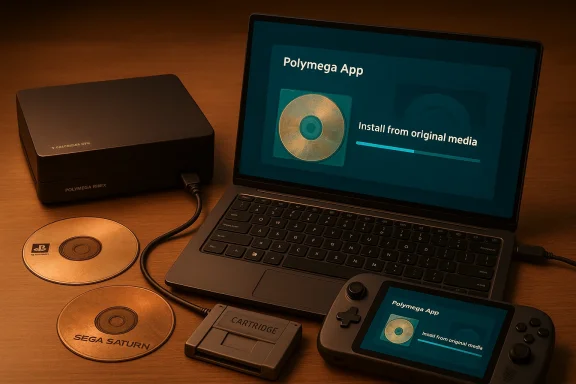
That framing also explains why this product is being discussed so intensely now. Playmaji has positioned the Remix as a practical preservation device, not simply an emulator box. The company says users connect the unit by USB, launch the Polymega App, and install physical media from supported systems, with cartridge support handled through separate Element Modules. In other words, the company is trying to make a once-fragmented retro workflow feel more like installing software than reverse-engineering hardware.
The timing is important. Retro hardware prices have remained stubbornly high, common consoles are no longer easy to replace, and the market for clean, legal, all-in-one retro solutions keeps expanding. At the same time, skepticism around Playmaji has also grown over years of missed timelines and long wait times. That tension gives the Remix a double identity: it is both a genuinely interesting preservation product and a test of whether the company can finally deliver at a predictable pace.
What makes the Remix particularly noteworthy is that it does not try to be everything by itself. Out of the box, it targets CD-based systems first, including the original PlayStation, Sega Saturn, Neo Geo CD, TurboGrafx-CD, and Sega CD. Cartridge systems such as the SNES, N64, and Genesis are supported through optional modules, which is a practical engineering compromise and a business model all at once. The result is a modular ecosystem that could be more flexible than a traditional console replacement, but only if the software and hardware stack arrive in a stable, well-supported form.
That detail matters because the device is not trying to replace your computer. Instead, it behaves more like a specialized ingest and media-access accessory for people who already own a PC or handheld. The app handles the front end, the Remix handles the physical media side, and the emulation layer handles playback. In theory, that should reduce friction compared with the classic homebrew emulation setup, where users often spend hours configuring BIOS files, controllers, scrapers, and front-end launchers.
This is a subtle but important distinction. A lot of retro solutions are built around dumping ROMs or attaching external flash hardware. The Remix instead markets itself as an integrated backup-and-install workflow, which makes it easier for less technical users to understand and potentially easier for preservation-minded collectors to justify. It is not a universal emulator in the abstract; it is a consumer product built around original media ingestion.
That also makes the product more compelling for players who want to revisit entire libraries rather than just a few iconic titles. Optical discs are physically simpler to manage than cartridge ecosystems with multiple region variants and different shell shapes. For preservation, this can be the most rational first step because it captures some of the most important late-20th-century console libraries without requiring a dozen hardware revisions.
This modular approach has practical advantages. It avoids forcing every customer to pay for every connector and chipset variation up front, and it lets Playmaji tailor modules to specific cartridge families. It also mirrors the reality that cartridge interfaces are physically incompatible across generations. But the downside is obvious: the effective price rises quickly once users start adding support for multiple platforms.
This is a smart positioning move. Windows handhelds like the ROG Ally and Lenovo’s PC gaming devices have become a natural home for emulation and game libraries, even if they were not designed specifically for retro media ingestion. By serving that audience, Playmaji can appeal to people who already understand the value of software-based emulation but want a cleaner physical-media workflow. It is a niche, yes, but a commercially meaningful one.
It also broadens the practical audience beyond hard-core collectors. A handheld owner who already uses Windows for gaming may find the Remix easier to adopt than a full retro console stack. That could be especially true for users who want to back up a few favorite CD or cartridge titles without becoming full-time emulation tweakers.
This is also why the product is likely to get attention beyond its immediate fan base. The idea of a plug-in retro ingestion device is novel enough to attract collectors, but practical enough to interest mainstream PC gamers who have old discs in storage. If Playmaji can communicate its value clearly, the Remix may become a reference point for how retro physical media is handled on modern systems.
In preservation terms, the best hardware is often the hardware that gets used without being abused. The Remix seems designed to reduce wear on original systems while keeping the legitimacy of the original media front and center. That matters because retro preservation has always had a split personality: part collector hobby, part conservation project, part practical convenience market. The Remix leans into all three.
That means Playmaji must be careful with messaging. If the company overpromises convenience while underexplaining lawful use, it risks muddying the very preservation narrative that makes the product attractive. If it overcorrects and becomes too cautious, it may fail to capture the casual audience that wants a simple answer. The best outcome is probably a clear own your media, back it up, play it responsibly story.
The company’s current statement that the Remix has completed mass production and will ship in May 2026 is therefore significant not just as a launch date, but as a credibility check. Retro hardware buyers have seen too many projects slip into long tail uncertainty. Even when the hardware itself is good, a pattern of delays can make customers hesitate to commit money to accessories, modules, or preorders.
Playmaji’s challenge is not simply to ship units. It is to ship enough units, with enough software stability, to convince buyers that the ecosystem is durable. A product line like this depends heavily on confidence that modules, updates, and app support will continue after launch. Without that confidence, the device risks being seen as a clever prototype rather than a reliable platform.
That means Playmaji needs to hit more than a shipping window. It needs polished onboarding, transparent updates, and a software stack that feels stable from day one. The company’s greatest challenge is not engineering novelty; it is operational confidence.
Compared with software-only emulation, the Remix offers a more guided physical-media workflow. Compared with FPGA hardware, it is likely more flexible across disc-based systems and potentially easier for consumers to understand. Compared with original hardware, it is obviously more convenient and potentially more durable. Its unique value proposition lies in the middle ground.
There is also a pricing angle. A $199 base price sounds manageable until the user starts adding modules. Once support for SNES, N64, Genesis, or Atari cartridges is factored in, the total outlay could move well beyond what casual buyers expect. That makes the competition not just about hardware, but about total ecosystem cost.
If it succeeds, it could help normalize a middle-tier retro category: not original hardware, not purely software emulation, but a curated bridge between both. If it fails, it may be remembered as another clever idea that ran into the economics of accessories and the realities of small-batch hardware.
Still, the base price is only part of the economics. If a buyer wants cartridge support for multiple systems, the modular ecosystem will likely push the real cost higher. That is not necessarily bad, but it changes the value proposition from “one device that does everything” to “a platform you grow into.” The distinction matters a lot to consumers.
That creates an interesting split. The base unit may attract mainstream curiosity, while the expansion ecosystem may mostly appeal to serious collectors. In business terms, that can be good: a lower entry point creates volume, while premium modules improve margin. But in public perception terms, it can also create disappointment if the practical system costs much more than the headline suggests.
Transparency could become a differentiator here. If the company communicates clearly which systems are included, which require modules, and what the practical setup looks like, it may earn goodwill even from skeptical buyers. Ambiguity, on the other hand, would almost certainly fuel backlash.
That is a difficult balancing act. Too much abstraction, and advanced users feel constrained. Too much configurability, and casual users become overwhelmed. The best retro products find a sweet spot where the defaults are smart enough for newcomers but the settings remain useful for enthusiasts who want precision.
Playmaji will also need to handle firmware updates carefully. Retro users are tolerant of occasional bugs, but they are less tolerant of devices that need repeated patches to do basic things. If the Remix launches with incomplete compatibility or awkward setup steps, early enthusiasm could cool rapidly.
This is especially true on handhelds, where screen space and input methods are more constrained. A beautiful feature list means little if the navigation is clumsy or the initial setup takes too long. Playmaji’s advantage is that it can tailor the app to its own hardware workflow. Its risk is that any weakness will be immediately visible, because the whole system is supposed to make retro gaming simpler, not more complicated.
The broader lesson is bigger than one product. Retro gaming is moving toward a future where preservation, convenience, and modern hardware compatibility are no longer separate conversations. Devices like the Remix are trying to sit at that intersection, and the winners will be the ones that make the experience feel both trustworthy and effortless.
Source: TweakTown Polymega Remix lets you play original SNES, N64, and PlayStation games on a Windows 11 PC
 Overview
The broader appeal of the Polymega Remix is easy to understand. Retro collectors have spent years juggling aging hardware, failing optical drives, dead capacitors, and increasingly fragile ecosystems of adapters, flash cartridges, and modded consoles. A device that can ingest original media and present it through a guided app on a Windows 11-compatible PC sounds like the cleanest possible answer for people who want to keep using the games they legally own without maintaining a museum of old plastic.That framing also explains why this product is being discussed so intensely now. Playmaji has positioned the Remix as a practical preservation device, not simply an emulator box. The company says users connect the unit by USB, launch the Polymega App, and install physical media from supported systems, with cartridge support handled through separate Element Modules. In other words, the company is trying to make a once-fragmented retro workflow feel more like installing software than reverse-engineering hardware.
The timing is important. Retro hardware prices have remained stubbornly high, common consoles are no longer easy to replace, and the market for clean, legal, all-in-one retro solutions keeps expanding. At the same time, skepticism around Playmaji has also grown over years of missed timelines and long wait times. That tension gives the Remix a double identity: it is both a genuinely interesting preservation product and a test of whether the company can finally deliver at a predictable pace.
What makes the Remix particularly noteworthy is that it does not try to be everything by itself. Out of the box, it targets CD-based systems first, including the original PlayStation, Sega Saturn, Neo Geo CD, TurboGrafx-CD, and Sega CD. Cartridge systems such as the SNES, N64, and Genesis are supported through optional modules, which is a practical engineering compromise and a business model all at once. The result is a modular ecosystem that could be more flexible than a traditional console replacement, but only if the software and hardware stack arrive in a stable, well-supported form.
What the Polymega Remix actually is
At its core, the Remix is a USB-connected base unit designed to work with a modern Windows PC or compatible handheld. Playmaji describes it as a way to connect a physical retro library to the Polymega App, which then performs the installation and emulation side of the experience. The product page specifically says it supports Windows 11-compatible PCs, and that it can work with Intel-based laptops and gaming handhelds such as the ROG Ally at launch.That detail matters because the device is not trying to replace your computer. Instead, it behaves more like a specialized ingest and media-access accessory for people who already own a PC or handheld. The app handles the front end, the Remix handles the physical media side, and the emulation layer handles playback. In theory, that should reduce friction compared with the classic homebrew emulation setup, where users often spend hours configuring BIOS files, controllers, scrapers, and front-end launchers.
A bridge between physical media and digital convenience
The promise here is not merely convenience. It is continuity. Many retro collectors do not want to abandon original discs or cartridges, but they also do not want to wear them out through repeated use. The Remix appears designed to let users create a digital installation from their own collection and then play it in a more modern environment, while still keeping the original media in the loop.This is a subtle but important distinction. A lot of retro solutions are built around dumping ROMs or attaching external flash hardware. The Remix instead markets itself as an integrated backup-and-install workflow, which makes it easier for less technical users to understand and potentially easier for preservation-minded collectors to justify. It is not a universal emulator in the abstract; it is a consumer product built around original media ingestion.
- USB-based connection to a Windows PC or handheld
- App-driven installation workflow for original retro media
- Designed around preservation and convenience
- Aims to reduce dependence on aging original hardware
- Uses emulation, but wraps it in a guided user experience
Why CD-based consoles are the easiest starting point
The Remix’s out-of-the-box focus on CD systems is not arbitrary. CD media is generally easier to ingest and emulate in a consistent way than the long tail of cartridge hardware, which often involves different connector formats, voltages, and board sizes. By starting with systems like PlayStation and Sega Saturn, Playmaji is targeting the part of the retro market where physical media is still common but aging hardware is especially fragile.That also makes the product more compelling for players who want to revisit entire libraries rather than just a few iconic titles. Optical discs are physically simpler to manage than cartridge ecosystems with multiple region variants and different shell shapes. For preservation, this can be the most rational first step because it captures some of the most important late-20th-century console libraries without requiring a dozen hardware revisions.
The cartridge problem is where the real complexity lives
Cartridge support is where the Remix becomes more ambitious, and more complicated. Playmaji says it will support NES, SNES, N64, Genesis, Sega 32X, and Atari 2600 cartridges through separately sold modules. That means the base device is only part of the story, and buyers will need to understand the broader ecosystem before they can judge the real cost.This modular approach has practical advantages. It avoids forcing every customer to pay for every connector and chipset variation up front, and it lets Playmaji tailor modules to specific cartridge families. It also mirrors the reality that cartridge interfaces are physically incompatible across generations. But the downside is obvious: the effective price rises quickly once users start adding support for multiple platforms.
- Base unit covers CD-based consoles first
- Cartridge support requires separate Element Modules
- Different console generations need different physical interfaces
- Expansion improves flexibility but raises total ownership cost
- The approach may be easier to manufacture than an all-in-one universal slot
Windows 11, handheld PCs, and the new retro market
The most interesting strategic choice in the Remix is the decision to center Windows 11 at launch. That immediately places the product in the ecosystem of modern handheld gaming PCs, mini PCs, and laptops rather than the traditional living-room console market. It also aligns the Remix with a category of devices that is already popular among retro fans because of their flexibility and portability.This is a smart positioning move. Windows handhelds like the ROG Ally and Lenovo’s PC gaming devices have become a natural home for emulation and game libraries, even if they were not designed specifically for retro media ingestion. By serving that audience, Playmaji can appeal to people who already understand the value of software-based emulation but want a cleaner physical-media workflow. It is a niche, yes, but a commercially meaningful one.
Why this matters for consumers
For consumers, the appeal is straightforward. They can keep using a familiar modern machine while adding a dedicated retro-media layer that feels purpose-built. That reduces the need for a separate stand-alone console and potentially makes the product easier to integrate into existing setups.It also broadens the practical audience beyond hard-core collectors. A handheld owner who already uses Windows for gaming may find the Remix easier to adopt than a full retro console stack. That could be especially true for users who want to back up a few favorite CD or cartridge titles without becoming full-time emulation tweakers.
Why this matters for the market
From a market perspective, the Remix sits in the overlap between three categories: preservation hardware, emulation convenience devices, and PC-accessory ecosystems. That overlap is important because it suggests that retro gaming is no longer just about dedicated consoles or software forks. It is about making legacy media usable in the places people actually play today.This is also why the product is likely to get attention beyond its immediate fan base. The idea of a plug-in retro ingestion device is novel enough to attract collectors, but practical enough to interest mainstream PC gamers who have old discs in storage. If Playmaji can communicate its value clearly, the Remix may become a reference point for how retro physical media is handled on modern systems.
- Windows 11-first launch widens compatibility
- Handheld PCs are a natural audience
- Retro fans increasingly expect portable, software-driven workflows
- The product bridges collector culture and PC gaming
- The market opportunity depends on clean onboarding and stable drivers
The preservation argument
The preservation case for the Remix is the strongest part of the pitch. Old consoles fail, discs degrade, and replacement parts become scarce. If you own original media, being able to back it up and play it on current hardware is far more sustainable than hunting for another aging console on the secondary market. That is especially true for systems whose optical drives are notoriously failure-prone or whose cartridge ports have already been worn down by decades of use.In preservation terms, the best hardware is often the hardware that gets used without being abused. The Remix seems designed to reduce wear on original systems while keeping the legitimacy of the original media front and center. That matters because retro preservation has always had a split personality: part collector hobby, part conservation project, part practical convenience market. The Remix leans into all three.
Legal and practical nuance
There is, however, a subtle but important distinction between preservation and piracy. Products like this are usually framed around using games you already own, which is both the safest legal stance and the most defensible ethical one. But a preservation device also sits close to the boundary of what many mainstream users think of as “just emulation.”That means Playmaji must be careful with messaging. If the company overpromises convenience while underexplaining lawful use, it risks muddying the very preservation narrative that makes the product attractive. If it overcorrects and becomes too cautious, it may fail to capture the casual audience that wants a simple answer. The best outcome is probably a clear own your media, back it up, play it responsibly story.
- Helps reduce wear on original consoles
- Supports long-term access to aging media
- Fits the preservation model better than hunting replacement hardware
- Requires careful legal and ethical messaging
- Benefits collectors who want functionality without constant maintenance
Playmaji’s delivery problem and why trust matters
No analysis of the Polymega Remix is complete without acknowledging the company’s history. Playmaji has spent years building a reputation for ambitious ideas and uneven execution. That does not automatically invalidate the Remix, but it does shape how the market will read every update, every shipping estimate, and every firmware promise. Trust is now part of the product specification.The company’s current statement that the Remix has completed mass production and will ship in May 2026 is therefore significant not just as a launch date, but as a credibility check. Retro hardware buyers have seen too many projects slip into long tail uncertainty. Even when the hardware itself is good, a pattern of delays can make customers hesitate to commit money to accessories, modules, or preorders.
Why skepticism is rational
Skepticism here is not cynicism for its own sake. It is a response to a market where timelines often slip because of supply chains, component sourcing, software readiness, and small-team production realities. Retro hardware is notoriously difficult to ship on schedule because its user base expects a level of compatibility that is hard to guarantee across decades of content and hardware variation.Playmaji’s challenge is not simply to ship units. It is to ship enough units, with enough software stability, to convince buyers that the ecosystem is durable. A product line like this depends heavily on confidence that modules, updates, and app support will continue after launch. Without that confidence, the device risks being seen as a clever prototype rather than a reliable platform.
The importance of first impressions
First impressions will matter more than usual. If early buyers encounter firmware issues, database mismatches, controller quirks, or media-reading inconsistencies, the narrative around the Remix could harden quickly. Retro communities are small enough that reputation spreads fast, and a troubled launch can linger far longer than the original defect.That means Playmaji needs to hit more than a shipping window. It needs polished onboarding, transparent updates, and a software stack that feels stable from day one. The company’s greatest challenge is not engineering novelty; it is operational confidence.
- Preorder trust is a major hurdle
- Software readiness will shape public perception
- Retro communities amplify both praise and criticism quickly
- Reliable module supply is as important as the base unit
- Launch quality may determine whether the Remix becomes a platform or a one-off gadget
The competitive landscape
The Remix enters a crowded but oddly fragmented market. There are emulation handhelds, PC-based front ends, FPGA systems, software emulators, and original hardware purist communities. Few products bridge those worlds in the exact way Playmaji is attempting, which gives the Remix a chance to stand out. But it also means the device will be judged against products that solve pieces of the same problem in different ways.Compared with software-only emulation, the Remix offers a more guided physical-media workflow. Compared with FPGA hardware, it is likely more flexible across disc-based systems and potentially easier for consumers to understand. Compared with original hardware, it is obviously more convenient and potentially more durable. Its unique value proposition lies in the middle ground.
How rivals are likely to respond
Rivals do not need to copy the Remix to pressure it. They can simply continue improving their own products. If other retro platforms offer stronger software polish, better controller support, lower friction, or fewer compatibility issues, the Remix will need to justify its modular approach with obvious user benefits.There is also a pricing angle. A $199 base price sounds manageable until the user starts adding modules. Once support for SNES, N64, Genesis, or Atari cartridges is factored in, the total outlay could move well beyond what casual buyers expect. That makes the competition not just about hardware, but about total ecosystem cost.
- Software emulation remains cheaper and more flexible
- FPGA devices may offer better purity for some purists
- Original hardware appeals to collectors but is increasingly fragile
- The Remix’s strength is physical-media convenience
- Total ecosystem cost could shape buyer decisions more than the base unit price
Consumer segmentation is the real battlefield
The real competition is not one product versus another. It is between different user mindsets. The collector wants authenticity and library access. The tinkerer wants control and open-ended software. The casual fan wants something that simply works. The Remix has to convince at least two of those groups that its hybrid model is worth the commitment.If it succeeds, it could help normalize a middle-tier retro category: not original hardware, not purely software emulation, but a curated bridge between both. If it fails, it may be remembered as another clever idea that ran into the economics of accessories and the realities of small-batch hardware.
What the $199 price really means
The headline price is attractive, but only if readers understand what it includes. At $199, the Remix base unit sits in a psychologically accessible range for enthusiasts who have already spent money on controllers, flash carts, handhelds, or AV adapters. It is expensive enough to signal seriousness, but low enough to be plausible as a specialized accessory rather than a luxury console.Still, the base price is only part of the economics. If a buyer wants cartridge support for multiple systems, the modular ecosystem will likely push the real cost higher. That is not necessarily bad, but it changes the value proposition from “one device that does everything” to “a platform you grow into.” The distinction matters a lot to consumers.
Budgeting for the ecosystem
The right way to evaluate the Remix is not just by the sticker price, but by the likely total cost of ownership. A user who only wants CD-based systems may find the $199 entry point perfectly reasonable. A user who wants SNES, N64, Genesis, and Atari compatibility will probably face a much more expensive path once modules are included.That creates an interesting split. The base unit may attract mainstream curiosity, while the expansion ecosystem may mostly appeal to serious collectors. In business terms, that can be good: a lower entry point creates volume, while premium modules improve margin. But in public perception terms, it can also create disappointment if the practical system costs much more than the headline suggests.
A familiar retro-hardware pattern
This pricing model is not new in retro hardware, but it remains controversial. Many enthusiasts have learned to read “affordable base unit” as shorthand for “more expensive ecosystem later.” That does not make the product dishonest, but it does mean Playmaji will need to be careful about how clearly it explains expansion requirements.Transparency could become a differentiator here. If the company communicates clearly which systems are included, which require modules, and what the practical setup looks like, it may earn goodwill even from skeptical buyers. Ambiguity, on the other hand, would almost certainly fuel backlash.
- $199 is a compelling entry point
- Cartridge modules likely raise the real total cost
- CD-only users may find the value strongest
- Expansion economics will shape consumer sentiment
- Clear pricing communication could build trust
Technical expectations and likely limitations
Even if the hardware works as advertised, the software experience will determine whether the Remix feels polished or merely functional. Retro compatibility is never as simple as “it runs” because every system carries edge cases: regional formats, disc protection behavior, controller support, BIOS expectations, save handling, and display scaling. The Polymega App will need to hide as much complexity as possible without becoming opaque.That is a difficult balancing act. Too much abstraction, and advanced users feel constrained. Too much configurability, and casual users become overwhelmed. The best retro products find a sweet spot where the defaults are smart enough for newcomers but the settings remain useful for enthusiasts who want precision.
Likely pain points to watch
The most likely sources of friction are predictable. Some users will care about controller latency, others about disc-reading reliability, and still others about how save files are managed across devices. There is also the question of whether the app feels native and responsive on different classes of Windows devices, especially handhelds with varying chipsets and screen resolutions.Playmaji will also need to handle firmware updates carefully. Retro users are tolerant of occasional bugs, but they are less tolerant of devices that need repeated patches to do basic things. If the Remix launches with incomplete compatibility or awkward setup steps, early enthusiasm could cool rapidly.
- BIOS and region handling may affect compatibility
- Controller mapping will shape usability
- Disc read reliability is critical for trust
- Save management and library organization matter
- Firmware maturity may define the launch narrative
Why the app matters as much as the hardware
In modern retro products, the app is the product. Hardware gets attention, but software determines whether users stay. The Polymega App will need to feel cohesive, quick, and easy to navigate if the Remix is going to stand apart from generic PC emulation setups.This is especially true on handhelds, where screen space and input methods are more constrained. A beautiful feature list means little if the navigation is clumsy or the initial setup takes too long. Playmaji’s advantage is that it can tailor the app to its own hardware workflow. Its risk is that any weakness will be immediately visible, because the whole system is supposed to make retro gaming simpler, not more complicated.
Strengths and Opportunities
The Remix arrives with real strengths, and those strengths could make it one of the more interesting retro products of 2026 if the company delivers on its promises. The opportunity is not just to sell a device, but to normalize a cleaner way of handling physical game libraries on modern PCs. If Playmaji executes well, it could open a broader conversation about preservation-first retro hardware.- Physical-media preservation is a genuine consumer need, not a marketing gimmick.
- Windows 11 compatibility gives the product immediate relevance on modern PCs and handhelds.
- Modular design lets buyers pay for the systems they actually want.
- CD-based support covers some of the most fragile and valuable retro libraries first.
- Collector appeal is strong because the device centers original media, not downloads.
- A simple app workflow could make emulation more approachable for less technical users.
- The timing is good because retro hardware interest remains high and replacement consoles are scarce.
Risks and Concerns
The main risks are less about the concept and more about execution. Retro hardware buyers are experienced, impatient, and skeptical for good reason. If Playmaji cannot deliver consistency in shipping, compatibility, and software polish, the Remix could be remembered as another promising idea trapped by its own complexity.- Historical trust issues around Playmaji may suppress early adoption.
- Accessory pricing could make the full system much more expensive than the base unit suggests.
- Software bugs would be especially damaging in a product built on convenience.
- Module availability will matter as much as base unit stock.
- Compatibility gaps could frustrate users expecting broad “plug and play” support.
- Launch delays would undercut the significance of the May 2026 shipping window.
- Overpromising preservation without clear legal framing could invite confusion.
Looking Ahead
The next few months will tell us whether the Polymega Remix is a turning point or just a better-packaged version of an old promise. If Playmaji ships on time, keeps the software stable, and communicates clearly about module support, the company could finally convert curiosity into genuine momentum. If it stumbles, the market will likely conclude that the idea remains ahead of the execution.The broader lesson is bigger than one product. Retro gaming is moving toward a future where preservation, convenience, and modern hardware compatibility are no longer separate conversations. Devices like the Remix are trying to sit at that intersection, and the winners will be the ones that make the experience feel both trustworthy and effortless.
- Shipping in May 2026 will be the first real test
- Early software polish will shape the narrative
- Module strategy will determine long-term adoption
- Handheld PC compatibility could broaden the audience
- Community trust will matter as much as feature lists
Source: TweakTown Polymega Remix lets you play original SNES, N64, and PlayStation games on a Windows 11 PC
