

Schneider Electric has published an urgent security notification and accompanying fixes for multiple vulnerabilities in PowerChute Serial Shutdown; operators should treat this as a high-priority patching and hardening task because the issues include path traversal, insufficient brute‑force protections, and incorrect default permissions that together raise the risk of local privilege escalation, account takeover, and elevated system access when left unpatched.
PowerChute Serial Shutdown is the Schneider Electric agent used to manage graceful shutdowns of servers and systems attached to UPS devices (Smart‑UPS, Easy UPS Online, etc.. It’s widely deployed in enterprise and industrial environments—particularly in data centers and critical manufacturing—where unexpected shutdown behavior can cause data loss, service interruption, or worse. Schneider Electric and government trackers have published coordinated advisories covering multiple discovery timelines and fixes. Two distinct waves of public disclosures matter here:
Source: CISA Schneider Electric PowerChute Serial Shutdown | CISA
 Background / Overview
PowerChute Serial Shutdown is the Schneider Electric agent used to manage graceful shutdowns of servers and systems attached to UPS devices (Smart‑UPS, Easy UPS Online, etc.. It’s widely deployed in enterprise and industrial environments—particularly in data centers and critical manufacturing—where unexpected shutdown behavior can cause data loss, service interruption, or worse. Schneider Electric and government trackers have published coordinated advisories covering multiple discovery timelines and fixes. Two distinct waves of public disclosures matter here:- January 10, 2025 — CISA published an ICS advisory describing an improper authentication issue impacting PowerChute Serial Shutdown versions up through 1.2.0.301 (CVE-2024-10511), recommending updates to v1.3 where appropriate and traditional ICS defensive measures.
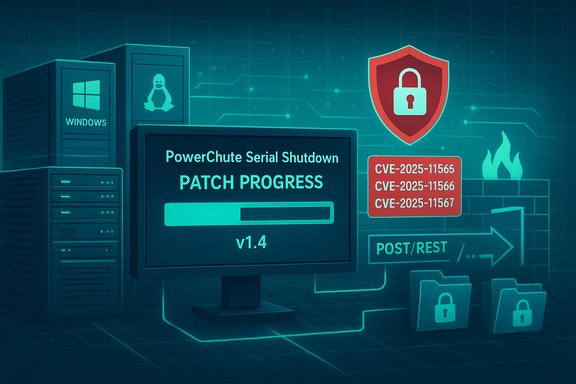
- November 2025 — Schneider’s security notifications list three new CVEs affecting PowerChute Serial Shutdown (CVE‑2025‑11565, CVE‑2025‑11566, CVE‑2025‑11567) and identify PowerChute Serial Shutdown v1.4 as the release that contains fixes across Windows and supported Linux distributions. The vendor also published release notes and download packages for v1.4.
What exactly is vulnerable — technical breakdown
CVE‑2025‑11565 — Path traversal via UpdateJRE payload
- What it is: An attacker who can access the Web Admin interface on the local network can tamper with the POST/REST/UpdateJRE request payload to perform a path traversal and write or overwrite files outside the intended directory. This can result in elevated system access when chained with other weaknesses. Schneider assigned CWE‑22 to this issue and lists it as fixed in v1.4.
- Impact and exploitability: The vendor-calculated CVSS v3.1 base score for this item is 7.0, reflecting high confidentiality/integrity/availability impact but limited to local network reachability and requiring some privileges or user roles in the web admin plane.
CVE‑2025‑11566 — Improper restriction of excessive authentication attempts (brute force)
- What it is: The REST endpoint /REST/shutdownnow lacked sufficient protections against repeated authentication attempts, allowing an attacker on the local network to trial many credential combinations without robust rate limiting or lockout. Schneider classified this behavior as CWE‑307 and fixed it in v1.4.
- Impact and exploitability: Schneider’s CVSS numbering places this at ~7.3, reflecting network exposure with low complexity (no user interaction) and the potential for account takeover if weak credentials are present. Independent trackers and enterprise scanners have flagged this as a high-priority operational concern.
CVE‑2025‑11567 — Incorrect default permissions
- What it is: A dangerously common misconfiguration—installer or installation folders shipped with insufficiently restrictive permissions—can allow a low‑privileged local account to modify files or inject code that is later executed with higher privileges. Schneider explicitly notes that custom installation folders must have administrative permissions and the vendor’s Security Handbook provides remediation steps.
- Impact and exploitability: With a CVSS v3.1 base score around 7.8, this vulnerability is significant when an adversary already has local network access or a foothold; it raises the probability of privilege escalation to root/Administrator.
Earlier advisory (CVE‑2024‑10511) — Improper authentication / DoS
- What it is: CISA’s January 2025 advisory described an improper authentication issue (CVE‑2024‑10511) where repeated requests to /accessdenied could cause denial of access to the PowerChute web interface. That advisory recommended upgrading affected installs (v1.2.0.301 and earlier) to v1.3 and following ICS network isolation guidance.
Why this matters to Windows sysadmins and ICS owners
PowerChute Serial Shutdown often runs on Windows servers (engineering workstations, HMI hosts, or servers tied to UPS management). A successful exploit can:- Interrupt graceful shutdown procedures, causing data corruption or unscheduled downtime.
- Allow reading or modification of configuration files used to manage UPS‑triggered behavior.
- Enable privilege escalation from a local low‑privileged account to system or Administrator, particularly when default permissions are lax.
- Facilitate lateral movement from an initially compromised engineering workstation into production systems that depend on orderly UPS behavior.
Immediate action checklist (priority order)
- Inventory first
- Identify every host running PowerChute Serial Shutdown (Windows and Linux), noting version strings and whether installs used default or custom folders.
- Record management IPs, access control lists, and whether the web admin interface is reachable from business or public networks.
- Patch to v1.4 where available
- Schneider lists PowerChute Serial Shutdown v1.4 as the fixed release for CVE‑2025‑11565/66/67 across Windows and supported Linux distributions; download and install the vendor package in accordance with internal change control.
- If you cannot immediately apply v1.4 in production, move to the mitigations below.
- If you cannot patch immediately — apply compensating controls
- Block inbound access to management interfaces from non‑trusted networks via firewall rules and ACLs. Only allow tightly controlled engineering jump hosts.
- Restrict access to the /REST/* endpoints and block or proxy known management paths where possible. Use a web application firewall or HTTP proxy to enforce rate limits on authentication endpoints.
- Enforce strong password policies and disable or remove any default accounts; implement multi‑factor authentication for jump hosts if supported.
- For installations in custom folders: immediately verify NTFS (or Linux) permissions and set administrative ownership where required; follow Schneider’s Security Handbook steps.
- Monitor and detect
- Instrument logging to detect repeated failed authentication attempts, anomalous POST/UpdateJRE payloads, or unusual file writes in the installation directories.
- Review Windows Event Viewer for PowerChute service errors and correlate with patching windows or unusual network events.
- Test and roll out
- Deploy updates to a staging environment first. Validate controlled shutdowns, UPS-triggered behavior, and event log cleanliness before production rollout.
- Maintain rollback images and documented recovery steps for service restarts.
Detection details — what to look for in logs and telemetry
- Repeated authentication failures against /REST/shutdownnow or other REST endpoints — indicates bad‑password brute force attempts. Log spikes should trigger an automated alert.
- Unexpected POST to /REST/UpdateJRE with unusual file paths or embedded “../” sequences — indicates attempted path traversal.
- Creation or modification of executables, DLLs, or JRE files in directories outside the vendor‑documented installation folder — possible code injection following traversal.
- Windows Event Viewer entries tied to PowerChute service restarts, preshutdown errors, or service crashes following malformed HTTP requests — community reports show these are useful early indicators.
Longer‑term hardening and operational recommendations
- Network segmentation: Place UPS management, PowerChute hosts, and engineering stations on isolated VLANs with minimal access from business networks. Enforce allow‑lists to engineering jump hosts and NOC IP ranges. This is consistent with CISA’s ICS defensive guidance.
- Principle of least privilege: Ensure the service runs with the minimum privileges required; remove or lock accounts that aren’t needed for operation.
- Signed packages and integrity checks: Require vendor-signed binaries and verify checksums for all downloads. Schneider’s security management pages and firmware PKI guidance are part of improving supply‑chain assurance.
- Patch governance: Keep an up‑to‑date inventory and notification subscription for Schneider security notifications so you receive CVE updates and fixed release announcements as soon as they appear.
- Incident playbooks: Update runbooks to include steps for isolating a compromised PowerChute host, validating UPS behavior manually, and coordinating with facilities teams to manage power events safely.
Why this release matters — analysis and risk considerations
Strengths of Schneider’s response:- The vendor issued a consolidated v1.4 that explicitly addresses the listed CVEs and made platform‑specific packages and release notes available for Windows and multiple Linux distributions. This streamlines remediation and reduces patch fragmentation risk.
- Coordination with public authorities (CISA and ICS‑CERT ecosystem) and listing of CWEs and CVSS vectors improves operator awareness and helps prioritize response.
- Local network exposure remains the common enabling condition; environments that present management interfaces to broader subnets or rely on insecure VPNs are still at elevated risk until segmentation and ACLs are enforced. CISA explicitly calls out minimizing network exposure as a primary mitigation.
- Default permissions issues (CVE‑2025‑11567) are often operational oversights; many deployments use the installer defaults or custom paths with overly permissive ACLs. Even after patching, misconfigured permissions can permit post‑patch exploitation if an attacker already has a foothold.
- Patching operational ICS servers often requires maintenance windows and careful validation—delays in applying v1.4 widen the exploitable window and increase the time an adversary has to scan and attempt local attacks. Independent trackers flagged these CVEs and still list them as development entries in some vulnerability pipelines, indicating active scanner interest.
Practical migration plan for Windows environments (step‑by‑step)
- Confirm inventory: enumerate hosts, versions, install paths.
- Subscribe to Schneider security notifications and CISA advisories for real‑time updates.
- Download v1.4 packages into a secured update repository and verify checksums before staging.
- Test upgrade process on a non‑production host:
- Verify graceful shutdown behavior with attached UPS under lab conditions.
- Check for service errors in Windows Event Viewer and application logs.
- Run post‑upgrade checks on permissions, ensure custom folders are owned by Administrators.
- Schedule a controlled production upgrade window with backups and rollback steps.
- After rollout, enable enhanced logging and monitor for suspicious REST calls or auth spikes for a monitored post‑deployment period (2–4 weeks).
- Remediate any remaining misconfigurations (ACLs, open ports) and document the change.
Closing analysis — what organizations should take away
- Apply v1.4 promptly where possible: Schneider’s v1.4 release is the definitive fix for the recent CVEs affecting PowerChute Serial Shutdown; it’s available for Windows and for supported Linux distributions.
- Assume local network access is enough: several of these vulnerabilities require only local network reachability or leverage misconfigurations; operators should assume the adversary model includes internal reconnaissance and pivoting from compromised endpoints.
- Harden, don’t just patch: fixing software is critical, but preventing exposure through segmentation, ACLs, rate limiting, and strict file permissions is equally necessary to lower risk of escalation.
- Operate with ICS discipline: treat UPS management and shutdown agents as OT assets—apply the same defense‑in‑depth, change control, and incident playbooks you use for other ICS components. This aligns with CISA’s recommended practices and industry guidance.
Source: CISA Schneider Electric PowerChute Serial Shutdown | CISA
