

Preservica and Cadence Solutions announced on June 11, 2026, that Cadence will resell Preservica’s Professional, Enterprise, and Preserve365 products in Canada and the United States for organizations running long-term records governance inside Microsoft 365. The deal is not a blockbuster acquisition or a new Microsoft SKU, but it lands in a part of the Microsoft ecosystem that increasingly decides whether yesterday’s documents become tomorrow’s usable institutional memory. The pitch is simple: SharePoint, Purview, Copilot, and Microsoft 365 Archive are becoming the everyday workplace for business content, but long-term preservation still needs more than storage and retention labels. That gap is where Preservica and Cadence are trying to build a business.
For years, Microsoft 365 was sold as productivity plumbing: email, documents, Teams chats, SharePoint libraries, and enough compliance tooling to keep auditors from immediately reaching for a red pen. In practice, it has become something larger and messier. It is now the default records repository for municipalities, universities, healthcare networks, law firms, nonprofits, and private companies that never intended SharePoint to become a permanent archive.
That evolution matters because the difference between retention and preservation is not semantic. Retention decides how long content must be kept, when it can be deleted, and under which legal or regulatory obligations it sits. Preservation asks a harder question: will this file still be readable, trustworthy, searchable, and contextually meaningful years or decades from now?
Microsoft Purview has become the control plane for much of the first problem. It can classify, label, retain, dispose, and govern data across Microsoft 365. But the second problem reaches beyond the usual lifecycle-management dashboard. File formats age. Metadata gets stripped. Permissions drift. Sites are reorganized. Users leave. Business context disappears. Eventually, “we kept the file” is not the same as “we can prove what it is and use it.”
That is the opening Preservica is targeting with Preserve365, and Cadence gives it a North American implementation partner already fluent in the Microsoft vocabulary. For WindowsForum readers, the interesting part is not the reseller badge. It is the tacit admission that Microsoft 365’s gravitational pull has grown so strong that preservation vendors now need to live inside it rather than beside it.
The larger subtext is that digital preservation is being pulled out of the archive department and into the operational Microsoft 365 stack. Historically, preservation was the province of national archives, museums, universities, libraries, and government records offices. Those institutions still matter, but the preservation problem is no longer confined to curators and records managers.
Every organization that uses Microsoft 365 now generates long-lived digital assets by default. Board minutes, contracts, engineering documents, case files, regulatory submissions, public-records material, research data, HR records, and policy decisions all flow through systems built primarily for collaboration. The same SharePoint site that helps a team move quickly in 2026 may also become evidence in 2036.
That is why Cadence’s Microsoft credentials are central to the story. Preservica does not need a reseller that merely understands archives. It needs one that understands how customers actually configure Purview labels, migrate file shares into SharePoint, structure permissions, manage storage costs, prepare content for Copilot, and survive compliance reviews. Preservation, in this framing, becomes another layer of Microsoft 365 architecture.
The companies are also leaning into AI as a justification. Cadence’s CEO Jordan Uytterhagen framed long-term, high-quality data as a foundation for legal compliance and AI agent learning. That is a very 2026 argument: preserve the records not only because auditors require them, but because AI systems are only as useful as the corpus they can safely and accurately reason over.
That word embedding is doing a lot of work. Enterprise archiving has often failed not because the archive was technically weak, but because it felt like exile. Content left the working environment, users lost convenient access, and records managers gained another system that IT had to secure, fund, and explain. The more disconnected the archive, the more likely teams were to keep unofficial copies in the places they already used.
Preserve365 tries to reduce that friction by treating SharePoint as the familiar front door. Users and administrators can keep working within Microsoft’s ecosystem while Preservica handles the preservation layer behind the scenes. In theory, that means long-term records can remain findable and usable without asking every department to learn the habits of an archival professional.
The appeal is obvious for public-sector bodies and regulated industries. Freedom of information requests, eDiscovery demands, investigations, audits, and operational knowledge reuse all become harder when old content is scattered across file shares, dead systems, exported PSTs, unsupported formats, and abandoned collaboration sites. If the content can be preserved from the place where it is created and governed, the preservation program has a better chance of surviving contact with everyday business.
But this is also where buyers should read carefully. Native-feeling integration does not eliminate the need for records strategy. It merely gives that strategy a more practical interface. Organizations still need to decide what counts as high-value content, who owns the metadata, how retention maps to preservation, when content moves from active collaboration to long-term stewardship, and what proof will satisfy auditors or courts.
Yet Purview’s strength is also its boundary. It governs information within a Microsoft-defined compliance and security framework. It can tell content when to be retained, disposed, labeled, protected, or discovered. It does not automatically solve every problem of long-term format sustainability, archival metadata, authenticity, or future usability across decades.
That distinction is the wedge for Preservica. Active digital preservation is built around the idea that files must be monitored, validated, and, when necessary, transformed into formats that remain readable as technology changes. It is not enough to store a document if the application needed to open it disappears, if the object’s integrity cannot be proven, or if future staff cannot understand the chain of custody.
For Windows admins, this may sound like a niche archival concern until the first audit turns into a hunt through legacy file formats and half-documented migrations. Many organizations have lived through this already with Lotus Notes databases, old CAD files, WordPerfect documents, obsolete media formats, custom line-of-business exports, and departmental Access databases that outlived the people who understood them. Cloud migration did not end that pattern. It merely moved the next version of it into SaaS.
The most pragmatic reading of the Preservica-Cadence announcement is that Microsoft 365 governance is maturing from “keep or delete” toward “keep, prove, read, reuse, and explain.” That is a broader and more expensive problem. It is also the problem that arrives when organizations realize AI search and Copilot-style tools are only useful if the underlying content is trustworthy.
For decades, old records were often treated as defensive assets. Keep them because the law requires it. Keep them because someone may sue. Keep them because regulators may ask. Keep them because public bodies have disclosure obligations. The archive was a liability-control mechanism.
Generative AI changes the perceived value of those records. Suddenly, decades of policy, correspondence, contracts, research, decisions, and institutional knowledge look like training material, retrieval material, or context for AI agents. The dusty archive becomes a potential knowledge base. That gives preservation programs a stronger business case than compliance alone.
It also raises the stakes. If organizations feed AI systems incomplete, poorly governed, obsolete, or misleading records, the output will inherit those weaknesses. A Copilot-like assistant that can summarize ten years of project history is useful only if the underlying records are authentic, complete enough, properly permissioned, and distinguishable from drafts, superseded versions, and convenience copies.
This is where preservation and governance converge. AI readiness is not just about licensing Copilot or enabling semantic indexing. It is about deciding which records deserve to become part of the machine-readable institutional memory. A preserved archive may become a competitive advantage, but only if the organization resists the temptation to shovel everything into the model and call it transformation.
The cost argument will get attention because it is easy to understand. Finance departments understand rising storage bills faster than they understand format obsolescence. IT leaders can justify a project if it reduces active SharePoint sprawl, improves lifecycle controls, and moves stale content into a better-managed state.
But cost savings should not be the headline value of digital preservation. If an organization treats preservation mainly as cheaper storage, it risks repeating the same mistakes under a more sophisticated label. The goal is not simply to move content somewhere less expensive. The goal is to preserve the right content with enough context, integrity, and accessibility that it remains useful.
That requires choices. Some content should be deleted when legally appropriate. Some should be retained for a fixed period and then defensibly disposed of. Some should be preserved for decades or permanently. The failure mode in Microsoft 365 is often keeping too much without knowing why, while still failing to preserve the subset that truly matters.
Cadence’s role could be significant here because implementation is where these distinctions either become real or collapse into vendor slideware. A partner that understands Purview retention, SharePoint architecture, Power Automate workflows, and business process design can help customers avoid treating Preserve365 as a magic export button. The value is in aligning records policy with the Microsoft 365 environment people actually use.
Microsoft’s own ecosystem encourages this. Customers have spent years consolidating productivity, identity, compliance, security, collaboration, and workflow into Microsoft 365 and Azure. Once that consolidation happens, adjacent vendors have two choices: integrate deeply or risk being treated as another disconnected platform. Preservica is choosing integration.
Cadence’s geography matters too. The announcement specifically covers Canada and the United States, where public-records requirements, privacy obligations, sectoral regulation, litigation risk, and cross-border governance concerns all create demand for stronger records programs. Canadian public institutions and regulated organizations also tend to be careful about data residency, procurement channels, and implementation partners with local credibility.
The deal is not exclusive evidence that Preservica will dominate preservation in Microsoft 365. Other records-management, backup, compliance, and archiving vendors will continue to crowd the same terrain. Microsoft itself will keep expanding native capabilities where customer demand is broad enough. The question is whether specialized preservation remains distinct enough to justify a dedicated product.
For now, the answer is likely yes. Microsoft can provide the platform, policy framework, and archive storage; a preservation specialist can provide the domain-specific machinery for long-term file viability, authenticity, and archival workflows. That division of labor is sensible as long as customers understand where one responsibility ends and the other begins.
A preservation layer changes the lifecycle of content. It affects site design, metadata, retention labels, automation flows, search expectations, access models, and disposal processes. It may also affect how departments define official records versus working documents. If implemented casually, it can add yet another governance layer to an already complicated tenant.
The best candidates for a project like this are organizations that can name their preservation problem concretely. A city clerk’s office that must preserve council records and respond to public-records requests has a clearer case than a company that vaguely wants to “archive SharePoint.” A research institution with permanent records and legacy formats has a different case from a sales organization trying to reduce storage bloat. A legal department preparing for long-horizon discovery needs different controls from a communications team preserving brand assets.
That specificity matters because Microsoft 365 tenants are already full of overlapping tools. Backup vendors promise recovery. Purview promises compliance governance. Microsoft 365 Archive promises colder storage for inactive sites. SharePoint Premium and Content AI capabilities promise content understanding and processing. Power Platform promises automation. Preserve365 has to fit into that stack without becoming a parallel universe.
The right question for IT is not “Do we need digital preservation?” It is “Which records will become business, legal, cultural, or operational liabilities if they are merely stored rather than preserved?” Once that question has an answer, the product conversation becomes much more grounded.
That anxiety has created budget for governance work that might previously have stalled. Companies are reviewing permissions, sensitivity labels, retention policies, site ownership, information architecture, and content quality because AI makes poor hygiene harder to ignore. Cadence already operates in that space, which gives Preservica a route into conversations that are not framed as archival projects.
This is a smart market move because “digital preservation” can sound like a cost center, while “AI-ready trusted content” sounds like transformation. The danger is that the latter phrase can become too elastic. Not every archive should feed an AI agent, and not every preserved record should be treated as an approved source for automated reasoning.
Still, the connection is real. Long-term records have value only if they can be found, understood, and trusted. AI raises the ceiling on what organizations can do with those records, but it also raises the penalty for bad governance. A preserved, permission-aware, well-described archive is far more useful than a chaotic pile of files that merely survived.
The companies are betting that customers will see preservation as part of the AI-readiness journey rather than as an afterthought. That is plausible, especially in sectors where institutional knowledge has high value and high risk. The best version of this market is not AI washing. It is using the AI moment to finally fund the unglamorous records work that should have been done years ago.
A stable SharePoint environment is not just uptime. It is predictable information architecture, sane permissions, controlled lifecycle processes, meaningful metadata, and content that does not rot invisibly. Preservation depends on that foundation. If SharePoint is a dumping ground, embedding preservation into it will preserve some of the mess along with the records.
The webinar will likely emphasize implementation services, integration patterns, and the practical path for customers already using Microsoft 365. The useful details to watch are not the broad claims, but the operational mechanics. How are retention labels mapped to preservation workflows? How are non-Microsoft-native records handled? What metadata is preserved? How does retrieval work for end users? How are permissions enforced after transfer? What is the administrative burden?
Those are the questions that separate an attractive integration from a durable operating model. The Microsoft 365 ecosystem is full of tools that demo well and then become complicated once real-world permissions, migrations, legacy content, and departmental politics enter the room. Preservation products are not immune to that pattern.
If Preservica and Cadence can show repeatable implementation patterns, especially for public-sector and regulated customers, the partnership will look more substantial than a channel announcement. If not, it risks becoming another specialized solution that appeals to records professionals but struggles to gain traction with overstretched IT teams.
That should make administrators cautious. SharePoint was not always designed, deployed, or governed with that weight in mind. Many tenants grew organically, with site sprawl, inconsistent metadata, broken ownership, and permissions inherited from yesterday’s urgent project. Turning that environment into a preservation-ready substrate takes discipline.
Preserve365’s promise is that preservation can be brought closer to the place where content lives. Cadence’s promise is that the implementation can be shaped by people who understand Microsoft 365 in the field, not just archives in theory. Together, that is a credible answer to a real problem.
But it is not a shortcut around information governance. In fact, it makes governance more important. The easier it becomes to preserve content from Microsoft 365, the more organizations need defensible rules about what deserves preservation. Without those rules, the archive becomes just another expensive mirror of the mess.
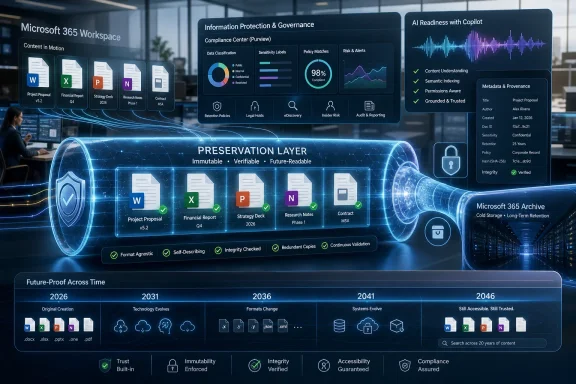 Microsoft 365 Has Become the Records Room, Whether IT Planned It or Not
For years, Microsoft 365 was sold as productivity plumbing: email, documents, Teams chats, SharePoint libraries, and enough compliance tooling to keep auditors from immediately reaching for a red pen. In practice, it has become something larger and messier. It is now the default records repository for municipalities, universities, healthcare networks, law firms, nonprofits, and private companies that never intended SharePoint to become a permanent archive.That evolution matters because the difference between retention and preservation is not semantic. Retention decides how long content must be kept, when it can be deleted, and under which legal or regulatory obligations it sits. Preservation asks a harder question: will this file still be readable, trustworthy, searchable, and contextually meaningful years or decades from now?
Microsoft Purview has become the control plane for much of the first problem. It can classify, label, retain, dispose, and govern data across Microsoft 365. But the second problem reaches beyond the usual lifecycle-management dashboard. File formats age. Metadata gets stripped. Permissions drift. Sites are reorganized. Users leave. Business context disappears. Eventually, “we kept the file” is not the same as “we can prove what it is and use it.”
That is the opening Preservica is targeting with Preserve365, and Cadence gives it a North American implementation partner already fluent in the Microsoft vocabulary. For WindowsForum readers, the interesting part is not the reseller badge. It is the tacit admission that Microsoft 365’s gravitational pull has grown so strong that preservation vendors now need to live inside it rather than beside it.
The Partnership Is Small News With a Large Subtext
On paper, the announcement is straightforward. Cadence Solutions, a Canadian systems implementer based around Microsoft 365 digital transformation work, becomes an authorized reseller for Preservica’s Professional, Enterprise, and Preserve365 offerings in Canada and the United States. Cadence already works in SharePoint, Purview, SharePoint Embedded, Power Platform, Microsoft 365 Archive, and Copilot enablement, which makes the partnership a natural channel move.The larger subtext is that digital preservation is being pulled out of the archive department and into the operational Microsoft 365 stack. Historically, preservation was the province of national archives, museums, universities, libraries, and government records offices. Those institutions still matter, but the preservation problem is no longer confined to curators and records managers.
Every organization that uses Microsoft 365 now generates long-lived digital assets by default. Board minutes, contracts, engineering documents, case files, regulatory submissions, public-records material, research data, HR records, and policy decisions all flow through systems built primarily for collaboration. The same SharePoint site that helps a team move quickly in 2026 may also become evidence in 2036.
That is why Cadence’s Microsoft credentials are central to the story. Preservica does not need a reseller that merely understands archives. It needs one that understands how customers actually configure Purview labels, migrate file shares into SharePoint, structure permissions, manage storage costs, prepare content for Copilot, and survive compliance reviews. Preservation, in this framing, becomes another layer of Microsoft 365 architecture.
The companies are also leaning into AI as a justification. Cadence’s CEO Jordan Uytterhagen framed long-term, high-quality data as a foundation for legal compliance and AI agent learning. That is a very 2026 argument: preserve the records not only because auditors require them, but because AI systems are only as useful as the corpus they can safely and accurately reason over.
Preserve365 Tries to Make Archiving Feel Native, Not Exiled
Preserve365’s central promise is that organizations can preserve high-value SharePoint and Microsoft 365 content without forcing users into a separate archival universe. Preservica describes the product as embedding active digital preservation into Microsoft 365 and SharePoint, with ties into Purview, Power Automate, Azure AI Services, Microsoft Copilot, and Microsoft 365 Archive.That word embedding is doing a lot of work. Enterprise archiving has often failed not because the archive was technically weak, but because it felt like exile. Content left the working environment, users lost convenient access, and records managers gained another system that IT had to secure, fund, and explain. The more disconnected the archive, the more likely teams were to keep unofficial copies in the places they already used.
Preserve365 tries to reduce that friction by treating SharePoint as the familiar front door. Users and administrators can keep working within Microsoft’s ecosystem while Preservica handles the preservation layer behind the scenes. In theory, that means long-term records can remain findable and usable without asking every department to learn the habits of an archival professional.
The appeal is obvious for public-sector bodies and regulated industries. Freedom of information requests, eDiscovery demands, investigations, audits, and operational knowledge reuse all become harder when old content is scattered across file shares, dead systems, exported PSTs, unsupported formats, and abandoned collaboration sites. If the content can be preserved from the place where it is created and governed, the preservation program has a better chance of surviving contact with everyday business.
But this is also where buyers should read carefully. Native-feeling integration does not eliminate the need for records strategy. It merely gives that strategy a more practical interface. Organizations still need to decide what counts as high-value content, who owns the metadata, how retention maps to preservation, when content moves from active collaboration to long-term stewardship, and what proof will satisfy auditors or courts.
Purview Handles Policy, but Preservation Demands Durability
Microsoft Purview is often treated as the answer to Microsoft 365 governance, and in many environments it is the right starting point. It gives administrators tools for retention labels, records management, data lifecycle policies, eDiscovery, sensitivity labeling, insider risk, and compliance workflows. For IT teams trying to impose order on sprawling tenants, Purview is indispensable.Yet Purview’s strength is also its boundary. It governs information within a Microsoft-defined compliance and security framework. It can tell content when to be retained, disposed, labeled, protected, or discovered. It does not automatically solve every problem of long-term format sustainability, archival metadata, authenticity, or future usability across decades.
That distinction is the wedge for Preservica. Active digital preservation is built around the idea that files must be monitored, validated, and, when necessary, transformed into formats that remain readable as technology changes. It is not enough to store a document if the application needed to open it disappears, if the object’s integrity cannot be proven, or if future staff cannot understand the chain of custody.
For Windows admins, this may sound like a niche archival concern until the first audit turns into a hunt through legacy file formats and half-documented migrations. Many organizations have lived through this already with Lotus Notes databases, old CAD files, WordPerfect documents, obsolete media formats, custom line-of-business exports, and departmental Access databases that outlived the people who understood them. Cloud migration did not end that pattern. It merely moved the next version of it into SaaS.
The most pragmatic reading of the Preservica-Cadence announcement is that Microsoft 365 governance is maturing from “keep or delete” toward “keep, prove, read, reuse, and explain.” That is a broader and more expensive problem. It is also the problem that arrives when organizations realize AI search and Copilot-style tools are only useful if the underlying content is trustworthy.
AI Gives Preservation a New Sales Pitch, and a New Risk
The partnership’s AI language is not incidental. Cadence explicitly connects preserved, high-quality long-term data to AI agent learning. Preservica’s broader positioning also increasingly links preservation to knowledge reuse and AI-driven initiatives. That is not mere buzzword inflation; it reflects a real shift in how organizations think about archived information.For decades, old records were often treated as defensive assets. Keep them because the law requires it. Keep them because someone may sue. Keep them because regulators may ask. Keep them because public bodies have disclosure obligations. The archive was a liability-control mechanism.
Generative AI changes the perceived value of those records. Suddenly, decades of policy, correspondence, contracts, research, decisions, and institutional knowledge look like training material, retrieval material, or context for AI agents. The dusty archive becomes a potential knowledge base. That gives preservation programs a stronger business case than compliance alone.
It also raises the stakes. If organizations feed AI systems incomplete, poorly governed, obsolete, or misleading records, the output will inherit those weaknesses. A Copilot-like assistant that can summarize ten years of project history is useful only if the underlying records are authentic, complete enough, properly permissioned, and distinguishable from drafts, superseded versions, and convenience copies.
This is where preservation and governance converge. AI readiness is not just about licensing Copilot or enabling semantic indexing. It is about deciding which records deserve to become part of the machine-readable institutional memory. A preserved archive may become a competitive advantage, but only if the organization resists the temptation to shovel everything into the model and call it transformation.
The Storage-Cost Argument Is Real, but It Is Not the Main Event
The announcement also points to reducing storage costs, a familiar pain point for Microsoft 365 administrators. SharePoint storage can become expensive and politically difficult once teams start treating every site as permanent. Retention policies can preserve deleted or modified content in ways that surprise business owners who thought cleanup would reduce consumption. Microsoft 365 Archive addresses part of that by offering colder storage for inactive SharePoint sites, but archiving and preservation are not the same thing.The cost argument will get attention because it is easy to understand. Finance departments understand rising storage bills faster than they understand format obsolescence. IT leaders can justify a project if it reduces active SharePoint sprawl, improves lifecycle controls, and moves stale content into a better-managed state.
But cost savings should not be the headline value of digital preservation. If an organization treats preservation mainly as cheaper storage, it risks repeating the same mistakes under a more sophisticated label. The goal is not simply to move content somewhere less expensive. The goal is to preserve the right content with enough context, integrity, and accessibility that it remains useful.
That requires choices. Some content should be deleted when legally appropriate. Some should be retained for a fixed period and then defensibly disposed of. Some should be preserved for decades or permanently. The failure mode in Microsoft 365 is often keeping too much without knowing why, while still failing to preserve the subset that truly matters.
Cadence’s role could be significant here because implementation is where these distinctions either become real or collapse into vendor slideware. A partner that understands Purview retention, SharePoint architecture, Power Automate workflows, and business process design can help customers avoid treating Preserve365 as a magic export button. The value is in aligning records policy with the Microsoft 365 environment people actually use.
The Channel Strategy Says Preservation Is Becoming a Microsoft Partner Business
Preservica expanding its reseller program through Cadence is also a sign of market normalization. When a technology category moves into the channel, it is usually because demand has become repeatable enough to package, sell, and implement through partners. That does not mean digital preservation is suddenly mainstream for every SMB, but it does suggest the buyer conversation is no longer limited to archivists.Microsoft’s own ecosystem encourages this. Customers have spent years consolidating productivity, identity, compliance, security, collaboration, and workflow into Microsoft 365 and Azure. Once that consolidation happens, adjacent vendors have two choices: integrate deeply or risk being treated as another disconnected platform. Preservica is choosing integration.
Cadence’s geography matters too. The announcement specifically covers Canada and the United States, where public-records requirements, privacy obligations, sectoral regulation, litigation risk, and cross-border governance concerns all create demand for stronger records programs. Canadian public institutions and regulated organizations also tend to be careful about data residency, procurement channels, and implementation partners with local credibility.
The deal is not exclusive evidence that Preservica will dominate preservation in Microsoft 365. Other records-management, backup, compliance, and archiving vendors will continue to crowd the same terrain. Microsoft itself will keep expanding native capabilities where customer demand is broad enough. The question is whether specialized preservation remains distinct enough to justify a dedicated product.
For now, the answer is likely yes. Microsoft can provide the platform, policy framework, and archive storage; a preservation specialist can provide the domain-specific machinery for long-term file viability, authenticity, and archival workflows. That division of labor is sensible as long as customers understand where one responsibility ends and the other begins.
IT Should Treat This as Architecture, Not Procurement
For sysadmins and Microsoft 365 architects, the temptation is to evaluate Preserve365 like any other add-on: licensing, deployment model, permissions, admin overhead, supportability, and cost. Those questions matter. But the bigger issue is architectural.A preservation layer changes the lifecycle of content. It affects site design, metadata, retention labels, automation flows, search expectations, access models, and disposal processes. It may also affect how departments define official records versus working documents. If implemented casually, it can add yet another governance layer to an already complicated tenant.
The best candidates for a project like this are organizations that can name their preservation problem concretely. A city clerk’s office that must preserve council records and respond to public-records requests has a clearer case than a company that vaguely wants to “archive SharePoint.” A research institution with permanent records and legacy formats has a different case from a sales organization trying to reduce storage bloat. A legal department preparing for long-horizon discovery needs different controls from a communications team preserving brand assets.
That specificity matters because Microsoft 365 tenants are already full of overlapping tools. Backup vendors promise recovery. Purview promises compliance governance. Microsoft 365 Archive promises colder storage for inactive sites. SharePoint Premium and Content AI capabilities promise content understanding and processing. Power Platform promises automation. Preserve365 has to fit into that stack without becoming a parallel universe.
The right question for IT is not “Do we need digital preservation?” It is “Which records will become business, legal, cultural, or operational liabilities if they are merely stored rather than preserved?” Once that question has an answer, the product conversation becomes much more grounded.
Cadence Gives Preservica a Door Into the Copilot Readiness Budget
One of the shrewder parts of the partnership is the connection to Copilot enablement and AI readiness. Many organizations are currently funding Microsoft 365 cleanup projects because Copilot exposed the consequences of years of permission sprawl and content neglect. Files that were obscure when buried in SharePoint become far more visible when an AI assistant can surface them in seconds.That anxiety has created budget for governance work that might previously have stalled. Companies are reviewing permissions, sensitivity labels, retention policies, site ownership, information architecture, and content quality because AI makes poor hygiene harder to ignore. Cadence already operates in that space, which gives Preservica a route into conversations that are not framed as archival projects.
This is a smart market move because “digital preservation” can sound like a cost center, while “AI-ready trusted content” sounds like transformation. The danger is that the latter phrase can become too elastic. Not every archive should feed an AI agent, and not every preserved record should be treated as an approved source for automated reasoning.
Still, the connection is real. Long-term records have value only if they can be found, understood, and trusted. AI raises the ceiling on what organizations can do with those records, but it also raises the penalty for bad governance. A preserved, permission-aware, well-described archive is far more useful than a chaotic pile of files that merely survived.
The companies are betting that customers will see preservation as part of the AI-readiness journey rather than as an afterthought. That is plausible, especially in sectors where institutional knowledge has high value and high risk. The best version of this market is not AI washing. It is using the AI moment to finally fund the unglamorous records work that should have been done years ago.
The Real Test Will Be What Happens After the Webinar
Preservica and Cadence are promoting a webinar for June 30, 2026, focused on implementing Preserve365 within Microsoft environments and fostering a stable SharePoint environment. That is exactly the kind of phrase that sounds bland until you have administered a tenant where stability is the entire battle.A stable SharePoint environment is not just uptime. It is predictable information architecture, sane permissions, controlled lifecycle processes, meaningful metadata, and content that does not rot invisibly. Preservation depends on that foundation. If SharePoint is a dumping ground, embedding preservation into it will preserve some of the mess along with the records.
The webinar will likely emphasize implementation services, integration patterns, and the practical path for customers already using Microsoft 365. The useful details to watch are not the broad claims, but the operational mechanics. How are retention labels mapped to preservation workflows? How are non-Microsoft-native records handled? What metadata is preserved? How does retrieval work for end users? How are permissions enforced after transfer? What is the administrative burden?
Those are the questions that separate an attractive integration from a durable operating model. The Microsoft 365 ecosystem is full of tools that demo well and then become complicated once real-world permissions, migrations, legacy content, and departmental politics enter the room. Preservation products are not immune to that pattern.
If Preservica and Cadence can show repeatable implementation patterns, especially for public-sector and regulated customers, the partnership will look more substantial than a channel announcement. If not, it risks becoming another specialized solution that appeals to records professionals but struggles to gain traction with overstretched IT teams.
The SharePoint Archive Era Needs Fewer Dumping Grounds
The most important part of this announcement is what it says about SharePoint’s changing role. SharePoint is no longer just the place where teams collaborate on documents. It is becoming the repository through which organizations manage institutional memory, regulatory evidence, AI-readable knowledge, and long-term accountability.That should make administrators cautious. SharePoint was not always designed, deployed, or governed with that weight in mind. Many tenants grew organically, with site sprawl, inconsistent metadata, broken ownership, and permissions inherited from yesterday’s urgent project. Turning that environment into a preservation-ready substrate takes discipline.
Preserve365’s promise is that preservation can be brought closer to the place where content lives. Cadence’s promise is that the implementation can be shaped by people who understand Microsoft 365 in the field, not just archives in theory. Together, that is a credible answer to a real problem.
But it is not a shortcut around information governance. In fact, it makes governance more important. The easier it becomes to preserve content from Microsoft 365, the more organizations need defensible rules about what deserves preservation. Without those rules, the archive becomes just another expensive mirror of the mess.
The Practical Read for WindowsForum Admins
For IT pros, the announcement should land less as vendor news and more as a reminder that Microsoft 365 content strategy is becoming a long-term infrastructure decision. The forum crowd knows this pattern well: today’s convenience layer becomes tomorrow’s dependency, and tomorrow’s dependency becomes the thing nobody can safely retire.- Cadence Solutions is now an authorized reseller of Preservica’s Professional, Enterprise, and Preserve365 products for customers in Canada and the United States.
- Preserve365 is designed to embed Preservica’s active digital preservation capabilities into Microsoft 365 and SharePoint workflows rather than forcing users into a separate archive front end.
- The partnership is aimed at organizations that already rely on SharePoint, Purview, Microsoft 365 Archive, Power Platform, Azure AI Services, and Copilot-related planning.
- The strongest use cases are likely to be public-sector, regulated, legal, cultural, research, and enterprise environments with high-value records that must remain readable and trustworthy over long periods.
- The main implementation risk is assuming that preservation technology can compensate for weak records policy, poor metadata, chaotic SharePoint design, or unclear ownership.
- The AI angle is meaningful, but only if preserved content is governed well enough to become reliable context rather than merely more material for automated confusion.
References
- Primary source: ACCESS Newswire
Published: Thu, 11 Jun 2026 13:06:30 GMT
Preservica and Cadence Solutions Bring Digital Preservation to Microsoft 365 Users
BOSTON, MA AND EDMONTON, AB / ACCESS Newswire / June 11, 2026 / Preservica , the global leader in Active Digital Preservation archiving, announced today the ...www.accessnewswire.com - Related coverage: preservica.com
Active Digital Preservation embedded into the Microsoft… | Preservica
Preservica’s game-changing Preserve365™ embeds our Active Digital Preservation™ archiving software right into the Microsoft & SharePoint experience. preservica.com
- Related coverage: community.preservica.com
Preserve365 Explained | Community
Preserve365® seamlessly embeds Preservica’s Active Digital Preservation archiving right into your Microsoft 365 and SharePoint experience. No need for... community.preservica.com
- Official source: azuremarketplace.microsoft.com
Microsoft Marketplace | cloud solutions, AI apps, and agents
azuremarketplace.microsoft.com
- Related coverage: finanzwire.com
Preservica |
Preservica enhances Preserve365, its Digital Preservation solution for Microsoft 365, with connectivity to Microsoft retention labels for automated archiving. The solution simplifies compliance for long-term recordswww.finanzwire.com
- Official source: techcommunity.microsoft.com
Preserving strategic value: Microsoft 365 Archive + Preservica Active Digital Preservation | Microsoft Community Hub
In the AI era, long-term content is no longer just a compliance overhead – it’s a strategic asset. From completed project sites in SharePoint to legacy... techcommunity.microsoft.com
- Related coverage: website-assets.preservica.com
- Related coverage: docpointsolutions.com
twitter circle
Young asian woman watching hologram screens. Business technology.www.docpointsolutions.com
- Related coverage: cdn2.assets-servd.host
