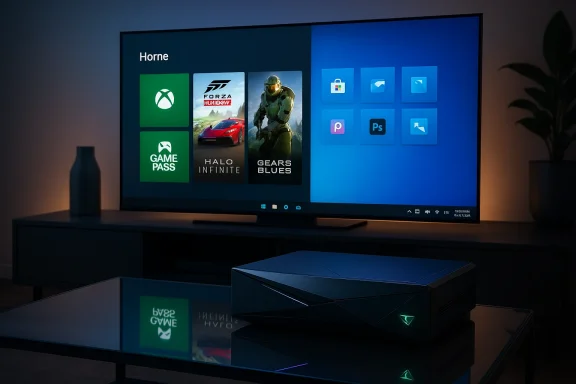
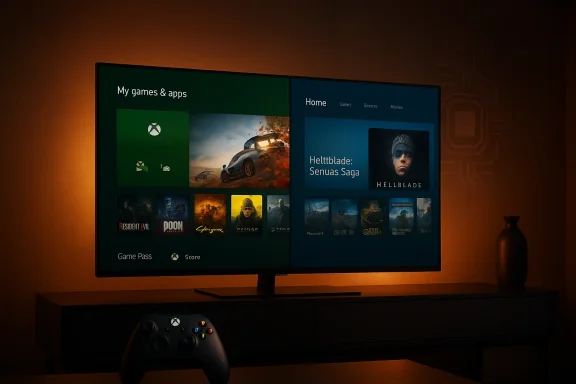
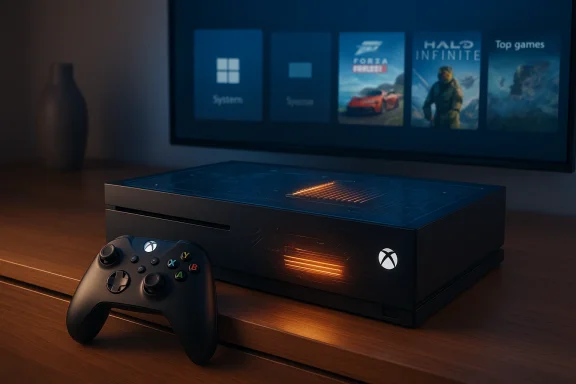
Microsoft's Xbox division quietly flipped a strategic switch on March 5: the next-generation console now carries an internal codename — Project Helix — and Microsoft's new gaming CEO, Asha Sharma, has publicly signalled the company is moving forward with first‑party hardware that blurs the line between console and PC. The public confirmation — a short post from Sharma and an Xbox teaser — does more than name a project; it crystallizes a long‑running pivot inside Microsoft toward a Windows‑rooted, open, console‑style device that aims to play both Xbox and PC games by default.
Microsoft's Xbox strategy has been in flux for several years. The company has steadily moved the Xbox ecosystem toward Windows-native engineering: the Xbox PC app has become an aggregating launcher, Windows received a new console‑style option called the Xbox Full Screen Experience (FSE), and Microsoft partnered closely with OEMs like ASUS on the ROG Xbox Ally devices that shipped with a controller‑first shell layered over Windows 11. Those moves were not isolated experiments — they read as a deliberate set of building blocks for a hybrid living‑room device.
On the silicon front, Microsoft is again working with AMD on custom semi‑custom silicon. AMD's CEO, Dr. Lisa Su, publicly said the company's semi‑custom SoC work for Microsoft's next console is “progressing well to support a launch in 2027,” giving the industry a tentative window while also reminding readers that supplier readiness and a formal ship date are not synonymous. Independently, outlets that track console chip design have associated the project with an AMD internal codename — Magnus — though the specifics reported by leakers remain unverified.
Project Helix is therefore the result of two converging trends: (1) Microsoft’s software work to make Windows behave like a polished, controller‑first console shell, and (2) a continued hardware partnership with AMD to build a high‑end, console‑class SoC family. The combination is intended to produce an Xbox that is both familiar to console players and unshackled by closed, console‑only software restrictions.
Why that matters:
What we can treat as plausible:
Recent corporate moves and reporting have shown Microsoft is less wedded to strict console exclusivity than past generations. Several high‑profile Xbox franchises are now being positioned to appear on non‑Xbox platforms in some form, and Microsoft’s broader multiplatform deals have made the business case modular rather than binary. That reality is central to the value equation for Helix: if Xbox first‑party games continue to arrive on PlayStation and other platforms, then Helix competes primarily on hardware, price, OS experience, and the convenience of running Xbox console titles alongside PC libraries.
Practical implications:
If Microsoft executes the UX flawlessly, commits to a deterministic developer target, and chooses a pricing and content strategy that gives the device a clear reason to exist, Project Helix could be the most consequential Xbox hardware shift since the original Xbox. If it fails to deliver on the console‑grade polish or tries to be everything to everyone without strong positioning, it risks being a costly experiment that pleases neither console die‑hards nor PC purists.
Either way, Project Helix is a bet on the future of platform convergence: a living‑room device that acknowledges the economic and technical reality of PC gaming while trying to preserve the simplicity and user experience that made consoles successful. The success of that bet will be decided over the next 12–24 months, as Microsoft fleshes out hardware details, developer commitments, and the all‑important price/performance equation.
In the weeks ahead, expect detailed developer sessions at GDC, additional technical primers from partners, and more public signals about how Microsoft plans to reconcile Windows openness with console reliability. For now, Project Helix is a clear statement of intent: Microsoft wants to bring the convenience of consoles together with the openness of PCs — and the industry will be watching closely to see whether the company can make that combination feel like a single, uncompromised product.
Source: Windows Central Xbox just dropped the Project Helix codename and confirmed new hardware
 Background / Overview
Microsoft's Xbox strategy has been in flux for several years. The company has steadily moved the Xbox ecosystem toward Windows-native engineering: the Xbox PC app has become an aggregating launcher, Windows received a new console‑style option called the Xbox Full Screen Experience (FSE), and Microsoft partnered closely with OEMs like ASUS on the ROG Xbox Ally devices that shipped with a controller‑first shell layered over Windows 11. Those moves were not isolated experiments — they read as a deliberate set of building blocks for a hybrid living‑room device.On the silicon front, Microsoft is again working with AMD on custom semi‑custom silicon. AMD's CEO, Dr. Lisa Su, publicly said the company's semi‑custom SoC work for Microsoft's next console is “progressing well to support a launch in 2027,” giving the industry a tentative window while also reminding readers that supplier readiness and a formal ship date are not synonymous. Independently, outlets that track console chip design have associated the project with an AMD internal codename — Magnus — though the specifics reported by leakers remain unverified.
Project Helix is therefore the result of two converging trends: (1) Microsoft’s software work to make Windows behave like a polished, controller‑first console shell, and (2) a continued hardware partnership with AMD to build a high‑end, console‑class SoC family. The combination is intended to produce an Xbox that is both familiar to console players and unshackled by closed, console‑only software restrictions.
What Microsoft actually confirmed (and what it didn’t)
- What Microsoft confirmed: the Xbox team is using Project Helix as the internal codename for next‑gen console hardware, and leadership is publicly recommitting to first‑party hardware under Asha Sharma’s tenure. Sharma explicitly stated Project Helix will "lead in performance and play your Xbox and PC games."
- What Microsoft did not provide: MSRP, formal product name, official hardware specs, final ship window, or which first‑party titles (if any) will be exclusive to the platform. Microsoft also did not lock in a 2027 launch date; that timeline comes from AMD’s investor comments, not Microsoft’s product announcement.
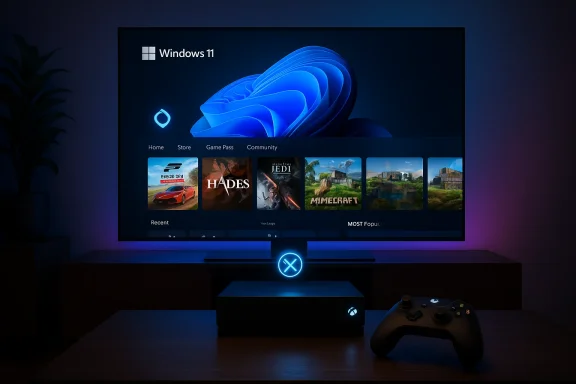
The technical thesis: a “consolized” Windows 11 PC
The clearest and most consequential technical takeaway from the Helix reveal is the product architecture Microsoft appears to be pursuing: a Windows‑first machine that behaves like a console by default. This is not Microsoft moving to Linux or to a proprietary embedded OS; it is a deliberate choice to keep Windows 11 — and therefore the full PC software ecosystem — beneath a console‑grade shell (the Xbox Full Screen Experience) that can be the device's primary UI. Early engineering work on the Full Screen Experience demonstrates how this could work: a session posture that boots directly into a controller‑first launcher, aggregates games across storefronts, and lets users “exit to Windows” when they want to run other apps.Why that matters:
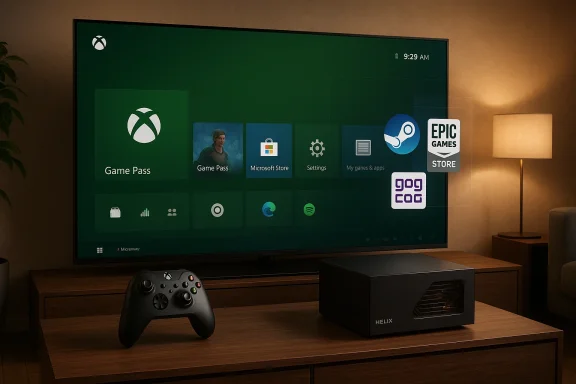
- For users it promises the best of both worlds: a simple, TV‑first play experience on the sofa — similar to the polished feel of a console — plus the flexibility to run Steam, Epic, GOG, Battle.net, and standard Windows apps when desired.
- For developers and partners it changes certification and support models: Microsoft will need to guarantee console‑grade performance and QA for titles that target the default Xbox experience, while simultaneously supporting the large and unpredictable compatibility matrix of Windows apps.
- For Microsoft’s business model it alters the unit economics: hardware becomes a more PC‑like product with potential for broader software revenue capture from multiple storefronts, but that comes at the cost of increased complexity for support and QA.
The hardware story: AMD, “Magnus,” and plausible capabilities
AMD’s public comments in early February put silicon work on the table: the company said the semi‑custom SoC for Microsoft's next console is moving along and could support a 2027 launch. That statement is meaningful — AMD is Microsoft’s historical partner on Xbox silicon and will likely continue to deliver custom APUs tuned for console power curves. But the exact hardware configuration remains a mixture of credible rumor and supply‑chain speculation.What we can treat as plausible:
- AMD involvement and an internally used SoC codename (industry reporting cites “Magnus” as an AMD internal name).
- A focus on high overall performance that targets modern PC and console expectations (4K, high frame rates, hardware‑accelerated ray tracing, and dedicated neural processing), consistent with AMD’s semi‑custom roadmap.
- Specific core counts, GPU CU numbers, and die layouts reported in leaks. These claims have circulated publicly but have not been corroborated by Microsoft or AMD, and they should be treated with caution until either firm releases documentation or hardware. We will flag such reports when they emerge, but they remain rumor until verified.
What Project Helix could mean for games and exclusives
The Helix architecture raises the sharpest strategic questions around software — specifically, whether Xbox will double‑down on console exclusives or prioritize openness and scale.Recent corporate moves and reporting have shown Microsoft is less wedded to strict console exclusivity than past generations. Several high‑profile Xbox franchises are now being positioned to appear on non‑Xbox platforms in some form, and Microsoft’s broader multiplatform deals have made the business case modular rather than binary. That reality is central to the value equation for Helix: if Xbox first‑party games continue to arrive on PlayStation and other platforms, then Helix competes primarily on hardware, price, OS experience, and the convenience of running Xbox console titles alongside PC libraries.
Practical implications:
- For existing Xbox fans: Helix could be compelling if Microsoft delivers a flawless “turn on and play” TV experience with seamless Game Pass integration and superior hardware value.
- For PlayStation or PC‑first players: the ability to buy Xbox console titles on PlayStation or run them on PC diminishes the exclusivity advantage that historically drove console hardware buys.
- For developers: a Windows‑based Xbox reduces porting friction to PC and may broaden install bases, but it also complicates certification and performance assumptions for developers who build for locked hardware. Microsoft will need to provide robust platform APIs and testing tools to make the target attractive.
The upside: why this could work
- Largest combined catalog: A Helix device that runs Xbox console games natively while giving access to Steam, Epic, and other PC stores would effectively offer the broadest single‑device library in gaming, especially if Microsoft can ensure high compatibility and controller ergonomics. That is a powerful consumer proposition for anyone already invested in Xbox and Windows ecosystems.
- Potential price leverage: Microsoft’s procurement scale could allow aggressive component pricing for a first‑party Helix SKU, delivering more performance per dollar than comparably specced retail PCs — if Microsoft chooses to subsidize hardware or pursue thin margins on devices to grow platform reach. That is not guaranteed but is a plausible strategic lever.
- Console UX with PC openness: If Microsoft can deliver a console‑grade boot experience with instant usability while keeping Windows available for creators and power users, Helix could bridge two consumer segments: the casual, TV‑first audience and the power user who wants full PC functionality.
The risks and friction points
- Positioning confusion — Is Helix a console, a PC, or a new category? Consumers buy into clear value promises. If Helix is priced like a gaming PC but messaged like a console, mainstream buyers could hesitate. Retailers and warranty channels will also need clear classification for point‑of‑sale placements and returns handling.
- Support complexity — A Windows‑rooted device multiplies support vectors: updates to Windows, OEM drivers, third‑party storefronts, anti‑cheat interactions, and game patches can each break the "console‑like" behavior users expect. Microsoft must commit substantial QA and long‑tail support resources if Helix is to feel as reliable as prior closed consoles.
- Developer burden and certification — Developers rely on deterministic hardware for performance tuning. A hybrid platform that allows third‑party stores and a full desktop increases variability. Microsoft will need to preserve a predictable development target (firm firmware, consistent drivers, and robust profiling tools) to keep first‑party and third‑party studios happy.
- The exclusivity trade — If the biggest first‑party games continue to appear on PlayStation and other platforms, Helix’s unique draw diminishes. Microsoft may have to choose between more openness and more platform differentiation — both strategic choices carry enormous long‑term consequences.
- Price‑to‑value perception — Game Pass’s revised pricing (Ultimate tier increased to $29.99/month in Microsoft’s 2025 overhaul) has altered the subscription calculus for many players; subscriptions no longer feel like an uncontested bargain. Consumers evaluating a Helix purchase will weigh hardware cost plus subscription cost against building a comparable PC or staying on PlayStation. Microsoft must manage that perception carefully.
Strategic recommendations Microsoft should consider (if Helix is to succeed)
- Define a clear product taxonomy:
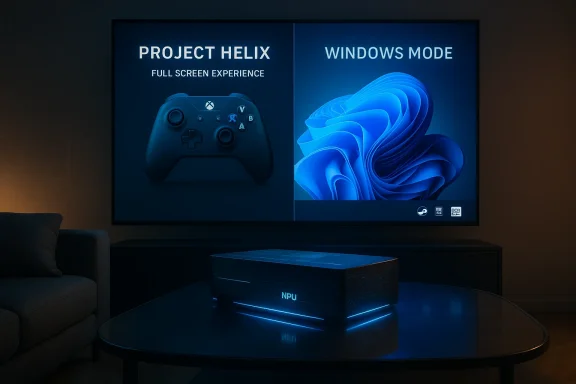
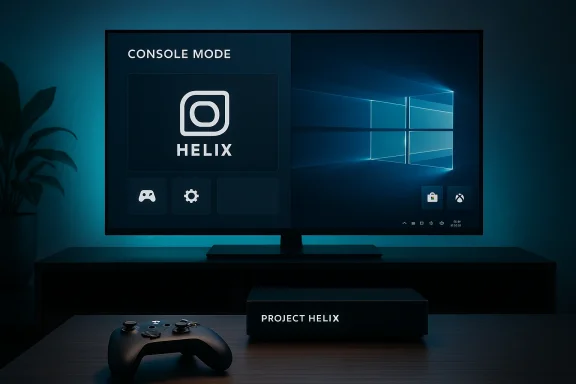
- 1.1. Publish a simple “modes” story for Helix: default TV‑first console mode vs. advanced Windows mode, each with guaranteed behaviors and support commitments.
- 1.2. Offer a clear warranty and support path for both modes.
- Lock a deterministic baseline for developers:
- 2.1. Release a set of certified drivers, firmware, and testing tools that guarantee a stable hardware target for party and third‑party studios.
- 2.2. Provide a “Console Mode SDK” that enforces console‑grade behavior while in FSE, reducing variability.
- Price and bundle strategically:
- 3.1. Consider subsidized SKUs or trade‑in programs to lower entry cost, or tier hardware SKUs with clear tradeoffs between price and upgradability.
- 3.2. Bundle sweeteners (temporary Game Pass credits, cloud storage, or creator tools) to reduce upfront friction.
- Commit to a long‑term content strategy:
- 4.1. Decide whether Microsoft will keep flagship titles exclusive, timed, or broadly multiplatform, and align hardware marketing with that decision.
- 4.2. If openness is the chosen path, double down on services and UX to make Helix the most convenient way to play on TV.
- Prioritize reliability and low‑maintenance updates:
- 5.1. Ensure Helix can apply Windows security and feature updates in ways that do not break the console experience.
- 5.2. Provide an “update rollback” and robust diagnostics to keep households from being the test lab.
Industry and community reaction so far
Reaction across press and community forums is a mix of cautious optimism and skepticism. Reporters see Project Helix as a logical next step given Microsoft’s prior moves; enthusiast communities are energized by the prospect of a consolized, open device but remain wary of price, polish, and the product’s ability to feel like a console when necessary. Internally generated forum threads and early commentary emphasize that Microsoft has already built many of the software primitives needed for Helix — the main remaining workstreams are hardware margins, Windows stability, and developer tooling.What to watch next (timeline and signals)
- GDC and partner briefings: Microsoft indicated that conversations with partners and studios will continue into the Game Developers Conference window. Expect developer‑oriented sessions that clarify certification, SDKs, and testing targets.
- AMD announcements and earnings commentary: AMD’s comments provided a tentative 2027 window; any new AMD public roadmap disclosure will materially narrow expectations for the Helix launch. Monitor for formal product naming or silicon details from AMD.
- FSE public rollout and quality signals: Microsoft must demonstrate that Full Screen Experience on Windows 11 is polished and robust on a broad set of hardware. Consumer satisfaction on that front will be the leading indicator for Helix’s usability proposition.
- First‑party release commitments: whether Microsoft opts to keep flagship franchises time‑exclusive, permanently exclusive, or multiplatform will be the single biggest influence on Helix demand. Expect continued debate and incremental announcements here.
Bottom line
Project Helix is the clearest public evidence yet that Microsoft intends to pivot Xbox hardware into a new category: a consolized Windows 11 gaming PC designed to sit in living rooms and treat Xbox console games as first‑class citizens while leaving the wider PC ecosystem accessible underneath. That architecture is technically elegant and commercially ambitious, but it also brings a long list of operational risks: support complexity, potential consumer confusion, and a tenuous content strategy if first‑party exclusives continue to migrate to other platforms.If Microsoft executes the UX flawlessly, commits to a deterministic developer target, and chooses a pricing and content strategy that gives the device a clear reason to exist, Project Helix could be the most consequential Xbox hardware shift since the original Xbox. If it fails to deliver on the console‑grade polish or tries to be everything to everyone without strong positioning, it risks being a costly experiment that pleases neither console die‑hards nor PC purists.
Either way, Project Helix is a bet on the future of platform convergence: a living‑room device that acknowledges the economic and technical reality of PC gaming while trying to preserve the simplicity and user experience that made consoles successful. The success of that bet will be decided over the next 12–24 months, as Microsoft fleshes out hardware details, developer commitments, and the all‑important price/performance equation.
In the weeks ahead, expect detailed developer sessions at GDC, additional technical primers from partners, and more public signals about how Microsoft plans to reconcile Windows openness with console reliability. For now, Project Helix is a clear statement of intent: Microsoft wants to bring the convenience of consoles together with the openness of PCs — and the industry will be watching closely to see whether the company can make that combination feel like a single, uncompromised product.
Source: Windows Central Xbox just dropped the Project Helix codename and confirmed new hardware