

Publicis Groupe’s new pact with Microsoft is more than a standard agency win. It signals a deeper shift in how global media, identity data, cloud infrastructure and agentic AI are converging inside enterprise marketing operations. By naming Publicis as Microsoft’s global media agency of record while also expanding their AI collaboration, the two companies are effectively tying media buying, cloud modernization and AI workflow automation into a single strategic narrative. The move builds on a relationship that dates back to the co-creation of Marcel, Publicis’ AI platform, and now extends it into a more industrial, full-stack model for the agentic era.
The Publicis-Microsoft relationship did not appear overnight. Microsoft and Publicis first worked together publicly on Marcel, the internal AI and productivity platform that Publicis unveiled in 2018, with the company explicitly describing Microsoft as a partner that shared its vision for greater employee autonomy and a unique AI-enabled operating model. That early move mattered because it showed Publicis was already thinking about AI as an organizational backbone rather than a marketing novelty. It also gave Microsoft a proof point in the agency world before “agentic AI” became the industry’s favorite phrase.
Since then, Publicis has steadily repositioned itself around data, identity and AI-driven workflow orchestration. Its 2024 and 2025 strategy materials emphasized CoreAI, the group’s proprietary data layer, which unifies consumer profiles, media signals and performance data across the organization. Publicis has said CoreAI sits on top of trillions of data points and 2.3 billion consumer profiles, while also pulling in assets and knowledge from Marcel. That matters because it explains why the group is now so eager to present itself not simply as an agency network, but as a platform company with media, data and transformation capabilities layered together.
Microsoft, for its part, has spent the past two years turning Copilot into a larger platform story and rolling out more explicit agent infrastructure. Copilot Studio is now framed as a platform for building and managing agents, while Agent 365 is being positioned as a control plane for enterprise agents. Microsoft’s own materials stress observability, governance, security and workflow automation as the foundation of the agentic stack. That is important context for Publicis, because it suggests the agency is not just buying AI tools; it is aligning itself with Microsoft’s broader enterprise operating model for AI.
The timing also reflects a broader market truth: marketing has become one of the most competitive battlegrounds for applied AI. Creative teams want faster production, media buyers want better activation, and CMOs want direct lines between investment and revenue. Legacy point solutions can still solve pieces of that puzzle, but the market is increasingly rewarding integrated systems that connect workflow, identity, cloud and outcomes. Publicis and Microsoft are clearly betting that the next advantage will belong to companies that can do all four at once.
This is also where the language of agentic AI becomes commercially meaningful. If AI agents can be deployed across operations, commerce, marketing and customer engagement, then marketers spend less time executing repetitive tasks and more time shaping strategy, creative direction and brand positioning. That is the promise Publicis is selling: not that AI replaces marketing leadership, but that it absorbs enough execution overhead to make leadership more valuable. That distinction matters.
The announcement also reveals how much Microsoft’s current AI story depends on control and governance. Agent 365 is explicitly framed as a control plane for agents, while Copilot Studio lets organizations build, publish and govern agents across work surfaces. Publicis appears to be using that governance story to reassure enterprise clients that AI can be operationalized without turning the marketing stack into a black box. That is a strong message in an era when many firms are still wary of letting generative systems touch real customer data.
The upside is that organizations already invested in Microsoft infrastructure may find this easier to adopt. The downside is that it further reinforces ecosystem dependence. Once marketing workflow, identity data and AI agents are all tuned to one cloud environment, switching costs rise quickly. That is not necessarily a bad thing for Microsoft or Publicis, but it does raise the strategic stakes for customers who want flexibility.
This evolution tracks with Publicis’ broader repositioning over the past several years. CoreAI, Epsilon and Publicis Sapient have each been elevated as strategic pillars, and now the Microsoft relationship is being used to tie them together more tightly. That gives Publicis a stronger story about how its media, data and consulting arms can reinforce each other instead of behaving like separate businesses. It also gives Microsoft a partner that can translate its technology into marketing-specific business outcomes.
The Marcel story also helps Publicis defend its cultural identity. Agency holding companies often struggle to explain why they should be trusted with advanced technology when so much of the market expects them to behave like service vendors. By presenting Marcel as an AI-native operating fabric, Publicis is saying it can be both a creative organization and a systems organization. That duality is increasingly essential in modern marketing. Creativity without infrastructure is fragile.
That is why the move from Marcel to the new partnership is strategically significant. It shows how agency AI has moved from experimentation to infrastructure. If Marcel was about finding a new internal rhythm, this new alliance is about building an AI-mediated commercial engine that can sit between data, workflows and media activation. That is a much harder problem, but also a much bigger opportunity.
This also aligns with broader Microsoft guidance around AI and governance. Microsoft’s Fabric and Purview materials emphasize that AI agents and data tools need permissions, lineage and policy controls if they are going to operate responsibly. In other words, the value of identity data is not just precision; it is controlled precision. That will matter a great deal for large brands, especially those operating in regulated or privacy-sensitive categories.
There is also a competitive implication here. Many AI vendors can claim they have smarter models. Far fewer can claim they have proprietary, outcome-linked identity data that can survive enterprise scrutiny. Publicis is effectively telling the market that model quality alone will not win marketing transformation. The real advantage comes from identity plus execution plus governance. That is a more durable moat.
That said, the promise depends on constraints being very carefully designed. Identity-based agents can be highly effective, but they also magnify the consequences of bad data, poor governance or overconfident automation. If the segmentation is wrong, the creative is wrong. If the permissions are wrong, the activation is wrong. If the measurement framework is wrong, the optimization engine will keep learning the wrong lesson. The power is real, but so is the fragility.
This is also why the partnership matters beyond the ad industry. Microsoft has increasingly treated AI as a platform business, and platform businesses need gravity. Publicis gives Microsoft another source of gravity by anchoring a major global media organization inside its cloud and AI stack. That helps Microsoft expand from productivity software into a broader operating layer for business transformation.
There is a subtle strategic advantage here as well: Microsoft gets a chance to show that its AI stack can serve creative and commercial workflows, not just office productivity. That broadens the narrative around Copilot, Agent 365 and Fabric. It also gives Microsoft a more human-facing case study for agentic AI, which has often sounded abstract in enterprise demos.
It also helps Microsoft defend against the idea that it is merely providing the plumbing while others get the excitement. In this case, Microsoft is helping power the orchestration layer itself. That is a more ambitious role, and one the company clearly wants to occupy as the market shifts from chatbots to agentic systems. The stakes are higher, but so is the strategic leverage.
That matters in a market where clients are asking for more than campaign ideas. They want data control, implementation support, AI deployment and measurable outcomes. Publicis can now argue that it has the creative, technical and data infrastructure to deliver all of that in one relationship. That is especially valuable for large multinational clients trying to reduce fragmentation across regions and business units.
There is also a balance-sheet implication. Deep strategic alliances can increase stickiness and reduce account churn, especially when they are tied to identity data and cloud workloads. In practical terms, that can make Publicis harder to displace. It can also make it easier to upsell clients from media services into transformation engagements and enterprise AI deployments.
The partnership also fits Publicis’ broader message that AI should serve people rather than replace them. That line is smart, because it reduces fear while preserving the efficiency narrative. It tells clients that the purpose of the system is to free humans for strategy and creativity, not to sideline them. In an industry worried about commoditization, that framing is commercially useful.
This is where Microsoft’s recent agent story matters. Copilot Studio is explicitly designed to build and publish agents across business surfaces, while Agent 365 adds governance and inventory. That gives Publicis a ready-made enterprise framework for deploying AI in a way that can satisfy both marketing leaders and IT teams. For large clients, that governance story may be just as important as the automation story.
The real question is whether agentic marketing can produce compounding gains rather than incremental ones. If AI only speeds up content generation, the value is useful but limited. If it can orchestrate the whole flow from audience selection to spend optimization, the economics become much more interesting. That is the line Publicis is trying to cross.
Still, autonomy creates a governance burden. Brands will want to know exactly when an agent can act independently, when it must ask for approval and how exceptions are handled. Publicis and Microsoft are smart to emphasize guardrails because the market is not ready to trust fully autonomous campaign systems without strong oversight. The best implementations will likely blend automated action with human sign-off at critical points.
This could put pressure on rivals. If one major global brand publicly deepens its relationship with a platform and an agency around AI-driven media, other holding companies will need to prove they can match that level of integration. The winner will not necessarily be the agency with the loudest AI marketing. It will be the one that can demonstrate operational leverage in live accounts.
The implications also extend to media measurement. The ability to connect audiences, signals and performance data within a governed AI stack can help shorten the gap between media spend and business outcome. That could be especially attractive to CFOs and procurement teams looking for more accountable advertising relationships. In a tighter market, accountability is currency.
That does not mean the old model disappears. But it does mean the bar is rising. Agencies will increasingly need to prove they can operate inside clients’ cloud, data and AI environments rather than merely adjacent to them. That is a much more demanding role, but also one with greater strategic value.
They will also care about implementation complexity. The promise of AI is easy to sell, but the real work lies in migrating legacy systems, connecting data sources and enforcing policy. That is why the Slingshot framework and Azure-native foundation matter so much. They suggest the partnership is built for adoption, not just demos.
One of the most practical enterprise benefits is that the system could reduce repetitive work across the marketing organization. If AI can handle campaign setup, content adaptation and reporting, teams can spend more time on planning, customer insight and creative differentiation. That may not sound glamorous, but it is exactly where enterprise buyers see value.
The danger, of course, is that deeper automation produces more intrusive or less transparent targeting. Identity-based marketing can be highly effective, but it also raises privacy sensitivities. Publicis and Microsoft will need to be careful to keep human judgment and compliance controls visible, especially as consumer trust around data use remains fragile. The more precise the targeting, the more carefully it must be governed.
Another concern is that identity-based marketing systems can become opaque very quickly. As AI agents make more decisions, clients will need confidence that the model is not amplifying flawed data, outdated assumptions or biased audience definitions. Publicis and Microsoft will need strong transparency and auditability if they want this model to scale across industries and geographies.
The next phase should reveal whether Publicis can turn this into a repeatable operating model for enterprise clients. If the partnership helps clients modernize legacy systems, deploy agents safely and connect identity data to measurable media performance, it could become a template for the industry. If it remains mostly a strategic statement, it will still be noteworthy, but primarily as a sign of where the market believes AI is headed.
What to watch next:
Source: Little Black Book | LBBOnline https://lbbonline.com/news/publicis...count-and-announces-strategic-ai-partnership/
 Background
The Publicis-Microsoft relationship did not appear overnight. Microsoft and Publicis first worked together publicly on Marcel, the internal AI and productivity platform that Publicis unveiled in 2018, with the company explicitly describing Microsoft as a partner that shared its vision for greater employee autonomy and a unique AI-enabled operating model. That early move mattered because it showed Publicis was already thinking about AI as an organizational backbone rather than a marketing novelty. It also gave Microsoft a proof point in the agency world before “agentic AI” became the industry’s favorite phrase.Since then, Publicis has steadily repositioned itself around data, identity and AI-driven workflow orchestration. Its 2024 and 2025 strategy materials emphasized CoreAI, the group’s proprietary data layer, which unifies consumer profiles, media signals and performance data across the organization. Publicis has said CoreAI sits on top of trillions of data points and 2.3 billion consumer profiles, while also pulling in assets and knowledge from Marcel. That matters because it explains why the group is now so eager to present itself not simply as an agency network, but as a platform company with media, data and transformation capabilities layered together.
Microsoft, for its part, has spent the past two years turning Copilot into a larger platform story and rolling out more explicit agent infrastructure. Copilot Studio is now framed as a platform for building and managing agents, while Agent 365 is being positioned as a control plane for enterprise agents. Microsoft’s own materials stress observability, governance, security and workflow automation as the foundation of the agentic stack. That is important context for Publicis, because it suggests the agency is not just buying AI tools; it is aligning itself with Microsoft’s broader enterprise operating model for AI.
The timing also reflects a broader market truth: marketing has become one of the most competitive battlegrounds for applied AI. Creative teams want faster production, media buyers want better activation, and CMOs want direct lines between investment and revenue. Legacy point solutions can still solve pieces of that puzzle, but the market is increasingly rewarding integrated systems that connect workflow, identity, cloud and outcomes. Publicis and Microsoft are clearly betting that the next advantage will belong to companies that can do all four at once.
What Publicis and Microsoft Are Actually Building
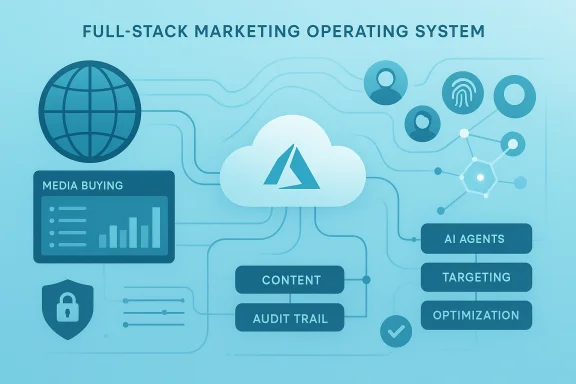
At the center of the announcement is a simple but ambitious idea: stitch together legacy systems, enterprise AI agents and identity-based data into a full-stack marketing solution. That language matters. It suggests the partnership is not just about buying media more efficiently; it is about reengineering how marketing work is structured, governed and measured. In practical terms, Publicis wants Microsoft’s cloud and AI stack to help make its own operating system for clients more coherent and more intelligent.A stack, not a point solution
The most important phrase in the announcement is “full-stack marketing solution.” That implies an architecture that connects cloud migration, AI deployment, identity resolution and media activation in one continuity. Publicis Sapient’s Slingshot framework, Microsoft Azure, Copilot Studio, Agent 365, Microsoft IQ and Fabric all appear to be part of that design. The partnership is therefore less about a single product and more about a layered operating model that can run enterprise marketing from data foundation to campaign execution.This is also where the language of agentic AI becomes commercially meaningful. If AI agents can be deployed across operations, commerce, marketing and customer engagement, then marketers spend less time executing repetitive tasks and more time shaping strategy, creative direction and brand positioning. That is the promise Publicis is selling: not that AI replaces marketing leadership, but that it absorbs enough execution overhead to make leadership more valuable. That distinction matters.
The announcement also reveals how much Microsoft’s current AI story depends on control and governance. Agent 365 is explicitly framed as a control plane for agents, while Copilot Studio lets organizations build, publish and govern agents across work surfaces. Publicis appears to be using that governance story to reassure enterprise clients that AI can be operationalized without turning the marketing stack into a black box. That is a strong message in an era when many firms are still wary of letting generative systems touch real customer data.
Why this matters for enterprise buyers
For enterprise buyers, this is not just a media-agency story. It is a procurement and architecture story. Microsoft’s cloud and AI stack gives Publicis a familiar enterprise foundation, while Publicis gives Microsoft a channel into marketing transformation use cases that are unusually close to revenue. Together, they can make a case that AI is not merely a productivity add-on, but an operating layer that can influence customer acquisition, retention and spend efficiency.The upside is that organizations already invested in Microsoft infrastructure may find this easier to adopt. The downside is that it further reinforces ecosystem dependence. Once marketing workflow, identity data and AI agents are all tuned to one cloud environment, switching costs rise quickly. That is not necessarily a bad thing for Microsoft or Publicis, but it does raise the strategic stakes for customers who want flexibility.
Marcel’s Second Life
Marcel is the symbolic thread that gives this announcement its narrative power. Publicis and Microsoft co-created Marcel a decade ago, and now the two companies are saying that the original AI platform should evolve into something more enterprise-wide and more outcome-oriented. That is a clever move because it lets the companies frame the partnership as continuity rather than reinvention, even though the technical and commercial ambitions are clearly much larger now.From internal collaboration to enterprise operating layer
The original Marcel was about employee autonomy, internal collaboration and a more AI-aware agency model. The new version is about building an AI-enabled marketing engine for clients, with more explicit ties to cloud modernization, identity data and media performance. In other words, Marcel has moved from being a creative productivity layer to being a potential backbone for enterprise transformation. That is a meaningful expansion of scope.This evolution tracks with Publicis’ broader repositioning over the past several years. CoreAI, Epsilon and Publicis Sapient have each been elevated as strategic pillars, and now the Microsoft relationship is being used to tie them together more tightly. That gives Publicis a stronger story about how its media, data and consulting arms can reinforce each other instead of behaving like separate businesses. It also gives Microsoft a partner that can translate its technology into marketing-specific business outcomes.
The Marcel story also helps Publicis defend its cultural identity. Agency holding companies often struggle to explain why they should be trusted with advanced technology when so much of the market expects them to behave like service vendors. By presenting Marcel as an AI-native operating fabric, Publicis is saying it can be both a creative organization and a systems organization. That duality is increasingly essential in modern marketing. Creativity without infrastructure is fragile.
What changed over ten years
A decade ago, the main challenge was helping teams collaborate better and work faster. Today, the challenge is making AI trustworthy enough to act on behalf of the business. That shift changes the requirements completely. It is no longer enough to generate ideas; the system must be able to reason, decide and act within defined guardrails.That is why the move from Marcel to the new partnership is strategically significant. It shows how agency AI has moved from experimentation to infrastructure. If Marcel was about finding a new internal rhythm, this new alliance is about building an AI-mediated commercial engine that can sit between data, workflows and media activation. That is a much harder problem, but also a much bigger opportunity.
The Role of Identity Data
Epsilon is one of the most important pieces of the deal, even if it is not the flashiest. Publicis is positioning Epsilon as the identity layer that makes the whole system commercially useful. In an AI market crowded with models trained on public data, that emphasis on identity-based, proprietary signals is a critical differentiator. It is also a reminder that marketing performance still depends on knowing who the customer is, not just what the model can generate.Why identity remains the hardest part
Identity is the bridge between content, audience and outcome. Without it, AI can produce content at scale but cannot reliably connect that content to the right person, the right channel or the right moment. Publicis’ pitch is that Epsilon helps solve this by fusing media, marketing and customer intelligence into a trusted data layer that agents can reason over. That is a powerful claim because it turns identity from a targeting asset into a decision engine.This also aligns with broader Microsoft guidance around AI and governance. Microsoft’s Fabric and Purview materials emphasize that AI agents and data tools need permissions, lineage and policy controls if they are going to operate responsibly. In other words, the value of identity data is not just precision; it is controlled precision. That will matter a great deal for large brands, especially those operating in regulated or privacy-sensitive categories.
There is also a competitive implication here. Many AI vendors can claim they have smarter models. Far fewer can claim they have proprietary, outcome-linked identity data that can survive enterprise scrutiny. Publicis is effectively telling the market that model quality alone will not win marketing transformation. The real advantage comes from identity plus execution plus governance. That is a more durable moat.
From audience lists to autonomous actions
The most interesting line in the announcement is the idea that an AI agent can autonomously identify high-value segments, generate content, deploy campaigns and optimize spend in real time. That is not just audience segmentation; it is closed-loop operational marketing. If executed well, it could compress weeks of work into a continuously adaptive system.That said, the promise depends on constraints being very carefully designed. Identity-based agents can be highly effective, but they also magnify the consequences of bad data, poor governance or overconfident automation. If the segmentation is wrong, the creative is wrong. If the permissions are wrong, the activation is wrong. If the measurement framework is wrong, the optimization engine will keep learning the wrong lesson. The power is real, but so is the fragility.
Microsoft’s Strategic Incentives
Microsoft is not doing this only out of generosity. The company has strong reasons to deepen its presence in marketing and agency transformation. First, AI needs more real-world use cases that tie directly to revenue. Second, Microsoft wants to make Azure, Fabric and Copilot more central to enterprise operating models. Third, a media-agency relationship can help Microsoft better understand how marketers think about signals, measurement and performance.Azure is the strategic anchor
The announcement repeatedly centers Azure, which is no surprise. Azure is where Microsoft wants customers to host their modern data estate, run AI workloads and manage secure agent infrastructure. By making Publicis a preferred cloud customer and architecting the solution on Azure, Microsoft strengthens the case that enterprise-grade AI belongs inside its ecosystem rather than in disconnected point tools.This is also why the partnership matters beyond the ad industry. Microsoft has increasingly treated AI as a platform business, and platform businesses need gravity. Publicis gives Microsoft another source of gravity by anchoring a major global media organization inside its cloud and AI stack. That helps Microsoft expand from productivity software into a broader operating layer for business transformation.
There is a subtle strategic advantage here as well: Microsoft gets a chance to show that its AI stack can serve creative and commercial workflows, not just office productivity. That broadens the narrative around Copilot, Agent 365 and Fabric. It also gives Microsoft a more human-facing case study for agentic AI, which has often sounded abstract in enterprise demos.
Beyond enterprise software
Microsoft’s commercial business has been steadily pushing AI deeper into everyday work. This partnership extends that push into media and marketing, where the ROI story is easier to express in terms of audience performance, campaign speed and revenue outcomes. That is important because it gives Microsoft a stronger argument that AI is not an experimental feature but a business discipline.It also helps Microsoft defend against the idea that it is merely providing the plumbing while others get the excitement. In this case, Microsoft is helping power the orchestration layer itself. That is a more ambitious role, and one the company clearly wants to occupy as the market shifts from chatbots to agentic systems. The stakes are higher, but so is the strategic leverage.
Publicis’ Competitive Advantage
For Publicis, the partnership reinforces a long-running strategy: own the data layer, own the transformation layer and own the operating layer. That approach has helped the group stand apart from peers who still lean heavily on creative reputation alone. Publicis increasingly looks like a hybrid of agency, consultancy and AI platform vendor. The Microsoft deal strengthens that identity.Turning services into systems
The biggest strategic move Publicis has made is to stop presenting itself as a collection of agencies and start presenting itself as an integrated system. Epsilon, Marcel, Publicis Sapient and CoreAI are all part of that repositioning. The Microsoft partnership adds validation because it associates Publicis with one of the most important enterprise AI platforms in the world.That matters in a market where clients are asking for more than campaign ideas. They want data control, implementation support, AI deployment and measurable outcomes. Publicis can now argue that it has the creative, technical and data infrastructure to deliver all of that in one relationship. That is especially valuable for large multinational clients trying to reduce fragmentation across regions and business units.
There is also a balance-sheet implication. Deep strategic alliances can increase stickiness and reduce account churn, especially when they are tied to identity data and cloud workloads. In practical terms, that can make Publicis harder to displace. It can also make it easier to upsell clients from media services into transformation engagements and enterprise AI deployments.
What Publicis gains in the market
The global media agency of record role gives Publicis a marquee relationship that can be used in client conversations, recruitment and partner development. It also gives the company a stronger proof point that its AI strategy is not theoretical. A lot of agencies talk about AI; fewer can claim they are helping co-build a full-stack solution with Microsoft.The partnership also fits Publicis’ broader message that AI should serve people rather than replace them. That line is smart, because it reduces fear while preserving the efficiency narrative. It tells clients that the purpose of the system is to free humans for strategy and creativity, not to sideline them. In an industry worried about commoditization, that framing is commercially useful.
The Agentic AI Angle
The phrase “agentic AI” is doing a lot of work in this announcement. It signals autonomy, orchestration and action, not just text generation or summarization. Microsoft’s own product direction with Copilot Studio and Agent 365 shows that the company wants AI systems to operate inside business processes with proper control mechanisms. Publicis is borrowing that architecture and applying it to marketing operations.Agents in service of workflow
Agentic AI becomes compelling when it is embedded in real workflows. In this case, that means audience targeting, campaign deployment, content personalization, media optimization and performance analysis. The appeal is not that agents think on their own, but that they can execute predictable marketing tasks with enough reliability to reduce manual overhead.This is where Microsoft’s recent agent story matters. Copilot Studio is explicitly designed to build and publish agents across business surfaces, while Agent 365 adds governance and inventory. That gives Publicis a ready-made enterprise framework for deploying AI in a way that can satisfy both marketing leaders and IT teams. For large clients, that governance story may be just as important as the automation story.
The real question is whether agentic marketing can produce compounding gains rather than incremental ones. If AI only speeds up content generation, the value is useful but limited. If it can orchestrate the whole flow from audience selection to spend optimization, the economics become much more interesting. That is the line Publicis is trying to cross.
Why this is not just automation
Traditional automation follows rules. Agentic AI is supposed to make decisions inside guardrails. That distinction matters because marketing is full of changing signals, ambiguous outcomes and trade-offs between brand and performance. A simple rule-based system cannot adapt as quickly as an agent that can reason over live data and respond to shifting conditions.Still, autonomy creates a governance burden. Brands will want to know exactly when an agent can act independently, when it must ask for approval and how exceptions are handled. Publicis and Microsoft are smart to emphasize guardrails because the market is not ready to trust fully autonomous campaign systems without strong oversight. The best implementations will likely blend automated action with human sign-off at critical points.
Implications for the Media Market
Publicis becoming Microsoft’s global media agency of record is the most visible commercial outcome of the announcement, and it is not just a title. Global media accounts of this size can influence platform negotiations, data access, investment priorities and the shape of campaign innovation. They also signal where a major vendor believes the future of media activation is heading.A vote of confidence in Publicis
By placing the account with Publicis, Microsoft is signaling that it sees the agency as a credible orchestrator of global media in an AI-heavy environment. That matters because many marketers are trying to determine whether agencies still have a role in a world where technology platforms increasingly provide their own automation. Microsoft’s answer here is clear: yes, but only if the agency can connect media to identity, data and business outcomes.This could put pressure on rivals. If one major global brand publicly deepens its relationship with a platform and an agency around AI-driven media, other holding companies will need to prove they can match that level of integration. The winner will not necessarily be the agency with the loudest AI marketing. It will be the one that can demonstrate operational leverage in live accounts.
The implications also extend to media measurement. The ability to connect audiences, signals and performance data within a governed AI stack can help shorten the gap between media spend and business outcome. That could be especially attractive to CFOs and procurement teams looking for more accountable advertising relationships. In a tighter market, accountability is currency.
Industry consequences
This kind of deal may accelerate a broader split in the agency market. On one side will be firms that still sell media, creative and transformation as separate services. On the other will be firms that sell them as a single, technology-driven system. Publicis is trying to live in the second camp, and this partnership gives it a stronger position from which to do so.That does not mean the old model disappears. But it does mean the bar is rising. Agencies will increasingly need to prove they can operate inside clients’ cloud, data and AI environments rather than merely adjacent to them. That is a much more demanding role, but also one with greater strategic value.
Enterprise vs Consumer Impact
This announcement has clear enterprise implications, but its consumer implications are more indirect. For enterprise users, the story is about control, governance and business outcomes. For consumers, the effect may be felt more through better-targeted content, more relevant experiences and faster iteration in the ads and campaigns they encounter.Enterprise buyers want trust
Enterprise buyers will care most about data governance, cloud security and the ability to deploy AI without creating operational chaos. Microsoft’s emphasis on Fabric, Purview, Agent 365 and Azure helps answer those concerns. Publicis’ emphasis on Epsilon and transformation expertise helps reassure buyers that the system can be made commercially useful, not just technically elegant.They will also care about implementation complexity. The promise of AI is easy to sell, but the real work lies in migrating legacy systems, connecting data sources and enforcing policy. That is why the Slingshot framework and Azure-native foundation matter so much. They suggest the partnership is built for adoption, not just demos.
One of the most practical enterprise benefits is that the system could reduce repetitive work across the marketing organization. If AI can handle campaign setup, content adaptation and reporting, teams can spend more time on planning, customer insight and creative differentiation. That may not sound glamorous, but it is exactly where enterprise buyers see value.
Consumer impact is less direct but still real
Consumers are unlikely to notice the partnership by name. They are more likely to feel its effects through better personalization, more coherent campaign experiences and improved relevance across channels. If the system works as intended, audiences should see fewer generic messages and more context-aware communication.The danger, of course, is that deeper automation produces more intrusive or less transparent targeting. Identity-based marketing can be highly effective, but it also raises privacy sensitivities. Publicis and Microsoft will need to be careful to keep human judgment and compliance controls visible, especially as consumer trust around data use remains fragile. The more precise the targeting, the more carefully it must be governed.
Strengths and Opportunities
The partnership has real advantages because it combines Microsoft’s scale with Publicis’ data and media reach. It also aligns two companies that already have a history of working together, which makes the current expansion feel more credible than a one-off announcement. The strongest opportunity is probably not a single product feature, but the chance to create a repeatable enterprise model for AI-powered marketing transformation.- Microsoft gets a stronger path into marketing transformation, not just generic enterprise AI.
- Publicis gains validation for its platform strategy and CoreAI direction.
- Epsilon becomes more central as the identity layer that links data to outcomes.
- Azure gains another high-value workload anchored in media and customer intelligence.
- Copilot Studio and Agent 365 gain a real-world use case beyond office productivity.
- Clients can potentially reduce workflow fragmentation across media, data and activation.
- The partnership offers a clearer ROI story than many AI announcements, because it ties directly to revenue outcomes.
Risks and Concerns
The biggest risk is that the partnership’s ambition outruns its execution. Integrating legacy systems, agentic AI and identity-based data is hard even when all the underlying technology works as promised. If the deployment is slow, fragmented or too dependent on custom integration, the market may treat the announcement as more symbolic than transformative.- Implementation complexity could delay real customer outcomes.
- Data governance failures could create privacy or compliance problems.
- Vendor lock-in may make some enterprise buyers cautious.
- Over-automation could weaken human oversight in campaign decisions.
- Measurement error could cause the AI system to optimize toward the wrong signals.
- Cultural resistance inside client organizations could slow adoption.
- Competitive imitation may reduce differentiation if rivals copy the same playbook.
Another concern is that identity-based marketing systems can become opaque very quickly. As AI agents make more decisions, clients will need confidence that the model is not amplifying flawed data, outdated assumptions or biased audience definitions. Publicis and Microsoft will need strong transparency and auditability if they want this model to scale across industries and geographies.
Looking Ahead
The immediate question is whether this becomes a flagship partnership or just another well-packaged AI announcement. The signs are encouraging because the companies are building on an existing relationship rather than starting from scratch, and the deal is tied to real infrastructure choices such as Azure, Copilot Studio and Agent 365. But the real test will be customer adoption and measurable performance improvements, not the elegance of the narrative.The next phase should reveal whether Publicis can turn this into a repeatable operating model for enterprise clients. If the partnership helps clients modernize legacy systems, deploy agents safely and connect identity data to measurable media performance, it could become a template for the industry. If it remains mostly a strategic statement, it will still be noteworthy, but primarily as a sign of where the market believes AI is headed.
What to watch next:
- Whether Publicis rolls out client-facing reference architectures built on Azure.
- Whether Microsoft expands the partnership into additional markets or business units.
- Whether agentic workflows show measurable gains in campaign speed and efficiency.
- Whether other agency holding companies respond with deeper platform alliances.
- Whether Publicis’ identity-data advantage becomes more visible in performance results.
Source: Little Black Book | LBBOnline https://lbbonline.com/news/publicis...count-and-announces-strategic-ai-partnership/
