

Microsoft plans to add a retention-period setting to Microsoft Purview Communication Compliance policies, with preview availability scheduled for December 2026 and general availability for January 2027 in worldwide standard multi-tenant cloud environments. That sounds like a small administrative knob, but it lands in one of the most sensitive corners of Microsoft 365: the place where employee communications become evidence, risk signals, and occasionally disciplinary material. The feature matters because Communication Compliance has long been a capture-and-review system first, while retention has usually lived elsewhere in Purview’s governance machinery. Microsoft is now acknowledging that compliance review data needs its own lifecycle, not just its own dashboard.
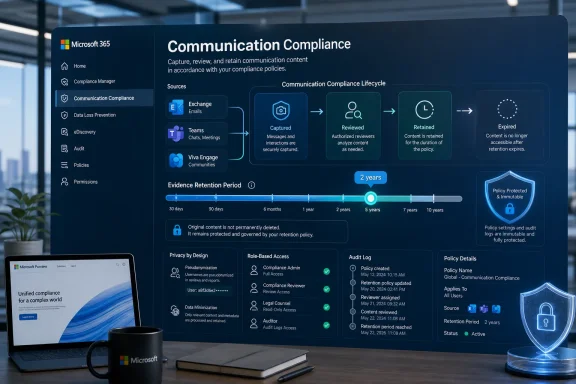
Communication Compliance is built to catch messages that may violate company policy or regulatory rules: harassment, threats, adult content, sensitive information sharing, and financial-sector supervision issues are all in its advertised wheelhouse. It spans the ordinary places where modern work happens, including Exchange, Teams, Viva Engage, Microsoft 365 Copilot experiences, and in some scenarios third-party communications. The product is not merely scanning messages; it is creating a reviewable compliance trail.
That distinction is the heart of this roadmap item. The original message may remain governed by retention policies, legal holds, or workload-specific records rules, but Communication Compliance also keeps copies for analysis and investigation. Until now, the policy lifecycle has been a blunt proxy for the lifecycle of those captured copies: keep the policy, keep the copies; delete the policy, delete the associated copies.
A policy-level retention period changes the operational model. Instead of treating captured content as an indefinite side effect of surveillance policy, administrators will be able to say how long that policy’s captured content should remain available. In a mature compliance program, that is not housekeeping. It is risk management.
The timing also matters. Microsoft lists the feature as in development, with preview in December 2026 and general availability in January 2027. This is not a current control that admins can plan around as if it were already shipped. It is a roadmap signal, and Microsoft 365 roadmap signals have a way of moving, narrowing, or appearing in stages by tenant and geography.
Communication Compliance’s existing behavior has been logical but coarse. A policy defines which users, locations, conditions, and reviewers participate in a supervision workflow. Captured messages then remain available for policy analysis and investigation while the policy exists. Delete the policy, and the system deletes the associated copies.
That makes policy deletion do two jobs at once. It removes the rule and purges the review corpus. For a regulated bank, a school district, a healthcare organization, or a multinational employer, those are not necessarily the same decision. You may want a policy to continue running while older captured items age out on schedule.
The new retention-period setting should separate those decisions. A supervision rule can remain active without turning into a permanent archive of every matched message it has ever seen. Conversely, a policy can be designed from the start around a documented evidence-retention window, rather than relying on a future administrator to remember why the policy exists.
That is the kind of change that rarely excites end users and should deeply interest compliance officers. The best governance features are often boring precisely because they reduce drama later.
Communication Compliance has always intersected with that world, but it has never been identical to it. The original message is governed by the original workload’s retention and hold policies. The compliance copy exists because a review workflow needs to evaluate, triage, and document possible misconduct or regulatory breach.
That duality is why this roadmap item is more than a UI improvement. Microsoft is bringing lifecycle control closer to the point where the extra copy is created. Instead of forcing admins to reason across multiple Purview surfaces after the fact, the retention decision can be embedded in the Communication Compliance policy itself.
The practical payoff is clearer accountability. A policy created to monitor broker-dealer communications can have one evidence window. A policy created to detect workplace harassment can have another. A policy created to flag accidental leakage of confidential data may require a shorter or longer window depending on legal advice, internal standards, and breach-response obligations.
This does not eliminate the complexity of Microsoft 365 retention. Anyone who has wrestled with Purview knows that labels, policies, holds, mailbox behavior, Teams substrate storage, and eDiscovery can produce outcomes that are difficult to explain to non-specialists. But it does give compliance teams a more natural place to express intent for the investigation copy itself.
A pseudonymized archive is still an archive. A role-gated investigation copy is still discoverable, governable, and potentially damaging if exposed or misused. The longer an organization keeps sensitive internal communications, the more it must justify that retention to regulators, courts, employees, works councils, and its own security team.
That is why the retention-period setting has a civil-liberties dimension as well as an administrative one. In heavily regulated industries, supervision is mandatory and defensible. In ordinary workplaces, scanning for harassment or threats may be necessary to protect employees. But the power to inspect communications should not silently become the power to preserve them forever.
This is especially relevant as Communication Compliance expands into richer channels. Teams chats are informal and conversational. Copilot interactions may include draft work, prompts, pasted business data, and fragments of decision-making. Viva Engage can blend workplace culture with internal politics. The more intimate the medium, the more important the expiration rule becomes.
Microsoft’s move does not make Communication Compliance non-invasive. It cannot; that is not what the product is for. But it gives organizations a better way to align monitoring with proportionality, and proportionality is where privacy programs either become real or remain slogans.
In that context, a retention-period setting can help map policy behavior to recordkeeping obligations. A firm may need evidence that a review occurred, that certain communications were captured, and that reviewers took appropriate action. But the firm also needs defensible disposal rules once the regulatory retention period has run.
The danger for regulated companies is not only keeping too little. It is keeping too much in unmanaged or poorly classified stores. Old review material can become a litigation burden, a breach liability, and a compliance ambiguity. If every captured message sits around because nobody wants to delete the policy that created it, the tool has solved one problem by manufacturing another.
A policy-level retention period should also make audits cleaner. Instead of explaining an inherited practice — “we keep these copies until someone retires the policy” — compliance teams can point to an explicit retention value tied to policy purpose. That is much easier to defend in front of auditors than administrative folklore.
Still, the feature will not substitute for legal analysis. SEC, FINRA, employment, privacy, and sector-specific obligations can overlap in messy ways. The retention period set in Communication Compliance should be the output of a governance decision, not the decision itself.
Admins will want to know whether the retention clock starts when a message is captured, when it is created, when it is matched, when it is resolved, or when an alert is closed. They will want to know what happens to existing captured content when a retention period is added to an existing policy. They will want reporting that shows what is due for deletion and what has actually been deleted.
They will also care about conflicts. What happens if the original item is under legal hold, but the Communication Compliance copy has reached the end of its policy retention period? Microsoft’s broader retention model generally gives preservation obligations priority, but the exact behavior of these investigation copies will need documentation. In compliance systems, ambiguity is not a small defect; it is a future ticket from legal.
The absence of PowerShell support for creating and managing Communication Compliance policies also matters. If this control remains portal-only, large organizations may struggle to inventory and standardize settings across many policies. Portal controls are fine for occasional configuration, but governance at scale usually wants scripting, export, drift detection, and change control.
That does not make the roadmap item weak. It makes it incomplete until Microsoft publishes the operational details. A retention field is only as useful as the evidence trail around it.
Copilot interactions are not just another message type. They may contain snippets copied from documents, summarizations of meetings, drafts of customer communications, or questions employees would never have typed into a public channel. Capturing those interactions for compliance reasons may be justified in some organizations, but storing them indefinitely would be reckless.
A retention period gives organizations a way to treat AI-era communications with more nuance. Not every prompt needs to become a long-term artifact. Not every flagged interaction should outlive the risk it was meant to investigate. As AI becomes embedded in Microsoft 365, the governance question shifts from “Can we capture this?” to “Should we still have this two years later?”
This is where Microsoft’s product strategy and customer anxiety meet. Microsoft wants Purview to be the governance layer for the AI workplace. Customers want assurance that AI adoption will not create an uncontrollable compliance exhaust trail. A policy-level retention period is one of the small but necessary controls that makes that pitch more credible.
It also reinforces a broader truth about AI governance: deletion is a feature. Organizations cannot responsibly embrace AI auditing, supervision, and data security controls unless they also build mechanisms for disposal. Capture without expiration is not governance. It is accumulation.
The delay is frustrating because the need is obvious. Communication Compliance has existed in a world where policy-based capture can create durable investigation stores. Customers have had years to ask a basic governance question: how do we keep the policy without keeping every captured item forever?
But late does not mean irrelevant. If anything, the feature is arriving into a more complicated environment than the one Microsoft faced in 2020. Hybrid work expanded chat volume. Teams became a primary business record for many organizations. Copilot introduced a new class of communications that are simultaneously conversational, creative, and potentially sensitive.
The roadmap also reflects a shift in Microsoft’s Purview posture. The company is no longer merely selling tools to find risky data. It is trying to sell an integrated compliance operating model: detect, investigate, retain, dispose, audit, and prove. That model only works if each stage has controls that match the risk of the data being handled.
A retention period for Communication Compliance policies is a small control in that larger machine. But small controls are often where enterprise trust is won or lost.
The next step is to map policy purposes to retention requirements. A regulatory supervision policy may require a different lifecycle than an anti-harassment policy or a sensitive-information leakage policy. The retention period should not be copied blindly across the tenant because the captured data is not equally risky, equally regulated, or equally useful.
Reviewers and investigators also need a voice in the design. If cases routinely take months to resolve, a very short retention period could undermine investigations. If cases are usually triaged quickly, long retention may be unnecessary. The right answer is not “short” or “long”; it is “documented and defensible.”
Security teams should also care. Communication Compliance content is high-value internal material. It may include offensive language, sensitive business data, employee allegations, financial conduct concerns, or AI prompts containing confidential information. Any system that stores that content should be treated as a sensitive repository, even if access is tightly controlled.
Finally, legal teams should decide how this new setting interacts with eDiscovery. Normal disposal should not destroy material that is subject to a legal hold or active matter. But organizations should not use the possibility of future litigation as an excuse to preserve every captured item indefinitely.
The migration question is especially important. If a tenant has a policy that has been running for years, will adding a one-year retention period immediately expire older captured copies? Will Microsoft provide warnings, reports, or staged enforcement? Will there be a grace period? These are the details that determine whether admins can adopt the setting confidently or must test it cautiously in low-risk policies first.
The reporting question is equally important. A retention control without visibility becomes another compliance black box. Customers need to see what is retained, what is expired, what is deleted, and what is preserved because of another obligation. They also need audit events that prove when settings changed and who changed them.
Microsoft should also clarify whether the setting will be available through any administrative API or export surface. Communication Compliance policy management is currently centered in the Purview portal, which limits automation. For small tenants, that may be fine. For global enterprises, manual portal review is not governance; it is a quarterly ritual that breaks under scale.
None of these gaps invalidate the feature. They define the checklist Microsoft must satisfy before January 2027 if it wants the setting to be trusted by the people who will be held responsible for it.
 Microsoft Turns a Compliance Archive Into a Timed Obligation
Communication Compliance is built to catch messages that may violate company policy or regulatory rules: harassment, threats, adult content, sensitive information sharing, and financial-sector supervision issues are all in its advertised wheelhouse. It spans the ordinary places where modern work happens, including Exchange, Teams, Viva Engage, Microsoft 365 Copilot experiences, and in some scenarios third-party communications. The product is not merely scanning messages; it is creating a reviewable compliance trail.That distinction is the heart of this roadmap item. The original message may remain governed by retention policies, legal holds, or workload-specific records rules, but Communication Compliance also keeps copies for analysis and investigation. Until now, the policy lifecycle has been a blunt proxy for the lifecycle of those captured copies: keep the policy, keep the copies; delete the policy, delete the associated copies.
A policy-level retention period changes the operational model. Instead of treating captured content as an indefinite side effect of surveillance policy, administrators will be able to say how long that policy’s captured content should remain available. In a mature compliance program, that is not housekeeping. It is risk management.
The timing also matters. Microsoft lists the feature as in development, with preview in December 2026 and general availability in January 2027. This is not a current control that admins can plan around as if it were already shipped. It is a roadmap signal, and Microsoft 365 roadmap signals have a way of moving, narrowing, or appearing in stages by tenant and geography.
The Old Model Made Deletion a Governance Shortcut
The uncomfortable truth about many compliance tools is that they are good at collecting evidence and less elegant at forgetting it. That bias is understandable. Regulators punish missing records more visibly than they punish over-retention, and investigators prefer more context to less. But over time, “keep it because we might need it” becomes its own liability.Communication Compliance’s existing behavior has been logical but coarse. A policy defines which users, locations, conditions, and reviewers participate in a supervision workflow. Captured messages then remain available for policy analysis and investigation while the policy exists. Delete the policy, and the system deletes the associated copies.
That makes policy deletion do two jobs at once. It removes the rule and purges the review corpus. For a regulated bank, a school district, a healthcare organization, or a multinational employer, those are not necessarily the same decision. You may want a policy to continue running while older captured items age out on schedule.
The new retention-period setting should separate those decisions. A supervision rule can remain active without turning into a permanent archive of every matched message it has ever seen. Conversely, a policy can be designed from the start around a documented evidence-retention window, rather than relying on a future administrator to remember why the policy exists.
That is the kind of change that rarely excites end users and should deeply interest compliance officers. The best governance features are often boring precisely because they reduce drama later.
Purview’s Retention Story Gets More Internally Consistent
Microsoft Purview already has a broad retention framework. Retention policies and retention labels can preserve or delete content across Exchange, SharePoint, OneDrive, Teams, Viva Engage, Copilot experiences, and other Microsoft 365 locations. The operating principle is familiar to records managers: retain content for as long as required, delete it when no longer required, and preserve it when legal or regulatory obligations override normal disposal.Communication Compliance has always intersected with that world, but it has never been identical to it. The original message is governed by the original workload’s retention and hold policies. The compliance copy exists because a review workflow needs to evaluate, triage, and document possible misconduct or regulatory breach.
That duality is why this roadmap item is more than a UI improvement. Microsoft is bringing lifecycle control closer to the point where the extra copy is created. Instead of forcing admins to reason across multiple Purview surfaces after the fact, the retention decision can be embedded in the Communication Compliance policy itself.
The practical payoff is clearer accountability. A policy created to monitor broker-dealer communications can have one evidence window. A policy created to detect workplace harassment can have another. A policy created to flag accidental leakage of confidential data may require a shorter or longer window depending on legal advice, internal standards, and breach-response obligations.
This does not eliminate the complexity of Microsoft 365 retention. Anyone who has wrestled with Purview knows that labels, policies, holds, mailbox behavior, Teams substrate storage, and eDiscovery can produce outcomes that are difficult to explain to non-specialists. But it does give compliance teams a more natural place to express intent for the investigation copy itself.
Privacy by Design Finally Meets Deletion by Design
Microsoft emphasizes that Communication Compliance is built with privacy controls: usernames are pseudonymized by default, access is role-based, investigators are explicitly assigned, and audit logs track activity. Those are important protections, especially because the product deals with employee speech and potentially sensitive workplace conduct. But privacy is not only about who can see data. It is also about how long the data exists.A pseudonymized archive is still an archive. A role-gated investigation copy is still discoverable, governable, and potentially damaging if exposed or misused. The longer an organization keeps sensitive internal communications, the more it must justify that retention to regulators, courts, employees, works councils, and its own security team.
That is why the retention-period setting has a civil-liberties dimension as well as an administrative one. In heavily regulated industries, supervision is mandatory and defensible. In ordinary workplaces, scanning for harassment or threats may be necessary to protect employees. But the power to inspect communications should not silently become the power to preserve them forever.
This is especially relevant as Communication Compliance expands into richer channels. Teams chats are informal and conversational. Copilot interactions may include draft work, prompts, pasted business data, and fragments of decision-making. Viva Engage can blend workplace culture with internal politics. The more intimate the medium, the more important the expiration rule becomes.
Microsoft’s move does not make Communication Compliance non-invasive. It cannot; that is not what the product is for. But it gives organizations a better way to align monitoring with proportionality, and proportionality is where privacy programs either become real or remain slogans.
Financial Services Will Read This Differently Than Everyone Else
For financial services, Communication Compliance is not just an HR safety net. It is part of a supervisory apparatus shaped by rules from bodies such as the SEC and FINRA. Firms are expected to monitor certain communications, preserve required records, review exceptions, and demonstrate that supervision actually happens.In that context, a retention-period setting can help map policy behavior to recordkeeping obligations. A firm may need evidence that a review occurred, that certain communications were captured, and that reviewers took appropriate action. But the firm also needs defensible disposal rules once the regulatory retention period has run.
The danger for regulated companies is not only keeping too little. It is keeping too much in unmanaged or poorly classified stores. Old review material can become a litigation burden, a breach liability, and a compliance ambiguity. If every captured message sits around because nobody wants to delete the policy that created it, the tool has solved one problem by manufacturing another.
A policy-level retention period should also make audits cleaner. Instead of explaining an inherited practice — “we keep these copies until someone retires the policy” — compliance teams can point to an explicit retention value tied to policy purpose. That is much easier to defend in front of auditors than administrative folklore.
Still, the feature will not substitute for legal analysis. SEC, FINRA, employment, privacy, and sector-specific obligations can overlap in messy ways. The retention period set in Communication Compliance should be the output of a governance decision, not the decision itself.
Enterprise IT Gets a New Control and Another Thing to Prove
For administrators, the feature will probably look simple when it arrives: define a retention period for a Communication Compliance policy. The hard part will be proving that the setting behaves as expected across old items, new items, deleted users, deleted mailboxes, and policies that have been edited over time. Microsoft’s roadmap entry does not yet answer those implementation questions.Admins will want to know whether the retention clock starts when a message is captured, when it is created, when it is matched, when it is resolved, or when an alert is closed. They will want to know what happens to existing captured content when a retention period is added to an existing policy. They will want reporting that shows what is due for deletion and what has actually been deleted.
They will also care about conflicts. What happens if the original item is under legal hold, but the Communication Compliance copy has reached the end of its policy retention period? Microsoft’s broader retention model generally gives preservation obligations priority, but the exact behavior of these investigation copies will need documentation. In compliance systems, ambiguity is not a small defect; it is a future ticket from legal.
The absence of PowerShell support for creating and managing Communication Compliance policies also matters. If this control remains portal-only, large organizations may struggle to inventory and standardize settings across many policies. Portal controls are fine for occasional configuration, but governance at scale usually wants scripting, export, drift detection, and change control.
That does not make the roadmap item weak. It makes it incomplete until Microsoft publishes the operational details. A retention field is only as useful as the evidence trail around it.
The Copilot Era Raises the Cost of Getting Retention Wrong
The arrival of Microsoft 365 Copilot in enterprise workflows makes this feature feel less like a cleanup item and more like preparation. Communication Compliance can already cover Copilot and Copilot Chat interactions in relevant contexts. That means compliance review is moving from email and chat into AI-assisted work, where prompts and responses can reveal intent, confusion, sensitive data exposure, or internal deliberation.Copilot interactions are not just another message type. They may contain snippets copied from documents, summarizations of meetings, drafts of customer communications, or questions employees would never have typed into a public channel. Capturing those interactions for compliance reasons may be justified in some organizations, but storing them indefinitely would be reckless.
A retention period gives organizations a way to treat AI-era communications with more nuance. Not every prompt needs to become a long-term artifact. Not every flagged interaction should outlive the risk it was meant to investigate. As AI becomes embedded in Microsoft 365, the governance question shifts from “Can we capture this?” to “Should we still have this two years later?”
This is where Microsoft’s product strategy and customer anxiety meet. Microsoft wants Purview to be the governance layer for the AI workplace. Customers want assurance that AI adoption will not create an uncontrollable compliance exhaust trail. A policy-level retention period is one of the small but necessary controls that makes that pitch more credible.
It also reinforces a broader truth about AI governance: deletion is a feature. Organizations cannot responsibly embrace AI auditing, supervision, and data security controls unless they also build mechanisms for disposal. Capture without expiration is not governance. It is accumulation.
The Roadmap Date Is Late, but the Direction Is Right
There is an awkward detail in this roadmap item: it was created in September 2020 and last updated in June 2026, with general availability now listed for January 2027. That long runway suggests this has either been deferred, reshaped, or dependent on deeper architectural work. In Microsoft 365, any of those explanations would be plausible.The delay is frustrating because the need is obvious. Communication Compliance has existed in a world where policy-based capture can create durable investigation stores. Customers have had years to ask a basic governance question: how do we keep the policy without keeping every captured item forever?
But late does not mean irrelevant. If anything, the feature is arriving into a more complicated environment than the one Microsoft faced in 2020. Hybrid work expanded chat volume. Teams became a primary business record for many organizations. Copilot introduced a new class of communications that are simultaneously conversational, creative, and potentially sensitive.
The roadmap also reflects a shift in Microsoft’s Purview posture. The company is no longer merely selling tools to find risky data. It is trying to sell an integrated compliance operating model: detect, investigate, retain, dispose, audit, and prove. That model only works if each stage has controls that match the risk of the data being handled.
A retention period for Communication Compliance policies is a small control in that larger machine. But small controls are often where enterprise trust is won or lost.
Admins Should Prepare the Policy Inventory Before the Toggle Arrives
The best time to prepare for this feature is before it appears in the portal. Organizations should start by inventorying existing Communication Compliance policies and documenting why each policy exists. If a policy’s purpose cannot be explained in one paragraph, it will be difficult to defend its retention period later.The next step is to map policy purposes to retention requirements. A regulatory supervision policy may require a different lifecycle than an anti-harassment policy or a sensitive-information leakage policy. The retention period should not be copied blindly across the tenant because the captured data is not equally risky, equally regulated, or equally useful.
Reviewers and investigators also need a voice in the design. If cases routinely take months to resolve, a very short retention period could undermine investigations. If cases are usually triaged quickly, long retention may be unnecessary. The right answer is not “short” or “long”; it is “documented and defensible.”
Security teams should also care. Communication Compliance content is high-value internal material. It may include offensive language, sensitive business data, employee allegations, financial conduct concerns, or AI prompts containing confidential information. Any system that stores that content should be treated as a sensitive repository, even if access is tightly controlled.
Finally, legal teams should decide how this new setting interacts with eDiscovery. Normal disposal should not destroy material that is subject to a legal hold or active matter. But organizations should not use the possibility of future litigation as an excuse to preserve every captured item indefinitely.
Microsoft Still Owes Customers the Boring Details
Roadmap entries are not documentation, and this one leaves important questions unanswered. Microsoft says organizations will be able to define how long content captured by a Communication Compliance policy is retained. It does not yet say how the retention period is calculated, whether default values will apply, or how existing policy content will be treated during rollout.The migration question is especially important. If a tenant has a policy that has been running for years, will adding a one-year retention period immediately expire older captured copies? Will Microsoft provide warnings, reports, or staged enforcement? Will there be a grace period? These are the details that determine whether admins can adopt the setting confidently or must test it cautiously in low-risk policies first.
The reporting question is equally important. A retention control without visibility becomes another compliance black box. Customers need to see what is retained, what is expired, what is deleted, and what is preserved because of another obligation. They also need audit events that prove when settings changed and who changed them.
Microsoft should also clarify whether the setting will be available through any administrative API or export surface. Communication Compliance policy management is currently centered in the Purview portal, which limits automation. For small tenants, that may be fine. For global enterprises, manual portal review is not governance; it is a quarterly ritual that breaks under scale.
None of these gaps invalidate the feature. They define the checklist Microsoft must satisfy before January 2027 if it wants the setting to be trusted by the people who will be held responsible for it.
The January 2027 Toggle Belongs in This Year’s Compliance Plan
This feature is far enough away that nobody should claim it as a solved problem, but close enough that serious Microsoft 365 shops should plan for it now. The practical work is not waiting for the button. It is deciding what the button should say when it finally appears.- Organizations should identify every Communication Compliance policy and record its business, legal, or regulatory purpose before assigning retention periods.
- Compliance teams should distinguish between retention requirements for original messages and retention requirements for Communication Compliance investigation copies.
- Administrators should expect to test how the setting handles existing captured content, deleted users, resolved alerts, and policy edits before broad rollout.
- Legal and security teams should agree on how policy-level disposal interacts with eDiscovery holds, investigations, breach response, and internal misconduct cases.
- Microsoft should publish clear documentation on retention-clock behavior, audit events, reporting, and migration effects before general availability.
- Tenants using Communication Compliance for Copilot interactions should treat this control as part of their AI governance program, not as a routine storage setting.
References
- Primary source: Microsoft 365 Roadmap
Published: 2026-06-25T23:15:45.5477468Z
Microsoft 365 Roadmap | Microsoft 365
The Microsoft 365 Roadmap lists updates that are currently planned for applicable subscribers. Check here for more information on the status of new features and updates.www.microsoft.com
- Official source: Microsoft
Published: 2026-06-25T23:15:45.5477468Z
Learn about Communication Compliance | Microsoft Learn
Learn about Communication Compliance in Microsoft Purviewdocs.microsoft.com - Official source: learn.microsoft.com
Learn about retention policies & labels to retain or delete | Microsoft Learn
Learn about Microsoft 365 retention policies and retention labels to retain what you need and delete what you don't to manage your organization's data.learn.microsoft.com - Official source: directionsonmicrosoft.com
Compliance Chapter - Directions on Microsoft
The Compliance roadmap provides information about Microsoft 365 regulatory- and legal-compliance-related services, including information about each service, and major changes expected to be made to these services. As the repository for many, if not most, organizational documents, ranging from...www.directionsonmicrosoft.com - Related coverage: docs.it.tamu.edu

- Related coverage: lab.algebra.hr
- Related coverage: altkomakademia.pl
Implement retention, eDiscovery, and Communication compliance in Microsoft Purview
Implement retention, eDiscovery, and Communication compliance in Microsoft Purviewwww.altkomakademia.pl
