

ASIO Director-General Mike Burgess disclosed in Canberra on June 24, 2026, that nation-state hackers had compromised an Australian critical infrastructure provider, mapped its network, stolen active user and IT administrator credentials, and maintained access that ASIO assessed was intended to enable future sabotage. The revelation was not framed as another data breach, and that is the point. In Burgess’s telling, the intruders were not rummaging for files so much as studying how to turn a private network into a public consequence. For Windows administrators and infrastructure operators, the uncomfortable lesson is that the most dangerous compromise may be the one that looks operationally quiet.
The modern cyber incident report has trained readers to ask familiar questions: what data was stolen, how many customers were affected, and whether passwords need to be reset. Burgess’s account points in a different direction. The attackers had acquired credentials belonging to active users, including IT professionals, and had mapped the environment well enough for ASIO to conclude they were preparing for sabotage.
That distinction matters because sabotage is not primarily about possession of information. It is about timing, leverage, and systems knowledge. A network map, a handful of privileged credentials, and persistence inside a critical infrastructure operator can be more strategically useful than a database dump if the attacker’s goal is to disrupt power, transport, water, communications, logistics, or other essential services at a chosen moment.
ASIO has not named the victim, the sector, or the foreign state. That restraint is normal in intelligence disclosures, but it leaves defenders to fill in the operational picture. The important signal is not the identity of the provider; it is that Australia’s domestic intelligence service chose to describe the activity publicly as preparation for sabotage rather than espionage alone.
For sysadmins, that changes the mental model. A compromised admin account in a normal enterprise is bad. A compromised admin account in an infrastructure environment can become a bridge between ordinary IT and systems whose failure has physical, economic, or public safety effects. The breach Burgess described is therefore less a story about one Australian company than a case study in what adversaries are now trying to buy with stolen identity.
That is why credential theft is the hinge of this incident. The most cinematic cyberattack is malware detonating across screens; the more plausible strategic campaign begins with valid logins, quiet enumeration, VPN access, remote management tools, and the patient collection of administrative context. The attacker does not need to break everything on day one. It needs to understand what would matter later.
Infrastructure providers often carry decades of accumulated complexity. Windows domains, legacy line-of-business applications, contractor access, industrial control interfaces, remote monitoring platforms, cloud administration consoles, and third-party maintenance channels may sit beside each other in arrangements that make sense historically but not defensively. A nation-state actor does not have to invent risk in that environment. It only has to trace it.
Burgess’s description of attackers maintaining access “so they could cripple it at a time of their choosing” is unusually blunt for an intelligence chief. It suggests ASIO saw intent in the pattern: mapping, credential acquisition, persistence, and positioning. That is the difference between a burglar wandering through a building and someone measuring the load-bearing walls.
Remote maintenance requires access. Monitoring requires data paths. Compliance requires reporting. Vendors require support channels. Engineers require tools that work from laptops. Managers require dashboards. Every one of those convenience layers can become a path of consequence if identity and segmentation are weak.
That is why stolen IT administrator credentials are so worrying in a sabotage context. Even where industrial control systems are segmented, admin access can reveal architecture, backup arrangements, jump hosts, firewall rules, remote access patterns, and the human workflows that keep the service running. The attacker may not need immediate access to a programmable logic controller if it can first learn how the organisation would respond to a disruption.
Windows environments sit at the centre of this problem because Active Directory and Entra ID often define who can do what across large organisations. Privilege sprawl, stale accounts, weak tiering, shared admin workstations, unconstrained delegation, over-permissive service accounts, and inconsistent MFA enforcement are not merely audit findings. In a critical infrastructure provider, they can become national resilience issues.
The lesson is not that Windows is uniquely insecure. It is that Windows identity is uniquely central. When attackers obtain valid credentials inside a Microsoft-heavy enterprise, they are not simply logging into machines. They are entering the organisation’s map of trust.
Boards tend to understand breach notification and reputational damage. Sabotage preparation is harder because it may not produce an obvious loss event. There may be no ransom note, no public leak site, no immediate outage, and no class-action headline. The organisation may continue operating while the adversary quietly improves its access.
That makes the governance challenge more severe. The board has to fund work whose success is invisible: identity hardening, privileged access redesign, network segmentation, incident exercises, backup validation, engineering workstations, vendor access controls, log retention, threat hunting, and tabletop scenarios that assume the attacker has already crossed the perimeter. Those investments often look expensive until the day the alternative becomes national news.
The public disclosure also gives executives fewer excuses. When an intelligence chief says state actors are positioning for sabotage, critical infrastructure security stops being an IT department concern and becomes a duty of institutional stewardship. The question is not whether the organisation has a cyber strategy slide. It is whether it can prove that privileged identity, remote access, and recovery paths would withstand a patient adversary.
The most striking detail was theatrical but revealing: ASIO officers borrowed the official’s phone and called the spy directly. Burgess said the foreign officer picked up expecting the target and instead heard from Australia’s security service. Intelligence agencies rarely waste such stories. The point was deterrence, reassurance, and a warning to anyone tempted to treat a “consulting” approach as harmless.
The AUKUS anecdote belongs in the same article as the infrastructure hack because both describe the same strategic appetite. Foreign states want access to systems, people, and plans that would matter in a crisis. They are not only stealing secrets for archives. They are building options.
For WindowsForum readers, the clearance-holder story is a reminder that security is not reducible to endpoints and firewalls. A well-patched laptop does not solve coercion, ego, debt, flattery, ideology, career ambition, or the greyness of paid “analysis” work. Nation-state operations blend cyber, human intelligence, influence, and legal ambiguity because real organisations are made of people as much as machines.
The risk for the public is threat fatigue. When intelligence chiefs list terrorism, espionage, foreign interference, sabotage, coercion, and democratic manipulation in the same speech, the result can sound like an undifferentiated fog of danger. But for practitioners, the overlap is precisely the problem.
A cyber intrusion into infrastructure is not separate from geopolitics. A foreign approach to a clearance holder is not separate from defence procurement. Extremist mobilisation is not separate from online ecosystems. Attempts to undermine the economy or manipulate democracy are not separate from the same adversarial playbook that treats open societies as attack surfaces.
This is where ASIO’s warning should be read carefully. Burgess was not simply asking Australians to be alarmed. He was arguing that the categories used by government, companies, and the public are becoming less useful. The adversary does not care whether an action is filed under cyber, espionage, sabotage, or influence if the combined effect advances strategic leverage.
The United States and other partners have spent the past several years warning that Chinese-linked groups are not merely collecting intelligence but pre-positioning inside networks that could matter during a crisis. The most important word there is pre-positioning. It implies patience, restraint, and a willingness to spend time inside networks without immediate monetisation.
That is a hard adversary for conventional enterprise security to detect. Ransomware operators are noisy because they need payment. Criminal data thieves often exfiltrate and move on. A state actor preparing sabotage may prefer to look like normal administration, to use living-off-the-land techniques, and to avoid actions that force a defender to rebuild the environment.
Australia’s geography does not protect it from that model. If anything, its role in Indo-Pacific strategy, AUKUS, minerals, logistics, undersea cables, ports, telecoms, and defence industry makes it a logical target. Infrastructure compromise is not just about local disruption. It can be about shaping the options available to Canberra and its allies during a regional crisis.
The attackers Burgess described acquired active credentials, including those of IT professionals. That means defenders should resist the temptation to treat the incident as exotic. The adversary may be a state, but the access path may still depend on familiar weaknesses: phishing-resistant MFA not deployed everywhere, legacy protocols left alive, password reuse, over-privileged administrators, service accounts no one owns, remote access exceptions, unmonitored PowerShell, and logs retained for days when the investigation needs months.
In Windows estates, the practical agenda is well known but unevenly executed. Privileged Access Workstations remain rare outside mature environments. Administrative tiering is often discussed after incidents rather than before them. Local administrator passwords are still mishandled despite available tooling. Entra ID conditional access policies may be strong for employees but weaker for vendors, break-glass accounts, or legacy applications.
The uncomfortable truth is that many infrastructure operators do not need a new framework before taking meaningful action. They need to decide that privileged identity is a production dependency, not an administrative convenience. If an attacker can become the administrator, the rest of the security architecture becomes negotiable.
The remediation challenge is therefore evidentiary. It is not enough to declare systems clean. The organisation must build a case that identity has been reset in a meaningful way, privileged paths have been reduced, persistence mechanisms have been hunted, and the monitoring environment can detect a return. That is slow work, and it conflicts with the operational pressure to restore normality.
For critical infrastructure, recovery planning also has to assume degraded trust. Backups must be tested not just for availability but for integrity. Incident response plans must include manual operations where feasible. Communications plans must work if identity systems are impaired. Vendor escalation paths must be known before an incident, not negotiated while the network is burning.
This is also where tabletop exercises often fail. Too many assume a ransomware scenario with an obvious trigger and a contained blast radius. The harder exercise begins with the premise that a nation-state actor has had valid admin credentials for weeks, has mapped the environment, and has not yet done the thing it came to do. That scenario is less dramatic, but it is closer to the warning Burgess delivered.
This is not unique to Australia. Across liberal democracies, governments increasingly rely on private companies to absorb the first impact of state conflict conducted below the threshold of war. Telecoms, cloud providers, energy companies, ports, hospitals, managed service providers, and software vendors are all part of the national attack surface, even when their budgets and incentives are not designed around national security.
Burgess’s disclosure suggests ASIO is trying to close that gap through direct engagement with victims and security partners. But the model depends on trust. Companies must be willing to report early, accept help, and tolerate uncomfortable scrutiny. Government agencies must share enough to be useful without compromising sources and methods.
That bargain is fragile. If companies fear blame more than compromise, they will hesitate. If government warning is too vague, boards will discount it. If intelligence is too classified, defenders cannot operationalise it. The best public-private cyber defence is therefore not built during the incident. It is built beforehand, through relationships, exercises, clear reporting channels, and a shared understanding that embarrassment is cheaper than sabotage.
A well-managed Windows environment will not stop every nation-state operation. It can, however, force more noise, more tooling, more time, and more risk onto the attacker. Phishing-resistant authentication, hardened admin paths, clean identity tiering, endpoint detection, application control, device compliance, rapid patching, and long-retention logging do not sound geopolitical. In aggregate, they shape adversary confidence.
This is where defenders should avoid magical thinking. Buying another dashboard will not compensate for a flat domain where too many users can become too many things. A zero-trust slogan will not help if break-glass accounts are unmanaged. Cloud migration will not fix identity debt if the same weak privilege model follows the organisation into Entra ID and Azure.
The ASIO disclosure should therefore land as a practical prod rather than an abstract alarm. If attackers want credentials and maps, defenders should make credentials harder to steal, privilege harder to use, and maps harder to assemble unnoticed. That is not glamorous, but national resilience rarely is.
That is the future security services are trying to describe. Nation-states will not always announce themselves with destructive malware. They will cultivate people, rent legitimacy, steal credentials, live inside infrastructure, and convert private administrative weakness into public strategic leverage. For Windows admins, infrastructure executives, and security teams, the task now is to make that conversion harder before the next quiet compromise becomes the loud event everyone claims not to have seen coming.
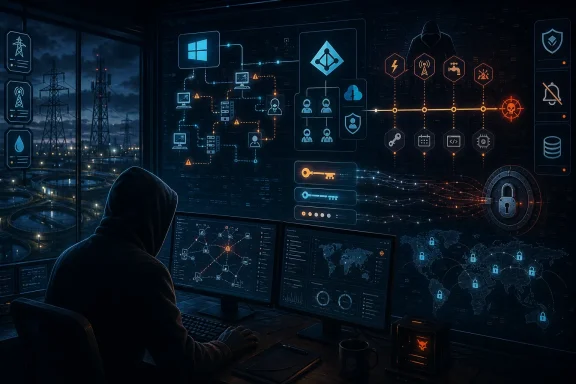 The Breach Was a Warning About Control, Not Theft
The modern cyber incident report has trained readers to ask familiar questions: what data was stolen, how many customers were affected, and whether passwords need to be reset. Burgess’s account points in a different direction. The attackers had acquired credentials belonging to active users, including IT professionals, and had mapped the environment well enough for ASIO to conclude they were preparing for sabotage.That distinction matters because sabotage is not primarily about possession of information. It is about timing, leverage, and systems knowledge. A network map, a handful of privileged credentials, and persistence inside a critical infrastructure operator can be more strategically useful than a database dump if the attacker’s goal is to disrupt power, transport, water, communications, logistics, or other essential services at a chosen moment.
ASIO has not named the victim, the sector, or the foreign state. That restraint is normal in intelligence disclosures, but it leaves defenders to fill in the operational picture. The important signal is not the identity of the provider; it is that Australia’s domestic intelligence service chose to describe the activity publicly as preparation for sabotage rather than espionage alone.
For sysadmins, that changes the mental model. A compromised admin account in a normal enterprise is bad. A compromised admin account in an infrastructure environment can become a bridge between ordinary IT and systems whose failure has physical, economic, or public safety effects. The breach Burgess described is therefore less a story about one Australian company than a case study in what adversaries are now trying to buy with stolen identity.
Critical Infrastructure Is Where Cyber Becomes Political Physics
The phrase critical infrastructure can sound bureaucratic, but the adversary logic is brutally simple. If a state wants leverage over another state without firing a missile, it looks for systems that society cannot pause. The more digitised those systems become, the more their operational continuity depends on ordinary identity, endpoint, patching, logging, remote access, and vendor-management decisions.That is why credential theft is the hinge of this incident. The most cinematic cyberattack is malware detonating across screens; the more plausible strategic campaign begins with valid logins, quiet enumeration, VPN access, remote management tools, and the patient collection of administrative context. The attacker does not need to break everything on day one. It needs to understand what would matter later.
Infrastructure providers often carry decades of accumulated complexity. Windows domains, legacy line-of-business applications, contractor access, industrial control interfaces, remote monitoring platforms, cloud administration consoles, and third-party maintenance channels may sit beside each other in arrangements that make sense historically but not defensively. A nation-state actor does not have to invent risk in that environment. It only has to trace it.
Burgess’s description of attackers maintaining access “so they could cripple it at a time of their choosing” is unusually blunt for an intelligence chief. It suggests ASIO saw intent in the pattern: mapping, credential acquisition, persistence, and positioning. That is the difference between a burglar wandering through a building and someone measuring the load-bearing walls.
The Old Line Between IT and OT Is No Longer a Comfort
Infrastructure security discussions often divide the world into IT and OT: the business systems that run email, identity, file shares, and billing, and the operational technology that runs pumps, switches, sensors, turbines, and other industrial equipment. The separation remains important, but it is no longer a guarantee. The real world is full of managed exceptions.Remote maintenance requires access. Monitoring requires data paths. Compliance requires reporting. Vendors require support channels. Engineers require tools that work from laptops. Managers require dashboards. Every one of those convenience layers can become a path of consequence if identity and segmentation are weak.
That is why stolen IT administrator credentials are so worrying in a sabotage context. Even where industrial control systems are segmented, admin access can reveal architecture, backup arrangements, jump hosts, firewall rules, remote access patterns, and the human workflows that keep the service running. The attacker may not need immediate access to a programmable logic controller if it can first learn how the organisation would respond to a disruption.
Windows environments sit at the centre of this problem because Active Directory and Entra ID often define who can do what across large organisations. Privilege sprawl, stale accounts, weak tiering, shared admin workstations, unconstrained delegation, over-permissive service accounts, and inconsistent MFA enforcement are not merely audit findings. In a critical infrastructure provider, they can become national resilience issues.
The lesson is not that Windows is uniquely insecure. It is that Windows identity is uniquely central. When attackers obtain valid credentials inside a Microsoft-heavy enterprise, they are not simply logging into machines. They are entering the organisation’s map of trust.
ASIO’s Public Warning Is Also a Message to Boards
Burgess said ASIO had identified, tracked, and attributed the compromise, and that remediation with the victim and security partners was ongoing. That wording carries two messages. First, the government has more visibility than it is willing to reveal. Second, remediation is not a quick password reset when the adversary has mapped an infrastructure network.Boards tend to understand breach notification and reputational damage. Sabotage preparation is harder because it may not produce an obvious loss event. There may be no ransom note, no public leak site, no immediate outage, and no class-action headline. The organisation may continue operating while the adversary quietly improves its access.
That makes the governance challenge more severe. The board has to fund work whose success is invisible: identity hardening, privileged access redesign, network segmentation, incident exercises, backup validation, engineering workstations, vendor access controls, log retention, threat hunting, and tabletop scenarios that assume the attacker has already crossed the perimeter. Those investments often look expensive until the day the alternative becomes national news.
The public disclosure also gives executives fewer excuses. When an intelligence chief says state actors are positioning for sabotage, critical infrastructure security stops being an IT department concern and becomes a duty of institutional stewardship. The question is not whether the organisation has a cyber strategy slide. It is whether it can prove that privileged identity, remote access, and recovery paths would withstand a patient adversary.
AUKUS Turns Espionage Into an Everyday Clearance Problem
Burgess’s speech did not isolate the infrastructure hack from the wider strategic environment. He also described an espionage operation aimed at AUKUS, the Australia-United Kingdom-United States security partnership centred on nuclear-powered submarines and advanced defence technology. In that case, a foreign intelligence officer allegedly posed as a consultant and paid an Australian security clearance holder to write reports before steering the relationship toward AUKUS information.The most striking detail was theatrical but revealing: ASIO officers borrowed the official’s phone and called the spy directly. Burgess said the foreign officer picked up expecting the target and instead heard from Australia’s security service. Intelligence agencies rarely waste such stories. The point was deterrence, reassurance, and a warning to anyone tempted to treat a “consulting” approach as harmless.
The AUKUS anecdote belongs in the same article as the infrastructure hack because both describe the same strategic appetite. Foreign states want access to systems, people, and plans that would matter in a crisis. They are not only stealing secrets for archives. They are building options.
For WindowsForum readers, the clearance-holder story is a reminder that security is not reducible to endpoints and firewalls. A well-patched laptop does not solve coercion, ego, debt, flattery, ideology, career ambition, or the greyness of paid “analysis” work. Nation-state operations blend cyber, human intelligence, influence, and legal ambiguity because real organisations are made of people as much as machines.
The Bondi Shadow Makes the Threat Picture Harder to Prioritise
Burgess’s 2026 assessment arrived in a grim domestic context. ASIO has said Australia’s terrorism threat level remains “probable,” and Burgess referred to dozens of disrupted major terrorism plots since 2014, including a significant number since the Bondi attack. He also described overlapping threats: coerced repatriation, state-based terrorism, sabotage preparation, and attempts to gain insight into AUKUS.The risk for the public is threat fatigue. When intelligence chiefs list terrorism, espionage, foreign interference, sabotage, coercion, and democratic manipulation in the same speech, the result can sound like an undifferentiated fog of danger. But for practitioners, the overlap is precisely the problem.
A cyber intrusion into infrastructure is not separate from geopolitics. A foreign approach to a clearance holder is not separate from defence procurement. Extremist mobilisation is not separate from online ecosystems. Attempts to undermine the economy or manipulate democracy are not separate from the same adversarial playbook that treats open societies as attack surfaces.
This is where ASIO’s warning should be read carefully. Burgess was not simply asking Australians to be alarmed. He was arguing that the categories used by government, companies, and the public are becoming less useful. The adversary does not care whether an action is filed under cyber, espionage, sabotage, or influence if the combined effect advances strategic leverage.
Salt Typhoon Made the Abstract Concrete
Burgess’s latest disclosure lands after earlier warnings about Chinese state-backed activity probing Australian infrastructure, including references in public reporting to Salt Typhoon and the broader pattern of telecommunications and critical infrastructure targeting. China has repeatedly rejected hacking allegations, and ASIO did not publicly name the state behind the 2026 infrastructure compromise. Still, the strategic pattern is familiar across allied warnings.The United States and other partners have spent the past several years warning that Chinese-linked groups are not merely collecting intelligence but pre-positioning inside networks that could matter during a crisis. The most important word there is pre-positioning. It implies patience, restraint, and a willingness to spend time inside networks without immediate monetisation.
That is a hard adversary for conventional enterprise security to detect. Ransomware operators are noisy because they need payment. Criminal data thieves often exfiltrate and move on. A state actor preparing sabotage may prefer to look like normal administration, to use living-off-the-land techniques, and to avoid actions that force a defender to rebuild the environment.
Australia’s geography does not protect it from that model. If anything, its role in Indo-Pacific strategy, AUKUS, minerals, logistics, undersea cables, ports, telecoms, and defence industry makes it a logical target. Infrastructure compromise is not just about local disruption. It can be about shaping the options available to Canberra and its allies during a regional crisis.
Credential Theft Is the Part Defenders Can Actually Change
The bleakness of nation-state threats can become paralysing. A national intelligence service can attribute an intrusion; most infrastructure operators cannot. A government can weigh strategic intent; a sysadmin has tickets to close. But the common ground is identity.The attackers Burgess described acquired active credentials, including those of IT professionals. That means defenders should resist the temptation to treat the incident as exotic. The adversary may be a state, but the access path may still depend on familiar weaknesses: phishing-resistant MFA not deployed everywhere, legacy protocols left alive, password reuse, over-privileged administrators, service accounts no one owns, remote access exceptions, unmonitored PowerShell, and logs retained for days when the investigation needs months.
In Windows estates, the practical agenda is well known but unevenly executed. Privileged Access Workstations remain rare outside mature environments. Administrative tiering is often discussed after incidents rather than before them. Local administrator passwords are still mishandled despite available tooling. Entra ID conditional access policies may be strong for employees but weaker for vendors, break-glass accounts, or legacy applications.
The uncomfortable truth is that many infrastructure operators do not need a new framework before taking meaningful action. They need to decide that privileged identity is a production dependency, not an administrative convenience. If an attacker can become the administrator, the rest of the security architecture becomes negotiable.
Remediation Means Proving the Attacker Has Nowhere Left to Stand
ASIO said remediation was ongoing, which is exactly what should happen after a sophisticated compromise. In a sabotage-preparation case, the defender cannot assume that removing one access method ends the campaign. The attacker may have established multiple footholds, learned the backup environment, created covert accounts, modified configurations, or discovered vendor paths that outlive the initial cleanup.The remediation challenge is therefore evidentiary. It is not enough to declare systems clean. The organisation must build a case that identity has been reset in a meaningful way, privileged paths have been reduced, persistence mechanisms have been hunted, and the monitoring environment can detect a return. That is slow work, and it conflicts with the operational pressure to restore normality.
For critical infrastructure, recovery planning also has to assume degraded trust. Backups must be tested not just for availability but for integrity. Incident response plans must include manual operations where feasible. Communications plans must work if identity systems are impaired. Vendor escalation paths must be known before an incident, not negotiated while the network is burning.
This is also where tabletop exercises often fail. Too many assume a ransomware scenario with an obvious trigger and a contained blast radius. The harder exercise begins with the premise that a nation-state actor has had valid admin credentials for weeks, has mapped the environment, and has not yet done the thing it came to do. That scenario is less dramatic, but it is closer to the warning Burgess delivered.
The Public-Private Boundary Is Doing More Work Than It Was Built For
The Australian government can warn, attribute, coordinate, and in some cases intervene. But most critical infrastructure is owned or operated outside the intelligence community. That leaves a structural tension at the heart of national cyber defence: the state sees strategic threat, while private operators carry much of the operational risk.This is not unique to Australia. Across liberal democracies, governments increasingly rely on private companies to absorb the first impact of state conflict conducted below the threshold of war. Telecoms, cloud providers, energy companies, ports, hospitals, managed service providers, and software vendors are all part of the national attack surface, even when their budgets and incentives are not designed around national security.
Burgess’s disclosure suggests ASIO is trying to close that gap through direct engagement with victims and security partners. But the model depends on trust. Companies must be willing to report early, accept help, and tolerate uncomfortable scrutiny. Government agencies must share enough to be useful without compromising sources and methods.
That bargain is fragile. If companies fear blame more than compromise, they will hesitate. If government warning is too vague, boards will discount it. If intelligence is too classified, defenders cannot operationalise it. The best public-private cyber defence is therefore not built during the incident. It is built beforehand, through relationships, exercises, clear reporting channels, and a shared understanding that embarrassment is cheaper than sabotage.
Windows Administrators Are Now Part of the Deterrence Story
It is tempting to treat deterrence as the work of diplomats, generals, and intelligence chiefs. But in the cyber domain, deterrence also depends on whether adversaries believe access will be costly to obtain, risky to maintain, and unreliable in a crisis. That makes everyday administration part of the strategic equation.A well-managed Windows environment will not stop every nation-state operation. It can, however, force more noise, more tooling, more time, and more risk onto the attacker. Phishing-resistant authentication, hardened admin paths, clean identity tiering, endpoint detection, application control, device compliance, rapid patching, and long-retention logging do not sound geopolitical. In aggregate, they shape adversary confidence.
This is where defenders should avoid magical thinking. Buying another dashboard will not compensate for a flat domain where too many users can become too many things. A zero-trust slogan will not help if break-glass accounts are unmanaged. Cloud migration will not fix identity debt if the same weak privilege model follows the organisation into Entra ID and Azure.
The ASIO disclosure should therefore land as a practical prod rather than an abstract alarm. If attackers want credentials and maps, defenders should make credentials harder to steal, privilege harder to use, and maps harder to assemble unnoticed. That is not glamorous, but national resilience rarely is.
Canberra’s Spy Story Leaves a Checklist on the Server Room Door
The lesson from Burgess’s warning is not that every organisation can see what ASIO sees. It is that infrastructure operators can act on the parts of the pattern that are already visible: credential theft, privileged access, network mapping, persistence, and delayed intent. A nation-state campaign may be strategic, but many of its dependencies are stubbornly administrative.- Critical infrastructure operators should treat stolen administrator credentials as a potential sabotage precursor, not merely as an account-security incident.
- Windows-heavy environments should prioritise privileged access tiering, phishing-resistant MFA, managed local administrator passwords, and separate admin workstations.
- Security teams should hunt for network mapping and living-off-the-land behaviour even when there is no ransomware, no data leak, and no obvious business disruption.
- Boards should require evidence that incident recovery plans work under degraded identity, compromised backups, and restricted vendor access conditions.
- Organisations connected to defence, AUKUS, energy, telecoms, transport, water, and logistics should assume that human targeting and cyber targeting will arrive together.
The Next Attack May Look Like Nothing Until It Matters
The most important feature of the ASIO disclosure is its quietness. There was no public outage attached to the incident, no named victim, and no dramatic technical indicator for defenders to paste into a firewall. The danger was potential energy: access held in reserve, knowledge accumulated over time, credentials ready to be used when circumstances made disruption valuable.That is the future security services are trying to describe. Nation-states will not always announce themselves with destructive malware. They will cultivate people, rent legitimacy, steal credentials, live inside infrastructure, and convert private administrative weakness into public strategic leverage. For Windows admins, infrastructure executives, and security teams, the task now is to make that conversion harder before the next quiet compromise becomes the loud event everyone claims not to have seen coming.
References
- Primary source: TechNadu
Published: 2026-06-25T12:10:54.983889
ASIO Reveals Nation-State Hack of Australian Critical Infrastructure - TechNadu
Nation-state hackers compromised an Australian critical infrastructure provider and stole credentials, ASIO's Mike Burgess revealed in the June 2026 threat assessment.www.technadu.com - Related coverage: asio.gov.au
- Related coverage: theguardian.com
Asio accuses Chinese hackers of seeking access to Australia’s critical infrastructure | Australia news | The Guardian
Mike Burgess points to successful infiltration in the US by units known as Salt Typhoon and Volt Typhoon ‘working for the Chinese government’www.theguardian.com - Related coverage: sbs.com.au
ASIO outlines looming security threats on and beyond Australian soil | SBS News
ASIO has revealed it has foiled 14 terror plots since the December mass shooting in Bondi, with the current terror level remaining "probable". But the service will undergo a review of its warning system, as Australia's spy chief warns the current one is understating the danger...www.sbs.com.au - Related coverage: itnews.com.au
ASIO boss warns Australian critical infrastructure systems "routinely" mapped - iTnews
For future cyber exploitation.www.itnews.com.au - Related coverage: sydneytimes.net.au
- Related coverage: techspot.com
Foreign spies are learning how to sabotage critical infrastructure, Australian intelligence agency warns | TechSpot
Australia is facing significant cyber threats from unknown parties, as foreign spies actively attempt to identify weaknesses in the country's digital infrastructure. According to Mike Burgess, the...www.techspot.com - Related coverage: aph.gov.au
- Related coverage: careers.asio.gov.au
Careers with ASIO | Australian Security Intelligence Organisation
Careers at Australian Security Intelligence Organisationwww.careers.asio.gov.au
