

RankPivot, an Alameda, California digital marketing company founded around a 2020 business-directory platform, announced on June 4, 2026 that it has relaunched as RankPivot.ai, positioning itself as an AI visibility agency for brands seeking placement in ChatGPT, Google AI Overviews, Perplexity, and Microsoft Copilot. The pitch is timely because search is no longer just a list of blue links and ad slots. But the more interesting story is not that another agency has discovered a new acronym. It is that the marketing industry is now trying to sell certainty in a discovery layer that is still unstable, opaque, and only partly measurable.
RankPivot’s relaunch reads like a marker in a broader shift: the old SEO industry is racing to rename, repackage, and re-price its expertise for an internet where answers increasingly appear before the user ever reaches a website. The company calls its new focus AI visibility, with services spanning Generative Engine Optimization, Answer Engine Optimization, entity building, technical SEO, paid media, local visibility, and audience psychology.
That bundle is not accidental. It reflects the practical reality that nobody has yet reduced AI discovery to a clean replacement for search rankings. A brand can rank well on Google and still be absent from an AI-generated answer. It can appear in one chatbot today, disappear tomorrow, and show up differently depending on prompt wording, location, freshness, personalization, or whatever retrieval pipeline the platform is using that week.
The press release leans heavily on the idea that RankPivot’s leadership has lived through previous discovery shifts, from online directories to local SEO to search-everywhere marketing. That history matters, but it also points to the central tension. The web has seen this movie before: every platform transition produces a gold rush of consultants who understand just enough of the new distribution channel to help clients, but not enough to guarantee the outcomes their sales language implies.
RankPivot’s strongest argument is that brands need to prepare for AI-mediated discovery now rather than wait for cleaner reporting later. Its weakest argument is that this market can already be treated as a mature discipline with repeatable, industry-disrupting results. The truth is likely less glamorous and more useful: AI visibility is becoming a real operational concern, but it is still closer to early-2000s SEO than to modern performance marketing.
Generative AI complicates that bargain. Google’s AI Overviews, ChatGPT search, Perplexity, Copilot, and other answer systems increasingly compress the discovery journey into a synthesized response. The user may still see citations, source cards, or links, but the primary interface is no longer a ranked page of destinations. It is a machine-written answer that decides which sources deserve to be surfaced at all.
That does not mean traditional SEO is dead. In fact, many AI answer systems still draw heavily from the same web corpus, authority signals, structured content, and reputation patterns that shaped search optimization for years. Pages that are clear, authoritative, crawlable, and frequently referenced remain more likely to be useful inputs for machine-generated answers than thin pages designed purely for keyword capture.
But the center of gravity has moved. In the classic model, a brand could treat the search result page as the battlefield. In the AI model, the battlefield is partly hidden inside retrieval, summarization, ranking, citation selection, and answer composition. The brand is not merely trying to be found; it is trying to be interpreted correctly by systems that may never reveal the full basis for their output.
That is why RankPivot’s positioning will resonate with CMOs and agency owners. Search has become less about winning a visible slot and more about becoming a trusted entity in a machine-readable knowledge environment. The question is whether an agency can turn that insight into durable results rather than just better-sounding invoices.
The mechanics, however, are not magic. Much of what agencies now call GEO or AEO overlaps with old-fashioned content quality, structured data, brand authority, digital PR, local listings hygiene, and technical accessibility. Clean entity definitions, consistent naming, expert-authored pages, original data, reviews, third-party mentions, schema markup, and credible citations are not new. They have simply acquired new urgency because AI systems are hungry for clear, extractable signals.
RankPivot’s service list reflects that hybrid reality. Entity building, audience intent, technical SEO, and local visibility are not separate from AI optimization; they are the likely substrate of it. If a model or retrieval system cannot confidently understand who a company is, what it sells, where it operates, and why third parties trust it, the brand is unlikely to become a preferred answer.
The risk is that the industry turns a sensible maintenance discipline into a mystical one. “Optimize for AI” can mean anything from rewriting content into clearer answer blocks to spamming low-quality Q&A pages and synthetic mentions across dubious sites. The former may help users and machines. The latter recreates the worst habits of SEO, only now pointed at systems that are even harder to audit.
RankPivot’s pitch is more credible when read as an evolution of technical marketing than as a revolution. The companies that will benefit most are probably not those chasing every new acronym, but those willing to make their digital identity more coherent across the web. AI visibility begins with being understandable, verifiable, and useful.
For WindowsForum readers, Microsoft’s role is especially important. Copilot is not just another consumer chatbot; it is becoming a layer across operating systems, productivity apps, developer tooling, cloud workflows, and enterprise knowledge bases. If users begin asking Copilot for recommendations, troubleshooting guidance, product comparisons, or vendor shortlists, the old separation between search marketing and workplace software starts to blur.
That is why AI visibility is not only a marketing problem. It touches documentation, support, reputation management, security communications, partner ecosystems, and procurement. A sysadmin who asks an AI assistant how to remediate a Windows update failure, evaluate an endpoint tool, or understand a licensing change is participating in a discovery process that may cite some vendors and ignore others.
This is where RankPivot’s “full-spectrum” language has a point. AI discovery does not respect the neat boundaries between SEO, public relations, documentation, customer success, and product marketing. A brand’s visibility can be affected by how its support pages are written, how often its executives are cited, how clean its business listings are, how customers describe it in public forums, and whether its technical claims are echoed by independent sources.
The agency opportunity is obvious. Businesses are being told that the next interface for the web may not show their site unless AI systems decide they are worth naming. That fear will sell audits. The challenge is making sure those audits identify fixable weaknesses rather than laundering uncertainty through expensive dashboards.
There is nothing inherently wrong with that. Many businesses genuinely need someone to test whether their brand appears in AI answers, whether their public identity is consistent, whether their documentation is crawlable, and whether competitors are being cited more often. For small businesses, a free diagnostic may be the first time anyone has looked at their web presence through something broader than local rankings or ad performance.
But the word “free” deserves the same skepticism here that it deserves in cybersecurity scans, cloud assessments, and SEO audits. A good diagnostic separates observation from sales pressure. A bad one turns every ambiguity into a crisis and every missing mention into proof that the client needs an urgent retainer.
The quality of an AI visibility audit depends on methodology. Which prompts are tested? How often are they run? Are results segmented by platform? Are logged-in and logged-out experiences distinguished? Are citations separated from mere mentions? Are recommendations tied to business outcomes, or only to vanity appearances in chatbot responses?
The companies buying these services should ask for that level of specificity. “You are invisible in AI” is not a diagnosis. “Your brand appears in only two of twenty high-intent comparative prompts across three answer engines, while two competitors are repeatedly cited because their documentation and third-party reviews define the category more clearly” is a diagnosis. The difference is the difference between marketing theater and operational intelligence.
The company also lists Brian Long as a senior engineering and systems advisor with experience across government, defense, semiconductor engineering, data centers, and industrial design. Anthony DiPasquale is presented as a longtime web development executive. Nadia Leon is described as an AI systems architect and researcher focused on multi-agent coordination and decentralized AI governance.
That roster is designed to say one thing: this is not a content farm with a new domain name. RankPivot wants prospective clients to see historical depth, technical credibility, and enough enterprise vocabulary to distinguish it from the many thin agencies now stapling “AI” onto existing SEO packages.
Experience matters in this field because AI visibility is not a single-channel trick. People who understand directories, structured data, local search, information architecture, and enterprise publishing are likely better positioned than those who only know how to generate blog posts at scale. The shift from search results to answers rewards the boring disciplines that good web teams have been practicing for years.
Still, the industry should resist pedigree as proof. The relaunch announcement does not provide independently verifiable case studies, client names, controlled benchmarks, before-and-after data, or a methodology that would let outsiders evaluate the “industry-disrupting” claim. That does not mean the claim is false. It means readers should treat it as positioning until evidence arrives.
In enterprise IT, that distinction is normal. A vendor’s architecture slide is not a deployment result. A security startup’s founder résumé is not a third-party audit. An AI visibility agency should be held to the same standard: interesting thesis, plausible team, but proof required.
AI discovery is less settled. Chatbot answers can vary across sessions. Some platforms cite sources clearly; others blur the line between retrieval and model memory. Google’s AI Overviews do not behave like a static ranking surface. ChatGPT search may retrieve fresh sources for one query while answering another from a different mix of systems. Copilot’s behavior can differ across consumer, enterprise, browser, and Microsoft 365 contexts.
That instability does not make measurement impossible. It makes measurement probabilistic. A serious program should track repeated prompts over time, across platforms, using controlled query sets and clear categories: whether the brand is mentioned, whether it is cited, whether the citation links to the brand or a third party, whether the answer is accurate, and whether the appearance occurs for branded, non-branded, comparative, local, and problem-led queries.
It should also connect those observations to conventional indicators. Branded search demand, referral traffic from AI systems where available, direct traffic changes, lead quality, customer surveys, and sales conversations may all help show whether AI visibility is having business impact. No single metric will be enough.
This is the part of the market where agencies can either mature or embarrass themselves. If they sell dashboards that imply precision where none exists, they will repeat the analytics sins of every previous marketing boom. If they explain uncertainty honestly and still help clients improve their public knowledge footprint, they may build a durable practice.
A user who asks Copilot how to fix a driver issue, pick a backup tool, compare endpoint detection products, or summarize licensing options is not necessarily “searching” in the traditional sense. They are delegating research to a system that may synthesize information from Microsoft documentation, the public web, internal enterprise data, and partner material. The vendor that appears in that answer has won a different kind of shelf space.
For admins, this creates both opportunity and risk. Good AI answers could reduce support burden, speed up troubleshooting, and surface better documentation. Bad or incomplete AI answers could amplify outdated advice, overlook niche tools, or reinforce whatever sources happen to be most machine-readable rather than most correct.
That makes AI visibility adjacent to information hygiene. Vendors serving Windows environments should care not only whether they appear in generated answers, but whether those answers describe their products accurately. A backup provider mischaracterized by an AI assistant has a marketing problem. A security vendor misrepresented in remediation guidance has a trust problem.
RankPivot’s relaunch is therefore relevant beyond the marketing department. If agencies like it can help companies publish clearer technical content, maintain consistent entity data, and correct public misinformation, they can improve the quality of AI-mediated discovery. If they merely chase mentions, they will add noise to an already noisy layer.
Some of them are already visible. Marketers are experimenting with mass-produced Q&A pages, synthetic comparison content, seeded forum posts, spammy directory listings, and publication networks designed less for readers than for model ingestion. The goal is not to inform humans; it is to create the appearance of authority in places retrieval systems might notice.
This is dangerous because AI answers can launder weak sources into confident prose. A dubious page in a traditional search result at least looks like a dubious page if the user clicks it. In a generated answer, the platform’s voice may make shaky information feel settled. That matters in consumer shopping; it matters far more in health, finance, security, and enterprise procurement.
Responsible AI visibility work should therefore have a user-benefit test. Does the optimization make the web more accurate, more navigable, and more transparent? Or does it merely increase the odds that a brand name appears in machine-generated text? The former is a legitimate evolution of technical marketing. The latter is spam with a better deck.
RankPivot’s public language emphasizes user experience, entity authority, brand trust, and long-term digital legacies. That is the right vocabulary. The market will judge whether the execution lives up to it.
Search engines have long moved beyond matching pages to keywords. They map people, places, organizations, products, and topics into knowledge systems. Generative AI adds another layer by using those systems, public web retrieval, and model training to form answers. A company with fragmented names, thin documentation, inconsistent listings, and few credible third-party references is harder to confidently recommend.
This is where AI visibility becomes less glamorous and more operational. A business may need to clean up its site architecture, consolidate duplicate profiles, publish clearer product pages, add structured data, improve author bios, solicit legitimate reviews, update stale documentation, and earn coverage or citations from sources users actually trust. None of that is as sexy as “ranking in ChatGPT.” Much of it is more important.
The challenge for agencies is packaging that work without overselling control. No outside consultant can force an AI platform to cite a brand. What a consultant can do is improve the probability that when answer systems look for evidence, they find consistent, authoritative, user-serving material.
That probabilistic framing may frustrate executives who want guarantees. But it is more honest than pretending AI discovery is a vending machine. Brands do not buy placement in organic AI answers the way they buy ads. They build the conditions under which recommendation becomes more likely.
This is particularly important because AI visibility touches public claims. If an agency rewrites technical content to make it more citation-friendly, the company must still ensure that content is accurate, compliant, and supportable. If it pursues third-party mentions, those efforts must not cross into undisclosed paid influence or reputation manipulation. If it builds pages targeting AI answers, those pages should help human readers too.
The best enterprise programs will likely combine marketing, communications, legal, product, support, and IT. That may sound cumbersome, but AI answer systems collapse those disciplines in practice. A support article can become a sales touchpoint. A public comparison page can influence procurement. A developer document can shape how a model explains an API.
RankPivot’s background claims suggest it wants to play at that strategic level rather than simply sell content packages. If so, it will need to show process maturity: audit trails, prompt libraries, change logs, content governance, reporting methodology, and client-specific risk controls.
The smaller the client, the more practical the service may become. Many small businesses do not need enterprise governance; they need consistent listings, clearer service pages, better reviews, and content that directly answers local buying questions. For them, AI visibility may simply be the newest reason to fix old digital neglect.
That is the same pattern that produced social media agencies, mobile-first consultancies, cloud migration specialists, cybersecurity posture firms, and digital transformation shops. Sometimes the new label captures a real discontinuity. Sometimes it is a procurement-friendly wrapper around familiar work. Often it is both.
AI visibility appears to be both. The underlying chores are recognizable: make content better, make entities clearer, make authority more visible, make technical infrastructure easier to crawl, make claims more verifiable, make user intent central. The discontinuity is that the audience for those signals is no longer only human searchers and ranking algorithms. It is also generative systems that mediate the answer before a click happens.
That change will redistribute value. Some publishers will lose traffic even if they are cited. Some brands will gain awareness without conventional referrals. Some vendors will discover that being mentioned in an AI answer matters more for consideration than for immediate clicks. Some agencies will find that their old ranking reports no longer satisfy clients who want to know how they appear in answer engines.
RankPivot is betting that this redistribution is early enough for a specialist to gain ground. It may be right. But the winners in this category will be the firms that can move from rhetoric to repeatable evidence.
The practical lessons are concrete:
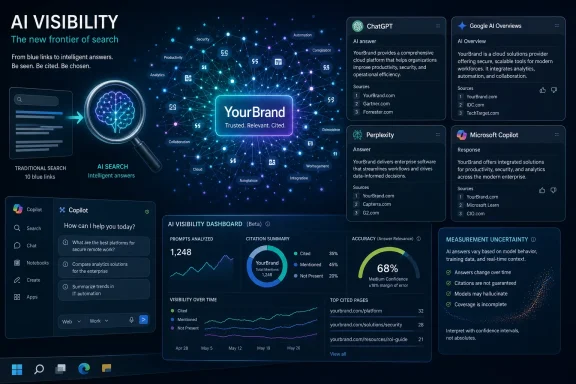 RankPivot Is Selling the Anxiety Search Created for Itself
RankPivot’s relaunch reads like a marker in a broader shift: the old SEO industry is racing to rename, repackage, and re-price its expertise for an internet where answers increasingly appear before the user ever reaches a website. The company calls its new focus AI visibility, with services spanning Generative Engine Optimization, Answer Engine Optimization, entity building, technical SEO, paid media, local visibility, and audience psychology.That bundle is not accidental. It reflects the practical reality that nobody has yet reduced AI discovery to a clean replacement for search rankings. A brand can rank well on Google and still be absent from an AI-generated answer. It can appear in one chatbot today, disappear tomorrow, and show up differently depending on prompt wording, location, freshness, personalization, or whatever retrieval pipeline the platform is using that week.
The press release leans heavily on the idea that RankPivot’s leadership has lived through previous discovery shifts, from online directories to local SEO to search-everywhere marketing. That history matters, but it also points to the central tension. The web has seen this movie before: every platform transition produces a gold rush of consultants who understand just enough of the new distribution channel to help clients, but not enough to guarantee the outcomes their sales language implies.
RankPivot’s strongest argument is that brands need to prepare for AI-mediated discovery now rather than wait for cleaner reporting later. Its weakest argument is that this market can already be treated as a mature discipline with repeatable, industry-disrupting results. The truth is likely less glamorous and more useful: AI visibility is becoming a real operational concern, but it is still closer to early-2000s SEO than to modern performance marketing.
The Blue Link Is Losing Its Monopoly, Not Its Relevance
For more than two decades, the commercial web has been organized around a familiar bargain. Publishers, merchants, local businesses, and software vendors produced pages; search engines indexed those pages; users clicked results; and marketers fought over ranking, snippets, ads, and reputation signals. It was messy, gamed, and frequently unfair, but it was at least legible enough to build an industry around.Generative AI complicates that bargain. Google’s AI Overviews, ChatGPT search, Perplexity, Copilot, and other answer systems increasingly compress the discovery journey into a synthesized response. The user may still see citations, source cards, or links, but the primary interface is no longer a ranked page of destinations. It is a machine-written answer that decides which sources deserve to be surfaced at all.
That does not mean traditional SEO is dead. In fact, many AI answer systems still draw heavily from the same web corpus, authority signals, structured content, and reputation patterns that shaped search optimization for years. Pages that are clear, authoritative, crawlable, and frequently referenced remain more likely to be useful inputs for machine-generated answers than thin pages designed purely for keyword capture.
But the center of gravity has moved. In the classic model, a brand could treat the search result page as the battlefield. In the AI model, the battlefield is partly hidden inside retrieval, summarization, ranking, citation selection, and answer composition. The brand is not merely trying to be found; it is trying to be interpreted correctly by systems that may never reveal the full basis for their output.
That is why RankPivot’s positioning will resonate with CMOs and agency owners. Search has become less about winning a visible slot and more about becoming a trusted entity in a machine-readable knowledge environment. The question is whether an agency can turn that insight into durable results rather than just better-sounding invoices.
GEO and AEO Are New Acronyms for an Old Instinct
Generative Engine Optimization and Answer Engine Optimization are awkward terms, but they describe a real instinct: marketers want to influence the answer layer before competitors do. If a user asks an AI assistant for the best endpoint security platform, the most reliable Windows migration partner, the top local HVAC company, or the most credible source on a medical condition, inclusion in the generated answer may be more valuable than a conventional ranking buried beneath it.The mechanics, however, are not magic. Much of what agencies now call GEO or AEO overlaps with old-fashioned content quality, structured data, brand authority, digital PR, local listings hygiene, and technical accessibility. Clean entity definitions, consistent naming, expert-authored pages, original data, reviews, third-party mentions, schema markup, and credible citations are not new. They have simply acquired new urgency because AI systems are hungry for clear, extractable signals.
RankPivot’s service list reflects that hybrid reality. Entity building, audience intent, technical SEO, and local visibility are not separate from AI optimization; they are the likely substrate of it. If a model or retrieval system cannot confidently understand who a company is, what it sells, where it operates, and why third parties trust it, the brand is unlikely to become a preferred answer.
The risk is that the industry turns a sensible maintenance discipline into a mystical one. “Optimize for AI” can mean anything from rewriting content into clearer answer blocks to spamming low-quality Q&A pages and synthetic mentions across dubious sites. The former may help users and machines. The latter recreates the worst habits of SEO, only now pointed at systems that are even harder to audit.
RankPivot’s pitch is more credible when read as an evolution of technical marketing than as a revolution. The companies that will benefit most are probably not those chasing every new acronym, but those willing to make their digital identity more coherent across the web. AI visibility begins with being understandable, verifiable, and useful.
The Relaunch Arrives at Exactly the Moment Agencies Need a New Story
The timing of RankPivot’s relaunch is almost too perfect. Google has spent the last two years pushing AI-generated answers deeper into Search. OpenAI turned ChatGPT into a search interface rather than a purely conversational model. Perplexity built its brand around answer-first discovery. Microsoft has woven Copilot across Windows, Edge, Bing, Microsoft 365, and its enterprise stack.For WindowsForum readers, Microsoft’s role is especially important. Copilot is not just another consumer chatbot; it is becoming a layer across operating systems, productivity apps, developer tooling, cloud workflows, and enterprise knowledge bases. If users begin asking Copilot for recommendations, troubleshooting guidance, product comparisons, or vendor shortlists, the old separation between search marketing and workplace software starts to blur.
That is why AI visibility is not only a marketing problem. It touches documentation, support, reputation management, security communications, partner ecosystems, and procurement. A sysadmin who asks an AI assistant how to remediate a Windows update failure, evaluate an endpoint tool, or understand a licensing change is participating in a discovery process that may cite some vendors and ignore others.
This is where RankPivot’s “full-spectrum” language has a point. AI discovery does not respect the neat boundaries between SEO, public relations, documentation, customer success, and product marketing. A brand’s visibility can be affected by how its support pages are written, how often its executives are cited, how clean its business listings are, how customers describe it in public forums, and whether its technical claims are echoed by independent sources.
The agency opportunity is obvious. Businesses are being told that the next interface for the web may not show their site unless AI systems decide they are worth naming. That fear will sell audits. The challenge is making sure those audits identify fixable weaknesses rather than laundering uncertainty through expensive dashboards.
Free Visibility Audits Are the New Foot in the Door
RankPivot says it will offer every new client a free visibility analysis and consultation. That is a familiar agency tactic, but it may be unusually effective in the AI search era because most organizations do not yet know what they should be measuring. A free audit gives anxious executives a vocabulary for a problem they can feel but cannot yet quantify.There is nothing inherently wrong with that. Many businesses genuinely need someone to test whether their brand appears in AI answers, whether their public identity is consistent, whether their documentation is crawlable, and whether competitors are being cited more often. For small businesses, a free diagnostic may be the first time anyone has looked at their web presence through something broader than local rankings or ad performance.
But the word “free” deserves the same skepticism here that it deserves in cybersecurity scans, cloud assessments, and SEO audits. A good diagnostic separates observation from sales pressure. A bad one turns every ambiguity into a crisis and every missing mention into proof that the client needs an urgent retainer.
The quality of an AI visibility audit depends on methodology. Which prompts are tested? How often are they run? Are results segmented by platform? Are logged-in and logged-out experiences distinguished? Are citations separated from mere mentions? Are recommendations tied to business outcomes, or only to vanity appearances in chatbot responses?
The companies buying these services should ask for that level of specificity. “You are invisible in AI” is not a diagnosis. “Your brand appears in only two of twenty high-intent comparative prompts across three answer engines, while two competitors are repeatedly cited because their documentation and third-party reviews define the category more clearly” is a diagnosis. The difference is the difference between marketing theater and operational intelligence.
The Leadership Story Is Useful, but It Cannot Substitute for Proof
RankPivot’s release spends considerable space on its leadership team. Founder David L. King II is described as having roots in Disney Online and the Walt Disney Internet Group, with a background in user experience, infrastructure engineering, and search visibility architecture. Managing partner Jeff Enabe is positioned as a veteran of business directory systems, branding, data infrastructure, Hearst, and Dun & Bradstreet.The company also lists Brian Long as a senior engineering and systems advisor with experience across government, defense, semiconductor engineering, data centers, and industrial design. Anthony DiPasquale is presented as a longtime web development executive. Nadia Leon is described as an AI systems architect and researcher focused on multi-agent coordination and decentralized AI governance.
That roster is designed to say one thing: this is not a content farm with a new domain name. RankPivot wants prospective clients to see historical depth, technical credibility, and enough enterprise vocabulary to distinguish it from the many thin agencies now stapling “AI” onto existing SEO packages.
Experience matters in this field because AI visibility is not a single-channel trick. People who understand directories, structured data, local search, information architecture, and enterprise publishing are likely better positioned than those who only know how to generate blog posts at scale. The shift from search results to answers rewards the boring disciplines that good web teams have been practicing for years.
Still, the industry should resist pedigree as proof. The relaunch announcement does not provide independently verifiable case studies, client names, controlled benchmarks, before-and-after data, or a methodology that would let outsiders evaluate the “industry-disrupting” claim. That does not mean the claim is false. It means readers should treat it as positioning until evidence arrives.
In enterprise IT, that distinction is normal. A vendor’s architecture slide is not a deployment result. A security startup’s founder résumé is not a third-party audit. An AI visibility agency should be held to the same standard: interesting thesis, plausible team, but proof required.
The Measurement Problem Is the Whole Market
The largest unresolved issue in AI visibility is not whether brands want it. They do. The issue is whether anyone can measure it consistently enough to manage it responsibly. Traditional SEO eventually developed a messy but usable toolchain: rank trackers, analytics, click-through data, Search Console, backlink indexes, log analysis, conversion tracking, and competitive intelligence platforms.AI discovery is less settled. Chatbot answers can vary across sessions. Some platforms cite sources clearly; others blur the line between retrieval and model memory. Google’s AI Overviews do not behave like a static ranking surface. ChatGPT search may retrieve fresh sources for one query while answering another from a different mix of systems. Copilot’s behavior can differ across consumer, enterprise, browser, and Microsoft 365 contexts.
That instability does not make measurement impossible. It makes measurement probabilistic. A serious program should track repeated prompts over time, across platforms, using controlled query sets and clear categories: whether the brand is mentioned, whether it is cited, whether the citation links to the brand or a third party, whether the answer is accurate, and whether the appearance occurs for branded, non-branded, comparative, local, and problem-led queries.
It should also connect those observations to conventional indicators. Branded search demand, referral traffic from AI systems where available, direct traffic changes, lead quality, customer surveys, and sales conversations may all help show whether AI visibility is having business impact. No single metric will be enough.
This is the part of the market where agencies can either mature or embarrass themselves. If they sell dashboards that imply precision where none exists, they will repeat the analytics sins of every previous marketing boom. If they explain uncertainty honestly and still help clients improve their public knowledge footprint, they may build a durable practice.
Windows Users Will Meet This Shift Through Copilot First
For many Windows users, the AI visibility debate sounds like a marketing industry argument until it shows up in the tools they use every day. Copilot changes that. Microsoft has spent years turning AI into an ambient assistant across Windows, Edge, Bing, Microsoft 365, GitHub, Azure, and enterprise workflows. That means answer engines are not merely replacing web searches; they are being embedded into work.A user who asks Copilot how to fix a driver issue, pick a backup tool, compare endpoint detection products, or summarize licensing options is not necessarily “searching” in the traditional sense. They are delegating research to a system that may synthesize information from Microsoft documentation, the public web, internal enterprise data, and partner material. The vendor that appears in that answer has won a different kind of shelf space.
For admins, this creates both opportunity and risk. Good AI answers could reduce support burden, speed up troubleshooting, and surface better documentation. Bad or incomplete AI answers could amplify outdated advice, overlook niche tools, or reinforce whatever sources happen to be most machine-readable rather than most correct.
That makes AI visibility adjacent to information hygiene. Vendors serving Windows environments should care not only whether they appear in generated answers, but whether those answers describe their products accurately. A backup provider mischaracterized by an AI assistant has a marketing problem. A security vendor misrepresented in remediation guidance has a trust problem.
RankPivot’s relaunch is therefore relevant beyond the marketing department. If agencies like it can help companies publish clearer technical content, maintain consistent entity data, and correct public misinformation, they can improve the quality of AI-mediated discovery. If they merely chase mentions, they will add noise to an already noisy layer.
The Worst Version of AI Visibility Will Look Like SEO’s Bad Old Days
Every new search interface invites manipulation. Keyword stuffing, doorway pages, link schemes, fake reviews, content spinning, parasite SEO, and low-quality guest posting were all attempts to exploit the distance between what algorithms could measure and what users actually needed. AI discovery will attract its own equivalents.Some of them are already visible. Marketers are experimenting with mass-produced Q&A pages, synthetic comparison content, seeded forum posts, spammy directory listings, and publication networks designed less for readers than for model ingestion. The goal is not to inform humans; it is to create the appearance of authority in places retrieval systems might notice.
This is dangerous because AI answers can launder weak sources into confident prose. A dubious page in a traditional search result at least looks like a dubious page if the user clicks it. In a generated answer, the platform’s voice may make shaky information feel settled. That matters in consumer shopping; it matters far more in health, finance, security, and enterprise procurement.
Responsible AI visibility work should therefore have a user-benefit test. Does the optimization make the web more accurate, more navigable, and more transparent? Or does it merely increase the odds that a brand name appears in machine-generated text? The former is a legitimate evolution of technical marketing. The latter is spam with a better deck.
RankPivot’s public language emphasizes user experience, entity authority, brand trust, and long-term digital legacies. That is the right vocabulary. The market will judge whether the execution lives up to it.
The Real Prize Is Entity Authority, Not Chatbot Name-Dropping
One of the more useful concepts in RankPivot’s announcement is entity building. In plain English, this means making sure machines can understand a company as a coherent thing: its name, location, people, products, category, expertise, relationships, and reputation. The idea sounds abstract, but it is increasingly central to how modern discovery works.Search engines have long moved beyond matching pages to keywords. They map people, places, organizations, products, and topics into knowledge systems. Generative AI adds another layer by using those systems, public web retrieval, and model training to form answers. A company with fragmented names, thin documentation, inconsistent listings, and few credible third-party references is harder to confidently recommend.
This is where AI visibility becomes less glamorous and more operational. A business may need to clean up its site architecture, consolidate duplicate profiles, publish clearer product pages, add structured data, improve author bios, solicit legitimate reviews, update stale documentation, and earn coverage or citations from sources users actually trust. None of that is as sexy as “ranking in ChatGPT.” Much of it is more important.
The challenge for agencies is packaging that work without overselling control. No outside consultant can force an AI platform to cite a brand. What a consultant can do is improve the probability that when answer systems look for evidence, they find consistent, authoritative, user-serving material.
That probabilistic framing may frustrate executives who want guarantees. But it is more honest than pretending AI discovery is a vending machine. Brands do not buy placement in organic AI answers the way they buy ads. They build the conditions under which recommendation becomes more likely.
The Enterprise Buyer Should Demand Receipts
For enterprise customers, AI visibility services should be evaluated with the same discipline applied to security, cloud, or data vendors. A slick relaunch announcement is not enough. The buyer needs to know what is being measured, how recommendations are prioritized, and whether the agency can operate inside real governance constraints.This is particularly important because AI visibility touches public claims. If an agency rewrites technical content to make it more citation-friendly, the company must still ensure that content is accurate, compliant, and supportable. If it pursues third-party mentions, those efforts must not cross into undisclosed paid influence or reputation manipulation. If it builds pages targeting AI answers, those pages should help human readers too.
The best enterprise programs will likely combine marketing, communications, legal, product, support, and IT. That may sound cumbersome, but AI answer systems collapse those disciplines in practice. A support article can become a sales touchpoint. A public comparison page can influence procurement. A developer document can shape how a model explains an API.
RankPivot’s background claims suggest it wants to play at that strategic level rather than simply sell content packages. If so, it will need to show process maturity: audit trails, prompt libraries, change logs, content governance, reporting methodology, and client-specific risk controls.
The smaller the client, the more practical the service may become. Many small businesses do not need enterprise governance; they need consistent listings, clearer service pages, better reviews, and content that directly answers local buying questions. For them, AI visibility may simply be the newest reason to fix old digital neglect.
RankPivot’s Relaunch Shows Where the Money Is Moving
The most telling part of RankPivot’s announcement is not any single service line. It is the assumption that AI visibility is now a market category worth owning. The company is not merely saying it can do SEO with AI awareness. It is saying the center of discovery has shifted enough to justify a new agency identity.That is the same pattern that produced social media agencies, mobile-first consultancies, cloud migration specialists, cybersecurity posture firms, and digital transformation shops. Sometimes the new label captures a real discontinuity. Sometimes it is a procurement-friendly wrapper around familiar work. Often it is both.
AI visibility appears to be both. The underlying chores are recognizable: make content better, make entities clearer, make authority more visible, make technical infrastructure easier to crawl, make claims more verifiable, make user intent central. The discontinuity is that the audience for those signals is no longer only human searchers and ranking algorithms. It is also generative systems that mediate the answer before a click happens.
That change will redistribute value. Some publishers will lose traffic even if they are cited. Some brands will gain awareness without conventional referrals. Some vendors will discover that being mentioned in an AI answer matters more for consideration than for immediate clicks. Some agencies will find that their old ranking reports no longer satisfy clients who want to know how they appear in answer engines.
RankPivot is betting that this redistribution is early enough for a specialist to gain ground. It may be right. But the winners in this category will be the firms that can move from rhetoric to repeatable evidence.
The Useful Lessons Hidden Inside the Relaunch
RankPivot’s announcement is best read neither as a breakthrough nor as empty hype. It is a signpost. The discovery stack is changing, the agency economy is reacting, and brands now need to think about how machines summarize them when users stop clicking through ten results.The practical lessons are concrete:
- Brands should test how they appear across ChatGPT, Google AI Overviews, Perplexity, Copilot, and other answer systems for branded, non-branded, local, and comparison prompts.
- AI visibility audits should disclose their prompt sets, testing frequency, platforms, assumptions, and the difference between mentions, citations, and linked citations.
- Traditional SEO fundamentals still matter because AI answer systems often rely on crawlable, authoritative, well-structured public information.
- Entity consistency is becoming a competitive advantage, especially for companies with fragmented names, stale listings, thin documentation, or weak third-party validation.
- Agencies that promise guaranteed AI answer placement should be treated with skepticism unless they can show transparent methodology and independently meaningful results.
- The best optimization work will improve the usefulness and accuracy of the web for humans, not merely manipulate machine-generated summaries.
References
- Primary source: openpr.com
Published: 2026-06-06T23:52:09.733746
Next-Generation AI Visibility Agency RankPivot Officially
Press release - Getnews - Next-Generation AI Visibility Agency RankPivot Officially Relaunches with Industry-Disrupting Results - published on openPR.comwww.openpr.com - Related coverage: rankpivot.ai
About Us - Meet The Rank Pivot Team | RankPivot
Meet the experienced executive team behind RankPivot's digital marketing, search optimization, web development and AI-powered technologies.rankpivot.ai - Related coverage: open.rankfor.ai
How to Sell AI Visibility to Your Clients: An Agency Guide | Rankfor.AI
A practical playbook for digital agencies looking to add AI visibility services to their portfolio. From positioning and pricing to client conversations and deliverables. open.rankfor.ai
- Related coverage: agency.rankplusplus.com
AI Visibility Insights - Track Client Citations & Brand Knowledge | Rank++ Agency
Discover where your clients' brands are cited by AI assistants and what they know about client brands. Track sources, monitor brand knowledge across ChatGPT, Claude, Perplexity for unlimited client projects. Free with active credits.agency.rankplusplus.com - Related coverage: onlinemarketinginct.com
- Related coverage: home.norg.ai
- Related coverage: searchenginejournal.com
Google Officially Launches Ads In AI Overviews
Google has officially launched the addition of serving ads in AI Overviews. This was originally previewed at the 2024 Google Marketing Live event.www.searchenginejournal.com - Related coverage: tomshardware.com
OpenAI launches ChatGPT Atlas AI browser, LLM can browse the internet for you and even complete tasks — initial release for macOS, with Windows, iOS, and Android to follow soon after | Tom's Hardware
‘It’s an amazing tool for vibe life-ing.’www.tomshardware.com - Related coverage: shorelinedigital.agency
