

ReactOS, the open source effort to recreate Windows NT compatibility outside Microsoft’s codebase, has produced an experimental ARM64 build that can boot on UEFI Arm hardware including QEMU and, with special handling, a Raspberry Pi 5, the project and early testers reported in late May 2026. That sentence is both the news and the warning label. This is not a sudden arrival of a usable Windows-on-Pi alternative, and it is not a shortcut to modern Windows application compatibility on cheap Arm boards. It is something stranger and more interesting: a stubborn, 30-year compatibility project proving that even its most old-fashioned ambitions still have room to move.
ReactOS has always lived in the awkward space between nostalgia, systems research, and a very practical itch: what if the Windows NT world could be recreated in open source form, without needing Windows itself? For years, that ambition has been measured in small increments: a driver that behaves better, a subsystem that no longer crashes, an installer that gets a little farther than before. The ARM64 boot changes the scenery without changing the fundamental pace.
That matters because ReactOS is not simply another operating system port. Linux on Arm is now mundane; BSD on Arm is familiar; even Windows on Arm is old news in commercial terms. ReactOS on Arm is different because its job is not merely to run on a processor architecture. Its job is to impersonate a family of operating systems whose habits, APIs, kernel expectations, drivers, and edge cases were built around decades of x86 Windows assumptions.
The result is a milestone that sounds comically modest until you remember what is being attempted. Booting to a familiar Windows-like desktop on a Raspberry Pi 5 does not make ReactOS useful on the Pi. It does show that the project’s architecture is not permanently trapped in the PC clone world where most people mentally filed it away.
The joy here is therefore not productivity. It is the moment when an old software idea appears on a new class of hardware and refuses to look as absurd as it should.
ReactOS is not WINE with a bootloader. WINE translates or reimplements Windows user-mode APIs so Windows applications can run on Unix-like operating systems. ReactOS borrows from and collaborates with WINE where that makes sense, but its larger conceit is more ambitious: recreate enough of the NT kernel and surrounding system to run Windows software and, at least in principle, Windows drivers.
That distinction is why an ARM64 port is so hard to dismiss. A user-mode compatibility layer can often follow the host operating system’s lead on hardware enablement. A full operating system has to bring its own assumptions about interrupts, boot services, memory layout, processor state, platform firmware, devices, and drivers. It does not get to hide behind Linux.
On ARM64, those assumptions become unusually exposed. The Windows NT design was always portable in theory, and Microsoft famously supported non-x86 architectures in earlier NT eras. But ReactOS is not Microsoft with archived design documents and internal test suites. It is a volunteer project reconstructing behavior, compatibility, and quirks from public information, clean-room work, and an enormous amount of patient debugging.
That makes the ARM64 build a technical flex in the old sense of the term. It is not flexing because it is polished. It is flexing because it got far enough to prove the architecture can be made to stand up.
ReactOS on a Pi 5 is not competing with Raspberry Pi OS, Ubuntu, Fedora, or any of the many Linux-based images that already make the board useful. It is not about turning the Pi into a pocket Windows workstation. The current ARM64 build is experimental, and even enthusiastic testers describe the process as something closer to mountaineering than installation.
The reported requirements explain why. The build expects a UEFI ARM64 system, with GICv2 or GICv3 support, and it targets boards from ARMv8-A onward. The Raspberry Pi 5 is treated as a special case rather than the happy path. That is exactly what seasoned Pi users have learned to expect from operating systems that want standard firmware abstractions on hardware that grew up with its own boot conventions.
There is a useful humility in that. The ReactOS team is not pretending this is a consumer release, and nobody should treat it as one. A successful boot on the Pi is a demonstration that the port can survive contact with real hardware, not a promise that the Pi has become a supported ReactOS machine in any ordinary sense.
For WindowsForum readers, that distinction is important. If you are the sort of person who keeps sacrificial SSDs, serial adapters, spare microSD cards, and a drawer full of power supplies, this is your kind of fun. If you are looking for a stable Arm desktop, the fun ends before the installer does.
But the obvious joke is also the least interesting analysis. ReactOS is trying to recreate the behavior of one of the most commercially consequential operating-system families ever shipped, including compatibility surfaces that were never designed to be neatly cloned by outsiders. The project’s target remains rooted in Windows Server 2003-era compatibility, which sounds antique until you remember how many industrial, embedded, archival, and hobbyist workflows still orbit old Windows software.
The age of the project does not absolve it from criticism. ReactOS is still not something an ordinary user should rely on for daily computing. Its hardware support remains narrow compared with mainstream operating systems, modern application compatibility is not the point, and security expectations for production systems are in another universe.
Still, “alpha” is not merely a legal shield here. It is a useful description of a project whose ambition is structurally punishing. Every visible success tends to expose a deeper compatibility problem. Every old Windows program that launches creates pressure for the one next to it to behave exactly as it did on Microsoft’s implementation.
That is why the ARM64 milestone lands differently from a routine port. It does not shorten the distance to a polished release. It shows that the project can still absorb new platform work while carrying the weight of its old compatibility promise.
ReactOS, meanwhile, is still chasing the older NT world — and that may be exactly why it retains its hold on enthusiasts. Modern Windows is a service, a platform, a policy engine, a telemetry surface, a security boundary, an app runtime, and a subscription-adjacent business asset. ReactOS is something more primitive: an attempt to make the old Windows contract understandable and reproducible.
That contract was powerful because it was stable enough to build a civilization of software around it. Applications expected certain APIs. Drivers expected certain kernel behaviors. Administrators expected a certain style of system layout. Users expected the desktop to behave in ways that became muscle memory.
ReactOS is interesting because it treats that old contract as a public artifact worth preserving, not merely a proprietary implementation to be replaced. The project’s ARM64 build does not suddenly make that contract modern. It suggests the contract can be moved, studied, and reanimated on hardware that did not exist when Windows Server 2003 was current.
That is more culturally significant than practically useful. But operating-system history is full of impractical ports that later taught developers where the real assumptions were hiding.
On x86 PCs, decades of standardization and accumulated hacks hide much of that complexity. On ARM64 systems, the story is cleaner in some ways and messier in others. UEFI helps. Standard interrupt controllers help. But boards still differ, firmware quality varies, and the assumptions baked into an operating system’s earliest startup code are brutally unforgiving.
That is why the “it boots” milestone deserves more respect than it usually gets. Booting is not the same as being usable, but it is the moment when theory becomes a machine state. Before boot, a port is an aspiration in a repository. After boot, it is a bug list with a heartbeat.
The reported eight months of contributor work behind the ARM64 port also matters. Volunteer operating-system projects do not have infinite staffing, and deep porting work is not glamorous in the way application features are. It is a long grind through build systems, architecture-specific code paths, firmware assumptions, exception handling, and low-level debugging.
This is the kind of work that keeps old systems alive and makes new experiments possible. It is also the kind of work that can disappear into a changelog unless someone stops to say: no, that was the hard part.
But nostalgia alone does not sustain a project for three decades. The more durable appeal is control. ReactOS represents the fantasy — and occasionally the reality — of a Windows-compatible system whose internals are open to inspection and modification. That fantasy has only become more potent as commercial operating systems have become more managed, more connected, and more opinionated.
There is also a preservation argument. Old Windows software is part of computing history, and a surprising amount of it still matters to people who run labs, factories, instruments, games, archives, and weird one-off business processes. Virtual machines help, but they do not solve every hardware, licensing, or long-term maintenance problem.
ReactOS offers a different preservation path: not emulating an entire old PC environment as a sealed museum exhibit, but recreating the operating system interface in a form that can evolve. That is a difficult and incomplete path, but it is not irrational.
The ARM64 port strengthens that argument symbolically. It says ReactOS is not only a shrine to beige-box Windows. It can also be a laboratory for asking which parts of the NT model survive when the old hardware assumptions are stripped away.
Architecture matters. Much of the classic Windows software people associate with ReactOS is x86 or x86-64 software. Running that on ARM64 requires either native ARM64 builds, emulation, translation, or some other compatibility layer beyond the operating-system port itself. Microsoft can throw large engineering teams at that problem. ReactOS cannot pretend it away.
Drivers are even more complicated. ReactOS has long aimed at driver compatibility, but the driver universe is architecture-specific, version-specific, and full of assumptions about the real Windows kernel. A Windows XP-era x86 driver is not going to become useful on a Pi 5 because the ReactOS desktop appeared there.
That does not make the port pointless. It clarifies what kind of point it has. ARM64 ReactOS is presently a platform milestone for developers and experimenters, not a user-facing compatibility breakthrough. Its value is in widening the project’s engineering horizon.
For IT pros, the practical advice is simple: admire it, test it only on expendable hardware, and do not confuse a successful boot with an operating environment you can support.
ReactOS occupies a different branch of that conversation. It is not an alternative to Windows because it offers a better modern desktop. It is an alternative in the more literal sense: a different implementation of the Windows idea. That makes it fascinating and frustrating in equal measure.
The frustration is obvious. Users want replacement operating systems to solve today’s problems: hardware support, security updates, modern browsers, current productivity apps, games, battery life, enterprise management, and sane installation. ReactOS is not positioned to satisfy that checklist.
The fascination is that ReactOS keeps pursuing a problem most of the industry has routed around. Instead of saying “port your app,” “use a web version,” “run a VM,” or “accept the vendor platform,” it asks whether the Windows-compatible substrate itself can be rebuilt. That is a stubbornly unfashionable question, which is why the project remains interesting.
The ARM64 boot does not settle the alternatives debate. It reminds us that compatibility is not one thing. It can mean source compatibility, binary compatibility, driver compatibility, UI familiarity, administrative habit, file format survival, or simply the emotional confidence that a machine behaves the way we expect.
In lab environments, however, this milestone has real educational value. It gives systems-minded users a way to watch NT-like design concepts meet modern Arm platform requirements. It can also serve as a reminder of how much work commercial operating systems hide behind a polished boot screen.
There is a security angle, too, though not the simplistic one. Open source does not automatically mean safe, and ReactOS should not be treated as a hardened replacement for supported Windows releases. Its value for security-minded readers is more about inspectability and experimentation than deployment.
A mature ReactOS would raise fascinating questions about legacy application containment, driver behavior, and forensic transparency. The current ARM64 build raises a simpler question: how do you even get an NT-like system to initialize reliably on a board like this? That is a worthy question, but it belongs on a bench, not in a rack.
The boundary is therefore not enthusiasm versus skepticism. It is lab versus production. ReactOS on ARM64 belongs firmly in the former.
That unreasonableness is part of why the project inspires loyalty. ReactOS persists without the normal incentives of platform dominance, app-store economics, cloud lock-in, or enterprise licensing. It advances because contributors find the problem worth solving.
There is a downside to that purity. Users waiting for a polished release can wait a very long time. Hardware support will lag. Compatibility will remain uneven. Big architectural leaps will depend on small numbers of people doing difficult work over months or years.
But there is also an upside. ReactOS is not being steered toward a quarterly product story. It can make a strange ARM64 port because that work is technically meaningful, even if it does not immediately produce a marketable feature. In an industry increasingly optimized around product surfaces and subscription funnels, that kind of engineering motivation feels almost antique.
Antique is not the same as obsolete. Sometimes it is how hard problems survive long enough for the next generation of hardware to make them interesting again.
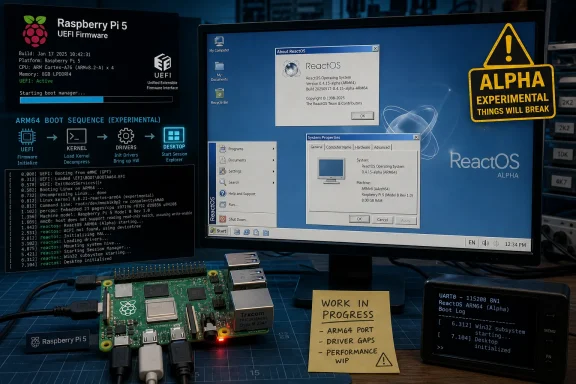
But the screenshot is also a trap. Desktops imply readiness. They suggest interactivity, applications, and a user journey. In this case, the more honest artifact is the boot log, the build note, the warning, the hardware requirement, and the phrase experimental state.
That tension is familiar in open source operating-system work. The first visible UI makes outsiders think the hard part is over. Developers know it often means the hard part has finally become debuggable.
ReactOS on ARM64 is now in that zone. It has crossed from hypothetical to demonstrable. The next steps are less photogenic: more hardware support, fewer boot failures, better drivers, improved stability, clearer installation paths, and eventually some reason for users beyond curiosity to spend time there.
Those steps may take a long time. With ReactOS, long time scales are not a prediction; they are the operating condition.
 ReactOS Finds New Life by Booting Somewhere Impractical
ReactOS has always lived in the awkward space between nostalgia, systems research, and a very practical itch: what if the Windows NT world could be recreated in open source form, without needing Windows itself? For years, that ambition has been measured in small increments: a driver that behaves better, a subsystem that no longer crashes, an installer that gets a little farther than before. The ARM64 boot changes the scenery without changing the fundamental pace.That matters because ReactOS is not simply another operating system port. Linux on Arm is now mundane; BSD on Arm is familiar; even Windows on Arm is old news in commercial terms. ReactOS on Arm is different because its job is not merely to run on a processor architecture. Its job is to impersonate a family of operating systems whose habits, APIs, kernel expectations, drivers, and edge cases were built around decades of x86 Windows assumptions.
The result is a milestone that sounds comically modest until you remember what is being attempted. Booting to a familiar Windows-like desktop on a Raspberry Pi 5 does not make ReactOS useful on the Pi. It does show that the project’s architecture is not permanently trapped in the PC clone world where most people mentally filed it away.
The joy here is therefore not productivity. It is the moment when an old software idea appears on a new class of hardware and refuses to look as absurd as it should.
The Desktop Is the Demo, but the Kernel Is the Story
A screenshot of a Windows-like desktop on a Raspberry Pi is the kind of thing that travels well on social media because it is instantly legible. The start menu, the taskbar, the gray dialog boxes, the ghost of Windows Server 2003-era UI conventions — these are the visible signals that ReactOS is doing its tribute act again. But the meaningful work is below that surface.ReactOS is not WINE with a bootloader. WINE translates or reimplements Windows user-mode APIs so Windows applications can run on Unix-like operating systems. ReactOS borrows from and collaborates with WINE where that makes sense, but its larger conceit is more ambitious: recreate enough of the NT kernel and surrounding system to run Windows software and, at least in principle, Windows drivers.
That distinction is why an ARM64 port is so hard to dismiss. A user-mode compatibility layer can often follow the host operating system’s lead on hardware enablement. A full operating system has to bring its own assumptions about interrupts, boot services, memory layout, processor state, platform firmware, devices, and drivers. It does not get to hide behind Linux.
On ARM64, those assumptions become unusually exposed. The Windows NT design was always portable in theory, and Microsoft famously supported non-x86 architectures in earlier NT eras. But ReactOS is not Microsoft with archived design documents and internal test suites. It is a volunteer project reconstructing behavior, compatibility, and quirks from public information, clean-room work, and an enormous amount of patient debugging.
That makes the ARM64 build a technical flex in the old sense of the term. It is not flexing because it is polished. It is flexing because it got far enough to prove the architecture can be made to stand up.
The Raspberry Pi 5 Is a Symbol, Not a Target Market
The Raspberry Pi 5 is a wonderful board for experiments precisely because it is not a bland enterprise reference platform. It is cheap enough to risk, powerful enough to be interesting, and popular enough that a screenshot from it carries meaning beyond the developer mailing list. But that popularity can mislead.ReactOS on a Pi 5 is not competing with Raspberry Pi OS, Ubuntu, Fedora, or any of the many Linux-based images that already make the board useful. It is not about turning the Pi into a pocket Windows workstation. The current ARM64 build is experimental, and even enthusiastic testers describe the process as something closer to mountaineering than installation.
The reported requirements explain why. The build expects a UEFI ARM64 system, with GICv2 or GICv3 support, and it targets boards from ARMv8-A onward. The Raspberry Pi 5 is treated as a special case rather than the happy path. That is exactly what seasoned Pi users have learned to expect from operating systems that want standard firmware abstractions on hardware that grew up with its own boot conventions.
There is a useful humility in that. The ReactOS team is not pretending this is a consumer release, and nobody should treat it as one. A successful boot on the Pi is a demonstration that the port can survive contact with real hardware, not a promise that the Pi has become a supported ReactOS machine in any ordinary sense.
For WindowsForum readers, that distinction is important. If you are the sort of person who keeps sacrificial SSDs, serial adapters, spare microSD cards, and a drawer full of power supplies, this is your kind of fun. If you are looking for a stable Arm desktop, the fun ends before the installer does.
Thirty Years Later, Alpha Still Means Alpha
ReactOS recently marked 30 years since the first commit to its source tree, a milestone that invites both admiration and mockery. Thirty years is a long time for any software project. Thirty years in alpha is an internet punchline waiting to happen.But the obvious joke is also the least interesting analysis. ReactOS is trying to recreate the behavior of one of the most commercially consequential operating-system families ever shipped, including compatibility surfaces that were never designed to be neatly cloned by outsiders. The project’s target remains rooted in Windows Server 2003-era compatibility, which sounds antique until you remember how many industrial, embedded, archival, and hobbyist workflows still orbit old Windows software.
The age of the project does not absolve it from criticism. ReactOS is still not something an ordinary user should rely on for daily computing. Its hardware support remains narrow compared with mainstream operating systems, modern application compatibility is not the point, and security expectations for production systems are in another universe.
Still, “alpha” is not merely a legal shield here. It is a useful description of a project whose ambition is structurally punishing. Every visible success tends to expose a deeper compatibility problem. Every old Windows program that launches creates pressure for the one next to it to behave exactly as it did on Microsoft’s implementation.
That is why the ARM64 milestone lands differently from a routine port. It does not shorten the distance to a polished release. It shows that the project can still absorb new platform work while carrying the weight of its old compatibility promise.
Microsoft Moved On, but the NT Shape Remains
The irony of ReactOS in 2026 is that Microsoft itself has moved Windows into places that once would have seemed exotic. Windows on Arm is now a real product line. Qualcomm-powered Copilot+ PCs have put Arm laptops into the mainstream Windows conversation. Azure, virtualization, Windows Subsystem for Linux, and cloud-managed endpoints have all changed what “Windows compatibility” means in practice.ReactOS, meanwhile, is still chasing the older NT world — and that may be exactly why it retains its hold on enthusiasts. Modern Windows is a service, a platform, a policy engine, a telemetry surface, a security boundary, an app runtime, and a subscription-adjacent business asset. ReactOS is something more primitive: an attempt to make the old Windows contract understandable and reproducible.
That contract was powerful because it was stable enough to build a civilization of software around it. Applications expected certain APIs. Drivers expected certain kernel behaviors. Administrators expected a certain style of system layout. Users expected the desktop to behave in ways that became muscle memory.
ReactOS is interesting because it treats that old contract as a public artifact worth preserving, not merely a proprietary implementation to be replaced. The project’s ARM64 build does not suddenly make that contract modern. It suggests the contract can be moved, studied, and reanimated on hardware that did not exist when Windows Server 2003 was current.
That is more culturally significant than practically useful. But operating-system history is full of impractical ports that later taught developers where the real assumptions were hiding.
The Real Achievement Is Surviving the Boot Chain
Booting an operating system is often described as if it were a single event. In reality, it is a sequence of negotiations, and every one can fail in a way that looks opaque to outsiders. Firmware must hand over control. The kernel must understand the machine well enough to continue. Interrupts, timers, memory, storage, display, and input must all reach some minimal level of cooperation.On x86 PCs, decades of standardization and accumulated hacks hide much of that complexity. On ARM64 systems, the story is cleaner in some ways and messier in others. UEFI helps. Standard interrupt controllers help. But boards still differ, firmware quality varies, and the assumptions baked into an operating system’s earliest startup code are brutally unforgiving.
That is why the “it boots” milestone deserves more respect than it usually gets. Booting is not the same as being usable, but it is the moment when theory becomes a machine state. Before boot, a port is an aspiration in a repository. After boot, it is a bug list with a heartbeat.
The reported eight months of contributor work behind the ARM64 port also matters. Volunteer operating-system projects do not have infinite staffing, and deep porting work is not glamorous in the way application features are. It is a long grind through build systems, architecture-specific code paths, firmware assumptions, exception handling, and low-level debugging.
This is the kind of work that keeps old systems alive and makes new experiments possible. It is also the kind of work that can disappear into a changelog unless someone stops to say: no, that was the hard part.
Nostalgia Helps, but It Does Not Explain the Persistence
ReactOS is often framed as nostalgia, and not unfairly. Its default visual language evokes the Windows era many enthusiasts still consider legible, efficient, and mercifully free of modern UI churn. For anyone who misses the feel of Windows 2000, XP, or Server 2003, ReactOS has an immediate emotional hook.But nostalgia alone does not sustain a project for three decades. The more durable appeal is control. ReactOS represents the fantasy — and occasionally the reality — of a Windows-compatible system whose internals are open to inspection and modification. That fantasy has only become more potent as commercial operating systems have become more managed, more connected, and more opinionated.
There is also a preservation argument. Old Windows software is part of computing history, and a surprising amount of it still matters to people who run labs, factories, instruments, games, archives, and weird one-off business processes. Virtual machines help, but they do not solve every hardware, licensing, or long-term maintenance problem.
ReactOS offers a different preservation path: not emulating an entire old PC environment as a sealed museum exhibit, but recreating the operating system interface in a form that can evolve. That is a difficult and incomplete path, but it is not irrational.
The ARM64 port strengthens that argument symbolically. It says ReactOS is not only a shrine to beige-box Windows. It can also be a laboratory for asking which parts of the NT model survive when the old hardware assumptions are stripped away.
The Port Also Exposes the Limits of the Dream
The danger with any ReactOS milestone is that enthusiasm outruns the facts. A booting ARM64 build does not mean the project is close to becoming a drop-in Windows replacement. It does not mean your old x86 Windows applications will magically run on a Raspberry Pi. It does not mean driver compatibility has somehow become easy.Architecture matters. Much of the classic Windows software people associate with ReactOS is x86 or x86-64 software. Running that on ARM64 requires either native ARM64 builds, emulation, translation, or some other compatibility layer beyond the operating-system port itself. Microsoft can throw large engineering teams at that problem. ReactOS cannot pretend it away.
Drivers are even more complicated. ReactOS has long aimed at driver compatibility, but the driver universe is architecture-specific, version-specific, and full of assumptions about the real Windows kernel. A Windows XP-era x86 driver is not going to become useful on a Pi 5 because the ReactOS desktop appeared there.
That does not make the port pointless. It clarifies what kind of point it has. ARM64 ReactOS is presently a platform milestone for developers and experimenters, not a user-facing compatibility breakthrough. Its value is in widening the project’s engineering horizon.
For IT pros, the practical advice is simple: admire it, test it only on expendable hardware, and do not confuse a successful boot with an operating environment you can support.
The Windows Alternative Conversation Keeps Splitting in Two
Every few years, the Windows community rediscovers the question of alternatives. Sometimes the answer is Linux, especially for users who can move their workflow to a browser, open source apps, or Steam-backed gaming. Sometimes the answer is macOS, for people willing to leave the PC ecosystem entirely. Sometimes the answer is simply older Windows in a VM, isolated and preserved for one stubborn application.ReactOS occupies a different branch of that conversation. It is not an alternative to Windows because it offers a better modern desktop. It is an alternative in the more literal sense: a different implementation of the Windows idea. That makes it fascinating and frustrating in equal measure.
The frustration is obvious. Users want replacement operating systems to solve today’s problems: hardware support, security updates, modern browsers, current productivity apps, games, battery life, enterprise management, and sane installation. ReactOS is not positioned to satisfy that checklist.
The fascination is that ReactOS keeps pursuing a problem most of the industry has routed around. Instead of saying “port your app,” “use a web version,” “run a VM,” or “accept the vendor platform,” it asks whether the Windows-compatible substrate itself can be rebuilt. That is a stubbornly unfashionable question, which is why the project remains interesting.
The ARM64 boot does not settle the alternatives debate. It reminds us that compatibility is not one thing. It can mean source compatibility, binary compatibility, driver compatibility, UI familiarity, administrative habit, file format survival, or simply the emotional confidence that a machine behaves the way we expect.
Where Sysadmins Should Draw the Line
For administrators, the temptation with ReactOS has always been to imagine it as a rescue tool for legacy Windows dependencies. That temptation should be resisted in production. ReactOS remains alpha-quality software, and the ARM64 build is explicitly more experimental still.In lab environments, however, this milestone has real educational value. It gives systems-minded users a way to watch NT-like design concepts meet modern Arm platform requirements. It can also serve as a reminder of how much work commercial operating systems hide behind a polished boot screen.
There is a security angle, too, though not the simplistic one. Open source does not automatically mean safe, and ReactOS should not be treated as a hardened replacement for supported Windows releases. Its value for security-minded readers is more about inspectability and experimentation than deployment.
A mature ReactOS would raise fascinating questions about legacy application containment, driver behavior, and forensic transparency. The current ARM64 build raises a simpler question: how do you even get an NT-like system to initialize reliably on a board like this? That is a worthy question, but it belongs on a bench, not in a rack.
The boundary is therefore not enthusiasm versus skepticism. It is lab versus production. ReactOS on ARM64 belongs firmly in the former.
The Small Team Problem Is Also the Integrity of the Project
ReactOS’s slow progress is inseparable from its scale. Recreating Windows compatibility is the kind of task that would be daunting for a large, well-funded engineering organization. For a volunteer-driven open source project, it is almost unreasonable by design.That unreasonableness is part of why the project inspires loyalty. ReactOS persists without the normal incentives of platform dominance, app-store economics, cloud lock-in, or enterprise licensing. It advances because contributors find the problem worth solving.
There is a downside to that purity. Users waiting for a polished release can wait a very long time. Hardware support will lag. Compatibility will remain uneven. Big architectural leaps will depend on small numbers of people doing difficult work over months or years.
But there is also an upside. ReactOS is not being steered toward a quarterly product story. It can make a strange ARM64 port because that work is technically meaningful, even if it does not immediately produce a marketable feature. In an industry increasingly optimized around product surfaces and subscription funnels, that kind of engineering motivation feels almost antique.
Antique is not the same as obsolete. Sometimes it is how hard problems survive long enough for the next generation of hardware to make them interesting again.
The Raspberry Pi Desktop Moment Says Less Than the Boot Log Says
The emotional center of this story is the screenshot: a Windows-like desktop on a Raspberry Pi 5. It is the kind of image that makes an old PC enthusiast smile before the rational brain has time to intervene. It compresses decades of computing history into one improbable frame.But the screenshot is also a trap. Desktops imply readiness. They suggest interactivity, applications, and a user journey. In this case, the more honest artifact is the boot log, the build note, the warning, the hardware requirement, and the phrase experimental state.
That tension is familiar in open source operating-system work. The first visible UI makes outsiders think the hard part is over. Developers know it often means the hard part has finally become debuggable.
ReactOS on ARM64 is now in that zone. It has crossed from hypothetical to demonstrable. The next steps are less photogenic: more hardware support, fewer boot failures, better drivers, improved stability, clearer installation paths, and eventually some reason for users beyond curiosity to spend time there.
Those steps may take a long time. With ReactOS, long time scales are not a prediction; they are the operating condition.
The Practical Lessons Hide Inside the Experiment
The most concrete lesson from the ARM64 milestone is not that everyone should rush to install ReactOS on a Pi. It is that compatibility projects remain technically alive when they keep challenging their own assumptions. A project devoted to an old Windows target just proved it can still learn a new platform trick.- ReactOS has produced an experimental ARM64 build that can boot on UEFI Arm systems and has been shown running through QEMU and on Raspberry Pi 5 hardware.
- The Raspberry Pi 5 work is a proof of concept rather than a practical desktop option, and the setup remains suitable only for patient testers with expendable hardware.
- The project’s larger goal remains Windows NT-style compatibility, especially around the Windows Server 2003 era, rather than becoming a modern Windows 11 clone.
- The ARM64 port does not make old x86 Windows applications or drivers automatically useful on Arm hardware.
- The milestone is most important as low-level operating-system work, because getting an NT-like environment through the ARM64 boot process is itself a significant achievement.
- For sysadmins and Windows enthusiasts, the right response is cautious admiration: test in the lab, keep it away from production, and treat every successful boot as data rather than a promise.
References
- Primary source: The Register
Published: 2026-05-28T11:30:25.765982
ReactOS brings its Windows NT tribute act to ARM64
Experimental build boots on Raspberry Pi 5, but for now the joy is mostly in getting therewww.theregister.com - Related coverage: phoronix.com
ReactOS Now Running On ARM64 In Experimental Form - Phoronix
ReactOS as the 'open-source Windows' project working to implement binary compatibility for computer programs and drivers for Microsoft Windows now has experimental support for running on 64-bit ARM.www.phoronix.com
- Related coverage: reactos.org
30 years of ReactOS | ReactOS Project
ReactOS is a free, opensource reimplementation of windowsreactos.org
- Related coverage: heise.de
Windows-XP-Nachbau ReactOS ist 30 | heise online
Das ReactOS-Projekt, das ein Windows-XP-kompatibles Betriebssystem entwickelt, feiert seinen 30. Geburtstag. www.heise.de
- Related coverage: medium.com
ReactOS at 30: Three Decades of Open-Source Windows Compatibility | by Re: News | Medium
ReactOS at 30: Three Decades of Open-Source Windows Compatibility ReactOS marks its 30th anniversary in January 2026, celebrating three decades since its first commit and a long-running ambition: to …medium.com - Official source: microsoft.fandom.com
ReactOS | Microsoft Wiki | Fandom
ReactOS is an operating system that is binary compatible with most Microsoft Windows programs, features, and services. It is written mostly in C, with some parts, such as the File Explorer, in C++ and some minor bits of assembly. It is mostly licensed under the GNU General Public License...microsoft.fandom.com
- Official source: github.com
GitHub - reactos/reactos: A free Windows-compatible Operating System · GitHub
A free Windows-compatible Operating System. Contribute to reactos/reactos development by creating an account on GitHub. github.com
- Related coverage: osnews.com
ReactOS Targets Windows 2003, Vista – OSnews
 www.osnews.com
- Related coverage: news.slashdot.org
ReactOS Celebrates 30 Years - Slashdot
jeditobe writes: ReactOS, the open-source operating system aimed at binary compatibility with Windows, recently marked its 30th anniversary. Launched in 1996, ReactOS has focused on providing a free alternative to Windows, with compatibility for Windows applications and drivers. Though still in...news.slashdot.org - Related coverage: fosdem.org
- Related coverage: unifiedbiz.com
