

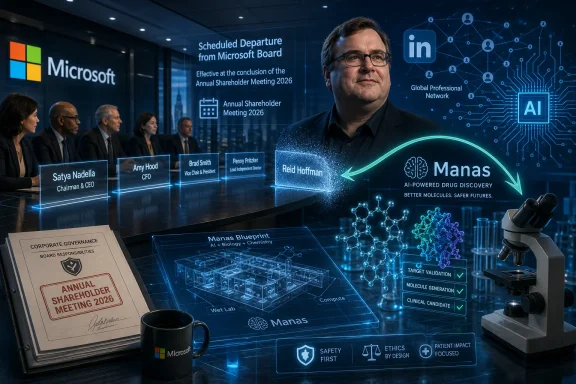
Reid Hoffman, the LinkedIn co-founder and longtime AI investor, told Microsoft on June 2, 2026, that he will not stand for re-election to its board at the company’s 2026 annual shareholder meeting, ending a directorship that began in 2017. He will remain in the seat until that vote, which makes this a scheduled handoff rather than a sudden boardroom rupture. The real story is not that Microsoft is losing a famous director; it is that one of the Valley’s most networked AI evangelists is choosing founder time over governance time. In 2026, that choice says as much about where AI prestige is moving as it does about Microsoft’s board.
Microsoft’s filing gives investors the cleanest possible version of a board departure. Hoffman is not resigning immediately, Microsoft is not announcing a dispute, and the company says the move is not tied to disagreement over management, operations, policies, or practices. In corporate-governance language, that is the boilerplate investors look for when a director’s exit should not be read as a warning flare.
But orderly does not mean insignificant. Hoffman joined Microsoft’s board in 2017, shortly after the company completed its $26.2 billion acquisition of LinkedIn, then the largest deal in Microsoft’s history. His presence helped symbolize a post-Ballmer Microsoft that was more fluent in Silicon Valley networks, enterprise social data, venture-backed platforms, and later the broader AI boom.
That symbolism mattered because LinkedIn was not just another asset folded into Microsoft’s productivity empire. It became a data-rich professional graph attached to Office, Dynamics, recruiting, advertising, and eventually AI-inflected work tools. Hoffman’s board role gave Microsoft a direct line to the founder culture behind one of its most strategically important acquisitions.
The departure also arrives after Microsoft has spent years recasting itself as an AI infrastructure and software company. Azure, Copilot, GitHub, OpenAI partnerships, Windows AI features, security automation, and enterprise agents are now part of the same strategic pitch. A director with Hoffman’s AI investing and founder history was never a routine résumé line on that board.
That is the opposite of the abrupt exits that invite speculation. Public companies know that a sudden resignation by a high-profile director can trigger investor anxiety, especially when the director sits near a major strategic theme. By anchoring the change to the annual meeting, Microsoft is telling shareholders that governance continuity is intact.
For WindowsForum readers, the practical effect is that nothing changes overnight in Microsoft’s operating structure. Nadella remains CEO, Microsoft AI remains under Mustafa Suleyman, LinkedIn remains integrated into the company, and the board continues functioning through the election cycle. The change matters at the level of oversight, influence, and signal — not at the level of this month’s Patch Tuesday.
Still, boards are not decorative. They approve executive compensation, oversee risk, monitor strategy, and provide networks of expertise that shape how management thinks. A Microsoft board without Hoffman will still be experienced, but it will lose a director whose career sits unusually close to LinkedIn, venture capital, AI startups, and the founder mythology now surrounding the industry’s next phase.
That makes Manas a more demanding use of founder attention than its sleek category label suggests. AI drug discovery companies must integrate models, biological knowledge, data pipelines, wet-lab validation, and clinical-development judgment. The work is slower, more expensive, and less forgiving than shipping a productivity feature to millions of users and improving it with telemetry.
Hoffman’s move therefore has a sharper edge than the usual “spend more time on other interests” language. He is moving from oversight at a mature software giant to hands-on influence at a startup trying to make AI useful in one of the hardest commercial environments in technology. If the AI boom’s first phase was about text, code, images, and search, Manas belongs to the second phase: AI as an engine for scientific and industrial work.
That distinction matters. The world has seen enough AI pitch decks promising acceleration, compression, and new discovery loops. In drug development, the proof is not a viral interface or a benchmark result; it is whether candidates move through validation and clinical pathways with better odds, lower cost, or greater speed than conventional methods.
That overlap became more sensitive as Microsoft reorganized around AI. In March 2024, Microsoft created a new Microsoft AI organization under Mustafa Suleyman, the DeepMind and Inflection co-founder who had built Inflection with Hoffman and Karén Simonyan. The new unit concentrated consumer AI products and research, including Copilot, Bing, and Edge, under a leader with deep ties to the same AI network Hoffman helped cultivate.
None of that means Hoffman’s board seat was improper. Large technology companies often recruit directors precisely because they understand adjacent markets, emerging technologies, and founder-led ecosystems. But the modern AI industry has made those relationships more visible, more scrutinized, and more politically charged.
Microsoft is under pressure from multiple directions. Investors want AI spending to translate into durable revenue. Regulators are watching partnerships, talent deals, cloud concentration, and platform leverage. Customers want productivity gains without security, privacy, or compliance surprises. A board member whose external AI interests keep multiplying is useful — but also inevitably closer to the thicket.
Nearly a decade later, LinkedIn is no longer a newly acquired property that needs founder translation. It is an established Microsoft business, deeply embedded in the company’s enterprise narrative. It has its own management structure, its own product cadence, and its own role in Microsoft’s broader data and AI ambitions.
That maturity reduces the governance need for Hoffman’s LinkedIn-specific presence. Microsoft no longer needs to reassure the market that it understands what it bought in 2016. The question now is how LinkedIn’s professional graph should be used responsibly inside AI-infused products for sales, recruiting, learning, advertising, and workplace analytics.
That is a different governance problem. It is less about founder integration and more about data stewardship, competition, labor-market effects, and enterprise trust. Microsoft can find directors with AI, security, healthcare, policy, or global regulatory experience who may be better suited to the company’s next decade than a director whose original strategic bridge has already been built.
That is especially true in health and life sciences. AI’s productivity story in software is already well understood, even if its economics remain contested. In biology, the promise is more profound and more uncertain. If AI can materially improve discovery pipelines, target selection, compound design, or clinical-development decisions, the upside is not merely faster office work but new medicines.
The catch is that biology punishes overconfidence. Models can generate plausible candidates, but the body is not a spreadsheet. Experimental validation, safety, efficacy, manufacturing, trial design, and regulatory review remain stubborn filters. A startup like Manas must prove that AI can change the odds, not simply decorate the process with modern tooling.
That is where founder attention becomes valuable. Early-stage biotech and AI companies need more than capital; they need narrative discipline, talent magnetism, partner credibility, and strategic patience. Hoffman brings a rare blend of investor network, founder identity, AI evangelism, and public persuasion to a company that will need all four.
That loss is manageable, but it sharpens the question of what kind of AI oversight Microsoft wants next. The company’s AI risks are no longer abstract. They involve massive infrastructure spending, model reliability, copyright litigation, cybersecurity, enterprise data boundaries, consumer safety, labor displacement, regulatory exposure, and the reputational consequences of pushing AI into products used by hundreds of millions of people.
A board optimized for the cloud transition may not automatically be optimized for the AI accountability era. Microsoft has already shown it can acquire, partner, and reorganize aggressively. The harder task is proving that the same speed can coexist with durable governance.
For administrators and enterprise buyers, this matters because board-level priorities eventually show up in product behavior. They influence how much Microsoft emphasizes security over growth, transparency over bundling, and customer control over frictionless adoption. AI governance may sound remote from the help desk, but it shapes the defaults that IT departments inherit.
But public filings are designed to answer legal and investor questions, not to narrate the full human logic of a career pivot. The filing explains what the exit is not. It does not explain why a founder-investor who has spent years near AI’s center of gravity now wants more time for a drug-discovery company.
That distinction is where the story lives. Hoffman is not leaving Microsoft’s board because Microsoft has become irrelevant to AI. He is leaving while Microsoft is one of the most important AI companies in the world. The implication is that the next interesting frontier, for him, is not the governance of a platform incumbent but the construction of an AI-native company in a regulated scientific market.
That should make Microsoft observers cautious about overreading the move as a negative judgment on Redmond. It looks more like a portfolio-of-attention decision. Hoffman has finite time, and Manas appears to require the kind of founder involvement that a Microsoft board seat competes with rather than complements.
The relevance is more strategic. Microsoft is embedding AI across Windows, developer tools, cloud services, security products, and productivity software. The company’s board must understand not only how AI creates revenue, but how it creates systemic risk. Losing one high-profile AI-connected director slightly changes the mix of voices around that table.
For sysadmins, the practical concern is Microsoft’s appetite for AI-by-default product design. Enterprise IT has spent the past three years sorting through Copilot licensing, data exposure questions, retention policies, admin controls, model behavior, and user training. The board does not write Group Policy settings, but it does oversee the management culture that decides whether control surfaces are first-class requirements or afterthoughts.
For developers, the story is similar. GitHub Copilot, Azure AI services, Windows developer tooling, and AI-assisted coding are now part of Microsoft’s growth narrative. The board’s job is to push management beyond hype and toward defensible platforms, sustainable margins, and responsible deployment.
The first wave of generative AI rewarded companies that could put language models in front of users quickly. The next wave will reward companies that can convert models into domain-specific outcomes. Those outcomes may appear in law, finance, engineering, materials science, robotics, cybersecurity, and medicine. They will require more than prompt boxes.
Drug discovery is a brutal test case because failure is normal. Many promising compounds never become approved medicines. Many biological hypotheses collapse under experimental pressure. The value of AI is not whether it can produce more possibilities; it is whether it can improve the quality of decisions at each expensive step.
That is why Manas is an unusually serious destination for Hoffman’s attention. It gives him a chance to argue that AI is not only a software interface revolution but a discovery infrastructure. If that argument works, it strengthens the entire AI industry’s claim to be more than a productivity bubble.
There is no single correct answer. Microsoft is now too large and too exposed for any one director profile to cover its needs. It is a cloud provider, operating-system maker, enterprise software vendor, gaming company, advertising business, AI platform, security provider, developer ecosystem, and LinkedIn owner. Every board seat is a tradeoff.
But the Hoffman transition gives Microsoft an opportunity to update the board for the next version of its AI era. The company’s early AI advantage was built on speed, capital, partnerships, and product integration. Its next advantage may depend on trust, deployment discipline, customer control, and the ability to satisfy regulators without slowing itself into irrelevance.
That is where governance becomes strategy. A board that asks sharper questions about AI margins, safety, competition, and enterprise readiness can make Microsoft stronger. A board that treats AI as a permanent halo around the stock price will not.
 Hoffman’s Exit Is Orderly, but It Is Not Small
Microsoft’s filing gives investors the cleanest possible version of a board departure. Hoffman is not resigning immediately, Microsoft is not announcing a dispute, and the company says the move is not tied to disagreement over management, operations, policies, or practices. In corporate-governance language, that is the boilerplate investors look for when a director’s exit should not be read as a warning flare.But orderly does not mean insignificant. Hoffman joined Microsoft’s board in 2017, shortly after the company completed its $26.2 billion acquisition of LinkedIn, then the largest deal in Microsoft’s history. His presence helped symbolize a post-Ballmer Microsoft that was more fluent in Silicon Valley networks, enterprise social data, venture-backed platforms, and later the broader AI boom.
That symbolism mattered because LinkedIn was not just another asset folded into Microsoft’s productivity empire. It became a data-rich professional graph attached to Office, Dynamics, recruiting, advertising, and eventually AI-inflected work tools. Hoffman’s board role gave Microsoft a direct line to the founder culture behind one of its most strategically important acquisitions.
The departure also arrives after Microsoft has spent years recasting itself as an AI infrastructure and software company. Azure, Copilot, GitHub, OpenAI partnerships, Windows AI features, security automation, and enterprise agents are now part of the same strategic pitch. A director with Hoffman’s AI investing and founder history was never a routine résumé line on that board.
The Calendar Turns a Departure Into a Managed Transition
The timing is doing quiet work here. Hoffman remains a director until Microsoft’s 2026 annual shareholder meeting, keeping the transition inside the normal cadence of director elections. That gives Microsoft room to nominate a replacement, shrink or reshape the slate, or use the next proxy cycle to explain how it wants the board to evolve.That is the opposite of the abrupt exits that invite speculation. Public companies know that a sudden resignation by a high-profile director can trigger investor anxiety, especially when the director sits near a major strategic theme. By anchoring the change to the annual meeting, Microsoft is telling shareholders that governance continuity is intact.
For WindowsForum readers, the practical effect is that nothing changes overnight in Microsoft’s operating structure. Nadella remains CEO, Microsoft AI remains under Mustafa Suleyman, LinkedIn remains integrated into the company, and the board continues functioning through the election cycle. The change matters at the level of oversight, influence, and signal — not at the level of this month’s Patch Tuesday.
Still, boards are not decorative. They approve executive compensation, oversee risk, monitor strategy, and provide networks of expertise that shape how management thinks. A Microsoft board without Hoffman will still be experienced, but it will lose a director whose career sits unusually close to LinkedIn, venture capital, AI startups, and the founder mythology now surrounding the industry’s next phase.
Manas Is the Destination, Not the Excuse
The destination of Hoffman’s attention is Manas, the AI-native biopharmaceutical startup he co-founded in 2025 with physician-scientist and author Siddhartha Mukherjee. The company is focused on applying AI to drug discovery, with ambitions that run far beyond building another chatbot or office assistant. It is the kind of company whose claims must eventually survive not just demos, but laboratories, regulators, clinical evidence, and patients.That makes Manas a more demanding use of founder attention than its sleek category label suggests. AI drug discovery companies must integrate models, biological knowledge, data pipelines, wet-lab validation, and clinical-development judgment. The work is slower, more expensive, and less forgiving than shipping a productivity feature to millions of users and improving it with telemetry.
Hoffman’s move therefore has a sharper edge than the usual “spend more time on other interests” language. He is moving from oversight at a mature software giant to hands-on influence at a startup trying to make AI useful in one of the hardest commercial environments in technology. If the AI boom’s first phase was about text, code, images, and search, Manas belongs to the second phase: AI as an engine for scientific and industrial work.
That distinction matters. The world has seen enough AI pitch decks promising acceleration, compression, and new discovery loops. In drug development, the proof is not a viral interface or a benchmark result; it is whether candidates move through validation and clinical pathways with better odds, lower cost, or greater speed than conventional methods.
Microsoft Loses a Director Who Sat at the Intersection of Its Biggest Bets
Hoffman’s Microsoft board role always carried more meaning than a single governance seat. He was the LinkedIn co-founder on the board of the company that bought LinkedIn. He was a Greylock partner and startup investor watching Microsoft transform itself into a cloud and AI platform company. He was also part of the broader AI founder ecosystem through Inflection AI and later Manas.That overlap became more sensitive as Microsoft reorganized around AI. In March 2024, Microsoft created a new Microsoft AI organization under Mustafa Suleyman, the DeepMind and Inflection co-founder who had built Inflection with Hoffman and Karén Simonyan. The new unit concentrated consumer AI products and research, including Copilot, Bing, and Edge, under a leader with deep ties to the same AI network Hoffman helped cultivate.
None of that means Hoffman’s board seat was improper. Large technology companies often recruit directors precisely because they understand adjacent markets, emerging technologies, and founder-led ecosystems. But the modern AI industry has made those relationships more visible, more scrutinized, and more politically charged.
Microsoft is under pressure from multiple directions. Investors want AI spending to translate into durable revenue. Regulators are watching partnerships, talent deals, cloud concentration, and platform leverage. Customers want productivity gains without security, privacy, or compliance surprises. A board member whose external AI interests keep multiplying is useful — but also inevitably closer to the thicket.
The LinkedIn Era Has Matured Into Something Less Founder-Dependent
When Hoffman joined Microsoft’s board, LinkedIn was still relatively fresh inside the company. The acquisition was a strategic leap: Microsoft was buying not only a professional network, but a data layer around identity, employment, recruiting, content, and business relationships. Keeping the co-founder close made obvious sense.Nearly a decade later, LinkedIn is no longer a newly acquired property that needs founder translation. It is an established Microsoft business, deeply embedded in the company’s enterprise narrative. It has its own management structure, its own product cadence, and its own role in Microsoft’s broader data and AI ambitions.
That maturity reduces the governance need for Hoffman’s LinkedIn-specific presence. Microsoft no longer needs to reassure the market that it understands what it bought in 2016. The question now is how LinkedIn’s professional graph should be used responsibly inside AI-infused products for sales, recruiting, learning, advertising, and workplace analytics.
That is a different governance problem. It is less about founder integration and more about data stewardship, competition, labor-market effects, and enterprise trust. Microsoft can find directors with AI, security, healthcare, policy, or global regulatory experience who may be better suited to the company’s next decade than a director whose original strategic bridge has already been built.
The AI Boom Is Pulling Talent Away From Oversight and Toward Ownership
There is a broader pattern underneath Hoffman’s exit. The AI boom has made board seats at huge companies prestigious, but it has made founder roles feel historically consequential. For investors and entrepreneurs who believe AI is still early, the highest-status move is not advising an incumbent; it is building the company that proves the next use case.That is especially true in health and life sciences. AI’s productivity story in software is already well understood, even if its economics remain contested. In biology, the promise is more profound and more uncertain. If AI can materially improve discovery pipelines, target selection, compound design, or clinical-development decisions, the upside is not merely faster office work but new medicines.
The catch is that biology punishes overconfidence. Models can generate plausible candidates, but the body is not a spreadsheet. Experimental validation, safety, efficacy, manufacturing, trial design, and regulatory review remain stubborn filters. A startup like Manas must prove that AI can change the odds, not simply decorate the process with modern tooling.
That is where founder attention becomes valuable. Early-stage biotech and AI companies need more than capital; they need narrative discipline, talent magnetism, partner credibility, and strategic patience. Hoffman brings a rare blend of investor network, founder identity, AI evangelism, and public persuasion to a company that will need all four.
Microsoft’s AI Governance Story Continues Without One of Its Most Visible Connectors
Microsoft will not struggle to find AI advice. The company has internal AI leadership, deep research capacity, major partnerships, and a board stocked with experienced executives. But Hoffman’s departure removes a particular kind of connector: someone who could bridge venture-backed AI culture, LinkedIn’s platform history, and Microsoft’s boardroom.That loss is manageable, but it sharpens the question of what kind of AI oversight Microsoft wants next. The company’s AI risks are no longer abstract. They involve massive infrastructure spending, model reliability, copyright litigation, cybersecurity, enterprise data boundaries, consumer safety, labor displacement, regulatory exposure, and the reputational consequences of pushing AI into products used by hundreds of millions of people.
A board optimized for the cloud transition may not automatically be optimized for the AI accountability era. Microsoft has already shown it can acquire, partner, and reorganize aggressively. The harder task is proving that the same speed can coexist with durable governance.
For administrators and enterprise buyers, this matters because board-level priorities eventually show up in product behavior. They influence how much Microsoft emphasizes security over growth, transparency over bundling, and customer control over frictionless adoption. AI governance may sound remote from the help desk, but it shapes the defaults that IT departments inherit.
The “No Disagreement” Line Is Useful, but It Is Not the Whole Story
Microsoft’s statement that Hoffman’s decision is not the result of a disagreement is important. It narrows the field of responsible interpretation. There is no public basis to claim a fight over strategy, management, operations, or policy.But public filings are designed to answer legal and investor questions, not to narrate the full human logic of a career pivot. The filing explains what the exit is not. It does not explain why a founder-investor who has spent years near AI’s center of gravity now wants more time for a drug-discovery company.
That distinction is where the story lives. Hoffman is not leaving Microsoft’s board because Microsoft has become irrelevant to AI. He is leaving while Microsoft is one of the most important AI companies in the world. The implication is that the next interesting frontier, for him, is not the governance of a platform incumbent but the construction of an AI-native company in a regulated scientific market.
That should make Microsoft observers cautious about overreading the move as a negative judgment on Redmond. It looks more like a portfolio-of-attention decision. Hoffman has finite time, and Manas appears to require the kind of founder involvement that a Microsoft board seat competes with rather than complements.
For Windows Users, the Change Is Indirect but Not Irrelevant
Most Windows users will not notice Hoffman’s departure. It will not change the Start menu, Copilot’s placement, Edge’s defaults, or Microsoft 365 licensing. Board transitions rarely announce themselves through visible interface changes.The relevance is more strategic. Microsoft is embedding AI across Windows, developer tools, cloud services, security products, and productivity software. The company’s board must understand not only how AI creates revenue, but how it creates systemic risk. Losing one high-profile AI-connected director slightly changes the mix of voices around that table.
For sysadmins, the practical concern is Microsoft’s appetite for AI-by-default product design. Enterprise IT has spent the past three years sorting through Copilot licensing, data exposure questions, retention policies, admin controls, model behavior, and user training. The board does not write Group Policy settings, but it does oversee the management culture that decides whether control surfaces are first-class requirements or afterthoughts.
For developers, the story is similar. GitHub Copilot, Azure AI services, Windows developer tooling, and AI-assisted coding are now part of Microsoft’s growth narrative. The board’s job is to push management beyond hype and toward defensible platforms, sustainable margins, and responsible deployment.
Manas Shows Where AI’s Prestige Economy Is Headed
The most revealing part of Hoffman’s move is that Manas is not a consumer social app, a work assistant, or a cloud abstraction layer. It is a bet that AI can contribute to drug discovery, one of the oldest dreams in computational biology and one of the most stubbornly difficult commercial categories. That tells us something about where the prestige economy of AI is moving.The first wave of generative AI rewarded companies that could put language models in front of users quickly. The next wave will reward companies that can convert models into domain-specific outcomes. Those outcomes may appear in law, finance, engineering, materials science, robotics, cybersecurity, and medicine. They will require more than prompt boxes.
Drug discovery is a brutal test case because failure is normal. Many promising compounds never become approved medicines. Many biological hypotheses collapse under experimental pressure. The value of AI is not whether it can produce more possibilities; it is whether it can improve the quality of decisions at each expensive step.
That is why Manas is an unusually serious destination for Hoffman’s attention. It gives him a chance to argue that AI is not only a software interface revolution but a discovery infrastructure. If that argument works, it strengthens the entire AI industry’s claim to be more than a productivity bubble.
The Board Seat Becomes a Signal About Microsoft’s Next Director
Microsoft’s next move will be watched less for the name and more for the category of expertise. If the company replaces Hoffman with another venture or AI figure, it will suggest that Microsoft still wants board-level proximity to frontier AI entrepreneurship. If it chooses a security, healthcare, regulatory, or global operations veteran, it may signal that the company sees its next governance challenge as risk management rather than frontier sensing.There is no single correct answer. Microsoft is now too large and too exposed for any one director profile to cover its needs. It is a cloud provider, operating-system maker, enterprise software vendor, gaming company, advertising business, AI platform, security provider, developer ecosystem, and LinkedIn owner. Every board seat is a tradeoff.
But the Hoffman transition gives Microsoft an opportunity to update the board for the next version of its AI era. The company’s early AI advantage was built on speed, capital, partnerships, and product integration. Its next advantage may depend on trust, deployment discipline, customer control, and the ability to satisfy regulators without slowing itself into irrelevance.
That is where governance becomes strategy. A board that asks sharper questions about AI margins, safety, competition, and enterprise readiness can make Microsoft stronger. A board that treats AI as a permanent halo around the stock price will not.
The Hoffman Handoff Leaves Microsoft With a Narrower but Cleaner Story
The concrete facts are simple, but their meaning is layered. Hoffman is not being pushed out in public, Microsoft is not disclosing a dispute, and the transition is scheduled through the annual meeting. The uncertainty lies in what Microsoft does next and how much founder-level AI expertise it wants in the boardroom.- Hoffman informed Microsoft on June 2, 2026, that he will not stand for re-election at the 2026 annual shareholder meeting.
- Microsoft says the decision is not the result of a disagreement over management, operations, policies, or practices.
- Hoffman will remain a director until the shareholder vote, giving Microsoft a normal governance window to manage the transition.
- His departure closes a board chapter that began after Microsoft’s 2016 LinkedIn acquisition and his 2017 appointment.
- Manas gives Hoffman a more hands-on AI project in drug discovery, a field where software claims must eventually meet scientific and clinical proof.
- Microsoft’s next board choice will help show whether it wants more frontier AI proximity, more regulatory and security depth, or a different balance of both.
References
- Primary source: WinBuzzer
Published: 2026-06-06T09:50:49.420925
Reid Hoffman Sets Microsoft Board Exit to Focus on His AI Drug Discovery Startup
LinkedIn co-founder Reid Hoffman will leave Microsoft's board after the 2026 shareholder vote as he spends more time on Manas, his AI drug-discovery startup. winbuzzer.com
- Related coverage: investing.com
LinkedIn co-founder Reid Hoffman to step down from Microsoft’s board By Reuters
LinkedIn co-founder Reid Hoffman to step down from Microsoft’s boardwww.investing.com - Related coverage: stocktitan.net
Reid Hoffman to exit Microsoft (MSFT) board after 2026 annual meeting
Microsoft says director Reid Hoffman will not stand for re-election at the 2026 annual meeting and will serve until then, with no disagreement cited.www.stocktitan.net - Related coverage: tradingview.com
Reid Hoffman to Not Stand for Re-election to Microsoft Board; Will Serve Until 2026 Annual Meeting — TradingView News
Microsoft director Reid Hoffman informed the company he will not stand for re-election at the 2026 annual meeting and will continue to serve until that meeting.Original SEC Filing: MICROSOFT CORP [ MSFT ] - 8-K - Jun. 05, 2026This is an AI-powered summary. It may contain inaccuracies. Consider veri…www.tradingview.com
- Official source: microsoft.com
2025 Annual Shareholder Meeting
www.microsoft.com
- Related coverage: streetinsider.com
Microsoft board member Reid Hoffman to step down at 2026 meeting
Microsoft Corp. (NASDAQ: MSFT) announced that board member Reid Hoffman will not seek re-election at the company's 2026 annual shareholder meeting. Hoffman informed the company of his decision on June 2,...www.streetinsider.com
- Related coverage: startupfortune.com
Reid Hoffman is leaving Microsoft's board as AI scrutiny rises - Startup Fortune
Reid Hoffman will not stand for re-election to Microsoft's board at the company's 2026 annual shareholder meeting. His exit comes as Microsoft's AIstartupfortune.com - Official source: microsoft.gcs-web.com
- Related coverage: es.marketscreener.com
Reid Hoffman no se presentará a la reelección como miembro del Consejo de Administración de Microsoft Corporation en la Junta General de Accionistas de 2026
El 2 de junio de 2026, Reid Hoffman, miembro del Consejo de Administración de Microsoft Corporation desde 2017, informó a la sociedad de su decisión de no presentarse a la reelección en la Junta...es.marketscreener.com
- Related coverage: theinformation.com
Reid Hoffman to Depart Microsoft Board — The Information
LinkedIn cofounder and investor Reid Hoffman will leave his seat on Microsoft’s board of directors at the end of this year, Microsoft said in a filing Friday. Hoffman has served as a Microsoft director since 2017, when Microsoft acquired LinkedIn. Since then he’s been a pivotal advisor to CEO...www.theinformation.com - Related coverage: zonebourse.com
Reid Hoffman ne sollicitera pas le renouvellement de son mandat au conseil d'administration de Microsoft lors de l'assemblée générale de 2026
Le 2 juin 2026, Reid Hoffman, membre du conseil d'administration de Microsoft Corporation depuis 2017, a informé la Société de sa décision de ne pas se représenter lors de l'assemblée...www.zonebourse.com
- Related coverage: marketscreener.com
LinkedIn Co-Founder Reid Hoffman to Exit Microsoft's Board
By Katherine Hamilton Microsoft said Reid Hoffman won't stand for re-election on its board. Hoffman, who co-founded LinkedIn, will step down after the annual shareholder meeting, Microsoft...www.marketscreener.com
- Related coverage: techcrunch.com
Microsoft hires Inflection founders to run new consumer AI division | TechCrunch
Microsoft has hired Mustafa Suleyman and Karén Simonyan, co-founders of high-profile AI startup Inflection AI, and several of their colleagues in one of Microsoft has hired Mustafa Suleyman and Karen Simonyan, co-founders of high-profile AI startup Inflection AI.techcrunch.com - Related coverage: windowscentral.com
DeepMind co-founder joins Microsoft to lead Copilot development under new 'Microsoft AI' org | Windows Central
Another internal reorg shapes the company for an AI-lead future.www.windowscentral.com - Related coverage: manasai.co
Introducing Manas AI: Disrupting Drug Discovery | Manas AI
Today marks a significant milestone toward a future where AI and human ingenuity combine to defeat our most devastating diseases.www.manasai.co - Related coverage: fortune.com
Microsoft hires DeepMind co-founder Mustafa Suleyman to run consumer AI division | Fortune
The software giant has hired Suleyman and most of the staff from his Inflection AI startup as it battles Google for AI supremacy.fortune.com
- Related coverage: cnbc.com
Microsoft hires DeepMind co-founder Mustafa Suleyman as CEO of new AI unit
Suleyman was part of DeepMind, one of the world's top artificial intelligence research labs. He's becoming a top leader at Microsoft after running a startup.www.cnbc.com - Related coverage: crn.com
Microsoft Hires Multiple Inflection AI Leaders, Naming Google DeepMind Co-Founder Its AI CEO
DeepMind co-founder Mustafa Suleyman, Karén Simonyan and other Inflection AI employees join new Microsoft AI organization.www.crn.com - Related coverage: mediapost.com
Microsoft Hires Google's DeepMind Co-Founder To Run New AI Unit 03/20/2024
Microsoft Hires Google's DeepMind Co-Founder To Run New AI Unit - 03/20/2024www.mediapost.com - Related coverage: axios.com
Microsoft hires DeepMind co-founder Mustafa Suleyman to head consumer AI
Much of Suleyman's team from Inflection AI will join him at the tech giant.www.axios.com
- Related coverage: techradar.com
Microsoft is mixing up its Copilot AI leadership, so Suleyman can 'build enterprise tuned lineages' | TechRadar
Microsoft brings consumer and enterprise Copilot into closer alignmentwww.techradar.com - Related coverage: assets.publishing.service.gov.uk
