

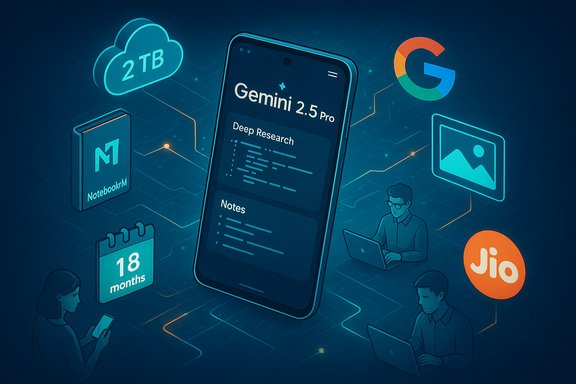
Google and Reliance’s surprise tie-up to give millions of Reliance Jio subscribers free access to Google’s premium AI suite is not a small marketing stunt — it is a deliberate, high‑stakes move to accelerate AI adoption across India by bundling advanced generative AI, large‑context models, and significant cloud storage into a telecom distribution channel. The program, which begins with an 18‑month complimentary subscription to Google’s AI Pro offering for eligible Jio users, promises access to Gemini 2.5 Pro, expanded video and image generation, and 2 TB of cloud storage — a package valued by Google at roughly ₹35,100 per user.
India is now the focal point for many global AI plays that combine cloud infrastructure, consumer distribution, and local market scale. Reliance — through Reliance Intelligence and its dominant Jio mobile brand — has pursued a strategy of embedding digital services into everyday telecom plans for years. Google’s Gemini family (including Gemini 2.5 Pro) is Google’s flagship large‑model offering, integrated across Google Workspace, the Gemini app, and core Android services. Combining these two vectors — a telecom with mass reach and a large‑model AI provider — creates an unusually broad access channel for advanced AI capabilities. The specifics announced in late October 2025 change a number of earlier, smaller promotional efforts (for example, earlier student promotions and limited trials). This latest commercial tier positions Google’s most capable model family alongside developer, creative, and storage services as a bundled benefit for Jio subscribers on qualifying plans. Initial rollout favors younger users and those on unlimited 5G plans, with a stated intent to expand eligibility quickly.
For individuals and organizations, the immediate imperative is to evaluate the offer’s terms, pilot use cases responsibly, and prepare for the responsibility that comes with broader access to powerful generative AI tools. The next 18 months will be a revealing period for India’s AI trajectory — whether this initiative catalyzes inclusive innovation or amplifies existing gaps will depend on how transparently and responsibly the technology is deployed and regulated.
Source: todaymyindia.com Google Gemini Pro Free For Reliance Jio Customers: Benefits, Features, And Effect On India's AI Revolution (2025)
 Background
India is now the focal point for many global AI plays that combine cloud infrastructure, consumer distribution, and local market scale. Reliance — through Reliance Intelligence and its dominant Jio mobile brand — has pursued a strategy of embedding digital services into everyday telecom plans for years. Google’s Gemini family (including Gemini 2.5 Pro) is Google’s flagship large‑model offering, integrated across Google Workspace, the Gemini app, and core Android services. Combining these two vectors — a telecom with mass reach and a large‑model AI provider — creates an unusually broad access channel for advanced AI capabilities. The specifics announced in late October 2025 change a number of earlier, smaller promotional efforts (for example, earlier student promotions and limited trials). This latest commercial tier positions Google’s most capable model family alongside developer, creative, and storage services as a bundled benefit for Jio subscribers on qualifying plans. Initial rollout favors younger users and those on unlimited 5G plans, with a stated intent to expand eligibility quickly. What the Reliance–Google offer actually includes
The public descriptions of the offer converge on several concrete inclusions. These are the load‑bearing elements every user should know:- Gemini 2.5 Pro access — access to Google’s most capable model tier for advanced reasoning, coding, and creative tasks.
- Extended image & video generation — higher quotas and access to Google’s media models (Nano Banana for images and Veo 3.x for video generation).
- 2 TB cloud storage — usable across Google Drive, Gmail, Photos and (on Android) backups; this is included as part of the bundled value.
- NotebookLM & Deep Research features — enhanced research and note‑management capabilities aimed at students, researchers, and content creators.
- Activation via MyJio — users can claim the offer through the MyJio app with a single activation flow described by Jio and media outlets; the benefit remains active while the user maintains an eligible Jio plan.
Who is eligible and how the roll‑out works
Who gets early access
The program starts with an initial cohort of Jio customers (notably users aged 18–25 on eligible Unlimited 5G plans priced from around ₹349 per month) and is designed to broaden to more Jio subscribers in the months after launch. The limited early window gives Reliance and Google a controlled testbed to scale services and evaluate user behavior before opening access to the platform’s full subscriber base.Activation steps (practical)
- Update or open the MyJio app on your Android or iOS device.
- Sign in with your Jio number and a Google Account when prompted.
- Tap the claim or “Google AI Pro” banner in MyJio and follow the onboarding steps.
- Confirm your eligibility (plan type, age band if required) and accept terms to activate 18 months of access.
- Once activated, launch the Gemini app or use Gemini integrations in Gmail, Docs, and other supported Google services.
Devices and platforms
The bundle is explicitly available on Android and iOS devices and is delivered through Google’s app ecosystem (Gemini app, Google Workspace integrations) and the MyJio distribution channel. Jio‑branded phones and Android devices that rely on Google services get the smoothest experience, though the core AI features are accessible across platforms.Technical detail: models, quotas and product terms
Google’s public subscription pages and several news reports provide a consistent picture of what the Pro/Ultra tiers offer. Key technical highlights include:- Model tiering: The Pro bundle unlocks Gemini 2.5 Pro, which offers higher reasoning capacity, expanded context windows, and advanced “Deep Research” utilities. The Ultra tier (where available) unlocks further capabilities.
- Context and tokens: Pro subscriptions include significantly larger context windows (measured in tokens) compared with baseline models; Google has published details about very large context windows for Pro/Ultra subscribers. Users building long scientific documents or codebases benefit directly from this.
- Media generation quotas: The package includes monthly AI credits used for image/video generation via Flow/Whisk and limited Veo 3 access; these are rationed via credits to control compute costs.
- NotebookLM & Deep Research: Higher notebook limits and expanded research features make the offering attractive for academic workflows and content production.
Why this matters for India: scale, inclusion, and market dynamics
The Reliance–Google arrangement matters for three overlapping reasons:- Scale of distribution: Jio’s subscriber base (hundreds of millions of users across India) gives Google a telecom channel that few other AI providers match. Bundling AI into connectivity plans reduces friction at the point of adoption and accelerates usage across demographics.
- Cost barrier removal: Advanced generative AI and media generation have non‑trivial monthly costs. An 18‑month free subscription removes the immediate financial barrier for youth, students, and small businesses — allowing experimentation at scale.
- Ecosystem effects: By coupling AI access with cloud storage and Google Workspace integrations, small businesses, educators, and app developers gain capabilities they can productize — creating a local supply of AI‑augmented services and startups. Reliance’s stated ambition to integrate AI across retail, telecom, and enterprise services means this is a strategic investment in local use cases.
Cross‑checking the record: how this differs from earlier reports
Several earlier online articles and promotional posts described smaller or shorter trials (for example, student offers or one‑year promotions). The key difference with the latest Reliance announcement is duration and scale: this is an 18‑month program targeted initially at a broad consumer cohort via a telecom subscription plan, rather than a time‑limited student verified promotion. Independent wire reports and national coverage confirmed that the 18‑month figure and ₹35,100 valuation reflect the package being offered to Jio users. Readers should treat earlier three‑month descriptions or other short‑term claims as outdated or incorrect relative to the corporate announcements and major press coverage published at the end of October 2025.Benefits: practical use cases to expect
- Education: Students can use Deep Research, NotebookLM, and high‑context models for complex assignments, code homework, and exam preparation. The 2 TB of storage supports large datasets and media projects.
- Micro and small businesses: SMEs can automate customer responses, generate marketing copy, produce product imagery, and draft proposals — lowering entry costs for digital transformation.
- Content creation and media: Amateur and professional creators receive a suite of media tools (image and video generation, flow‑editing features) that compress the production timeline for short‑form and long‑form media.
- Developer productivity: Code assist features and large context windows help developers debug, prototype, and document projects faster, while NotebookLM and Deep Research accelerate exploratory data work.
Risks and unanswered questions
No large‑scale distribution of powerful AI comes without material risks. The most important are:- Privacy and data handling: The integration of AI with personal Gmail, Drive, and phone backups raises questions about how user prompts, uploads, and generated artifacts are stored, used to improve models, or shared with partners. The public announcements emphasize product features but leave many details about data retention, model‑training reuse, and specific enterprise data partitioning underexplained. Users should assume that some logs and aggregated telemetry are collected unless explicitly told otherwise, and demand clear, accessible privacy terms. This is a critical area where regulatory clarity and provider transparency matter.
- Post‑trial cost and vendor lock‑in: After the complimentary 18 months ends, users will face subscription choices. While exact Indian pricing for Pro/Ultra tiers varies by region and promotional windows, businesses and heavy users must plan for potentially material monthly fees if they adopt Gemini‑dependent workflows. Organizations should evaluate portability, multi‑vendor strategies, and exportable artifacts to avoid lock‑in.
- Digital divide and selection bias: The offer starts with 5G unlimited plan subscribers and younger users — groups that are already more likely to have devices and digital literacy. If expansion is slow, this could widen access between those who receive the benefit and those on low‑cost, non‑5G plans. Policymakers should track actual rollout metrics rather than headline promises.
- Misinformation and synthetic media: Wider access to image and video generation increases the risk surface for deepfakes and misinformation. Responsible defaults, watermarking, and robust content detection tools are necessary to mitigate misuse at scale. The announcements mention media models but do not detail safety guardrails; that gap needs closing.
- Market concentration and competition: A telecom‑sponsored distribution of a single provider’s best model raises competitive questions. Microsoft, OpenAI, and others pursue similar partnerships and subscription models; regulators will want to ensure consumer choice and competitive parity in the AI marketplace.
Strategic and regulatory implications
This is not merely a consumer promotion: it is a strategic play with implications for cloud infrastructure, national AI readiness, and regulatory oversight.- Cloud and compute alignment: Reliance’s investment in AI hardware accelerators and Google Cloud integration suggests the partnership extends beyond consumer apps into enterprise AI infrastructure and model deployments. That has implications for domestic AI workloads and how India hosts compute‑intensive projects.
- Policy scrutiny: Regulators will watch for data localization, lawful access, and privacy compliance. The government’s digital inclusion and AI policies will intersect with corporate deployment plans; both providers and public authorities should publish clear implementation roadmaps.
- Competitive response: Microsoft, OpenAI and other AI providers will likely accelerate their own India‑focused partnerships and telco integrations, triggering a rapid sequence of promotions and enterprise offers that could lower costs for consumers but also complicate interoperability.
Practical recommendations (for users, businesses, and policymakers)
- Users — read the activation terms carefully. Before claiming the offer, verify what data flows to Google, what permissions are granted, and how to opt out of model‑improvement sharing if that is important to you.
- Businesses — start small, validate ROI. Pilot Gemini workflows on non‑critical tasks first, measure outcomes (time saved, quality of output), and build exit strategies in case costs or strategic needs change after 18 months.
- Educators & students — document usage and citations. Encourage students to use NotebookLM and Deep Research tools for learning, but require transparent citation of AI‑generated material and clear academic integrity guidance.
- Developers — emphasize portability. When building AI‑augmented apps, design so that data, prompts, and generated assets are exportable and vendor‑agnostic where possible.
- Policymakers — demand transparency and consumer protections. Ensure consumer terms, privacy impacts, and content‑safety measures are published in clear local language and that marginalized communities are not excluded by rollout choices.
What to expect next
Expect rapid follow‑on developments over the next 6–12 months: broader eligibility announcements, clarifications on privacy and data handling, competitor responses from other cloud/AI providers, and early case studies from students and SMEs showcasing productivity gains. Observers should treat this launch as the opening act in a contested commercial and regulatory phase of AI adoption in India — one where distribution channels like telecom operators will be decisive in shaping which models and ecosystems gain mainstream traction.Conclusion
The Google–Reliance Jio offer to provide extended free access to Gemini AI Pro is a consequential, well‑resourced push to democratize advanced AI capabilities across India. It pairs Google’s top‑tier model access, multimedia generation, and cloud storage with Reliance’s distribution power — a combination likely to spur experimentation, new services, and accelerated learning at scale. At the same time, the program raises legitimate questions about data use, long‑term costs, market concentration, and content safety that must be addressed with clear contractual terms, oversight, and technical guardrails.For individuals and organizations, the immediate imperative is to evaluate the offer’s terms, pilot use cases responsibly, and prepare for the responsibility that comes with broader access to powerful generative AI tools. The next 18 months will be a revealing period for India’s AI trajectory — whether this initiative catalyzes inclusive innovation or amplifies existing gaps will depend on how transparently and responsibly the technology is deployed and regulated.
Source: todaymyindia.com Google Gemini Pro Free For Reliance Jio Customers: Benefits, Features, And Effect On India's AI Revolution (2025)
