

Capcom announced Resident Evil Veronica at Summer Game Fest on June 5, 2026, positioning the full remake of 2000’s Resident Evil — Code: Veronica for release in 2027 on modern platforms, while leaving PC system requirements, graphics modes, and performance targets officially unconfirmed. That silence has already created a vacuum, and the first serious attempt to fill it comes from GameGPU’s extrapolation based on Resident Evil Requiem benchmarking. The useful part is not the exact GPU table; it is the shape of the warning. If Veronica inherits Requiem’s most expensive RE Engine features, the next Resident Evil remake may be less about whether your PC can run horror and more about which compromises you are willing to call “native.”
Resident Evil Veronica is real, and that matters because Code: Veronica has long been the awkward missing link in Capcom’s remake strategy. Resident Evil 2, 3, and 4 have already been rebuilt for a modern audience, while Code: Veronica remained stranded between canonical importance and technical neglect. A 2027 remake finally gives Capcom a route to revisit Claire Redfield’s post-Raccoon City story, the Ashford twins, and the series’ Dreamcast-era experiment in more elaborate 3D environments.
But Capcom’s reveal did what reveals usually do: it sold mood, not memory bandwidth. We know the broad release window. We know the remake is being framed as a modern reimagining rather than a remaster. We do not yet know the official PC minimums, recommended specs, ray tracing presets, VRAM expectations, upscaling support, or whether Capcom will divide requirements by standard rasterization, ray tracing, and any heavier path-traced mode.
That last omission is where the conversation becomes interesting for WindowsForum readers. In 2026, “system requirements” are no longer a simple floor and ceiling. A modern PC spec sheet is a political document: it tells players which settings the publisher considers normal, which technologies it assumes you will use, and which performance targets are quietly being outsourced to DLSS, FSR, XeSS, frame generation, and temporal reconstruction.
GameGPU’s forecast is therefore best read as an early stress test of assumptions. It predicts Resident Evil Veronica requirements by using Resident Evil Requiem as the stand-in workload, on the argument that both games share the current RE Engine lineage and similar heavy rendering behavior. That is plausible as a starting point, but it is not the same thing as official guidance. It is a weather forecast, not a flight plan.
That does not mean the two games will behave identically. Horror games are deeply sensitive to scene design. A narrow corridor lit by a handful of local lights can be visually extravagant but relatively controlled; a wide exterior area with complex transparency, dense geometry, animated foliage, volumetrics, and reflective wet surfaces can punish a GPU in very different ways. Code: Veronica’s original structure includes prisons, mansions, laboratories, Antarctic facilities, and stylized set-piece spaces that could be rebuilt with very different performance profiles.
The CPU picture is also more complicated than a table suggests. RE Engine has historically been impressively scalable on PC, but modern rendering features can shift pressure onto asset streaming, decompression, shader compilation, and draw-call management. A remake with denser environments, more dynamic objects, and aggressive ray tracing may be limited by the GPU most of the time, while still producing unpleasant frame-time spikes on weaker processors.
So the Requiem comparison is useful because it sets a ceiling for anxiety, not because it gives anyone permission to etch RTX 5090 into stone. Capcom can still optimize. Capcom can still alter feature sets. Capcom can still ship separate presets that make the “recommended” experience far less extreme than an enthusiast’s maximum-settings benchmark.
That distinction matters more than the individual model numbers. In the first projected mode, 1080p and 1440p look relatively approachable by modern gaming-PC standards. GameGPU places the RTX 3060 and Radeon RX 6700 XT around the 1080p floor and even leaves the RX 6700 XT in the 1440p recommended bracket, with the RTX 4060 Ti appearing for 1440p at 60 FPS. For native 4K ray tracing, the projection rises sharply to an RTX 4070 Ti Super or Radeon RX 9070-class card for a comfortable 60 FPS.
That is demanding, but not absurd for a 2027 AAA remake if native rendering and ray tracing are both in play. The striking part is how little the CPU changes through much of the first table. The Core i3-10100 and Ryzen 3 3100 are projected as enough for 25 FPS targets at 1080p and 1440p, while the Core i5-12400 and Ryzen 5 5600X become the practical baseline for 60 FPS and 4K entry-level play. That implies a heavily GPU-bound workload, which is consistent with ray-traced rendering at high resolutions.
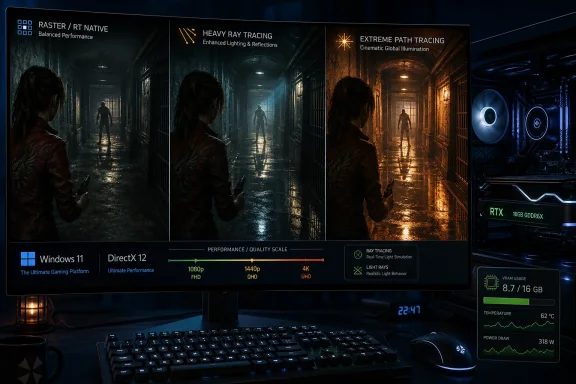
The second block is where the forecast stops being a shopping guide and starts being a warning label. For the presumed path-traced mode, GameGPU jumps to an RTX 4060 Ti merely for 1080p at 25 FPS, an RTX 5080-class card for 1080p at 60 FPS, an RTX 5090 for 1440p at 60 FPS, and still says native 4K at a stable 60 FPS is not achievable on current-generation GPUs without DLSS or similar assistance. Whether every number survives contact with the final game is less important than the trend: full-fat lighting is no longer designed around brute-force native pixels.
That is not a scandal so much as an admission of where rendering has gone. Path tracing is a fundamentally different burden from conventional rasterization with a few ray-traced effects attached. It asks the GPU to solve lighting in a way that is more coherent and physically convincing, but the price is enormous. The reason technologies like DLSS Ray Reconstruction, frame generation, and temporal upscalers have become central to PC gaming is not because developers forgot how to optimize. It is because the industry keeps choosing effects that scale faster than hardware can brute-force.
For years, PC players treated “native” as the honest rendering mode and upscaling as a compromise. That distinction is now too simple. Modern games are often authored with temporal reconstruction in mind from the beginning, and their visual stability depends on the quality of motion vectors, anti-aliasing, denoisers, and reconstruction passes as much as raw pixel count. In a path-traced game, the cleanest image may come not from native 4K, but from a lower internal resolution processed through a smarter reconstruction pipeline.
That is a difficult cultural shift for PC enthusiasts. A 4K monitor used to imply that a high-end GPU should drive 8.3 million fresh pixels per frame. In the ray-tracing era, the more realistic question is whether your system can produce enough high-quality samples, preserve temporal stability, and avoid latency penalties while the image is reconstructed into something that looks better than old-school native rendering ever did.
The Windows 11 assumption is still worth pausing on. Capcom has not officially declared Windows 11 as the only supported OS for Veronica, and many PC games continue to run on Windows 10 even when Windows 11 is the preferred environment. But by 2027, a Windows 11-first requirement would not be surprising, particularly for a game leaning heavily on current GPU drivers, modern CPU scheduling, and contemporary platform support.
The SSD requirement is even less negotiable. Survival horror depends on pacing, but modern remakes also depend on aggressive asset streaming. Higher-resolution textures, detailed character models, dense interiors, and rapid scene transitions all punish storage latency. An SSD is not just about loading screens anymore; it is part of the frame-time story.
RAM is the one area where the forecast may be conservative in its lower modes and realistic in its upper modes. Sixteen gigabytes remains the broad PC gaming baseline, but the second block’s move to 32GB for high-end 1440p and 4K path-traced play reflects where enthusiast configurations are heading. The game may technically run on 16GB, but a Windows gaming PC is not just running the game. It is running the OS, overlays, capture tools, launchers, chat apps, browser tabs, driver suites, and whatever RGB control panel refuses to die.
That reflects a broader reality in PC graphics: Nvidia has held a clear software and hardware advantage in heavy ray tracing and AI-assisted reconstruction, especially when DLSS features are part of the expected performance story. If Veronica ships with the kind of expensive lighting stack GameGPU is modeling, Nvidia cards may indeed have the easier path to high-end settings.
But AMD users should not read an unofficial forecast as a verdict. Capcom’s final implementation matters enormously. FSR support, driver maturity, console-oriented optimization, ray count, denoiser design, BVH update cost, and the exact balance of rasterized and ray-traced effects can all change the outcome. A game can be brutal in one ray-tracing mode and perfectly reasonable in another.
The more practical lesson is that Radeon buyers should wait for launch-window testing before making an upgrade specifically for Veronica. If the goal is standard high-quality 1440p play, the answer may be quite different than if the goal is maximum path-traced lighting. “Can it run the game?” and “Can it run the prestige graphics mode?” are now separate questions.
At first glance, that seems contradictory. If 4K ray tracing is GPU-bound, why would a much faster CPU matter? The answer is that average FPS tables compress too much information. A high-end CPU may not dramatically raise the average frame rate in a GPU-bound scene, but it can reduce stutter, improve one-percent lows, feed a high-end GPU more consistently, and handle background simulation or streaming without creating ugly frame pacing.
That distinction is especially important in horror. A competitive shooter can feel bad when frame pacing collapses, but a survival horror game can lose its entire atmosphere when traversal stutters through a doorway or a scripted encounter hitches as a monster enters the frame. Smoothness is not a luxury in this genre; it is part of the direction.
Still, players should be careful not to overbuy the CPU before seeing real tests. For many systems, the best Veronica upgrade may be the GPU, not a new platform. A modern six-core or eight-core processor paired with a strong graphics card and fast SSD will probably age better than a flagship CPU attached to an underpowered GPU, particularly if the final game leans heavily on ray tracing.
This is not just a clerical issue. The PC graphics vocabulary has become a mess. Publishers use “ray tracing” to describe everything from a single reflection effect to multiple ray-traced systems. Enthusiasts use “path tracing” to mean a more comprehensive lighting model, but implementations vary. Upscaling may be labeled performance, balanced, quality, super resolution, frame generation, or reconstruction depending on vendor and menu design.
For normal players, the result is confusion. A card that is “recommended for ray tracing” may be recommended for 1080p at 30 FPS, 1440p at 60 FPS with upscaling, or 4K with frame generation. Those are wildly different experiences hidden behind similar language.
Capcom would do itself a favor by publishing Veronica’s requirements in a more modern format when the time comes. Instead of a single minimum and recommended line, the PC audience needs presets tied to resolution, frame rate, ray-tracing level, upscaling status, VRAM target, and expected CPU class. Anything less will be reverse-engineered by benchmarkers anyway.
That creates pressure on Veronica. Code: Veronica is not just another nostalgia project; it is a game with locations that could benefit enormously from modern lighting and environmental detail. The prison island, the Ashford mansion, and the Antarctic base are practically begging for dense shadows, reflective surfaces, volumetric atmosphere, and elaborate material work. Those are exactly the features that make modern GPUs sweat.
The business case is also clear. Capcom’s Resident Evil remake pipeline has become one of the industry’s most reliable prestige machines. Each remake is expected to serve old fans, onboard new players, and demonstrate that the franchise can keep mining its past without feeling trapped by it. Technical spectacle is part of that pitch.
But spectacle has a cost, and on PC the cost is no longer hidden. Console versions absorb the compromise into fixed modes: quality, performance, balanced, maybe 120Hz. PC exposes the entire bargain. If Veronica’s best lighting mode requires a flagship GPU and reconstruction to reach fluid performance, that will not be a footnote. It will be one of the launch conversation’s central facts.
The first reason is obvious: optimization happens late. Developers tune presets, drivers improve, shader compilation changes, memory management is adjusted, and platform-specific fixes arrive close to launch. The difference between a preview-era performance profile and a day-one build can be substantial, especially for a major publisher with a mature engine.
The second reason is that GPU generations and pricing will shift before Veronica arrives. A card that looks exotic in mid-2026 may be less unusual by launch, while today’s value pick may age poorly if the game leans into a specific reconstruction or ray-tracing feature. Buying early for one unreleased title is a good way to pay the impatience tax.
The third reason is that Capcom may offer sane presets. Maximum settings are rarely the best settings. A well-tuned high preset with selective ray tracing, quality upscaling, and stable frame pacing can look nearly as good as an ultra preset while cutting the hardware bill dramatically. The difference between “cinematic screenshot mode” and “actually play this for twelve hours” will matter more than the marketing label.
For Windows users planning ahead, the current unofficial picture looks like this:
This matters because trust in system requirements has eroded across PC gaming. Too many spec sheets still behave as if 1080p low and 1080p high are enough to describe a game’s hardware needs. That was barely adequate ten years ago. It is absurd in an era of multi-mode ray tracing, reconstruction pipelines, shader precompilation, DirectStorage-style expectations, high-refresh displays, ultrawide monitors, and GPUs whose performance varies wildly depending on whether a game uses vendor-specific features.
Capcom has generally earned goodwill on PC compared with many AAA publishers, but goodwill is not a substitute for clarity. Resident Evil players will forgive demanding settings if those settings are clearly marked as demanding. They will be less forgiving if “recommended” turns out to mean 1080p with hidden reconstruction and compromised frame pacing.
The industry’s best path forward is not to pretend native rendering is still the universal benchmark. It is to describe rendering honestly. Native, upscaled, frame-generated, ray-traced, and path-traced modes can all coexist, but they should not be collapsed into one vague promise of “recommended” performance.
Resident Evil Veronica’s official requirements are still to come, and GameGPU’s forecast should be treated as informed speculation rather than gospel. But it points to the right fight: not whether Capcom can remake another classic, but whether PC players will be told plainly what kind of machine each version of that remake really demands. By 2027, the scariest thing in Resident Evil may not be the Ashford family’s experiments; it may be a graphics menu that proves native 4K has become the new ultra-hard mode.
 Capcom Has Announced the Game, Not the Hardware Reality
Resident Evil Veronica is real, and that matters because Code: Veronica has long been the awkward missing link in Capcom’s remake strategy. Resident Evil 2, 3, and 4 have already been rebuilt for a modern audience, while Code: Veronica remained stranded between canonical importance and technical neglect. A 2027 remake finally gives Capcom a route to revisit Claire Redfield’s post-Raccoon City story, the Ashford twins, and the series’ Dreamcast-era experiment in more elaborate 3D environments.But Capcom’s reveal did what reveals usually do: it sold mood, not memory bandwidth. We know the broad release window. We know the remake is being framed as a modern reimagining rather than a remaster. We do not yet know the official PC minimums, recommended specs, ray tracing presets, VRAM expectations, upscaling support, or whether Capcom will divide requirements by standard rasterization, ray tracing, and any heavier path-traced mode.
That last omission is where the conversation becomes interesting for WindowsForum readers. In 2026, “system requirements” are no longer a simple floor and ceiling. A modern PC spec sheet is a political document: it tells players which settings the publisher considers normal, which technologies it assumes you will use, and which performance targets are quietly being outsourced to DLSS, FSR, XeSS, frame generation, and temporal reconstruction.
GameGPU’s forecast is therefore best read as an early stress test of assumptions. It predicts Resident Evil Veronica requirements by using Resident Evil Requiem as the stand-in workload, on the argument that both games share the current RE Engine lineage and similar heavy rendering behavior. That is plausible as a starting point, but it is not the same thing as official guidance. It is a weather forecast, not a flight plan.
The Requiem Baseline Makes Sense, but It Is Not a Crystal Ball
Using Resident Evil Requiem as the model for Veronica is not a random choice. Requiem is the newest mainline Resident Evil title, it is built on Capcom’s modern RE Engine stack, and it represents the most relevant public benchmark for what Capcom currently considers high-end horror rendering. If Veronica is being rebuilt in the same production window, with the same engine family and similar lighting ambitions, Requiem is the closest thing analysts have to a real-world proxy.That does not mean the two games will behave identically. Horror games are deeply sensitive to scene design. A narrow corridor lit by a handful of local lights can be visually extravagant but relatively controlled; a wide exterior area with complex transparency, dense geometry, animated foliage, volumetrics, and reflective wet surfaces can punish a GPU in very different ways. Code: Veronica’s original structure includes prisons, mansions, laboratories, Antarctic facilities, and stylized set-piece spaces that could be rebuilt with very different performance profiles.
The CPU picture is also more complicated than a table suggests. RE Engine has historically been impressively scalable on PC, but modern rendering features can shift pressure onto asset streaming, decompression, shader compilation, and draw-call management. A remake with denser environments, more dynamic objects, and aggressive ray tracing may be limited by the GPU most of the time, while still producing unpleasant frame-time spikes on weaker processors.
So the Requiem comparison is useful because it sets a ceiling for anxiety, not because it gives anyone permission to etch RTX 5090 into stone. Capcom can still optimize. Capcom can still alter feature sets. Capcom can still ship separate presets that make the “recommended” experience far less extreme than an enthusiast’s maximum-settings benchmark.
The First Forecast Draws a Hard Line Between Ray Tracing and Everything Beyond It
GameGPU’s projected table separates the conversation into two broad classes of rendering, though the submitted text labels both as “Ray Tracing Native.” The first block appears to describe a heavy ray-tracing mode at native resolution. The second block, based on the hardware jump and language around “pure path tracing,” clearly reads like a more extreme full path-tracing or maximum ray-tracing scenario.That distinction matters more than the individual model numbers. In the first projected mode, 1080p and 1440p look relatively approachable by modern gaming-PC standards. GameGPU places the RTX 3060 and Radeon RX 6700 XT around the 1080p floor and even leaves the RX 6700 XT in the 1440p recommended bracket, with the RTX 4060 Ti appearing for 1440p at 60 FPS. For native 4K ray tracing, the projection rises sharply to an RTX 4070 Ti Super or Radeon RX 9070-class card for a comfortable 60 FPS.
That is demanding, but not absurd for a 2027 AAA remake if native rendering and ray tracing are both in play. The striking part is how little the CPU changes through much of the first table. The Core i3-10100 and Ryzen 3 3100 are projected as enough for 25 FPS targets at 1080p and 1440p, while the Core i5-12400 and Ryzen 5 5600X become the practical baseline for 60 FPS and 4K entry-level play. That implies a heavily GPU-bound workload, which is consistent with ray-traced rendering at high resolutions.
The second block is where the forecast stops being a shopping guide and starts being a warning label. For the presumed path-traced mode, GameGPU jumps to an RTX 4060 Ti merely for 1080p at 25 FPS, an RTX 5080-class card for 1080p at 60 FPS, an RTX 5090 for 1440p at 60 FPS, and still says native 4K at a stable 60 FPS is not achievable on current-generation GPUs without DLSS or similar assistance. Whether every number survives contact with the final game is less important than the trend: full-fat lighting is no longer designed around brute-force native pixels.
Native Rendering Has Become the Luxury Setting
The most provocative claim in the forecast is not that Veronica might need a fast GPU. Every AAA game does. The provocative claim is that 4K, 60 FPS, native resolution, and pure path tracing may not coexist on present hardware.That is not a scandal so much as an admission of where rendering has gone. Path tracing is a fundamentally different burden from conventional rasterization with a few ray-traced effects attached. It asks the GPU to solve lighting in a way that is more coherent and physically convincing, but the price is enormous. The reason technologies like DLSS Ray Reconstruction, frame generation, and temporal upscalers have become central to PC gaming is not because developers forgot how to optimize. It is because the industry keeps choosing effects that scale faster than hardware can brute-force.
For years, PC players treated “native” as the honest rendering mode and upscaling as a compromise. That distinction is now too simple. Modern games are often authored with temporal reconstruction in mind from the beginning, and their visual stability depends on the quality of motion vectors, anti-aliasing, denoisers, and reconstruction passes as much as raw pixel count. In a path-traced game, the cleanest image may come not from native 4K, but from a lower internal resolution processed through a smarter reconstruction pipeline.
That is a difficult cultural shift for PC enthusiasts. A 4K monitor used to imply that a high-end GPU should drive 8.3 million fresh pixels per frame. In the ray-tracing era, the more realistic question is whether your system can produce enough high-quality samples, preserve temporal stability, and avoid latency penalties while the image is reconstructed into something that looks better than old-school native rendering ever did.
Windows 11 and DirectX 12 Are the Least Surprising Parts of the Prediction
Every projected configuration in the GameGPU table assumes Windows 11, DirectX 12, an SSD, and at least 16GB of RAM. None of that should shock anyone building or maintaining gaming PCs in 2026. The era of hard-drive-friendly AAA gaming is over, and DirectX 12 has become the expected baseline for modern PC rendering features, shader models, and low-level GPU control.The Windows 11 assumption is still worth pausing on. Capcom has not officially declared Windows 11 as the only supported OS for Veronica, and many PC games continue to run on Windows 10 even when Windows 11 is the preferred environment. But by 2027, a Windows 11-first requirement would not be surprising, particularly for a game leaning heavily on current GPU drivers, modern CPU scheduling, and contemporary platform support.
The SSD requirement is even less negotiable. Survival horror depends on pacing, but modern remakes also depend on aggressive asset streaming. Higher-resolution textures, detailed character models, dense interiors, and rapid scene transitions all punish storage latency. An SSD is not just about loading screens anymore; it is part of the frame-time story.
RAM is the one area where the forecast may be conservative in its lower modes and realistic in its upper modes. Sixteen gigabytes remains the broad PC gaming baseline, but the second block’s move to 32GB for high-end 1440p and 4K path-traced play reflects where enthusiast configurations are heading. The game may technically run on 16GB, but a Windows gaming PC is not just running the game. It is running the OS, overlays, capture tools, launchers, chat apps, browser tabs, driver suites, and whatever RGB control panel refuses to die.
The GPU Table Tells AMD Users to Wait for Real Benchmarks
One oddity in the submitted forecast is the way AMD GPUs appear in the first block and then largely vanish from the second. The ray-tracing-native predictions include Radeon equivalents such as the RX 6700 XT and RX 9070, while the presumed path-tracing block becomes overwhelmingly Nvidia-oriented, naming RTX 4060 Ti, RTX 4080, RTX 5080, and RTX 5090.That reflects a broader reality in PC graphics: Nvidia has held a clear software and hardware advantage in heavy ray tracing and AI-assisted reconstruction, especially when DLSS features are part of the expected performance story. If Veronica ships with the kind of expensive lighting stack GameGPU is modeling, Nvidia cards may indeed have the easier path to high-end settings.
But AMD users should not read an unofficial forecast as a verdict. Capcom’s final implementation matters enormously. FSR support, driver maturity, console-oriented optimization, ray count, denoiser design, BVH update cost, and the exact balance of rasterized and ray-traced effects can all change the outcome. A game can be brutal in one ray-tracing mode and perfectly reasonable in another.
The more practical lesson is that Radeon buyers should wait for launch-window testing before making an upgrade specifically for Veronica. If the goal is standard high-quality 1440p play, the answer may be quite different than if the goal is maximum path-traced lighting. “Can it run the game?” and “Can it run the prestige graphics mode?” are now separate questions.
The CPU Recommendations Are a Reminder That Average FPS Is Not the Whole Game
GameGPU’s first block makes the Core i5-12400 and Ryzen 5 5600X look like the sensible mainstream CPU line for 60 FPS at 1080p and 1440p, while the most demanding 4K recommendation jumps to much higher-end chips such as the Core i9-13900K and Ryzen 9 9950X. In the presumed path-tracing table, the top-end recommendations include Core i9-14900K and Ryzen 7 9800X3D-class hardware.At first glance, that seems contradictory. If 4K ray tracing is GPU-bound, why would a much faster CPU matter? The answer is that average FPS tables compress too much information. A high-end CPU may not dramatically raise the average frame rate in a GPU-bound scene, but it can reduce stutter, improve one-percent lows, feed a high-end GPU more consistently, and handle background simulation or streaming without creating ugly frame pacing.
That distinction is especially important in horror. A competitive shooter can feel bad when frame pacing collapses, but a survival horror game can lose its entire atmosphere when traversal stutters through a doorway or a scripted encounter hitches as a monster enters the frame. Smoothness is not a luxury in this genre; it is part of the direction.
Still, players should be careful not to overbuy the CPU before seeing real tests. For many systems, the best Veronica upgrade may be the GPU, not a new platform. A modern six-core or eight-core processor paired with a strong graphics card and fast SSD will probably age better than a flagship CPU attached to an underpowered GPU, particularly if the final game leans heavily on ray tracing.
The Duplicate “Ray Tracing Native” Label Is a Symptom of a Bigger Naming Problem
The submitted requirements list has a formatting problem: both major groups are labeled “Mode: Ray Tracing Native.” Yet the second group discusses pure path tracing and says stable native 4K 60 FPS is not achievable on current-generation GPUs. That almost certainly means the second group is meant to represent a more extreme mode than the first.This is not just a clerical issue. The PC graphics vocabulary has become a mess. Publishers use “ray tracing” to describe everything from a single reflection effect to multiple ray-traced systems. Enthusiasts use “path tracing” to mean a more comprehensive lighting model, but implementations vary. Upscaling may be labeled performance, balanced, quality, super resolution, frame generation, or reconstruction depending on vendor and menu design.
For normal players, the result is confusion. A card that is “recommended for ray tracing” may be recommended for 1080p at 30 FPS, 1440p at 60 FPS with upscaling, or 4K with frame generation. Those are wildly different experiences hidden behind similar language.
Capcom would do itself a favor by publishing Veronica’s requirements in a more modern format when the time comes. Instead of a single minimum and recommended line, the PC audience needs presets tied to resolution, frame rate, ray-tracing level, upscaling status, VRAM target, and expected CPU class. Anything less will be reverse-engineered by benchmarkers anyway.
Requiem’s Shadow Makes Veronica a PC Story Before It Is a Horror Story
Resident Evil Requiem changed the context around Veronica because it gave players a recent example of Capcom’s technical ambition. Requiem’s role as the latest mainline entry means it establishes expectations for lighting, asset quality, animation, and rendering features. A remake arriving after it cannot easily look like a cheaper branch of the family without inviting comparison.That creates pressure on Veronica. Code: Veronica is not just another nostalgia project; it is a game with locations that could benefit enormously from modern lighting and environmental detail. The prison island, the Ashford mansion, and the Antarctic base are practically begging for dense shadows, reflective surfaces, volumetric atmosphere, and elaborate material work. Those are exactly the features that make modern GPUs sweat.
The business case is also clear. Capcom’s Resident Evil remake pipeline has become one of the industry’s most reliable prestige machines. Each remake is expected to serve old fans, onboard new players, and demonstrate that the franchise can keep mining its past without feeling trapped by it. Technical spectacle is part of that pitch.
But spectacle has a cost, and on PC the cost is no longer hidden. Console versions absorb the compromise into fixed modes: quality, performance, balanced, maybe 120Hz. PC exposes the entire bargain. If Veronica’s best lighting mode requires a flagship GPU and reconstruction to reach fluid performance, that will not be a footnote. It will be one of the launch conversation’s central facts.
The Smart Upgrade Path Is Patience, Not Panic
The temptation after reading an unofficial requirements table is to start pricing graphics cards. That is exactly the wrong move for a game due in 2027 with no official PC specification. A forecast based on Requiem can help identify risk, but it cannot justify a purchase by itself.The first reason is obvious: optimization happens late. Developers tune presets, drivers improve, shader compilation changes, memory management is adjusted, and platform-specific fixes arrive close to launch. The difference between a preview-era performance profile and a day-one build can be substantial, especially for a major publisher with a mature engine.
The second reason is that GPU generations and pricing will shift before Veronica arrives. A card that looks exotic in mid-2026 may be less unusual by launch, while today’s value pick may age poorly if the game leans into a specific reconstruction or ray-tracing feature. Buying early for one unreleased title is a good way to pay the impatience tax.
The third reason is that Capcom may offer sane presets. Maximum settings are rarely the best settings. A well-tuned high preset with selective ray tracing, quality upscaling, and stable frame pacing can look nearly as good as an ultra preset while cutting the hardware bill dramatically. The difference between “cinematic screenshot mode” and “actually play this for twelve hours” will matter more than the marketing label.
The Practical Shape of the Unofficial Requirements
The useful conclusion from GameGPU’s forecast is not that every player needs a monster PC. It is that Veronica may divide into three very different experiences: mainstream rasterized or lightly ray-traced play, heavy ray-traced native rendering, and an enthusiast path-traced mode that treats upscaling as part of the renderer rather than an optional crutch.For Windows users planning ahead, the current unofficial picture looks like this:
- Players targeting 1080p at sensible settings should not panic, but older quad-core CPUs and low-VRAM GPUs are likely to feel increasingly exposed by 2027.
- Players targeting 1440p at 60 FPS with ray tracing should expect the GPU to matter far more than the CPU, assuming they already have a modern six-core processor and an SSD.
- Players targeting native 4K with heavy ray tracing should treat upper-midrange GPUs as the entry point rather than the comfort zone.
- Players chasing path tracing should assume DLSS, FSR, XeSS, ray reconstruction, or frame generation will be part of the conversation, not an embarrassing fallback.
- Anyone considering an upgrade specifically for Resident Evil Veronica should wait for Capcom’s official PC requirements and independent launch benchmarks before buying hardware.
Capcom’s Next Spec Sheet Needs to Be Honest About Reconstruction
The most important thing Capcom can do when it finally publishes Resident Evil Veronica’s PC requirements is define the assumptions. If a recommended spec uses upscaling, say so. If a 4K figure assumes frame generation, say so. If ray tracing has separate low, medium, high, and path-traced modes, say so. The modern PC audience can handle complexity; what it punishes is ambiguity.This matters because trust in system requirements has eroded across PC gaming. Too many spec sheets still behave as if 1080p low and 1080p high are enough to describe a game’s hardware needs. That was barely adequate ten years ago. It is absurd in an era of multi-mode ray tracing, reconstruction pipelines, shader precompilation, DirectStorage-style expectations, high-refresh displays, ultrawide monitors, and GPUs whose performance varies wildly depending on whether a game uses vendor-specific features.
Capcom has generally earned goodwill on PC compared with many AAA publishers, but goodwill is not a substitute for clarity. Resident Evil players will forgive demanding settings if those settings are clearly marked as demanding. They will be less forgiving if “recommended” turns out to mean 1080p with hidden reconstruction and compromised frame pacing.
The industry’s best path forward is not to pretend native rendering is still the universal benchmark. It is to describe rendering honestly. Native, upscaled, frame-generated, ray-traced, and path-traced modes can all coexist, but they should not be collapsed into one vague promise of “recommended” performance.
Resident Evil Veronica’s official requirements are still to come, and GameGPU’s forecast should be treated as informed speculation rather than gospel. But it points to the right fight: not whether Capcom can remake another classic, but whether PC players will be told plainly what kind of machine each version of that remake really demands. By 2027, the scariest thing in Resident Evil may not be the Ashford family’s experiments; it may be a graphics menu that proves native 4K has become the new ultra-hard mode.
References
- Primary source: GameGPU
Published: 2026-06-06T13:10:23.162133
Resident Evil: Veronica System Requirements for 1080p, 1440p, and 4K
A detailed technical forecast of the system requirements for the upcoming Resident Evil Veronica remake has been compiled based on an analysis of the RE Engine's performance.en.gamegpu.com
- Related coverage: gamesradar.com
Summer Game Fest Live 2026 time and how to watch as rumors swirl of Final Fantasy 7 Remake Part 3 and a new Resident Evil remake taking part | GamesRadar+
Could we have two Tifa appearances in one show?www.gamesradar.com - Related coverage: gamingtrend.com
Capcom unveils Resident Evil Veronica Remake at Summer Game Fest 2026
Claire Redfield's Dreamcast-era nightmare gets the modern treatment gamingtrend.com
- Related coverage: pcgamer.com
Resident Evil – Code: Veronica remake announced | PC Gamer
The 2026 Summer Game Fest showcase kicked off with another Resi remake.www.pcgamer.com - Related coverage: destructoid.com
Capcom confirms Resident Evil Veronica remake coming next year – Destructoid
Code Veronica is coming.www.destructoid.com - Related coverage: nintendowire.com
Resident Evil Veronica kicks off Summer Games Fest, reimagines Code Veronica in the RE Engine – Nintendo Wire
As was heavily rumored leading into today’s showcase, Capcom announced Resident Evil Veronica as the first game during the Summer Game Fest stream. A remakenintendowire.com
- Related coverage: nintendoworldreport.com
- Related coverage: gamenguide.com
Capcom Announces 'Resident Evil Veronica' Remake With Q1 2027 Launch Window
Capcom confirms “Resident Evil Veronica” remake, targeting a Q1 2027 launch and bringing modern visuals, platforms, and expanded survival horror features to the classic title.www.gamenguide.com - Related coverage: shacknews.com
Resident Evil Code: Veronica remake announced for console and PCs in 2027 | Shacknews
In the opening reveal of Summer Game Fest 2026, we got the official reveal of the remake of Capcom's 2000 entry, Resident Evil: Code Veronica.www.shacknews.com - Related coverage: nintendolife.com
- Related coverage: mediaindonesia.com
Summer Game Fest 2026 Capcom Resmi Umumkan Resident Evil Veronica Remake, Siap Rilis 2027
Capcom umumkan Resident Evil Veronica Code Veronica Remake di Summer Game Fest 2026 Claire Redfield kembali dalam teror Rockfort Island untuk PS5 Xbox Switch 2 mediaindonesia.com
- Related coverage: tech.yahoo.com
SGF 2026: Resident Evil Veronica Announced At Summer Game Fest
Capcom have unveiled Resident Evil Veronica at Summer Game Fest.tech.yahoo.com - Related coverage: los40.com
Capcom hace oficial 'Resident Evil Veronica', el esperadísimo remake de Code: Veronica | Videojuegos | LOS40
La compañía japonesa abre el evento de Geoff Keighley haciendo realidad el sueño de los fans de la época clásica. Claire Redfield regresará por todo lo alto en 2027 bajo el imponente RE Engine.los40.com - Related coverage: as.com
Resident Evil Veronica es el regreso en forma de remake de uno de los grandes clásicos de Capcom
Capcom suma y sigue: Resident Evil: Code Veronica es su nuevo juego presentado durante el Summer Game Fest 2026.as.com
- Related coverage: windowscentral.com
Capcom dropped the release date for Resident Evil 9 | Windows Central
Capcom showed up during Summer Game Fest 2025 to reveal Resident Evil Requiem, the next entry in the long-running survival-horror franchise.www.windowscentral.com
