

RiskFootprint announced on May 22, 2026, in Boca Raton, Florida, that it has launched a Microsoft Copilot-assisted workflow that turns its parcel-level hazard and climate reports into rapid summaries for real estate, lending, underwriting, engineering, and due-diligence professionals. The pitch is simple: take a dense risk report, add a controlled AI layer, and make it usable before a deal clock runs out. The more interesting story is not that another vendor has “added AI,” but that climate-risk intelligence is being packaged for the same executive-summary culture that already governs loans, insurance, and property transactions. In that world, the summary is not a convenience feature; it is where risk becomes legible enough to influence money.
Microsoft Copilot has spent the last few years being sold as a productivity layer for email, documents, meetings, code, and security operations. RiskFootprint’s announcement points to a narrower but more consequential direction: Copilot as an interpreter of specialized datasets in regulated or quasi-regulated workflows. That is a different proposition from asking an AI assistant to draft a memo or summarize a Teams call.
The product described in the release is not a general chatbot wandering the open web. RiskFootprint says the workflow uses its own hazard intelligence, drawn from government and peer-reviewed sources, and applies Copilot’s reasoning layer to generate a narrative summary. In theory, that makes the tool less like a magic oracle and more like a controlled front end for an existing report.
That distinction matters because real estate and lending decisions do not tolerate the same level of casual error as office productivity experiments. A wrong summary of a meeting is irritating. A wrong risk characterization of a flood-exposed commercial property can affect pricing, financing, insurance, disclosure, and liability.
The announcement also shows how Microsoft’s AI stack is finding its way into vertical markets without Microsoft needing to build every vertical product itself. Copilot becomes the brand name and reasoning layer; the domain vendor supplies the data, workflow, and liability-sensitive context. If that pattern holds, many future Copilot stories will not look like Microsoft apps at all.
Due diligence is often a race between incomplete information and fixed deadlines. A lender, buyer, underwriter, or engineering consultant may have access to a report, but access does not guarantee comprehension. The problem is not merely whether the data exists; it is whether the right person can understand it quickly enough to change a decision.
That is why the summary layer has commercial power. A parcel-level hazard report may contain maps, category scores, exposure analysis, and technical assumptions. The executive summary turns that material into something that can be forwarded, discussed, challenged, and documented.
This is also where AI becomes both useful and dangerous. Summaries compress complexity, and compression always involves judgment. The value of the RiskFootprint-Copilot workflow will depend less on whether it can write fluent prose and more on whether it preserves the uncertainty, thresholds, caveats, and provenance that make a hazard report defensible.
Copilot’s expansion into real estate risk is therefore part of a broader enterprise pattern. Microsoft is trying to make AI less like a separate destination and more like an ambient interface over business data. If a hazard report lives in a portal, PDF, data room, SharePoint library, or transaction file, the pressure will be to summarize it where employees already work.
For IT administrators, this shifts the challenge from “Should we allow AI?” to “Which data can AI touch, under what controls, with what audit trail, and for which users?” A climate-risk workflow may involve property addresses, borrower information, transaction documents, insurance files, and legal correspondence. That is not casual content.
The Windows ecosystem has always absorbed business process changes through the back door. A new reporting workflow becomes a browser dependency, then a Microsoft 365 integration, then a permissions question, then a records-retention problem. AI summaries in real estate and lending will follow the same path.
But defensibility is not a property that a vendor can simply declare. It is earned through source quality, methodology, repeatability, access controls, versioning, and documentation. If an AI-generated summary becomes part of a loan file or investment memo, users will need to know what report version it summarized, which data sources were used, what assumptions were included, and whether the output can be reproduced later.
This is where generic AI language often runs ahead of operational reality. “Grounded” is not the same as correct. “Peer-reviewed” does not automatically mean every generated sentence follows from the underlying evidence. “Auditable” does not mean much unless the audit trail survives export, sharing, and human edits.
The good news for RiskFootprint is that it appears to be starting from a structured report rather than asking Copilot to invent a risk profile from scratch. The harder question is whether the summary output clearly distinguishes observed history, modeled exposure, probable future hazard, and recommended mitigation. Those are different categories of knowledge, and blending them into one smooth paragraph can create a false sense of certainty.
This is a familiar enterprise problem. Security tools generate alerts faster than analysts can triage them. Observability platforms generate telemetry faster than engineers can interpret it. Compliance systems produce reports that few executives read in full. Now climate and hazard intelligence is meeting the same bottleneck.
AI is well suited to this middle layer: not the creation of primary evidence, but the translation of structured evidence into decision-ready language. That is why summaries, narratives, and recommendations have become the first commercially viable AI features in many vertical markets. They do not replace the expert; they reduce the distance between the expert artifact and the business decision.
Still, the human bottleneck does not vanish. It moves. Instead of asking an expert to write every summary from scratch, organizations must ask experts to validate the templates, test the outputs, monitor exceptions, and define when a summary is not enough. The workflow becomes faster, but governance becomes more important.
Commercial real estate has historically treated environmental diligence and property condition assessments as bounded exercises. Climate and hazard risk complicate that model because the relevant risk is not always visible during a site visit and may not be captured by yesterday’s insurance premium. A property can look sound and still be badly exposed to future physical risk.
RiskFootprint positions itself around parcel-level intelligence across more than 34 natural hazard categories, aligned with ASTM Property Resilience Assessment methodologies. That alignment is important because markets tend to trust risk information more when it can be mapped to recognized practices rather than vendor-specific scoring alone. Standards do not eliminate debate, but they create a shared language for it.
For lenders and underwriters, the issue is not ideological. It is collateral risk, business interruption, loss severity, default probability, and regulatory scrutiny. For buyers, it is purchase price, capital expenditure, disclosure, and exit risk. For architects and engineers, it is whether resilience measures are being considered early enough to matter.
But county history must be handled carefully. County-level disaster history is not the same as parcel-level exposure. A large county can contain coastlines, hills, floodplains, urban heat islands, wildfire interfaces, and inland areas with sharply different profiles. A summary that leans too heavily on county history could either exaggerate or understate the risk for a specific property.
RiskFootprint’s advantage, if the implementation matches the release, is that the county history sits on top of a parcel-level report rather than replacing it. That ordering matters. The parcel should remain the unit of decision, while the county history provides context.
This is the kind of nuance that AI summaries must preserve. A good summary can say, in effect, “The county has experienced repeated hazard events, but this parcel’s specific exposure is driven by these particular factors.” A bad summary will flatten geography into a generic risk narrative that sounds authoritative because it is well written.
It also creates expectations. Microsoft has spent enormous energy positioning Copilot around enterprise data protection, grounding, permissions, and productivity. Customers will reasonably ask whether this workflow inherits the same control model they expect from Microsoft’s business AI products, or whether “Copilot” is being used more loosely as a reasoning component in a partner workflow.
The press release includes the standard caveat that Microsoft and Microsoft Copilot are trademarks of Microsoft Corporation and that use of the names does not imply endorsement. That caveat matters. This is not, on the face of the release, a Microsoft product announcement. It is a RiskFootprint product using or integrating with Microsoft Copilot.
For IT buyers, that means the diligence does not stop at the Microsoft name. They should ask where prompts and outputs are processed, whether customer data is retained, whether reports are stored in Microsoft tenants or vendor systems, how access is controlled, and whether outputs can be logged for compliance. The Microsoft brand may open the door, but the implementation details decide whether the tool belongs in a regulated workflow.
Large language models can make mistakes even when supplied with good source material. They can overstate, omit, misread, or blend context. They can also generate recommendations that sound reasonable but do not follow from the evidence or do not fit local codes, building conditions, financing structures, or insurance constraints.
A more cautious framing would be that the workflow is designed to reduce hallucinations by restricting the source corpus and tying outputs to RiskFootprint’s underlying report. That would still be valuable. In fact, it would be more credible because enterprise buyers know that AI risk management is a discipline, not a spell.
This does not make the product suspect. It makes validation essential. If RiskFootprint can show transparent source linkage, repeatable outputs, and clear boundaries between report-derived findings and AI-generated prose, it will have a stronger story than vendors that promise accuracy through branding alone.
Consider a lender reviewing a property in a hazard-prone area. If the AI summary says the property has elevated flood and wind exposure but recommends only “high-level resilience measures,” who decides whether that affects loan terms? If an underwriter uses the summary to triage risk, is the full report still reviewed? If a buyer later claims a hazard was understated, what exactly becomes the record: the report, the AI summary, the human memo, or the final credit decision?
These are not reasons to avoid the technology. They are reasons to design the workflow with clear roles. AI should accelerate first-pass interpretation, but it should not blur accountability. The summary must point back to the underlying report, not become a substitute for it.
That is especially true because resilience recommendations can imply cost. A recommendation to improve drainage, harden building systems, evaluate roof performance, or assess wildfire defensible space may trigger additional engineering work. In property transactions, every recommendation competes with timing, budget, negotiating leverage, and deal certainty.
For commercial buyers, lenders, and consultants, $375 is a small line item if the report helps identify a material exposure before closing. For residential users, $200 is more meaningful, but still plausible in the context of a home purchase, insurance concern, or climate-risk decision. The inclusion of AI summaries may make the report feel more accessible to nontechnical users.
That accessibility is commercially important. Climate-risk data has often struggled with a translation problem: too technical for consumers, too broad for individual property decisions, and too scattered for transaction teams. A concise AI-generated summary could make the product easier to adopt across a wider range of users.
The risk is that accessibility becomes overconfidence. A polished summary can make uncertain information feel settled. The best implementations will use plain English without sanding away the conditional nature of hazard analysis.
This is where the announcement intersects with a larger shift in enterprise AI. The first wave of adoption rewarded novelty. The next wave will reward controls. Buyers will ask whether an AI workflow is grounded in accepted data sources, whether it follows a repeatable methodology, and whether its outputs can survive scrutiny from auditors, lawyers, regulators, insurers, and counterparties.
For Windows and Microsoft 365 administrators, this means AI governance will increasingly be domain-specific. A Copilot deployment for HR carries different risks than one for security operations. A Copilot-assisted hazard summary carries different risks than one for sales emails. The control plane may be shared, but the governance questions are not.
Standards also help define when AI should stop. A tool aligned with a property resilience methodology can guide a user through identification, evaluation, and recommendation. But it should also indicate when a qualified engineer, environmental consultant, insurance specialist, or legal adviser is needed. In high-stakes workflows, escalation is a feature.
This is the emerging shape of enterprise AI competition. The model layer is powerful, but the data layer determines usefulness. Vendors with proprietary workflows, cleaned datasets, industry-specific assumptions, and trusted methodologies can use AI to expose value that was previously buried in reports or dashboards.
That also means customers should evaluate the data before they admire the prose. What sources feed the hazard categories? How current are they? How are conflicts between datasets resolved? How are local variations captured? How does the system handle missing data? How are climate projections distinguished from historical observations?
A beautiful summary of weak data is still weak. A plain summary of strong data may be operationally valuable. The best products will combine both, but buyers should not confuse language quality with analytical quality.
RiskFootprint’s announcement fits that model neatly. The company owns the domain story; Copilot supplies the familiar AI layer. Customers get a workflow that sounds modern without requiring them to trust a generic chatbot with a specialized decision.
This is likely where many successful AI deployments will land: not in open-ended assistants, but in constrained workflows with known inputs and bounded outputs. The prompt is not “Tell me about climate risk.” It is “Summarize this report, using these sources, for this transaction, with this audit trail.” That is a much more enterprise-friendly shape.
The lesson for IT teams is that AI procurement will increasingly arrive through business units. A real estate team may buy a hazard intelligence platform. A finance team may buy an underwriting tool. A legal team may buy contract review. Each may include Copilot or another AI layer, and each will create data governance questions that central IT must answer after the fact unless it gets involved early.
That boundary matters. A hazard summary can inform a loan decision, but it is not itself a credit policy. A resilience recommendation can flag mitigation options, but it is not a stamped engineering plan. A county disaster history can contextualize risk, but it is not a guarantee of future loss.
The more AI tools sound like expert advisers, the more important it becomes to define what they are not. This is not just legal hygiene. It is product design. Users need to know whether they are reading a summary, a recommendation, a risk score, a compliance artifact, or a professional opinion.
For administrators and risk officers, the practical question is whether those distinctions survive in the workflow. If a user copies the AI summary into a loan memo, does the provenance remain? If the summary is emailed to a borrower, does the caveat travel with it? If an output is edited by a human, can the organization tell what changed?
The system must be especially careful when the answer is not clean. A parcel may have moderate modeled exposure but severe recent local losses. A county may have a dramatic disaster history that does not map neatly to the subject property. A building may face low present risk but higher projected future risk. A mitigation recommendation may be technically sound but economically unrealistic.
Those are the situations where a fluent AI summary can either help or harm. It can help by surfacing the ambiguity clearly. It can harm by turning ambiguity into false simplicity. The difference depends on prompt design, source grounding, review processes, and the humility of the output.
This is why “instant” should not be the only performance metric. Ninety seconds is impressive, but the better question is whether the summary is faithful, bounded, and reviewable. In high-stakes workflows, a slower trustworthy answer beats a faster confident mistake.
A Windows administrator may soon find that AI-generated outputs are entering SharePoint libraries, Teams channels, loan origination systems, CRM records, and PDF archives. Some will come from Microsoft 365 Copilot. Some will come from partner applications. Some will be exported from web portals and treated as ordinary documents even though they were generated by AI.
That raises familiar but sharper questions. Should AI-generated reports carry metadata? Should they be labeled? Should retention policies treat them as records? Should users be trained to verify underlying sources? Should data loss prevention rules apply to prompts and outputs? Should procurement require vendors to disclose model behavior and data handling?
The answer will vary by organization, but ignoring the issue is not viable. AI summaries are becoming business artifacts. Once they influence a decision, they become part of the governance surface.
The signal is that AI is moving into the interpretive layer of regulated business decisions. Not replacing the source report, at least not yet. Not replacing the professional, at least not honestly. But reshaping the middle step where evidence becomes narrative and narrative becomes action.
That middle step is where Microsoft wants Copilot to live. It is also where risk accumulates if organizations fail to govern it. The companies that succeed will not be the ones that merely attach AI to a PDF; they will be the ones that can prove what the AI saw, what it said, why it said it, and how a human was expected to use it.
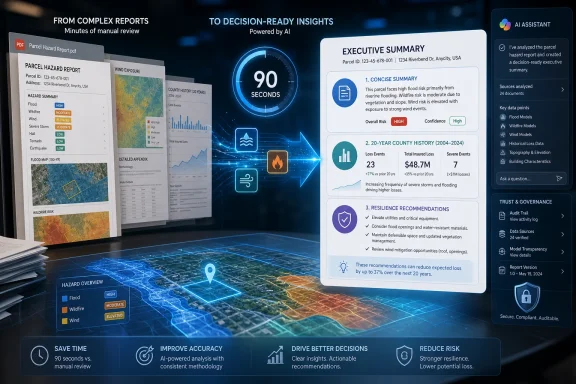 Copilot Moves From Office Assistant to Deal-Room Interpreter
Microsoft Copilot has spent the last few years being sold as a productivity layer for email, documents, meetings, code, and security operations. RiskFootprint’s announcement points to a narrower but more consequential direction: Copilot as an interpreter of specialized datasets in regulated or quasi-regulated workflows. That is a different proposition from asking an AI assistant to draft a memo or summarize a Teams call.The product described in the release is not a general chatbot wandering the open web. RiskFootprint says the workflow uses its own hazard intelligence, drawn from government and peer-reviewed sources, and applies Copilot’s reasoning layer to generate a narrative summary. In theory, that makes the tool less like a magic oracle and more like a controlled front end for an existing report.
That distinction matters because real estate and lending decisions do not tolerate the same level of casual error as office productivity experiments. A wrong summary of a meeting is irritating. A wrong risk characterization of a flood-exposed commercial property can affect pricing, financing, insurance, disclosure, and liability.
The announcement also shows how Microsoft’s AI stack is finding its way into vertical markets without Microsoft needing to build every vertical product itself. Copilot becomes the brand name and reasoning layer; the domain vendor supplies the data, workflow, and liability-sensitive context. If that pattern holds, many future Copilot stories will not look like Microsoft apps at all.
The Executive Summary Is the Product
RiskFootprint says the new workflow produces three outputs: a concise summary of the full hazard report, a 20-year county-level hazard and disaster history, and high-level resilience recommendations. The company says the result is generated in roughly 90 seconds and delivered on top of the underlying report. That sounds modest until you remember how commercial property decisions actually move.Due diligence is often a race between incomplete information and fixed deadlines. A lender, buyer, underwriter, or engineering consultant may have access to a report, but access does not guarantee comprehension. The problem is not merely whether the data exists; it is whether the right person can understand it quickly enough to change a decision.
That is why the summary layer has commercial power. A parcel-level hazard report may contain maps, category scores, exposure analysis, and technical assumptions. The executive summary turns that material into something that can be forwarded, discussed, challenged, and documented.
This is also where AI becomes both useful and dangerous. Summaries compress complexity, and compression always involves judgment. The value of the RiskFootprint-Copilot workflow will depend less on whether it can write fluent prose and more on whether it preserves the uncertainty, thresholds, caveats, and provenance that make a hazard report defensible.
Climate Risk Is Becoming a Windows-Adjacent Workflow
At first glance, a property resilience product may look outside the usual orbit of WindowsForum readers. It is not. The modern Windows workplace is where these specialized workflows are increasingly being surfaced: in Microsoft 365, SharePoint, Teams, Edge, Power Platform, Azure, and line-of-business systems stitched together by identity and permissions.Copilot’s expansion into real estate risk is therefore part of a broader enterprise pattern. Microsoft is trying to make AI less like a separate destination and more like an ambient interface over business data. If a hazard report lives in a portal, PDF, data room, SharePoint library, or transaction file, the pressure will be to summarize it where employees already work.
For IT administrators, this shifts the challenge from “Should we allow AI?” to “Which data can AI touch, under what controls, with what audit trail, and for which users?” A climate-risk workflow may involve property addresses, borrower information, transaction documents, insurance files, and legal correspondence. That is not casual content.
The Windows ecosystem has always absorbed business process changes through the back door. A new reporting workflow becomes a browser dependency, then a Microsoft 365 integration, then a permissions question, then a records-retention problem. AI summaries in real estate and lending will follow the same path.
The Press Release Says “Defensible”; The Market Will Ask “Defensible Enough”
RiskFootprint’s most important word is not “AI.” It is defensible. The release repeatedly frames the product as traceable, auditable, and suitable for high-stakes environments. That is exactly the vocabulary buyers in lending, underwriting, engineering, and commercial real estate want to hear.But defensibility is not a property that a vendor can simply declare. It is earned through source quality, methodology, repeatability, access controls, versioning, and documentation. If an AI-generated summary becomes part of a loan file or investment memo, users will need to know what report version it summarized, which data sources were used, what assumptions were included, and whether the output can be reproduced later.
This is where generic AI language often runs ahead of operational reality. “Grounded” is not the same as correct. “Peer-reviewed” does not automatically mean every generated sentence follows from the underlying evidence. “Auditable” does not mean much unless the audit trail survives export, sharing, and human edits.
The good news for RiskFootprint is that it appears to be starting from a structured report rather than asking Copilot to invent a risk profile from scratch. The harder question is whether the summary output clearly distinguishes observed history, modeled exposure, probable future hazard, and recommended mitigation. Those are different categories of knowledge, and blending them into one smooth paragraph can create a false sense of certainty.
AI Is Being Asked to Solve a Human Bottleneck
The company’s founder, Albert Slap, is quoted in the release saying RiskFootprint reports are not complex, but that clients now get a solid and understandable executive summary to accelerate decisions. That phrasing reveals the real pain point. The report may not be complex to the people who built it, but it may still be functionally complex to the people who must act on it.This is a familiar enterprise problem. Security tools generate alerts faster than analysts can triage them. Observability platforms generate telemetry faster than engineers can interpret it. Compliance systems produce reports that few executives read in full. Now climate and hazard intelligence is meeting the same bottleneck.
AI is well suited to this middle layer: not the creation of primary evidence, but the translation of structured evidence into decision-ready language. That is why summaries, narratives, and recommendations have become the first commercially viable AI features in many vertical markets. They do not replace the expert; they reduce the distance between the expert artifact and the business decision.
Still, the human bottleneck does not vanish. It moves. Instead of asking an expert to write every summary from scratch, organizations must ask experts to validate the templates, test the outputs, monitor exceptions, and define when a summary is not enough. The workflow becomes faster, but governance becomes more important.
The Real Estate Industry Is Learning to Price the Weather
The timing is not accidental. Natural hazard exposure has moved from a background assumption to a front-line financial variable. Flood, wind, wildfire, extreme heat, drought, storm surge, and other hazards increasingly affect insurance availability, operating costs, tenant expectations, capital planning, and asset values.Commercial real estate has historically treated environmental diligence and property condition assessments as bounded exercises. Climate and hazard risk complicate that model because the relevant risk is not always visible during a site visit and may not be captured by yesterday’s insurance premium. A property can look sound and still be badly exposed to future physical risk.
RiskFootprint positions itself around parcel-level intelligence across more than 34 natural hazard categories, aligned with ASTM Property Resilience Assessment methodologies. That alignment is important because markets tend to trust risk information more when it can be mapped to recognized practices rather than vendor-specific scoring alone. Standards do not eliminate debate, but they create a shared language for it.
For lenders and underwriters, the issue is not ideological. It is collateral risk, business interruption, loss severity, default probability, and regulatory scrutiny. For buyers, it is purchase price, capital expenditure, disclosure, and exit risk. For architects and engineers, it is whether resilience measures are being considered early enough to matter.
County History Is Useful, but Parcels Still Pay the Bills
One of the three promised outputs is a 20-year hazard and disaster history at the county level. That is a sensible feature because county-level history gives users a quick narrative of recent events, declarations, and recurring hazards. It can orient a lender or buyer who does not know the local risk environment.But county history must be handled carefully. County-level disaster history is not the same as parcel-level exposure. A large county can contain coastlines, hills, floodplains, urban heat islands, wildfire interfaces, and inland areas with sharply different profiles. A summary that leans too heavily on county history could either exaggerate or understate the risk for a specific property.
RiskFootprint’s advantage, if the implementation matches the release, is that the county history sits on top of a parcel-level report rather than replacing it. That ordering matters. The parcel should remain the unit of decision, while the county history provides context.
This is the kind of nuance that AI summaries must preserve. A good summary can say, in effect, “The county has experienced repeated hazard events, but this parcel’s specific exposure is driven by these particular factors.” A bad summary will flatten geography into a generic risk narrative that sounds authoritative because it is well written.
Microsoft’s Brand Helps, but It Also Raises the Bar
Putting Microsoft Copilot in the product name gives the workflow instant enterprise familiarity. Many customers already know Copilot as part of Microsoft 365, Windows, Edge, GitHub, or security tooling. That brand recognition can reduce friction for a specialized vendor selling into conservative professional markets.It also creates expectations. Microsoft has spent enormous energy positioning Copilot around enterprise data protection, grounding, permissions, and productivity. Customers will reasonably ask whether this workflow inherits the same control model they expect from Microsoft’s business AI products, or whether “Copilot” is being used more loosely as a reasoning component in a partner workflow.
The press release includes the standard caveat that Microsoft and Microsoft Copilot are trademarks of Microsoft Corporation and that use of the names does not imply endorsement. That caveat matters. This is not, on the face of the release, a Microsoft product announcement. It is a RiskFootprint product using or integrating with Microsoft Copilot.
For IT buyers, that means the diligence does not stop at the Microsoft name. They should ask where prompts and outputs are processed, whether customer data is retained, whether reports are stored in Microsoft tenants or vendor systems, how access is controlled, and whether outputs can be logged for compliance. The Microsoft brand may open the door, but the implementation details decide whether the tool belongs in a regulated workflow.
“No Hallucinations” Is a Claim That Deserves Pressure
The release says the workflow is trained to use only government and peer-reviewed sources, “eliminating hallucinations” and ensuring every output is traceable and defensible. That is the boldest claim in the announcement, and it should be read with care. In AI systems, limiting source material and grounding outputs can reduce hallucination risk, but elimination is a much higher bar.Large language models can make mistakes even when supplied with good source material. They can overstate, omit, misread, or blend context. They can also generate recommendations that sound reasonable but do not follow from the evidence or do not fit local codes, building conditions, financing structures, or insurance constraints.
A more cautious framing would be that the workflow is designed to reduce hallucinations by restricting the source corpus and tying outputs to RiskFootprint’s underlying report. That would still be valuable. In fact, it would be more credible because enterprise buyers know that AI risk management is a discipline, not a spell.
This does not make the product suspect. It makes validation essential. If RiskFootprint can show transparent source linkage, repeatable outputs, and clear boundaries between report-derived findings and AI-generated prose, it will have a stronger story than vendors that promise accuracy through branding alone.
Regulated Workflows Want Speed, but They Fear Ambiguity
The press release names commercial real estate transactions, lending and underwriting, engineering and due diligence, and portfolio risk governance as target environments. These are precisely the kinds of workflows where speed has value but ambiguity has cost. A summary that saves an hour can be useful; a summary that creates unclear responsibility can become a problem.Consider a lender reviewing a property in a hazard-prone area. If the AI summary says the property has elevated flood and wind exposure but recommends only “high-level resilience measures,” who decides whether that affects loan terms? If an underwriter uses the summary to triage risk, is the full report still reviewed? If a buyer later claims a hazard was understated, what exactly becomes the record: the report, the AI summary, the human memo, or the final credit decision?
These are not reasons to avoid the technology. They are reasons to design the workflow with clear roles. AI should accelerate first-pass interpretation, but it should not blur accountability. The summary must point back to the underlying report, not become a substitute for it.
That is especially true because resilience recommendations can imply cost. A recommendation to improve drainage, harden building systems, evaluate roof performance, or assess wildfire defensible space may trigger additional engineering work. In property transactions, every recommendation competes with timing, budget, negotiating leverage, and deal certainty.
The Price Makes This a Transaction Tool, Not a Toy
RiskFootprint says commercial property reports are available at $375 per property and residential reports at $200, with the Copilot hazard summary workflow included. Those prices position the product as a transaction and diligence tool rather than a broad consumer app. It is inexpensive compared with many professional services, but expensive enough to signal that the output is meant to matter.For commercial buyers, lenders, and consultants, $375 is a small line item if the report helps identify a material exposure before closing. For residential users, $200 is more meaningful, but still plausible in the context of a home purchase, insurance concern, or climate-risk decision. The inclusion of AI summaries may make the report feel more accessible to nontechnical users.
That accessibility is commercially important. Climate-risk data has often struggled with a translation problem: too technical for consumers, too broad for individual property decisions, and too scattered for transaction teams. A concise AI-generated summary could make the product easier to adopt across a wider range of users.
The risk is that accessibility becomes overconfidence. A polished summary can make uncertain information feel settled. The best implementations will use plain English without sanding away the conditional nature of hazard analysis.
Standards Are Becoming the Antidote to AI Vapor
RiskFootprint’s reference to ASTM Property Resilience Assessment methodologies is more than a marketing footnote. In a crowded AI market, standards-based positioning is a way to separate domain practice from demo culture. Anyone can build a chatbot that talks about floods and wildfire; fewer can map that output to recognized assessment methods used by professionals.This is where the announcement intersects with a larger shift in enterprise AI. The first wave of adoption rewarded novelty. The next wave will reward controls. Buyers will ask whether an AI workflow is grounded in accepted data sources, whether it follows a repeatable methodology, and whether its outputs can survive scrutiny from auditors, lawyers, regulators, insurers, and counterparties.
For Windows and Microsoft 365 administrators, this means AI governance will increasingly be domain-specific. A Copilot deployment for HR carries different risks than one for security operations. A Copilot-assisted hazard summary carries different risks than one for sales emails. The control plane may be shared, but the governance questions are not.
Standards also help define when AI should stop. A tool aligned with a property resilience methodology can guide a user through identification, evaluation, and recommendation. But it should also indicate when a qualified engineer, environmental consultant, insurance specialist, or legal adviser is needed. In high-stakes workflows, escalation is a feature.
The Vendor Data Moat Is the Real Asset
The announcement’s focus on Copilot may attract attention, but RiskFootprint’s real asset is the hazard dataset and methodology underneath. AI summarization is becoming easier to replicate. Domain-specific, parcel-level, multi-hazard intelligence with a credible evidence base is harder.This is the emerging shape of enterprise AI competition. The model layer is powerful, but the data layer determines usefulness. Vendors with proprietary workflows, cleaned datasets, industry-specific assumptions, and trusted methodologies can use AI to expose value that was previously buried in reports or dashboards.
That also means customers should evaluate the data before they admire the prose. What sources feed the hazard categories? How current are they? How are conflicts between datasets resolved? How are local variations captured? How does the system handle missing data? How are climate projections distinguished from historical observations?
A beautiful summary of weak data is still weak. A plain summary of strong data may be operationally valuable. The best products will combine both, but buyers should not confuse language quality with analytical quality.
Copilot’s Vertical Future Will Be Built by Specialists
Microsoft cannot possibly build expert products for every profession that wants AI. Real estate lending, civil engineering, property insurance, municipal planning, healthcare compliance, tax, logistics, and energy all have their own data, jargon, standards, and liability profiles. The scalable play is for Microsoft to provide the AI substrate while specialists package it for their markets.RiskFootprint’s announcement fits that model neatly. The company owns the domain story; Copilot supplies the familiar AI layer. Customers get a workflow that sounds modern without requiring them to trust a generic chatbot with a specialized decision.
This is likely where many successful AI deployments will land: not in open-ended assistants, but in constrained workflows with known inputs and bounded outputs. The prompt is not “Tell me about climate risk.” It is “Summarize this report, using these sources, for this transaction, with this audit trail.” That is a much more enterprise-friendly shape.
The lesson for IT teams is that AI procurement will increasingly arrive through business units. A real estate team may buy a hazard intelligence platform. A finance team may buy an underwriting tool. A legal team may buy contract review. Each may include Copilot or another AI layer, and each will create data governance questions that central IT must answer after the fact unless it gets involved early.
The Fine Print Is Where AI Governance Lives
The press release includes several caveats: it is paid press release content, StreetInsider’s news staff was not involved, Microsoft’s name does not imply endorsement, and the release does not constitute legal, financial, or investment advice. Those disclaimers are easy to skip. They are also a useful reminder that AI products in professional markets often sit between information and advice.That boundary matters. A hazard summary can inform a loan decision, but it is not itself a credit policy. A resilience recommendation can flag mitigation options, but it is not a stamped engineering plan. A county disaster history can contextualize risk, but it is not a guarantee of future loss.
The more AI tools sound like expert advisers, the more important it becomes to define what they are not. This is not just legal hygiene. It is product design. Users need to know whether they are reading a summary, a recommendation, a risk score, a compliance artifact, or a professional opinion.
For administrators and risk officers, the practical question is whether those distinctions survive in the workflow. If a user copies the AI summary into a loan memo, does the provenance remain? If the summary is emailed to a borrower, does the caveat travel with it? If an output is edited by a human, can the organization tell what changed?
Real Estate AI Will Be Judged in the Bad Cases
Most AI demos are judged on ordinary cases. Real enterprise trust is built in edge cases. For a property-risk workflow, the difficult cases will be mixed-hazard parcels, incomplete source data, conflicting maps, recent disasters not yet reflected in datasets, fast-changing insurance markets, and properties where mitigation is possible but expensive.The system must be especially careful when the answer is not clean. A parcel may have moderate modeled exposure but severe recent local losses. A county may have a dramatic disaster history that does not map neatly to the subject property. A building may face low present risk but higher projected future risk. A mitigation recommendation may be technically sound but economically unrealistic.
Those are the situations where a fluent AI summary can either help or harm. It can help by surfacing the ambiguity clearly. It can harm by turning ambiguity into false simplicity. The difference depends on prompt design, source grounding, review processes, and the humility of the output.
This is why “instant” should not be the only performance metric. Ninety seconds is impressive, but the better question is whether the summary is faithful, bounded, and reviewable. In high-stakes workflows, a slower trustworthy answer beats a faster confident mistake.
Windows Shops Should Read This as a Preview
For WindowsForum readers, the most relevant takeaway is not whether they personally need a hazard report. It is that business AI is becoming embedded inside narrow professional services, many of which will touch Microsoft identity, documents, browsers, and collaboration tools. The AI adoption curve will not wait for a neat enterprise-wide Copilot strategy.A Windows administrator may soon find that AI-generated outputs are entering SharePoint libraries, Teams channels, loan origination systems, CRM records, and PDF archives. Some will come from Microsoft 365 Copilot. Some will come from partner applications. Some will be exported from web portals and treated as ordinary documents even though they were generated by AI.
That raises familiar but sharper questions. Should AI-generated reports carry metadata? Should they be labeled? Should retention policies treat them as records? Should users be trained to verify underlying sources? Should data loss prevention rules apply to prompts and outputs? Should procurement require vendors to disclose model behavior and data handling?
The answer will vary by organization, but ignoring the issue is not viable. AI summaries are becoming business artifacts. Once they influence a decision, they become part of the governance surface.
The Hazard Summary Is Small, but the Pattern Is Big
RiskFootprint’s Copilot workflow is a specialized launch from a specialized company, announced through paid press release distribution. It would be easy to dismiss it as another entry in the long parade of “AI-powered” announcements. That would miss the signal.The signal is that AI is moving into the interpretive layer of regulated business decisions. Not replacing the source report, at least not yet. Not replacing the professional, at least not honestly. But reshaping the middle step where evidence becomes narrative and narrative becomes action.
That middle step is where Microsoft wants Copilot to live. It is also where risk accumulates if organizations fail to govern it. The companies that succeed will not be the ones that merely attach AI to a PDF; they will be the ones that can prove what the AI saw, what it said, why it said it, and how a human was expected to use it.
The Deal File Now Has an AI Layer
RiskFootprint’s announcement leaves several practical lessons for buyers, lenders, consultants, and IT teams that will encounter AI-generated risk summaries in the wild.- The RiskFootprint-Copilot workflow is best understood as a summary and interpretation layer on top of an underlying hazard report, not as a replacement for professional due diligence.
- The most important implementation details are source grounding, traceability, version control, permissions, and whether the generated summary can be tied back to the exact report it summarized.
- Claims that a system “eliminates hallucinations” should be tested against difficult cases, because constrained sourcing can reduce AI error without making it impossible.
- County-level disaster history can add useful context, but parcel-level exposure should remain the center of any real estate or lending decision.
- IT and compliance teams should treat AI-generated summaries as business records when they influence transactions, underwriting, governance, or investment decisions.
- Microsoft’s Copilot brand may make these tools feel familiar, but each partner workflow still requires its own security, privacy, and audit review.
References
- Primary source: StreetInsider
Published: Tue, 26 May 2026 20:36:02 GMT
RiskFootprint™ and Microsoft Copilot Launch AI Hazard Summary Engine for Real Estate and Lending Professionals
BOCA RATON, FL, May 22, 2026 RiskFootprint, the leading provider of...www.streetinsider.com - Official source: support.microsoft.com
What information does Copilot use to answer my prompt? | Microsoft Support
Learn what information Copilot uses to answer your prompts.support.microsoft.com - Related coverage: riskfootprint.com
Property Resilience Assessment - RiskFootprint Risk Assessment
Resilience & Risk Assessments and Risk Mitigation Advisory Services for Residential & Commercial Real Estate, Lenders, and Government riskfootprint.com
- Official source: learn.microsoft.com
Enterprise data protection in Microsoft 365 Copilot and Microsoft 365 Copilot Chat | Microsoft Learn
Learn what enterprise data protection means for Microsoft 365 Copilot and Microsoft 365 Copilot Chat.learn.microsoft.com - Related coverage: techtarget.com
How does enterprise data protection in Copilot work? | TechTarget
Under enterprise data protection, Microsoft promises not to train Copilot on data that users submit in their queries. Learn more.www.techtarget.com - Related coverage: windowscentral.com
Microsoft Copilot blamed for Maccabi Tel Aviv soccer fan ban | Windows Central
UK police blame Copilot for wrongly flagging a soccer fan, sparking AI controversy and backlash.www.windowscentral.com
- Related coverage: techradar.com
'Copilot is for entertainment purposes only': Even Microsoft's official terms and conditions say you really shouldn't be using its AI at work | TechRadar
"Use Copilot at your own risk," Microsoft sayswww.techradar.com - Related coverage: researchgate.net
- Related coverage: m365.fm
Copilot Hallucination Risks Explained 2026 | M365 AI Governance Guide
Learn what Copilot hallucinations are, why they happen, and how to prevent them. Complete 2026 guide covering RAG pipelines, governance, red teaming, SLMs, and Microsoft Purview for M365 enterprises. www.m365.fm
- Related coverage: erniecosta.com
- Official source: cdn-dynmedia-1.microsoft.com
- Related coverage: cawildfirefund.com
marty walters property resilience assessment astm standard for commercial real estate email message information submission
PDF documentwww.cawildfirefund.com
