

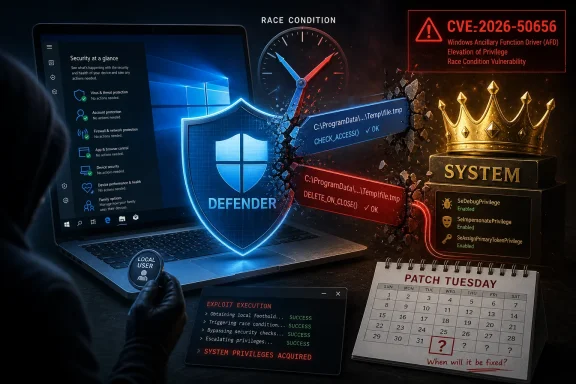
Microsoft disclosed CVE-2026-50656 in June 2026, confirming that a Windows Defender flaw publicly called RoguePlanet can let a local standard Windows user escalate to SYSTEM privileges while the company prepares a security update with no release date yet announced. The immediate story is a missing patch; the larger one is a security product becoming the attack path. As reported by IBTimes Singapore and detailed by Microsoft’s own advisory, Defender is not merely failing to stop a local attack here — it is allegedly being turned into the privileged actor that completes it. For Windows users and administrators, that distinction matters.
Privilege-escalation bugs are not rare in Windows. They are part of the monthly rhythm of Patch Tuesday, often sitting beneath flashier remote-code-execution flaws in Exchange, Office, or the browser stack. But a privilege-escalation vulnerability in Microsoft Defender lands differently because Defender is the component many users are told to trust by default.
Microsoft’s advisory, as reflected in the National Vulnerability Database, describes CVE-2026-50656 as an elevation-of-privilege issue in the Microsoft Malware Protection Engine. Microsoft says it is “working to provide a high quality security update,” which is vendor language for a fix that is not ready yet. The vulnerability has a Microsoft CVSS score of 7.8, high severity, and Microsoft’s exploitability assessment reportedly rates exploitation as more likely.
That does not mean every Windows 11 machine is seconds away from compromise. RoguePlanet is a local privilege escalation, not a magic Internet worm. An attacker must already have a foothold — a standard user account, malware execution, stolen credentials, or some other way to run code locally.
But local escalation is the bridge between nuisance and ownership. A phishing payload running as a normal user is one problem; the same payload jumping to SYSTEM is another. At SYSTEM level, an attacker can tamper with security tooling, harvest secrets, install persistence, interfere with backups, and move laterally with far fewer guardrails.
That race condition framing matters. A race condition is not usually a single bad permission bit or forgotten bounds check. It is a timing bug, a moment where two operations make assumptions about the same object and an attacker slips a substitution in between. In this case, the reported mechanics involve Defender’s trust in what it is handling during cleanup or quarantine.
The NVD entry also ties the weakness to improper link resolution before file access, a class of flaw where software follows a file-system reference in a way the attacker can influence. On Windows, where links, junctions, reparse points, temporary files, and privileged services frequently intersect, that category has produced plenty of bruises over the years. Security tools are especially sensitive because they often need broad access to inspect, move, or delete suspicious content.
The most uncomfortable detail is that researchers say the proof of concept works even when Defender real-time protection is disabled. That sounds counterintuitive only if Defender is imagined as a single on/off switch. In practice, Microsoft’s antimalware stack includes services, engines, scheduled actions, and privileged plumbing that may remain relevant even when a user-facing protection toggle is changed.
That leaves users with a frustrating answer: do not assume a cosmetic mitigation is a mitigation. If the vulnerable engine behavior exists on the machine, simply flipping a Defender setting may not remove the attack surface. Until Microsoft ships a corrected engine or platform update, defenders are stuck reducing the chances that untrusted code gets to run in the first place.
That timing is more than trivia. Patch Tuesday is supposed to be the moment when enterprise risk compresses: administrators test, deploy, reboot, and move a fleet closer to a known-good state. If fresh proof-of-concept exploits repeatedly appear immediately after those updates, the psychological contract changes. Customers still need to patch, but the act of patching no longer feels like closure.
The claim in the user-supplied IBTimes Singapore report is that this is the seventh publicly disclosed zero-day from the researcher and the fourth targeting Microsoft Defender. Help Net Security listed earlier releases including BlueHammer, RedSun, UnDefend, YellowKey, and GreenPlasma. Some of those names sound almost theatrical, but the operational impact is not theater if exploit code is public before a vendor fix is available.
This is where Microsoft’s advisory language becomes important. The company says it is working on a fix and has not reported active exploitation of RoguePlanet. That is a meaningful distinction. But “not observed exploited in the wild” is not the same as “safe,” especially when proof-of-concept code is reportedly circulating and when prior tools from the same campaign have allegedly been adapted into real attacks.
For administrators, the pattern means each month’s Windows security work may need a second phase: not just “install the cumulative update,” but “check whether new unpatched issues emerged in the update’s wake.” That is a grimly modern workflow. It treats the patch calendar less like a finish line and more like a weather front.
Brian Krebs and The Register, according to the user-provided report, have connected the Nightmare Eclipse identity to a former Microsoft security engineer, though Microsoft has not publicly confirmed that identification. That detail should be handled carefully. If true, it would make the campaign more embarrassing for Microsoft; if unconfirmed, it remains attribution by reporting rather than established fact.
Either way, Microsoft’s Security Response Center is now defending more than code. It is defending process. When a company asks researchers to report vulnerabilities privately, wait for triage, accept severity decisions, and trust the bounty program, it is asking for a social contract. If researchers believe that contract is broken, some will go public. If they go public with weaponized or near-weaponized exploit code, users become the blast radius.
That does not excuse reckless disclosure. Publishing reliable local privilege escalation code against a widely deployed security component creates real risk for schools, hospitals, small businesses, and ordinary Windows users who have no role in a dispute over bounty handling. Barracuda and incident-response teams cited in the provided material reportedly view Nightmare Eclipse less as a conventional researcher and more as a malicious actor, especially because earlier Defender exploits were allegedly used before Microsoft patched them.
But Microsoft cannot dismiss the process critique merely because the messenger is radioactive. Trend Micro’s Zero Day Initiative, through Dustin Childs, has argued in related reporting that vendor response practices can fuel researcher frustration. Even if one rejects the tactics, the existence of a recurring monthly exploit cycle suggests a deeper failure of trust between Microsoft and parts of the research community.
The problem is that “some other weakness” is exactly how many intrusions begin. A malicious attachment runs. A user installs a fake utility. A help-desk credential is stolen. A remote access tool is abused. On its own, that first foothold may be constrained by user permissions, application control, or endpoint detection.
A reliable SYSTEM escalation changes the tempo. It can turn a low-privilege beachhead into a full endpoint compromise before defenders have time to respond. That matters in ransomware intrusions, where speed and privilege are everything. It matters in espionage, where persistence and stealth matter even more.
This is why local privilege escalation bugs are sometimes underrated by consumers and overrated by exploit marketers, but rarely ignored by professionals. They do not open the door; they widen it. They are the tool that lets an attacker who is already inside stop acting like a guest and start acting like the building manager.
For Defender specifically, there is an added irony. The vulnerable component is present precisely because the system is trying to protect itself. Microsoft has spent years making Defender a credible default antivirus, integrating it deeply into Windows and into enterprise offerings such as Defender for Endpoint. That deep integration is a strength when it detects malware early. It is a liability when the trusted component itself becomes a privilege boundary crossing.
This is a useful place to separate certainty from scope. Microsoft’s CVE entry identifies the Microsoft Malware Protection Engine as affected, which points toward the Defender engine rather than a single Windows shell feature. That does not automatically mean every configuration is equally exposed, every proof-of-concept path works identically, or Windows Server behaves the same as consumer Windows. It does mean administrators should think in terms of Defender engine deployment, not just Windows 11 branding.
For home users, the advice is boring but still correct: do not run unknown executables, avoid pirated software, keep browsers and Office updated, and install Microsoft’s fix as soon as it arrives. The difficulty is that boring advice feels inadequate when the vulnerability sits inside the default security tool. But most RoguePlanet scenarios still need the attacker to run something locally, and preventing that first execution remains the best practical defense.
For enterprises, the answer is less about individual caution and more about layered control. Application control, least privilege, endpoint monitoring, tamper protection, network segmentation, and rapid isolation procedures all matter more during an unpatched local escalation window. Defender can remain part of that stack, but it should not be the whole stack.
There is also a communications problem for IT departments. “You are fully patched, but exposed to a public Defender zero-day with no fix yet” is not a sentence that calms executives. Security teams will need to explain that patch compliance is necessary but not sufficient, and that compensating controls exist precisely for these uncomfortable gaps.
That conclusion is not irrational. Defender has improved dramatically from the bad old days of Microsoft Security Essentials being treated as the minimum viable shield. It integrates cleanly, avoids the bloat of some third-party suites, updates automatically, and benefits from Microsoft’s visibility across a vast Windows install base.
But monoculture always has a cost. When the default security layer is everywhere, a flaw in that layer becomes unusually attractive. Attackers do not need to guess which antivirus product is installed if the target is a fresh Windows machine or a Microsoft-standardized enterprise fleet. They can bet on Defender being present, active, or at least installed.
Third-party antivirus is not a magic answer. Security suites have had their own disastrous kernel bugs, insecure updaters, browser injection problems, and privilege-escalation flaws. Swapping one privileged security product for another can merely change the attack surface. The better lesson is not “install any other antivirus immediately,” but “do not treat a single antivirus engine as a complete security architecture.”
Microsoft has also blurred the line between consumer protection and enterprise security platform. Defender is no longer just the thing that scans downloads on a family laptop. In business environments, Defender branding stretches across endpoint detection, identity, cloud apps, email, and threat intelligence. That breadth makes the brand powerful, but it also means a Defender flaw can carry reputational weight beyond the specific component affected.
The first move is inventory. Organizations need to know where Defender’s Malware Protection Engine is deployed, which endpoints are most exposed to untrusted local execution, and where users have unnecessary local privileges. If the exploit requires a standard user foothold, reducing local admin sprawl still matters because it limits what attackers can already do and improves the signal when privilege changes occur.
The second move is detection. Teams should watch for suspicious child processes, unusual command shells launched from security-service contexts, Defender tampering events, unexpected changes in quarantine-related paths, and privilege transitions that do not match normal software deployment activity. No one should pretend generic monitoring is equivalent to a patch, but it can shorten dwell time if exploit attempts begin.
The third move is containment. If a user workstation is compromised through an unpatched local escalation, network segmentation and credential hygiene determine whether that machine becomes the whole incident or merely one host. That means reviewing lateral movement paths, service-account exposure, cached credentials, and backup access.
For smaller organizations without mature security operations, the practical version is simpler: keep backups offline or protected, restrict software installation, remove unnecessary local admin rights, and be more skeptical than usual of downloads until Microsoft ships the fix. If you rely entirely on Defender and have no visibility beyond it, RoguePlanet is a reminder that “free and built in” still needs operational backup.
Those two truths do not cancel each other out. They coexist, and users pay for the gap between them. The more public and personal the dispute becomes, the easier it is for each side to frame the other as the sole problem. Microsoft can point to irresponsible publication; the researcher can point to alleged mishandling and retaliation.
The danger is that the argument becomes more interesting than the affected systems. Security Twitter, forums, and newsrooms can spend days litigating whether Nightmare Eclipse is a whistleblower, vandal, extortionist, disgruntled insider, or some combination of labels. Meanwhile, administrators still need to know whether Tuesday’s endpoint build is vulnerable on Wednesday.
The mature view is to separate ethics from exploitability. A researcher can behave irresponsibly and still reveal a real vulnerability. A vendor can be legitimately targeted by reckless disclosure and still have process failures worth fixing. RoguePlanet should force Microsoft to patch the bug, but it should also force a harder look at how MSRC communicates, credits, prioritizes, and de-escalates researcher conflict.
For WindowsForum readers, this is not abstract governance drama. The health of Microsoft’s disclosure pipeline affects the machines on your desk and the fleets under your control. When that pipeline breaks, vulnerability knowledge does not disappear; it leaks into public repositories, private exploit markets, ransomware playbooks, and defensive Slack channels all at once.
That leaves Windows users with a narrow but important set of conclusions:
Microsoft will almost certainly fix RoguePlanet; the company has the engineering depth, telemetry, and update machinery to do it. The harder repair is trust: trust that Defender’s privileged plumbing is being audited with the seriousness it deserves, trust that MSRC can absorb hostile disclosures without turning them into monthly spectacles, and trust that “fully updated” still means something close to safe. Until that repair happens, Windows administrators should treat RoguePlanet not as an isolated Defender embarrassment, but as a warning that the default shield can become part of the attack chain — and that resilient security starts when we stop pretending otherwise.
The practical catch is that this is a Defender engine update, not simply another monthly Windows cumulative update. Systems that were already current on June 2026 Patch Tuesday still need to receive the updated Malware Protection Engine to close this specific exposure.
Windows users and IT administrators should verify the engine version on affected endpoints rather than assuming “fully patched Windows” is enough. The fix matters across consumer and enterprise environments because the Malware Protection Engine underpins Microsoft Defender and other Microsoft security products.
The update supersedes the earlier no-fix-yet status: the immediate priority is now deployment verification, especially on Windows 10 and Windows 11 machines where RoguePlanet was reported to affect fully patched systems.
According to the researcher, a specially configured SMB server can supply an oversized Zone.Identifier data stream and keep the connection open, causing Defender to retain growing amounts of data. A full drive may disrupt applications, updates, logging, and Windows services, although it does not necessarily crash the operating system immediately.
Microsoft has not confirmed the reported behavior, independent researchers have not publicly reproduced it, and there is no evidence of exploitation against users. Administrators should therefore continue deploying the RoguePlanet fix, while monitoring unexpected disk-space consumption and unusual SMB activity on updated endpoints.
Administrators can verify installation by opening PowerShell as administrator and running
Although standard Windows configurations should receive the engine alongside Defender security intelligence updates, enterprise deployment may lag because of delayed update rings, proxy restrictions, or internally managed update infrastructure. IT teams should therefore query engine versions centrally rather than relying solely on Windows Update compliance status.
This distribution confirmation does not resolve the separately reported disk-filling behavior allegedly affecting version 1.1.26060.3008. Microsoft has not confirmed that claim, so the current practical course remains to deploy and verify the RoguePlanet fix while monitoring updated systems for abnormal disk-space consumption.

 Defender’s Job Is Protection, Which Is Why This Bug Cuts Deeper
Privilege-escalation bugs are not rare in Windows. They are part of the monthly rhythm of Patch Tuesday, often sitting beneath flashier remote-code-execution flaws in Exchange, Office, or the browser stack. But a privilege-escalation vulnerability in Microsoft Defender lands differently because Defender is the component many users are told to trust by default.Microsoft’s advisory, as reflected in the National Vulnerability Database, describes CVE-2026-50656 as an elevation-of-privilege issue in the Microsoft Malware Protection Engine. Microsoft says it is “working to provide a high quality security update,” which is vendor language for a fix that is not ready yet. The vulnerability has a Microsoft CVSS score of 7.8, high severity, and Microsoft’s exploitability assessment reportedly rates exploitation as more likely.
That does not mean every Windows 11 machine is seconds away from compromise. RoguePlanet is a local privilege escalation, not a magic Internet worm. An attacker must already have a foothold — a standard user account, malware execution, stolen credentials, or some other way to run code locally.
But local escalation is the bridge between nuisance and ownership. A phishing payload running as a normal user is one problem; the same payload jumping to SYSTEM is another. At SYSTEM level, an attacker can tamper with security tooling, harvest secrets, install persistence, interfere with backups, and move laterally with far fewer guardrails.
RoguePlanet Turns Defender’s Authority Against the Machine
According to reporting by Help Net Security, Windows Central, IBTimes Singapore, and analysis from researchers who reproduced the issue, RoguePlanet abuses a race condition in Defender’s file-handling workflow. ThreatLocker and Cyderes are among the firms reported to have examined or reproduced the behavior. The basic allegation is elegant in the unpleasant way good exploit chains often are: Defender performs file-scanning and quarantine operations with elevated privileges, and the exploit manipulates timing and file references so those privileged operations land somewhere the attacker controls.That race condition framing matters. A race condition is not usually a single bad permission bit or forgotten bounds check. It is a timing bug, a moment where two operations make assumptions about the same object and an attacker slips a substitution in between. In this case, the reported mechanics involve Defender’s trust in what it is handling during cleanup or quarantine.
The NVD entry also ties the weakness to improper link resolution before file access, a class of flaw where software follows a file-system reference in a way the attacker can influence. On Windows, where links, junctions, reparse points, temporary files, and privileged services frequently intersect, that category has produced plenty of bruises over the years. Security tools are especially sensitive because they often need broad access to inspect, move, or delete suspicious content.
The most uncomfortable detail is that researchers say the proof of concept works even when Defender real-time protection is disabled. That sounds counterintuitive only if Defender is imagined as a single on/off switch. In practice, Microsoft’s antimalware stack includes services, engines, scheduled actions, and privileged plumbing that may remain relevant even when a user-facing protection toggle is changed.
That leaves users with a frustrating answer: do not assume a cosmetic mitigation is a mitigation. If the vulnerable engine behavior exists on the machine, simply flipping a Defender setting may not remove the attack surface. Until Microsoft ships a corrected engine or platform update, defenders are stuck reducing the chances that untrusted code gets to run in the first place.
The Patch Tuesday Pattern Is Becoming Part of the Threat Model
RoguePlanet did not arrive in a vacuum. Help Net Security reported that the exploit appeared around Microsoft’s June 2026 Patch Tuesday cycle, the same update wave that addressed other vulnerabilities tied to the same researcher’s releases. Windows Central likewise framed RoguePlanet as the latest chapter in a bruising dispute between Microsoft and the researcher known as Nightmare Eclipse, also referred to in some reporting as Chaotic Eclipse.That timing is more than trivia. Patch Tuesday is supposed to be the moment when enterprise risk compresses: administrators test, deploy, reboot, and move a fleet closer to a known-good state. If fresh proof-of-concept exploits repeatedly appear immediately after those updates, the psychological contract changes. Customers still need to patch, but the act of patching no longer feels like closure.
The claim in the user-supplied IBTimes Singapore report is that this is the seventh publicly disclosed zero-day from the researcher and the fourth targeting Microsoft Defender. Help Net Security listed earlier releases including BlueHammer, RedSun, UnDefend, YellowKey, and GreenPlasma. Some of those names sound almost theatrical, but the operational impact is not theater if exploit code is public before a vendor fix is available.
This is where Microsoft’s advisory language becomes important. The company says it is working on a fix and has not reported active exploitation of RoguePlanet. That is a meaningful distinction. But “not observed exploited in the wild” is not the same as “safe,” especially when proof-of-concept code is reportedly circulating and when prior tools from the same campaign have allegedly been adapted into real attacks.
For administrators, the pattern means each month’s Windows security work may need a second phase: not just “install the cumulative update,” but “check whether new unpatched issues emerged in the update’s wake.” That is a grimly modern workflow. It treats the patch calendar less like a finish line and more like a weather front.
Microsoft’s Disclosure Problem Is Now a Product Problem
The public fight around Nightmare Eclipse has created two overlapping arguments. One is about the vulnerability itself: whether RoguePlanet is exploitable, how reliable it is, which Windows versions are affected, and what Microsoft must change. The other is about vulnerability disclosure: what happens when a researcher decides coordinated disclosure has failed and starts publishing working zero-days instead.Brian Krebs and The Register, according to the user-provided report, have connected the Nightmare Eclipse identity to a former Microsoft security engineer, though Microsoft has not publicly confirmed that identification. That detail should be handled carefully. If true, it would make the campaign more embarrassing for Microsoft; if unconfirmed, it remains attribution by reporting rather than established fact.
Either way, Microsoft’s Security Response Center is now defending more than code. It is defending process. When a company asks researchers to report vulnerabilities privately, wait for triage, accept severity decisions, and trust the bounty program, it is asking for a social contract. If researchers believe that contract is broken, some will go public. If they go public with weaponized or near-weaponized exploit code, users become the blast radius.
That does not excuse reckless disclosure. Publishing reliable local privilege escalation code against a widely deployed security component creates real risk for schools, hospitals, small businesses, and ordinary Windows users who have no role in a dispute over bounty handling. Barracuda and incident-response teams cited in the provided material reportedly view Nightmare Eclipse less as a conventional researcher and more as a malicious actor, especially because earlier Defender exploits were allegedly used before Microsoft patched them.
But Microsoft cannot dismiss the process critique merely because the messenger is radioactive. Trend Micro’s Zero Day Initiative, through Dustin Childs, has argued in related reporting that vendor response practices can fuel researcher frustration. Even if one rejects the tactics, the existence of a recurring monthly exploit cycle suggests a deeper failure of trust between Microsoft and parts of the research community.
The Real Risk Is Post-Compromise Acceleration
RoguePlanet is not the kind of flaw most home users should interpret as “someone can hack my laptop from across the Internet.” That would overstate the case. The attacker needs local code execution or authenticated local access, which usually means some other weakness has already happened first.The problem is that “some other weakness” is exactly how many intrusions begin. A malicious attachment runs. A user installs a fake utility. A help-desk credential is stolen. A remote access tool is abused. On its own, that first foothold may be constrained by user permissions, application control, or endpoint detection.
A reliable SYSTEM escalation changes the tempo. It can turn a low-privilege beachhead into a full endpoint compromise before defenders have time to respond. That matters in ransomware intrusions, where speed and privilege are everything. It matters in espionage, where persistence and stealth matter even more.
This is why local privilege escalation bugs are sometimes underrated by consumers and overrated by exploit marketers, but rarely ignored by professionals. They do not open the door; they widen it. They are the tool that lets an attacker who is already inside stop acting like a guest and start acting like the building manager.
For Defender specifically, there is an added irony. The vulnerable component is present precisely because the system is trying to protect itself. Microsoft has spent years making Defender a credible default antivirus, integrating it deeply into Windows and into enterprise offerings such as Defender for Endpoint. That deep integration is a strength when it detects malware early. It is a liability when the trusted component itself becomes a privilege boundary crossing.
“Fully Updated” Is No Longer the Comforting Phrase It Used to Be
One of the most jarring claims in the reports around RoguePlanet is that it affects fully patched Windows systems. Help Net Security reported that the flaw affects fully patched Windows 10 and Windows 11 devices. The user-provided story focuses on Windows 11, while other reporting has included Windows 10 as well because Defender’s Malware Protection Engine is not unique to one client release.This is a useful place to separate certainty from scope. Microsoft’s CVE entry identifies the Microsoft Malware Protection Engine as affected, which points toward the Defender engine rather than a single Windows shell feature. That does not automatically mean every configuration is equally exposed, every proof-of-concept path works identically, or Windows Server behaves the same as consumer Windows. It does mean administrators should think in terms of Defender engine deployment, not just Windows 11 branding.
For home users, the advice is boring but still correct: do not run unknown executables, avoid pirated software, keep browsers and Office updated, and install Microsoft’s fix as soon as it arrives. The difficulty is that boring advice feels inadequate when the vulnerability sits inside the default security tool. But most RoguePlanet scenarios still need the attacker to run something locally, and preventing that first execution remains the best practical defense.
For enterprises, the answer is less about individual caution and more about layered control. Application control, least privilege, endpoint monitoring, tamper protection, network segmentation, and rapid isolation procedures all matter more during an unpatched local escalation window. Defender can remain part of that stack, but it should not be the whole stack.
There is also a communications problem for IT departments. “You are fully patched, but exposed to a public Defender zero-day with no fix yet” is not a sentence that calms executives. Security teams will need to explain that patch compliance is necessary but not sufficient, and that compensating controls exist precisely for these uncomfortable gaps.
The Antivirus Monoculture Question Returns
Microsoft Defender’s success has changed the consumer antivirus market. For years, Windows users were trained to install something else immediately after setting up a PC. More recently, many technically literate users have concluded that Defender is good enough, especially when paired with sane browsing habits, SmartScreen, browser sandboxing, and regular updates.That conclusion is not irrational. Defender has improved dramatically from the bad old days of Microsoft Security Essentials being treated as the minimum viable shield. It integrates cleanly, avoids the bloat of some third-party suites, updates automatically, and benefits from Microsoft’s visibility across a vast Windows install base.
But monoculture always has a cost. When the default security layer is everywhere, a flaw in that layer becomes unusually attractive. Attackers do not need to guess which antivirus product is installed if the target is a fresh Windows machine or a Microsoft-standardized enterprise fleet. They can bet on Defender being present, active, or at least installed.
Third-party antivirus is not a magic answer. Security suites have had their own disastrous kernel bugs, insecure updaters, browser injection problems, and privilege-escalation flaws. Swapping one privileged security product for another can merely change the attack surface. The better lesson is not “install any other antivirus immediately,” but “do not treat a single antivirus engine as a complete security architecture.”
Microsoft has also blurred the line between consumer protection and enterprise security platform. Defender is no longer just the thing that scans downloads on a family laptop. In business environments, Defender branding stretches across endpoint detection, identity, cloud apps, email, and threat intelligence. That breadth makes the brand powerful, but it also means a Defender flaw can carry reputational weight beyond the specific component affected.
Waiting for Microsoft Is a Strategy, but Not a Complete One
Microsoft has urged users to install the security update when it becomes available. That is the correct advice, but it is not enough for the interim. A no-fix-yet vulnerability creates a holding pattern, and holding patterns are where security teams earn their keep.The first move is inventory. Organizations need to know where Defender’s Malware Protection Engine is deployed, which endpoints are most exposed to untrusted local execution, and where users have unnecessary local privileges. If the exploit requires a standard user foothold, reducing local admin sprawl still matters because it limits what attackers can already do and improves the signal when privilege changes occur.
The second move is detection. Teams should watch for suspicious child processes, unusual command shells launched from security-service contexts, Defender tampering events, unexpected changes in quarantine-related paths, and privilege transitions that do not match normal software deployment activity. No one should pretend generic monitoring is equivalent to a patch, but it can shorten dwell time if exploit attempts begin.
The third move is containment. If a user workstation is compromised through an unpatched local escalation, network segmentation and credential hygiene determine whether that machine becomes the whole incident or merely one host. That means reviewing lateral movement paths, service-account exposure, cached credentials, and backup access.
For smaller organizations without mature security operations, the practical version is simpler: keep backups offline or protected, restrict software installation, remove unnecessary local admin rights, and be more skeptical than usual of downloads until Microsoft ships the fix. If you rely entirely on Defender and have no visibility beyond it, RoguePlanet is a reminder that “free and built in” still needs operational backup.
The Security Industry Is Split Because Both Sides Have a Point
The Nightmare Eclipse saga has polarized security observers because it sits at the ugly intersection of researcher grievance, vendor power, public safety, and exploit spectacle. Microsoft is right that dropping working zero-days can help criminals. Researchers are right that opaque triage, rejected reports, slow fixes, and disputed bounties can make coordinated disclosure feel like a dead end.Those two truths do not cancel each other out. They coexist, and users pay for the gap between them. The more public and personal the dispute becomes, the easier it is for each side to frame the other as the sole problem. Microsoft can point to irresponsible publication; the researcher can point to alleged mishandling and retaliation.
The danger is that the argument becomes more interesting than the affected systems. Security Twitter, forums, and newsrooms can spend days litigating whether Nightmare Eclipse is a whistleblower, vandal, extortionist, disgruntled insider, or some combination of labels. Meanwhile, administrators still need to know whether Tuesday’s endpoint build is vulnerable on Wednesday.
The mature view is to separate ethics from exploitability. A researcher can behave irresponsibly and still reveal a real vulnerability. A vendor can be legitimately targeted by reckless disclosure and still have process failures worth fixing. RoguePlanet should force Microsoft to patch the bug, but it should also force a harder look at how MSRC communicates, credits, prioritizes, and de-escalates researcher conflict.
For WindowsForum readers, this is not abstract governance drama. The health of Microsoft’s disclosure pipeline affects the machines on your desk and the fleets under your control. When that pipeline breaks, vulnerability knowledge does not disappear; it leaks into public repositories, private exploit markets, ransomware playbooks, and defensive Slack channels all at once.
The RoguePlanet Lesson Is That Patch Compliance Needs Company
The immediate facts are concrete enough, even while some surrounding claims remain disputed. Microsoft has acknowledged CVE-2026-50656. The flaw affects the Microsoft Malware Protection Engine in Defender. A fix is still pending. Public reporting says proof-of-concept exploitation can produce SYSTEM-level access from a lower-privileged local context.That leaves Windows users with a narrow but important set of conclusions:
- Microsoft Defender remains a capable default security tool, but RoguePlanet shows why no single security component should be treated as a complete defense.
- The vulnerability is most dangerous after an attacker already has local code execution, so preventing untrusted programs from running remains the most important near-term control.
- Disabling real-time protection should not be considered a reliable mitigation, because researchers report the proof of concept works regardless of that setting.
- Enterprises should monitor for unusual privilege escalation, suspicious shells, Defender tampering, and abnormal activity around quarantine or file-handling workflows.
- The eventual Microsoft update should be deployed quickly, but organizations should preserve logs and review suspicious activity from the exposure window after patching.
- The recurring Nightmare Eclipse disclosures suggest administrators should watch the days around Patch Tuesday for new unpatched issues, not just the fixes Microsoft ships.
Microsoft will almost certainly fix RoguePlanet; the company has the engineering depth, telemetry, and update machinery to do it. The harder repair is trust: trust that Defender’s privileged plumbing is being audited with the seriousness it deserves, trust that MSRC can absorb hostile disclosures without turning them into monthly spectacles, and trust that “fully updated” still means something close to safe. Until that repair happens, Windows administrators should treat RoguePlanet not as an isolated Defender embarrassment, but as a warning that the default shield can become part of the attack chain — and that resilient security starts when we stop pretending otherwise.
Update: Microsoft ships Defender engine fix for RoguePlanet (July 9, 2026)
Microsoft has now patched CVE-2026-50656 through an updated Microsoft Malware Protection Engine, closing the RoguePlanet Defender flaw that had previously been listed as awaiting a fix. WindowsReport, citing BleepingComputer, says the issue is addressed in Malware Protection Engine version 1.1.26060.3008.The practical catch is that this is a Defender engine update, not simply another monthly Windows cumulative update. Systems that were already current on June 2026 Patch Tuesday still need to receive the updated Malware Protection Engine to close this specific exposure.
Windows users and IT administrators should verify the engine version on affected endpoints rather than assuming “fully patched Windows” is enough. The fix matters across consumer and enterprise environments because the Malware Protection Engine underpins Microsoft Defender and other Microsoft security products.
The update supersedes the earlier no-fix-yet status: the immediate priority is now deployment verification, especially on Windows 10 and Windows 11 machines where RoguePlanet was reported to affect fully patched systems.
Update: Researcher claims RoguePlanet fix enables disk-filling attack (July 10, 2026)
The Defender engine update that patched RoguePlanet may have introduced a separate denial-of-service risk. Mezha, citing reporting attributed to ArcTechnica, says Nightmare Eclipse claims engine version 1.1.26060.3008 can be forced to cache an unrestricted amount of data until the affected drive runs out of free space.According to the researcher, a specially configured SMB server can supply an oversized Zone.Identifier data stream and keep the connection open, causing Defender to retain growing amounts of data. A full drive may disrupt applications, updates, logging, and Windows services, although it does not necessarily crash the operating system immediately.
Microsoft has not confirmed the reported behavior, independent researchers have not publicly reproduced it, and there is no evidence of exploitation against users. Administrators should therefore continue deploying the RoguePlanet fix, while monitoring unexpected disk-space consumption and unusual SMB activity on updated endpoints.
Update: Defender fix now confirmed for automatic distribution (July 11, 2026)
Igor’s Lab reports that Microsoft’s official Defender security intelligence page listed Malware Protection Engine version 1.1.26060.3008 on July 10, confirming the corrected RoguePlanet engine is entering normal automatic distribution. A separate Windows cumulative update is not required.Administrators can verify installation by opening PowerShell as administrator and running
Get-MpComputerStatus | Format-Table AMEngineVersion. The reported AMEngineVersion should be 1.1.26060.3008 or later.Although standard Windows configurations should receive the engine alongside Defender security intelligence updates, enterprise deployment may lag because of delayed update rings, proxy restrictions, or internally managed update infrastructure. IT teams should therefore query engine versions centrally rather than relying solely on Windows Update compliance status.
This distribution confirmation does not resolve the separately reported disk-filling behavior allegedly affecting version 1.1.26060.3008. Microsoft has not confirmed that claim, so the current practical course remains to deploy and verify the RoguePlanet fix while monitoring updated systems for abnormal disk-space consumption.
RoguePlanet in Defender: SYSTEM privileges via Malware Engine
Microsoft closes the RoguePlanet vulnerability in the Defender Malware Protection Engine; the flaw enabled local privilege escalation up to NT AUTHORITYSYST…
www.igorslab.de
References
- Primary source: International Business Times, Singapore Edition
Published: 2026-07-04T14:10:10.817921
Microsoft Confirms Windows Defender Flaw That Could Give Attac...
The newly disclosed Windows Defender flaw, tracked as CVE-2026-50656, could let attackers escalate privileges on fully updated Windows 11 systems, while Microsoft says a patch is still being developed.www.ibtimes.sg - Related coverage: windowscentral.com
A critical exploit bypasses Microsoft Defender in Windows 11 and Windows 10 — so much for "everyday risk protection without additional software" | Windows Central
RoguePlanet flaw in Windows Defender gives hackers full control of Windows 10 and Windows 11 devices.www.windowscentral.com - Related coverage: blog.toolslib.net
CVE-2026-50656 “RoguePlanet” in Microsoft Defender: what’s known and how to prepare - ToolsLib Blog
Microsoft is preparing a fix for CVE-2026-50656 (“RoguePlanet”), an elevation-of-privilege flaw in Microsoft Defender’s engine. What’s confirmed, what’s unclear, and practical steps to prepare.blog.toolslib.net - Related coverage: denizhalil.com
CVE-2026-50656: Microsoft Defender Privilege Escalation
Technical analysis of CVE-2026-50656 (RoguePlanet), a high-severity privilege escalation flaw in Microsoft Defender.denizhalil.com - Related coverage: news.shield53.com
CVE-2026-50656: Microsoft Races to Patch RoguePlanet Defender Zero-Day as Researcher Dispute Escalates | Shield53 Insights
Microsoft confirms CVE-2026-50656, the RoguePlanet Defender zero-day enabling SYSTEM privilege escalation on Windows 10/11. Patch in development — act now.news.shield53.com - Related coverage: planetjon.net
RoguePlanet: Critical Zero-Day CVE-2026-50656 Compromises Microsoft Defender via Symlink Flaw - PlanetJon Network
Microsoft has officially acknowledged a critical zero-day vulnerability, identified as CVE-2026-50656, which impacts the Microsoft Defender security suite.www.planetjon.net
- Related coverage: rescana.com
CVE-2026-50656: Microsoft Defender RoguePlanet Zero-Day Enables Local Privilege Escalation on Fully Patched Windows 10 & 11 Systems – Rescana
Executive SummaryA critical zero-day vulnerability, RoguePlanet (CVE-2026-50656), has been confirmed by Microsoft in Microsoft Defender. This flaw enables local privilege escalation (LPE) to SYSTEM on www.rescana.com
- Related coverage: op-c.net
Microsoft Defender RoguePlanet Zero-Day (CVE-2026-50656) | OP Innovate
Microsoft confirmed CVE-2026-50656, an unpatched RoguePlanet zero-day in Defender that may allow attackers to gain SYSTEM privileges on Windows systems.op-c.net - Related coverage: byteiota.com
- Related coverage: techradar.com
Microsoft says it's hard at work on a patch for this worrying Defender zero-day | TechRadar
RoguePlanet now has a CVE and a patch in the workswww.techradar.com

Last edited:

