

A researcher using the name Nightmare Eclipse publicly disclosed two Windows zero-day proof-of-concept exploits in June 2026: RoguePlanet, a Microsoft Defender local privilege-escalation technique, and GreatXML, a claimed BitLocker bypass involving the Windows Recovery Environment on patched Windows systems. The uncomfortable part is not merely that Windows has fresh bugs; Windows always has fresh bugs. It is that both claims aim at the machinery Microsoft tells customers to trust when everything else has gone wrong. Defender and BitLocker are supposed to be the floor under the floor, and this week that floor looked less solid than Microsoft would like.
The familiar zero-day story usually begins with a browser, a document parser, a driver, or some dusty component that should have been retired years ago. RoguePlanet and GreatXML are different because they point at Windows’ own recovery and protection systems. Defender is the built-in sentinel. BitLocker is the encryption layer that makes a stolen laptop less interesting. WinRE is the rescue room you enter when the operating system cannot be trusted to boot normally.
That makes the disclosures politically potent even before Microsoft assigns CVEs, ships formal fixes, or disputes parts of the research. A bug in a peripheral feature is an engineering problem. A bug in the thing that is supposed to contain compromise is a trust problem.
RoguePlanet, by early public accounts, is the more immediately credible and operationally useful of the two. It is described as a race-condition exploit that can turn local code execution into SYSTEM-level execution, the highest practical privilege level on Windows. That does not make it a remote worm, and it does not mean a random website can automatically own every PC. But in real intrusions, attackers often start with one weak foothold and then spend the rest of the campaign trying to become more powerful, more persistent, and harder to remove.
GreatXML is stranger, more conditional, and more contested. It claims to abuse Windows Recovery Environment behavior and setup automation files to reach files protected by BitLocker. The claim lands in the wake of earlier BitLocker and WinRE controversy, which is why it has attracted attention even as some researchers argue that the described path may require enough prior access to make the impact far less dramatic.
The two exploits therefore belong in different risk buckets. RoguePlanet looks like a practical local privilege-escalation concern that defenders should track closely. GreatXML looks like a warning flare over Windows’ recovery architecture, but one whose real-world blast radius still needs careful validation.
RoguePlanet reportedly targets Microsoft Defender through a timing flaw involving Defender-related operations and Windows file-system behavior. The exploit has been described as racing privileged activity so that Windows performs an action on the attacker’s behalf. In plain English, the attacker does not need to be SYSTEM at the beginning; the trick is to make something that already has elevated trust do the dangerous part.
That is why the Defender angle matters. Microsoft Defender is not some optional freeware scanner bolted onto the side of Windows. It is deeply integrated into consumer and enterprise Windows deployments, and it runs with the kind of authority required to inspect, quarantine, delete, and remediate files across the system. Those privileges are necessary for a security product, but they also make the product an attractive target.
Public reporting says ThreatLocker reproduced RoguePlanet on Windows 10 and Windows 11 systems after the June 2026 Patch Tuesday updates. Nightmare Eclipse has also reportedly said the exploit is timing-sensitive, with high reliability on some installations and poor reliability on others. That combination should sound familiar to incident responders: not guaranteed, not universal, but plausible enough to be folded into attacker testing.
There is also a psychological dimension here. An exploit against Defender is a morale hit for administrators because Defender is the thing many organizations standardized on precisely to reduce complexity. The more Microsoft persuades the world to accept native security as the baseline, the more consequential it becomes when native security becomes part of the attack surface.
That does not make patching useless. It makes patching insufficient by itself. A fully patched Windows endpoint is not a safe endpoint in the abstract; it is simply an endpoint with known vendor fixes applied as of a specific moment. Attackers, researchers, and vendors all operate on different clocks, and the public proof-of-concept ecosystem has made that mismatch harder to ignore.
Microsoft’s monthly cadence is built for scale. The company must test fixes across consumer laptops, industrial workstations, domain-joined fleets, servers, virtual desktops, language packs, OEM drivers, and a staggering long tail of enterprise weirdness. A researcher publishing exploit code does not carry the same burden. That asymmetry is one reason modern vulnerability management feels less like a sprint and more like air-traffic control.
Still, the June disclosures put Microsoft in a familiar bind. Move too slowly and customers accuse the company of minimizing risk. Move too quickly and a rushed patch risks breaking the very recovery and security components enterprises depend on. When the vulnerable surface is Defender or WinRE, a bad fix can be operationally expensive.
For WindowsForum readers, the practical lesson is not to sneer at Patch Tuesday. It is to stop treating it as the finish line. Patching is the cover charge for a secure Windows estate, not the whole evening.
BitLocker’s value proposition is simple: if someone steals the device, they should not get the data. That promise is complicated by the reality that Windows must also be recoverable, serviceable, upgradeable, and repairable. The recovery environment needs controlled access to the system it is repairing, and any seam between “locked” and “recoverable” is a seam attackers will examine.
The earlier YellowKey controversy primed the community to see GreatXML as part of a pattern rather than a one-off curiosity. The allegation is not merely that BitLocker had a bug, but that Windows’ maintenance layer has too many implicit trust paths. Whether GreatXML proves broadly exploitable or mostly theoretical, it keeps pressure on that architectural question.
Early analysis has been cautious. Some researchers have suggested the GreatXML flow may require administrator-level access, previous system interaction, or write access to areas that are not trivially reachable by an outside attacker. If true, that would sharply limit its practical value. A person who already has administrator rights or physical control over a poorly managed machine may have easier ways to defeat protections.
But “limited” is not the same as “irrelevant.” Enterprise security failures often happen in the margins: a misconfigured recovery partition, a device that once ran an offline scan, a fleet image with permissive assumptions, a laptop in transit, a technician workflow that bypasses normal controls. GreatXML may turn out to be a weak exploit, but it is aimed at a strong question: how much does Windows recovery trust itself?
That does not mean BitLocker is broken as a concept. Properly deployed BitLocker remains one of the most important protections for lost and stolen devices. But the word “properly” is doing more work than many organizations admit. TPM-only deployments, weak recovery-key handling, loose firmware settings, unmonitored recovery partitions, and inconsistent Secure Boot posture can all turn encryption into a checkbox rather than a control.
Microsoft has spent years trying to make encryption invisible enough for ordinary users and manageable enough for enterprises. That design goal is defensible. If encryption is too painful, people avoid it, disable it, or store recovery material in unsafe places. The tension is that invisible security often depends on chains of trust the user never sees.
GreatXML lands precisely in that tension. It suggests, or at least alleges, that automation and recovery conveniences can collide with encryption guarantees. Even if the exploit requires a privileged setup, defenders should ask why recovery workflows have the access they do, how they are audited, and whether “offline” operations leave behind state that later changes the machine’s risk profile.
For sysadmins, this is not an argument to panic-wipe every laptop. It is an argument to treat recovery configuration as part of the security boundary. WinRE is not a dusty emergency closet. It is a privileged environment adjacent to the encrypted operating system, and it deserves the same inventory, hardening, and monitoring discipline as the OS itself.
But software does not become secure because the messenger is abrasive, anonymous, theatrical, or angry. The only question that matters operationally is whether the claims can be reproduced, whether they affect supported systems, and whether attackers can adapt them. RoguePlanet appears to have crossed enough of that threshold to be treated seriously. GreatXML remains more uncertain, but uncertainty is not the same as dismissal.
There is a legitimate debate about public proof-of-concept releases, especially when they arrive before a vendor patch is available. Full public disclosure can accelerate fixes and warn defenders, but it can also hand working techniques to criminals who would otherwise need more time. Responsible disclosure is supposed to balance those concerns, yet the balance depends on trust between researchers and vendors.
The recent Microsoft-versus-researcher backdrop shows how fragile that trust can be. When researchers believe reports are ignored, minimized, or handled with legal pressure, they may choose maximum publicity. When vendors believe researchers are burning customers for leverage, they harden their own process. The result is a disclosure spiral in which users and administrators become the blast shield.
Windows customers should not have to care about the personal history behind a bug to know whether they are exposed. But in practice, disclosure politics affect how quickly information emerges, how confidently it can be validated, and how clearly mitigations are communicated. That makes the drama relevant, even if it should never be the center of the risk assessment.
They need deep access because shallow access cannot defend a modern endpoint. They inspect files before users open them, intercept execution, quarantine malware, talk to cloud services, modify protected locations, and run remediation logic in contexts ordinary users cannot touch. Every one of those powers is useful to defenders. Every one is also interesting to attackers.
This is why living off the land has expanded from abusing PowerShell and WMI to abusing the broader trust fabric of Windows. Attackers do not always need to bring the most suspicious tool into the environment. Sometimes they can persuade a trusted service to move, copy, scan, mount, delete, restore, or execute something at the wrong moment.
Race conditions are especially unpleasant because they are often messy to reproduce and hard to reason about from policy alone. The exploit does not necessarily violate a simple permission rule. It exploits the gap between one state and another, between the file that was checked and the file that was used, between the path Windows believed it was handling and the object an attacker arranged for it to touch.
That makes mitigation more complicated than “block the executable.” Application control, script restrictions, tamper protection, and EDR behavioral detections can all help, but none is a magic shield. The real defense is layered friction: reduce who can run arbitrary code, restrict where scripts execute, monitor suspicious child processes, detect unusual Defender interactions, and investigate unexpected SYSTEM shells as emergencies.
Modern Windows security is a moving target because Microsoft is simultaneously maintaining an old platform, shipping a cloud-connected endpoint stack, integrating AI-era telemetry and management features, and supporting enterprises that move slower than attackers. A single Patch Tuesday may close hundreds of holes while leaving adjacent design assumptions untouched. Researchers often live in those adjacent spaces.
For home users, the advice remains boring because boring advice works: install updates, keep Defender enabled, avoid running random scripts, and do not treat administrator prompts as decorative. RoguePlanet is not a magic attack that floats through the air into a clean machine. It needs local execution or some route to get attacker-controlled activity running.
For enterprises, the problem is less about a single user clicking a script and more about the thousands of places where code execution is already tolerated. Help desk tools, software deployment systems, developer build machines, admin jump boxes, legacy login scripts, and remote monitoring agents all create legitimate pathways for code to run. A local privilege escalation turns those pathways into staging lanes.
That is why security teams should not wait for a tidy Microsoft advisory before doing basic threat modeling. If a user-level process can trigger Defender into producing a SYSTEM shell, then controls that limit user-level execution matter. If an exploit is timing-sensitive, monitoring failed attempts may matter as much as catching successful ones. If proof-of-concept code is public, assume someone is testing it in lab environments right now.
The awkward reality is that many organizations have only a vague picture of their recovery partitions. They know whether BitLocker is on. They may know whether Secure Boot is on. They may not know whether WinRE is enabled, current, correctly partitioned, consistently patched, or configured differently across OEM images and upgrade paths.
Microsoft’s recent BitLocker and WinRE fixes have already forced administrators to confront this complexity. Recovery partitions can be too small for updates. Offline environments can lag behind the operating system. Enterprise images can carry forward assumptions from years earlier. A laptop may be “compliant” in the management console while its recovery environment tells a more complicated story.
GreatXML should therefore be used as a forcing function, even if its exploitability narrows under scrutiny. Administrators should ask whether recovery partitions are protected from ordinary users, whether recovery-key access is audited, whether firmware settings prevent unauthorized boot paths, and whether offline Defender workflows are understood. These are not exotic questions. They are basic endpoint hygiene in a world where recovery is part of the attack surface.
The broader lesson is that Windows security is no longer confined to the running OS. The pre-boot environment, recovery environment, cloud identity plane, management plane, and security agent ecosystem all participate in the outcome. An attacker only needs one bridge between them to behave differently than Microsoft intended.
But attackers do not shop for perfect vulnerabilities. They shop for usable links in a chain. A user-level foothold plus a Defender privilege escalation is more dangerous than either condition alone. A stolen laptop plus weak BitLocker posture plus a recovery-environment bypass is more dangerous than any one weakness in isolation.
This is how real compromise works. The ransomware operator does not care whether the initial foothold was elegant. The data thief does not care whether the BitLocker bypass required a particular recovery state if the target fleet happens to have that state. The red team does not care whether a race condition is unreliable if repeated attempts eventually land.
Security teams should therefore map these disclosures onto their own environments rather than argue about generic severity. On a locked-down kiosk with application control, RoguePlanet may be difficult to trigger. On a developer workstation where scripts and ISO images are routine, it deserves more attention. On a desktop that never leaves a controlled office, GreatXML may be academic. On a traveling executive laptop with sensitive files and TPM-only BitLocker, it is a more uncomfortable conversation.
The best risk analysis is local. It asks not “Is this scary?” but “What would an attacker need before this matters here, and do we already give them that?”
Customers deserve clarity on that point because mitigation differs by cause. If RoguePlanet is a narrow timing bug in one Defender workflow, then a targeted fix may be enough. If it reflects a broader pattern in privileged scanning, mounting, and file handling, then defenders need to know where else similar behavior might exist. If GreatXML is mostly a non-issue without administrator access, Microsoft should say so with technical precision. If it reveals a recovery-design weakness, a quiet patch will not be enough.
Microsoft also has to manage the optics of its own security platform. The company has successfully made Defender the default security layer for a huge share of Windows endpoints. That success brings responsibility. When Defender is implicated in privilege escalation, the answer cannot be merely “run Defender harder.”
There is a communication gap here that Microsoft often struggles to fill. Security advisories are written for precision, legal review, and operational caution. Customers need precision, but they also need an intelligible account of how a flaw fits into the real world. Is exploitation likely? What prerequisites matter? Which configurations reduce risk? What telemetry should defenders watch? Which mitigations are durable and which are temporary?
The best version of Microsoft’s response would separate the two disclosures rather than blur them into a single zero-day panic. RoguePlanet needs immediate endpoint-hardening guidance and detection logic. GreatXML needs a sober WinRE and BitLocker configuration discussion. Both need enough technical detail to let enterprises act without waiting for rumor to calcify into policy.
Application control is central. If ordinary users can download and run arbitrary scripts, mount images freely, and execute tools from user-writable locations, a local privilege escalation has room to breathe. If software execution is constrained, logged, and reviewed, the exploit chain becomes noisier and less reliable.
Defender tamper protection and endpoint detection policies also matter, but they should not be treated as binary shields. Security tools can reduce exploit reliability, block known proof-of-concept behavior, or catch suspicious process trees. They cannot erase the architectural risk that privileged security components perform dangerous work by design.
BitLocker posture deserves a separate audit. Enterprises should review whether sensitive devices use TPM-only unlock or require additional authentication, how recovery keys are stored and accessed, whether Secure Boot is consistently enforced, and whether recovery partitions are current and properly sized. A BitLocker deployment is not secure simply because the drive says it is encrypted.
Lost and stolen device procedures should also be revisited. If a machine is missing, the assumption should be that physical-access attack paths are in play. Remote wipe, rapid credential revocation, device compliance invalidation, and recovery-key access review are not paperwork. They are the difference between encryption as a control and encryption as a hope.
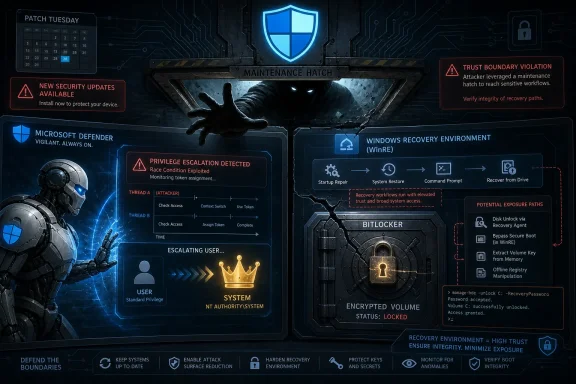 Microsoft’s Security Stack Is Being Attacked From the Maintenance Hatch
The familiar zero-day story usually begins with a browser, a document parser, a driver, or some dusty component that should have been retired years ago. RoguePlanet and GreatXML are different because they point at Windows’ own recovery and protection systems. Defender is the built-in sentinel. BitLocker is the encryption layer that makes a stolen laptop less interesting. WinRE is the rescue room you enter when the operating system cannot be trusted to boot normally.That makes the disclosures politically potent even before Microsoft assigns CVEs, ships formal fixes, or disputes parts of the research. A bug in a peripheral feature is an engineering problem. A bug in the thing that is supposed to contain compromise is a trust problem.
RoguePlanet, by early public accounts, is the more immediately credible and operationally useful of the two. It is described as a race-condition exploit that can turn local code execution into SYSTEM-level execution, the highest practical privilege level on Windows. That does not make it a remote worm, and it does not mean a random website can automatically own every PC. But in real intrusions, attackers often start with one weak foothold and then spend the rest of the campaign trying to become more powerful, more persistent, and harder to remove.
GreatXML is stranger, more conditional, and more contested. It claims to abuse Windows Recovery Environment behavior and setup automation files to reach files protected by BitLocker. The claim lands in the wake of earlier BitLocker and WinRE controversy, which is why it has attracted attention even as some researchers argue that the described path may require enough prior access to make the impact far less dramatic.
The two exploits therefore belong in different risk buckets. RoguePlanet looks like a practical local privilege-escalation concern that defenders should track closely. GreatXML looks like a warning flare over Windows’ recovery architecture, but one whose real-world blast radius still needs careful validation.
RoguePlanet Turns Defender From Guardrail Into Escalator
Local privilege escalation is easy to undersell because the word “local” sounds comforting. It should not. Many serious intrusions are a chain, and the attacker’s first step is rarely the step that matters most. A phishing payload, stolen VPN credential, malicious script, exposed remote-management tool, or compromised developer workstation gives the intruder a starting point; privilege escalation determines whether that starting point becomes full control.RoguePlanet reportedly targets Microsoft Defender through a timing flaw involving Defender-related operations and Windows file-system behavior. The exploit has been described as racing privileged activity so that Windows performs an action on the attacker’s behalf. In plain English, the attacker does not need to be SYSTEM at the beginning; the trick is to make something that already has elevated trust do the dangerous part.
That is why the Defender angle matters. Microsoft Defender is not some optional freeware scanner bolted onto the side of Windows. It is deeply integrated into consumer and enterprise Windows deployments, and it runs with the kind of authority required to inspect, quarantine, delete, and remediate files across the system. Those privileges are necessary for a security product, but they also make the product an attractive target.
Public reporting says ThreatLocker reproduced RoguePlanet on Windows 10 and Windows 11 systems after the June 2026 Patch Tuesday updates. Nightmare Eclipse has also reportedly said the exploit is timing-sensitive, with high reliability on some installations and poor reliability on others. That combination should sound familiar to incident responders: not guaranteed, not universal, but plausible enough to be folded into attacker testing.
There is also a psychological dimension here. An exploit against Defender is a morale hit for administrators because Defender is the thing many organizations standardized on precisely to reduce complexity. The more Microsoft persuades the world to accept native security as the baseline, the more consequential it becomes when native security becomes part of the attack surface.
The Patch Tuesday Timing Was the Message
The timing was not incidental. RoguePlanet surfaced just after Microsoft’s June 2026 Patch Tuesday, a release cycle already notable for addressing a large number of vulnerabilities and earlier Nightmare Eclipse disclosures. Dropping a new Defender exploit after the monthly patch ritual makes a point that is both technical and theatrical: even fully patched does not mean finished.That does not make patching useless. It makes patching insufficient by itself. A fully patched Windows endpoint is not a safe endpoint in the abstract; it is simply an endpoint with known vendor fixes applied as of a specific moment. Attackers, researchers, and vendors all operate on different clocks, and the public proof-of-concept ecosystem has made that mismatch harder to ignore.
Microsoft’s monthly cadence is built for scale. The company must test fixes across consumer laptops, industrial workstations, domain-joined fleets, servers, virtual desktops, language packs, OEM drivers, and a staggering long tail of enterprise weirdness. A researcher publishing exploit code does not carry the same burden. That asymmetry is one reason modern vulnerability management feels less like a sprint and more like air-traffic control.
Still, the June disclosures put Microsoft in a familiar bind. Move too slowly and customers accuse the company of minimizing risk. Move too quickly and a rushed patch risks breaking the very recovery and security components enterprises depend on. When the vulnerable surface is Defender or WinRE, a bad fix can be operationally expensive.
For WindowsForum readers, the practical lesson is not to sneer at Patch Tuesday. It is to stop treating it as the finish line. Patching is the cover charge for a secure Windows estate, not the whole evening.
GreatXML Reopens the WinRE and BitLocker Argument
GreatXML is less straightforward than RoguePlanet, and that is exactly why it deserves a more careful reading. The exploit claim centers on Windows Recovery Environment, Defender Offline Scan behavior, and a crafted setup automation file. The alleged outcome is the ability to reach a BitLocker-protected volume from recovery in a way users and administrators would not expect.BitLocker’s value proposition is simple: if someone steals the device, they should not get the data. That promise is complicated by the reality that Windows must also be recoverable, serviceable, upgradeable, and repairable. The recovery environment needs controlled access to the system it is repairing, and any seam between “locked” and “recoverable” is a seam attackers will examine.
The earlier YellowKey controversy primed the community to see GreatXML as part of a pattern rather than a one-off curiosity. The allegation is not merely that BitLocker had a bug, but that Windows’ maintenance layer has too many implicit trust paths. Whether GreatXML proves broadly exploitable or mostly theoretical, it keeps pressure on that architectural question.
Early analysis has been cautious. Some researchers have suggested the GreatXML flow may require administrator-level access, previous system interaction, or write access to areas that are not trivially reachable by an outside attacker. If true, that would sharply limit its practical value. A person who already has administrator rights or physical control over a poorly managed machine may have easier ways to defeat protections.
But “limited” is not the same as “irrelevant.” Enterprise security failures often happen in the margins: a misconfigured recovery partition, a device that once ran an offline scan, a fleet image with permissive assumptions, a laptop in transit, a technician workflow that bypasses normal controls. GreatXML may turn out to be a weak exploit, but it is aimed at a strong question: how much does Windows recovery trust itself?
Physical Access Is Still the Oldest Zero-Day
The BitLocker side of this story also revives an old truth that endpoint security marketing tends to bury. Physical access changes the game. Once an attacker can hold the device, boot alternate environments, tamper with recovery partitions, or wait for unattended repair workflows, the defender’s margin narrows.That does not mean BitLocker is broken as a concept. Properly deployed BitLocker remains one of the most important protections for lost and stolen devices. But the word “properly” is doing more work than many organizations admit. TPM-only deployments, weak recovery-key handling, loose firmware settings, unmonitored recovery partitions, and inconsistent Secure Boot posture can all turn encryption into a checkbox rather than a control.
Microsoft has spent years trying to make encryption invisible enough for ordinary users and manageable enough for enterprises. That design goal is defensible. If encryption is too painful, people avoid it, disable it, or store recovery material in unsafe places. The tension is that invisible security often depends on chains of trust the user never sees.
GreatXML lands precisely in that tension. It suggests, or at least alleges, that automation and recovery conveniences can collide with encryption guarantees. Even if the exploit requires a privileged setup, defenders should ask why recovery workflows have the access they do, how they are audited, and whether “offline” operations leave behind state that later changes the machine’s risk profile.
For sysadmins, this is not an argument to panic-wipe every laptop. It is an argument to treat recovery configuration as part of the security boundary. WinRE is not a dusty emergency closet. It is a privileged environment adjacent to the encrypted operating system, and it deserves the same inventory, hardening, and monitoring discipline as the OS itself.
The Researcher Drama Is a Distraction, But Not a Meaningless One
Nightmare Eclipse, also known in some reporting as Chaotic Eclipse, has become part of the story because the disclosures have arrived in a series and with visible hostility toward Microsoft’s handling of prior reports. That drama can become a trap. It is tempting for defenders to reduce the matter to personality, grievance, or spectacle.But software does not become secure because the messenger is abrasive, anonymous, theatrical, or angry. The only question that matters operationally is whether the claims can be reproduced, whether they affect supported systems, and whether attackers can adapt them. RoguePlanet appears to have crossed enough of that threshold to be treated seriously. GreatXML remains more uncertain, but uncertainty is not the same as dismissal.
There is a legitimate debate about public proof-of-concept releases, especially when they arrive before a vendor patch is available. Full public disclosure can accelerate fixes and warn defenders, but it can also hand working techniques to criminals who would otherwise need more time. Responsible disclosure is supposed to balance those concerns, yet the balance depends on trust between researchers and vendors.
The recent Microsoft-versus-researcher backdrop shows how fragile that trust can be. When researchers believe reports are ignored, minimized, or handled with legal pressure, they may choose maximum publicity. When vendors believe researchers are burning customers for leverage, they harden their own process. The result is a disclosure spiral in which users and administrators become the blast shield.
Windows customers should not have to care about the personal history behind a bug to know whether they are exposed. But in practice, disclosure politics affect how quickly information emerges, how confidently it can be validated, and how clearly mitigations are communicated. That makes the drama relevant, even if it should never be the center of the risk assessment.
Defender’s Privilege Is Both Its Superpower and Its Liability
The most important architectural lesson from RoguePlanet is not that Defender is uniquely bad. It is that security tools are high-value privileged software, and high-value privileged software must be assumed attackable. Antivirus, EDR agents, backup clients, remote management tools, patching agents, and device-control platforms all sit in the same uncomfortable category.They need deep access because shallow access cannot defend a modern endpoint. They inspect files before users open them, intercept execution, quarantine malware, talk to cloud services, modify protected locations, and run remediation logic in contexts ordinary users cannot touch. Every one of those powers is useful to defenders. Every one is also interesting to attackers.
This is why living off the land has expanded from abusing PowerShell and WMI to abusing the broader trust fabric of Windows. Attackers do not always need to bring the most suspicious tool into the environment. Sometimes they can persuade a trusted service to move, copy, scan, mount, delete, restore, or execute something at the wrong moment.
Race conditions are especially unpleasant because they are often messy to reproduce and hard to reason about from policy alone. The exploit does not necessarily violate a simple permission rule. It exploits the gap between one state and another, between the file that was checked and the file that was used, between the path Windows believed it was handling and the object an attacker arranged for it to touch.
That makes mitigation more complicated than “block the executable.” Application control, script restrictions, tamper protection, and EDR behavioral detections can all help, but none is a magic shield. The real defense is layered friction: reduce who can run arbitrary code, restrict where scripts execute, monitor suspicious child processes, detect unusual Defender interactions, and investigate unexpected SYSTEM shells as emergencies.
Fully Patched No Longer Means Operationally Calm
The phrase “fully patched Windows system” appears repeatedly in coverage of RoguePlanet because it is what makes the story sting. Administrators patched, rebooted, and still faced a public exploit claim. That is not new in principle, but it is increasingly common in practice.Modern Windows security is a moving target because Microsoft is simultaneously maintaining an old platform, shipping a cloud-connected endpoint stack, integrating AI-era telemetry and management features, and supporting enterprises that move slower than attackers. A single Patch Tuesday may close hundreds of holes while leaving adjacent design assumptions untouched. Researchers often live in those adjacent spaces.
For home users, the advice remains boring because boring advice works: install updates, keep Defender enabled, avoid running random scripts, and do not treat administrator prompts as decorative. RoguePlanet is not a magic attack that floats through the air into a clean machine. It needs local execution or some route to get attacker-controlled activity running.
For enterprises, the problem is less about a single user clicking a script and more about the thousands of places where code execution is already tolerated. Help desk tools, software deployment systems, developer build machines, admin jump boxes, legacy login scripts, and remote monitoring agents all create legitimate pathways for code to run. A local privilege escalation turns those pathways into staging lanes.
That is why security teams should not wait for a tidy Microsoft advisory before doing basic threat modeling. If a user-level process can trigger Defender into producing a SYSTEM shell, then controls that limit user-level execution matter. If an exploit is timing-sensitive, monitoring failed attempts may matter as much as catching successful ones. If proof-of-concept code is public, assume someone is testing it in lab environments right now.
WinRE Deserves a Place in the Security Inventory
Windows Recovery Environment is usually treated as infrastructure, not as an endpoint component with its own risk posture. That is a mistake. WinRE can influence boot repair, reset flows, offline scans, BitLocker recovery, and system maintenance. It is part of the endpoint’s trust chain whether or not the user ever sees it.The awkward reality is that many organizations have only a vague picture of their recovery partitions. They know whether BitLocker is on. They may know whether Secure Boot is on. They may not know whether WinRE is enabled, current, correctly partitioned, consistently patched, or configured differently across OEM images and upgrade paths.
Microsoft’s recent BitLocker and WinRE fixes have already forced administrators to confront this complexity. Recovery partitions can be too small for updates. Offline environments can lag behind the operating system. Enterprise images can carry forward assumptions from years earlier. A laptop may be “compliant” in the management console while its recovery environment tells a more complicated story.
GreatXML should therefore be used as a forcing function, even if its exploitability narrows under scrutiny. Administrators should ask whether recovery partitions are protected from ordinary users, whether recovery-key access is audited, whether firmware settings prevent unauthorized boot paths, and whether offline Defender workflows are understood. These are not exotic questions. They are basic endpoint hygiene in a world where recovery is part of the attack surface.
The broader lesson is that Windows security is no longer confined to the running OS. The pre-boot environment, recovery environment, cloud identity plane, management plane, and security agent ecosystem all participate in the outcome. An attacker only needs one bridge between them to behave differently than Microsoft intended.
The Real Risk Is Chaining, Not Headline Severity
Neither RoguePlanet nor GreatXML should be analyzed as a standalone apocalypse. RoguePlanet needs initial access. GreatXML may need physical access, administrative preparation, or unusual system state. Those limits matter, and responsible coverage should say so plainly.But attackers do not shop for perfect vulnerabilities. They shop for usable links in a chain. A user-level foothold plus a Defender privilege escalation is more dangerous than either condition alone. A stolen laptop plus weak BitLocker posture plus a recovery-environment bypass is more dangerous than any one weakness in isolation.
This is how real compromise works. The ransomware operator does not care whether the initial foothold was elegant. The data thief does not care whether the BitLocker bypass required a particular recovery state if the target fleet happens to have that state. The red team does not care whether a race condition is unreliable if repeated attempts eventually land.
Security teams should therefore map these disclosures onto their own environments rather than argue about generic severity. On a locked-down kiosk with application control, RoguePlanet may be difficult to trigger. On a developer workstation where scripts and ISO images are routine, it deserves more attention. On a desktop that never leaves a controlled office, GreatXML may be academic. On a traveling executive laptop with sensitive files and TPM-only BitLocker, it is a more uncomfortable conversation.
The best risk analysis is local. It asks not “Is this scary?” but “What would an attacker need before this matters here, and do we already give them that?”
Microsoft Needs More Than Another Patch
Microsoft will likely patch what it can patch. That is the easy prediction. The harder work is explaining whether these issues are isolated implementation mistakes or symptoms of deeper trust assumptions in Defender, WinRE, and BitLocker recovery flows.Customers deserve clarity on that point because mitigation differs by cause. If RoguePlanet is a narrow timing bug in one Defender workflow, then a targeted fix may be enough. If it reflects a broader pattern in privileged scanning, mounting, and file handling, then defenders need to know where else similar behavior might exist. If GreatXML is mostly a non-issue without administrator access, Microsoft should say so with technical precision. If it reveals a recovery-design weakness, a quiet patch will not be enough.
Microsoft also has to manage the optics of its own security platform. The company has successfully made Defender the default security layer for a huge share of Windows endpoints. That success brings responsibility. When Defender is implicated in privilege escalation, the answer cannot be merely “run Defender harder.”
There is a communication gap here that Microsoft often struggles to fill. Security advisories are written for precision, legal review, and operational caution. Customers need precision, but they also need an intelligible account of how a flaw fits into the real world. Is exploitation likely? What prerequisites matter? Which configurations reduce risk? What telemetry should defenders watch? Which mitigations are durable and which are temporary?
The best version of Microsoft’s response would separate the two disclosures rather than blur them into a single zero-day panic. RoguePlanet needs immediate endpoint-hardening guidance and detection logic. GreatXML needs a sober WinRE and BitLocker configuration discussion. Both need enough technical detail to let enterprises act without waiting for rumor to calcify into policy.
Enterprises Should Harden the Boring Paths First
The most useful response for organizations is not dramatic. It is disciplined. Apply the June 2026 security updates, track Microsoft’s follow-up guidance, and assume additional Defender or WinRE changes may arrive. Then look at the mundane controls that determine whether these proof-of-concepts become incidents.Application control is central. If ordinary users can download and run arbitrary scripts, mount images freely, and execute tools from user-writable locations, a local privilege escalation has room to breathe. If software execution is constrained, logged, and reviewed, the exploit chain becomes noisier and less reliable.
Defender tamper protection and endpoint detection policies also matter, but they should not be treated as binary shields. Security tools can reduce exploit reliability, block known proof-of-concept behavior, or catch suspicious process trees. They cannot erase the architectural risk that privileged security components perform dangerous work by design.
BitLocker posture deserves a separate audit. Enterprises should review whether sensitive devices use TPM-only unlock or require additional authentication, how recovery keys are stored and accessed, whether Secure Boot is consistently enforced, and whether recovery partitions are current and properly sized. A BitLocker deployment is not secure simply because the drive says it is encrypted.
Lost and stolen device procedures should also be revisited. If a machine is missing, the assumption should be that physical-access attack paths are in play. Remote wipe, rapid credential revocation, device compliance invalidation, and recovery-key access review are not paperwork. They are the difference between encryption as a control and encryption as a hope.
The WindowsForum Read on the Week’s Chaos
The story is not that every Windows machine is doomed. The story is that Microsoft’s defensive layers are increasingly the place where serious researchers are looking for leverage, and at least one of this week’s disclosures appears credible enough to demand action. The correct posture is skeptical urgency: do not believe every dramatic exploit claim at face value, but do not wait for perfect certainty before reducing exposure.- RoguePlanet should be treated as the more operationally significant disclosure because it reportedly enables local privilege escalation to SYSTEM through Microsoft Defender on patched Windows 10 and Windows 11 systems.
- GreatXML should be treated as an unresolved BitLocker and WinRE design concern rather than a universally proven disk-encryption break.
- Fully patched Windows systems can still be exposed to newly disclosed proof-of-concept code, so patching must be paired with execution control, monitoring, and incident response readiness.
- BitLocker security depends on configuration, recovery-key handling, firmware protections, and recovery-environment hygiene, not merely on whether encryption is enabled.
- Organizations should assume public exploit code will be tested quickly by criminals, red teams, and opportunists, even when reliability is imperfect.
- Microsoft’s next move should include clear technical guidance, not just fixes, because administrators need to understand the trust boundaries around Defender, WinRE, and BitLocker.
References
- Primary source: Petri IT Knowledgebase
Published: 2026-06-15T13:40:10.101308
New Windows Zero‑Day Flaws Target Defender and BitLocker
New Windows zero‑day exploits allow privilege escalation and raise BitLocker bypass concerns, exposing potential risks to enterprise systems. petri.com
- Related coverage: tomshardware.com
Microsoft's bug-hunting nemesis extends vendetta with more zero-day attacks — Nightmare Eclipse publishes RoguePlanet and GreatXML local privilege escalation exploits | Tom's Hardware
I don't have any more room in my Windows bingo card for 2026.www.tomshardware.com - Related coverage: windowscentral.com
Windows 11’s June update shuts down an intentional BitLocker backdoor with full file access — here’s what changed | Windows Central
Microsoft’s June 2026 Patch Tuesday update fixes a controversial BitLocker flaw.www.windowscentral.com - Related coverage: techradar.com
This Microsoft Defender zero-day could give hackers unprecedented access to your system | TechRadar
Chaotic Eclipse strikes againwww.techradar.com - Related coverage: techrepublic.com
New Windows Zero-Day Claims BitLocker Bypass Amid Microsoft Disclosure Fight
A new Windows zero-day reportedly bypasses BitLocker, adding pressure on Microsoft as researchers debate the exploit’s real-world impact.www.techrepublic.com
- Related coverage: hothardware.com
Nightmare-Eclipse Drops Another BitLocker Bypass After YellowKey Patch | HotHardware
Nightmare-Eclipse, the current bane of Microsoft's existence, strike again with new exploits for BitLocker and Windows Defender.hothardware.com
- Related coverage: bleepingcomputer.com
Microsoft Defender 'RoguePlanet' zero-day grants SYSTEM privileges
A security researcher has released a new Microsoft Defender zero-day exploit namedwww.bleepingcomputer.com
- Related coverage: securityaffairs.com
Chaotic Eclipse Strikes Again: New Zero-Day Unlocks BitLocker in Four Hours of Research
GreatXML bypasses BitLocker via Defender offline scan artifacts, giving SYSTEM shell in Recovery Mode. No patch exists.securityaffairs.com
- Related coverage: cybernews.com
Nightmare Eclipse drops RoguePlanet zero-day after Patch Tuesday | Cybernews
Nightmare Eclipse has published a new Microsoft Defender zero-day exploit called RoguePlanet, marking the third consecutive month the researcher has released a vulnerability shortly after Patch Tuesday security updates. They also chose to publish them on GitHub, a repo they've been banned from. cybernews.com
- Related coverage: threatlocker.com
Microsoft Defender zero-day RoguePlanet grants SYSTEM privileges
RoguePlanet is a Microsoft Defender zero-day that grants SYSTEM privileges. It was disclosed by the researcher Nightmare Eclipse, who also disclosed BlueHammer, YellowKey, and GreenPlasma.www.threatlocker.com - Related coverage: hivesecurity.gitlab.io
RoguePlanet: Nightmare Eclipse's New Windows Defender LPE PoC After the June 2026 Patch — Hive Security
RoguePlanet is the latest public Nightmare Eclipse proof-of-concept targeting Microsoft Defender. The code points to a race condition that turns Defender cleanup behavior into SYSTEM execution.hivesecurity.gitlab.io - Related coverage: i-secure.co.th
ช่องโหว่ Zero-day 'RoguePlanet' ของ Microsoft Defender ทำให้ได้สิทธิ์ระดับ SYSTEM บนระบบ - Bangkok, Thailand | i-secure Co, Ltd.
นักวิจัยด้านความปลอดภัยได้ปล่อยโค้ด exploit สำหรับช่องโหว่ zero-day ตัวใหม่บน Microsoft Defender ในชื่อ "RoguePlanet" เพียงไม่กี่ชั่วโมงหลังจาก Microsoft เพิ่งออกอัปเดต Patch Tuesday ในเดือนมิถุนายน 2026 นักวิจัยที่ใช้นามแฝงว่า Nightmare Eclipse ระบุว่า...www.i-secure.co.th
- Related coverage: medium.com
RoguePlanet: “Nightmare Eclipse” Unleashes New Defender Zero-Day on Patch Tuesday | by Ali Mansoor | Jun, 2026 | Medium
RoguePlanet: “Nightmare Eclipse” Unleashes New Defender Zero-Day on Patch Tuesday On 10 June 2026 (Patch Tuesday), a security researcher under the alias “Nightmare-Eclipse” (also known as …medium.com - Related coverage: turbolab.it
RoguePlanet: nuova vulnerabilità zero-day in Microsoft Defender concede privilegi SYSTEM su Windows 11 (aggiornato: 10 giugno 2026, ore 07:07) | TurboLab.it
A poche ore dal Patch Tuesday di giugno 2026, il "solito" ricercatore di sicurezza noto come Nightmare Eclipse ha pubblicato un ennesimo exploit proof-of-concept chiamato RoguePlanet che prende di mira una vulnerabilità zero-day in Microsoft Defender. Il risultato, quando...turbolab.it
