

Background
Samsung has spent the last several years trying to turn its sprawling hardware portfolio into a more unified, software-defined ecosystem. That effort accelerated as the company framed AI not as a feature buried inside individual products, but as the connective tissue tying together TVs, appliances, displays, and home environments. The company’s CES 2026 messaging made that explicit, presenting “Your Companion to AI Living” as a broader strategy for daily life rather than a narrow device roadmap.
The Edison Awards are a useful barometer for that ambition because they reward innovation across both concept and commercialization. Samsung’s 2026 wins span the spectrum: a future housing concept, a TV intelligence platform, a washer-dryer, and a commercial display product. That range matters because it shows the company is not leaning on a single category to carry its brand narrative; instead, it is building a portfolio story around design, AI, connectivity, and everyday usefulness.
This is also not Samsung’s first public step toward these ideas. At IFA 2025, the company highlighted AI home appliances, Vision AI-enabled TV features, and Spatial Signage-style display concepts, signaling that the architecture for a broader AI home had already been under construction. The Edison recognition suggests that what started as a showcase has become a repeatable product and design language, which is often where consumer technology transitions from buzz to staying power.
The broader context is a market where rivals are racing to define what an AI-enabled home should feel like. For Samsung, the competitive challenge is not just feature parity; it is persuasion. It must convince consumers and enterprise buyers that AI can reduce friction, save time, and improve spaces in ways that are visible, tangible, and repeatable, not merely impressive in a demo booth.
Samsung’s 2026 awards therefore read as validation of a larger playbook: design the home, the screen, the appliance, and the display as parts of one ecosystem. That is a more demanding strategy than selling isolated products, but it is also the one most likely to create durable differentiation in a saturated electronics market.
What Samsung Actually Won
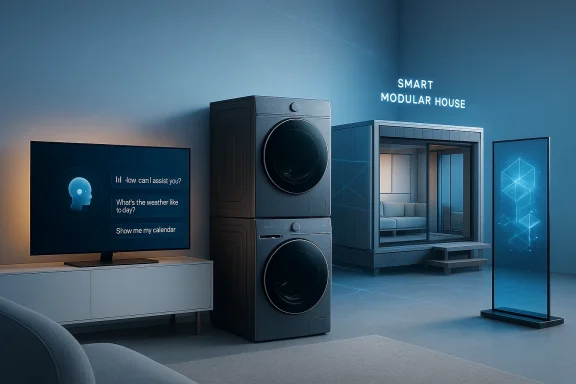
The headline is simple: two golds and two silvers. But the deeper story is how deliberately the awards map onto Samsung’s strategic pillars. Smart Modular House and Vision AI Companion represent the company’s long-horizon and consumer-facing software ambitions, while Spatial Signage and the Bespoke AI Laundry Combo ground the vision in commercial and household products that buyers can evaluate today.
The four award winners at a glance
Samsung’s Edison-winning entries were:
- Smart Modular House
- Vision AI Companion
- Bespoke AI Laundry Combo
- Spatial Signage
The company’s own framing matters here. It emphasized that the Edison Awards recognized innovation across home appliances, TVs, commercial displays, and future housing concepts, which is a far broader spread than a typical product launch cycle. That breadth reinforces Samsung’s identity as an end-to-end experience company rather than a simple device manufacturer.
What stands out most is that each award winner solves a different kind of problem. One addresses housing flexibility, one rethinks television as an AI interface, one automates laundry workflow, and one creates immersive signage for retail and exhibitions. The common thread is not a single AI model or chip, but a shared belief that interface design can make complex technology feel useful and humane.
Why the mix is strategically important
If Samsung had won only for a flagship TV or a home appliance, the story would be incremental. Winning for a future housing concept alongside a commercial display and a laundry combo suggests the company is using design awards to prove coherence across categories. That is important because the future of consumer electronics is increasingly about ecosystems, not standalone box sales.
The awards also show that Samsung is willing to pursue both practical utility and aspirational design at once. In a market that often separates “visionary” concepts from real products, Samsung appears intent on collapsing that divide. That can create stronger brand equity, provided the company continues to ship meaningful features instead of just polished mockups. That is the hard part.
Smart Modular House and the Future of Adaptive Living
Samsung’s Smart Modular House won gold because it turns housing into a configurable platform rather than a fixed shell. The Edison Awards praised its prefabricated ADU-based design, integrated IT and architectural standards, and its 1.5-module system, which can expand to support use cases such as a sauna or office. The concept is especially compelling because it tracks life-stage changes, shifting from newlywed living to child-rearing to retirement in a single adaptable framework.
A home that changes with life stages
The value proposition here is not merely larger living space. It is the idea that a home can evolve the way software does, adding capabilities as needs change. That is a striking departure from traditional housing, where adaptation often requires renovation, moving, or compromise.
Samsung’s vision also suggests a deeper integration of appliances, sensors, and climate control into the structure itself. The company described a future in which connected devices and environmental data are visible at a glance, allowing energy use and indoor-outdoor conditions to be managed in a more coordinated way. If executed well, that could make housing feel less like static real estate and more like an intelligent operating environment.
This is where the concept moves beyond architecture aesthetics. A modular home that can reconfigure for work, wellness, and family life points toward a future in which residential design is increasingly tied to digital services and device orchestration. That could be highly attractive for urban infill, ADUs, and premium developments where space efficiency is already at a premium.
The business case and the long game
Samsung’s future housing idea has already collected design recognition, including IDEA 2025, according to the company’s reporting. That continuity is meaningful because it suggests the concept is becoming a design asset rather than a one-off fair exhibit. In other words, Samsung seems to be building legitimacy around a housing vision that may take years to commercialize.
There is also an important strategic hedge here. Even if Samsung never becomes a major housing developer, the concept strengthens its authority in connected living. It gives the company a compelling way to talk about SmartThings, appliances, energy management, and home intelligence as pieces of a broader lifestyle platform. That kind of narrative can outlast any single floorplan.
Vision AI Companion and the Television as an Interface
The other gold winner, Vision AI Companion, is perhaps the most commercially recognizable of Samsung’s four wins. The platform links Bixby, Perplexity, and Microsoft Copilot so users can ask contextual questions while watching content, such as filming locations, cast information, or sports records. Samsung is essentially redefining the TV from a passive screen into a conversational, context-aware interface.
Turning the TV into a contextual AI hub
The important shift here is from search to assistance. Instead of forcing users to pause, open another device, and search manually, Samsung wants the television to answer in the moment. That can make the living room screen feel more like a live companion and less like a fixed content endpoint.
Samsung also wrapped this intelligence into a broader bundle of capabilities, including AI Soccer Mode Pro, AI Sound Control Pro, and AI Upscaling Pro. That matters because the product is not selling AI as a novelty; it is embedding it in picture quality, sound optimization, and information retrieval. The result is a more credible consumer pitch, especially for buyers who care about convenience but still expect first-rate entertainment performance.
The company’s CES 2026 messaging strongly supports this interpretation. Under the theme “Your Companion to AI Living,” Samsung positioned AI as a foundation connecting R&D, product development, operations, and user experience. That framing indicates the company sees TV not as a standalone category, but as an anchor point for the home-wide AI experience.
Why this matters for consumers and rivals
For consumers, the upside is ease. A TV that can answer questions about a movie, help with sports context, or guide the user through related content could reduce friction in a crowded streaming world. It may also improve discoverability, which has become one of the least elegant parts of modern entertainment.
For rivals, the implication is more serious. Samsung is staking out the TV as an AI workspace, not just a display panel, which raises the competitive bar for LG, Sony, TCL, and others. If users begin expecting conversational and contextual services built into the living room screen, then display makers will need to compete on ecosystem intelligence as much as panel quality.
Bespoke AI Laundry Combo and the New Appliance Premium
Samsung’s Bespoke AI Laundry Combo won silver, and for good reason: it addresses one of the most persistent annoyances in home laundry by combining washing and drying in a single workflow. The machine offers 25 kg wash and 20 kg dry capacity, and Samsung says its AI Wash Plus feature detects load weight, fabric type, and soil level to adjust water, detergent, wash intensity, and drying conditions automatically.
Automation that removes real friction
This is the kind of AI application that consumers immediately understand. Nobody needs a seminar on why avoiding the transfer from washer to dryer is helpful, and that simplicity is a strength. In appliance design, the best innovations often remove tiny chores that add up to major frustration over time.
Samsung also highlighted a booster heat exchanger that improves dehumidification performance by up to 15%. That detail matters because it shows the company is pairing software intelligence with hardware refinement. In practical terms, better drying efficiency and smarter cycle management can make a premium appliance feel more justified to buyers comparing it with ordinary washer-dryer stacks.
The broader significance is that Samsung is using AI to justify premium household pricing. That strategy only works if the intelligence reliably produces better outcomes, not just a more complicated settings menu. Consumers will forgive a feature list only when the machine genuinely saves time, energy, and attention. Otherwise the AI label becomes noise.
Consumer adoption vs. premium positioning
There is a tension here that Samsung will need to manage carefully. Premium combo units can be attractive in cities and smaller homes, where space is scarce and convenience is king, but they still have to overcome concerns about cost, serviceability, and long-term durability. If Samsung can prove the combo format is reliable at scale, it could convert skeptics who still prefer separate machines.
At the same time, the product reinforces Samsung’s broader appliance strategy: make mundane domestic tasks feel smarter without requiring the user to become a systems expert. That is a powerful proposition if the company can keep the interface simple and the automation trustworthy. The AI must disappear into the experience, not dominate it.
Spatial Signage and the Commercial Display Opportunity
The fourth winner, Spatial Signage, shows Samsung’s ambitions in commercial display hardware. The glasses-free 3D product uses Samsung’s proprietary 3D Plate technology to create a sense of depth behind the LCD panel while preserving 2D clarity, and the 85-inch model is only 52 mm thick. Samsung says it can display 4K UHD content in a 9:16 portrait format and turn still images into three-dimensional content via Samsung VXT’s AI Studio.
Immersive signage as a retail differentiator
Commercial displays live or die on attention. If a signage system can stop shoppers long enough to consider a product, it has created value that standard flat-panel advertising cannot always match. Samsung’s Spatial Signage is designed precisely for that problem, especially in retail and exhibition settings where motion, depth, and novelty can influence engagement.
The product’s exposure at ISE 2026, CES 2026, and IFA 2025 suggests Samsung has been building a sustained launch narrative rather than a single-event splash. That matters because commercial buyers typically want proof of longevity and ecosystem support before they invest in new signage formats. Repeated appearances help build confidence that the platform is real, supported, and strategically important.
The AI Studio angle is also notable because it lowers the barrier to entry for content creation. If a brand can turn a still image into spatial content more quickly, then Samsung is not merely selling a display but a workflow. That can be especially persuasive for retailers and exhibit designers who care as much about production speed as about visual impact.
The enterprise angle
For enterprise customers, the pitch is about differentiation and efficiency. A 3D signage product that is thin, high-resolution, and software-assisted can fit into flagship stores, trade shows, airports, and experiential marketing environments where visual memorability translates into business outcomes. Samsung is clearly betting that immersive display hardware will command a premium if it also simplifies content operations.
This also positions Samsung against a broader commercial display market that increasingly values managed ecosystems over isolated panels. By tying Spatial Signage to VXT and AI Studio, the company is making the commercial display stack feel more like a service platform. That is a smart move because enterprise buyers often prefer tools that improve workflows, not just screens that look impressive in a demo.
Why the Edison Awards Matter Now
The timing of the awards gives them extra weight. Samsung used CES 2026 to frame its AI story and then, a few months later, received outside validation across multiple product categories. That sequence gives the company something more valuable than publicity: external confirmation that its AI living strategy is being recognized as a serious design and innovation program.
Validation beyond the trade-show stage
Trade-show launches can be dazzling, but awards from an independent body help establish legitimacy. The Edison Awards are not a sales leaderboard, yet they matter because they signal that Samsung’s ideas are being judged not just by fans or analysts but by an institution focused on innovation. That can strengthen confidence among retail partners, integrators, and enterprise buyers.
It also helps that Samsung’s wins span both speculative and market-ready areas. Smart Modular House is aspirational, while the laundry combo and spatial signage are clearly productizable. That spread gives the company narrative flexibility: it can talk about the future of living without losing sight of the products already on shelves or entering market channels.
In brand terms, this is a clever move. Samsung gets to say it is inventing the future while also proving present-day competence. That balance is hard to maintain, but when it works, it can create a perception that the company is simultaneously visionary and dependable.
A design language, not a one-off campaign
The company’s award list also suggests an emerging design language built around connected intelligence, adaptive spaces, and human-centered automation. The repeated emphasis on connectivity, experience design, and life-stage flexibility indicates a long-term thesis rather than scattered product experiments. That is exactly the kind of narrative that design awards tend to reward, especially when the products can be tied back to a recognizable corporate philosophy.
Mauro Porcini’s remarks about translating needs, dreams, and emotions into meaningful experiences are consistent with that broader approach. The language is aspirational, but the products behind it show Samsung is trying to anchor aspiration in measurable utility. If the company can keep doing that, its AI living strategy may become one of the clearest consumer-tech positioning efforts in the market.
Strengths and Opportunities
Samsung’s Edison Awards performance highlights a strategy with unusual breadth. It is not just selling more AI features; it is trying to reframe how homes, screens, appliances, and displays behave together. That breadth creates multiple paths to monetization, brand reinforcement, and ecosystem lock-in.
- Ecosystem coherence across TVs, appliances, signage, and housing concepts.
- Human-centered design that focuses on practical outcomes rather than flashy demos.
- Premium differentiation in crowded categories like TVs and laundry appliances.
- Commercial display expansion through Spatial Signage and content-creation tools.
- Stronger brand authority in AI living and connected home narratives.
- Cross-category upsell potential via SmartThings, AI services, and device integration.
- Design awards momentum that can support sales conversations and channel confidence.
The upside for Samsung
Samsung’s biggest opportunity is to turn conceptual leadership into repeatable consumer behavior. If people begin to expect TVs to answer questions, appliances to adapt intelligently, and homes to flex with life stages, Samsung can shape the definition of modern living around its own ecosystem. That is a powerful position in a market where feature parity often erodes margins.
Risks and Concerns
The same strategy that gives Samsung breadth also gives it exposure. The more categories it touches, the greater the chance of uneven execution, confusing messaging, or features that sound more impressive than they feel in daily use. That risk is especially acute when AI becomes a marketing umbrella rather than a clearly measurable product improvement.
- Expectation risk if AI features overpromise relative to real-world usefulness.
- Execution complexity across housing, appliances, TV software, and signage.
- Premium pricing pressure if consumers do not see enough value.
- Privacy and data concerns as home AI becomes more contextual and pervasive.
- Commercial adoption hurdles for 3D signage in cost-sensitive enterprise segments.
- Concept-to-product gap for housing innovations that may take years to commercialize.
- Competitive imitation if rivals copy features without Samsung retaining clear differentiation.
The challenge of proving utility
The biggest concern is that AI can become a catch-all claim. If a user rarely invokes the TV assistant, if laundry automation is only marginally better, or if housing concepts remain mostly aspirational, the brand story can outpace the product reality. Samsung will need to show that its AI features are consistently helpful, not just occasionally impressive.
There is also a reputational risk in tying too much of the future-home story to one company’s ecosystem. The more intertwined the devices become, the more consumers may worry about lock-in, compatibility, and long-term support. In connected living, convenience and dependency often rise together. That is a trade-off Samsung cannot ignore.
Looking Ahead
Samsung’s Edison Awards sweep is best understood as a proof point, not a finish line. The company has shown that its AI living concept can be translated into products and concepts that outsiders consider innovative enough to reward. The next test is whether those ideas can deliver everyday value at scale, in the messy reality of homes, stores, and media rooms.
If Samsung can keep the user experience intuitive, the ecosystem integrated, and the feature set genuinely useful, it may define the consumer expectation for AI-enhanced living in the way it once helped define the premium TV and appliance market. If not, these awards may be remembered as an elegant snapshot of a strategy that outpaced its own maturity. The difference will come down to execution, not vision.
What to watch next
- Whether Vision AI Companion expands to more regions, languages, and TV lines.
- How quickly Bespoke AI Laundry Combo scales in premium and compact-home markets.
- Whether Spatial Signage converts show-floor buzz into enterprise deployments.
- Whether Smart Modular House evolves into pilot housing projects or commercial partnerships.
- How Samsung positions privacy, security, and account control in its broader AI living stack.
Samsung has clearly decided that the future of consumer technology is not just smarter devices, but smarter environments. The Edison Awards do not prove that this vision is inevitable, but they do show that the company’s idea is gaining shape, credibility, and commercial texture. If Samsung can keep turning design ambition into durable utility, its AI living strategy may become one of the most consequential home-tech narratives of the decade.