

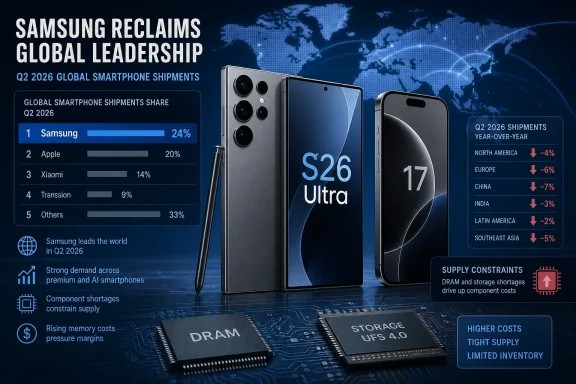
Samsung has retaken the top spot in global smartphone shipments, displacing Apple in the second quarter of 2026, according to Counterpoint Research figures reported by Mashable and Reuters. Samsung held 24% of the market, while Apple reached a record 20% share despite slipping to second place.
The shift follows Apple’s first-quarter lead, powered by strong iPhone 17 demand. Samsung’s return was driven by the Galaxy S26 range, with Counterpoint identifying the Galaxy S26 Ultra as a particularly strong seller.
The wider result is less a sign of booming handset demand than a snapshot of a market under supply pressure. Reuters reported that global smartphone shipments fell 11% year over year in Q2, reaching the weakest second-quarter level since 2013.
Memory shortages are a central problem. DRAM and storage suppliers have prioritized higher-margin AI data-center demand, raising component costs for handset makers. The impact is most acute for budget and mid-range phones, where manufacturers have little room to absorb higher bills of materials without raising retail prices.
Counterpoint expects the broader smartphone market to remain difficult through the rest of 2026, with shipment volumes projected to decline by roughly 14% for the year.
Apple, meanwhile, grew iPhone shipments 3% year over year even as the market contracted. The iPhone 17 was Counterpoint’s top-shipped model globally, and Apple maintained pricing on that range. Older iPhone models were reportedly softer, however, as component allocation favored current-generation hardware amid memory constraints. China also remained a weaker market for Apple.
For Windows users and IT buyers, the immediate consequence is simple: handset prices and availability—especially below the flagship tier—are likely to remain less favorable through 2026, regardless of whether Samsung or Apple holds the quarterly crown.
The shift follows Apple’s first-quarter lead, powered by strong iPhone 17 demand. Samsung’s return was driven by the Galaxy S26 range, with Counterpoint identifying the Galaxy S26 Ultra as a particularly strong seller.
 A shrinking market, not a runaway win
The wider result is less a sign of booming handset demand than a snapshot of a market under supply pressure. Reuters reported that global smartphone shipments fell 11% year over year in Q2, reaching the weakest second-quarter level since 2013.Memory shortages are a central problem. DRAM and storage suppliers have prioritized higher-margin AI data-center demand, raising component costs for handset makers. The impact is most acute for budget and mid-range phones, where manufacturers have little room to absorb higher bills of materials without raising retail prices.
Counterpoint expects the broader smartphone market to remain difficult through the rest of 2026, with shipment volumes projected to decline by roughly 14% for the year.
Samsung’s advantage, Apple’s resilience
Samsung appears to have benefited from its vertically integrated supply chain and broad premium portfolio. Its semiconductor operations give it more exposure to memory manufacturing than most rivals, although that does not make its phone business immune to rising component costs. The company reportedly avoided an Ultra-model price increase during the quarter, helping its highest-end Galaxy S26 device sustain demand.Apple, meanwhile, grew iPhone shipments 3% year over year even as the market contracted. The iPhone 17 was Counterpoint’s top-shipped model globally, and Apple maintained pricing on that range. Older iPhone models were reportedly softer, however, as component allocation favored current-generation hardware amid memory constraints. China also remained a weaker market for Apple.
For Windows users and IT buyers, the immediate consequence is simple: handset prices and availability—especially below the flagship tier—are likely to remain less favorable through 2026, regardless of whether Samsung or Apple holds the quarterly crown.
References
- Primary source: Mashable
Published: 2026-07-13T17:57:13+00:00
Samsung bests Apple to become the top smartphone brand in the world | Mashable
Samsung has displaced Apple as the global leader among smartphone manufacturers.mashable.com - Related coverage: 9to5mac.com
Apple hits record 20% global smartphone shipment share as market plunges - 9to5Mac
Apple grew iPhone shipments by 3% year over year and captured a record 20% share of global smartphone shipments despite an industry-wide downturn.9to5mac.com - Related coverage: phonearena.com
Samsung clings on to top spot as Apple inches closer with record Q2 smartphone market share - PhoneArena
Both Samsung and Apple can be content with their latest quarterly smartphone sales results, but one of the two top vendors is likely to be more pleased than the other.www.phonearena.com - Related coverage: tech.yahoo.com
Apple surpasses Samsung to become the world's number one smartphone maker
The two companies have been neck and neck for years, but now Apple is winning.tech.yahoo.com - Related coverage: korea.counterpointresearch.com
1분기 글로벌 스마트폰 출하량 6% 감소… 애플, 1분기 사상 첫 글로벌 1위 - 카운터포인트
카운터포인트리서치의 시장 모니터링 보고서에 따르면, 2026년 1분기 글로벌 스마트폰 시장 출하량은 전년 동기 대비 6% 감소한 것으로 나타났다. 이번 감소는 D램 및 낸 메모리 공급 부족에 따른 부품 수급 차질과 원가 상승, 여기에 중동 지역 긴장 고조에 따른 소비심리 위축이 복합적으로 작용한 결과로 분석된다. 일부 지역에서는 비교적 안정적인 흐름이 나타났지만, 전반적인 시장 심리는 여전히 신중한 […]korea.counterpointresearch.com - Related coverage: neowin.net
Samsung and Apple lead the global smartphone market in 2Q26 - Neowin
Despite a decline in global smartphone shipments in 2Q26, Samsung and Apple have increased their market share by 2% and 4%, respectively. www.neowin.net
