

Samsung SDS used CES 2026 to stake a clear claim: the next battleground for corporate competitiveness will be agentic AI — autonomous, task-oriented software agents that can reason, act and coordinate across enterprise systems without constant human direction.
Samsung SDS is no longer just an IT integrator; it presents itself as a full‑stack AI provider that combines cloud infrastructure, generative-AI platforms and enterprise software to deliver what it calls an “AI full‑stack.” At CES the company framed that stack around three elements: a GPU-first AI infrastructure (including planned deployment of the latest NVIDIA Blackwell B300 family), a generative‑AI platform (branded FabriX), and integrated workplace solutions (Brity Works and Brity Copilot). The company also announced expanded commercial ties with global AI vendors — most notably a reseller partnership for ChatGPT Enterprise — and reiterated its role in public‑sector AI projects led by the South Korean government.
This article explains what Samsung SDS demonstrated, verifies the technical claims it made, evaluates competitive and operational risks, and offers practical guidance for organizations considering similar agentic AI deployments.
Samsung SDS described use cases where a user delegates finance-report compilation to an agent through Brity Messenger, which then calls Brity RPA and back‑end systems to assemble the report and deliver a summarized result to the user.
Caveat: corporate procurement and integration schedules can shift. The February service launch was presented as a firm target by Samsung SDS executives at CES and covered by multiple technology outlets, but these plans remain subject to supply, integration and certification timelines.
Strengths in the approach are concrete: early B300 access, public‑sector contracts to scale repeatable use cases, and a reseller route to industry‑leading models. Those elements together create a credible go‑to‑market for organizations that must balance performance with compliance.
However, the road to reliable, enterprise‑grade agentic AI is long. Successful deployments require meticulous engineering around state management, observability, human‑machine boundaries and governance. The most likely near‑term winners will be organizations that treat agents as orchestrated, auditable services rather than black‑box assistants.
Samsung SDS’s strategy will succeed if it converts CES‑stage demos into documented, independently validated enterprise outcomes — measurable reductions in process cycle times, reliable error‑handling at scale and clear ROI on productivity. Until independent case studies emerge, treat product launch timelines and performance claims as vendor commitments rather than proven outcomes.
The invitation is straightforward: enterprises seeking to accelerate agentic AI adoption can access high‑performance infrastructure and integrated tooling through a single vendor, but they must also demand transparency — in governance, cost, and auditability — and insist on pilot results that validate claims outside the marketing floor.
Agentic AI promises to reshape workflows; Samsung SDS is betting its future on helping customers manage that change end‑to‑end. Organizations evaluating this proposition should weigh the potential productivity gains against the operational complexity and governance obligations that agentic systems introduce, and require clear, testable commitments before moving mission‑critical processes under an autonomous agent’s control.
Source: The Korea Times Samsung SDS positions agentic AI as key driver of competitiveness - The Korea Times
 Background / Overview
Samsung SDS is no longer just an IT integrator; it presents itself as a full‑stack AI provider that combines cloud infrastructure, generative-AI platforms and enterprise software to deliver what it calls an “AI full‑stack.” At CES the company framed that stack around three elements: a GPU-first AI infrastructure (including planned deployment of the latest NVIDIA Blackwell B300 family), a generative‑AI platform (branded FabriX), and integrated workplace solutions (Brity Works and Brity Copilot). The company also announced expanded commercial ties with global AI vendors — most notably a reseller partnership for ChatGPT Enterprise — and reiterated its role in public‑sector AI projects led by the South Korean government.This article explains what Samsung SDS demonstrated, verifies the technical claims it made, evaluates competitive and operational risks, and offers practical guidance for organizations considering similar agentic AI deployments.
What Samsung SDS showed at CES 2026
Agentic AI demos: from admin assistants to industrial agents
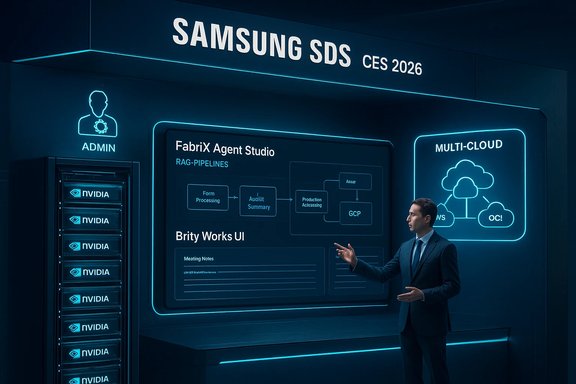
Samsung SDS staged live demonstrations that emphasized agentic workflows: AI agents that accept high‑level goals, translate them into multi‑step workflows, coordinate with other agents and systems, and return actionable results. The scenarios covered:- Public administration: agents that automate form processing, produce policy briefs from large document sets, and prepare draft responses to citizen inquiries.
- Finance: agents that aggregate finance system outputs, generate audit summaries, and flag anomalies for human review.
- Manufacturing: agents that orchestrate production data, schedule maintenance, and generate root‑cause analyses.
Workplace integration: Brity Works + Brity Copilot
Brity Works — Samsung SDS’s enterprise collaboration suite — was shown as the human face for agentic automation. Brity Copilot, a paid add‑on, inserts generative‑AI capabilities directly into mail, messenger, meeting and drive functions: automated meeting notes, draft generation, RAG (retrieval‑augmented generation) for internal documents, and RPA triggers invoked by conversational prompts.Samsung SDS described use cases where a user delegates finance-report compilation to an agent through Brity Messenger, which then calls Brity RPA and back‑end systems to assemble the report and deliver a summarized result to the user.
Infrastructure: the B300 strategy and what it means technically
What is the NVIDIA B300 family?
NVIDIA’s Blackwell Ultra family — introduced as the successor to Hopper and branded in rack and DGX configurations such as GB300 and B300 — targets large‑scale reasoning and inference workloads common to agentic AI. Key technical points verified in vendor materials:- The DGX B300 and related B‑series systems are purpose‑built for energy‑efficient inference and scaled reasoning.
- DGX B300 systems are reported to offer multi‑terabyte HBM3e configurations and significantly higher dense FP4 inference throughput versus the prior generation.
- The Blackwell Ultra family is explicitly positioned for “AI reasoning” and test‑time scaling typical of multi‑step agentic workloads.
Samsung SDS’s declared timeline and capacity
At CES Samsung SDS’s leadership stated the company has pre‑procured hundreds of B300 units and intends to bring B300‑backed AI infrastructure online in February. Independent Korean reporting and Samsung SDS’s own messaging to clients corroborate that the company is preparing GPU‑first cloud services (GPU‑as‑a‑service and private cloud GPU pools) centered on the Samsung Cloud Platform (SCP) and integrated with major hyperscalers (AWS, Azure, GCP, OCI).Caveat: corporate procurement and integration schedules can shift. The February service launch was presented as a firm target by Samsung SDS executives at CES and covered by multiple technology outlets, but these plans remain subject to supply, integration and certification timelines.
Platform and product stack: FabriX, Brity and SCP
FabriX — the generative AI platform
FabriX is Samsung SDS’s branded generative‑AI platform that aggregates multiple large language models (LLMs), provides an Agent Studio for designing agents, and supports multi‑agent orchestration. The platform claims to:- Support both Samsung’s in‑house LLMs and third‑party models.
- Offer a development console to define agent goals, connectors and governance policies.
- Provide RAG tooling to connect agents to internal documents and line‑of‑business data.
Samsung Cloud Platform (SCP) and multi‑cloud support
SCP is Samsung SDS’s cloud control plane and service gateway. At CES the company emphasized SCP’s role in providing:- GPUaaS (subscription GPU services) to enterprise and public customers.
- Multi‑cloud brokerage that integrates AWS, Azure, GCP and OCI to match workloads to environments.
- Dedicated private‑cloud zones for public institutions and regulated industries.
OpenAI reseller partnership and how it will be used
Samsung SDS announced (and publicly reiterated) a reseller partnership for ChatGPT Enterprise, making it one of the first Korean companies to do so. The practical implications stated by the company:- Samsung SDS will resell ChatGPT Enterprise and offer end‑to‑end adoption services: consulting, technical integration and management.
- Customers will be able to deploy ChatGPT Enterprise alongside FabriX and SCP components or use it as an independent service.
- Samsung SDS has committed to offering configuration, on‑site training and security consulting for enterprise deployment.
Public sector play: government projects and data sovereignty
Samsung SDS is playing a visible role in South Korea’s public AI projects. The company’s announcements and subsequent reporting indicate:- Samsung SDS operates private‑cloud infrastructure for public agencies and has been awarded or is participating in projects that include a government‑wide AI common foundation and an intelligent work management platform.
- The company is part of consortium bids and has drawn partners for supplying AI tooling to the government common platform program that aims to provide secure, shared compute, datasets and development environments for public agencies.
What the announcements mean for enterprise customers
- Faster access to high‑performance GPUs: early availability of B300 capacity through SCP or managed DGX offerings gives customers a way to run larger LLM inference and multi‑step agents without procuring hardware.
- Choice of models and managed services: combining FabriX, third‑party models and ChatGPT Enterprise reseller services means customers can choose hosted OpenAI models or local/private models depending on governance needs.
- Integrated workplace automation: Brity Works’ Copilot features lower the barrier to embedding generative AI into everyday workflows (mail, meetings, approvals), accelerating ROI for digital‑workplace automation.
Strengths: why Samsung SDS’s approach could work
- Full‑stack control: by combining infrastructure (GPU pools, SCP), platform (FabriX) and UX (Brity Works), Samsung SDS can deliver a smoother adoption path than a single‑component vendor.
- Government and enterprise footprint: existing relationships with public agencies and large corporate customers provide immediate pilots and measurable use cases.
- Early access to cutting‑edge hardware: pre‑securing Blackwell B300 capacity closes a critical supply bottleneck for customers seeking high‑memory inference and multi‑agent orchestration.
- Localized reseller model for OpenAI: a managed channel for ChatGPT Enterprise can help Korean enterprises with onboarding, compliance and Korean‑language customization.
Risks and limitations: operational, security and market concerns
Technical and operational risk
- Complexity of agentic systems: agentic AI is fundamentally more complex than single‑prompt LLM usage. Multi‑step agents require robust orchestration, state management, error recovery, and observability. Early production deployments often uncover edge cases, race conditions and cost surprises.
- Integration debt: connecting agents to ERP, CRM, document stores and legacy systems is non‑trivial. Each connector increases the attack surface and operational overhead.
- Cost curve: B300‑class infrastructure delivers performance but at a cost. Customers must design allocation policies and autoscaling to avoid runaway expenses during heavy inference periods.
Security, privacy and governance
- Data residency and leakage: using third‑party models (including ChatGPT Enterprise) requires careful configuration to guarantee that sensitive documents never leave controlled environments unless contractual protections and technical safeguards are in place.
- Model hallucination and auditability: agent outputs used for decision‑making must be auditable; enterprises will need provenance tracing, confidence thresholds and human‑in‑the‑loop gating.
- Concentration risk: heavy reliance on a single integrator (SDS) and a single GPU vendor (NVIDIA) may raise questions with regulators and enterprise risk teams.
Market and competitive risk
- Competition from hyperscalers and local cloud providers: AWS, Microsoft and Google are aggressively packaging managed inference and agent orchestration services. Local competitors (including national cloud and telco providers) are also strengthening their AI offerings.
- Vendor lock‑in vs. portability: the appeal of a fully integrated stack must be balanced against the need for portability. Enterprises should demand clear exit plans and standardized model/data formats.
Verifications and cautionary notes
- NVIDIA B300 technical positioning and DGX B300 product capabilities have been confirmed in vendor materials describing the Blackwell Ultra family; these materials show a focus on inference, high memory and DGX system configurations designed for scaled reasoning.
- Samsung SDS’s reseller agreement with OpenAI and the company’s public statements about becoming a ChatGPT Enterprise reseller have been publicly announced by Samsung SDS and widely reported.
- Samsung SDS’s intention to bring B300‑backed services online in February and its claim of procuring “hundreds” of B300 units were stated by company executives and reported by multiple Korean outlets during and after CES. These are corporate plans and therefore subject to change.
- Any numerical performance improvements claimed in vendor or vendor‑partner materials (for example, X‑fold inference speedups compared to prior generations) are manufacturer guidance; real‑world gains will depend on workload, model architecture, and system tuning.
Practical checklist for enterprise buyers
When evaluating Samsung SDS’s agentic AI offerings or similar vendor propositions, ask these focused questions:- Data governance and residency: Where will my data be stored and processed? Can I opt for fully private, on‑prem or sovereign‑cloud execution?
- Model provenance and updates: Which models will be used, who controls updates, and how are model weights and checkpoints handled?
- Security and compliance: What certifications and technical protections (encryption at rest/in transit, DLP, tokenization) are in place? How does the service meet sectoral regulations?
- Observability and audit trails: Can I trace agent decisions, inputs and data sources for regulatory or internal audit?
- Cost management: How are GPU usage, inference calls and RAG retrieval billed? Are there burst controls or caps to prevent runaway charges?
- Integration and connectors: Which enterprise systems come with prebuilt connectors, and which require custom work?
- SLA and support: What service levels are guaranteed for latency, throughput and uptime, especially for mission‑critical agent tasks?
- Exit and portability: How easy is it to migrate models and data to another provider or back on‑prem?
Strategic implications and final analysis
Samsung SDS is pursuing a disciplined strategy: assemble hardware advantage, couple it with a platform that manages models and agents, and front it with a workplace UX that lowers adoption friction. This full‑stack approach is compelling for enterprises that want a single partner to manage the entire lifecycle from GPU allocation to agent deployment.Strengths in the approach are concrete: early B300 access, public‑sector contracts to scale repeatable use cases, and a reseller route to industry‑leading models. Those elements together create a credible go‑to‑market for organizations that must balance performance with compliance.
However, the road to reliable, enterprise‑grade agentic AI is long. Successful deployments require meticulous engineering around state management, observability, human‑machine boundaries and governance. The most likely near‑term winners will be organizations that treat agents as orchestrated, auditable services rather than black‑box assistants.
Samsung SDS’s strategy will succeed if it converts CES‑stage demos into documented, independently validated enterprise outcomes — measurable reductions in process cycle times, reliable error‑handling at scale and clear ROI on productivity. Until independent case studies emerge, treat product launch timelines and performance claims as vendor commitments rather than proven outcomes.
Conclusion
CES 2026 cemented Samsung SDS’s positioning: the company wants to be the bridge between GPU power, generative‑AI models, and everyday work. By pre‑securing Blackwell B300 capacity, signing reseller partnerships for enterprise LLMs, and tying these assets into Brity Works and FabriX, Samsung SDS has assembled a pragmatic pathway to deliver agentic AI to enterprise and public customers.The invitation is straightforward: enterprises seeking to accelerate agentic AI adoption can access high‑performance infrastructure and integrated tooling through a single vendor, but they must also demand transparency — in governance, cost, and auditability — and insist on pilot results that validate claims outside the marketing floor.
Agentic AI promises to reshape workflows; Samsung SDS is betting its future on helping customers manage that change end‑to‑end. Organizations evaluating this proposition should weigh the potential productivity gains against the operational complexity and governance obligations that agentic systems introduce, and require clear, testable commitments before moving mission‑critical processes under an autonomous agent’s control.
Source: The Korea Times Samsung SDS positions agentic AI as key driver of competitiveness - The Korea Times
