

Microsoft CEO Satya Nadella said in an interview released Friday that companies should build AI systems shaped by their own data, workflows, and institutional memory rather than depending entirely on a small group of frontier model providers. His argument is not anti-OpenAI, despite Microsoft’s deep partnership with OpenAI. It is a warning that the next phase of enterprise AI will be won less by access to a famous model and more by control over learning itself.
That distinction matters because the first wave of generative AI adoption taught companies to ask which model was “best.” Nadella is pushing a more uncomfortable question: if every competitor can rent the same intelligence by the token, where does the company’s advantage actually live? For Microsoft, the answer is conveniently Azure-shaped. For enterprise IT, it is also probably correct.
Nadella’s line — that there should be “as many models in the world as firms in the world” — lands because it reframes AI from a vendor product into an organizational capability. A company, in his telling, is not merely a bundle of processes, contracts, and headcount. It is a learning system, and AI becomes dangerous when that learning is externalized to a provider that also serves everyone else.
That is a more sophisticated pitch than the usual cloud-era mantra of “let us run the infrastructure.” Microsoft is not saying enterprises should all train frontier models from scratch. Very few companies have the capital, data-center access, research bench, or patience to compete with OpenAI, Anthropic, Google, Meta, xAI, or the next foundation-model contender. Nadella’s point is narrower and more strategic: enterprises should not confuse renting a model with building an intelligence layer.
The difference is where the valuable context sits. A general-purpose model can write code, summarize contracts, generate marketing copy, and reason across common knowledge. But the durable advantage for a bank, hospital system, manufacturer, logistics company, or software vendor is not that it can ask a chatbot to draft an email. It is whether the system understands the company’s risk tolerances, customer histories, operating constraints, defect patterns, compliance obligations, and internal language.
That is why the phrase “build its own AI” should not be read as a call for every regional insurance company to become a model lab. It means enterprises need to own the feedback loops, data pipelines, retrieval systems, fine-tuning choices, evaluation sets, and governance practices that make AI useful inside a specific business. In other words, they need to own the learning layer, even if they rent much of the raw computation.
Once access becomes broadly available, differentiation moves somewhere else. If two law firms use the same foundation model, the better firm will not win because the model knows more general law. It will win because its AI systems are grounded in better precedent libraries, better matter metadata, better review workflows, and better human feedback. If two manufacturers use the same coding assistant, the advantage will come from proprietary failure logs, design constraints, plant-specific process knowledge, and integration with operational systems.
This is the enterprise version of a familiar technology cycle. The first phase rewards companies that get the new tool into production. The second phase punishes companies that deployed the tool without reorganizing around it. The spreadsheet, the relational database, the web, mobile, and cloud all followed some version of that path. AI will not be different simply because the demo looks more magical.
Nadella’s argument also undercuts the comforting belief that AI adoption can be purchased as a finished transformation. Companies love managed services because they turn messy capability-building into a line item. But if the capability in question is learning — how the organization notices patterns, encodes judgment, and updates behavior — outsourcing becomes existentially risky. A company can outsource payroll. It cannot outsource its ability to understand why customers leave, why defects recur, or why a sales process works in one market and fails in another.
That is the sharp edge of Nadella’s remark that if you outsource your learning, the reason for the firm’s existence starts to erode. It sounds like CEO philosophy, but it has practical consequences. The firms that treat AI as a generic productivity plug-in may get efficiency gains. The firms that embed AI into their proprietary loops may get compounding advantage.
That is why Microsoft Foundry — formerly discussed widely under the Azure AI Foundry branding — matters. Microsoft has been turning Foundry into a catalog, evaluation, deployment, and governance layer for many models, not just OpenAI’s. Official Microsoft materials describe access to models from Microsoft, OpenAI, Anthropic, Meta, Mistral, DeepSeek, Hugging Face, xAI, and others, with tooling for comparison, fine-tuning, monitoring, responsible AI controls, and deployment patterns.
This is not charity toward model pluralism. It is cloud strategy. If the enterprise world fragments across many models, Microsoft wants Azure to be the place where that fragmentation becomes manageable. If the model market consolidates, Microsoft wants to be the platform through which enterprises consume the winners. Either way, Azure sits underneath the workloads.
The OpenAI partnership gave Microsoft a head start, brand heat, and a powerful product story for Copilot. But the economics of enterprise AI point toward heterogeneity. A customer may want a frontier model for legal reasoning, a smaller model for internal ticket triage, an open-weight model for sensitive on-premises inference, a vision model for factory inspection, and a specialized embedding model for search. Treating all of those jobs as one “AI” problem served by one universal model is administratively simple and technically lazy.
Microsoft’s positioning is therefore both principled and opportunistic. Nadella can argue that enterprises should not depend on a handful of models, while Microsoft sells the platform that makes dependence on any single model less necessary. The anti-lock-in message becomes a different kind of lock-in: not to a model, but to the control plane.
The model is visible, but the surrounding system is stickier. A production enterprise AI application needs prompt management, retrieval, evaluation, audit logs, red-team results, content safety filters, human review workflows, cost monitoring, access controls, data-loss prevention, and incident response. The more serious the use case, the less the model endpoint looks like the whole product.
That is why Microsoft can be relaxed about a multi-model world. If Azure becomes the environment where companies test models, route tasks, run agents, attach corporate data, and enforce policy, then Microsoft benefits whether the underlying intelligence comes from OpenAI, Anthropic, Meta, Mistral, DeepSeek, or a future provider that has not yet become famous. The model becomes a component. The platform becomes the system of record.
For sysadmins and enterprise architects, this should sound familiar. Windows Server was never just a kernel. Microsoft 365 is not just Office apps. Azure is not just virtual machines. Microsoft’s strongest businesses tend to wrap core functionality in identity, management, policy, developer tooling, and procurement convenience until the wrapper becomes as important as the thing inside it.
The risk for customers is that “don’t be locked into one model” becomes “be deeply dependent on one AI orchestration estate.” That may still be a rational trade. Most enterprises would rather manage model choice through an incumbent cloud platform than stitch together a dozen vendors by hand. But IT leaders should be clear-eyed: the escape hatch from model lock-in may lead into platform lock-in.
Cost matters. Latency matters. Data residency matters. Customization matters. The right to run a model in a controlled environment matters. The ability to fine-tune or adapt a model for a specific domain matters. In many enterprise workflows, “good enough, cheaper, controllable, and auditable” will beat “best benchmark score” every day.
That is where models from Meta, Mistral, DeepSeek, and other open or open-weight ecosystems become strategically important. Open-weight does not automatically mean open source in the traditional software sense, and licensing terms vary widely. But the practical appeal is clear: organizations get more control over deployment, adaptation, and unit economics than they usually get from a closed API.
The security argument cuts both ways. A model whose weights can be inspected, hosted, and restricted may appeal to organizations wary of sending sensitive prompts to an outside endpoint. But open-weight models can also carry supply-chain, provenance, licensing, safety, and geopolitical concerns. A model is not magically trustworthy because it is downloadable. The enterprise question is not whether open models are pure; it is whether they can be governed.
Microsoft’s strategy is to make that governance a cloud feature. By hosting selected models in Azure, wrapping them in enterprise security controls, and placing them inside Foundry’s evaluation and monitoring apparatus, Microsoft tries to turn a messy open-model ecosystem into something procurement departments can approve. That does not eliminate risk, but it changes who is expected to manage it.
That dynamic makes model choice a financial-control issue. A company might happily use an expensive frontier model for a board-level legal analysis or a mission-critical software migration. It may not want that same model classifying help-desk tickets, summarizing low-risk chats, or generating routine internal documentation. The enterprise AI stack will increasingly resemble a routing problem: send each task to the cheapest model that meets the quality, safety, and latency requirement.
This is another reason Nadella’s “as many models as firms” line is more than rhetoric. The optimal model mix for a pharmaceutical company will not look like the optimal mix for a retailer, a game studio, a school district, or a regional government. Even within a company, finance, engineering, HR, sales, and security teams may need different models, different data boundaries, and different evaluation thresholds.
The frontier-model race is still important, but it is only one layer of the market. At enterprise scale, the winning architecture may be a portfolio of models connected by policy, telemetry, and feedback. That is less glamorous than a single omniscient chatbot. It is also much closer to how IT actually works.
For WindowsForum readers, the practical echo is obvious. Enterprises did not standardize on one database, one endpoint type, one scripting language, or one identity integration forever. They standardized on management patterns. AI is heading the same way.
That matters because the enterprise desktop is where governance meets behavior. A model strategy is abstract until employees start pasting data into prompts, asking agents to touch files, generating code, summarizing meetings, or letting automated workflows act on business systems. The endpoint, identity provider, document repository, and compliance stack all become part of the AI perimeter.
Microsoft is unusually well positioned there. It controls Windows, Entra identity, Microsoft 365, Teams, SharePoint, Defender, Purview, GitHub, Power Platform, and Azure. That does not guarantee success, but it gives Microsoft a map of enterprise activity that few rivals can match. If AI value comes from context and traces, Microsoft’s existing footprint becomes a strategic asset.
This is also where Nadella’s warning gets complicated. He says companies need their own AI, but many of the traces that make such AI useful already flow through Microsoft systems. Email, calendars, documents, chats, tickets, repositories, security alerts, spreadsheets, and workflows are not neutral artifacts. They are the institutional exhaust from which enterprise AI will learn.
The question for customers is whether Microsoft helps them own that learning or simply intermediates it. The difference will show up in exportability, auditability, model portability, data controls, and the ability to move workloads without losing the intelligence built around them. If the AI layer becomes impossible to separate from Microsoft’s productivity and cloud estate, enterprises may gain capability while surrendering leverage.
The hard work is not glamorous. It starts with data hygiene, identity boundaries, retention policy, classification, evaluation sets, and a clear definition of what a model is allowed to do. It requires people who understand the business process and people who understand machine-learning failure modes to work together. It also requires measuring outcomes, not just demo quality.
Fine-tuning is not a magic wand either. In many enterprise cases, retrieval-augmented generation, tool use, workflow integration, or carefully designed prompts may outperform or outlast a fine-tuned model. In other cases, fine-tuning a smaller model on well-curated traces may be exactly the right move. The point is that “custom AI” is an architecture decision, not a branding exercise.
Nadella’s most useful contribution is not that every company needs a model with its name on it. It is that every company needs a learning system it understands and controls. That system may use frontier APIs, open-weight models, small language models, embeddings, rules engines, knowledge graphs, and old-fashioned databases. The enterprise AI winners will be the ones that stop treating those pieces as a novelty stack and start treating them as production infrastructure.
That is already visible in some low-risk use cases. Corporate writing starts to sound the same. Support replies flatten into the same careful tone. Marketing copy inherits the same rhythm. Code suggestions converge around familiar patterns. None of this is catastrophic, but it is a preview of what happens when organizations use general systems without injecting their own judgment.
Real differentiation requires friction. It requires deciding which internal knowledge is worth encoding, which practices should be challenged, which historical decisions should not be repeated, and which human experts should shape the feedback loop. AI systems trained or grounded on corporate history can preserve advantage, but they can also preserve dysfunction. The organization has to know the difference.
That is why “proprietary data” is not automatically a moat. Some proprietary data is obsolete, biased, low-quality, or legally sensitive. Some internal workflows are inefficient because they were built around old software constraints. If companies pour that material into AI systems without scrutiny, they may automate the past rather than invent the future.
Nadella’s framing works best when “learning” implies adaptation, not mere ingestion. A firm is not a learning system because it stores documents. It is a learning system because it changes behavior when reality pushes back. Enterprise AI has to be judged by that standard.
The old software-as-a-service contract assumed the vendor provided functionality and the customer supplied data. AI blurs that boundary. Customer data, prompts, corrections, traces, and workflow outcomes can improve the system. Even when vendors promise not to train foundation models on customer data, the operational intelligence created inside a tenant may still become deeply dependent on the vendor’s environment.
This will make portability a serious enterprise concern. Can a company move its evaluation sets, prompt libraries, agent definitions, embeddings, fine-tuned models, audit logs, and policy rules? Can it reproduce behavior on another cloud or with another model? Can it prove why an AI-assisted decision was made six months later? These questions are less exciting than benchmark charts, but they are where long-term leverage lives.
Regulated industries will feel this first. A bank, hospital, insurer, defense contractor, or public agency cannot simply accept a black-box dependency because the demo looked good. They need evidence, repeatability, risk controls, and failure procedures. The more AI systems act rather than merely suggest, the more these requirements intensify.
Microsoft’s bet is that enterprises will prefer to solve those problems inside a familiar platform. That may be true. But the smartest customers will use the multi-model moment to negotiate architecture, not just pricing.
Microsoft benefits if enterprises believe they need custom AI because custom AI consumes storage, compute, networking, governance tools, developer services, monitoring, and security products. The more companies experiment with model portfolios, the more they need a place to manage them. The more they ground models in corporate data, the more they need cloud-scale data plumbing. The more they deploy agents, the more they need identity, policy, and observability.
But that commercial motive does not invalidate the substance. Vendor strategy and customer reality often overlap in technology markets. Microsoft wanted everyone on Windows because it benefited Microsoft, and also because a standardized PC platform solved real problems. Microsoft wanted enterprises in Azure because it benefited Microsoft, and also because cloud infrastructure solved real scaling and procurement problems. Now Microsoft wants enterprises building AI through Foundry because it benefits Microsoft, and also because unmanaged AI sprawl is going to be ugly.
The critical question is whether customers can adopt Microsoft’s tooling without surrendering the very learning Nadella says they must protect. That means designing for model replaceability where possible, retaining ownership of evaluation data, documenting agent behavior, and avoiding architectures that make business logic disappear into proprietary orchestration layers. It also means resisting the urge to turn every workflow into an AI workflow before the organization understands the risk.
Nadella is right that firms exist because they learn. But learning is not just data accumulation. It is judgment under constraints. Enterprises that forget that will build impressive AI systems that know a great deal and understand very little.
That distinction matters because the first wave of generative AI adoption taught companies to ask which model was “best.” Nadella is pushing a more uncomfortable question: if every competitor can rent the same intelligence by the token, where does the company’s advantage actually live? For Microsoft, the answer is conveniently Azure-shaped. For enterprise IT, it is also probably correct.
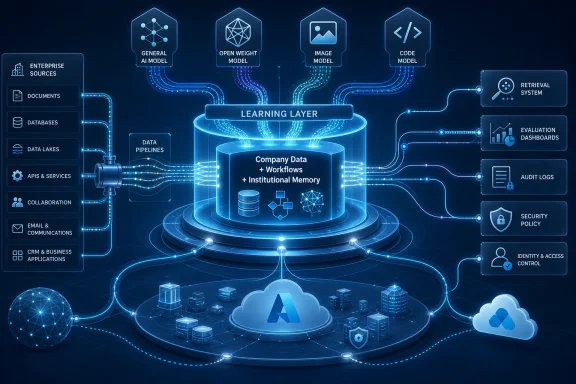 Nadella Turns the AI Pitch Back on the Enterprise
Nadella’s line — that there should be “as many models in the world as firms in the world” — lands because it reframes AI from a vendor product into an organizational capability. A company, in his telling, is not merely a bundle of processes, contracts, and headcount. It is a learning system, and AI becomes dangerous when that learning is externalized to a provider that also serves everyone else.That is a more sophisticated pitch than the usual cloud-era mantra of “let us run the infrastructure.” Microsoft is not saying enterprises should all train frontier models from scratch. Very few companies have the capital, data-center access, research bench, or patience to compete with OpenAI, Anthropic, Google, Meta, xAI, or the next foundation-model contender. Nadella’s point is narrower and more strategic: enterprises should not confuse renting a model with building an intelligence layer.
The difference is where the valuable context sits. A general-purpose model can write code, summarize contracts, generate marketing copy, and reason across common knowledge. But the durable advantage for a bank, hospital system, manufacturer, logistics company, or software vendor is not that it can ask a chatbot to draft an email. It is whether the system understands the company’s risk tolerances, customer histories, operating constraints, defect patterns, compliance obligations, and internal language.
That is why the phrase “build its own AI” should not be read as a call for every regional insurance company to become a model lab. It means enterprises need to own the feedback loops, data pipelines, retrieval systems, fine-tuning choices, evaluation sets, and governance practices that make AI useful inside a specific business. In other words, they need to own the learning layer, even if they rent much of the raw computation.
The Frontier Model Was Always the Beginning, Not the Moat
The early enterprise AI story was dominated by access. Could you get GPT-4? Could your employees use Copilot? Could your developers call a high-quality API without violating procurement rules? That access problem was real, especially for regulated industries, but it was never the final problem.Once access becomes broadly available, differentiation moves somewhere else. If two law firms use the same foundation model, the better firm will not win because the model knows more general law. It will win because its AI systems are grounded in better precedent libraries, better matter metadata, better review workflows, and better human feedback. If two manufacturers use the same coding assistant, the advantage will come from proprietary failure logs, design constraints, plant-specific process knowledge, and integration with operational systems.
This is the enterprise version of a familiar technology cycle. The first phase rewards companies that get the new tool into production. The second phase punishes companies that deployed the tool without reorganizing around it. The spreadsheet, the relational database, the web, mobile, and cloud all followed some version of that path. AI will not be different simply because the demo looks more magical.
Nadella’s argument also undercuts the comforting belief that AI adoption can be purchased as a finished transformation. Companies love managed services because they turn messy capability-building into a line item. But if the capability in question is learning — how the organization notices patterns, encodes judgment, and updates behavior — outsourcing becomes existentially risky. A company can outsource payroll. It cannot outsource its ability to understand why customers leave, why defects recur, or why a sales process works in one market and fails in another.
That is the sharp edge of Nadella’s remark that if you outsource your learning, the reason for the firm’s existence starts to erode. It sounds like CEO philosophy, but it has practical consequences. The firms that treat AI as a generic productivity plug-in may get efficiency gains. The firms that embed AI into their proprietary loops may get compounding advantage.
Microsoft’s Multi-Model Strategy Is Not a Break With OpenAI
The easy reading is that Nadella is distancing Microsoft from OpenAI. The better reading is that Microsoft is building an insurance policy around abundance. OpenAI remains strategically important to Microsoft, but Azure cannot afford to look like a single-model distribution channel in a market where customers increasingly want choice, cost control, locality, latency options, and bargaining power.That is why Microsoft Foundry — formerly discussed widely under the Azure AI Foundry branding — matters. Microsoft has been turning Foundry into a catalog, evaluation, deployment, and governance layer for many models, not just OpenAI’s. Official Microsoft materials describe access to models from Microsoft, OpenAI, Anthropic, Meta, Mistral, DeepSeek, Hugging Face, xAI, and others, with tooling for comparison, fine-tuning, monitoring, responsible AI controls, and deployment patterns.
This is not charity toward model pluralism. It is cloud strategy. If the enterprise world fragments across many models, Microsoft wants Azure to be the place where that fragmentation becomes manageable. If the model market consolidates, Microsoft wants to be the platform through which enterprises consume the winners. Either way, Azure sits underneath the workloads.
The OpenAI partnership gave Microsoft a head start, brand heat, and a powerful product story for Copilot. But the economics of enterprise AI point toward heterogeneity. A customer may want a frontier model for legal reasoning, a smaller model for internal ticket triage, an open-weight model for sensitive on-premises inference, a vision model for factory inspection, and a specialized embedding model for search. Treating all of those jobs as one “AI” problem served by one universal model is administratively simple and technically lazy.
Microsoft’s positioning is therefore both principled and opportunistic. Nadella can argue that enterprises should not depend on a handful of models, while Microsoft sells the platform that makes dependence on any single model less necessary. The anti-lock-in message becomes a different kind of lock-in: not to a model, but to the control plane.
The New Lock-In Is the AI Operating Layer
Cloud vendors learned long ago that customers rarely feel locked in by raw compute alone. They feel locked in by identity systems, security policy, data gravity, observability tooling, developer workflows, compliance attestations, billing models, and the accumulated muscle memory of the IT organization. AI adds another layer to that stack.The model is visible, but the surrounding system is stickier. A production enterprise AI application needs prompt management, retrieval, evaluation, audit logs, red-team results, content safety filters, human review workflows, cost monitoring, access controls, data-loss prevention, and incident response. The more serious the use case, the less the model endpoint looks like the whole product.
That is why Microsoft can be relaxed about a multi-model world. If Azure becomes the environment where companies test models, route tasks, run agents, attach corporate data, and enforce policy, then Microsoft benefits whether the underlying intelligence comes from OpenAI, Anthropic, Meta, Mistral, DeepSeek, or a future provider that has not yet become famous. The model becomes a component. The platform becomes the system of record.
For sysadmins and enterprise architects, this should sound familiar. Windows Server was never just a kernel. Microsoft 365 is not just Office apps. Azure is not just virtual machines. Microsoft’s strongest businesses tend to wrap core functionality in identity, management, policy, developer tooling, and procurement convenience until the wrapper becomes as important as the thing inside it.
The risk for customers is that “don’t be locked into one model” becomes “be deeply dependent on one AI orchestration estate.” That may still be a rational trade. Most enterprises would rather manage model choice through an incumbent cloud platform than stitch together a dozen vendors by hand. But IT leaders should be clear-eyed: the escape hatch from model lock-in may lead into platform lock-in.
Open-Weight Models Are the Pressure Valve
Nadella’s comments also reflect a shift in how enterprises think about open-weight models. For a while, the assumption was that closed frontier models would dominate serious enterprise use because they were simply better. That remains true for many high-end reasoning and multimodal tasks, but the gap is not the only variable that matters.Cost matters. Latency matters. Data residency matters. Customization matters. The right to run a model in a controlled environment matters. The ability to fine-tune or adapt a model for a specific domain matters. In many enterprise workflows, “good enough, cheaper, controllable, and auditable” will beat “best benchmark score” every day.
That is where models from Meta, Mistral, DeepSeek, and other open or open-weight ecosystems become strategically important. Open-weight does not automatically mean open source in the traditional software sense, and licensing terms vary widely. But the practical appeal is clear: organizations get more control over deployment, adaptation, and unit economics than they usually get from a closed API.
The security argument cuts both ways. A model whose weights can be inspected, hosted, and restricted may appeal to organizations wary of sending sensitive prompts to an outside endpoint. But open-weight models can also carry supply-chain, provenance, licensing, safety, and geopolitical concerns. A model is not magically trustworthy because it is downloadable. The enterprise question is not whether open models are pure; it is whether they can be governed.
Microsoft’s strategy is to make that governance a cloud feature. By hosting selected models in Azure, wrapping them in enterprise security controls, and placing them inside Foundry’s evaluation and monitoring apparatus, Microsoft tries to turn a messy open-model ecosystem into something procurement departments can approve. That does not eliminate risk, but it changes who is expected to manage it.
The Cost Curve Is Forcing the Conversation
AI’s economics are becoming harder to hide. The first wave of enterprise generative AI was sold on productivity, not metering anxiety. But agentic systems — tools that keep invoking models while they plan, search, write, test, revise, and call other tools — can generate unpredictable consumption. The more useful they become, the more they run.That dynamic makes model choice a financial-control issue. A company might happily use an expensive frontier model for a board-level legal analysis or a mission-critical software migration. It may not want that same model classifying help-desk tickets, summarizing low-risk chats, or generating routine internal documentation. The enterprise AI stack will increasingly resemble a routing problem: send each task to the cheapest model that meets the quality, safety, and latency requirement.
This is another reason Nadella’s “as many models as firms” line is more than rhetoric. The optimal model mix for a pharmaceutical company will not look like the optimal mix for a retailer, a game studio, a school district, or a regional government. Even within a company, finance, engineering, HR, sales, and security teams may need different models, different data boundaries, and different evaluation thresholds.
The frontier-model race is still important, but it is only one layer of the market. At enterprise scale, the winning architecture may be a portfolio of models connected by policy, telemetry, and feedback. That is less glamorous than a single omniscient chatbot. It is also much closer to how IT actually works.
For WindowsForum readers, the practical echo is obvious. Enterprises did not standardize on one database, one endpoint type, one scripting language, or one identity integration forever. They standardized on management patterns. AI is heading the same way.
The Windows and Microsoft 365 Angle Is Bigger Than Copilot
For many Windows users, Microsoft’s AI strategy is visible mainly through Copilot: in Windows, in Microsoft 365, in Edge, in GitHub, and across the company’s developer tools. But Nadella’s remarks point to a deeper shift than sprinkling a chatbot across familiar interfaces. Microsoft wants AI to become an organizational substrate, and Windows endpoints are one surface among many.That matters because the enterprise desktop is where governance meets behavior. A model strategy is abstract until employees start pasting data into prompts, asking agents to touch files, generating code, summarizing meetings, or letting automated workflows act on business systems. The endpoint, identity provider, document repository, and compliance stack all become part of the AI perimeter.
Microsoft is unusually well positioned there. It controls Windows, Entra identity, Microsoft 365, Teams, SharePoint, Defender, Purview, GitHub, Power Platform, and Azure. That does not guarantee success, but it gives Microsoft a map of enterprise activity that few rivals can match. If AI value comes from context and traces, Microsoft’s existing footprint becomes a strategic asset.
This is also where Nadella’s warning gets complicated. He says companies need their own AI, but many of the traces that make such AI useful already flow through Microsoft systems. Email, calendars, documents, chats, tickets, repositories, security alerts, spreadsheets, and workflows are not neutral artifacts. They are the institutional exhaust from which enterprise AI will learn.
The question for customers is whether Microsoft helps them own that learning or simply intermediates it. The difference will show up in exportability, auditability, model portability, data controls, and the ability to move workloads without losing the intelligence built around them. If the AI layer becomes impossible to separate from Microsoft’s productivity and cloud estate, enterprises may gain capability while surrendering leverage.
“Build Your Own AI” Does Not Mean “Train Recklessly”
There is a danger in turning Nadella’s argument into a slogan. Many companies are not ready to build bespoke AI systems responsibly. Their data is messy, permissions are inconsistent, document stores are stale, logs are incomplete, and business processes depend on tribal knowledge no one has written down. Feeding that chaos into an AI platform does not create intelligence. It creates fast-moving confusion.The hard work is not glamorous. It starts with data hygiene, identity boundaries, retention policy, classification, evaluation sets, and a clear definition of what a model is allowed to do. It requires people who understand the business process and people who understand machine-learning failure modes to work together. It also requires measuring outcomes, not just demo quality.
Fine-tuning is not a magic wand either. In many enterprise cases, retrieval-augmented generation, tool use, workflow integration, or carefully designed prompts may outperform or outlast a fine-tuned model. In other cases, fine-tuning a smaller model on well-curated traces may be exactly the right move. The point is that “custom AI” is an architecture decision, not a branding exercise.
Nadella’s most useful contribution is not that every company needs a model with its name on it. It is that every company needs a learning system it understands and controls. That system may use frontier APIs, open-weight models, small language models, embeddings, rules engines, knowledge graphs, and old-fashioned databases. The enterprise AI winners will be the ones that stop treating those pieces as a novelty stack and start treating them as production infrastructure.
The Real Competitive Threat Is Sameness
The nightmare scenario for enterprise AI is not that a model refuses to answer a prompt. It is that every company gets slightly faster at doing the same things in the same way. If the underlying models, workflows, templates, and decision systems converge, AI becomes a force for operational sameness rather than strategic differentiation.That is already visible in some low-risk use cases. Corporate writing starts to sound the same. Support replies flatten into the same careful tone. Marketing copy inherits the same rhythm. Code suggestions converge around familiar patterns. None of this is catastrophic, but it is a preview of what happens when organizations use general systems without injecting their own judgment.
Real differentiation requires friction. It requires deciding which internal knowledge is worth encoding, which practices should be challenged, which historical decisions should not be repeated, and which human experts should shape the feedback loop. AI systems trained or grounded on corporate history can preserve advantage, but they can also preserve dysfunction. The organization has to know the difference.
That is why “proprietary data” is not automatically a moat. Some proprietary data is obsolete, biased, low-quality, or legally sensitive. Some internal workflows are inefficient because they were built around old software constraints. If companies pour that material into AI systems without scrutiny, they may automate the past rather than invent the future.
Nadella’s framing works best when “learning” implies adaptation, not mere ingestion. A firm is not a learning system because it stores documents. It is a learning system because it changes behavior when reality pushes back. Enterprise AI has to be judged by that standard.
The Next AI Procurement Fight Will Be About Control
For CIOs, the procurement question is moving from “Which AI model should we buy?” to “Who controls the intelligence we are building?” That is a much harder conversation. It crosses vendor management, data governance, security architecture, finance, legal, HR, and line-of-business ownership.The old software-as-a-service contract assumed the vendor provided functionality and the customer supplied data. AI blurs that boundary. Customer data, prompts, corrections, traces, and workflow outcomes can improve the system. Even when vendors promise not to train foundation models on customer data, the operational intelligence created inside a tenant may still become deeply dependent on the vendor’s environment.
This will make portability a serious enterprise concern. Can a company move its evaluation sets, prompt libraries, agent definitions, embeddings, fine-tuned models, audit logs, and policy rules? Can it reproduce behavior on another cloud or with another model? Can it prove why an AI-assisted decision was made six months later? These questions are less exciting than benchmark charts, but they are where long-term leverage lives.
Regulated industries will feel this first. A bank, hospital, insurer, defense contractor, or public agency cannot simply accept a black-box dependency because the demo looked good. They need evidence, repeatability, risk controls, and failure procedures. The more AI systems act rather than merely suggest, the more these requirements intensify.
Microsoft’s bet is that enterprises will prefer to solve those problems inside a familiar platform. That may be true. But the smartest customers will use the multi-model moment to negotiate architecture, not just pricing.
Nadella’s Warning Lands Because It Flatters Azure and Challenges Customers
There is a dual nature to Nadella’s message. On one side, it is a serious warning about competitive dependence in the AI age. On the other, it is a perfectly timed argument for Microsoft’s own cloud platform. The two are not mutually exclusive.Microsoft benefits if enterprises believe they need custom AI because custom AI consumes storage, compute, networking, governance tools, developer services, monitoring, and security products. The more companies experiment with model portfolios, the more they need a place to manage them. The more they ground models in corporate data, the more they need cloud-scale data plumbing. The more they deploy agents, the more they need identity, policy, and observability.
But that commercial motive does not invalidate the substance. Vendor strategy and customer reality often overlap in technology markets. Microsoft wanted everyone on Windows because it benefited Microsoft, and also because a standardized PC platform solved real problems. Microsoft wanted enterprises in Azure because it benefited Microsoft, and also because cloud infrastructure solved real scaling and procurement problems. Now Microsoft wants enterprises building AI through Foundry because it benefits Microsoft, and also because unmanaged AI sprawl is going to be ugly.
The critical question is whether customers can adopt Microsoft’s tooling without surrendering the very learning Nadella says they must protect. That means designing for model replaceability where possible, retaining ownership of evaluation data, documenting agent behavior, and avoiding architectures that make business logic disappear into proprietary orchestration layers. It also means resisting the urge to turn every workflow into an AI workflow before the organization understands the risk.
Nadella is right that firms exist because they learn. But learning is not just data accumulation. It is judgment under constraints. Enterprises that forget that will build impressive AI systems that know a great deal and understand very little.
The Fine Print Behind the “One Model Per Company” Era
Nadella’s interview should be read as a marker for where enterprise AI is heading: away from model worship and toward AI operations. The companies that benefit most will not necessarily be the ones with the most adventurous pilots. They will be the ones that turn AI into a governed, measured, business-specific capability.- Companies should treat foundation models as components, not as complete enterprise strategies.
- Microsoft’s multi-model Foundry push makes Azure more valuable precisely because the model market is fragmenting.
- Open-weight and smaller models will gain enterprise traction where cost, control, latency, or customization matter more than maximum benchmark performance.
- The hardest work will be building clean data pipelines, evaluation systems, governance controls, and feedback loops around the models.
- The next form of lock-in may be the AI management layer rather than the model itself.
- Competitive advantage will come from proprietary learning systems, not from giving every employee access to the same general-purpose chatbot.
References
- Primary source: Tekedia
Published: 2026-06-27T17:30:08.674081
Satya Nadella Urges Every Company to Build Its Own AI, Warns Against Dependence on a Handful of Models - Tekedia
Microsoft Chief Executive Satya Nadella has outlined a vision for enterprise artificial intelligence in which every company develops AI models tailored to its own business, arguing that organizations risk losing their competitive edge if they rely solely on models built by a handful of...www.tekedia.com - Official source: learn.microsoft.com
Foundry Models sold by Azure - Microsoft Foundry | Microsoft Learn
Learn about Microsoft Foundry Models sold by Azure, their capabilities, deployment types, and regional availability for AI applications.learn.microsoft.com - Official source: azure.microsoft.com
- Official source: ai.azure.com
AI Model Catalog | Microsoft Foundry Models
Explore the comprehensive catalog of AI models from Microsoft Foundry ai.azure.com
- Related coverage: winmill.com
Microsoft Foundry Models: How to Upgrade from Azure OpenAI | Winmill
Learn Microsoft Foundry Models, how they extend Azure OpenAI, and a practical transition plan with guardrails and model routing.www.winmill.com - Related coverage: techradar.com
50 Microsoft tools you can use for free just in time for Build 2026 | TechRadar
Free tools from across the Microsoft ecosystemwww.techradar.com
