

Microsoft CEO Satya Nadella warned in mid-June 2026 that artificial intelligence could hollow out industries much as outsourcing hollowed out manufacturing, arguing that too much economic value flowing to a handful of large AI models would provoke political and social backlash. The warning is striking because it comes from the executive most visibly wiring generative AI into the daily machinery of white-collar work. Nadella is not rejecting the AI boom; he is trying to define the terms under which it remains politically survivable. That makes his argument less a confession than a map of Microsoft’s next defensive line.
The easy reading is hypocrisy: Microsoft sells Copilot, rents cloud capacity, backs OpenAI, and then its CEO warns that AI could concentrate value and damage workers. That reading is not wrong, but it is incomplete. Nadella is describing the central tension of the AI platform era, in which the same technology that promises to make every company more productive could also make many companies less strategically independent.
His phrase about a few models that “eat everything they see” gets at the real fear. Large language models do not merely automate a task in the old software sense. They absorb examples, workflows, documents, code, tickets, meeting notes, and decisions, then turn that accumulated pattern into a service sold back across the economy.
That is why the outsourcing analogy lands. The first wave of globalization did not simply move work from one location to another; it shifted bargaining power, dissolved local industrial ecosystems, and left firms optimized for cost rather than resilience. Nadella’s argument is that AI could do something similar to knowledge work if companies treat frontier models as magical contractors rather than as components inside systems they control.
For Windows users and IT departments, this is not an abstract macroeconomic debate. Microsoft 365 Copilot already sits inside Word, Outlook, Excel, Teams, and the administrative perimeter that governs modern office work. If AI becomes the interface through which employees write, search, summarize, decide, and code, the question of who owns the learning loop becomes the question of who owns the workplace.
A legal department might still employ lawyers, but its first drafts, precedent search, and contract analysis may increasingly run through a model layer controlled by outside vendors. A software team might still have developers, but more of the scaffolding, testing, refactoring, and documentation may be generated through systems that turn internal engineering practice into rented intelligence. A support organization might still answer tickets, but the institutional memory that once lived in veteran employees may be encoded into an assistant that belongs to the platform provider.
This is why the manufacturing analogy is imperfect but useful. Offshoring moved labor-intensive production to lower-cost regions. AI can move judgment-intensive routines into model-mediated workflows without the same visible displacement event. The badge remains; the leverage changes.
Nadella’s warning also hints at a political problem that Silicon Valley often underestimates. If shareholders, cloud providers, and model owners capture most of the gains while employees experience monitoring, deskilling, or headcount pressure, the backlash will not wait for economists to finish measuring productivity. The political system tends to react when voters feel a loss of control, not when the spreadsheet finally proves the mechanism.
This is a subtle but important shift in how Microsoft wants enterprises to think about AI. The model is not the strategy. The strategy is the loop: human expertise produces work, AI assists and observes, the organization captures feedback, and the system improves in ways specific to that organization.
That framing is convenient for Microsoft because it places Azure, Microsoft 365, security controls, identity management, data governance, and Copilot Studio at the center of the enterprise AI stack. Microsoft does not need every customer to believe that one model will rule them all. It needs customers to believe that the serious work of AI happens inside a managed platform where Microsoft already owns the plumbing.
Still, the argument is not merely salesmanship. Any organization that pipes sensitive workflows into a generic model without thinking about feedback, retention, governance, and process design is effectively exporting part of its operating memory. The risk is not just data leakage. The deeper risk is strategic flattening, where every company buys the same assistant, asks it the same questions, and gradually converges on the same median answer.
That creates a practical dilemma for IT departments. Disable AI too aggressively and the organization may fall behind competitors that use it to move faster. Enable it casually and the organization may create cost, compliance, and knowledge-management problems that only become obvious after workflows have already changed.
Copilot in Microsoft 365 is the clearest example. It promises to summarize meetings, draft emails, analyze documents, pull context from Microsoft Graph, and reduce the busywork that clogs office life. But those capabilities depend on permissions, data hygiene, retention policies, and a realistic understanding of what the assistant can infer from corporate content.
Many companies are now discovering that AI readiness is really information-governance readiness under a brighter spotlight. If a user has access to files they should not see, an AI assistant may make that overpermissioning more visible and more useful. If SharePoint is a decade-old swamp, AI will not magically turn it into a knowledge base; it may simply make the swamp conversational.
Nadella’s warning about owning the learning system therefore has a very concrete enterprise translation. Before a company asks what AI can automate, it should ask what organizational knowledge it is exposing, what feedback it is capturing, and whether the result makes the company smarter or merely more dependent.
The temptation is obvious. If the best model is available, why not use it for everything? Why not throw the largest context window at a mundane summary, the most capable reasoning model at a routine classification task, or an expensive agentic workflow at a problem a script could solve?
That instinct is how cloud bills become board-level conversations. The early SaaS era taught companies to treat software seats as manageable operating expenses. The AI era adds metered cognition, where employees can burn real money through invisible tokens while experimenting, iterating, or simply asking a model to do work that cheaper tools could handle.
Microsoft’s answer is model routing: use powerful models when necessary and cheaper models when sufficient. That sounds like common sense, but it also reveals how immature many AI deployments remain. If an organization cannot tell which tasks require frontier intelligence, which require a small model, and which require no AI at all, then it is not implementing a strategy; it is subsidizing experimentation.
This is where Nadella’s economic caution connects directly to admin reality. AI governance will not be only about data loss prevention and acceptable-use policies. It will also be about budgets, routing, telemetry, chargebacks, and deciding whether productivity gains justify the compute they consume.
That is not a retreat. It is an attempt to make the boom durable. Microsoft’s leadership understands that enterprise technology does not survive on novelty alone; it survives when CFOs can justify it, regulators can tolerate it, workers can live with it, and customers can see value beyond demos.
The company has already lived through platform backlash. Windows antitrust fights, browser bundling scrutiny, cloud licensing disputes, and security criticism all taught Microsoft that dominance creates political risk. Nadella’s AI language reflects a CEO who knows that being central to the next computing platform is a privilege that must be narrated as ecosystem-building rather than extraction.
That is why he talks about a “frontier ecosystem” instead of just frontier models. The phrase is doing political work. It implies pluralism, complementary value, local adaptation, and broad participation — the opposite of a world where a small number of model vendors vacuum up the surplus from every profession.
Whether that ecosystem actually emerges is another matter. The economics of AI still favor companies with capital, data-center scale, chip access, distribution, and developer mindshare. Microsoft is one of them.
This can be empowering. A junior employee can draft faster, a support engineer can find relevant cases more quickly, a developer can avoid repetitive boilerplate, and a manager can extract signal from a week of meetings. Used well, AI can reduce the tax imposed by bad software, bloated communication, and organizational sprawl.
But there is a darker version. The same systems can be used to compress roles, standardize judgment, measure output, and justify smaller teams. The worker becomes both beneficiary and data source, both operator and benchmark.
Nadella’s comments about human capital and token capital compounding together are an attempt to resolve that tension. The optimistic version is that AI makes skilled people more valuable because it amplifies their judgment. The pessimistic version is that AI captures enough of that judgment to reduce the number of skilled people an organization believes it needs.
Both outcomes will happen in different places. The difference will depend less on the model itself than on management choices, labor markets, regulation, and whether organizations treat AI as a capability builder or a headcount-reduction machine with a nicer interface.
A company that cannot operate without its AI assistant has created a new class of outage risk. A company that cannot switch models has created vendor lock-in. A company that cannot explain how AI-influenced decisions were made has created audit exposure.
For Windows administrators, the familiar disciplines still apply. Identity, least privilege, logging, endpoint management, retention, classification, and incident response all matter more when AI can retrieve, summarize, and act across systems. The assistant is only as safe as the permissions and connectors behind it.
The challenge is that AI makes old messes faster. Overbroad access becomes instant discovery. Poorly labeled data becomes ambiguous context. Shadow IT becomes shadow intelligence. A neglected knowledge base becomes an authoritative-sounding answer generator.
That is why the next phase of AI adoption will likely be less glamorous than the first. After the demos come permission reviews, pilot scopes, cost controls, model evaluations, red-team exercises, and uncomfortable meetings about who is accountable when an AI-assisted workflow produces a bad outcome.
The early evidence is mixed in the way early platform shifts usually are. Developers can often move faster with coding assistants, but the quality and maintainability of AI-assisted code depend heavily on review discipline. Office workers can produce drafts and summaries more quickly, but faster document production is not the same as better decisions. Customer support can automate more responses, but automation that frustrates customers may simply move costs elsewhere.
This is where Microsoft’s position is unusually powerful. It does not need AI to replace every job to make money. It needs AI to become a default expectation inside software subscriptions, cloud workloads, developer tooling, and business processes.
That incremental path may be more consequential than the dramatic “AI replaces everyone” narrative. If every employee saves fifteen minutes here, generates more text there, relies on automated analysis elsewhere, and gradually shifts work into AI-mediated interfaces, the structure of work changes without a single cinematic moment of replacement.
The danger is that organizations mistake motion for productivity. More generated code, more summarized meetings, more automated emails, and more dashboards do not automatically equal more value. Nadella’s own warning about compute running in circles without human direction should be read as a critique of AI theater as much as AI concentration.
That is the hopeful case. A small manufacturer could use AI to improve documentation, sales, maintenance, and design. A local government could improve service delivery. A school district could reduce administrative load. A small software shop could compete above its weight.
But those benefits do not arrive automatically. If the tools are expensive, the models centralized, the skills unevenly distributed, and the gains captured mostly by platforms, the democratizing story weakens. The same technology that helps a small firm compete can also help a larger firm squeeze suppliers, automate middle layers, and consolidate markets.
Nadella is trying to position Microsoft on the right side of that divide. He wants AI to be seen as infrastructure for broad capability, not as a vacuum hose for economic value. The credibility of that position will depend on product design, pricing, interoperability, governance tools, and whether customers can genuinely retain control over their own learning loops.
The key questions are becoming more strategic than technical. Which workflows should be augmented? Which decisions require human review? Which data should never enter an AI workflow? Which vendors can be swapped out? Which productivity claims can be measured? Which employees are being trained to use AI critically rather than passively?
Those questions belong in the same room as licensing negotiations and security architecture. If AI is treated as a feature toggle, organizations will discover too late that they have changed how institutional memory flows. If it is treated as a managed transformation, they at least have a chance to capture value rather than merely rent it.
Microsoft’s own product stack makes this both easier and harder. Easier, because many organizations already have the identity, compliance, and management layers needed to impose order. Harder, because Microsoft can make adoption feel frictionless enough that governance lags behind usage.
The enterprises that do best will likely be those that resist both panic and intoxication. They will use AI, but not everywhere. They will measure it, but not pretend every benefit is quantifiable. They will protect human expertise, not out of nostalgia, but because without it the machines have no direction worth scaling.
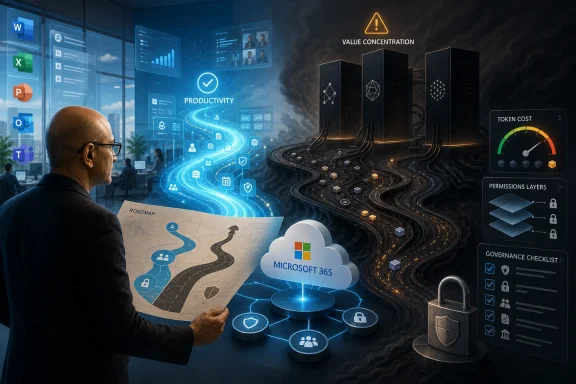 Nadella Is Warning About the Economy Microsoft Is Helping Build
The easy reading is hypocrisy: Microsoft sells Copilot, rents cloud capacity, backs OpenAI, and then its CEO warns that AI could concentrate value and damage workers. That reading is not wrong, but it is incomplete. Nadella is describing the central tension of the AI platform era, in which the same technology that promises to make every company more productive could also make many companies less strategically independent.His phrase about a few models that “eat everything they see” gets at the real fear. Large language models do not merely automate a task in the old software sense. They absorb examples, workflows, documents, code, tickets, meeting notes, and decisions, then turn that accumulated pattern into a service sold back across the economy.
That is why the outsourcing analogy lands. The first wave of globalization did not simply move work from one location to another; it shifted bargaining power, dissolved local industrial ecosystems, and left firms optimized for cost rather than resilience. Nadella’s argument is that AI could do something similar to knowledge work if companies treat frontier models as magical contractors rather than as components inside systems they control.
For Windows users and IT departments, this is not an abstract macroeconomic debate. Microsoft 365 Copilot already sits inside Word, Outlook, Excel, Teams, and the administrative perimeter that governs modern office work. If AI becomes the interface through which employees write, search, summarize, decide, and code, the question of who owns the learning loop becomes the question of who owns the workplace.
The New Outsourcing Does Not Need a Factory Gate
Outsourcing was visible. A plant closed, a call center moved, a supplier replaced an internal team, and the economic shock had a geography. AI hollowing is quieter because the work may remain in the same office, on the same laptop, under the same corporate logo, while the value of that work migrates elsewhere.A legal department might still employ lawyers, but its first drafts, precedent search, and contract analysis may increasingly run through a model layer controlled by outside vendors. A software team might still have developers, but more of the scaffolding, testing, refactoring, and documentation may be generated through systems that turn internal engineering practice into rented intelligence. A support organization might still answer tickets, but the institutional memory that once lived in veteran employees may be encoded into an assistant that belongs to the platform provider.
This is why the manufacturing analogy is imperfect but useful. Offshoring moved labor-intensive production to lower-cost regions. AI can move judgment-intensive routines into model-mediated workflows without the same visible displacement event. The badge remains; the leverage changes.
Nadella’s warning also hints at a political problem that Silicon Valley often underestimates. If shareholders, cloud providers, and model owners capture most of the gains while employees experience monitoring, deskilling, or headcount pressure, the backlash will not wait for economists to finish measuring productivity. The political system tends to react when voters feel a loss of control, not when the spreadsheet finally proves the mechanism.
The Model Is Not the Moat
Nadella’s proposed answer is that companies should build their own agentic systems rather than merely rent intelligence from a frontier lab. In plain English, that means organizations should design AI workflows that preserve their institutional knowledge, encode their own judgment, and allow them to swap underlying models as the technology changes.This is a subtle but important shift in how Microsoft wants enterprises to think about AI. The model is not the strategy. The strategy is the loop: human expertise produces work, AI assists and observes, the organization captures feedback, and the system improves in ways specific to that organization.
That framing is convenient for Microsoft because it places Azure, Microsoft 365, security controls, identity management, data governance, and Copilot Studio at the center of the enterprise AI stack. Microsoft does not need every customer to believe that one model will rule them all. It needs customers to believe that the serious work of AI happens inside a managed platform where Microsoft already owns the plumbing.
Still, the argument is not merely salesmanship. Any organization that pipes sensitive workflows into a generic model without thinking about feedback, retention, governance, and process design is effectively exporting part of its operating memory. The risk is not just data leakage. The deeper risk is strategic flattening, where every company buys the same assistant, asks it the same questions, and gradually converges on the same median answer.
Copilot Makes the Warning Personal for Windows Shops
The reason this matters to WindowsForum readers is that Microsoft’s AI strategy is not a separate product line sitting off to the side. It is being threaded through Windows, Microsoft 365, GitHub, Defender, Azure, Power Platform, and the management tools administrators use to control them. AI is becoming less like an app and more like a layer of the operating environment.That creates a practical dilemma for IT departments. Disable AI too aggressively and the organization may fall behind competitors that use it to move faster. Enable it casually and the organization may create cost, compliance, and knowledge-management problems that only become obvious after workflows have already changed.
Copilot in Microsoft 365 is the clearest example. It promises to summarize meetings, draft emails, analyze documents, pull context from Microsoft Graph, and reduce the busywork that clogs office life. But those capabilities depend on permissions, data hygiene, retention policies, and a realistic understanding of what the assistant can infer from corporate content.
Many companies are now discovering that AI readiness is really information-governance readiness under a brighter spotlight. If a user has access to files they should not see, an AI assistant may make that overpermissioning more visible and more useful. If SharePoint is a decade-old swamp, AI will not magically turn it into a knowledge base; it may simply make the swamp conversational.
Nadella’s warning about owning the learning system therefore has a very concrete enterprise translation. Before a company asks what AI can automate, it should ask what organizational knowledge it is exposing, what feedback it is capturing, and whether the result makes the company smarter or merely more dependent.
Tokenmaxxing Is the Cost Problem Wearing a Meme Hat
Nadella’s “tokenmaxxer” remark during the Hard Fork appearance gave the story a lighter hook, but it points to a serious operational issue. Generative AI is not free magic. Every prompt, context window, file ingestion, tool call, and generated response consumes compute, and frontier models are expensive relative to smaller or specialized systems.The temptation is obvious. If the best model is available, why not use it for everything? Why not throw the largest context window at a mundane summary, the most capable reasoning model at a routine classification task, or an expensive agentic workflow at a problem a script could solve?
That instinct is how cloud bills become board-level conversations. The early SaaS era taught companies to treat software seats as manageable operating expenses. The AI era adds metered cognition, where employees can burn real money through invisible tokens while experimenting, iterating, or simply asking a model to do work that cheaper tools could handle.
Microsoft’s answer is model routing: use powerful models when necessary and cheaper models when sufficient. That sounds like common sense, but it also reveals how immature many AI deployments remain. If an organization cannot tell which tasks require frontier intelligence, which require a small model, and which require no AI at all, then it is not implementing a strategy; it is subsidizing experimentation.
This is where Nadella’s economic caution connects directly to admin reality. AI governance will not be only about data loss prevention and acceptable-use policies. It will also be about budgets, routing, telemetry, chargebacks, and deciding whether productivity gains justify the compute they consume.
Microsoft Wants Moderation Without Slowing the Flywheel
The contradiction at the center of Nadella’s comments is real. Microsoft has poured enormous capital into AI infrastructure and partnership strategy, and the company has every incentive to make AI feel inevitable. At the same time, Nadella is warning that an AI economy dominated by a few platforms could lose legitimacy.That is not a retreat. It is an attempt to make the boom durable. Microsoft’s leadership understands that enterprise technology does not survive on novelty alone; it survives when CFOs can justify it, regulators can tolerate it, workers can live with it, and customers can see value beyond demos.
The company has already lived through platform backlash. Windows antitrust fights, browser bundling scrutiny, cloud licensing disputes, and security criticism all taught Microsoft that dominance creates political risk. Nadella’s AI language reflects a CEO who knows that being central to the next computing platform is a privilege that must be narrated as ecosystem-building rather than extraction.
That is why he talks about a “frontier ecosystem” instead of just frontier models. The phrase is doing political work. It implies pluralism, complementary value, local adaptation, and broad participation — the opposite of a world where a small number of model vendors vacuum up the surplus from every profession.
Whether that ecosystem actually emerges is another matter. The economics of AI still favor companies with capital, data-center scale, chip access, distribution, and developer mindshare. Microsoft is one of them.
Knowledge Workers Are Being Asked to Train Their Successors and Their Tools
The most uncomfortable part of the AI transition is that productivity tools learn from the work they help produce. That does not mean every employee is literally training a public model with every prompt. Enterprise privacy boundaries, tenant controls, and contractual terms matter. But at the process level, organizations are undeniably trying to turn human expertise into reusable machine-assisted workflows.This can be empowering. A junior employee can draft faster, a support engineer can find relevant cases more quickly, a developer can avoid repetitive boilerplate, and a manager can extract signal from a week of meetings. Used well, AI can reduce the tax imposed by bad software, bloated communication, and organizational sprawl.
But there is a darker version. The same systems can be used to compress roles, standardize judgment, measure output, and justify smaller teams. The worker becomes both beneficiary and data source, both operator and benchmark.
Nadella’s comments about human capital and token capital compounding together are an attempt to resolve that tension. The optimistic version is that AI makes skilled people more valuable because it amplifies their judgment. The pessimistic version is that AI captures enough of that judgment to reduce the number of skilled people an organization believes it needs.
Both outcomes will happen in different places. The difference will depend less on the model itself than on management choices, labor markets, regulation, and whether organizations treat AI as a capability builder or a headcount-reduction machine with a nicer interface.
The Security Story Is Bigger Than Prompt Injection
Security teams have often framed generative AI risk around prompt injection, data leakage, hallucinations, and malicious use. Those risks are real, but Nadella’s warning points to a broader security concern: dependency. If critical business processes become mediated by a small set of external AI systems, resilience becomes a supply-chain issue.A company that cannot operate without its AI assistant has created a new class of outage risk. A company that cannot switch models has created vendor lock-in. A company that cannot explain how AI-influenced decisions were made has created audit exposure.
For Windows administrators, the familiar disciplines still apply. Identity, least privilege, logging, endpoint management, retention, classification, and incident response all matter more when AI can retrieve, summarize, and act across systems. The assistant is only as safe as the permissions and connectors behind it.
The challenge is that AI makes old messes faster. Overbroad access becomes instant discovery. Poorly labeled data becomes ambiguous context. Shadow IT becomes shadow intelligence. A neglected knowledge base becomes an authoritative-sounding answer generator.
That is why the next phase of AI adoption will likely be less glamorous than the first. After the demos come permission reviews, pilot scopes, cost controls, model evaluations, red-team exercises, and uncomfortable meetings about who is accountable when an AI-assisted workflow produces a bad outcome.
The Productivity Boom Still Has to Prove Itself
Nadella has previously argued that AI must produce broad, measurable value rather than remain a speculative infrastructure race. That matters because the industry has spent heavily ahead of proof. Data centers, chips, power contracts, model training, and enterprise licenses all assume that AI will become deeply embedded in work.The early evidence is mixed in the way early platform shifts usually are. Developers can often move faster with coding assistants, but the quality and maintainability of AI-assisted code depend heavily on review discipline. Office workers can produce drafts and summaries more quickly, but faster document production is not the same as better decisions. Customer support can automate more responses, but automation that frustrates customers may simply move costs elsewhere.
This is where Microsoft’s position is unusually powerful. It does not need AI to replace every job to make money. It needs AI to become a default expectation inside software subscriptions, cloud workloads, developer tooling, and business processes.
That incremental path may be more consequential than the dramatic “AI replaces everyone” narrative. If every employee saves fifteen minutes here, generates more text there, relies on automated analysis elsewhere, and gradually shifts work into AI-mediated interfaces, the structure of work changes without a single cinematic moment of replacement.
The danger is that organizations mistake motion for productivity. More generated code, more summarized meetings, more automated emails, and more dashboards do not automatically equal more value. Nadella’s own warning about compute running in circles without human direction should be read as a critique of AI theater as much as AI concentration.
The Outsourcing Analogy Cuts Both Ways
The outsourcing comparison is potent because it invokes a widely understood failure: efficiency gains that looked rational at the firm level produced social costs that were ignored until they became political facts. But the analogy also has limits. AI is not just labor arbitrage; it is a general-purpose technology that can be deployed inside existing teams, across small businesses, and by individuals who never had access to advanced software capabilities before.That is the hopeful case. A small manufacturer could use AI to improve documentation, sales, maintenance, and design. A local government could improve service delivery. A school district could reduce administrative load. A small software shop could compete above its weight.
But those benefits do not arrive automatically. If the tools are expensive, the models centralized, the skills unevenly distributed, and the gains captured mostly by platforms, the democratizing story weakens. The same technology that helps a small firm compete can also help a larger firm squeeze suppliers, automate middle layers, and consolidate markets.
Nadella is trying to position Microsoft on the right side of that divide. He wants AI to be seen as infrastructure for broad capability, not as a vacuum hose for economic value. The credibility of that position will depend on product design, pricing, interoperability, governance tools, and whether customers can genuinely retain control over their own learning loops.
The Windows Admin’s AI Checklist Is Becoming a Strategy Document
For years, IT strategy around Microsoft platforms could be reduced to a familiar rhythm: manage endpoints, secure identities, patch aggressively, govern data, and keep users productive. AI does not replace that work. It turns it into the foundation for whether the organization benefits from the next decade of software or becomes dependent on it.The key questions are becoming more strategic than technical. Which workflows should be augmented? Which decisions require human review? Which data should never enter an AI workflow? Which vendors can be swapped out? Which productivity claims can be measured? Which employees are being trained to use AI critically rather than passively?
Those questions belong in the same room as licensing negotiations and security architecture. If AI is treated as a feature toggle, organizations will discover too late that they have changed how institutional memory flows. If it is treated as a managed transformation, they at least have a chance to capture value rather than merely rent it.
Microsoft’s own product stack makes this both easier and harder. Easier, because many organizations already have the identity, compliance, and management layers needed to impose order. Harder, because Microsoft can make adoption feel frictionless enough that governance lags behind usage.
The enterprises that do best will likely be those that resist both panic and intoxication. They will use AI, but not everywhere. They will measure it, but not pretend every benefit is quantifiable. They will protect human expertise, not out of nostalgia, but because without it the machines have no direction worth scaling.
Nadella’s Warning Lands Hardest on the Companies Already Buying Copilot
The practical message under Nadella’s rhetoric is sharper than the usual AI keynote optimism.- Companies that treat frontier AI models as their entire strategy are likely to surrender knowledge, pricing power, and differentiation to the model layer.
- Microsoft customers need to clean up permissions, data governance, and retention before AI assistants make old information problems newly visible.
- The most expensive model should not become the default tool for every task, because token costs will become a real operational constraint.
- Knowledge workers should expect AI to augment parts of their jobs while also turning their workflows into systems management will try to measure and reuse.
- IT departments should evaluate Copilot and similar tools as infrastructure decisions, not as ordinary productivity add-ons.
- The central question is not whether AI will be used, but whether organizations will own enough of the learning loop to remain strategically independent.
References
- Primary source: RS Web Solutions
Published: 2026-06-16T18:00:16.038564
Microsoft CEO Warns AI Surge Could Wipe Out Jobs Like Outsourcing
Microsoft CEO warns AI surge may wipe out jobs like outsourcing did; discover which careers are at risk and what you can do to stay ahead today.www.rswebsols.com - Related coverage: techradar.com
'The last thing any of us want': Microsoft CEO Satya Nadella warns AI dominance could 'hollow out entire industries' | TechRadar
Satya Nadella says current AI transition is like early years of globalizationwww.techradar.com - Related coverage: windowscentral.com
Microsoft CEO Satya Nadella says AI tokenmaxxing is costly: "I'm a tokenmaxxer too, it's addictive." | Windows Central
The executive wants staffers to rethink how they use frontier AI models to solve problems.www.windowscentral.com - Related coverage: tomshardware.com
Microsoft CEO says the company doesn't have enough electricity to install all the AI GPUs in its inventory - 'you may actually have a bunch of chips sitting in inventory that I can’t plug in' | Tom's Hardware
‘I don’t have warm shells to plug into’www.tomshardware.com - Related coverage: techtimes.com
Microsoft CEO Issues AI Warning: Companies That Rent Models Risk Industry Hollowing
Microsoft AI concentration warning: Satya Nadella published a 28-million-view essay arguing that companies renting AI models risk the same structural hollowing that outsourcing brought towww.techtimes.com - Related coverage: as.com
Satya Nadella, CEO de Microsoft, avisa: " Si no hacemos cosas útiles con la IA, nos quitarán el permiso para usar la energía que consume" - Meristation
Nadella advierte que la IA necesita utilidad demostrable para justificar su consumo energético y evitar restricciones en un mundo con red tensionada.as.com
- Related coverage: benzinga.com
Microsoft's Satya Nadella Warns Against AI Model Concentration - Microsoft (NASDAQ:MSFT) - Benzinga
Microsoft CEO warns against AI future dominated by a few models, emphasizes need to maintain control over IP.www.benzinga.com - Related coverage: techspot.com
Satya Nadella warns AI must go mainstream to avoid becoming a bubble | TechSpot
While remaining an enthusiastic proponent of AI, Satya Nadella now warns that the technology could eventually face the consequences of a massively speculative bubble. The Microsoft CEO...www.techspot.com - Related coverage: index.vn
- Related coverage: ibtimes.co.uk
Microsoft CEO Compares the AI Boom to Outsourcing and Warns Your Job Could Be Next to Be 'Hollowed Out' | IBTimes UK
Satya Nadella compares the AI boom to globalisation's outsourcing wave, warning concentration in a few models could hollow out entire sectors and workers' roles.www.ibtimes.co.uk - Related coverage: kucoin.com
Microsoft CEO Warns Against Overusing Advanced AI Models | KuCoin
Satya Nadella has a message for every company reaching for the shiniest AI tool in the drawer: stop it.The Microsoft CEO, speaking on the New York Times Hard Fowww.kucoin.com - Related coverage: pcgamer.com
Microsoft CEO warns that we must 'do something useful' with AI or they'll lose 'social permission' to burn electricity on it | PC Gamer
Workers should learn AI skills and companies should use it because it's a "cognitive amplifier," claims Satya Nadella.www.pcgamer.com - Related coverage: inkl.com
'The last thing any of us want': Microsoft CEO Satya…
Microsoft CEO Satya Nadella cautions against giving AI models too much control and information.www.inkl.com - Related coverage: computerworld.com
Nadella warns of AI bubble unless more people use the technology – Computerworld
The Microsoft CEO is also certain that AI will transform several industries. www.computerworld.com
- Related coverage: gurutecno.com
Satya Nadella (Microsoft): Gastar tokens de IA sin valor no es sostenible
Satya Nadella, analiza en el podcast Hard Fork los costes de la IA, el futuro del empleo humano y la crisis de componentes en Xbox.gurutecno.com
