

Schneider Electric’s latest collaboration milestone with Microsoft arrives at exactly the moment industrial buyers are asking for something more than another dashboard, another pilot, or another AI proof of concept. The companies are positioning agentic manufacturing as a practical operating model, not a buzzword: one that links design, simulation, commissioning, and operations into a single traceable workflow. For manufacturers wrestling with volatility, labor shortages, and the pressure to modernize without disrupting production, the promise is unmistakable: faster engineering, fewer handoffs, and AI that works inside industrial guardrails rather than outside them.
The immediate news is that Schneider Electric is using Hannover Messe 2026 to showcase a deeper integration with Microsoft, centered on EcoStruxure Automation Expert and Microsoft’s Azure AI stack. Schneider says the combined approach is already reducing engineering time on control configuration and documentation by up to 50%, while production changes that once took weeks can now be completed in hours. That is a meaningful claim because it shifts AI from the level of conversational assistance into the realm of engineering productivity and plant execution.
The larger story is about how industrial software is being reorganized around open, software-defined control. Schneider Electric has spent years pushing the idea that automation should not be locked to a single PLC, a single vendor stack, or a rigid hardware model. The company’s platform emphasizes reusable logic, asset-centric engineering, and deployment across on-premises, edge, and hybrid environments, which makes it a natural fit for AI-assisted workflows. Microsoft, meanwhile, brings cloud scale, AI orchestration, and data services that can reason over plant signals and operational context.
This is not the first time the two companies have worked together, and that matters. The partnership has been building through earlier industrial copilot announcements and through Schneider’s broader software strategy, which already ties into AVEVA and a software-defined automation roadmap. In that sense, Hannover Messe 2026 is less of a debut than a proof point: an attempt to show that the old boundaries between engineering, OT, IT, and AI are becoming less defensible. That is the real strategic shift.
The timing also reflects a broader industry pattern. Microsoft has been framing Hannover Messe 2026 around industrial intelligence, digital twins, agentic workflows, and human-agent trust. Schneider Electric’s presence fits neatly into that agenda, but with a different emphasis: operational reliability, safety, compliance, and the realities of deploying automation in regulated environments. The result is a partnership that speaks to both the enthusiasm around industrial AI and the skepticism that seasoned plant managers bring to any promise of transformation.
At the center of the company’s software strategy is EcoStruxure Automation Expert, which Schneider describes as an open, software-defined automation platform that can run consistently across hardware and deployment environments. The platform’s design philosophy is critical here: logic is meant to be reusable, portable, and less dependent on tightly coupled proprietary architecture. That makes it easier to simulate, validate, and redeploy automation packages without retooling every step of the stack.
Microsoft’s role is different but complementary. Azure AI, cloud services, and increasingly orchestration-oriented products help industrial firms process and contextualize data that would otherwise remain trapped in separate systems. Microsoft has also spent several years building out its manufacturing narrative at Hannover Messe, repeatedly emphasizing factory data, copilots, digital twins, and agentic workflows. In other words, the company has been laying the groundwork for industrial AI to become a platform story rather than an isolated product story.
The significance of the collaboration becomes clearer when viewed against the industry’s recent evolution. Manufacturers have moved from digitizing isolated processes to trying to coordinate the entire lifecycle of a product and plant. That shift has exposed the cost of handoffs between engineering, simulation, commissioning, and operations. It has also revealed a hard truth: if data is fragmented, AI can only be partially useful. The promise of agentic manufacturing is to stitch those fragments together.
From automation islands to unified workflows, the industrial world is trying to replace brittle handoffs with a more continuous operational model. Traditional automation systems are reliable, but they are often rigid, siloed, and expensive to modify when production requirements change. That is why software-defined automation has become such a powerful idea: it promises portability, reuse, and faster change management without forcing manufacturers to rebuild everything from scratch.
That context explains why the language has shifted from “AI as a helper” to “AI as part of the control architecture.” Earlier efforts helped build the conceptual bridge, but 2026 is the moment the partnership is being framed as an operating model rather than a pilot. That is a subtle but important move, because industrial buyers tend to respond more to repeatability than novelty.
The practical question is no longer whether AI can generate text or summarize alarms. It is whether AI can help make factories easier to change, easier to validate, and easier to trust. If that sounds less glamorous than consumer AI, it is. It is also where the real money is in manufacturing software.
The practical value is in standardization. Instead of treating each line, machine, or process variant as a separate engineering project, manufacturers can model the logic once, simulate it, validate it, and deploy it with less manual rework. That reduces the friction between design and production, which has historically been one of the most expensive bottlenecks in manufacturing transformation. It also makes faster product changes less disruptive, which is crucial in sectors where demand, regulation, or supply conditions shift quickly.
That distinction matters because industrial leaders are not asking AI to replace engineers. They are asking it to reduce friction. That includes repetitive control configuration, documentation, validation, troubleshooting, and decision support. If the agentic model works, it can shrink the distance between an idea and a deployable automation package.
The most compelling version of this story is not a fully autonomous plant. It is a plant where the system learns to automate the boring parts of engineering and operations, while humans stay responsible for safety, compliance, and final judgment. That is a much more realistic proposition, and it is one reason the announcement feels more credible than much of the AI marketing coming out of the industrial sector.
The companies are also framing this as a trust and resiliency story, not just a productivity story. Microsoft’s Hannover Messe theme, “Industrial Intelligence Unlocked,” is explicitly tied to human ingenuity and AI grounded in trust. That language is deliberate: industrial buyers want the upside of AI without sacrificing deterministic behavior, safety, or compliance.
Open architecture is the selling point, not just AI features. Simulation first reduces downstream engineering churn. Cloud plus edge gives manufacturers flexibility in deployment. Reusable automation packages can shorten changeovers and commissioning. Trust and resiliency are becoming as important as speed.
This also changes the economics of automation projects. Conventional industrial transformation often fails not because the technology is weak, but because integration is slow, costly, and highly customized. By shifting more of that effort into a standardized software layer, Schneider Electric and Microsoft are essentially trying to commoditize the hard parts of automation engineering. That is exactly the kind of move that can unlock broad enterprise adoption.
There is also a workforce angle. Software-defined systems can reduce dependence on scarce specialists for every modification, though they do not eliminate the need for expertise. That distinction matters, because the goal is not to replace engineers but to amplify them with more repeatable tooling and better decision support.
That is why the reported time savings matter. Schneider says its industrial copilot, powered by Azure AI, is already delivering up to 50% time savings on control configuration and documentation tasks. It also says that production-line changes that once took weeks can now be completed in hours. Those numbers should be treated cautiously, but they point to a real and valuable problem: industrial labor is expensive, scarce, and frequently spent on repeat work.
When logic is validated earlier and documentation is generated more consistently, fewer errors survive into commissioning and production. That lowers rework, helps operators trust the system, and makes change less disruptive. In manufacturing, those benefits are often more durable than the headline improvement itself.
Microsoft wants to be the orchestrator of industrial AI, not just a cloud vendor. Its framing emphasizes a unified intelligence layer, human-agent trust, and factory-of-the-future scenarios where design, simulation, and execution are connected in one adaptive system. Schneider Electric becomes one of the clearest examples of how that strategy is meant to work in practice.
A factory-side copilot that understands the plant’s constraints can help; one that does not can create noise, risk, or mistrust. That is why the architecture matters as much as the model choice. In industrial settings, the best AI is the one that is embedded in workflows, constrained by context, and capable of being audited after the fact.
This approach also helps preserve investment in existing infrastructure. Manufacturers do not want to abandon proven controls just to modernize their software stack. By treating Azure as an enabling layer rather than a replacement for industrial systems, Schneider Electric and Microsoft are offering a modernization path that feels incremental rather than disruptive.
That incrementalism is not a weakness. It is one of the reasons enterprise buyers may take the pitch seriously. A big-bang cloud migration is often dead on arrival in manufacturing, whereas a hybrid architecture can be introduced site by site, line by line, and use case by use case.
That example matters because it moves the discussion from theory to measurable industrial output. Green hydrogen is not a toy problem. It is technically demanding, capital intensive, and highly sensitive to operational efficiency. If software-defined automation and AI can contribute there, it strengthens the case for broader industrial adoption.
The green hydrogen example also reinforces the sustainability narrative. Industrial customers increasingly want AI systems that improve efficiency without creating excessive energy overhead or operational risk. If software-defined automation can stabilize operations while reducing engineering drag, it becomes easier to justify on both financial and environmental grounds.
Still, readers should separate demonstrated capability from universal readiness. Success in one environment does not automatically translate to every factory, process line, or geography. The broader significance is that the companies are trying to prove the model under tough conditions, which is exactly how industrial trust is built.
The important nuance is that autonomous operation in industrial settings does not mean the absence of humans. It means the system can hold steady, detect anomalies, and preserve operating discipline with less manual intervention. That is especially valuable where staffing is constrained or where round-the-clock optimization matters.
For manufacturers, this matters because industrial AI depends on more than inference speed. It depends on simulation, digital twins, networking, data pipelines, and integration with operational systems. That is why the factory of the future will be shaped by the same economic forces driving data centers, only with stricter uptime and safety requirements.
Schneider Electric and Microsoft are clearly targeting the workflow layer, but they benefit from the broader silicon arms race because modern industrial AI workloads demand serious compute. That is why the manufacturing story cannot be separated from the chip story. The factory of the future will be shaped by the same economic forces driving data centers, only with stricter uptime and safety requirements.
That does not mean every demo becomes a deployment. It means the market is giving companies a chance to define what “modern manufacturing” should look like, and that definition is becoming more software-centric by the year. The strategic move here is not merely to showcase AI, but to normalize AI as an operating layer inside industrial execution.
It also benefits from timing. Manufacturing leaders are under pressure to improve resiliency, reduce complexity, and make plants more adaptive, while AI buyers are increasingly demanding concrete ROI. The collaboration sits neatly at that intersection, which could make it easier to move from pilot to procurement.
There is also the integration challenge. Even with an open, software-defined platform, most factories still have old hardware, custom logic, and fragmented data sources. That means implementation complexity will not disappear; it will just move to a different layer, and organizations may need new skills to manage that transition.
The most important question is whether manufacturers view this as a better way to work or merely a more sophisticated layer of software complexity. If the platform can reliably convert engineering intent into validated, deployable automation packages, then it may become a template for the next generation of smart manufacturing. If not, it risks being remembered as one more ambitious demonstration that looked more transformative than it eventually proved to be.
What happens next will also depend on ecosystem breadth. The more Schneider and Microsoft can pull in integrators, software partners, and reference customers, the more convincing the model becomes. The industrial market rarely moves on vision alone; it moves on proof, repeatability, and a credible path to scale.
Source: riauone.com Schneider Electric unveils next generation agentic manufacturing capabilities powered by Microsoft Azure AI at Hannover Messe 2026
 Overview
The immediate news is that Schneider Electric is using Hannover Messe 2026 to showcase a deeper integration with Microsoft, centered on EcoStruxure Automation Expert and Microsoft’s Azure AI stack. Schneider says the combined approach is already reducing engineering time on control configuration and documentation by up to 50%, while production changes that once took weeks can now be completed in hours. That is a meaningful claim because it shifts AI from the level of conversational assistance into the realm of engineering productivity and plant execution.The larger story is about how industrial software is being reorganized around open, software-defined control. Schneider Electric has spent years pushing the idea that automation should not be locked to a single PLC, a single vendor stack, or a rigid hardware model. The company’s platform emphasizes reusable logic, asset-centric engineering, and deployment across on-premises, edge, and hybrid environments, which makes it a natural fit for AI-assisted workflows. Microsoft, meanwhile, brings cloud scale, AI orchestration, and data services that can reason over plant signals and operational context.
This is not the first time the two companies have worked together, and that matters. The partnership has been building through earlier industrial copilot announcements and through Schneider’s broader software strategy, which already ties into AVEVA and a software-defined automation roadmap. In that sense, Hannover Messe 2026 is less of a debut than a proof point: an attempt to show that the old boundaries between engineering, OT, IT, and AI are becoming less defensible. That is the real strategic shift.
The timing also reflects a broader industry pattern. Microsoft has been framing Hannover Messe 2026 around industrial intelligence, digital twins, agentic workflows, and human-agent trust. Schneider Electric’s presence fits neatly into that agenda, but with a different emphasis: operational reliability, safety, compliance, and the realities of deploying automation in regulated environments. The result is a partnership that speaks to both the enthusiasm around industrial AI and the skepticism that seasoned plant managers bring to any promise of transformation.
Background
Schneider Electric has long occupied a unique position in industrial technology because it straddles energy management, automation, and software. That combination gives the company a broader view than a pure controls vendor or a cloud provider. It understands the physical constraints of manufacturing, the economics of uptime, and the complexity of making industrial systems interoperable across many generations of equipment.At the center of the company’s software strategy is EcoStruxure Automation Expert, which Schneider describes as an open, software-defined automation platform that can run consistently across hardware and deployment environments. The platform’s design philosophy is critical here: logic is meant to be reusable, portable, and less dependent on tightly coupled proprietary architecture. That makes it easier to simulate, validate, and redeploy automation packages without retooling every step of the stack.
Microsoft’s role is different but complementary. Azure AI, cloud services, and increasingly orchestration-oriented products help industrial firms process and contextualize data that would otherwise remain trapped in separate systems. Microsoft has also spent several years building out its manufacturing narrative at Hannover Messe, repeatedly emphasizing factory data, copilots, digital twins, and agentic workflows. In other words, the company has been laying the groundwork for industrial AI to become a platform story rather than an isolated product story.
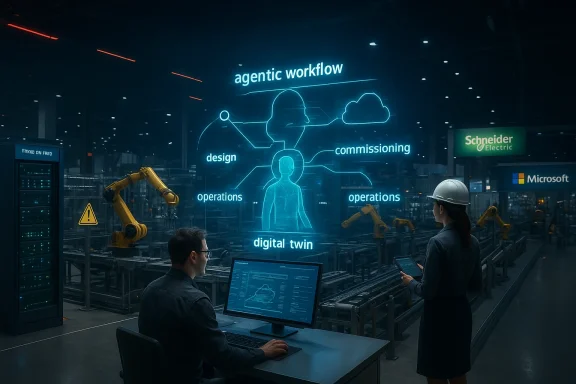
The significance of the collaboration becomes clearer when viewed against the industry’s recent evolution. Manufacturers have moved from digitizing isolated processes to trying to coordinate the entire lifecycle of a product and plant. That shift has exposed the cost of handoffs between engineering, simulation, commissioning, and operations. It has also revealed a hard truth: if data is fragmented, AI can only be partially useful. The promise of agentic manufacturing is to stitch those fragments together.
From automation islands to unified workflows, the industrial world is trying to replace brittle handoffs with a more continuous operational model. Traditional automation systems are reliable, but they are often rigid, siloed, and expensive to modify when production requirements change. That is why software-defined automation has become such a powerful idea: it promises portability, reuse, and faster change management without forcing manufacturers to rebuild everything from scratch.
Why this matters now
Manufacturers are under simultaneous pressure from product variability, supply instability, and workforce constraints. Those forces make manual coordination slower and more expensive. They also amplify the cost of mistakes, because there is less slack in the system than there used to be.That context explains why the language has shifted from “AI as a helper” to “AI as part of the control architecture.” Earlier efforts helped build the conceptual bridge, but 2026 is the moment the partnership is being framed as an operating model rather than a pilot. That is a subtle but important move, because industrial buyers tend to respond more to repeatability than novelty.
The practical question is no longer whether AI can generate text or summarize alarms. It is whether AI can help make factories easier to change, easier to validate, and easier to trust. If that sounds less glamorous than consumer AI, it is. It is also where the real money is in manufacturing software.
What Schneider Electric and Microsoft Actually Announced
The core announcement is straightforward but strategically significant. Schneider Electric said it is using Microsoft Azure AI with EcoStruxure Automation Expert to create a more open, adaptive automation environment that can run across on-premises, edge, and hybrid deployments. Microsoft described the effort as “agentic design,” emphasizing a closed loop from engineering intent to operational reality, with early validation and reusable automation packages that can move across cloud and edge environments.The practical value is in standardization. Instead of treating each line, machine, or process variant as a separate engineering project, manufacturers can model the logic once, simulate it, validate it, and deploy it with less manual rework. That reduces the friction between design and production, which has historically been one of the most expensive bottlenecks in manufacturing transformation. It also makes faster product changes less disruptive, which is crucial in sectors where demand, regulation, or supply conditions shift quickly.
The meaning of “agentic”
The phrase agentic manufacturing sounds futuristic, but in practice it is about delegation with guardrails. Instead of a human doing every routine step, software agents can assemble context, draft decisions, validate logic, and route tasks to the right people. The human still approves the important actions, but the machine does much more of the repetitive connective work.That distinction matters because industrial leaders are not asking AI to replace engineers. They are asking it to reduce friction. That includes repetitive control configuration, documentation, validation, troubleshooting, and decision support. If the agentic model works, it can shrink the distance between an idea and a deployable automation package.
The most compelling version of this story is not a fully autonomous plant. It is a plant where the system learns to automate the boring parts of engineering and operations, while humans stay responsible for safety, compliance, and final judgment. That is a much more realistic proposition, and it is one reason the announcement feels more credible than much of the AI marketing coming out of the industrial sector.
Why the architecture matters
A software-defined automation architecture can be more than a technical upgrade. It can become a governance model for industrial change, creating a common environment for engineers, operators, and data teams. That matters because factories are now expected to be both efficient and adaptable, often simultaneously.The companies are also framing this as a trust and resiliency story, not just a productivity story. Microsoft’s Hannover Messe theme, “Industrial Intelligence Unlocked,” is explicitly tied to human ingenuity and AI grounded in trust. That language is deliberate: industrial buyers want the upside of AI without sacrificing deterministic behavior, safety, or compliance.
Open architecture is the selling point, not just AI features. Simulation first reduces downstream engineering churn. Cloud plus edge gives manufacturers flexibility in deployment. Reusable automation packages can shorten changeovers and commissioning. Trust and resiliency are becoming as important as speed.
Manufacturing Efficiency as the Core Business Case
The biggest promise here is shorter engineering time. If AI can help generate, validate, and adapt automation logic more quickly, plants can spend less time in setup and reconfiguration and more time producing. In sectors with frequent product variation, that difference can be the margin between scaling efficiently and being trapped by complexity.This also changes the economics of automation projects. Conventional industrial transformation often fails not because the technology is weak, but because integration is slow, costly, and highly customized. By shifting more of that effort into a standardized software layer, Schneider Electric and Microsoft are essentially trying to commoditize the hard parts of automation engineering. That is exactly the kind of move that can unlock broad enterprise adoption.
Engineering time as a strategic KPI
Engineers are not just building new lines; they are constantly updating, debugging, and validating existing ones. AI-assisted workflows can compress that cycle, especially when they are anchored to simulations and digital twins rather than live production risk. The result is less downtime, fewer risky changes, and faster introduction of new recipes, products, or production constraints.There is also a workforce angle. Software-defined systems can reduce dependence on scarce specialists for every modification, though they do not eliminate the need for expertise. That distinction matters, because the goal is not to replace engineers but to amplify them with more repeatable tooling and better decision support.
- Faster commissioning
- Lower integration overhead
- More repeatable change management
- Less risk during production transitions
- Better utilization of engineering talent
- Stronger alignment between plant and cloud teams
Documentation is not a side issue
One of the more important details in the announcement is that AI is helping with documentation, not just configuration. In industrial environments, documentation is not bureaucracy for its own sake. It is traceability, compliance, maintenance continuity, and knowledge retention. Automating documentation is therefore not just a productivity play; it is a risk-management play.That is why the reported time savings matter. Schneider says its industrial copilot, powered by Azure AI, is already delivering up to 50% time savings on control configuration and documentation tasks. It also says that production-line changes that once took weeks can now be completed in hours. Those numbers should be treated cautiously, but they point to a real and valuable problem: industrial labor is expensive, scarce, and frequently spent on repeat work.
When logic is validated earlier and documentation is generated more consistently, fewer errors survive into commissioning and production. That lowers rework, helps operators trust the system, and makes change less disruptive. In manufacturing, those benefits are often more durable than the headline improvement itself.
The Microsoft Industrial AI Stack
Microsoft’s role in this story is to provide the intelligence fabric that surrounds Schneider’s automation layer. The company has been using Hannover Messe to showcase how Azure services, industrial data flows, and agents can support manufacturing use cases from the factory floor to the supply chain. That broader context matters because the Schneider announcement is part of a much larger Microsoft industrial strategy.Microsoft wants to be the orchestrator of industrial AI, not just a cloud vendor. Its framing emphasizes a unified intelligence layer, human-agent trust, and factory-of-the-future scenarios where design, simulation, and execution are connected in one adaptive system. Schneider Electric becomes one of the clearest examples of how that strategy is meant to work in practice.
Azure AI as orchestration
Azure AI brings more than model access. It adds services for processing data, governing workflows, and connecting models to industrial context. In a manufacturing environment, that means AI can be tied to maintenance records, production signals, documentation, and operator workflows. This matters because context is the difference between a useful recommendation and a dangerous guess.A factory-side copilot that understands the plant’s constraints can help; one that does not can create noise, risk, or mistrust. That is why the architecture matters as much as the model choice. In industrial settings, the best AI is the one that is embedded in workflows, constrained by context, and capable of being audited after the fact.
- Azure AI adds reasoning and automation on top of plant data
- Cloud services help unify disparate data sources
- Agents can reduce repetitive manual work
- Governance and traceability are essential in regulated environments
- Microsoft is aiming for platform-level adoption, not single-use trials
Why hybrid still wins in factories
Factories are not office environments. Machines need deterministic response times, networks can be segmented, and uptime expectations are unforgiving. Running every task in the cloud would add unnecessary complexity, while running everything locally can limit intelligence and scale. The hybrid model is the compromise that makes industrial AI practical.This approach also helps preserve investment in existing infrastructure. Manufacturers do not want to abandon proven controls just to modernize their software stack. By treating Azure as an enabling layer rather than a replacement for industrial systems, Schneider Electric and Microsoft are offering a modernization path that feels incremental rather than disruptive.
That incrementalism is not a weakness. It is one of the reasons enterprise buyers may take the pitch seriously. A big-bang cloud migration is often dead on arrival in manufacturing, whereas a hybrid architecture can be introduced site by site, line by line, and use case by use case.
Real-World Proof Points
One of the most striking proof points in the announcement is the live autonomous green hydrogen deployment with H2E Power, which Schneider says has maintained more than 6,000 hours of stable autonomous operation. The company also says the system has reduced the levelized cost of hydrogen by up to 10%, equivalent to around €500,000 per year for a typical 10 MW plant. Those are big claims, and they are the kind of claims industrial buyers will notice.That example matters because it moves the discussion from theory to measurable industrial output. Green hydrogen is not a toy problem. It is technically demanding, capital intensive, and highly sensitive to operational efficiency. If software-defined automation and AI can contribute there, it strengthens the case for broader industrial adoption.
Why hydrogen is a useful stress test
Hydrogen production is a good proving ground because the process environment is demanding and economics are unforgiving. High temperatures, continuous operation, and tight safety expectations make it difficult to absorb inefficiency. That means the gains from better automation are easier to observe.The green hydrogen example also reinforces the sustainability narrative. Industrial customers increasingly want AI systems that improve efficiency without creating excessive energy overhead or operational risk. If software-defined automation can stabilize operations while reducing engineering drag, it becomes easier to justify on both financial and environmental grounds.
Still, readers should separate demonstrated capability from universal readiness. Success in one environment does not automatically translate to every factory, process line, or geography. The broader significance is that the companies are trying to prove the model under tough conditions, which is exactly how industrial trust is built.
- Stable autonomous operation builds confidence in the model
- Hydrogen economics benefit from reduced downtime
- High-temperature processes magnify the cost of inconsistency
- This use case signals serious industrial ambition
- Proof at the edge is more persuasive than lab demos
Why industrial credibility is earned, not claimed
Manufacturing buyers are skeptical by nature, and with good reason. They have seen many technologies promise radical change only to struggle with integration, maintenance, or operator acceptance. That is why a demonstrated use case in a difficult environment carries more weight than another abstract AI vision deck.The important nuance is that autonomous operation in industrial settings does not mean the absence of humans. It means the system can hold steady, detect anomalies, and preserve operating discipline with less manual intervention. That is especially valuable where staffing is constrained or where round-the-clock optimization matters.
The Competitive Landscape
This manufacturing announcement lands in a much larger competitive environment. Broadcom’s extended partnership with Meta through 2029 reinforces the trend toward custom AI accelerators, while NVIDIA continues to expand its industrial software ecosystem with Cadence, Siemens, and others. The common thread is that companies are no longer just buying AI; they are building platforms that control their own economics and technical destiny.For manufacturers, this matters because industrial AI depends on more than inference speed. It depends on simulation, digital twins, networking, data pipelines, and integration with operational systems. That is why the factory of the future will be shaped by the same economic forces driving data centers, only with stricter uptime and safety requirements.
Hardware versus workflow control
The market is splitting into two overlapping battles. One is the race for the best AI silicon and accelerator ecosystems, where Broadcom, NVIDIA, AMD, and custom-chip designers are trying to capture value at the hardware layer. The other is the race to own the workflow layer, where industrial automation and cloud providers aim to become the default operating systems for manufacturing intelligence.Schneider Electric and Microsoft are clearly targeting the workflow layer, but they benefit from the broader silicon arms race because modern industrial AI workloads demand serious compute. That is why the manufacturing story cannot be separated from the chip story. The factory of the future will be shaped by the same economic forces driving data centers, only with stricter uptime and safety requirements.
- AI chip competition is pushing more specialized architectures
- Industrial AI vendors are racing to own the software stack
- Workflow control may matter as much as raw compute
- Partnerships are becoming the dominant go-to-market strategy
- Manufacturing is increasingly tied to data-center economics
Why the show floor still matters
Skeptics sometimes dismiss trade-show news as theater, but in industrial technology, these events often define procurement conversations for the next 12 to 18 months. Executives, integrators, and plant operators attend Hannover Messe to compare roadmaps, not just product features. As a result, announcements like this can influence partner ecosystems, pilot pipelines, and capital allocation.That does not mean every demo becomes a deployment. It means the market is giving companies a chance to define what “modern manufacturing” should look like, and that definition is becoming more software-centric by the year. The strategic move here is not merely to showcase AI, but to normalize AI as an operating layer inside industrial execution.
Strengths and Opportunities
The strongest part of this story is that it aligns technical architecture with a real operational pain point: manufacturers need faster change without sacrificing reliability. By combining Azure AI with EcoStruxure Automation Expert, Schneider Electric and Microsoft are addressing a genuine bottleneck rather than inventing a problem to solve. That gives the collaboration more commercial credibility than a generic “AI everywhere” pitch.It also benefits from timing. Manufacturing leaders are under pressure to improve resiliency, reduce complexity, and make plants more adaptive, while AI buyers are increasingly demanding concrete ROI. The collaboration sits neatly at that intersection, which could make it easier to move from pilot to procurement.
- Clear engineering ROI through reduced configuration and documentation time
- A credible platform base in EcoStruxure Automation Expert
- Better lifecycle continuity from design through operations
- Strong fit for regulated environments where traceability matters
- Potential for multi-site standardization across disparate plants
- Improved resilience through faster change management and validation
- A strong ecosystem story that aligns OT, IT, and AI
Risks and Concerns
The main risk is overpromising autonomy in a domain that still depends on safety, reliability, and human oversight. If “agentic manufacturing” becomes shorthand for vague AI claims, buyers may become cautious rather than enthusiastic. The industrial market has a long memory, and credibility can be lost quickly when marketing outruns deployment reality.There is also the integration challenge. Even with an open, software-defined platform, most factories still have old hardware, custom logic, and fragmented data sources. That means implementation complexity will not disappear; it will just move to a different layer, and organizations may need new skills to manage that transition.
- Pilot-to-production gaps may limit broad adoption
- Savings claims may not generalize across all plant types
- Model governance and auditing will be critical
- Integration complexity could slow enterprise rollouts
- Safety and compliance expectations are unforgiving in OT
- Skills gaps may persist if tools are too specialized
- Vendor dependency could grow if openness is only partial
Looking Ahead
The next phase of this story will depend on whether Schneider Electric and Microsoft can show repeatable industrial outcomes across more sites, more sectors, and more operating conditions. Hannover Messe is the right stage for announcement, but industrial technology earns trust in production, not on the show floor. The companies will need to prove that the agentic workflow can be applied consistently, that it genuinely reduces engineering friction, and that it improves operations without compromising safety.The most important question is whether manufacturers view this as a better way to work or merely a more sophisticated layer of software complexity. If the platform can reliably convert engineering intent into validated, deployable automation packages, then it may become a template for the next generation of smart manufacturing. If not, it risks being remembered as one more ambitious demonstration that looked more transformative than it eventually proved to be.
What happens next will also depend on ecosystem breadth. The more Schneider and Microsoft can pull in integrators, software partners, and reference customers, the more convincing the model becomes. The industrial market rarely moves on vision alone; it moves on proof, repeatability, and a credible path to scale.
- Additional customer deployments beyond the hydrogen example
- Tighter integration with AVEVA and other industrial software
- Clearer benchmarks on engineering productivity gains
- More detail on governance, auditing, and safety controls
- Competitive responses from rival automation and cloud vendors
Source: riauone.com Schneider Electric unveils next generation agentic manufacturing capabilities powered by Microsoft Azure AI at Hannover Messe 2026
