

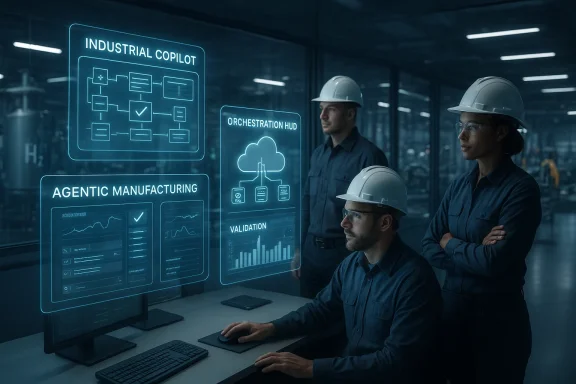
Schneider Electric’s latest Hannover Messe announcement is less a product launch than a bet on how industrial software will be built, deployed, and maintained in the next phase of automation. The company says its collaboration with Microsoft now reaches a new milestone: an industrial copilot and an agentic manufacturing workflow that can cut engineering time by up to 50% and compress production changes from weeks to hours. If those claims hold up in broader deployment, the implications extend well beyond one vendor partnership and into the future of plant engineering, controls integration, and industrial AI adoption. (globenewswire.com)
At its core, the announcement frames manufacturing as a software problem as much as a hardware problem. Schneider Electric positions EcoStruxure Automation Expert as the execution layer, while Microsoft contributes Azure cloud and AI services to orchestrate, analyze, and optimize industrial processes. That division of labor matters because it mirrors the direction many manufacturers have been heading for years: more abstraction, more reusable logic, and more effort spent on software-defined operations rather than fixed-function control cabinets. (globenewswire.com)
The choice of Hannover Messe is also strategic. The trade fair remains one of the most visible stages in industrial technology, and Schneider Electric has clearly used it to signal continuity as much as novelty. In March, the company already laid out a broader Hannover Messe 2026 message about electrification, open automation, and digital intelligence, with Microsoft listed among several ecosystem partners. The April 16 announcement is the sharper, more specific version of that pitch.
What makes this notable is the language around agentic manufacturing. That term implies more than traditional AI assistance; it suggests a workflow in which specialized software agents can make routine decisions, validate logic, and hand off reusable automation packages for deployment. In other words, the value proposition is not just faster documentation or smarter dashboards. It is a more continuous pipeline from engineering intent to operational reality. (globenewswire.com)
The collaboration also lands at a moment when industrial buyers are under pressure from multiple directions. Factories are dealing with product variability, labor shortages, supply chain volatility, and a constant mandate to modernize without taking on unacceptable risk. Schneider Electric is arguing that an open, software-defined stack can reduce that friction by standardizing logic and simulation before code reaches the plant floor. That is a compelling message, but it is also one that will be judged on integration quality, not marketing language. (globenewswire.com)
That direction is not new, but the wording in this announcement shows how Schneider Electric is repositioning the same architectural ideas for the AI era. Earlier company material already described EcoStruxure Automation Expert as a software-centric universal automation system, and Schneider Electric has been steadily extending the concept into motion, process, and distributed control use cases. The current announcement takes that foundation and adds orchestration, simulation, and AI-driven workflow automation on top.
Microsoft’s role fits a larger pattern as well. Rather than selling a generic AI layer, Microsoft is embedding Azure AI into industry-specific workflows where traceability, validation, and runtime reliability matter. That is important because industrial AI lives or dies on trust. A model that looks impressive in a demo can become a liability if it cannot be validated, audited, and integrated with existing engineering practices. (globenewswire.com)
The collaboration appears to have evolved from proof-of-concept language into something closer to operational deployment. Schneider Electric says engineering teams are already seeing up to 50% time savings on control configuration and documentation tasks, and that production changes that once required weeks can now be completed in hours. The company also cites a live autonomous green hydrogen deployment with H2E Power, where it says the platform has sustained more than 6,000 hours of autonomous operation. Those are substantial claims, but they are still vendor-reported results and should be treated as such. (globenewswire.com)
The broader industry context is equally important. Industrial software vendors have spent much of the last decade promising “digital transformation,” yet many factories still run on fragmented toolchains and highly customized integrations. The promise of Schneider Electric and Microsoft’s approach is that one traceable workflow can replace many disconnected handoffs. If that workflow becomes genuinely reusable across sites and sectors, it could be more significant than a single AI feature. (globenewswire.com)
This matters because engineering work in manufacturing is usually constrained by process, not just talent. Every change can trigger drawings, safety reviews, test cycles, and documentation updates, especially in regulated environments. If an AI-assisted workflow can shorten those steps while preserving traceability, manufacturers may be able to launch more variants, recover from change orders faster, and reduce the hidden cost of complexity. (globenewswire.com)
But the concept also raises the bar. A plant engineer will not accept a system that merely appears intelligent. The workflow must be deterministic enough to satisfy compliance teams and repeatable enough to survive equipment variation, plant-specific standards, and legacy interfaces. That is why Schneider Electric keeps emphasizing safety, compliance, and industrial integration alongside the AI story. (globenewswire.com)
If Schneider Electric and Microsoft can really unify those stages, they may help solve one of manufacturing’s oldest problems: the gap between engineering intent and shop-floor reality. The significance is not just speed. It is consistency, because consistency is what makes replication possible across plants, countries, and hardware generations. (globenewswire.com)
That kind of improvement, if reproducible, would be highly attractive to both OEMs and end users. For OEMs, faster configuration shortens quotation cycles and customer-specific engineering. For manufacturers, it reduces downtime and helps them absorb change without overloading scarce engineering teams. (globenewswire.com)
The documentation piece is especially significant. In many industrial projects, documentation is not an afterthought; it is a compliance artifact, a handover package, and a maintenance tool all at once. Any AI that can reliably generate or update it while preserving traceability can reduce a major bottleneck, provided the underlying model stays accurate and explainable. (globenewswire.com)
The company’s own product pages reinforce that point. Schneider Electric describes the platform as built around open interfaces and integration with broader software tools, aiming to reduce engineering effort and improve reuse. In practical terms, that means the platform is trying to make automation behave more like software engineering and less like a collection of one-off plant projects.
Still, openness is relative. Even an open architecture can create a new kind of dependency if the orchestration, AI models, data flows, and deployment tooling all converge around one commercial alliance. Manufacturers will want to know not only whether they can integrate third-party systems, but whether they can do so without losing support, visibility, or bargaining power. That question is not theoretical. (globenewswire.com)
The more ambitious the AI, the more important those guardrails become. An agent that writes or modifies control logic without rigorous validation would be a nonstarter in most factories. So the company’s emphasis on a single traceable workflow is really a statement about governance as much as technology. (globenewswire.com)
That matters because industrial customers usually want AI to behave less like a creative tool and more like a controlled system component. Microsoft’s role, then, is to bring the cloud-scale tools while Schneider Electric supplies the industrial semantics and deployment discipline. It is a classic division of labor, but one that only works if both sides stay tightly aligned. (globenewswire.com)
The strategic benefit for Microsoft is obvious. Industrial AI is one of the few enterprise markets where cloud providers can still expand materially by attaching themselves to real operational value rather than abstract productivity promises. If Azure becomes embedded in manufacturing workflows, Microsoft gains not just usage, but stickiness. (globenewswire.com)
This hybrid model is likely to be one of the deciding factors in enterprise adoption. It gives vendors room to promise AI-driven intelligence without demanding that every process be moved offsite. It also reflects the reality that industrial transformation is usually incremental, not revolutionary. (globenewswire.com)
Schneider Electric also says the deployment has cut the levelized cost of hydrogen by up to 10%, which it translates into around €500,000 per year for a typical 10 MW plant. That is a powerful business case if broadly reproducible. But it is also the kind of figure that will invite scrutiny from potential customers who want to know what assumptions sit underneath the estimate. (globenewswire.com)
It is also strategically useful. Hydrogen projects are closely watched by energy-intensive industries, governments, and infrastructure investors. If Schneider Electric can show reliable autonomous operation there, it can borrow credibility for other sectors that face similar operational complexity. (globenewswire.com)
The company’s earlier Hannover Messe materials show that this is part of a broader campaign. Schneider Electric has been promoting electrification, AI, and open automation as converging themes, with Microsoft among the highlighted collaborators. The April announcement sharpens that campaign by adding a specific industrial AI narrative.
Trade fairs also matter because they help vendors show ecosystem depth. If Schneider Electric and Microsoft can demonstrate partner interoperability, they reduce the perception that the solution is a closed marketing bundle. That distinction could be decisive in a market where customers increasingly want flexibility. (globenewswire.com)
For enterprise buyers, the immediate implications are more direct. Engineering teams may be able to standardize more of their logic, speed up commissioning, and reduce rework. Operations teams may gain more consistent visibility from design to runtime, which could improve maintenance planning and change management. (globenewswire.com)
Consumer brands, by contrast, will care about speed to market and resilience. If manufacturing becomes more flexible and less brittle, companies can introduce new product variants faster and react to disruptions with fewer stockouts. In that sense, industrial AI becomes a supply-chain competitiveness tool as much as a factory tool. (globenewswire.com)
The other thing to watch is whether the collaboration spurs a broader shift in industrial software procurement. If buyers start demanding validation-first, AI-assisted engineering flows, vendors that cannot offer a cohesive answer may need to partner quickly or risk becoming point-solution suppliers in a platform-driven market. In that sense, this announcement may be as much about market structure as product capability. (globenewswire.com)
Source: GlobeNewswire Schneider Electric unveils next generation agentic manufacturing capabilities powered by Microsoft Azure AI at Hannover Messe 2026
 Overview
At its core, the announcement frames manufacturing as a software problem as much as a hardware problem. Schneider Electric positions EcoStruxure Automation Expert as the execution layer, while Microsoft contributes Azure cloud and AI services to orchestrate, analyze, and optimize industrial processes. That division of labor matters because it mirrors the direction many manufacturers have been heading for years: more abstraction, more reusable logic, and more effort spent on software-defined operations rather than fixed-function control cabinets. (globenewswire.com)The choice of Hannover Messe is also strategic. The trade fair remains one of the most visible stages in industrial technology, and Schneider Electric has clearly used it to signal continuity as much as novelty. In March, the company already laid out a broader Hannover Messe 2026 message about electrification, open automation, and digital intelligence, with Microsoft listed among several ecosystem partners. The April 16 announcement is the sharper, more specific version of that pitch.
What makes this notable is the language around agentic manufacturing. That term implies more than traditional AI assistance; it suggests a workflow in which specialized software agents can make routine decisions, validate logic, and hand off reusable automation packages for deployment. In other words, the value proposition is not just faster documentation or smarter dashboards. It is a more continuous pipeline from engineering intent to operational reality. (globenewswire.com)
The collaboration also lands at a moment when industrial buyers are under pressure from multiple directions. Factories are dealing with product variability, labor shortages, supply chain volatility, and a constant mandate to modernize without taking on unacceptable risk. Schneider Electric is arguing that an open, software-defined stack can reduce that friction by standardizing logic and simulation before code reaches the plant floor. That is a compelling message, but it is also one that will be judged on integration quality, not marketing language. (globenewswire.com)
Background
Schneider Electric has spent years pushing the industry toward software-defined automation. Its EcoStruxure Automation Expert platform is built around the idea that control logic should be authored once and deployed across different environments without constant rework. The company’s own product descriptions emphasize open APIs, OPC UA-based communication, and integration with the broader AVEVA portfolio, all of which support a more modular automation model than classic proprietary PLC-centric systems.That direction is not new, but the wording in this announcement shows how Schneider Electric is repositioning the same architectural ideas for the AI era. Earlier company material already described EcoStruxure Automation Expert as a software-centric universal automation system, and Schneider Electric has been steadily extending the concept into motion, process, and distributed control use cases. The current announcement takes that foundation and adds orchestration, simulation, and AI-driven workflow automation on top.
Microsoft’s role fits a larger pattern as well. Rather than selling a generic AI layer, Microsoft is embedding Azure AI into industry-specific workflows where traceability, validation, and runtime reliability matter. That is important because industrial AI lives or dies on trust. A model that looks impressive in a demo can become a liability if it cannot be validated, audited, and integrated with existing engineering practices. (globenewswire.com)
The collaboration appears to have evolved from proof-of-concept language into something closer to operational deployment. Schneider Electric says engineering teams are already seeing up to 50% time savings on control configuration and documentation tasks, and that production changes that once required weeks can now be completed in hours. The company also cites a live autonomous green hydrogen deployment with H2E Power, where it says the platform has sustained more than 6,000 hours of autonomous operation. Those are substantial claims, but they are still vendor-reported results and should be treated as such. (globenewswire.com)
The broader industry context is equally important. Industrial software vendors have spent much of the last decade promising “digital transformation,” yet many factories still run on fragmented toolchains and highly customized integrations. The promise of Schneider Electric and Microsoft’s approach is that one traceable workflow can replace many disconnected handoffs. If that workflow becomes genuinely reusable across sites and sectors, it could be more significant than a single AI feature. (globenewswire.com)
The Agentic Manufacturing Pitch
The centerpiece of the announcement is the idea that specialized AI agents, coordinated by an orchestrator, can automate routine design decisions and validate logic before deployment. That is a meaningful shift from the usual industrial AI narrative, which often focuses on predictive maintenance or anomaly detection. Here, AI is being inserted upstream into engineering and commissioning, where the economics of time savings can be even more dramatic. (globenewswire.com)This matters because engineering work in manufacturing is usually constrained by process, not just talent. Every change can trigger drawings, safety reviews, test cycles, and documentation updates, especially in regulated environments. If an AI-assisted workflow can shorten those steps while preserving traceability, manufacturers may be able to launch more variants, recover from change orders faster, and reduce the hidden cost of complexity. (globenewswire.com)
Why “agentic” is different
The word agentic is doing a lot of work here. In practice, it implies software that does more than answer prompts; it performs chained tasks, checks itself against constraints, and hands off structured outputs. In industrial settings, that is far more interesting than a chatbot because the output can be tied to logic packages, validation routines, and simulation results. (globenewswire.com)But the concept also raises the bar. A plant engineer will not accept a system that merely appears intelligent. The workflow must be deterministic enough to satisfy compliance teams and repeatable enough to survive equipment variation, plant-specific standards, and legacy interfaces. That is why Schneider Electric keeps emphasizing safety, compliance, and industrial integration alongside the AI story. (globenewswire.com)
- Agentic systems are more workflow-oriented than conversational.
- Validation before deployment is central to the industrial value proposition.
- Reusable automation packages could lower the cost of multi-site standardization.
- Trust will matter more than novelty in real factory adoption.
- The orchestrator model suggests a coordinated chain of tasks, not a single model prompt. (globenewswire.com)
The manufacturing workflow advantage
One of the strongest parts of the pitch is the end-to-end coverage: design, engineering, build, commissioning, and operations. That is where industrial AI has usually fractured in the past. Many projects improve one slice of the lifecycle but leave the rest untouched, so the gains evaporate when the code crosses a tool boundary or hits a different site. (globenewswire.com)If Schneider Electric and Microsoft can really unify those stages, they may help solve one of manufacturing’s oldest problems: the gap between engineering intent and shop-floor reality. The significance is not just speed. It is consistency, because consistency is what makes replication possible across plants, countries, and hardware generations. (globenewswire.com)
What the Industrial Copilot Actually Promises
The announcement’s most concrete productivity claim is that the industrial copilot, powered by Azure AI, cuts engineering time by up to 50%. The cited gains apply to control configuration and documentation, two areas where repetitive work and human error often compound one another. Production line changes that once took weeks are said to now finish in hours. (globenewswire.com)That kind of improvement, if reproducible, would be highly attractive to both OEMs and end users. For OEMs, faster configuration shortens quotation cycles and customer-specific engineering. For manufacturers, it reduces downtime and helps them absorb change without overloading scarce engineering teams. (globenewswire.com)
Where the time savings come from
Time savings in industrial engineering usually come from four sources: reuse, automation, validation, and documentation reduction. Schneider Electric’s platform appears to target all four by allowing logic to be authored once, simulated earlier, validated against constraints, and reused across sites. That is a more systematic approach than bolting AI onto a legacy workflow. (globenewswire.com)The documentation piece is especially significant. In many industrial projects, documentation is not an afterthought; it is a compliance artifact, a handover package, and a maintenance tool all at once. Any AI that can reliably generate or update it while preserving traceability can reduce a major bottleneck, provided the underlying model stays accurate and explainable. (globenewswire.com)
- Faster control configuration.
- Reduced documentation overhead.
- Earlier validation of automation logic.
- Fewer handoffs between engineering phases.
- More repeatable commissioning across sites. (globenewswire.com)
Why the claim matters competitively
This is also a competitive signal to rivals in industrial automation and industrial software. If one vendor can credibly combine controls, cloud AI, and workflow orchestration, it raises the pressure on competitors to offer similarly integrated stacks rather than narrow point products. That could reshape the discussion around who owns the industrial AI interface: the cloud provider, the automation vendor, or the systems integrator. (globenewswire.com)EcoStruxure Automation Expert as the Backbone
Schneider Electric’s argument hinges on EcoStruxure Automation Expert being more than a conventional automation suite. The platform is presented as open, software-defined, and capable of running across on-premises, edge, and hybrid environments. That portability is crucial because industrial buyers rarely operate in a single clean architecture; they usually mix new and legacy systems across a sprawling footprint. (globenewswire.com)The company’s own product pages reinforce that point. Schneider Electric describes the platform as built around open interfaces and integration with broader software tools, aiming to reduce engineering effort and improve reuse. In practical terms, that means the platform is trying to make automation behave more like software engineering and less like a collection of one-off plant projects.
Open automation versus proprietary lock-in
One of the most important subtexts here is the ongoing contest between open automation and proprietary vendor lock-in. Schneider Electric has repeatedly framed its architecture around interoperability and reusable logic, which is a strong selling point for manufacturers that fear being trapped in a single ecosystem. Microsoft’s cloud services strengthen that case by adding a large-scale AI and data platform without forcing the entire stack into a single hardware model. (globenewswire.com)Still, openness is relative. Even an open architecture can create a new kind of dependency if the orchestration, AI models, data flows, and deployment tooling all converge around one commercial alliance. Manufacturers will want to know not only whether they can integrate third-party systems, but whether they can do so without losing support, visibility, or bargaining power. That question is not theoretical. (globenewswire.com)
- Open software-defined control reduces dependence on fixed hardware paths.
- Hybrid deployment supports real-world industrial constraints.
- Interoperability helps multi-site manufacturers standardize.
- Cloud AI still introduces platform dependency.
- The value of openness depends on how portable the workflows really are. (globenewswire.com)
Why validation is central
The announcement repeatedly emphasizes simulation and validation. That is not accidental. In industrial environments, the difference between a clever idea and a safe deployment is often the ability to validate behavior before the logic ever reaches production. Siemens, Rockwell, ABB, and others all compete on related themes, but Schneider Electric is stressing an engineering flow that keeps trust anchored in simulation and traceability. (globenewswire.com)The more ambitious the AI, the more important those guardrails become. An agent that writes or modifies control logic without rigorous validation would be a nonstarter in most factories. So the company’s emphasis on a single traceable workflow is really a statement about governance as much as technology. (globenewswire.com)
The Microsoft Azure AI Layer
Microsoft’s contribution is not just branding. The company is adding Azure AI as the layer that orchestrates and optimizes industrial processes, and that aligns with Microsoft’s broader strategy of making Azure the place where enterprise AI becomes operational rather than experimental. In this case, the industrial context makes the AI story more concrete and more demanding. (globenewswire.com)That matters because industrial customers usually want AI to behave less like a creative tool and more like a controlled system component. Microsoft’s role, then, is to bring the cloud-scale tools while Schneider Electric supplies the industrial semantics and deployment discipline. It is a classic division of labor, but one that only works if both sides stay tightly aligned. (globenewswire.com)
Azure AI as a workflow engine
The announcement suggests Azure AI is being used as more than a model endpoint. It is part of a workflow engine that coordinates agents, validates logic, and connects data across lifecycle stages. That makes the collaboration more interesting than a simple “copilot” label might imply. (globenewswire.com)The strategic benefit for Microsoft is obvious. Industrial AI is one of the few enterprise markets where cloud providers can still expand materially by attaching themselves to real operational value rather than abstract productivity promises. If Azure becomes embedded in manufacturing workflows, Microsoft gains not just usage, but stickiness. (globenewswire.com)
- Azure AI brings orchestration and analytics.
- Schneider Electric provides the execution backbone.
- The combination targets operational, not just informational, workflows.
- Industrial customers get a single integrated approach to data and control.
- Microsoft gains exposure to higher-value industrial transformation budgets. (globenewswire.com)
The cloud-edge balance
A critical detail is that the Schneider Electric platform is said to run across cloud and edge environments. That is essential because many plants cannot depend on cloud connectivity for core control, and many regulated processes need local determinism. The architecture described in the announcement appears designed to satisfy both realities. (globenewswire.com)This hybrid model is likely to be one of the deciding factors in enterprise adoption. It gives vendors room to promise AI-driven intelligence without demanding that every process be moved offsite. It also reflects the reality that industrial transformation is usually incremental, not revolutionary. (globenewswire.com)
The H2E Power Reference Case
The H2E Power deployment is the announcement’s strongest proof point because it gives the story a real industrial workload. Schneider Electric says the platform has delivered more than 6,000 hours of stable autonomous operation in high-temperature solid oxide electrolysis for green hydrogen production. That is exactly the sort of environment where reliability claims matter, because the operating conditions are demanding and the economics are unforgiving. (globenewswire.com)Schneider Electric also says the deployment has cut the levelized cost of hydrogen by up to 10%, which it translates into around €500,000 per year for a typical 10 MW plant. That is a powerful business case if broadly reproducible. But it is also the kind of figure that will invite scrutiny from potential customers who want to know what assumptions sit underneath the estimate. (globenewswire.com)
Why hydrogen is a useful testbed
Green hydrogen is a smart showcase application because it combines software, energy, process control, and sustainability into one complex system. Any vendor can claim AI value in a low-stakes dashboard demo, but electrolysis under real production conditions is a more credible test of whether the platform can handle dynamic industrial operations. (globenewswire.com)It is also strategically useful. Hydrogen projects are closely watched by energy-intensive industries, governments, and infrastructure investors. If Schneider Electric can show reliable autonomous operation there, it can borrow credibility for other sectors that face similar operational complexity. (globenewswire.com)
- 6,000+ hours of autonomous operation is a meaningful durability signal.
- Hydrogen production offers a high-complexity environment.
- Cost reduction claims will attract investor and customer attention.
- The case study strengthens the narrative around measurable ROI.
- Real-world reference deployments matter more than lab demos. (globenewswire.com)
What to be cautious about
The H2E Power numbers should still be viewed carefully. Vendor case studies often depend on favorable baseline comparisons, narrowly defined workloads, or partially controlled environments. That does not make them unimportant, but it does mean readers should treat the results as evidence of promise, not proof of universal scalability. The difference is important. (globenewswire.com)Hannover Messe as a Competitive Stage
The timing and venue matter because Hannover Messe is where industrial vendors go to make ecosystem claims in public. Schneider Electric’s booth presence alongside Microsoft’s suggests a coordinated message meant to show the partnership in action rather than in slideware. That kind of visibility can help move the discussion from concept to buyer confidence. (globenewswire.com)The company’s earlier Hannover Messe materials show that this is part of a broader campaign. Schneider Electric has been promoting electrification, AI, and open automation as converging themes, with Microsoft among the highlighted collaborators. The April announcement sharpens that campaign by adding a specific industrial AI narrative.
Why trade fairs still matter
In a market as complex as industrial automation, live demos can still sway procurement discussions. Many buyers want to see not just a product brochure, but a workflow that touches engineering, validation, deployment, and operations in one coherent sequence. That is especially true when a vendor is pitching a relatively new concept like agentic manufacturing. (globenewswire.com)Trade fairs also matter because they help vendors show ecosystem depth. If Schneider Electric and Microsoft can demonstrate partner interoperability, they reduce the perception that the solution is a closed marketing bundle. That distinction could be decisive in a market where customers increasingly want flexibility. (globenewswire.com)
- Hannover Messe provides a global industrial credibility platform.
- Live demonstrations can reduce skepticism around AI claims.
- Ecosystem breadth is a major buying criterion.
- The venue lets vendors compare themselves against rivals in real time.
- Industrial buyers often make long-cycle decisions after trade-show validation. (globenewswire.com)
Competitive pressure on rivals
The announcement also increases pressure on other industrial software and automation vendors to explain their own AI strategies. It is no longer enough to say AI will help maintenance or planning; customers are starting to expect AI integrated into design, commissioning, and operations. That raises the bar for competitors that are still focused on isolated use cases. (globenewswire.com)Enterprise and Consumer Implications
This is an enterprise story first, but the consumer angle is not irrelevant. Industrial efficiency, supply chain resilience, and energy optimization ultimately affect product availability, pricing, and sustainability claims across consumer-facing markets. If manufacturers can launch lines faster and waste less energy, downstream industries benefit in ways that are not always visible but are economically real. (globenewswire.com)For enterprise buyers, the immediate implications are more direct. Engineering teams may be able to standardize more of their logic, speed up commissioning, and reduce rework. Operations teams may gain more consistent visibility from design to runtime, which could improve maintenance planning and change management. (globenewswire.com)
Enterprise buyers will ask different questions
A factory leader will care about integration, auditability, and supportability. They will want to know whether the copilot can handle existing systems, whether the AI outputs are traceable, and whether the workflow can survive plant-level exceptions. Those are harder questions than “does it save time?” but they are the questions that determine adoption. (globenewswire.com)Consumer brands, by contrast, will care about speed to market and resilience. If manufacturing becomes more flexible and less brittle, companies can introduce new product variants faster and react to disruptions with fewer stockouts. In that sense, industrial AI becomes a supply-chain competitiveness tool as much as a factory tool. (globenewswire.com)
The sustainability dimension
Schneider Electric also frames the collaboration through sustainability. That should not be dismissed as generic corporate positioning. In industrial settings, sustainability often overlaps with process efficiency, energy usage, and scrap reduction, which are all measurable economic variables. If the workflow reduces rework and improves yield, the sustainability story can be more than a branding layer. (globenewswire.com)Strengths and Opportunities
The announcement has several genuine strengths, and they are strongest where the technology story meets operational reality. The value proposition is not just AI novelty; it is a workflow model designed to reduce friction across the industrial lifecycle. That makes it more likely to matter to real manufacturers than a generic copilot pitch. (globenewswire.com)- End-to-end workflow coverage from design to operations.
- Traceability that should appeal to regulated industries.
- Cloud-edge flexibility for hybrid industrial environments.
- Reusable logic that can reduce multi-site engineering effort.
- Validation and simulation before deployment, lowering risk.
- Real-world case studies that make the pitch more credible.
- Sustainability benefits that can align with corporate mandates. (globenewswire.com)
Risks and Concerns
The main risk is overpromising. Industrial AI is full of impressive demonstrations that do not survive the messiness of actual plants, legacy assets, and changing operator behavior. Even with strong architecture, there is always a gap between controlled demo environments and broad production deployment. (globenewswire.com)- Vendor-reported gains may not generalize across sectors.
- Integration complexity could slow adoption in legacy plants.
- AI governance will be critical in safety-sensitive environments.
- Platform dependency could replace old lock-in with new lock-in.
- Skills gaps may limit how quickly manufacturers can adopt the model.
- Cybersecurity concerns grow as cloud and edge systems converge.
- Change management may be harder than the technology itself. (globenewswire.com)
Looking Ahead
What happens next will depend on whether Schneider Electric and Microsoft can convert this announcement into repeatable customer wins, not just headline momentum. The presence of a live hydrogen reference case is helpful, but broader adoption will require evidence across discrete manufacturing, process industries, and regulated environments. The more diverse the deployments, the stronger the story becomes. (globenewswire.com)The other thing to watch is whether the collaboration spurs a broader shift in industrial software procurement. If buyers start demanding validation-first, AI-assisted engineering flows, vendors that cannot offer a cohesive answer may need to partner quickly or risk becoming point-solution suppliers in a platform-driven market. In that sense, this announcement may be as much about market structure as product capability. (globenewswire.com)
- Watch for additional customer references beyond H2E Power.
- Monitor whether engineering time savings remain near the claimed 50%.
- Track integration with more legacy automation environments.
- Look for clearer details on AI governance and validation methods.
- See whether other automation vendors respond with similar agentic workflows. (globenewswire.com)
Source: GlobeNewswire Schneider Electric unveils next generation agentic manufacturing capabilities powered by Microsoft Azure AI at Hannover Messe 2026
Last edited:
