

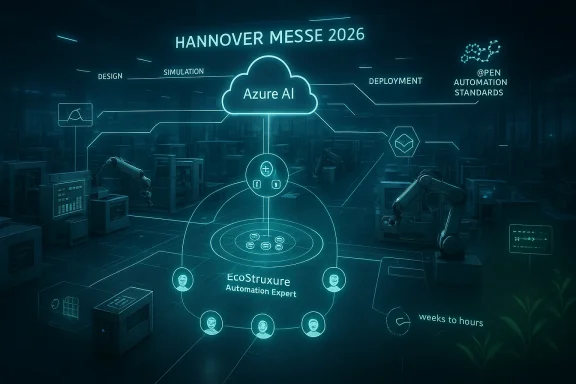
Schneider Electric is using Hannover Messe 2026 to send a clear message to industrial customers: the next phase of factory modernization will not be defined by isolated copilots or point solutions, but by a tightly coupled workflow that blends open automation, cloud-scale AI, and agentic manufacturing across the full asset lifecycle. The company’s latest milestone with Microsoft positions Azure AI as the intelligence layer and EcoStruxure Automation Expert as the execution backbone, with Schneider Electric claiming engineering time reductions of up to 50% and faster production changes that can move from weeks to hours. That is an ambitious promise, but it also reflects a broader industry shift toward software-defined operations that can be validated in simulation before they touch the plant floor.
Schneider Electric and Microsoft have been building toward this moment for years, and the 2026 announcement makes the partnership look less like a pilot and more like a platform strategy. In earlier Hannover Messe appearances, Schneider Electric emphasized open, software-defined automation, modularity, and AI-infused industrial workflows, while Microsoft has steadily expanded its industrial cloud and AI stack around manufacturers’ need for trusted data, real-time decision support, and edge-to-cloud orchestration. The result is a collaboration that now stretches from engineering design into commissioning and operations, rather than stopping at visualization or analytics.
The core architectural idea is straightforward, even if the execution is not: Schneider Electric supplies the industrial execution layer, and Microsoft supplies the cloud and AI intelligence layer. In Schneider Electric’s framing, EcoStruxure Automation Expert allows automation logic to be authored once and deployed across on-premises, edge, and hybrid environments without repeated retooling, while Microsoft’s services help orchestrate, analyze, and optimize industrial processes across those environments. That combination is designed to reduce the classic friction points of industrial transformation, where every site, machine, and vendor stack behaves a little differently.
The timing matters. Manufacturers are dealing with product variability, supply chain instability, labor shortages, and pressure to modernize without introducing downtime or compliance risk. In the past, many digital transformation programs solved one piece of the puzzle — for example, predictive maintenance, MES integration, or energy monitoring — without creating a reusable digital thread across the plant lifecycle. The new messaging from Schneider Electric and Microsoft is that those piecemeal gains are no longer enough; companies want a single workflow that connects engineering intent to real-world execution and captures feedback for the next design cycle.
Schneider Electric says its industrial copilot, powered by Azure AI, is already producing up to 50% time savings on control configuration and documentation tasks. It also says line changes that once took weeks can now be completed in hours, which is the kind of claim that will attract attention from manufacturing executives and skepticism from controls engineers in equal measure. Still, the underlying logic is compelling: if AI can reduce the back-and-forth between engineering, simulation, and deployment, the real value is not just labor savings but faster response to customer demand and less loss from delayed changeovers.
One of the more interesting pieces of evidence in the announcement is the reference to a live autonomous green hydrogen deployment with H2E Power in India. Schneider Electric says the system has maintained more than 6,000 hours of stable autonomous operation in high-temperature solid oxide electrolysis, while reducing the levelized cost of hydrogen by up to 10%, or roughly EUR500,000 per year for a typical 10 MW plant. That is not a trivial proof point, because industrial buyers care far more about uptime, yield, and operating cost than about the novelty of AI agents.
That model is attractive because it tries to break one of manufacturing’s long-standing constraints: control logic often becomes tied to a specific machine, a specific engineer, or a specific vendor toolchain. If logic can be made portable and traceable, then engineering teams can standardize reusable modules, cut duplicate work, and reduce the risks that come from ad hoc site-by-site customization. The promise is not total abstraction, but a disciplined way to reuse more of the work safely.
It is easy to overstate the benefits, though. In the real world, decoupling can create new integration work, and plant operators will still demand proven reliability, real-time performance, and safety certification. That is why Schneider Electric keeps emphasizing its industrial integration and compliance expertise; the software may be open, but the burden of proof remains very closed.
This distinction matters because industrial environments are not consumer apps. An AI that hallucinates a recommendation in an office setting is annoying; an AI that pushes the wrong logic into a production line can create downtime, scrap, or safety issues. The most credible interpretation of the announcement is therefore not that agents will autonomously run factories, but that they will narrow the window between design intent and verified deployment.
In practice, orchestration could also make AI adoption easier for enterprises that are wary of black-box automation. If each agent has a narrow purpose and can be validated against domain rules, the system becomes easier to audit and more likely to survive procurement scrutiny. That is a small but important shift from “AI assistant” to “governed industrial workflow engine.”
The more strategic part of the claim is the suggestion that production line changes once requiring weeks can be completed in hours. That is not just a productivity story; it is a responsiveness story. In markets where product variants change quickly or where customers expect customization, the ability to alter a line rapidly can become a competitive advantage, especially when supply chains are volatile and factories cannot afford long pauses for reconfiguration.
There is also a talent-angle here. As veteran controls engineers retire and plants struggle to hire replacements, copilots may become less about shaving minutes and more about preserving institutional knowledge. That may be the bigger story: not replacing engineers, but making hard-won know-how easier to reuse and transfer across sites.
Microsoft’s role reinforces this openness story, but from a cloud and data perspective. Microsoft has been pushing a unified intelligence layer across people, processes, and operational data, and its Hannover Messe 2026 messaging highlights interoperability across edge, cloud, and industrial workflows. Together, the two companies are trying to make openness feel enterprise-ready rather than experimental.
That said, openness can be marketed too easily. The real test is whether customers can substitute components, keep data portable, and avoid hidden dependency on proprietary orchestration or model services. Open by branding is not the same as open by contract, and industrial buyers will increasingly know the difference.
The H2E Power example is useful because green hydrogen is a harsh proving ground for automation. High-temperature electrolysis, autonomous operation, and cost pressure create a setting where process stability and operational intelligence are worth more than flashy demos. A claimed 10% reduction in levelized hydrogen cost from autonomy is the sort of metric that can change how industrial customers think about AI adoption.
This is where Schneider Electric may have a particularly strong narrative advantage. Unlike pure software players, it can speak credibly about power systems, automation, and the plant floor at the same time. That combination matters in an era when manufacturers increasingly want one plan for operational efficiency and sustainability instead of two competing roadmaps.
That puts pressure on multiple categories of rivals. Automation incumbents such as Siemens, Rockwell Automation, ABB, and others must now explain how their ecosystems support similar levels of portability, simulation, and AI orchestration. Cloud vendors and AI platform players, for their part, have to show they understand uptime, safety, and industrial determinism rather than treating manufacturing like a generic enterprise workload.
There is also a subtle branding competition underway. “Agentic manufacturing” is a powerful phrase because it suggests active systems rather than passive analytics. But if competitors can demonstrate better uptime, better safety, or clearer ROI, the marketing label will matter less than the operational outcomes. In industrial markets, proof still beats poetry.
The opportunity set is even larger if Schneider Electric and Microsoft can convert headline demos into repeatable deployment patterns. Manufacturers want easier change management, faster engineering, stronger traceability, and better resilience; they also want all of that without sacrificing compliance or adding new cyber risk. The companies that can package those requirements into a trusted blueprint will be the ones that win the next wave of industrial software spending.
Another concern is vendor complexity. A software-defined stack sounds attractive until a customer has to integrate legacy assets, connect multiple sites, manage cybersecurity controls, and explain every layer to auditors and regulators. If the solution becomes too dependent on one vendor’s cloud services or orchestration model, the promise of openness could erode in practice. That tension will be watched closely by CIOs and plant managers alike.
The most important near-term question is whether industrial buyers treat the system as a productivity accelerator, a resiliency platform, or a modernization framework. In reality, it may need to be all three to justify the organizational change it requires. That means the story now shifts from “what can the demo do?” to “what can be deployed safely, repeatedly, and profitably across hundreds of assets and multiple factories?”
Source: riauone.com Schneider Electric unveils next generation agentic manufacturing capabilities powered by Microsoft Azure AI at Hannover Messe 2026
 Background
Schneider Electric and Microsoft have been building toward this moment for years, and the 2026 announcement makes the partnership look less like a pilot and more like a platform strategy. In earlier Hannover Messe appearances, Schneider Electric emphasized open, software-defined automation, modularity, and AI-infused industrial workflows, while Microsoft has steadily expanded its industrial cloud and AI stack around manufacturers’ need for trusted data, real-time decision support, and edge-to-cloud orchestration. The result is a collaboration that now stretches from engineering design into commissioning and operations, rather than stopping at visualization or analytics.The core architectural idea is straightforward, even if the execution is not: Schneider Electric supplies the industrial execution layer, and Microsoft supplies the cloud and AI intelligence layer. In Schneider Electric’s framing, EcoStruxure Automation Expert allows automation logic to be authored once and deployed across on-premises, edge, and hybrid environments without repeated retooling, while Microsoft’s services help orchestrate, analyze, and optimize industrial processes across those environments. That combination is designed to reduce the classic friction points of industrial transformation, where every site, machine, and vendor stack behaves a little differently.
The timing matters. Manufacturers are dealing with product variability, supply chain instability, labor shortages, and pressure to modernize without introducing downtime or compliance risk. In the past, many digital transformation programs solved one piece of the puzzle — for example, predictive maintenance, MES integration, or energy monitoring — without creating a reusable digital thread across the plant lifecycle. The new messaging from Schneider Electric and Microsoft is that those piecemeal gains are no longer enough; companies want a single workflow that connects engineering intent to real-world execution and captures feedback for the next design cycle.
What changed since the earlier wave of industrial AI
The industrial AI conversation in 2024 and 2025 was largely about visibility, copilots, and data access. Microsoft’s Hannover Messe 2025 material emphasized industrial data, real-time monitoring, and the adaptive cloud, while Schneider Electric highlighted AI-infused automation and the move toward open ecosystems. By 2026, the language has shifted toward agentic workflows, closed-loop lifecycle intelligence, and evidence that software-defined automation can materially change engineering throughput and commissioning speed. That shift is important because it moves the discussion from “can AI help?” to “can AI become part of the operating model?”- The partnership is evolving from demos to a lifecycle workflow.
- The emphasis is now on simulation, traceability, and deployment reuse.
- Industrial AI is being positioned as infrastructure, not just assistance.
- The competitive framing has shifted from dashboards to operational decisions.
Overview
At the center of the announcement is the idea of agentic manufacturing, a term that deserves scrutiny because it can mean different things depending on who is speaking. In this context, it appears to describe a system in which specialized AI agents handle routine design, validation, and orchestration tasks under an overall coordinator, rather than a single chatbot responding to prompts. That matters because industrial environments need deterministic behavior, auditability, and validation, not merely fluent text generation.Schneider Electric says its industrial copilot, powered by Azure AI, is already producing up to 50% time savings on control configuration and documentation tasks. It also says line changes that once took weeks can now be completed in hours, which is the kind of claim that will attract attention from manufacturing executives and skepticism from controls engineers in equal measure. Still, the underlying logic is compelling: if AI can reduce the back-and-forth between engineering, simulation, and deployment, the real value is not just labor savings but faster response to customer demand and less loss from delayed changeovers.
One of the more interesting pieces of evidence in the announcement is the reference to a live autonomous green hydrogen deployment with H2E Power in India. Schneider Electric says the system has maintained more than 6,000 hours of stable autonomous operation in high-temperature solid oxide electrolysis, while reducing the levelized cost of hydrogen by up to 10%, or roughly EUR500,000 per year for a typical 10 MW plant. That is not a trivial proof point, because industrial buyers care far more about uptime, yield, and operating cost than about the novelty of AI agents.
Why Hannover Messe remains the stage that matters
Hannover Messe is not just a trade show; it is one of the few venues where automation vendors, cloud providers, machine builders, and industrial customers all compete for the same attention. That matters because manufacturing buyers do not evaluate AI in abstraction. They evaluate it in the context of vendor ecosystems, supportability, cybersecurity, and whether the proposed architecture can survive real plant conditions.- The fair rewards credible operational proofs, not slogans.
- The audience includes both CIOs and plant-floor specialists.
- The event is where industrial ecosystems are publicly compared.
- It is also where rival narratives get tested side by side.
The technical model behind the partnership
The most consequential part of the Schneider Electric-Microsoft story is not the branding of “agentic manufacturing,” but the technical model underneath it. Schneider Electric’s EcoStruxure Automation Expert is presented as the software-defined control layer, while Microsoft’s Azure AI and cloud services provide analysis, orchestration, and contextual intelligence. In practical terms, that means industrial logic can be created, simulated, validated, and deployed with more consistency across sites and hardware types than traditional control projects usually allow.That model is attractive because it tries to break one of manufacturing’s long-standing constraints: control logic often becomes tied to a specific machine, a specific engineer, or a specific vendor toolchain. If logic can be made portable and traceable, then engineering teams can standardize reusable modules, cut duplicate work, and reduce the risks that come from ad hoc site-by-site customization. The promise is not total abstraction, but a disciplined way to reuse more of the work safely.
Why software-defined automation matters
Software-defined automation is significant because it decouples logic from hardware more aggressively than many legacy architectures do. That opens the door to faster commissioning, better simulation, and easier adaptation when a plant upgrades equipment or changes product mix. It also makes the industrial stack feel more like modern software infrastructure, where reusable components and environment parity are essential to speed.It is easy to overstate the benefits, though. In the real world, decoupling can create new integration work, and plant operators will still demand proven reliability, real-time performance, and safety certification. That is why Schneider Electric keeps emphasizing its industrial integration and compliance expertise; the software may be open, but the burden of proof remains very closed.
- Reuse reduces engineering duplication.
- Simulation lowers commissioning risk.
- Hardware independence can improve flexibility.
- Traceability supports compliance and audits.
- Standardized logic can improve multi-site scaling.
Agentic AI in manufacturing workflows
The phrase agentic AI is the headline feature, but in manufacturing it must be understood as workflow automation with governance. The Microsoft material around Hannover Messe 2026 stresses “trusted” industrial intelligence, while Schneider Electric frames agents as tools that automate routine design decisions and validate logic before deployment. That suggests a layered system where AI does not replace engineers, but helps them move faster and with fewer repetitive checks.This distinction matters because industrial environments are not consumer apps. An AI that hallucinates a recommendation in an office setting is annoying; an AI that pushes the wrong logic into a production line can create downtime, scrap, or safety issues. The most credible interpretation of the announcement is therefore not that agents will autonomously run factories, but that they will narrow the window between design intent and verified deployment.
The role of orchestration
The announcement repeatedly references an orchestrator coordinating specialized AI agents. That is a meaningful architectural choice because it implies modular intelligence rather than one large model making every call. For manufacturers, that may be the only acceptable path forward, since the task mix includes control logic, documentation, compliance checks, simulation, and operational analysis, each of which benefits from different guardrails.In practice, orchestration could also make AI adoption easier for enterprises that are wary of black-box automation. If each agent has a narrow purpose and can be validated against domain rules, the system becomes easier to audit and more likely to survive procurement scrutiny. That is a small but important shift from “AI assistant” to “governed industrial workflow engine.”
- Specialized agents can reduce manual handoffs.
- Orchestration improves governance and traceability.
- Narrow tasks are easier to validate than broad autonomy.
- Industrial AI needs guardrails more than glamour.
Engineering productivity and commissioning speed
Schneider Electric’s most visible performance claim is the reported up to 50% reduction in time for engineering tasks such as control configuration and documentation. In industrial engineering, that is a substantial number because the work is often repetitive, standards-driven, and full of search-and-verify loops. If AI can cut that workload without compromising quality, manufacturers could redirect scarce engineering talent toward exception handling, optimization, and continuous improvement.The more strategic part of the claim is the suggestion that production line changes once requiring weeks can be completed in hours. That is not just a productivity story; it is a responsiveness story. In markets where product variants change quickly or where customers expect customization, the ability to alter a line rapidly can become a competitive advantage, especially when supply chains are volatile and factories cannot afford long pauses for reconfiguration.
What faster engineering means in practice
Faster engineering is valuable only if it also produces higher-quality outcomes. If AI-generated logic still requires lengthy rework, the time savings may disappear in downstream testing. That is why the emphasis on simulation and validation is important; in manufacturing, moving faster is only useful if you can keep the change controlled and predictable.There is also a talent-angle here. As veteran controls engineers retire and plants struggle to hire replacements, copilots may become less about shaving minutes and more about preserving institutional knowledge. That may be the bigger story: not replacing engineers, but making hard-won know-how easier to reuse and transfer across sites.
- Engineering documentation is a prime automation target.
- Commissioning speed can affect revenue realization.
- Reusable logic shortens ramp-up across plants.
- Institutional knowledge becomes easier to preserve.
- Simulation can reduce expensive late-stage revisions.
Open ecosystems versus closed stacks
Schneider Electric is clearly leaning into the language of open standards, interoperability, and vendor flexibility. In the company’s earlier Hannover Messe messaging, it explicitly argued that open, software-defined automation can connect third-party hardware and software rather than locking customers into a rigid stack. That positioning is not accidental; it is one of Schneider Electric’s strongest responses to the traditional criticism that industrial modernization often trades one form of lock-in for another.Microsoft’s role reinforces this openness story, but from a cloud and data perspective. Microsoft has been pushing a unified intelligence layer across people, processes, and operational data, and its Hannover Messe 2026 messaging highlights interoperability across edge, cloud, and industrial workflows. Together, the two companies are trying to make openness feel enterprise-ready rather than experimental.
Ecosystem logic and strategic leverage
The ecosystem angle is commercially important because manufacturers rarely buy a control architecture in isolation. They buy a path to future upgrades, integration partners, and predictable operations across multiple plants and geographies. If Schneider Electric and Microsoft can make their joint environment the easiest place to deploy industrial AI safely, the ecosystem itself becomes a moat.That said, openness can be marketed too easily. The real test is whether customers can substitute components, keep data portable, and avoid hidden dependency on proprietary orchestration or model services. Open by branding is not the same as open by contract, and industrial buyers will increasingly know the difference.
- Open ecosystems reduce integration dead ends.
- Customers want choice across hardware and software.
- Portability matters as much as innovation.
- Real openness must survive procurement and audits.
Sustainability, energy, and industrial resilience
A notable feature of this announcement is how often it links manufacturing AI with sustainability and energy performance. Schneider Electric is framing the collaboration not only as a productivity play but as a way to help manufacturers improve resiliency, traceability, and end-to-end sustainability. That emphasis fits the company’s broader identity, but it also reflects a market reality: energy costs, carbon reporting, and resource efficiency are now board-level industrial concerns.The H2E Power example is useful because green hydrogen is a harsh proving ground for automation. High-temperature electrolysis, autonomous operation, and cost pressure create a setting where process stability and operational intelligence are worth more than flashy demos. A claimed 10% reduction in levelized hydrogen cost from autonomy is the sort of metric that can change how industrial customers think about AI adoption.
Why energy and AI are converging
The convergence of energy and industrial AI is not just about saving electricity. It is about using digital systems to balance throughput, uptime, and carbon intensity in ways that were too slow or too manual before. Microsoft’s manufacturing messaging also reinforces this by connecting AI with real-time operational visibility, edge data control, and safer infrastructure management.This is where Schneider Electric may have a particularly strong narrative advantage. Unlike pure software players, it can speak credibly about power systems, automation, and the plant floor at the same time. That combination matters in an era when manufacturers increasingly want one plan for operational efficiency and sustainability instead of two competing roadmaps.
- Energy efficiency is now part of industrial digital strategy.
- Resiliency and sustainability are converging.
- Green hydrogen is a strong test bed for autonomy.
- Industrial AI can affect both cost and carbon metrics.
- Integrated power and data planning is becoming essential.
Competitive implications for Microsoft, Schneider Electric, and rivals
This announcement also says something about the competitive map in industrial AI. Microsoft is clearly trying to position Azure as the trusted AI layer for manufacturing, not merely the infrastructure beneath someone else’s application stack. Schneider Electric, meanwhile, is making a case that control systems vendors can become the execution backbone for software-defined factories without ceding strategic control to cloud-only platforms.That puts pressure on multiple categories of rivals. Automation incumbents such as Siemens, Rockwell Automation, ABB, and others must now explain how their ecosystems support similar levels of portability, simulation, and AI orchestration. Cloud vendors and AI platform players, for their part, have to show they understand uptime, safety, and industrial determinism rather than treating manufacturing like a generic enterprise workload.
Who gets challenged most
The most immediate challenge may be to companies that offer either strong industrial software or strong cloud AI, but not both in a deeply integrated way. Customers increasingly want the ability to start with one use case — say, engineering assistance or production monitoring — and expand into a connected lifecycle without rebuilding their architecture. That favors vendors that can link plant reality to cloud intelligence without making the customer manage a stack of ad hoc connectors.There is also a subtle branding competition underway. “Agentic manufacturing” is a powerful phrase because it suggests active systems rather than passive analytics. But if competitors can demonstrate better uptime, better safety, or clearer ROI, the marketing label will matter less than the operational outcomes. In industrial markets, proof still beats poetry.
- Microsoft is competing for the industrial AI control plane.
- Schneider Electric is defending the execution backbone.
- Siemens and ABB must answer with equivalent lifecycle integration.
- Cloud-only narratives may struggle against plant-floor credibility.
- The winner will be the vendor that proves repeatable ROI first.
Strengths and Opportunities
The partnership has several obvious strengths. It aligns industrial automation with cloud AI in a way that looks practical, not speculative, and it ties those capabilities to measurable outcomes such as engineering time reduction, commissioning speed, and autonomous uptime. It also fits a broader market trend toward open, software-defined industrial architectures that can scale across diverse sites and hardware without forcing a wholesale rip-and-replace.The opportunity set is even larger if Schneider Electric and Microsoft can convert headline demos into repeatable deployment patterns. Manufacturers want easier change management, faster engineering, stronger traceability, and better resilience; they also want all of that without sacrificing compliance or adding new cyber risk. The companies that can package those requirements into a trusted blueprint will be the ones that win the next wave of industrial software spending.
- Faster engineering cycles can improve time-to-market.
- Reusable logic can reduce duplication across plants.
- Simulation and validation can lower commissioning risk.
- Open interoperability can ease multi-vendor integration.
- Energy and sustainability gains can support ESG and cost goals.
- Industrial copilot workflows can help address the skills gap.
- Hybrid cloud and edge support can fit real factory constraints.
Risks and Concerns
The risks are just as real. Industrial AI is only as useful as the quality of the data, the robustness of the validation pipeline, and the willingness of operators to trust the system in high-stakes environments. There is also a danger that agentic terminology oversells autonomy before the underlying safety, auditability, and failover mechanisms have been proven at scale.Another concern is vendor complexity. A software-defined stack sounds attractive until a customer has to integrate legacy assets, connect multiple sites, manage cybersecurity controls, and explain every layer to auditors and regulators. If the solution becomes too dependent on one vendor’s cloud services or orchestration model, the promise of openness could erode in practice. That tension will be watched closely by CIOs and plant managers alike.
- Overpromising autonomy could trigger skepticism.
- Data quality gaps can undermine AI outputs.
- Cybersecurity exposure increases with more integration.
- Legacy integration may reduce the speed benefits.
- Vendor dependency could limit real portability.
- Change management may be harder than the technology itself.
- Safety and compliance will remain non-negotiable.
Looking Ahead
The next stage of this collaboration will be judged less by booth demonstrations and more by how many industrial customers can replicate the results in their own plants. If Schneider Electric and Microsoft can show that the same lifecycle workflow works across multiple sectors — from discrete manufacturing to process industries to energy-intensive applications — the partnership could become one of the defining industrial AI reference models of the decade. If not, the announcement will still matter, but mostly as a snapshot of where the market hoped it was heading in 2026.The most important near-term question is whether industrial buyers treat the system as a productivity accelerator, a resiliency platform, or a modernization framework. In reality, it may need to be all three to justify the organizational change it requires. That means the story now shifts from “what can the demo do?” to “what can be deployed safely, repeatedly, and profitably across hundreds of assets and multiple factories?”
What to watch next
- Whether Schneider Electric publishes more concrete customer deployment metrics.
- Whether Microsoft expands industrial AI tooling around manufacturing-specific agent orchestration.
- Whether competitor demonstrations at Hannover Messe match or exceed the lifecycle integration story.
- Whether the H2E Power results are followed by additional autonomous industrial proofs.
- Whether customers can prove interoperability across cloud, edge, and legacy control assets.
Source: riauone.com Schneider Electric unveils next generation agentic manufacturing capabilities powered by Microsoft Azure AI at Hannover Messe 2026
