

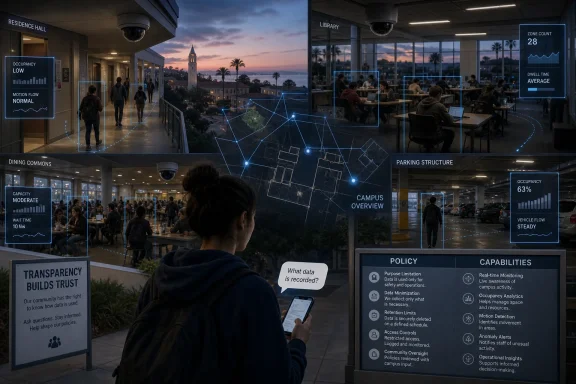
San Diego State University’s police department completed a roughly $1.3 million upgrade in 2024 that placed more than 1,300 AI-enabled surveillance cameras across campus buildings, residence halls, libraries, recreation facilities, dining areas, parking structures, and other university spaces in San Diego. The stated case is safety and maintenance; the practical controversy is governance. SDSU is now a local example of a national problem: institutions are buying AI-capable infrastructure faster than they are explaining who controls it, what it records, and what “disabled” really means.
The most important fact in the SDSU camera story is not that there are more than 1,300 cameras. Large campuses have long used video systems, and universities are, in many ways, small cities with predictable security problems: theft, assault, trespassing, fire alarms, protests, emergency response, and the mundane churn of late-night building access.
The shift is that SDSU’s upgraded network is described as AI-enabled. That phrase does not mean every camera is actively scanning faces, classifying behavior, or feeding a Minority Report control room. It does mean the hardware and software are capable of functions that move surveillance from passive recording toward automated interpretation.
That is where the public-relations line gets thin. University officials can say advanced features such as facial recognition or behavior analysis are not being deployed, and that may be true today. But a camera system designed to support those features is different from a conventional security camera, in the same way a laptop with an unused webcam is different from a desktop monitor. Capability changes the risk model.
For students, faculty, and staff, the question is not merely “Are they watching?” It is “What did the institution make possible, who can turn it on, and what prevents that decision from being made quietly later?”
That appears to be the central tension at SDSU. The cameras were reportedly part of a university police-led project, with installation and software upgrades implemented during the 2024 academic year. The public debate, however, is breaking open after the network has already been put in place.
This is the same pattern that has defined much of the AI boom in education. Administrators talk about efficiency, readiness, modernization, and safety. Critics ask about consent, governance, labor, intellectual property, and data retention. The disagreement is not only about technology; it is about whether technology decisions are being used to outrun institutional democracy.
In the CSU system, that broader conflict is already visible. The system has embraced AI partnerships involving OpenAI and other major technology vendors, while faculty groups have argued that administrators moved too quickly and without sufficient consultation. SDSU’s camera network is separate from a classroom chatbot rollout, but it belongs to the same institutional moment: AI is becoming infrastructure before it becomes a settled social contract.
For IT professionals, the difference between installed but disabled and not technically present is not pedantry. It is the difference between a policy safeguard and a configuration setting. A feature that exists in the stack can be enabled later through a license change, an administrative decision, a vendor update, a law-enforcement request, or an emergency exception.
That is why experienced sysadmins tend to ask boring but essential questions. Who has administrator access? Are changes logged? Are feature toggles auditable? Is there a documented approval chain? Are vendor support sessions recorded? Are retention limits enforced by architecture or merely promised in policy? Can footage be exported, and if so, under what conditions?
The public conversation often collapses all of this into a binary: facial recognition on or off. The real governance problem is more granular. AI-enabled surveillance systems include multiple analytic layers, and not all of them sound as alarming as face matching. Object detection, crowd density alerts, license-plate capture, intrusion detection, audio detection, and “behavioral” analytics each carry different privacy implications.
A campus can honestly say it is not using facial recognition while still operating a system that meaningfully changes how people are monitored. That is the uncomfortable middle ground SDSU now occupies.
A quad is public in the ordinary sense. A parking structure is closer to public, though still institutionally controlled. A residence hall lobby, a dorm corridor, a library study floor, or a recreation center is something else. These are shared spaces, but they are also spaces where students live, study, socialize, decompress, argue, organize, and make the mistakes that come with being young.
The Mission Times newsletter notes an apparent tension between CSU policy describing camera use in public areas and SDSU’s own Buildings and Grounds code, which includes spaces such as residence halls, the library, and the recreation center in a category of non-public spaces where student privacy is expected and media access is restricted. If that framing is accurate, the university has a definitional problem as much as a technical one.
Students do not experience a dorm hallway as a town square. They experience it as the outer edge of home. That does not mean cameras can never be justified there, particularly in entryways or areas with repeated safety incidents. But the justification has to be sharper, and the disclosure has to be clearer.
The most damaging privacy controversies are often not born from one obviously malicious act. They grow from a mismatch between how an institution classifies a space and how the people inside it experience that space.
If a university has a reputation for transparent governance, careful consultation, limited retention, and meaningful oversight, an AI-enabled camera upgrade might still be controversial but not explosive. If the same university rolls out AI tools across classrooms, student services, and security infrastructure while giving affected communities partial answers after the fact, the controversy becomes predictable.
SDSU and CSU are not alone here. School districts, transit agencies, retail chains, apartment complexes, and city governments are all facing the same temptation: use AI-enabled cameras to stretch limited staff, detect incidents faster, and produce searchable evidence after something goes wrong. The sales pitch is simple because the pain points are real.
But surveillance systems are not like replacing fluorescent bulbs with LEDs. They alter the relationship between an institution and the people who move through it. Once video becomes searchable, categorizable, alert-generating data, it is no longer just a record of the past. It becomes a system for shaping behavior in the present.
That is particularly potent on a university campus, where protest, dissent, intimate life, political organizing, religious practice, and student discipline all intersect.
That creates a governance challenge for every organization, not only universities. Procurement teams may buy a system for one feature set, while vendors market an expanding roadmap of analytics, integrations, and automations. The system an institution installs in 2024 may not be functionally identical to the system it is operating in 2026.
The camera vendor named in reporting, Avigilon, is part of a market that has aggressively pushed AI capabilities into security infrastructure. These systems can be useful. A camera that alerts staff when a restricted door is opened at 2 a.m. may prevent harm. A system that quickly locates footage after a reported assault may be valuable. A tool that detects a blocked or malfunctioning camera can improve reliability.
The problem is not that all analytics are inherently abusive. The problem is that analytics are often adopted under a safety rationale, then governed under policies written for a less capable era. A rulebook built for passive CCTV may not be adequate for AI-enabled surveillance.
Students living on campus are not simply customers entering a monitored facility for an hour. They are residents under institutional authority. They may be minors or barely adults. They may have disabilities, stalker concerns, immigration concerns, religious privacy concerns, or political concerns. They may reasonably assume that a university will draw stronger lines around residence halls than around open plazas.
Clear disclosure does not solve every issue, but unclear disclosure compounds every issue. If a student signs housing documents without being told that the surveillance system in residence areas is AI-capable, the university has made a choice about what students need to know. That choice is itself a governance statement.
There is a familiar institutional defense here: the cameras are visible, signage exists, policies are online, and the system is not being used in its most invasive mode. That may satisfy a narrow compliance checklist. It does not satisfy the standard of trust a university should apply when monitoring students in quasi-domestic spaces.
A campus that wants to deploy AI-capable surveillance should say so plainly, repeatedly, and in the documents students actually read when they decide where to live.
But safety rationales have a way of expanding. A system installed to investigate theft can later be used to monitor protest. A tool justified for restricted-area alerts can later support disciplinary fishing expeditions. Footage collected for safety can become attractive to outside law enforcement. A technology that begins with “we only review footage after incidents” can drift toward proactive monitoring as analytic tools improve.
SDSU’s own recent regional context makes that concern concrete. Reporting on prior San Diego law-enforcement access to surveillance systems during the 2020 Black Lives Matter protests has become part of the debate around campus cameras. Even when surveillance begins as a safety tool, politically charged moments test the boundaries.
This is not paranoia; it is institutional realism. Systems are used by people under pressure, and pressure tends to widen exceptions. A policy that works only when everyone is calm is not a policy. It is a press release.
The CSU’s AI initiative, including its OpenAI partnership, has drawn faculty criticism and labor pushback. The California Faculty Association has argued that the system failed to properly meet and confer before implementing AI changes that could affect faculty work, data, intellectual property, and academic life. CSU leaders, for their part, have positioned AI access as a workforce and educational imperative.
That split is not unique to California, but California makes it visible at scale. CSU is enormous, diverse, and deeply tied to public higher education’s promise of access. When it adopts AI, the decision reaches beyond elite campuses and into the daily lives of students who may not have the power, time, or money to opt out.
The camera controversy adds a harder edge to the AI debate because it moves from generative tools to surveillance infrastructure. A chatbot can be ignored, at least in theory. A camera in a residence hall cannot be opted out of by choosing a different browser.
This is why the phrase “AI-powered university” deserves scrutiny. It can mean students get access to useful tools, faculty experiment with new teaching methods, and staff automate drudgery. It can also mean the university increasingly sees itself through dashboards, analytics, prediction, and monitoring.
Good governance introduces friction. It requires approvals, records decisions, separates privileges, limits retention, notifies affected communities, and creates consequences for violations. It does not rely on the goodwill of whoever happens to run the system this year.
For an AI-enabled camera network, that means more than a general surveillance policy. It means a public inventory of camera locations and capabilities. It means plain-language descriptions of which analytics are active, which are disabled, and who can change that status. It means annual reporting on access requests, exports, law-enforcement sharing, and disciplinary uses. It means independent oversight that includes students and faculty, not only police and administrators.
It also means technical controls. If facial recognition is not permitted, the capability should be unavailable by license, contract, configuration, and audit—not merely dormant. If footage retention is limited, deletion should be automated and verifiable. If camera feeds cannot be used for routine student conduct monitoring, that restriction should be written into policy and backed by logs.
The point is not to make campuses unsafe. The point is to prevent safety infrastructure from becoming a general-purpose observation layer.
The SDSU story is a campus story, but the lesson is enterprise-wide. AI features are increasingly arriving as part of routine upgrades, and organizations are treating them as incremental improvements rather than governance events. That is a mistake.
Consider Microsoft 365 Copilot, Windows Recall, endpoint detection platforms, browser telemetry, smart meeting transcription, or AI-enhanced physical security tools. Each system has a plausible productivity or safety use case. Each also raises questions about data capture, retention, employee monitoring, privilege boundaries, and secondary use.
The same principle applies from a dorm hallway to a corporate laptop: if the system can observe, classify, search, and summarize human activity, it is not just an IT asset. It is a power relationship.
Transparency is not merely releasing statements after criticism. It is building disclosure into the rollout. It is telling students before they move in. It is telling faculty before they teach in monitored buildings. It is telling staff before they become both subjects and operators of the system. It is telling the community before trust has to be reconstructed.
There are legitimate security reasons not to publish every detail of a surveillance network. No serious person needs a vandalism manual. But the existence, general location categories, analytic capabilities, access rules, retention timelines, and oversight mechanisms are not operational secrets. They are the minimum ingredients of democratic accountability.
If SDSU wants to argue that its camera system is limited, safety-oriented, and responsibly governed, it should welcome that kind of specificity. Vague reassurance is what institutions offer when they want the benefits of trust without the work of earning it.
 SDSU Did Not Just Buy Cameras; It Bought a Policy Problem
The most important fact in the SDSU camera story is not that there are more than 1,300 cameras. Large campuses have long used video systems, and universities are, in many ways, small cities with predictable security problems: theft, assault, trespassing, fire alarms, protests, emergency response, and the mundane churn of late-night building access.The shift is that SDSU’s upgraded network is described as AI-enabled. That phrase does not mean every camera is actively scanning faces, classifying behavior, or feeding a Minority Report control room. It does mean the hardware and software are capable of functions that move surveillance from passive recording toward automated interpretation.
That is where the public-relations line gets thin. University officials can say advanced features such as facial recognition or behavior analysis are not being deployed, and that may be true today. But a camera system designed to support those features is different from a conventional security camera, in the same way a laptop with an unused webcam is different from a desktop monitor. Capability changes the risk model.
For students, faculty, and staff, the question is not merely “Are they watching?” It is “What did the institution make possible, who can turn it on, and what prevents that decision from being made quietly later?”
The AI Campus Arrives Through Procurement, Not Debate
The modern AI rollout rarely begins with a campus-wide referendum. It arrives through procurement language, vendor demos, software subscriptions, pilot programs, and maintenance budgets. By the time students notice the hardware on the ceiling, the institution has often already framed the issue as an operational upgrade rather than a political choice.That appears to be the central tension at SDSU. The cameras were reportedly part of a university police-led project, with installation and software upgrades implemented during the 2024 academic year. The public debate, however, is breaking open after the network has already been put in place.
This is the same pattern that has defined much of the AI boom in education. Administrators talk about efficiency, readiness, modernization, and safety. Critics ask about consent, governance, labor, intellectual property, and data retention. The disagreement is not only about technology; it is about whether technology decisions are being used to outrun institutional democracy.
In the CSU system, that broader conflict is already visible. The system has embraced AI partnerships involving OpenAI and other major technology vendors, while faculty groups have argued that administrators moved too quickly and without sufficient consultation. SDSU’s camera network is separate from a classroom chatbot rollout, but it belongs to the same institutional moment: AI is becoming infrastructure before it becomes a settled social contract.
“Disabled” Is Not the Same as “Impossible”
SDSU spokespeople have reportedly said that certain advanced camera features are not active. That distinction matters. It also does not end the story.For IT professionals, the difference between installed but disabled and not technically present is not pedantry. It is the difference between a policy safeguard and a configuration setting. A feature that exists in the stack can be enabled later through a license change, an administrative decision, a vendor update, a law-enforcement request, or an emergency exception.
That is why experienced sysadmins tend to ask boring but essential questions. Who has administrator access? Are changes logged? Are feature toggles auditable? Is there a documented approval chain? Are vendor support sessions recorded? Are retention limits enforced by architecture or merely promised in policy? Can footage be exported, and if so, under what conditions?
The public conversation often collapses all of this into a binary: facial recognition on or off. The real governance problem is more granular. AI-enabled surveillance systems include multiple analytic layers, and not all of them sound as alarming as face matching. Object detection, crowd density alerts, license-plate capture, intrusion detection, audio detection, and “behavioral” analytics each carry different privacy implications.
A campus can honestly say it is not using facial recognition while still operating a system that meaningfully changes how people are monitored. That is the uncomfortable middle ground SDSU now occupies.
The Dorm Hallway Is Where the Public-Area Argument Breaks
Universities often defend camera systems by saying they are limited to public areas. On a campus, that phrase is doing a lot of work.A quad is public in the ordinary sense. A parking structure is closer to public, though still institutionally controlled. A residence hall lobby, a dorm corridor, a library study floor, or a recreation center is something else. These are shared spaces, but they are also spaces where students live, study, socialize, decompress, argue, organize, and make the mistakes that come with being young.
The Mission Times newsletter notes an apparent tension between CSU policy describing camera use in public areas and SDSU’s own Buildings and Grounds code, which includes spaces such as residence halls, the library, and the recreation center in a category of non-public spaces where student privacy is expected and media access is restricted. If that framing is accurate, the university has a definitional problem as much as a technical one.
Students do not experience a dorm hallway as a town square. They experience it as the outer edge of home. That does not mean cameras can never be justified there, particularly in entryways or areas with repeated safety incidents. But the justification has to be sharper, and the disclosure has to be clearer.
The most damaging privacy controversies are often not born from one obviously malicious act. They grow from a mismatch between how an institution classifies a space and how the people inside it experience that space.
Universities Keep Discovering That AI Is a Trust Accelerator
AI does not create institutional mistrust from nothing. It accelerates whatever trust or distrust already exists.If a university has a reputation for transparent governance, careful consultation, limited retention, and meaningful oversight, an AI-enabled camera upgrade might still be controversial but not explosive. If the same university rolls out AI tools across classrooms, student services, and security infrastructure while giving affected communities partial answers after the fact, the controversy becomes predictable.
SDSU and CSU are not alone here. School districts, transit agencies, retail chains, apartment complexes, and city governments are all facing the same temptation: use AI-enabled cameras to stretch limited staff, detect incidents faster, and produce searchable evidence after something goes wrong. The sales pitch is simple because the pain points are real.
But surveillance systems are not like replacing fluorescent bulbs with LEDs. They alter the relationship between an institution and the people who move through it. Once video becomes searchable, categorizable, alert-generating data, it is no longer just a record of the past. It becomes a system for shaping behavior in the present.
That is particularly potent on a university campus, where protest, dissent, intimate life, political organizing, religious practice, and student discipline all intersect.
The Vendor Stack Is Now Part of Campus Governance
For WindowsForum readers, the SDSU story should sound familiar in a broader enterprise sense. AI is increasingly bundled into products that used to be comparatively inert. Cameras are not just cameras. Productivity suites are not just document editors. Endpoint tools are not just antivirus. The AI layer turns ordinary infrastructure into a decision-support system, and sometimes into a decision-making system.That creates a governance challenge for every organization, not only universities. Procurement teams may buy a system for one feature set, while vendors market an expanding roadmap of analytics, integrations, and automations. The system an institution installs in 2024 may not be functionally identical to the system it is operating in 2026.
The camera vendor named in reporting, Avigilon, is part of a market that has aggressively pushed AI capabilities into security infrastructure. These systems can be useful. A camera that alerts staff when a restricted door is opened at 2 a.m. may prevent harm. A system that quickly locates footage after a reported assault may be valuable. A tool that detects a blocked or malfunctioning camera can improve reliability.
The problem is not that all analytics are inherently abusive. The problem is that analytics are often adopted under a safety rationale, then governed under policies written for a less capable era. A rulebook built for passive CCTV may not be adequate for AI-enabled surveillance.
Student Privacy Cannot Be an Afterthought Hidden in Housing Paperwork
One of the sharpest details in the SDSU controversy is the claim that AI usage is not mentioned in housing handbooks. That matters because residence life is one of the most sensitive contexts in higher education.Students living on campus are not simply customers entering a monitored facility for an hour. They are residents under institutional authority. They may be minors or barely adults. They may have disabilities, stalker concerns, immigration concerns, religious privacy concerns, or political concerns. They may reasonably assume that a university will draw stronger lines around residence halls than around open plazas.
Clear disclosure does not solve every issue, but unclear disclosure compounds every issue. If a student signs housing documents without being told that the surveillance system in residence areas is AI-capable, the university has made a choice about what students need to know. That choice is itself a governance statement.
There is a familiar institutional defense here: the cameras are visible, signage exists, policies are online, and the system is not being used in its most invasive mode. That may satisfy a narrow compliance checklist. It does not satisfy the standard of trust a university should apply when monitoring students in quasi-domestic spaces.
A campus that wants to deploy AI-capable surveillance should say so plainly, repeatedly, and in the documents students actually read when they decide where to live.
Safety Is Real, but So Is Function Creep
The strongest argument for SDSU’s camera system is also the reason the debate is hard. Campus safety is not imaginary. Universities deal with theft, harassment, vandalism, medical emergencies, and violence. Parents expect institutions to protect students. Students who have been victims of crime may reasonably want better camera coverage, faster response, and better evidence.But safety rationales have a way of expanding. A system installed to investigate theft can later be used to monitor protest. A tool justified for restricted-area alerts can later support disciplinary fishing expeditions. Footage collected for safety can become attractive to outside law enforcement. A technology that begins with “we only review footage after incidents” can drift toward proactive monitoring as analytic tools improve.
SDSU’s own recent regional context makes that concern concrete. Reporting on prior San Diego law-enforcement access to surveillance systems during the 2020 Black Lives Matter protests has become part of the debate around campus cameras. Even when surveillance begins as a safety tool, politically charged moments test the boundaries.
This is not paranoia; it is institutional realism. Systems are used by people under pressure, and pressure tends to widen exceptions. A policy that works only when everyone is calm is not a policy. It is a press release.
The CSU AI Push Makes the Camera Fight Bigger Than SDSU
SDSU’s camera network would be controversial even in isolation. It is more combustible because it lands inside a CSU system already trying to brand itself around AI.The CSU’s AI initiative, including its OpenAI partnership, has drawn faculty criticism and labor pushback. The California Faculty Association has argued that the system failed to properly meet and confer before implementing AI changes that could affect faculty work, data, intellectual property, and academic life. CSU leaders, for their part, have positioned AI access as a workforce and educational imperative.
That split is not unique to California, but California makes it visible at scale. CSU is enormous, diverse, and deeply tied to public higher education’s promise of access. When it adopts AI, the decision reaches beyond elite campuses and into the daily lives of students who may not have the power, time, or money to opt out.
The camera controversy adds a harder edge to the AI debate because it moves from generative tools to surveillance infrastructure. A chatbot can be ignored, at least in theory. A camera in a residence hall cannot be opted out of by choosing a different browser.
This is why the phrase “AI-powered university” deserves scrutiny. It can mean students get access to useful tools, faculty experiment with new teaching methods, and staff automate drudgery. It can also mean the university increasingly sees itself through dashboards, analytics, prediction, and monitoring.
The Real Standard Should Be Administrative Friction
Institutions often promise that sensitive capabilities will be used responsibly. The better question is whether misuse is made difficult.Good governance introduces friction. It requires approvals, records decisions, separates privileges, limits retention, notifies affected communities, and creates consequences for violations. It does not rely on the goodwill of whoever happens to run the system this year.
For an AI-enabled camera network, that means more than a general surveillance policy. It means a public inventory of camera locations and capabilities. It means plain-language descriptions of which analytics are active, which are disabled, and who can change that status. It means annual reporting on access requests, exports, law-enforcement sharing, and disciplinary uses. It means independent oversight that includes students and faculty, not only police and administrators.
It also means technical controls. If facial recognition is not permitted, the capability should be unavailable by license, contract, configuration, and audit—not merely dormant. If footage retention is limited, deletion should be automated and verifiable. If camera feeds cannot be used for routine student conduct monitoring, that restriction should be written into policy and backed by logs.
The point is not to make campuses unsafe. The point is to prevent safety infrastructure from becoming a general-purpose observation layer.
Windows Admins Have Seen This Movie Before
Enterprise IT has spent decades learning that defaults matter. A feature that ships enabled by default will be used. A log that is retained forever will eventually become discoverable. A permission that is granted broadly will be abused accidentally before it is abused deliberately. A vendor setting described as “optional” can become a compliance nightmare after one software update.The SDSU story is a campus story, but the lesson is enterprise-wide. AI features are increasingly arriving as part of routine upgrades, and organizations are treating them as incremental improvements rather than governance events. That is a mistake.
Consider Microsoft 365 Copilot, Windows Recall, endpoint detection platforms, browser telemetry, smart meeting transcription, or AI-enhanced physical security tools. Each system has a plausible productivity or safety use case. Each also raises questions about data capture, retention, employee monitoring, privilege boundaries, and secondary use.
The same principle applies from a dorm hallway to a corporate laptop: if the system can observe, classify, search, and summarize human activity, it is not just an IT asset. It is a power relationship.
Transparency Is Not a Map After the Fact
The Daily Aztec’s reporting reportedly included a map of camera locations, which is exactly the kind of work student journalists should not have to do alone. If an institution installs more than 1,300 AI-capable cameras, the public should not need an investigation to understand the scope.Transparency is not merely releasing statements after criticism. It is building disclosure into the rollout. It is telling students before they move in. It is telling faculty before they teach in monitored buildings. It is telling staff before they become both subjects and operators of the system. It is telling the community before trust has to be reconstructed.
There are legitimate security reasons not to publish every detail of a surveillance network. No serious person needs a vandalism manual. But the existence, general location categories, analytic capabilities, access rules, retention timelines, and oversight mechanisms are not operational secrets. They are the minimum ingredients of democratic accountability.
If SDSU wants to argue that its camera system is limited, safety-oriented, and responsibly governed, it should welcome that kind of specificity. Vague reassurance is what institutions offer when they want the benefits of trust without the work of earning it.
The Lesson From SDSU’s Ceiling-Mounted AI Debate
SDSU’s camera network is not a simple story of dystopia or negligence. It is a story about an institution doing what many institutions are doing: modernizing infrastructure with AI-capable tools while relying on old habits of disclosure, consultation, and control.- SDSU’s camera upgrade matters because the system is AI-capable, even if the most controversial analytics are reportedly not active today.
- The presence of cameras in residence halls, libraries, and recreation spaces makes the “public area” justification harder to defend without much clearer definitions.
- The wider CSU fight over AI partnerships has primed students and faculty to see surveillance technology as part of a larger governance problem.
- The key test is not whether administrators promise restraint, but whether technical, contractual, and procedural limits make overreach difficult.
- Universities adopting AI infrastructure should publish plain-language policies before deployment, not after student journalists force the issue.
References
- Primary source: Times of San Diego
Published: 2026-06-04T18:50:12.651899
Over 1,300 AI-enabled cameras on SDSU's campus - Times of San Diego
*|DATE:F j, Y|* Today's newsletter is presented by addressSD.com. Hello, Navajo and College Area! San Diego State University and the California Statetimesofsandiego.com - Related coverage: thedailyaztec.com
- Related coverage: calfac.org
CFA Leader Voices Concerns Over CSU AI Implementation at Oversight Hearing - California Faculty Association
CFA members have been raising concerns since the Chancellor’s Office first announced in February 2025 that the CSU will become the first Artificialwww.calfac.org - Related coverage: universityherald.com
Outrage Erupts in San Diego State University After It Introduced Massive AI-Powered Surveillance System
San Diego State University faces student backlash after quietly installing a $1.3M AI camera network across classrooms and dorms, raising privacy and transparency concerns.www.universityherald.com
