

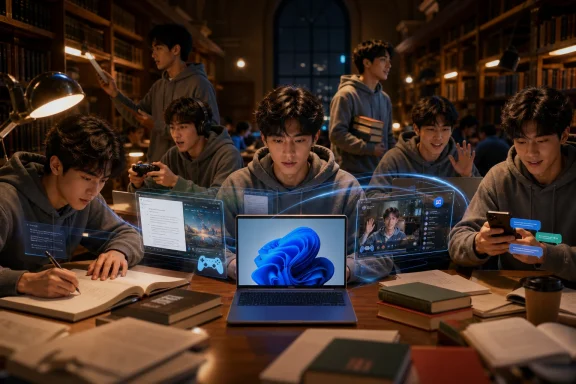
Microsoft’s new Windows 11 college campaign, created with Droga5 and centered on the “Doppelmode” film, pitches a Windows PC as the single machine that can carry students between coursework, gaming, social life, and everyday productivity. The ad’s trick is not the usual spec-sheet escalation; it is a visual argument about identity. Microsoft is telling students that they do not need to choose between the serious device and the fun one, because campus life has already collapsed those categories.
That is a sharper message than it first appears. For years, Windows marketing has had to fight on two fronts: Apple’s cultural hold on campus cool and Chromebooks’ blunt appeal as inexpensive classroom utilities. “Two Worlds. One Machine” is Microsoft’s attempt to reframe the contest around something more emotionally durable than processor tiers or back-to-school discounts. The company is selling a laptop not as a computer, but as a truce between the student you are supposed to be and the student you actually are.
The cleverness of “Doppelmode” is that it does not hide the messiness of student computing. A laptop in college is rarely just a lecture-note machine, just a gaming device, just a streaming screen, just a communication hub, or just an AI-assisted writing station. It is all of those things, often within the same hour, and sometimes within the same browser session.
That reality has always been Windows’ native terrain. The platform’s historical strength is breadth: cheap machines, premium machines, touch machines, gaming laptops, convertible notebooks, enterprise-ready PCs, and oddball hardware experiments that would never fit neatly into Apple’s tighter catalog. The weakness is that breadth can look like clutter when a campaign is trying to tell one clean story.
Droga5’s debut Windows campaign solves that problem by turning clutter into choreography. The library setting gives Microsoft the old academic credibility cue, while the sudden appearance of playful doubles gives the ad permission to acknowledge everything students are doing when they are not dutifully staring at a document. The machine becomes the hinge, not the hero in a cape.
That is a useful correction. Windows campaigns too often drift into feature inventory: snap layouts, security, performance, Copilot, gaming, battery life, touch, and compatibility, all competing for attention like icons on a crowded desktop. “Doppelmode” instead begins with behavior. Students switch contexts constantly; therefore the device must keep up.
That is not a rejection of discipline. It is a recognition that the modern student’s “focus” is often mediated through tools designed for interruption. Notes sit beside group chats. Research tabs sit beside shopping carts. A paper draft sits beside Discord. A lecture recording sits beside a game update.
Microsoft’s line, “Two Worlds. One Machine,” is effective because it does not pretend those worlds are cleanly separated. The ad’s twin gimmick literalizes the split self: the student working and the student playing, the person performing seriousness and the person itching to move. The point is not that Windows eliminates distraction. It is that Windows is comfortable inside the contradiction.
That is also where the campaign starts to feel more strategically honest than the usual productivity sermon. Students do not buy laptops only because they are planning to become miniature consultants. They buy them because the machine will be dragged through schoolwork, entertainment, identity, and social performance. Microsoft is trying to meet them there, rather than scolding them back into a spreadsheet.
The agency’s recent Microsoft work has leaned into cinematic, youth-facing energy, including Xbox campaigns and broader Microsoft brand efforts. Bringing that sensibility to Windows is sensible, because Windows 11 has always had a brand problem that is more emotional than technical. Many users rely on it every day, but fewer describe that reliance with affection.
A campaign like “Doppelmode” tries to generate affection by borrowing from the language of music videos, campus comedy, and practical filmmaking. The use of 25 sets of identical twins is not just a production stunt; it gives the film a memorable physical grammar. The fact that the illusion was reportedly achieved in-camera rather than as a purely digital effect also fits the campaign’s larger argument about seamlessness: the trick is visible, but the system still feels coherent.
That matters in an advertising landscape where tech campaigns are saturated with synthetic polish. Practical choreography gives the spot texture. It also helps Windows avoid sounding like a platform reciting its own release notes.
The soundtrack choice, “Play Me” by Fcukers, is another clue that Microsoft is chasing a specific campus mood rather than a universal family-room demographic. It gives the ad a pulse without turning the brand into a desperate chaperone at a student party. For a Windows campaign, that is already a notable tonal upgrade.
Apple has understood this for years. Macs on campus are not merely devices; they are status objects, creative signals, and ecosystem anchors. Chromebooks, meanwhile, have trained a generation of students in the logic of browser-first computing, especially in K–12 environments where cost, manageability, and simplicity matter more than local power.
Windows sits between those poles. It can be the affordable default, the gaming rig, the engineering workstation, the business laptop, the AI PC, or the family hand-me-down. That flexibility is powerful, but it is harder to mythologize.
“Two Worlds. One Machine” is Microsoft’s attempt to mythologize flexibility itself. Instead of saying Windows can do more because there are more SKUs, the campaign says Windows fits the way students already live. It turns compatibility from a dull enterprise virtue into a lifestyle claim.
The Microsoft College Offer gives the campaign a transactional spine. Ads can be charming, but students and parents still look at price, bundles, financing, and perceived longevity. By tying the creative to an offer that rolls through video, social, creator content, and retail media, Microsoft is making sure the brand argument lands close to the purchase moment.
Windows 11 has tried to soften that inheritance with a cleaner interface, centered taskbar, rounded visuals, better window management, gaming improvements, and increasingly prominent AI integration. Still, the emotional pitch has remained uneven. Microsoft wants Windows to feel modern, personal, and fluid, while many users still judge it through update nags, hardware requirements, driver issues, or whatever happened the last time their printer misbehaved.
The student campaign sidesteps that baggage by narrowing the frame. It is not trying to persuade every Windows skeptic that the platform has been reborn. It is trying to make a Windows 11 PC feel like the most practical and least compromising choice for a student who wants one device to carry multiple lives.
That is a winnable argument. College is one of the few settings where the “one machine” pitch is not just marketing rhetoric. Dorm rooms are small, budgets are finite, and students do not always have the luxury of separate devices for study, gaming, media creation, and entertainment.
But the claim also raises the bar. If Windows tells students one machine can cover everything, the experience has to deliver. Battery life, sleep reliability, webcam quality, fan noise, gaming performance, app compatibility, and build quality all become part of the campaign whether the ad mentions them or not.
That restraint may be wise. Students are already surrounded by AI discourse, much of it anxious, moralizing, or institutionally confused. Universities are still sorting out what counts as acceptable assistance, what counts as cheating, and how to teach in a world where generative tools are available by default.
A campaign that led with AI might have wandered into that minefield. By leading with switching between study and play, Microsoft keeps the message broader and less controversial. The Windows PC becomes a flexible student companion, not an essay-writing machine with a compliance problem.
Still, the AI layer is likely to become more explicit over time. Microsoft’s long game is not merely to keep Windows relevant as a traditional desktop OS. It is to make the PC feel like the natural home for AI-assisted work, search, creation, summarization, and automation.
That creates a delicate tension for student marketing. The company wants to sell capability without implying academic shortcutting. The “two worlds” framing gives Microsoft room to talk about assistance, creativity, and organization later without reducing the machine to a homework bot.
Windows’ hardware diversity means the student shopping experience can be either empowering or bewildering. One student may find an excellent thin-and-light laptop with long battery life and a good keyboard. Another may end up with a bargain-bin machine saddled with weak storage, a dim display, and just enough RAM to make multitasking painful.
That is where Microsoft’s “one machine” promise becomes risky. Apple can control the range tightly enough that most MacBook buyers understand the basic quality floor. Windows depends on OEM partners, retail merchandising, and buyer literacy to prevent the low end from defining the brand.
The campaign’s emphasis on seamless movement between worlds implicitly assumes a certain baseline of performance. Students need enough memory to run a browser full of tabs, Office apps, collaboration tools, streaming services, and perhaps a game launcher without the machine turning into a fan-powered apology. They need storage that will not fill after a semester of downloads, recordings, photos, and coursework.
If Microsoft wants the emotional message to stick, the retail channel needs to reinforce it with sane configurations. The worst version of this campaign would be a student seeing the ad, buying the cheapest eligible Windows laptop, and discovering that “two worlds” becomes “one spinning cursor.”
That advantage is broader than raw frame rates. It includes storefronts, peripherals, modding, Discord culture, esports titles, controller support, and a vast library of older and current games. For students, gaming is often social infrastructure as much as recreation.
Apple has made meaningful gestures toward gaming, and cloud gaming continues to blur device boundaries, but Windows still has the cultural and technical center of gravity. Microsoft can make that argument without sounding forced because Xbox, Game Pass, and PC gaming already sit inside the company’s larger entertainment strategy.
“Doppelmode” uses gaming as a symbol for play, but the subtext is commercial. If a student wants a machine that can write a paper, join a video call, edit a clip, and run the games their friends are playing, Windows has a stronger claim than most rivals. That is exactly the kind of concrete advantage that makes the “one machine” message more than a slogan.
The danger is overpromising. Not every Windows 11 PC is a gaming PC, and not every student offer machine will be happy with modern titles. Microsoft’s challenge is to let gaming halo the platform without implying that every thin budget notebook is secretly a dorm-room console.
College computing is messy because college is messy. Students are managing deadlines, part-time jobs, group projects, friendships, homesickness, internships, clubs, games, video calls, and the low-grade administrative burden of modern life. Their devices are not accessories to education; they are the surface on which much of that life happens.
Microsoft’s campaign works because it captures that simultaneity. The doubles are funny, but they also suggest the pressure of being more than one person at once. The same student has to be studious, social, employable, entertained, reachable, and self-directed.
That framing is stronger than a generic “do more” message. “Do more” can sound like a threat. “Two Worlds. One Machine” sounds like permission.
There is a subtle generational intelligence in that. Students do not need a brand to tell them their lives are digital. They need a brand to show that it understands how fragmented those lives feel.
That overlap creates policy headaches. Administrators care about identity, compliance, data protection, patching, endpoint management, and acceptable use. Users care about whether the device lets them move quickly between tasks without friction. Microsoft’s platform strategy has to satisfy both.
In the student campaign, the tension is rendered as playful doubles. In the workplace, it becomes the employee using a corporate laptop for personal errands, the developer running local tools beside cloud dashboards, or the hybrid worker moving between Teams calls, browser apps, and creative software. The cultural behavior is different, but the device demand is similar.
Windows’ enterprise strength remains a major advantage here. A platform that can speak to students about play while speaking to IT about manageability has a broader runway than one that only owns a lifestyle niche. Microsoft’s challenge is to keep those messages from contaminating each other.
Students do not want to feel like they are being sold a corporate endpoint. IT departments do not want to feel like they are managing a gaming identity crisis. Windows has to be both without looking ridiculous.
A campaign built on seamlessness is vulnerable to every moment that feels anything but seamless. If setup pushes too hard for cloud services, if notifications get noisy, if battery drain becomes unpredictable, or if an update lands at the wrong time, the brand promise weakens. The student does not distinguish between Windows, the OEM, the driver stack, and the retailer; they experience one machine.
That is the brutal part of platform marketing. Microsoft can craft the line, Droga5 can choreograph the film, and ProdCo can execute the in-camera illusion, but the final ad impression is made later, alone, when the buyer opens the laptop and tries to live with it.
This is also why the campaign’s restraint is valuable. It does not promise magic. It promises a machine that can contain duality. That is ambitious enough.
The real opportunity is to align the creative with product discipline. Fewer nags, clearer setup, better defaults, stronger battery behavior, and more consistent hardware guidance would do as much for the campaign as any media buy. Brand affection is built in the gap between what the ad says and what the device repeatedly proves.
For students, parents, and campus IT buyers, the ad points toward a few concrete realities behind the choreography:
The best technology advertising finds a truth users already recognize and gives it a sharper outline. “Doppelmode” does that for student life by admitting that study and play are no longer neatly scheduled, physically separate states. If Microsoft can make the actual Windows 11 buying and ownership experience feel as fluid as Droga5’s library ballet, the company may have found more than a back-to-school campaign; it may have found a better way to explain why the multipurpose PC still matters.
Source: Little Black Book | LBBOnline https://lbbonline.com/news/Droga5-Sees-Double-in-Debut-Windows-Campaign/
That is a sharper message than it first appears. For years, Windows marketing has had to fight on two fronts: Apple’s cultural hold on campus cool and Chromebooks’ blunt appeal as inexpensive classroom utilities. “Two Worlds. One Machine” is Microsoft’s attempt to reframe the contest around something more emotionally durable than processor tiers or back-to-school discounts. The company is selling a laptop not as a computer, but as a truce between the student you are supposed to be and the student you actually are.
 Microsoft Stops Apologizing for the Multipurpose PC
The cleverness of “Doppelmode” is that it does not hide the messiness of student computing. A laptop in college is rarely just a lecture-note machine, just a gaming device, just a streaming screen, just a communication hub, or just an AI-assisted writing station. It is all of those things, often within the same hour, and sometimes within the same browser session.That reality has always been Windows’ native terrain. The platform’s historical strength is breadth: cheap machines, premium machines, touch machines, gaming laptops, convertible notebooks, enterprise-ready PCs, and oddball hardware experiments that would never fit neatly into Apple’s tighter catalog. The weakness is that breadth can look like clutter when a campaign is trying to tell one clean story.
Droga5’s debut Windows campaign solves that problem by turning clutter into choreography. The library setting gives Microsoft the old academic credibility cue, while the sudden appearance of playful doubles gives the ad permission to acknowledge everything students are doing when they are not dutifully staring at a document. The machine becomes the hinge, not the hero in a cape.
That is a useful correction. Windows campaigns too often drift into feature inventory: snap layouts, security, performance, Copilot, gaming, battery life, touch, and compatibility, all competing for attention like icons on a crowded desktop. “Doppelmode” instead begins with behavior. Students switch contexts constantly; therefore the device must keep up.
The Library Is Quiet, but the Positioning Is Loud
The choice of a silent college library is doing more work than the production notes suggest. It gives the film a comic constraint, but it also compresses the contradiction Microsoft wants to own. The library is the temple of study; the ad fills it with game controllers, laptop theft gags, rapid window-switching, and a swarm of identical twins acting as visible manifestations of distracted student life.That is not a rejection of discipline. It is a recognition that the modern student’s “focus” is often mediated through tools designed for interruption. Notes sit beside group chats. Research tabs sit beside shopping carts. A paper draft sits beside Discord. A lecture recording sits beside a game update.
Microsoft’s line, “Two Worlds. One Machine,” is effective because it does not pretend those worlds are cleanly separated. The ad’s twin gimmick literalizes the split self: the student working and the student playing, the person performing seriousness and the person itching to move. The point is not that Windows eliminates distraction. It is that Windows is comfortable inside the contradiction.
That is also where the campaign starts to feel more strategically honest than the usual productivity sermon. Students do not buy laptops only because they are planning to become miniature consultants. They buy them because the machine will be dragged through schoolwork, entertainment, identity, and social performance. Microsoft is trying to meet them there, rather than scolding them back into a spreadsheet.
Droga5 Gives Windows a Cultural Brief, Not a Product Demo
Droga5’s involvement matters because this is exactly the kind of problem a strong agency can clarify. Microsoft has no shortage of product claims. What it often lacks is a clean cultural wrapper that makes those claims feel inevitable rather than assembled.The agency’s recent Microsoft work has leaned into cinematic, youth-facing energy, including Xbox campaigns and broader Microsoft brand efforts. Bringing that sensibility to Windows is sensible, because Windows 11 has always had a brand problem that is more emotional than technical. Many users rely on it every day, but fewer describe that reliance with affection.
A campaign like “Doppelmode” tries to generate affection by borrowing from the language of music videos, campus comedy, and practical filmmaking. The use of 25 sets of identical twins is not just a production stunt; it gives the film a memorable physical grammar. The fact that the illusion was reportedly achieved in-camera rather than as a purely digital effect also fits the campaign’s larger argument about seamlessness: the trick is visible, but the system still feels coherent.
That matters in an advertising landscape where tech campaigns are saturated with synthetic polish. Practical choreography gives the spot texture. It also helps Windows avoid sounding like a platform reciting its own release notes.
The soundtrack choice, “Play Me” by Fcukers, is another clue that Microsoft is chasing a specific campus mood rather than a universal family-room demographic. It gives the ad a pulse without turning the brand into a desperate chaperone at a student party. For a Windows campaign, that is already a notable tonal upgrade.
The Student Market Is a Brand War Disguised as a Buying Season
Back-to-school and college campaigns are never just seasonal retail exercises. They are acquisition campaigns for future loyalty. A student’s first personally chosen laptop can become a decade-long default, shaping what operating system feels natural, what ecosystem feels trustworthy, and what trade-offs feel acceptable.Apple has understood this for years. Macs on campus are not merely devices; they are status objects, creative signals, and ecosystem anchors. Chromebooks, meanwhile, have trained a generation of students in the logic of browser-first computing, especially in K–12 environments where cost, manageability, and simplicity matter more than local power.
Windows sits between those poles. It can be the affordable default, the gaming rig, the engineering workstation, the business laptop, the AI PC, or the family hand-me-down. That flexibility is powerful, but it is harder to mythologize.
“Two Worlds. One Machine” is Microsoft’s attempt to mythologize flexibility itself. Instead of saying Windows can do more because there are more SKUs, the campaign says Windows fits the way students already live. It turns compatibility from a dull enterprise virtue into a lifestyle claim.
The Microsoft College Offer gives the campaign a transactional spine. Ads can be charming, but students and parents still look at price, bundles, financing, and perceived longevity. By tying the creative to an offer that rolls through video, social, creator content, and retail media, Microsoft is making sure the brand argument lands close to the purchase moment.
Windows 11 Needs More Than Familiarity
Windows has a strange problem: it is everywhere, but ubiquity does not automatically produce desire. For many users, Windows is the system that came with the computer, the thing required by work, school, gaming, or software compatibility. That makes it essential, but not necessarily aspirational.Windows 11 has tried to soften that inheritance with a cleaner interface, centered taskbar, rounded visuals, better window management, gaming improvements, and increasingly prominent AI integration. Still, the emotional pitch has remained uneven. Microsoft wants Windows to feel modern, personal, and fluid, while many users still judge it through update nags, hardware requirements, driver issues, or whatever happened the last time their printer misbehaved.
The student campaign sidesteps that baggage by narrowing the frame. It is not trying to persuade every Windows skeptic that the platform has been reborn. It is trying to make a Windows 11 PC feel like the most practical and least compromising choice for a student who wants one device to carry multiple lives.
That is a winnable argument. College is one of the few settings where the “one machine” pitch is not just marketing rhetoric. Dorm rooms are small, budgets are finite, and students do not always have the luxury of separate devices for study, gaming, media creation, and entertainment.
But the claim also raises the bar. If Windows tells students one machine can cover everything, the experience has to deliver. Battery life, sleep reliability, webcam quality, fan noise, gaming performance, app compatibility, and build quality all become part of the campaign whether the ad mentions them or not.
The AI PC Is the Ghost in the Library
The campaign copy foregrounds productivity and play, not artificial intelligence, but Microsoft’s broader platform agenda is impossible to miss. Windows 11 is now inseparable from the company’s AI ambitions, from Copilot branding to the emerging category of AI PCs with neural processing units and local AI workloads. Even when an ad does not say “AI” every five seconds, the strategic backdrop is there.That restraint may be wise. Students are already surrounded by AI discourse, much of it anxious, moralizing, or institutionally confused. Universities are still sorting out what counts as acceptable assistance, what counts as cheating, and how to teach in a world where generative tools are available by default.
A campaign that led with AI might have wandered into that minefield. By leading with switching between study and play, Microsoft keeps the message broader and less controversial. The Windows PC becomes a flexible student companion, not an essay-writing machine with a compliance problem.
Still, the AI layer is likely to become more explicit over time. Microsoft’s long game is not merely to keep Windows relevant as a traditional desktop OS. It is to make the PC feel like the natural home for AI-assisted work, search, creation, summarization, and automation.
That creates a delicate tension for student marketing. The company wants to sell capability without implying academic shortcutting. The “two worlds” framing gives Microsoft room to talk about assistance, creativity, and organization later without reducing the machine to a homework bot.
Practical Effects Matter More Than the Spot’s Cleverness
For WindowsForum readers, the real test is not whether “Doppelmode” is a good commercial. It is whether the campaign maps to the machines students will actually buy. A beautifully choreographed ad can create interest, but a bad retail experience can kill it in minutes.Windows’ hardware diversity means the student shopping experience can be either empowering or bewildering. One student may find an excellent thin-and-light laptop with long battery life and a good keyboard. Another may end up with a bargain-bin machine saddled with weak storage, a dim display, and just enough RAM to make multitasking painful.
That is where Microsoft’s “one machine” promise becomes risky. Apple can control the range tightly enough that most MacBook buyers understand the basic quality floor. Windows depends on OEM partners, retail merchandising, and buyer literacy to prevent the low end from defining the brand.
The campaign’s emphasis on seamless movement between worlds implicitly assumes a certain baseline of performance. Students need enough memory to run a browser full of tabs, Office apps, collaboration tools, streaming services, and perhaps a game launcher without the machine turning into a fan-powered apology. They need storage that will not fill after a semester of downloads, recordings, photos, and coursework.
If Microsoft wants the emotional message to stick, the retail channel needs to reinforce it with sane configurations. The worst version of this campaign would be a student seeing the ad, buying the cheapest eligible Windows laptop, and discovering that “two worlds” becomes “one spinning cursor.”
The Gaming Angle Gives Windows a Real Advantage
The play side of the campaign is not a throwaway. Gaming remains one of Windows’ most defensible advantages among students, especially those who want a single machine that can handle coursework and entertainment. Even students who are not buying high-end gaming laptops understand that Windows is where PC gaming lives.That advantage is broader than raw frame rates. It includes storefronts, peripherals, modding, Discord culture, esports titles, controller support, and a vast library of older and current games. For students, gaming is often social infrastructure as much as recreation.
Apple has made meaningful gestures toward gaming, and cloud gaming continues to blur device boundaries, but Windows still has the cultural and technical center of gravity. Microsoft can make that argument without sounding forced because Xbox, Game Pass, and PC gaming already sit inside the company’s larger entertainment strategy.
“Doppelmode” uses gaming as a symbol for play, but the subtext is commercial. If a student wants a machine that can write a paper, join a video call, edit a clip, and run the games their friends are playing, Windows has a stronger claim than most rivals. That is exactly the kind of concrete advantage that makes the “one machine” message more than a slogan.
The danger is overpromising. Not every Windows 11 PC is a gaming PC, and not every student offer machine will be happy with modern titles. Microsoft’s challenge is to let gaming halo the platform without implying that every thin budget notebook is secretly a dorm-room console.
The Campaign Understands That Students Are Not a Productivity Segment
The most refreshing part of the spot is that it does not treat students as productivity units waiting to be optimized. It treats them as people with competing impulses, limited attention, and overlapping identities. That is closer to reality than most education technology marketing, which often imagines the student as a clean desk with a pulse.College computing is messy because college is messy. Students are managing deadlines, part-time jobs, group projects, friendships, homesickness, internships, clubs, games, video calls, and the low-grade administrative burden of modern life. Their devices are not accessories to education; they are the surface on which much of that life happens.
Microsoft’s campaign works because it captures that simultaneity. The doubles are funny, but they also suggest the pressure of being more than one person at once. The same student has to be studious, social, employable, entertained, reachable, and self-directed.
That framing is stronger than a generic “do more” message. “Do more” can sound like a threat. “Two Worlds. One Machine” sounds like permission.
There is a subtle generational intelligence in that. Students do not need a brand to tell them their lives are digital. They need a brand to show that it understands how fragmented those lives feel.
The Enterprise Echo Is Hiding in the Student Pitch
Although this campaign is aimed at college students, enterprise IT should pay attention to the logic underneath it. Microsoft is sharpening a message that also applies to the modern workplace: users do not live in single-purpose modes anymore. Work and personal computing overlap, and the device is expected to keep up without moralizing.That overlap creates policy headaches. Administrators care about identity, compliance, data protection, patching, endpoint management, and acceptable use. Users care about whether the device lets them move quickly between tasks without friction. Microsoft’s platform strategy has to satisfy both.
In the student campaign, the tension is rendered as playful doubles. In the workplace, it becomes the employee using a corporate laptop for personal errands, the developer running local tools beside cloud dashboards, or the hybrid worker moving between Teams calls, browser apps, and creative software. The cultural behavior is different, but the device demand is similar.
Windows’ enterprise strength remains a major advantage here. A platform that can speak to students about play while speaking to IT about manageability has a broader runway than one that only owns a lifestyle niche. Microsoft’s challenge is to keep those messages from contaminating each other.
Students do not want to feel like they are being sold a corporate endpoint. IT departments do not want to feel like they are managing a gaming identity crisis. Windows has to be both without looking ridiculous.
The Risk Is That the Brand Outruns the Product Experience
Advertising can reframe a product, but it cannot erase the lived experience of using it. Windows 11 has improved in many visible ways, yet users remain sensitive to interruptions, unwanted prompts, account nudges, default app friction, and the sense that Microsoft sometimes treats the desktop as a billboard for its own services. For students, that friction can be especially annoying because their patience and budgets are both limited.A campaign built on seamlessness is vulnerable to every moment that feels anything but seamless. If setup pushes too hard for cloud services, if notifications get noisy, if battery drain becomes unpredictable, or if an update lands at the wrong time, the brand promise weakens. The student does not distinguish between Windows, the OEM, the driver stack, and the retailer; they experience one machine.
That is the brutal part of platform marketing. Microsoft can craft the line, Droga5 can choreograph the film, and ProdCo can execute the in-camera illusion, but the final ad impression is made later, alone, when the buyer opens the laptop and tries to live with it.
This is also why the campaign’s restraint is valuable. It does not promise magic. It promises a machine that can contain duality. That is ambitious enough.
The real opportunity is to align the creative with product discipline. Fewer nags, clearer setup, better defaults, stronger battery behavior, and more consistent hardware guidance would do as much for the campaign as any media buy. Brand affection is built in the gap between what the ad says and what the device repeatedly proves.
The Doppelgänger Trick Leaves Microsoft With a Clearer Campus Playbook
The practical lesson from “Doppelmode” is that Windows marketing is strongest when it stops trying to win every argument at once. The campaign does not need to mention every feature because it has found a human behavior that can carry the platform’s breadth. That is the kind of messaging discipline Windows needs more often.For students, parents, and campus IT buyers, the ad points toward a few concrete realities behind the choreography:
- A Windows 11 PC makes the most sense for students who need one device to span coursework, entertainment, communication, and PC gaming.
- The “one machine” promise depends heavily on buying a configuration with enough memory, storage, battery life, and build quality to survive real multitasking.
- Microsoft is positioning Windows less as a default operating system and more as a flexible student-life platform.
- Droga5’s campaign gives Windows a more culturally fluent voice, but the product experience still has to carry the claim after the ad ends.
- The college market remains strategically important because student device choices can harden into long-term ecosystem loyalty.
- The campaign’s restraint around AI is notable, because Microsoft can fold Copilot and AI PC messaging into this student pitch later without making the first impression feel like a lecture.
The best technology advertising finds a truth users already recognize and gives it a sharper outline. “Doppelmode” does that for student life by admitting that study and play are no longer neatly scheduled, physically separate states. If Microsoft can make the actual Windows 11 buying and ownership experience feel as fluid as Droga5’s library ballet, the company may have found more than a back-to-school campaign; it may have found a better way to explain why the multipurpose PC still matters.
Source: Little Black Book | LBBOnline https://lbbonline.com/news/Droga5-Sees-Double-in-Debut-Windows-Campaign/
