

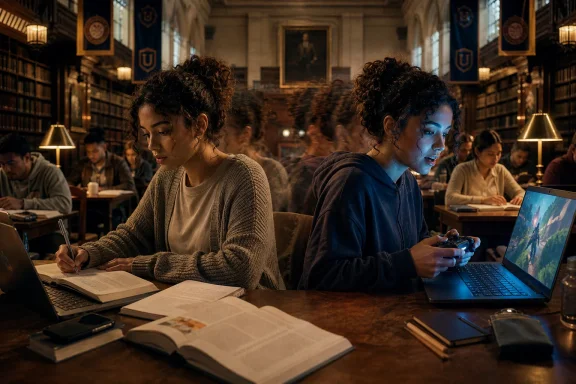
Microsoft’s Windows brand has a new student-focused campaign from Droga5, launched in May 2026 and built around “Doppelmode,” a Mackenzie Sheppard-directed film in which 25 sets of twins turn a quiet college library into a choreographed argument for one Windows 11 PC as both work machine and gaming rig. The spot is charming because it does not begin with a benchmark, an AI promise, or a spec-sheet flex. It begins with a very old camera trick: the eerie pleasure of seeing two versions of the same person occupy the same space. For Microsoft, that may be the smarter pitch, because Windows’ biggest consumer advantage has never been purity; it has been plurality.
The cleanest computer marketing usually tries to erase contradiction. A laptop is either the serious tool for getting things done, the beautiful object for creative identity, or the high-performance box for play. Microsoft’s new Windows campaign takes the opposite route: it says the contradiction is the product.
That is a more honest position for Windows than most of the aspirational gloss the PC industry has leaned on for years. Windows is not one thing. It is the place where Word documents, Discord calls, Steam libraries, browser tabs, school portals, controller overlays, printer drivers, cloud storage prompts, and late-night panic all collide.
“Doppelmode” turns that collision into a visual gag. A student tries to work; the double wants to play. A laptop meant for coursework becomes the same laptop that can run a game. The library remains quiet, but the choreography says what the copy does not need to: student life is a constant context switch.
The campaign’s phrase, “Two Worlds. One Machine,” is not subtle. But it is useful. Microsoft is drawing a line between Windows and single-purpose narratives, especially in a student market where the device purchase is often one of the few big hardware decisions a family makes before college.
For years, Windows advertising often sounded defensive. It explained compatibility, productivity, value, gaming, choice, touch, pen, security, and partner hardware as if stacking enough reasons would create an emotional argument. Sometimes it did. Often it produced the unmistakable smell of a committee.
Droga5’s work appears to understand that Windows does not need to pretend to be frictionless in the Apple sense. Its appeal is that it can absorb friction. The student in the library does not have a perfectly compartmentalized digital life; almost nobody does.
That is why the in-camera twin effect matters. It makes the split feel embodied rather than abstract. A generative-AI clone would have been too on-the-nose for 2026 Microsoft, and probably too clean. Real twins give the film texture, timing, and just enough uncanniness to remind viewers that the joke is physical, not merely conceptual.
“Doppelmode” does not ignore that world so much as step around it. The film’s appeal is not that a machine generated impossible bodies. It is that real bodies were arranged cleverly around a simple idea. That gives the spot a warmth that much AI-forward marketing still struggles to fake.
For a brand like Windows, that distinction is not cosmetic. Microsoft has spent the last several years asking users to accept that more intelligence will be embedded in the PC experience. But the emotional problem with AI marketing is that it can make the machine feel like the main character.
Here, the PC is important, but the students remain the show. The laptop enables the switch; it does not become the personality. That is a healthier balance for a brand that still needs to persuade ordinary buyers that Windows 11 is not merely a compliance requirement or an update prompt with a Start menu.
The point is not that students are secretly gaming instead of studying, although the ad has fun with that possibility. The point is that the modern student’s machine has to survive both states without apology. The laptop must be able to open the assignment and the game launcher, handle the presentation and the controller, carry Teams or Zoom and still have enough credibility to be fun.
That is where Windows has a real claim. The platform is still the default home for much of PC gaming, while also remaining deeply embedded in school and productivity workflows. Microsoft does not need to invent that duality. It needs to make it feel current.
The danger, of course, is overpromising. “One machine” sounds clean in a campaign line, but Windows laptops vary wildly. A premium gaming-capable notebook and a bargain-bin student laptop are not the same thing, even if both run Windows 11. If Microsoft wants the student market to believe the promise, the surrounding retail offer and hardware guidance need to be as clear as the ad is playful.
“Doppelmode” solves this by focusing on behavior rather than hardware detail. It does not need to tell you which exact processor, GPU, display, or battery spec matters. It tells you that the same PC can cross the border between study and play. That is emotionally clean, even if the buying decision underneath it remains messy.
This is where Microsoft’s partner model is both strength and weakness. The Windows world can offer students convertibles, ultralights, budget notebooks, gaming laptops, creator machines, and premium Surface devices. That breadth is a real advantage against narrower hardware ecosystems.
But breadth can also become fog. A student who wants “the laptop from the ad” may discover that Windows PCs range from excellent to exasperating. Microsoft’s brand campaign can create desire, but the OEM shelf has to close the deal.
Microsoft’s campaign wisely does not make the old, brittle argument that PCs are only about power. It makes the lifestyle argument that gaming is part of the same student identity as work. That is more persuasive because it treats play as normal, not as a guilty add-on.
The Windows 11 gaming story is also more coherent than it used to be. Features such as Auto HDR, Game Bar integrations, windowed-game optimizations, DirectStorage support, and the broader Xbox ecosystem give Microsoft a credible platform story. Not every feature matters to every buyer, and not every Windows laptop can exploit them equally, but the direction is obvious: Microsoft wants Windows to feel like the natural home for PC gaming, not merely the place where games happen to run.
That matters because college buyers are not only comparing laptops. They are comparing ecosystems of time. A device that handles assignments but blocks off a student’s preferred entertainment world has a hidden cost. Microsoft’s ad is designed to make that cost visible without turning into a spec lecture.
That was never the real appeal. Windows won the world by being broad, compatible, and commercially unavoidable. It stayed relevant because it could be bent into different shapes by gamers, businesses, schools, developers, hardware makers, and hobbyists.
A campaign for students should not sand that down. It should frame it. Droga5’s twin conceit gives Microsoft a way to say that split attention, split identity, and split use cases are not failures of modern computing. They are the normal condition of a PC user’s day.
There is a risk here, too. A split-personality campaign can accidentally remind people of Windows’ rough edges: notifications at the wrong time, background updates, driver weirdness, app clutter, vendor utilities, and the sheer cognitive load of owning a general-purpose machine. The ad’s neat choreography is not the same as the lived experience of a low-end laptop during finals week.
But that is precisely why the campaign is more compelling than a frictionless fantasy. Windows is not credible when it pretends to be a sealed appliance. It is credible when it argues that a little complexity buys a lot of possibility.
That makes the student market unusually important. A college laptop purchase in 2026 is not just a back-to-school transaction; it is a platform choice that may last through several years of coursework, internships, gaming habits, and early career use. Microsoft wants that choice to feel expansive rather than obligatory.
The “Two Worlds. One Machine” message also helps shift the conversation away from Windows 11 as merely the thing that replaced Windows 10. That is necessary because many users still evaluate Windows upgrades through the lens of disruption. They ask what changed, what broke, what moved, and whether the new requirements were worth it.
A brand campaign cannot answer all of that. But it can reframe the reason to buy a new Windows PC around a positive identity: not “your old machine is aging out,” but “your next machine can carry more of your life.”
That gap is where Microsoft needs discipline. If the campaign drives buyers toward underpowered machines that technically run Windows 11 but do not deliver credible gaming, the promise collapses. A student does not need a monster rig to enjoy PC gaming, but there is a meaningful difference between “can play games” and “can play the games you care about well.”
The same is true on the productivity side. A cheap laptop with limited RAM and storage can become a false economy once browser tabs, Office apps, collaboration tools, game launchers, and background services pile up. The campaign’s emotional simplicity should not become retail ambiguity.
Microsoft’s best move would be to pair the advertising with clearer student buying guidance. Not every buyer needs the same machine, but they do need honest lanes: coursework-first, balanced study-and-play, creator-friendly, and gaming-capable. The slogan says one machine; the shopping experience should explain which one.
Identical twins are an almost comically analog special effect. They require casting, blocking, timing, and direction. They also produce a reaction that viewers understand instantly, because the brain knows the difference between a digital copy and two real people moving in concert.
That physical credibility helps the Windows message. The campaign is about duality, not artificiality. Students are not becoming simulations of themselves. They are switching modes, sometimes gracefully and sometimes chaotically, on the same device.
In that sense, Droga5 has given Microsoft a brand metaphor that is better than many of the company’s AI metaphors. It is less grandiose, less futuristic, and more grounded in a recognizable daily truth. The laptop is not magic. It is a hinge between obligations and escape.
“Doppelmode” gives Windows something lighter: timing, mischief, visual wit. The spot’s library choreography lets the brand be playful without becoming unserious. That balance is difficult, and it matters for a platform that younger buyers may associate as much with school requirements as with personal expression.
The campaign also avoids the trap of making students look like demographic clip art. The twin conceit does the work, so the students do not need to deliver lines about creativity, empowerment, or changing the world before lunch. They can simply exist inside a joke that makes sense.
That restraint is welcome. Tech advertising is often unbearable when it treats ordinary product benefits as spiritual transformation. A Windows PC that handles coursework and gaming is not a revolution in human potential. It is a practical, desirable convenience. The ad is better because it seems to know the difference.
Windows has always lived in that overlap. Its challenge now is to make the overlap feel intentional rather than accidental. “Doppelmode” does that by turning context switching into choreography.
That is an important distinction. Context switching is usually discussed as a productivity tax. Microsoft reframes it as a capability: the PC can move because the user moves. The risk is that this sounds like permission to blur work and leisure even further, but the ad’s student setting keeps the tone closer to reality than hustle culture.
The best reading is not that Windows solves the tension between productivity and play. It is that Windows acknowledges the tension and gives users a machine flexible enough to survive it.
Source: shots.net Microsoft Windows gets double glazed by Droga5 | shots
 Microsoft Sells the Messy Middle Instead of the Perfect Device
The cleanest computer marketing usually tries to erase contradiction. A laptop is either the serious tool for getting things done, the beautiful object for creative identity, or the high-performance box for play. Microsoft’s new Windows campaign takes the opposite route: it says the contradiction is the product.That is a more honest position for Windows than most of the aspirational gloss the PC industry has leaned on for years. Windows is not one thing. It is the place where Word documents, Discord calls, Steam libraries, browser tabs, school portals, controller overlays, printer drivers, cloud storage prompts, and late-night panic all collide.
“Doppelmode” turns that collision into a visual gag. A student tries to work; the double wants to play. A laptop meant for coursework becomes the same laptop that can run a game. The library remains quiet, but the choreography says what the copy does not need to: student life is a constant context switch.
The campaign’s phrase, “Two Worlds. One Machine,” is not subtle. But it is useful. Microsoft is drawing a line between Windows and single-purpose narratives, especially in a student market where the device purchase is often one of the few big hardware decisions a family makes before college.
The Twin Gag Works Because Windows Has Always Been a Split Personality
The identical-twin device is more than a cute production flourish. It maps neatly onto the core Windows proposition: the same machine has to be respectable at 9 a.m. and indulgent at midnight. That has been true since the beige-box era, but Microsoft has not always known how to make it feel desirable.For years, Windows advertising often sounded defensive. It explained compatibility, productivity, value, gaming, choice, touch, pen, security, and partner hardware as if stacking enough reasons would create an emotional argument. Sometimes it did. Often it produced the unmistakable smell of a committee.
Droga5’s work appears to understand that Windows does not need to pretend to be frictionless in the Apple sense. Its appeal is that it can absorb friction. The student in the library does not have a perfectly compartmentalized digital life; almost nobody does.
That is why the in-camera twin effect matters. It makes the split feel embodied rather than abstract. A generative-AI clone would have been too on-the-nose for 2026 Microsoft, and probably too clean. Real twins give the film texture, timing, and just enough uncanniness to remind viewers that the joke is physical, not merely conceptual.
Droga5 Gives Windows a Human Campaign in an AI-Saturated Year
There is a small but meaningful irony in Microsoft leaning on a tactile, choreographed, in-camera conceit at the same time the company is still pressing AI into nearly every corner of its product story. Windows in 2026 is inseparable from Copilot+ PCs, NPUs, automatic image tricks, recall-adjacent controversies, and the broader promise that the operating system will increasingly predict what users want.“Doppelmode” does not ignore that world so much as step around it. The film’s appeal is not that a machine generated impossible bodies. It is that real bodies were arranged cleverly around a simple idea. That gives the spot a warmth that much AI-forward marketing still struggles to fake.
For a brand like Windows, that distinction is not cosmetic. Microsoft has spent the last several years asking users to accept that more intelligence will be embedded in the PC experience. But the emotional problem with AI marketing is that it can make the machine feel like the main character.
Here, the PC is important, but the students remain the show. The laptop enables the switch; it does not become the personality. That is a healthier balance for a brand that still needs to persuade ordinary buyers that Windows 11 is not merely a compliance requirement or an update prompt with a Start menu.
The Library Is a Smarter Battleground Than the Lecture Hall
Setting the film in a library is a clever choice because it is one of the last remaining symbols of official seriousness in student life. A dorm room would have made the work-play split too obvious. A classroom would have trapped the spot in education marketing. A library gives the campaign tension.The point is not that students are secretly gaming instead of studying, although the ad has fun with that possibility. The point is that the modern student’s machine has to survive both states without apology. The laptop must be able to open the assignment and the game launcher, handle the presentation and the controller, carry Teams or Zoom and still have enough credibility to be fun.
That is where Windows has a real claim. The platform is still the default home for much of PC gaming, while also remaining deeply embedded in school and productivity workflows. Microsoft does not need to invent that duality. It needs to make it feel current.
The danger, of course, is overpromising. “One machine” sounds clean in a campaign line, but Windows laptops vary wildly. A premium gaming-capable notebook and a bargain-bin student laptop are not the same thing, even if both run Windows 11. If Microsoft wants the student market to believe the promise, the surrounding retail offer and hardware guidance need to be as clear as the ad is playful.
The Campaign Is Really About the PC Ecosystem, Not Just Windows
Microsoft’s Windows brand has always had a peculiar marketing problem: it sells the operating system, but most people buy the device. That means a Windows ad must make an ecosystem argument without letting the complexity of that ecosystem eat the message.“Doppelmode” solves this by focusing on behavior rather than hardware detail. It does not need to tell you which exact processor, GPU, display, or battery spec matters. It tells you that the same PC can cross the border between study and play. That is emotionally clean, even if the buying decision underneath it remains messy.
This is where Microsoft’s partner model is both strength and weakness. The Windows world can offer students convertibles, ultralights, budget notebooks, gaming laptops, creator machines, and premium Surface devices. That breadth is a real advantage against narrower hardware ecosystems.
But breadth can also become fog. A student who wants “the laptop from the ad” may discover that Windows PCs range from excellent to exasperating. Microsoft’s brand campaign can create desire, but the OEM shelf has to close the deal.
Gaming Is the Wedge Microsoft Can Actually Own
For students choosing between a Windows laptop and a MacBook, gaming remains one of the clearest dividing lines. Apple’s machines have improved dramatically in performance and battery life, and macOS is a strong platform for many creative and academic workloads. But if a student’s leisure life includes a serious PC game library, Windows still has the deeper bench.Microsoft’s campaign wisely does not make the old, brittle argument that PCs are only about power. It makes the lifestyle argument that gaming is part of the same student identity as work. That is more persuasive because it treats play as normal, not as a guilty add-on.
The Windows 11 gaming story is also more coherent than it used to be. Features such as Auto HDR, Game Bar integrations, windowed-game optimizations, DirectStorage support, and the broader Xbox ecosystem give Microsoft a credible platform story. Not every feature matters to every buyer, and not every Windows laptop can exploit them equally, but the direction is obvious: Microsoft wants Windows to feel like the natural home for PC gaming, not merely the place where games happen to run.
That matters because college buyers are not only comparing laptops. They are comparing ecosystems of time. A device that handles assignments but blocks off a student’s preferred entertainment world has a hidden cost. Microsoft’s ad is designed to make that cost visible without turning into a spec lecture.
The Best Windows Advertising Stops Apologizing for Windows
The most interesting thing about “Doppelmode” is that it does not appear ashamed of the PC’s multiplicity. That sounds obvious, but it has not always been Microsoft’s posture. Too much Windows marketing has tried to make the platform seem as controlled and singular as its competitors.That was never the real appeal. Windows won the world by being broad, compatible, and commercially unavoidable. It stayed relevant because it could be bent into different shapes by gamers, businesses, schools, developers, hardware makers, and hobbyists.
A campaign for students should not sand that down. It should frame it. Droga5’s twin conceit gives Microsoft a way to say that split attention, split identity, and split use cases are not failures of modern computing. They are the normal condition of a PC user’s day.
There is a risk here, too. A split-personality campaign can accidentally remind people of Windows’ rough edges: notifications at the wrong time, background updates, driver weirdness, app clutter, vendor utilities, and the sheer cognitive load of owning a general-purpose machine. The ad’s neat choreography is not the same as the lived experience of a low-end laptop during finals week.
But that is precisely why the campaign is more compelling than a frictionless fantasy. Windows is not credible when it pretends to be a sealed appliance. It is credible when it argues that a little complexity buys a lot of possibility.
The Student Pitch Lands as Windows 10 Nears the Rearview Mirror
The timing gives the campaign extra weight. Windows 10’s consumer support deadline has put migration pressure on households, schools, and small organizations that stretched older PCs for years. Even where extended options exist, the mainstream consumer story is moving decisively toward Windows 11 hardware.That makes the student market unusually important. A college laptop purchase in 2026 is not just a back-to-school transaction; it is a platform choice that may last through several years of coursework, internships, gaming habits, and early career use. Microsoft wants that choice to feel expansive rather than obligatory.
The “Two Worlds. One Machine” message also helps shift the conversation away from Windows 11 as merely the thing that replaced Windows 10. That is necessary because many users still evaluate Windows upgrades through the lens of disruption. They ask what changed, what broke, what moved, and whether the new requirements were worth it.
A brand campaign cannot answer all of that. But it can reframe the reason to buy a new Windows PC around a positive identity: not “your old machine is aging out,” but “your next machine can carry more of your life.”
The Campaign’s Weak Spot Is the Gap Between Brand and Retail Reality
A polished film can make one Windows laptop look like a universal answer. The market is not that tidy. Students and parents will still face a wall of model numbers, memory configurations, display types, GPU tiers, and limited-time bundles.That gap is where Microsoft needs discipline. If the campaign drives buyers toward underpowered machines that technically run Windows 11 but do not deliver credible gaming, the promise collapses. A student does not need a monster rig to enjoy PC gaming, but there is a meaningful difference between “can play games” and “can play the games you care about well.”
The same is true on the productivity side. A cheap laptop with limited RAM and storage can become a false economy once browser tabs, Office apps, collaboration tools, game launchers, and background services pile up. The campaign’s emotional simplicity should not become retail ambiguity.
Microsoft’s best move would be to pair the advertising with clearer student buying guidance. Not every buyer needs the same machine, but they do need honest lanes: coursework-first, balanced study-and-play, creator-friendly, and gaming-capable. The slogan says one machine; the shopping experience should explain which one.
The Old Camera Trick Carries the New Platform Argument
The ad industry loves to declare each new production technology a revolution. Virtual production, generative video, synthetic talent, AI-assisted storyboarding, and automated localization all have real utility. But “Doppelmode” is a reminder that craft still matters most when it clarifies the idea.Identical twins are an almost comically analog special effect. They require casting, blocking, timing, and direction. They also produce a reaction that viewers understand instantly, because the brain knows the difference between a digital copy and two real people moving in concert.
That physical credibility helps the Windows message. The campaign is about duality, not artificiality. Students are not becoming simulations of themselves. They are switching modes, sometimes gracefully and sometimes chaotically, on the same device.
In that sense, Droga5 has given Microsoft a brand metaphor that is better than many of the company’s AI metaphors. It is less grandiose, less futuristic, and more grounded in a recognizable daily truth. The laptop is not magic. It is a hinge between obligations and escape.
The Windows Brand Gets a Rare Moment of Lightness
Microsoft often communicates with the weight of an institution. That is understandable; Windows is infrastructure for homes, schools, enterprises, governments, and industries. But consumer affection rarely grows from institutional gravity alone.“Doppelmode” gives Windows something lighter: timing, mischief, visual wit. The spot’s library choreography lets the brand be playful without becoming unserious. That balance is difficult, and it matters for a platform that younger buyers may associate as much with school requirements as with personal expression.
The campaign also avoids the trap of making students look like demographic clip art. The twin conceit does the work, so the students do not need to deliver lines about creativity, empowerment, or changing the world before lunch. They can simply exist inside a joke that makes sense.
That restraint is welcome. Tech advertising is often unbearable when it treats ordinary product benefits as spiritual transformation. A Windows PC that handles coursework and gaming is not a revolution in human potential. It is a practical, desirable convenience. The ad is better because it seems to know the difference.
The Windows Pitch Is Strongest When It Admits Life Is Not Compartmentalized
The campaign’s real insight is that the old separation between “work computer” and “fun computer” has collapsed for many users. Students are the obvious audience, but the point travels. Remote workers, creators, freelancers, and IT pros all know the same machine can host a budget spreadsheet, a virtual meeting, a game, a side project, and a dozen browser tabs that should have been closed days ago.Windows has always lived in that overlap. Its challenge now is to make the overlap feel intentional rather than accidental. “Doppelmode” does that by turning context switching into choreography.
That is an important distinction. Context switching is usually discussed as a productivity tax. Microsoft reframes it as a capability: the PC can move because the user moves. The risk is that this sounds like permission to blur work and leisure even further, but the ad’s student setting keeps the tone closer to reality than hustle culture.
The best reading is not that Windows solves the tension between productivity and play. It is that Windows acknowledges the tension and gives users a machine flexible enough to survive it.
The Library Twins Leave Microsoft With a Clearer Assignment
The campaign works because it gives Windows a human metaphor, but the product experience still has to earn the metaphor after the ad ends. The promise of “Two Worlds. One Machine” is only useful if buyers understand what kind of Windows machine can actually carry both worlds.- Microsoft’s new Windows campaign from Droga5 positions Windows 11 PCs as student devices that can move between coursework and gaming without changing machines.
- The “Doppelmode” film uses 25 sets of twins and in-camera choreography to make the work-play split feel tangible rather than abstract.
- The campaign is strongest because it sells Windows’ breadth as a virtue instead of pretending the PC is a single-purpose appliance.
- The message depends on hardware clarity, because not every Windows 11 laptop can deliver the same gaming, battery, display, or multitasking experience.
- The ad’s analog craft gives Microsoft a warmer consumer story at a time when much of the company’s platform messaging is dominated by AI.
- The next challenge is making the retail and setup experience as coherent as the campaign line.
Source: shots.net Microsoft Windows gets double glazed by Droga5 | shots
