
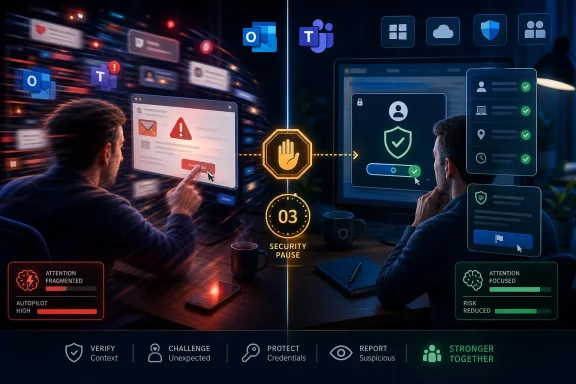
 The Real Security Problem Is Not TikTok, but the Interface It Perfected
The phrase “TikTok Brain” is imprecise, catchy, and probably too convenient. It compresses a messy cluster of behaviors into a meme: rapid scanning, impatience with slow information, craving for novelty, and a tendency to respond before reflecting. But as shorthand for a workplace security problem, it is useful because it names something CISOs already see every day.
The modern employee is not simply distracted. They are surrounded by software that competes for reflexes. Slack, Teams, Outlook, SMS, authenticator prompts, browser notifications, mobile alerts, HR portals, customer systems, and SaaS dashboards all ask for attention in tiny bursts. TikTok did not invent that rhythm, but it turned it into a dominant cultural grammar.
That grammar matters because social engineering attacks increasingly resemble ordinary work interruptions. A fake Teams message, a clipped “urgent” email from a senior executive, or a push notification that appears during a busy day does not need to defeat a hardened security architecture by itself. It only needs to arrive at the right moment, in the right emotional register, and look enough like the stream of prompts employees already process on autopilot.
The uncomfortable implication is that many organizations still train people for a slower internet than the one attackers exploit. They run annual security modules as if the decisive moment is a rational employee sitting quietly at a desktop, absorbing policy, and later applying it calmly. Real attacks happen inside noise.
Annual Training Belongs to the Desktop Era
The old model of security awareness was built around proof of delivery. The company purchased a library of compliance content, assigned everyone a module, chased completions, and filed the report. The metric was tidy: 100 percent completion meant the program had happened.
But training that “happened” is not the same as training that changed behavior. A user can pass a quiz about phishing and still click a convincing credential-harvesting link after a stressful meeting. An employee can know that MFA fatigue attacks exist and still approve a push notification to make the interruptions stop.
That gap between knowledge and action is where modern attackers live. They do not need employees to be ignorant. They need them to be hurried, overloaded, flattered, frightened, or annoyed. The attack surface is no longer just the inbox; it is the employee’s momentary cognitive state.
This is why the long, dry compliance module has become such a bad fit for the threat landscape. It treats cybersecurity as information transfer, when much of the practical battle is habit formation. The employee does not merely need to remember that sender addresses can be spoofed. They need a practiced pause strong enough to interrupt the click.
Attackers Already Understand Engagement Better Than Trainers Do
Cybercriminals have absorbed the lessons of the attention economy because those lessons are profitable. They use urgency, scarcity, authority, social proof, and emotional compression with the same instincts that drive high-performing marketing campaigns. The message must be short enough to process instantly and persuasive enough to bypass skepticism.
That is why “snackable” attacks work. A 15-word note from the “CEO” asking for a quick action can be more effective than a long, clumsy phishing email. A fake login prompt can succeed because it looks like one more routine authentication step. An MFA push flood can turn security itself into the source of irritation.
The best social engineering is not always technically sophisticated. It is behaviorally sophisticated. It knows that the employee who would spot a suspicious URL during a classroom exercise may not inspect it while juggling a customer escalation, a calendar reminder, and a buzzing phone.
This should disturb security leaders because it means user awareness cannot be treated as a static asset. Awareness decays under pressure. Training that fails to account for pressure is training for the wrong environment.
The Brain Is Not Broken, but the Defaults Are Hostile
It is tempting to frame this as a generational decline in attention, with TikTok as the villain and the employee as the victim. That story is emotionally satisfying, but it is too simple. Humans have always filtered information, preferred novelty, and relied on shortcuts under stress.
What has changed is the scale and precision of the systems exploiting those tendencies. Consumer platforms optimize for retention. Workplace platforms optimize for responsiveness. Attackers optimize for compliance with malicious instructions. The user sits at the center of all three optimization systems.
The result is a workplace where speed is rewarded and hesitation is often punished. Employees are told to be responsive, collaborative, customer-focused, and efficient. Then security teams ask them to slow down at exactly the moments when every other part of the business culture tells them to move faster.
That contradiction cannot be solved by scolding users. It has to be designed around. If the environment trains reflexive clicking, then the security program must train interruption of reflexive clicking.
Microlearning Is Useful Only If It Does Not Become TikTok With a Badge
The obvious response is to make security training shorter. That is partly right. Short, focused lessons are better suited to busy employees than hour-long modules, especially when the lesson is tied to a specific behavior such as verifying a link, reporting a suspicious message, or recognizing an MFA fatigue attempt.
But brevity alone is not a strategy. If security awareness simply borrows the addictive mechanics of short-form media, it may reinforce the same impulsivity it is trying to correct. A rapid carousel of cyber tips is not automatically better than a long video if it still trains the user to consume, swipe, and forget.
The better version of microlearning is not “make it entertaining at all costs.” It is “make it small enough to practice deliberately.” The difference matters. One approach competes for attention in the same dopamine market as every other app. The other uses short intervals to rebuild the habit of attention itself.
A one-minute lesson can be powerful if it asks the employee to stop, inspect, decide, and reflect. It is far less useful if it merely delivers a clever animation and a green check mark. Security training should not just fit into fractured attention; it should repair some of the damage caused by fractured attention.
The Security Pause Is a Design Pattern, Not a Slogan
The most useful idea in this debate is the “security pause.” It is simple enough to sound trivial, which is why many organizations underestimate it. In practice, it is the behavioral hinge between awareness and action.
A security pause is the small interruption that happens before a user approves, clicks, forwards, downloads, scans, pays, or shares. It gives the employee time to ask whether the request is expected, whether the channel is appropriate, whether the sender is verified, and whether the action creates risk. The goal is not paranoia. The goal is a repeatable moment of friction.
Good security programs make that pause normal rather than heroic. They do not rely on employees becoming amateur forensic analysts. They teach a few concrete patterns and reinforce them often: unexpected urgency deserves verification; authentication prompts should be tied to actions the user initiated; financial or credential requests should move through known channels; a message that triggers panic is exactly the message that deserves a breath.
This is where security awareness should borrow from product design rather than classroom instruction. If consumer apps can build habits with cues, rewards, and repetition, security teams can build protective habits with cues, practice, and feedback.
Smart Friction Beats More Warnings
Corporate systems already generate too many warnings. Employees learn to dismiss them because many warnings are vague, repetitive, or disconnected from meaningful choices. A banner that says an email came from outside the organization may be technically useful, but over time it becomes part of the wallpaper.
Smart friction is different. It appears at moments of elevated risk and asks for a specific cognitive action. It might delay a wire-transfer request until a second channel confirms it. It might nudge a user to verify a new device login. It might make an MFA approval screen clearer about location, device, and whether the employee initiated the request.
The point is not to slow everything down. Excessive friction creates workarounds, resentment, and shadow IT. The point is to slow down the moments that matter most.
Security leaders should see this as a design problem. If a malicious prompt and a legitimate prompt feel equally routine, the organization has created ambiguity. If reporting a suspicious message takes longer than deleting it, the organization has made the safe behavior harder than the unsafe one.
Gamification Works When It Builds Judgment, Not Just Points
Gamification has a mixed reputation in enterprise security because it is often implemented superficially. Badges, leaderboards, and cartoon villains can make a program look modern without changing how people behave under pressure. Worse, they can trivialize serious risks.
But interactive practice has real value when it is contextual. A simulated phishing message that resembles the actual tools and workflows employees use can teach more than a generic lecture about “bad links.” A short challenge that asks a user to choose whether to approve an MFA prompt can expose the danger of autopilot better than a policy paragraph.
The reward should not merely be a point total. The reward should be fluency. Employees should become faster at recognizing emotional manipulation, not faster at clicking through training. They should learn what urgency feels like when it is being weaponized.
This is why the best awareness programs increasingly look less like school and more like rehearsal. Pilots use simulators because emergencies are rare, stressful, and unforgiving. Cybersecurity should treat high-risk employee decisions with similar seriousness.
Measuring Completion Is Comforting and Mostly Insufficient
The shift from annual training to behavioral security creates an uncomfortable measurement problem. Completion rates are easy. Behavior is harder.
But the hard measurement is the useful one. Security leaders should care whether phishing report rates improve, whether repeated clickers shrink as a population, whether employees challenge unusual payment requests, whether MFA fatigue incidents decline, and whether risky behaviors change after targeted interventions. Those measures are imperfect, but they are closer to operational reality than a completion dashboard.
This also changes how CISOs should talk to boards. “Everyone completed training” is a compliance statement. “Employees are reporting simulated phish faster, approving fewer suspicious prompts, and escalating high-risk requests through verified channels” is a risk statement.
The distinction matters because attackers are not trying to defeat the training department. They are trying to produce a specific behavior. Defensive programs should be judged by whether they change that behavior.
AI Will Make the Attention Problem Worse Before It Makes Training Better
The next phase of social engineering will not merely be shorter and faster. It will be more personalized. Generative AI lowers the cost of producing convincing messages in the recipient’s language, tone, role, and business context.
That makes the “spot the typo” era of awareness training even more obsolete. Future phishing messages may be grammatically perfect, contextually plausible, and timed around real events. Deepfake audio and video will further blur the boundary between familiar communication and manipulation.
This does not mean users are doomed. It means training has to move away from brittle indicators and toward durable behaviors. Employees should not be taught to trust a message because it looks polished. They should be taught to verify requests that create risk, regardless of polish.
AI may also help defenders create more adaptive training, but that promise comes with a warning. If AI-driven awareness becomes just another stream of nudges, reminders, and synthetic content, it may worsen the overload. The best use of AI in this space will be selective, contextual, and restrained.
Windows Shops Have a Particular Stake in Getting This Right
For Windows administrators, this debate is not abstract. The Microsoft 365 workplace is where many of these split-second trust decisions happen: Outlook messages, Teams chats, SharePoint links, OneDrive files, Entra ID sign-ins, Defender alerts, and authenticator prompts. The attack chain often moves through familiar Microsoft-branded surfaces because those surfaces are where work happens.
That makes the distinction between tool deployment and behavior change especially important. Conditional access, phishing-resistant MFA, endpoint detection, email filtering, and identity protection all matter. But users still make consequential decisions inside those environments every day.
A Windows-heavy organization can reduce the burden on users by adopting stronger defaults: passkeys where possible, number matching and richer context for authenticator prompts, stricter controls for OAuth app consent, safer link handling, better reporting buttons, and clearer incident workflows. These controls do not replace awareness. They make awareness less lonely.
Security culture is strongest when the human is not treated as the last brittle layer after every technical control fails. The human should be supported by systems that make the safe action visible, fast, and normal.
The Compliance Checkbox Is a Cultural Smell
Organizations often cling to annual training because it satisfies auditors, budgets, and procurement cycles. It is predictable. It produces records. It feels controllable.
But when completion becomes the goal, the program begins to serve itself. Employees learn that security awareness is something to endure once a year. Managers learn that chasing completion is more important than discussing risky workflows. Security teams learn to optimize for dashboards that may have little relationship to actual exposure.
This is the cultural smell behind checkbox training: it teaches everyone to confuse evidence of activity with evidence of resilience. Attackers, meanwhile, are testing resilience directly. They do not care whether the user passed a module in March if they can get a credential in June.
A mature organization does not abandon compliance requirements. It demotes them to the floor, not the ceiling. The real program happens in the repeated moments where employees practice secure behavior inside the tools they actually use.
The Fight for Attention Has to Become Part of the Security Model
The argument over whether TikTok is “rewiring our brains” can easily become a moral panic about young users, screen time, and cultural decline. That framing is too narrow for enterprise security. The more useful framing is that attention is now a contested resource.
Every notification is a claim on that resource. Every attacker-crafted prompt is an attempt to hijack it. Every poorly designed internal workflow that demands instant action weakens the employee’s ability to notice when something is wrong.
Security teams should therefore treat attention as part of the control environment. That means reducing unnecessary alerts, clarifying high-risk prompts, training with realistic pressure, and giving employees permission to verify before acting. It also means leadership must stop rewarding speed in ways that undermine security.
An employee who pauses to validate a suspicious request should not be seen as slowing the business. That employee is performing a security function. If the culture treats caution as obstruction, no amount of microlearning will fix the problem.
The Lesson From TikTok Is Not to Make Everything Faster
The seductive conclusion is that security training must become more like TikTok: shorter, punchier, more addictive, more visual, more frequent. Some of that is true at the level of format. Nobody is defending the hour-long slide deck as a masterpiece of pedagogy.
But the deeper lesson is almost the opposite. The organization must help employees resist the behavioral patterns that short-form platforms normalize. It must teach them to notice urgency, interrupt reflexes, and reclaim a few seconds of judgment before the click.
That requires restraint. Not every threat update should be a panic bulletin. Not every training moment should chase novelty. Not every employee interaction should become a game.
Cybersecurity awareness should be engaging, but its final purpose is not engagement. Its final purpose is better decisions under pressure.
The New Training Contract Is Written in Seconds
The practical future of security awareness is neither the annual lecture nor the endless stream of bite-sized content. It is a disciplined mix of short learning, contextual practice, smart friction, and behavioral measurement. It recognizes that the decisive security moment often lasts only a few seconds.
In that window, the employee needs more than knowledge. They need a habit. They need a system that supports the habit. They need a culture that rewards the pause.
This is the part many organizations still miss. You cannot ask employees to behave securely in a hostile attention environment while leaving the environment unchanged. If the workplace is a slot machine of prompts, pings, and urgent requests, users will eventually behave like slot-machine users.
The better approach is not to blame the brain. It is to redesign the conditions around the brain.
Where the Swipe Meets the Sign-In Prompt
The debate over “TikTok Brain” becomes useful only when it turns into concrete operational change. Security leaders do not need to litigate whether short-form video is uniquely harmful to cognition before acting on the obvious mismatch between modern attacks and legacy training.
- Employees need short, focused security practice that teaches a deliberate pause rather than another reflexive swipe.
- Organizations should measure changes in risky behavior, reporting, and response quality instead of celebrating completion rates alone.
- Security prompts and warnings should be redesigned so that high-risk moments create clear, useful friction rather than generic alert fatigue.
- Simulated attacks should resemble the actual tools, workflows, and emotional pressures employees face during the workday.
- Technical controls such as phishing-resistant authentication, conditional access, and safer collaboration defaults should reduce how often users must make high-stakes decisions alone.
- Security culture should reward verification and escalation, even when that means slowing down a request that appears urgent.
TikTok may not be literally rewriting the enterprise brain, but it has helped define the tempo of the modern internet — fast, emotional, frictionless, and relentlessly optimized for reaction. Attackers have adapted to that tempo faster than many training programs have. The organizations that fare best will not be the ones that simply make security awareness shorter; they will be the ones that make the critical pause easier, more practiced, and more culturally acceptable than the click.
