

ServiceNow’s hire of Hossein Nowbar as president and chief legal officer on January 5, 2026, crystallizes a broader strategic pivot: the workflow giant is stacking senior legal firepower as it accelerates an aggressive M&A program to build an AI‑native, data‑driven security and governance stack. The appointment brings a seasoned Microsoft legal strategist into the heart of ServiceNow’s fast‑moving expansion, and it raises equally compelling opportunities and risks around integration, regulatory scrutiny, and the governance of AI across enterprise customers.
ServiceNow announced the appointment of Hossein Nowbar as President and Chief Legal Officer on January 5, 2026. In this role, Nowbar will oversee the company’s global legal, ethics, governance, compliance, risk, ServiceNow.org, impact and sustainability, and corporate and government affairs organizations. The hire follows an intense hiring and acquisition period for ServiceNow across 2025 and into 2026, during which the company closed or announced a string of deals including Cuein (Q1 2025), data.world (intent announced May 7, 2025; closed Q3 2025), Logik.ai (closed Q2 2025), Quality 360 (Feb 26, 2025), Veza (intent announced Dec 2, 2025), and the December 23, 2025 announcement to acquire Armis for approximately $7.75 billion in cash, with an expected close in the second half of 2026 subject to regulatory approvals.
Hossein Nowbar spent decades at Microsoft, rising to the role of Chief Legal Officer and Corporate Vice President. He was a public face for several of Microsoft’s most consequential legal and policy initiatives during the cloud and AI era — including work on major acquisitions and a high‑profile indemnity policy for AI customers. Microsoft leadership publicly praised Nowbar’s move to ServiceNow, and the executive himself framed law as an enabler of innovation in his exit commentary.
Analysts note that asset and data scale can be an “order of magnitude” multiplier for discovery tooling. In other words, more high‑quality input data increases the economic value of automation and security workflows because it reduces false positives, improves remediation prioritization, and enables higher‑trust autonomous actions.
Translating that experience into ServiceNow, Nowbar offers:
That ambition is backed by meaningful acquisitions that stitch together device telemetry, governed data, and identity graphs into a single operational fabric. But strategic promise brings countervailing risks: regulatory scrutiny, integration complexity, and concentrated data exposure require diligent legal‑product orchestration. Nowbar’s experience at Microsoft and public role in shaping AI customer commitments provides ServiceNow with an executive who can bridge law, policy, and product — but execution will be the ultimate arbiter.
The next 12–18 months will be a critical proving ground: regulatory reviews for Armis, the technical integration of acquired stacks into the Workflow Data Fabric, and the company’s ability to offer tangible trust and governance assurances to large enterprises. If ServiceNow can translate Nowbar’s legal and policy experience into operational frameworks that reduce customer risk while enabling autonomous workflows, it stands to cement a commanding position in the enterprise AI market. If integration and trust fail to materialize, the rapid acquisition pace could instead amplify operational and regulatory headwinds.
Source: theregister.com ServiceNow snags Microsoft vet to run legal amid M&A spree
 Background
ServiceNow announced the appointment of Hossein Nowbar as President and Chief Legal Officer on January 5, 2026. In this role, Nowbar will oversee the company’s global legal, ethics, governance, compliance, risk, ServiceNow.org, impact and sustainability, and corporate and government affairs organizations. The hire follows an intense hiring and acquisition period for ServiceNow across 2025 and into 2026, during which the company closed or announced a string of deals including Cuein (Q1 2025), data.world (intent announced May 7, 2025; closed Q3 2025), Logik.ai (closed Q2 2025), Quality 360 (Feb 26, 2025), Veza (intent announced Dec 2, 2025), and the December 23, 2025 announcement to acquire Armis for approximately $7.75 billion in cash, with an expected close in the second half of 2026 subject to regulatory approvals.Hossein Nowbar spent decades at Microsoft, rising to the role of Chief Legal Officer and Corporate Vice President. He was a public face for several of Microsoft’s most consequential legal and policy initiatives during the cloud and AI era — including work on major acquisitions and a high‑profile indemnity policy for AI customers. Microsoft leadership publicly praised Nowbar’s move to ServiceNow, and the executive himself framed law as an enabler of innovation in his exit commentary.
Overview: why this hire matters
ServiceNow is not hiring a routine corporate counsel. By naming Nowbar both President and Chief Legal Officer, ServiceNow is centralizing legal, policy, trust, and external affairs in an executive role with board‑level visibility. This signals three strategic priorities:- Bold M&A integration: ServiceNow’s buy‑and‑build strategy — particularly in security, data cataloging, and identity governance — requires a legal leader who understands cross‑border merger approvals, antitrust clearance pathways, and complex contractual integrations.
- Regulatory and policy navigation for AI: With customer deployments of agentic AI and platform‑level orchestration of workflows, ServiceNow faces novel governance, IP, and privacy challenges. Nowbar’s background dealing with Microsoft’s AI commitments and public policy teams positions him to shape external-facing trust frameworks.
- Reputation and customer assurance: ServiceNow’s customers demand strong legal guardrails. Elevating the CLO to a presidential role signals to boards, CISOs, and procurement teams that legal oversight is a strategic product and go‑to‑market enabler, not a back‑office cost center.
Timeline and key facts (clear, verifiable dates)
- January 5, 2026 — ServiceNow announces Hossein Nowbar as President and Chief Legal Officer.
- December 23, 2025 — ServiceNow announced the agreement to acquire Armis for approximately $7.75 billion in cash; expected close: second half of 2026, subject to regulatory approvals.
- May 7, 2025 — ServiceNow announced intent to acquire data.world at its Knowledge 2025 event and framed a Workflow Data Fabric and Workflow Data Network to feed AI agents.
- Q1–Q3 2025 — ServiceNow completed or announced acquisitions including Cuein (closed Q1 2025), Logik.ai (closed Q2 2025), and data.world (closed Q3 2025).
- 2023–2024 — At Microsoft, Nowbar co‑authored or supported public-facing AI customer commitments that promised indemnity for customers using Copilot and Azure OpenAI Service under certain guardrails; the original Copilot Copyright Commitment was announced in 2023 and was broadened to include Azure OpenAI Service by late 2023 and subsequent updates.
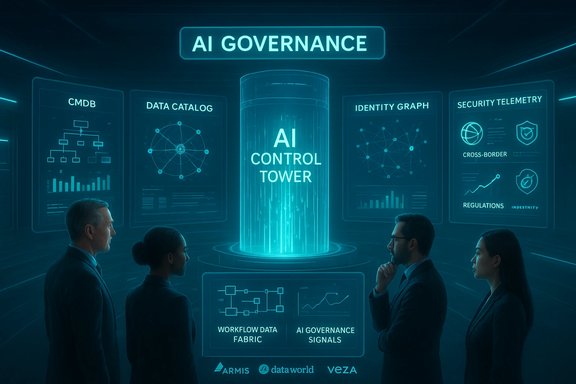
ServiceNow’s M&A context: building an AI control tower
What ServiceNow is buying — and why it matters
ServiceNow’s acquisitions in 2025–2026 collectively reinforce a coherent strategic thesis: become the enterprise control plane for data, identity, security, and AI‑driven workflows. Key elements:- Armis (cyber exposure and asset visibility) — brings agentless discovery and classification across IT, OT, and IoT assets. Integrating Armis into ServiceNow’s CMDB aims to strengthen real‑time visibility for vulnerability and exposure management.
- data.world (data catalog and governance) — supplies metadata, lineage, and cataloging to make enterprise data discoverable, searchable, and governable for AI agents and workflows.
- Veza (identity access graph) — supplies identity‑centric access mapping to enforce least privilege and manage machine/AI identities.
- Cuein (conversation data analysis) and Logik.ai (AI‑powered CPQ) — provide domain capabilities that feed the platform with structured, AI‑ready signals (customer conversations, sales workflows).
The economic and product logic
ServiceNow’s products depend on the accuracy and scope of enterprise context: ticket data, asset inventories, change histories, and access relationships. The addition of asset telemetry (Armis), governed data (data.world), and identity context (Veza) materially increases the platform’s input signals, which in turn buttresses claims about AI accuracy, reduced hallucination risk, and better automation outcomes.Analysts note that asset and data scale can be an “order of magnitude” multiplier for discovery tooling. In other words, more high‑quality input data increases the economic value of automation and security workflows because it reduces false positives, improves remediation prioritization, and enables higher‑trust autonomous actions.
What Hossein Nowbar brings: strengths and strategic fit
Deep experience on the regulatory front
Nowbar has led or advised on large, complex M&A and regulatory matters at Microsoft, including work related to acquisitions widely described in public commentary such as Nuance and the Activision Blizzard transaction. He was also involved in shaping Microsoft’s public AI commitments that offered indemnity to customers using Copilot and the Azure OpenAI Service under documented guardrails.Translating that experience into ServiceNow, Nowbar offers:
- Experience with large, cross‑jurisdictional merger clearance processes.
- Familiarity with government and regulatory stakeholders on data, AI, and competition matters.
- A public track record of coupling legal protections with product guardrails (e.g., IP indemnity tied to product safety features).
Signal to customers and governments
Hiring a senior legal executive from Microsoft — and granting the role president‑level authority — sends a message: ServiceNow intends to meet enterprise customers and governments at the level of trust, accountability, and compliance needed for mission‑critical AI deployments.- For large customers, this can speed procurement and board approvals where legal comfort and vendor commitments matter.
- For governments and regulators, the presence of an experienced interlocutor reduces the time needed to establish working relationships and clarifies governance expectations.
Integration of legal and product strategy
ServiceNow’s list of oversight items for Nowbar includes not just traditional legal and compliance teams but also ethics, impact and sustainability, ServiceNow.org, and corporate affairs. This structure reflects a modern expectation: legal leadership is a product and risk function that must operatively shape how features are built, marketed, and sold — especially where agentic AI can autonomously act on customer data.Risks and open questions
No strategic hire or acquisition program is risk‑free. The following are the key risks and unresolved issues ServiceNow now faces.1) Regulatory and antitrust exposure from rapid M&A
A high cadence of acquisitions — including a $7.75 billion cash deal for Armis — raises natural antitrust and national security reviews, particularly where visibility into critical infrastructure, OT, and device telemetry is involved.- Large cross‑border deals attract multilateral scrutiny. ServiceNow will need to demonstrate competition safeguards, interoperability commitments, and transparent integration plans.
- The regulatory environment for AI governance is evolving rapidly. M&A that changes data concentration dynamics across security and identity domains could draw closer examination.
2) Integration risk and technical debt
Acquiring multiple specialized vendors and folding them into a single platform is a massive engineering and product management exercise.- Integration challenges: aligning data models, APIs, identity schemas, and security postures is non‑trivial. Early integration missteps can create customer churn or expose newly combined attack surfaces.
- Cultural retention: retaining engineers, product leads, and institutional knowledge is essential. Each acquired company has its own product roadmap and customer commitments that ServiceNow must honor and rationalize.
3) Conflict of interest and the revolving door perception
Bringing a C‑level leader from a major technology vendor can trigger perception issues:- Customers, competitors, and regulators may scrutinize whether incumbent relationships are insulated from preferential treatment.
- ServiceNow must demonstrate clear ethics and recusal policies around prior Microsoft contracts and partnerships to avoid claims of preferential vendor treatment.
4) Liability for AI outputs and indemnity expectations
Microsoft’s public Customer Copyright Commitment tied indemnity to use of built‑in guardrails and content filters. ServiceNow, now running its own AI control plane and acquiring data, identity, and security tools, will need to define its own customer commitments:- Will ServiceNow offer indemnity or legal protections for customer actions driven by ServiceNow AI agents?
- If so, those commitments must be tightly coupled with guardrails, logging, and auditable governance controls — a legal promise that requires robust technical enforcement.
5) Concentration of sensitive data
As ServiceNow brings asset discovery, cataloged enterprise data, and identity graphs under one roof, it will host rich datasets that could be attractive to attackers.- Centralizing sensitive telemetry increases the criticality of ServiceNow’s security posture and incident response readiness.
- Customers may demand stronger data partitioning, zero‑copy integrations, or contractual constraints on how aggregated data may be used for model training or product analytics.
Strategic playbook: how ServiceNow can maximize upside and reduce risk
To realize the strategic value of Nowbar’s hire and its M&A spree, ServiceNow should consider the following pragmatic steps.- Operationalize legal‑product integration
- Embed legal and compliance checkpoints into the product development lifecycle for every acquired capability.
- Create living governance runbooks that define when human oversight must intercede for agentic actions.
- Publish clear, auditable customer commitments
- Offer contractual assurances tied to demonstrable technical guardrails (logging, content filters, model provenance).
- Explicitly state the bounds of indemnity, liability caps, and required customer behaviors to qualify for protections.
- Design conservative integration paths for sensitive domains
- Use phased integration: start with data enrichment and visibility, then gradually add remediation automation.
- Preserve access controls and identity separation until identity graphs and device telemetry are validated in production.
- Engage proactively with regulators and standards bodies
- Place legal and policy teams (led by the CLO) at the center of standards engagement for AI safety, data flows, and identity governance.
- Participate in multi‑stakeholder policy working groups to shape pragmatic compliance frameworks that support enterprise adoption.
- Invest in post‑merger talent retention and alignment
- Create cross‑acquisition squads that pair legacy product owners with new acquisition teams to accelerate replatforming.
- Offer retention incentives for key engineers and product leaders who are instrumental to integration.
Competitive landscape and market implications
ServiceNow’s platform‑centric play positions it as a direct counter to point solutions and a defender against encroachment from other large SaaS vendors aiming for horizontal control planes.- Platform vs. point solutions: ServiceNow is betting that customers will prefer a unified AI control tower that brings data, identity, and exposure intelligence together — rather than dozens of niche tools stitched together.
- Industry consolidation: If ServiceNow successfully integrates Armis, data.world, Veza, and other acquisitions, it may tilt enterprise buying patterns toward platform consolidation and away from fragmented security stacks.
- Vendor responses: Competitors will likely accelerate their own platform strategies and partnerships. Expect deeper integrations from cloud providers and security vendors aimed at countering ServiceNow’s combined value proposition.
Why the timing matters
Two factors make this leadership and M&A push especially time‑sensitive:- The rise of agentic AI has increased demand for context‑aware automation. Enterprises want AI that can act reliably and with governance — which requires tight coupling of data quality, identity, and security.
- Regulatory attention on AI, data protection, and competition is intensifying. Early investments in legal leadership, cross‑functional governance, and defensible product controls can be a differentiator in an era where public commitments matter to large enterprise customers and procurement committees.
Caveats and unverifiable or contested points
- Published profiles of Hossein Nowbar’s Microsoft tenure vary slightly. Some materials describe “25+ years” while public career notes indicate a start date in the late 1990s; the precise number of years in Microsoft service as reported in different summaries varies modestly. This difference does not materially alter his experience profile but is worth noting for accuracy.
- Analyst commentary that quantifies exact multipliers (for example, “order of magnitude” increases in discovery capabilities) reflects expert interpretation of technical synergies rather than a precise, universally applicable metric. Those statements are directional and should be read as analyst judgment, not deterministic outcomes.
- Any forward‑looking claims about deal synergies, customer retention improvements, or revenue multipliers are inherently conditional upon successful integration, regulatory approvals (particularly for the Armis deal), and market adoption.
Conclusion
ServiceNow’s appointment of Hossein Nowbar as President and Chief Legal Officer is a high‑stakes, high‑signal move that aligns legal authority with product and corporate strategy during a period of intensive M&A. The hire underlines ServiceNow’s ambition to be the AI control tower for enterprise workflows — a platform that not only automates work but also governs it safely and reliably.That ambition is backed by meaningful acquisitions that stitch together device telemetry, governed data, and identity graphs into a single operational fabric. But strategic promise brings countervailing risks: regulatory scrutiny, integration complexity, and concentrated data exposure require diligent legal‑product orchestration. Nowbar’s experience at Microsoft and public role in shaping AI customer commitments provides ServiceNow with an executive who can bridge law, policy, and product — but execution will be the ultimate arbiter.
The next 12–18 months will be a critical proving ground: regulatory reviews for Armis, the technical integration of acquired stacks into the Workflow Data Fabric, and the company’s ability to offer tangible trust and governance assurances to large enterprises. If ServiceNow can translate Nowbar’s legal and policy experience into operational frameworks that reduce customer risk while enabling autonomous workflows, it stands to cement a commanding position in the enterprise AI market. If integration and trust fail to materialize, the rapid acquisition pace could instead amplify operational and regulatory headwinds.
Source: theregister.com ServiceNow snags Microsoft vet to run legal amid M&A spree
