

Shopify’s Winter ’26 push turns a nascent idea — letting AI assistants not just recommend products but actually sell them inside conversations — into a platform-ready reality with a new feature set called Agentic Storefronts, and it does so by turning merchant catalogs into machine-readable, agent-friendly feeds that plug directly into ChatGPT, Perplexity, Microsoft Copilot and other assistants.
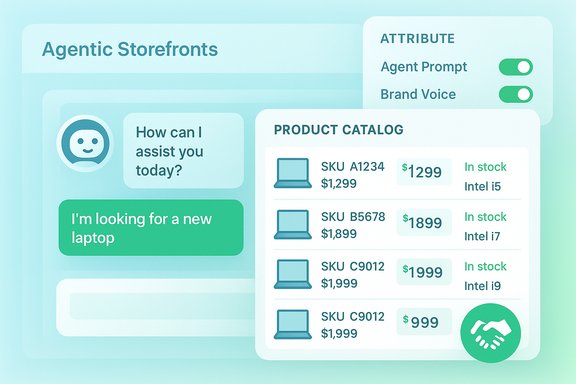
Agentic commerce is the term industry engineers and product teams now use to describe a flow where conversational AI performs discovery, comparison, and the checkout handshake inside the same conversational context. This is a structural shift away from page-centric web commerce toward conversation-first discovery and purchase. In practice, that means an assistant might ask clarifying questions, present a short list of buyable items, and — when permitted — initiate a tokenized checkout without sending the user away from the chat. OpenAI’s Instant Checkout rollout is a high-profile example of the model in action.
Shopify’s Winter ’26 Edition bundles more than 150 updates but places Agentic Storefronts at the center of its thesis: prepare merchants to appear in AI conversations and preserve merchant control over branding, inventory and checkout. Shopify frames the capability as a one-time setup that syndicates merchant product metadata to multiple AI platforms while routing purchases back through Shopify checkout rails. Shopify’s product pages and Editions materials describe the feature as a way to make every Shopify store “agent-ready by default.”
This single-setup approach is the practical answer to the fragmentation problem: instead of building bespoke integrations for each assistant (ChatGPT, Copilot, Perplexity, etc., merchants opt into a canonical feed managed by Shopify that is purpose-built for agentic discovery. Shopify says orders originated by agents flow back into merchant admin with attribution intact so merchants retain the relationship and order records.
Agents rely on that structure to do the heavy-lifting of comparison and pre-qualification. Without it, an AI assistant may simply not surface a merchant’s product even when it perfectly matches intent. That visibility issue is the core reason Shopify positions Agentic Storefronts as critical infrastructure for merchants that want to remain discoverable in AI-driven channels.
By offering a standardized feed and attribution, Shopify reduces friction for merchants and strengthens its position as the conduit between brands and agentic discovery surfaces. However, platform dependence is a double-edged sword: merchants who bind too much of their revenue to third-party assistants risk being subject to changing commercial terms or ranking rules. Diversification and ownership of customer relationships remain crucial.
For AI platforms, agentic commerce is both an engagement play and a monetization opportunity. Instant Checkout demonstrates how an agent becomes sticky when it can complete transactions. The payment and tokenization work, however, requires careful engineering and partnerships with processors — which is why Stripe, card networks and payments players are actively involved in standardization efforts.
The opportunity is substantial — faster conversions, new discovery surfaces and lower acquisition friction for merchants who prepare their metadata and operations. The downside is real too: concentration of gatekeeper power, measurement opacity, and operational risks for underprepared sellers. Merchants and IT leaders should treat agentic commerce as both a technical challenge and a strategic channel: invest in catalog quality, token testing, observability and contingency plans so that the promise of in-chat buying becomes a reliable, auditable revenue stream rather than a fleeting experiment.
What’s happening now is not simply a new widget — it’s an infrastructural race to define how commerce gets represented and transacted inside AI systems. For merchants that take the engineering steps Shopify recommends, being discoverable in the next wave of shopping conversations will be an immediate advantage; for those that delay, the risk is that discovery moves somewhere they don’t control.
Source: PYMNTS.com Shopify Brings Merchant Catalogs to ChatGPT, Perplexity and Copilot | PYMNTS.com
 Background
Agentic commerce is the term industry engineers and product teams now use to describe a flow where conversational AI performs discovery, comparison, and the checkout handshake inside the same conversational context. This is a structural shift away from page-centric web commerce toward conversation-first discovery and purchase. In practice, that means an assistant might ask clarifying questions, present a short list of buyable items, and — when permitted — initiate a tokenized checkout without sending the user away from the chat. OpenAI’s Instant Checkout rollout is a high-profile example of the model in action.Shopify’s Winter ’26 Edition bundles more than 150 updates but places Agentic Storefronts at the center of its thesis: prepare merchants to appear in AI conversations and preserve merchant control over branding, inventory and checkout. Shopify frames the capability as a one-time setup that syndicates merchant product metadata to multiple AI platforms while routing purchases back through Shopify checkout rails. Shopify’s product pages and Editions materials describe the feature as a way to make every Shopify store “agent-ready by default.”
What Shopify shipped: Agentic Storefronts and Shopify Catalog
One feed, many AI surfaces
Agentic Storefronts are essentially a syndication and normalization layer. Merchants configure catalog metadata once inside Shopify, and Shopify Catalog transforms that data into structured, canonical records — categories, attributes, variants, GTINs/identifiers, prices and live inventory — that AI assistants can query and interpret reliably. Merchants can toggle which AI platforms may surface their products and control knowledge-base content (policies, FAQs, brand voice) exposed to agents.This single-setup approach is the practical answer to the fragmentation problem: instead of building bespoke integrations for each assistant (ChatGPT, Copilot, Perplexity, etc., merchants opt into a canonical feed managed by Shopify that is purpose-built for agentic discovery. Shopify says orders originated by agents flow back into merchant admin with attribution intact so merchants retain the relationship and order records.
Catalog hygiene and machine-readable metadata
The secret sauce for agentic discovery is structured, high-fidelity product metadata. Shopify Catalog attempts to infer and normalize attributes across millions of SKUs, consolidating duplicates and exposing canonical variants so agents avoid showing stale or duplicate results. Properly structured metadata — consistent SKUs, accurate dimensions, up-to-date inventory, shipping windows and clear return policies — is what prevents a product from being invisible to agents even if it fits a shopper’s query.Agents rely on that structure to do the heavy-lifting of comparison and pre-qualification. Without it, an AI assistant may simply not surface a merchant’s product even when it perfectly matches intent. That visibility issue is the core reason Shopify positions Agentic Storefronts as critical infrastructure for merchants that want to remain discoverable in AI-driven channels.
The technical plumbing: tokens, protocols and provenance
Agentic Commerce Protocol and Instant Checkout
Agentic commerce depends on three interlocking technical primitives:- Machine-readable product data — structured catalog records that capture attributes, pricing, inventory and merchant policies.
- Delegated/tokenized payments — ephemeral credentials or scoped tokens that let an assistant initiate payment without exposing raw card data.
- Orchestration and provenance — runtime layers that record the conversation, the agent’s decision path, and an auditable link between the agent action and the resulting merchant order.
Why tokenization matters
Tokenized payments are essential to reduce credential exposure and make in-chat checkouts auditable. Tokens are scoped — by merchant, amount, time window or SKU — and revocable, giving merchants, processors and card networks an auditable trail for disputes. Payment partners have been explicit that tokenization and short-lived credentials are the practical enablers for safe agentic payments.Attribution & observability
A critical engineering requirement is observability: merchants must be able to trace an order back to the agent prompt, the items presented, and the token handshake to resolve disputes or fraud signals. Shopify says every order flows into the merchant admin with full AI channel attribution; independent reporting and analyst coverage show Shopify is treating this as a first-class telemetry and measurement challenge. Still, definitions of “AI traffic” and “AI-attributed orders” vary and require careful interpretation.Sidekick and the Winter ’26 productivity push
Sidekick, Shopify’s merchant-facing assistant, has moved from being a reactive aide to a proactive workflow tool in this release. The upgrade transforms Sidekick into a workflow builder that can:- Generate and modify admin settings from natural-language prompts,
- Scaffold simple admin apps and Flow automations,
- Produce marketing copy, product descriptions and theme edits,
- Save and reuse “skills” for repeatable tasks.
Why merchants should care: benefits and practical upside
- New discovery surface: AI assistants are increasingly the first place consumers start product searches, and inclusion in agentic channels creates an incremental demand source beyond search and social.
- Friction reduction: Instant Checkout and tokenized rails can shorten the funnel dramatically, reducing abandonment and speeding conversions.
- Leveling effect for smaller merchants: Properly structured feeds allow small sellers to compete on product fit and feed quality rather than on hefty ad budgets.
- Centralized control: Shopify promises merchant-of-record status, attribution and visibility so brands keep customer relationships and order fulfillment responsibility.
The risks: gatekeepers, opacity, and operational strain
Visibility and ranking risk
If an AI assistant cannot interpret a product’s attributes, that SKU may never appear in the shortlist — even when it’s a perfect match. That creates a new form of ranking risk: discoverability becomes a function of feed quality and the agent’s internal ranking rules rather than traditional SEO or paid placements. Small merchants with poor metadata may effectively disappear from agentic channels. Shopify’s approach seeks to mitigate that by making catalog formatting and metadata hygiene easier, but the underlying gatekeeper dynamics remain.Attribution and measurement opacity
Large relative multipliers (7×, 11×) draw attention but also require precise definitions. What counts as “AI traffic”? How is an “AI-attributed order” attributed when a buyer interacts with multiple channels? Without standardized, auditable attribution rules, headline metrics risk overstating the absolute business impact. Analysts and merchants should expect attribution models to evolve and should instrument their systems to capture provenance and agent IDs properly.Fees, economics and platform leverage
When checkout moves into the assistant, platforms gain leverage: they can monetize discovery or capture incremental payment flows. OpenAI’s Instant Checkout has explicitly introduced a fee structure for merchants in early pilots; other agents could layer in placement or commission models over time. Merchants must weigh the distribution value against potential fee erosion and the risk of being subject to changing platform commercial terms.Fraud, disputes and operational overload
Agentic checkouts create new fraud vectors — token misuse, prompt injection, or misinterpreted constraints leading to the wrong SKU purchase. Merchants must extend fraud detection to account for agent-originated sessions, add reconciliation steps linking tokens to merchant orders, and prepare customer-service playbooks for ambiguous refunds and returns. The operational strain can be acute for merchants without robust fulfillment and inventory systems.Privacy and regulatory exposure
Exposing product feeds, order metadata and customer interactions to third-party AI platforms raises data-protection and cross-border transfer questions. Regulators will likely scrutinize how conversational purchases are disclosed, how consent is captured, and how agents surface merchant information. Merchants operating in strict jurisdictions must treat agentic-enabled flows as a compliance and privacy engineering problem.Practical checklist for merchants: readiness playbook
- Audit your product feed
- Ensure canonical SKUs, GTINs/UPC where available, normalized titles and complete attribute sets (size, color, material).
- Implement near real-time inventory sync
- Define freshness SLAs and guardrails to avoid overselling if agent-driven demand spikes.
- Enable and test tokenized checkout flows
- Integrate delegated payment rails (Stripe, Shop Pay) and exercise sandbox token flows end-to-end.
- Harden fraud and dispute workflows
- Add AI-aware fraud rules, map tokens to order IDs, and rehearse dispute resolution for agent-originated orders.
- Improve product content quality
- Use structured attributes and crisp copy so agents can match intent to the right SKU.
- Instrument provenance and attribution
- Capture prompt → agent response → token issuance → order ID in logs and analytics to measure channel quality.
- Maintain owned channels
- Continue investments in SEO, email, and direct-retail relationships to avoid over-dependence on any single agent.
Strategic implications for Shopify and the industry
Shopify’s move is a classic platform play: build the supply-side primitives (catalog, checkout rails, admin tooling) and partner with multiple demand-side agents so merchants can be distributed across a fragmented assistant landscape. Shopify’s dataset advantage — access to billions of transaction signals and millions of merchants — is an immediate moat when training commerce-focused models or improving recommendation quality.By offering a standardized feed and attribution, Shopify reduces friction for merchants and strengthens its position as the conduit between brands and agentic discovery surfaces. However, platform dependence is a double-edged sword: merchants who bind too much of their revenue to third-party assistants risk being subject to changing commercial terms or ranking rules. Diversification and ownership of customer relationships remain crucial.
For AI platforms, agentic commerce is both an engagement play and a monetization opportunity. Instant Checkout demonstrates how an agent becomes sticky when it can complete transactions. The payment and tokenization work, however, requires careful engineering and partnerships with processors — which is why Stripe, card networks and payments players are actively involved in standardization efforts.
Critical analysis: strengths, unanswered questions and what to watch
- Strength: Usability and reduced friction. Bringing shopping into conversation reduces context switching and can materially lift conversion if the product data and tokenized rails are flawless. Shopify’s one-feed model simplifies merchant participation across multiple agents.
- Strength: Merchant control and telemetry. Shopify emphasizes merchant-of-record status and admin-level attribution so brands retain ownership of their customers and orders. This is consequential for loyalty, returns and lifetime value measurement.
- Unanswered: Absolute scale vs. relative multipliers. Shopify’s 7× and 11× growth figures are directionally meaningful but lack context about absolute volumes (what share of total GMV is AI-originated today?. Treat these as indicators of momentum, not proof of large absolute impact without definitions.
- Unanswered: Commercial terms over time. Will agents monetize placement and discovery? Early pilots show fees and commissions may appear; merchants should expect changing economics as platforms seek sustainable revenue models.
- Risk: Gatekeeper concentration. If a small set of assistants become dominant discovery layers, they’ll wield significant influence over who is seen and how purchases are completed. That creates both commercial and regulatory pressure.
- Risk: Operational mismatch. Small merchants can gain demand suddenly; without operational readiness (accurate inventory, cancellations, fulfillment capacity), they risk chargebacks, poor reviews and damaged brand trust.
Short-term recommendations for IT leaders and merchants
- Treat agentic readiness as an engineering program, not a marketing checkbox. Catalog normalization, API SLAs, token mapping and observability require engineering discipline.
- Start with low-complexity SKUs for pilot programs — consumables, replacement parts or single-item purchases where Instant Checkout is simplest.
- Maintain robust monitoring for chargeback rates and returns specifically attributed to agentic channels; instrument test alerts for abnormal order patterns.
- Negotiate contractual clarity on fees, data sharing, and attribution with any agent partners or integrations you adopt.
- Preserve first-party customer relationships via email capture and loyalty programs even when purchases originate in a third-party assistant.
Conclusion
Shopify’s Agentic Storefronts make a pragmatic bet: conversations are already where shoppers begin discovery, and the technical barriers to agentic commerce are solvable with structured catalogs, tokenized payment rails and clear provenance. By packaging these primitives inside the Winter ’26 Edition and coupling them with productivity upgrades like Sidekick, Shopify aims to make the transition to conversation-first commerce accessible to millions of merchants.The opportunity is substantial — faster conversions, new discovery surfaces and lower acquisition friction for merchants who prepare their metadata and operations. The downside is real too: concentration of gatekeeper power, measurement opacity, and operational risks for underprepared sellers. Merchants and IT leaders should treat agentic commerce as both a technical challenge and a strategic channel: invest in catalog quality, token testing, observability and contingency plans so that the promise of in-chat buying becomes a reliable, auditable revenue stream rather than a fleeting experiment.
What’s happening now is not simply a new widget — it’s an infrastructural race to define how commerce gets represented and transacted inside AI systems. For merchants that take the engineering steps Shopify recommends, being discoverable in the next wave of shopping conversations will be an immediate advantage; for those that delay, the risk is that discovery moves somewhere they don’t control.
Source: PYMNTS.com Shopify Brings Merchant Catalogs to ChatGPT, Perplexity and Copilot | PYMNTS.com
