

Shopify released its Spring ’26 Edition in June 2026, bundling more than 150 product updates under the “Everywhere” banner and pushing merchants toward AI-assisted discovery, agentic storefronts, automated marketing, richer analytics, and broader cross-channel selling. The announcement is not just another seasonal feature dump. It is Shopify’s clearest statement yet that the storefront is no longer the center of commerce. The company is preparing merchants for a world where buying begins inside chatbots, search assistants, social feeds, retail counters, and marketplaces that may never send a shopper to a traditional website at all.
For years, the e-commerce playbook was simple enough to explain in a dashboard screenshot: attract traffic, convert it on your site, retain the customer by email, repeat. Shopify’s Spring ’26 Edition argues that this model is becoming too slow for the way discovery now works. If a shopper asks ChatGPT, Copilot, Gemini, Google AI Mode, or another assistant for a product recommendation, the old merchant problem was ranking in Google; the new one is whether the product is visible to the agent at all.
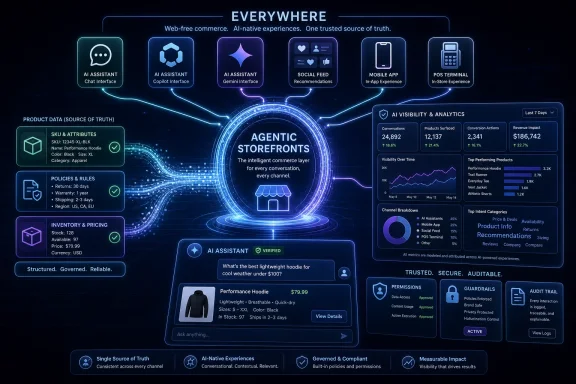
That is the strategic weight behind Shopify’s Agentic Storefronts push. The feature is pitched as a way for merchants to control how products and brand information appear across AI shopping experiences, including major assistants and Shopify’s own Shop app. In plain terms, Shopify wants to be the commerce layer underneath the AI interface, even when the customer never thinks of themselves as visiting a Shopify store.
This is not a cosmetic change. The moment an AI assistant can recommend, compare, answer questions, and route a buyer toward checkout, the storefront becomes less like a destination and more like a structured data source. Merchants who once obsessed over home page banners may find themselves tuning product metadata, return policies, inventory feeds, and brand guidelines so software agents can interpret them correctly.
That shift benefits Shopify if it can make itself the trusted pipe between merchants and AI platforms. It also creates new dependency. A merchant may gain access to more surfaces, but the rules governing those surfaces will be shaped by Shopify, the AI platform, and whatever commercial agreements or ranking systems sit between them.
That sounds expansive, but it is also defensive. Shopify has spent years giving independent merchants an alternative to Amazon-style marketplace dependence. Now the platform has to stop those same merchants from becoming invisible in AI-mediated shopping, where the first screen may be a generated answer rather than a search results page.
Agentic Storefronts are the headline because they directly address that fear. Shopify says merchants will be able to manage AI-channel visibility and track orders, sales, and conversions from a dedicated dashboard inside Shopify Admin. The addition of search intelligence data and AI visibility recommendations is a tacit admission that “SEO” is mutating into something stranger: optimization for software intermediaries that may not disclose their ranking logic in familiar ways.
The risk is that merchants mistake presence for control. Being available inside an AI shopping flow does not necessarily mean being fairly surfaced, correctly described, or profitably converted. The dashboard may tell a store owner where conversions came from, but it cannot fully explain why an assistant recommended one product over another.
For small merchants, this is an obvious pitch. Many stores do not have a data analyst, merchandising manager, ad buyer, and operations lead. If Sidekick can summarize performance, suggest actions, pull information from integrated apps, and execute changes with guardrails, Shopify can sell AI as labor leverage rather than futuristic decoration.
For larger merchants, the calculus is more complicated. Admin-level AI that can “perform actions” across connected software raises familiar governance questions: who approved the action, what data was used, what changed, and how easily can it be audited? The more useful Sidekick becomes, the more it needs enterprise-grade permissions, logging, and rollback behavior.
This is where Shopify’s audience splits. The entrepreneur wants fewer tabs and faster decisions. The IT administrator wants least privilege, change history, and predictable integration behavior. Shopify has to satisfy both without turning Sidekick into either a toy or a compliance headache.
This is exactly the kind of feature merchants ask for after a decade of rising ad complexity. A small retailer may know its product and customer but still struggle with budget allocation, creative rotation, audience targeting, email timing, and channel attribution. Campaign Autopilot compresses that work into a system Shopify can tune using its commerce data.
But automation changes the accountability chain. If a human marketer wastes a budget, the merchant knows whom to blame. If an AI campaign quietly shifts spend toward low-margin products, misreads seasonality, or optimizes for conversions that increase returns, the answer is harder. The system may be correct by its own metric and wrong by the merchant’s cash flow.
The planned inclusion of ChatGPT Ads is especially important. If shopping discovery moves into AI conversations, advertising will follow. Shopify is positioning itself to help merchants buy their way into those channels as well as appear organically within them. That could be useful, but it also means the next era of commerce may reproduce the same pay-to-play dynamics merchants already know from search and social.
The upside is obvious. Many abandoned carts are really unanswered questions: will this fit, does it ship to my country, is it compatible, can I return it, what is the difference between these two options? If an AI assistant can answer those questions accurately at the moment of hesitation, conversion rates should improve.
The harder part is trust. A chatbot that invents a shipping promise or misstates a warranty can create a customer service problem faster than a human would. Shopify’s emphasis on using merchant catalogues, policies, and brand guidelines is meant to reduce that risk, but the quality of the answers will still depend on the quality of the underlying data.
This is where many merchants will discover that their “content problem” is actually an operations problem. If product data is sparse, policies are inconsistent, inventory is messy, and brand rules live in someone’s head, an AI assistant will not magically fix the store. It will expose the disorder at conversational speed.
The old analytics model assumed relatively clean paths: ad click, website session, add to cart, checkout, purchase. Agentic commerce breaks that simplicity. A shopper may discover a product in an AI assistant, compare it in another surface, complete the purchase through a commerce layer, and later interact with customer support through yet another channel.
Shopify’s AI-channel dashboard is meant to bring some order to that mess. Tracking orders, sales, and conversions from AI channels gives merchants a first view of whether these surfaces are meaningful revenue drivers or just another dashboard tile. Search intelligence and visibility insights add a more diagnostic layer: not merely what sold, but where the merchant is failing to appear.
The strategic question is whether Shopify can make these measurements credible enough for merchants to act on. Attribution has always been a contested fiction in digital commerce. AI intermediaries may make it even murkier, because recommendation logic, ad exposure, product feeds, and checkout behavior are distributed across multiple companies.
Collective is not as flashy as Agentic Storefronts, but it may be more immediately practical for many merchants. Inventory risk remains one of the hardest constraints in retail. The ability to add products without buying stock upfront can help smaller stores test categories, respond to trends, and smooth seasonal gaps.
There is a marketplace logic here, but Shopify is trying to avoid making it feel like a marketplace. Instead of pushing merchants into a single consumer-facing bazaar, it lets them form supplier-retailer relationships behind their own storefronts. That preserves brand ownership while borrowing some of the inventory flexibility that made larger platforms powerful.
For Australian businesses, the broader Spring ’26 package also speaks to a familiar problem: cross-channel selling is no longer optional, but managing it is expensive. AI visibility, marketing automation, supplier expansion, and cross-border tools all target the same pressure point. Shopify is trying to make a small merchant behave like a distributed retail operation without hiring a distributed retail team.
That balance is important. The future of commerce may involve AI assistants, but plenty of revenue still moves through counters, pop-ups, markets, and stores. For merchants that sell both online and offline, the value of Shopify is not merely having an e-commerce site; it is having inventory, customer, payment, and reporting systems that do not fracture when a sale happens in person.
The POS work also underscores Shopify’s larger ambition. The company does not want to be a website builder with payments. It wants to be the merchant operating system, spanning online storefronts, retail terminals, supplier networks, B2B tools, international shipping, marketing campaigns, and now AI shopping agents.
That ambition explains the density of the release. More than 150 updates can look like a product-marketing avalanche, but the underlying pattern is consistent: reduce the number of separate tools a merchant needs, then use Shopify’s data position to automate more of the work.
Commerce platforms tend to reveal their ceiling through administrative edge cases. Can a company sell under multiple entities? Can it separate reporting, taxes, billing, permissions, and compliance obligations without duct tape? Can the same platform serve a founder selling handmade goods and a retailer with several business units?
Shopify has spent years trying to prove the answer is yes. Features like multi-entity selling are not headline-grabbers, but they remove reasons for more complex merchants to graduate away from the platform. In that sense, Spring ’26 is both a merchant-acquisition release and a retention release.
This also matters for IT teams. The more Shopify becomes core infrastructure, the more it enters conversations about governance, integration, identity, auditability, and data ownership. The platform’s consumer-simple reputation is useful, but enterprise commerce is won or lost in the boring corners.
Merchants will need to think about product feeds the way administrators think about identity directories: structured, accurate, permissioned, and monitored. Bad data will not merely produce a bad search result. It may produce a bad recommendation, a wrong promise, or a transaction that customer support has to unwind.
There is also a platform-dependence issue. AI commerce surfaces will likely have their own eligibility rules, ranking systems, commercial incentives, and policy constraints. Merchants may get new traffic, but they may also face new opacity. The question “Why did my product not appear?” may become as common as “Why did my ad stop converting?”
Shopify’s advantage is that it can abstract some of this complexity. Its challenge is that abstraction can become lock-in. The easier Shopify makes it to participate in AI commerce, the more merchants may depend on Shopify’s interpretation of what AI platforms need.
That is a major change in leverage. The assistant becomes a gatekeeper, the product catalogue becomes a machine-readable pitch, and checkout becomes an embedded action rather than a destination. Shopify wants to make sure its merchants are not locked out of that future.
The company’s framing is optimistic: merchants of every size can show up wherever customers are discovering and buying. That is true as far as it goes. But every “wherever” comes with rules. A merchant that sells through ChatGPT, Copilot, Gemini, Shop, Meta, email, POS, and supplier networks is not escaping platforms; it is managing more of them.
The best version of Shopify’s strategy gives merchants a unified cockpit for this complexity. The worst version gives them more channels than they can understand and more automation than they can audit. Spring ’26 is a bet that Shopify can land closer to the first outcome.
 Shopify Is Trying to Move the Checkout Before the Customer Leaves the Conversation
For years, the e-commerce playbook was simple enough to explain in a dashboard screenshot: attract traffic, convert it on your site, retain the customer by email, repeat. Shopify’s Spring ’26 Edition argues that this model is becoming too slow for the way discovery now works. If a shopper asks ChatGPT, Copilot, Gemini, Google AI Mode, or another assistant for a product recommendation, the old merchant problem was ranking in Google; the new one is whether the product is visible to the agent at all.That is the strategic weight behind Shopify’s Agentic Storefronts push. The feature is pitched as a way for merchants to control how products and brand information appear across AI shopping experiences, including major assistants and Shopify’s own Shop app. In plain terms, Shopify wants to be the commerce layer underneath the AI interface, even when the customer never thinks of themselves as visiting a Shopify store.
This is not a cosmetic change. The moment an AI assistant can recommend, compare, answer questions, and route a buyer toward checkout, the storefront becomes less like a destination and more like a structured data source. Merchants who once obsessed over home page banners may find themselves tuning product metadata, return policies, inventory feeds, and brand guidelines so software agents can interpret them correctly.
That shift benefits Shopify if it can make itself the trusted pipe between merchants and AI platforms. It also creates new dependency. A merchant may gain access to more surfaces, but the rules governing those surfaces will be shaped by Shopify, the AI platform, and whatever commercial agreements or ranking systems sit between them.
The “Everywhere” Edition Is Really About Not Being Stranded on the Web
Shopify’s branding for Spring ’26 is unusually literal. “Everywhere” is not just a marketing theme; it is the operating assumption of the release. Commerce is being scattered across conversational AI, social platforms, mobile apps, retail point-of-sale systems, cross-border tooling, supplier networks, and B2B workflows.That sounds expansive, but it is also defensive. Shopify has spent years giving independent merchants an alternative to Amazon-style marketplace dependence. Now the platform has to stop those same merchants from becoming invisible in AI-mediated shopping, where the first screen may be a generated answer rather than a search results page.
Agentic Storefronts are the headline because they directly address that fear. Shopify says merchants will be able to manage AI-channel visibility and track orders, sales, and conversions from a dedicated dashboard inside Shopify Admin. The addition of search intelligence data and AI visibility recommendations is a tacit admission that “SEO” is mutating into something stranger: optimization for software intermediaries that may not disclose their ranking logic in familiar ways.
The risk is that merchants mistake presence for control. Being available inside an AI shopping flow does not necessarily mean being fairly surfaced, correctly described, or profitably converted. The dashboard may tell a store owner where conversions came from, but it cannot fully explain why an assistant recommended one product over another.
Sidekick Becomes Less of a Chatbot and More of an Operating Layer
Shopify’s AI assistant Sidekick has been steadily moving from novelty to infrastructure, and Spring ’26 continues that progression. The updated Sidekick is embedded more deeply into Shopify Admin, offers personalized recommendations, and can connect with third-party applications. That matters because an assistant trapped inside one product is a help widget; an assistant that can see across commerce operations starts to look like a management console.For small merchants, this is an obvious pitch. Many stores do not have a data analyst, merchandising manager, ad buyer, and operations lead. If Sidekick can summarize performance, suggest actions, pull information from integrated apps, and execute changes with guardrails, Shopify can sell AI as labor leverage rather than futuristic decoration.
For larger merchants, the calculus is more complicated. Admin-level AI that can “perform actions” across connected software raises familiar governance questions: who approved the action, what data was used, what changed, and how easily can it be audited? The more useful Sidekick becomes, the more it needs enterprise-grade permissions, logging, and rollback behavior.
This is where Shopify’s audience splits. The entrepreneur wants fewer tabs and faster decisions. The IT administrator wants least privilege, change history, and predictable integration behavior. Shopify has to satisfy both without turning Sidekick into either a toy or a compliance headache.
Campaign Autopilot Turns Marketing Into a Guardrailed Black Box
Campaign Autopilot may be the most commercially straightforward update in the release. Shopify is promising automated marketing campaigns across Meta platforms, the Shop app, and email, with additional integrations including Microsoft Advertising, ChatGPT Ads, and Snapchat planned. The pitch is simple: tell Shopify the business goal, set the guardrails, and let the system create and optimize campaigns.This is exactly the kind of feature merchants ask for after a decade of rising ad complexity. A small retailer may know its product and customer but still struggle with budget allocation, creative rotation, audience targeting, email timing, and channel attribution. Campaign Autopilot compresses that work into a system Shopify can tune using its commerce data.
But automation changes the accountability chain. If a human marketer wastes a budget, the merchant knows whom to blame. If an AI campaign quietly shifts spend toward low-margin products, misreads seasonality, or optimizes for conversions that increase returns, the answer is harder. The system may be correct by its own metric and wrong by the merchant’s cash flow.
The planned inclusion of ChatGPT Ads is especially important. If shopping discovery moves into AI conversations, advertising will follow. Shopify is positioning itself to help merchants buy their way into those channels as well as appear organically within them. That could be useful, but it also means the next era of commerce may reproduce the same pay-to-play dynamics merchants already know from search and social.
Storefront Agent Is the Sales Associate Shopify Wants to Put on Every Site
The new Storefront Agent brings AI assistance directly to merchants’ online stores. It can answer customer questions, recommend products, and guide shoppers through purchases using catalog data, policies, and brand guidelines. In retail terms, Shopify is giving every store a tireless sales associate who never asks for lunch and never admits it has not read the returns policy.The upside is obvious. Many abandoned carts are really unanswered questions: will this fit, does it ship to my country, is it compatible, can I return it, what is the difference between these two options? If an AI assistant can answer those questions accurately at the moment of hesitation, conversion rates should improve.
The harder part is trust. A chatbot that invents a shipping promise or misstates a warranty can create a customer service problem faster than a human would. Shopify’s emphasis on using merchant catalogues, policies, and brand guidelines is meant to reduce that risk, but the quality of the answers will still depend on the quality of the underlying data.
This is where many merchants will discover that their “content problem” is actually an operations problem. If product data is sparse, policies are inconsistent, inventory is messy, and brand rules live in someone’s head, an AI assistant will not magically fix the store. It will expose the disorder at conversational speed.
Analytics Becomes the Control Panel for AI Commerce
Shopify Analytics is also getting attention in Spring ’26, with support for custom business data in reporting and automation tied to ShopifyQL queries. That may sound less glamorous than AI storefronts, but it is one of the more important parts of the release. Merchants cannot manage distributed commerce if they cannot measure it.The old analytics model assumed relatively clean paths: ad click, website session, add to cart, checkout, purchase. Agentic commerce breaks that simplicity. A shopper may discover a product in an AI assistant, compare it in another surface, complete the purchase through a commerce layer, and later interact with customer support through yet another channel.
Shopify’s AI-channel dashboard is meant to bring some order to that mess. Tracking orders, sales, and conversions from AI channels gives merchants a first view of whether these surfaces are meaningful revenue drivers or just another dashboard tile. Search intelligence and visibility insights add a more diagnostic layer: not merely what sold, but where the merchant is failing to appear.
The strategic question is whether Shopify can make these measurements credible enough for merchants to act on. Attribution has always been a contested fiction in digital commerce. AI intermediaries may make it even murkier, because recommendation logic, ad exposure, product feeds, and checkout behavior are distributed across multiple companies.
Australian Retailers Get a Local Signal, Not Just a Global Feature Dump
The announcement’s Australian framing matters. Shopify called out the local launch of Shopify Collective, allowing Australian merchants to sell products from participating Australian suppliers without holding inventory. That gives retailers a way to expand assortments while giving suppliers access to new channels.Collective is not as flashy as Agentic Storefronts, but it may be more immediately practical for many merchants. Inventory risk remains one of the hardest constraints in retail. The ability to add products without buying stock upfront can help smaller stores test categories, respond to trends, and smooth seasonal gaps.
There is a marketplace logic here, but Shopify is trying to avoid making it feel like a marketplace. Instead of pushing merchants into a single consumer-facing bazaar, it lets them form supplier-retailer relationships behind their own storefronts. That preserves brand ownership while borrowing some of the inventory flexibility that made larger platforms powerful.
For Australian businesses, the broader Spring ’26 package also speaks to a familiar problem: cross-channel selling is no longer optional, but managing it is expensive. AI visibility, marketing automation, supplier expansion, and cross-border tools all target the same pressure point. Shopify is trying to make a small merchant behave like a distributed retail operation without hiring a distributed retail team.
The Point-of-Sale Work Shows Shopify Still Wants the Counter
It would be easy to read Spring ’26 as an AI-only release, but the point-of-sale updates show Shopify is not abandoning physical retail. A rebuilt POS workflow is designed to speed up in-store transactions, while expanded Quick Sale functionality and cross-border improvements address less glamorous but important operational friction.That balance is important. The future of commerce may involve AI assistants, but plenty of revenue still moves through counters, pop-ups, markets, and stores. For merchants that sell both online and offline, the value of Shopify is not merely having an e-commerce site; it is having inventory, customer, payment, and reporting systems that do not fracture when a sale happens in person.
The POS work also underscores Shopify’s larger ambition. The company does not want to be a website builder with payments. It wants to be the merchant operating system, spanning online storefronts, retail terminals, supplier networks, B2B tools, international shipping, marketing campaigns, and now AI shopping agents.
That ambition explains the density of the release. More than 150 updates can look like a product-marketing avalanche, but the underlying pattern is consistent: reduce the number of separate tools a merchant needs, then use Shopify’s data position to automate more of the work.
Multi-Entity Selling Is Shopify Chasing More Complicated Merchants
The addition of multi-entity selling capabilities for businesses operating multiple legal entities within the same country is another sign that Shopify continues to move upmarket. Independent merchants may not care about this at all. Larger retailers, holding companies, franchises, and businesses with complex accounting structures very much might.Commerce platforms tend to reveal their ceiling through administrative edge cases. Can a company sell under multiple entities? Can it separate reporting, taxes, billing, permissions, and compliance obligations without duct tape? Can the same platform serve a founder selling handmade goods and a retailer with several business units?
Shopify has spent years trying to prove the answer is yes. Features like multi-entity selling are not headline-grabbers, but they remove reasons for more complex merchants to graduate away from the platform. In that sense, Spring ’26 is both a merchant-acquisition release and a retention release.
This also matters for IT teams. The more Shopify becomes core infrastructure, the more it enters conversations about governance, integration, identity, auditability, and data ownership. The platform’s consumer-simple reputation is useful, but enterprise commerce is won or lost in the boring corners.
Agentic Commerce Makes Product Data a Security and Reputation Surface
For WindowsForum’s IT-minded audience, the most interesting part of Shopify’s announcement is not whether AI can sell a pair of shoes. It is the operational model behind agentic commerce. When external assistants can ingest product information, answer customer questions, and potentially initiate purchase flows, the boundaries around data quality, policy control, and transaction authority become more important.Merchants will need to think about product feeds the way administrators think about identity directories: structured, accurate, permissioned, and monitored. Bad data will not merely produce a bad search result. It may produce a bad recommendation, a wrong promise, or a transaction that customer support has to unwind.
There is also a platform-dependence issue. AI commerce surfaces will likely have their own eligibility rules, ranking systems, commercial incentives, and policy constraints. Merchants may get new traffic, but they may also face new opacity. The question “Why did my product not appear?” may become as common as “Why did my ad stop converting?”
Shopify’s advantage is that it can abstract some of this complexity. Its challenge is that abstraction can become lock-in. The easier Shopify makes it to participate in AI commerce, the more merchants may depend on Shopify’s interpretation of what AI platforms need.
The Real Contest Is Over Who Owns the Customer Moment
Shopify’s Spring ’26 Edition is ultimately about ownership of the customer moment. In traditional e-commerce, the merchant fought to bring the customer to a storefront it controlled. In social commerce, the merchant fought to convert inside a feed it did not control. In agentic commerce, the merchant may be fighting for an AI assistant’s recommendation before the customer has even seen a product page.That is a major change in leverage. The assistant becomes a gatekeeper, the product catalogue becomes a machine-readable pitch, and checkout becomes an embedded action rather than a destination. Shopify wants to make sure its merchants are not locked out of that future.
The company’s framing is optimistic: merchants of every size can show up wherever customers are discovering and buying. That is true as far as it goes. But every “wherever” comes with rules. A merchant that sells through ChatGPT, Copilot, Gemini, Shop, Meta, email, POS, and supplier networks is not escaping platforms; it is managing more of them.
The best version of Shopify’s strategy gives merchants a unified cockpit for this complexity. The worst version gives them more channels than they can understand and more automation than they can audit. Spring ’26 is a bet that Shopify can land closer to the first outcome.
The Spring ’26 Release Draws a New Map for Merchants
The practical reading of the announcement is less breathless than the marketing copy but still significant. Shopify is not merely adding AI features; it is reorienting the merchant stack around distributed discovery and automated execution. Stores that treat these tools as optional decorations may miss the deeper platform shift.- Merchants will need cleaner product data, policies, and brand guidance because AI assistants can only sell accurately from information they can understand.
- Agentic Storefronts may create new revenue channels, but they also introduce new questions about visibility, attribution, ranking, and control.
- Sidekick and Campaign Autopilot can reduce operational workload, but merchants should treat AI-driven actions as systems that require permissions, review, and measurement.
- Storefront Agent could improve conversion by answering buyer questions in real time, but poor underlying data may turn it into a source of support problems.
- Australian retailers get a particularly concrete addition with Shopify Collective, which can expand product ranges without the same inventory burden.
- Shopify’s POS, analytics, cross-border, and multi-entity updates show that the company is still building for operational depth, not just AI spectacle.
References
- Primary source: retailbiz
Published: 2026-06-24T00:10:52.860582
Shopify launches over 150 updates in Spring '26 edition - retailbiz
Shopify has unveiled more than 150 new features and product updates as part of its Spring ’26 Editionwww.retailbiz.com.au
- Related coverage: shopify.com
Shopify Editions | Spring ’26
Sell face to face, online, in social channels, and AI chats with 150+ updates to Shopify. The only platform you need to sell everywhere. www.shopify.com
- Related coverage: editions-spring-2026.shopify.com
Shopify Editions | Spring ’26
Sell face to face, online, in social channels, and AI chats with 150+ updates to Shopify. The only platform you need to sell everywhere.
editions-spring-2026.shopify.com
- Related coverage: coalitiontechnologies.com
Shopify Editions Spring '26: What Merchants Should Do | Coalition
Shopify Editions Spring '26 centers on agentic commerce, AI channels, Shop Pay, POS, and marketing updates. See what matters and what merchants should do. coalitiontechnologies.com
- Related coverage: webvista.studio
Shopify Editions Spring '26: A Merchant's Practical Recap
A practical merchant's recap of Shopify Editions Spring '26 — agentic commerce, Sidekick, Rollouts, POS v11, and what to act on this week. Read the breakdown. www.webvista.studio
- Related coverage: virtualassistantva.com
Shopify Launches 150+ AI Updates in Winter '26 Renaissance
Shopify Winter '26 delivers 150+ AI updates. Agentic Storefronts enable selling in ChatGPT, Copilot, Google AI. Universal Commerce Protocol backed by 20+virtualassistantva.com
- Related coverage: base-xtech.com
What's New in Shopify 2026 — Spring Edition Breakdown
Shopify Spring '26 dropped 150+ updates. Most of it can wait. A few things — EU withdrawal compliance, the Scripts deprecation on June 30, B2B on all plans — can't. We went through it all and pulled out what needs action now. base-xtech.com
- Related coverage: aishoppingfeeds.com
Shopify Agentic Storefronts (Winter '26): The Merchant Guide
Shopify's Winter '26 Renaissance Edition launched Agentic Storefronts, one setup that syndicates your catalogue to ChatGPT, Perplexity and Microsoft Copilot. Here's what it actually does, what's gated, and what merchants should action now. www.aishoppingfeeds.com
- Related coverage: lockpro.io
Shopify Spring 2026 Edition has arrived - The Shopify Access Guide
The Shopify Spring 2026 Edition has arrived — and it's one of the biggest releases in years, with more than 150 updates aimed at one idea: letting you sell everywhere, including inside AI chats. www.lockpro.io
- Related coverage: binaryic.com
