

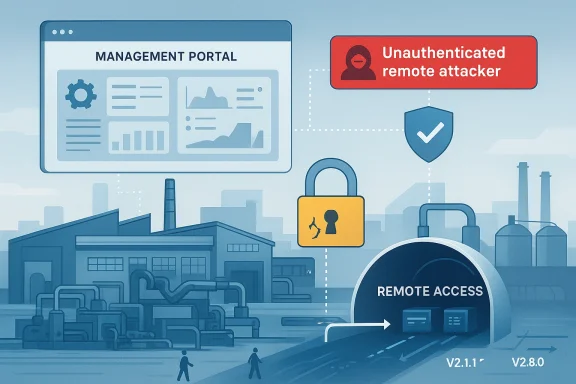
Industrial Edge Management has an authorization bypass vulnerability that can let an unauthenticated remote attacker slip past authentication and reach connected Industrial Edge Devices through the remote connection feature. Siemens has already issued fixed versions for the affected branches, while CISA’s republication has amplified the warning for operators who may not watch Siemens advisories closely. The immediate takeaway is straightforward: this is not a theoretical flaw for lab-only conditions, but a remotely exploitable issue with real exposure in industrial environments, especially where remote access has been enabled.
Siemens Industrial Edge sits at the intersection of OT and IT, providing an application and device management layer for edge deployments in factories, plants, and other industrial settings. Siemens describes the platform as an open, ready-to-use edge computing stack made up of Edge devices, Edge apps, Edge connectivity, and an application and device management infrastructure. That makes the management plane especially sensitive, because it is the control point for remote administration, app lifecycle operations, and device access.
The newly disclosed flaw, tracked as CVE-2026-33892, affects multiple Industrial Edge Management branches: Industrial Edge Management Pro V1 from 1.7.6 through 1.15.16, Pro V2 from 2.0.0 through 2.1.0, and Industrial Edge Management Virtual from 2.2.0 through 2.7.x. Siemens says the vulnerability is fixed in V1.15.17, V2.1.1, and V2.8.0 respectively. In plain English, the affected versions are not fringe releases; they span the current product lines that many operators would expect to still be actively deployed.
What makes the case more serious is the attack path. Siemens says the bug can be exploited remotely by an unauthenticated attacker, but only when the attacker has identified the header and port used for remote connections and when the remote connection feature is enabled on the device. That combination lowers the bar enough to matter, because remote access is exactly the kind of feature organizations enable to reduce operational friction and to support maintenance workflows.
This is also a reminder that industrial edge management software is not “just another admin portal.” Industrial Edge Management can expose remote access to connected devices when the feature is switched on, and Siemens documentation explains that users can enable remote access for a device and then connect to the device UI from the management interface. That means a weakness in the management layer can become a gateway into the broader OT environment if the right controls are not in place.
Siemens lists the weakness under CWE-305: Authentication Bypass by Primary Weakness. That classification is important because it suggests the problem is not merely a misconfiguration, but a security-control failure in the product’s authentication enforcement. The advisory also gives a CVSS v3.1 score of 7.1, which places it in the high-severity range, even if the newer CVSS v4 score is lower.
A subtle but important nuance is the exploitability condition. The attacker must identify the header and port used for remote connections, and remote connection must be enabled. That means exposure is likely to vary dramatically from site to site, which is typical for industrial software but not a reason to delay patching. It is a reason to inventory where the feature is active and treat every enabled instance as potentially exposed.
In this advisory, the reported weakness is not in the Edge Device itself but in the enforcement logic around that remote tunnel. That distinction matters because security teams often spend more time hardening endpoints than validating the access broker in front of them. If the gatekeeper fails, the endpoint can still be reached even if its internal defenses remain intact.
The advisory says exploitation permits tunneling to the device. In practice, tunneling can create a path to management interfaces, service endpoints, or internal tooling that were never intended to be reachable from outside the trusted zone. That is why authentication bypass vulnerabilities in remote-management infrastructure frequently carry outsized operational impact compared with their numeric score alone.
Siemens also recommends limiting network access to trusted parties only. That is not merely generic hygiene; it is a compensating control that directly reduces the chance that the management system can be reached by unintended actors before an upgrade is completed. The company further points operators to its industrial security guidelines and product manuals, reinforcing that patching should be paired with segmentation and access control.
One practical reading of the advisory is that patching alone is necessary but not sufficient. Organizations should assume that some environments will have delayed maintenance, temporarily leaving the flaw exposed. In those environments, the network perimeter becomes part of the mitigation, not just the patch backlog.
For defenders, this type of flaw is especially troublesome because it is likely to be abused selectively rather than noisily. An attacker doesn’t need to take down a controller to profit from unauthorized remote access; they may only need to reach the device UI, inspect its configuration, or pivot into adjacent functions. That makes detection harder than with destructive malware or obvious scanning.
The advisory also underscores a recurring weakness in industrial security programs: remote-access features are often enabled to solve a business problem, and later forgotten. Once they are live, they become part of the assumed operating model. A flaw in the remote gateway therefore becomes a flaw in the organization’s day-to-day maintenance architecture.
Enterprises should also think in terms of governance. Remote access in industrial environments is often shared across internal teams, integrators, contractors, and service providers. That makes identity, authorization, and logging more difficult to standardize, which in turn increases the value of a flaw that sidesteps the normal chain of trust.
There is also a compliance angle. Organizations that classify these systems under critical manufacturing or other regulated operational domains may need to show that they responded quickly, assessed exposure, and documented compensating controls. The remediation effort therefore extends beyond patch installation into evidence collection and operational sign-off.
The safest operational stance is to assume that any exposed management plane with remote access enabled deserves urgent review, even if no compromise has been observed. The absence of visible exploitation is not proof of safety; it may simply mean the access path has not yet been abused.
That said, no industrial platform escapes the basic reality that remote administration creates attack surface. The difference between vendors will increasingly come down to how much they reduce privilege, how much they log, and how quickly they can ship fixes when authentication logic fails. For buyers, those are no longer niche technical details; they are procurement criteria.
There is also a reputational angle. Siemens has been repeatedly positioning industrial cybersecurity as a central part of its digital-industrial strategy. Every new advisory therefore becomes a test of whether product security, response speed, and customer guidance are keeping pace with the expanding attack surface of connected manufacturing.
The other thing to watch is operational response quality. In industrial environments, the best advisories are the ones that lead to quick inventory, fast patch adoption, and better segmentation long after the headline fades. If Siemens customers use this episode to tighten remote-access governance, the long-term outcome may be better security posture across the entire edge estate. That is the real measure of success, not the publication date of the fix.
Source: CISA Siemens Industrial Edge Management | CISA
 Overview
Siemens Industrial Edge sits at the intersection of OT and IT, providing an application and device management layer for edge deployments in factories, plants, and other industrial settings. Siemens describes the platform as an open, ready-to-use edge computing stack made up of Edge devices, Edge apps, Edge connectivity, and an application and device management infrastructure. That makes the management plane especially sensitive, because it is the control point for remote administration, app lifecycle operations, and device access.The newly disclosed flaw, tracked as CVE-2026-33892, affects multiple Industrial Edge Management branches: Industrial Edge Management Pro V1 from 1.7.6 through 1.15.16, Pro V2 from 2.0.0 through 2.1.0, and Industrial Edge Management Virtual from 2.2.0 through 2.7.x. Siemens says the vulnerability is fixed in V1.15.17, V2.1.1, and V2.8.0 respectively. In plain English, the affected versions are not fringe releases; they span the current product lines that many operators would expect to still be actively deployed.
What makes the case more serious is the attack path. Siemens says the bug can be exploited remotely by an unauthenticated attacker, but only when the attacker has identified the header and port used for remote connections and when the remote connection feature is enabled on the device. That combination lowers the bar enough to matter, because remote access is exactly the kind of feature organizations enable to reduce operational friction and to support maintenance workflows.
This is also a reminder that industrial edge management software is not “just another admin portal.” Industrial Edge Management can expose remote access to connected devices when the feature is switched on, and Siemens documentation explains that users can enable remote access for a device and then connect to the device UI from the management interface. That means a weakness in the management layer can become a gateway into the broader OT environment if the right controls are not in place.
What Siemens Disclosed
Siemens’ advisory is unusually direct: the affected management systems do not properly enforce user authentication on remote connections to devices. The company says exploitation could let an unauthenticated attacker circumvent authentication and impersonate a legitimate user, ultimately allowing tunneling to the device. The affected device’s own security features, such as app-specific authentication, are not directly bypassed, but that distinction should not be reassuring in practice.Why the wording matters
The phrase authorization bypass can sound abstract, but in this case it means the control that should verify who is allowed to initiate a remote connection has failed. That is different from a simple login issue on a web page. In an industrial context, control-plane authentication failures can be especially dangerous because they may create access paths into engineering stations, runtime interfaces, or maintenance channels that were assumed to be restricted.Siemens lists the weakness under CWE-305: Authentication Bypass by Primary Weakness. That classification is important because it suggests the problem is not merely a misconfiguration, but a security-control failure in the product’s authentication enforcement. The advisory also gives a CVSS v3.1 score of 7.1, which places it in the high-severity range, even if the newer CVSS v4 score is lower.
A subtle but important nuance is the exploitability condition. The attacker must identify the header and port used for remote connections, and remote connection must be enabled. That means exposure is likely to vary dramatically from site to site, which is typical for industrial software but not a reason to delay patching. It is a reason to inventory where the feature is active and treat every enabled instance as potentially exposed.
- The flaw affects the management plane, not just a single device.
- Exploitation is remote and requires no prior authentication.
- The attack hinges on the remote connection feature being enabled.
- Fixed releases are already available for all affected branches.
- The risk is highest where remote administration is broadly permitted.
Technical Context
Industrial Edge Management exists to simplify lifecycle control across distributed edge assets, and that convenience is part of the risk profile. Siemens’ own product materials describe remote deployment, updates, diagnostics, and centralized app management as core benefits. When those capabilities are exposed to the wrong party, the same centralized access that helps operations can become a centralized failure point.Remote access is the attack surface
Siemens documentation for Industrial Edge Management shows that administrators can enable remote access for an Edge Device and later connect to the device UI from the management console. The manual also notes that the feature depends on a relay server and that remote access is time-limited once enabled. That design makes sense operationally, but it also means the management system is brokering a high-value connection on behalf of the device.In this advisory, the reported weakness is not in the Edge Device itself but in the enforcement logic around that remote tunnel. That distinction matters because security teams often spend more time hardening endpoints than validating the access broker in front of them. If the gatekeeper fails, the endpoint can still be reached even if its internal defenses remain intact.
The advisory says exploitation permits tunneling to the device. In practice, tunneling can create a path to management interfaces, service endpoints, or internal tooling that were never intended to be reachable from outside the trusted zone. That is why authentication bypass vulnerabilities in remote-management infrastructure frequently carry outsized operational impact compared with their numeric score alone.
- Management-plane bugs can amplify across many devices.
- Brokered remote access is useful, but it concentrates risk.
- Time limits on access do not eliminate authentication flaws.
- Device-local controls may remain intact while the access path is compromised.
- Operational convenience often competes with security rigor.
Affected Versions and Remediation
Siemens has pinned down the vulnerable ranges clearly enough for operators to act without guesswork. Industrial Edge Management Pro V1 is affected from V1.7.6 through V1.15.16, Pro V2 from V2.0.0 through V2.1.0, and Industrial Edge Management Virtual from V2.2.0 through V2.7.x. The recommended fixes are V1.15.17, V2.1.1, and V2.8.0 or later.How to interpret the version guidance
For many industrial customers, version boundaries are not trivial. Patch cycles are often tied to change windows, validation procedures, and production availability constraints. Still, this advisory is the kind that should jump to the top of the queue because it affects a remote access function and not a rare edge-case component.Siemens also recommends limiting network access to trusted parties only. That is not merely generic hygiene; it is a compensating control that directly reduces the chance that the management system can be reached by unintended actors before an upgrade is completed. The company further points operators to its industrial security guidelines and product manuals, reinforcing that patching should be paired with segmentation and access control.
One practical reading of the advisory is that patching alone is necessary but not sufficient. Organizations should assume that some environments will have delayed maintenance, temporarily leaving the flaw exposed. In those environments, the network perimeter becomes part of the mitigation, not just the patch backlog.
- Patch first where possible.
- Restrict access to trusted management hosts and users.
- Audit remote access enablement across the fleet.
- Document version drift before planning the remediation window.
- Treat compensating controls as temporary, not permanent substitutes.
Why This Matters for OT Security
This advisory lands at a sensitive point in the broader OT security conversation. Industrial organizations increasingly rely on remote access, virtualized management, and edge orchestration to keep plants running with leaner support teams. That operational model is efficient, but it also means a flaw in a single control plane can expose a lot of production logic very quickly.The centralization tradeoff
Industrial edge platforms are attractive because they centralize deployment and maintenance. Siemens’ marketing for Industrial Edge emphasizes app handling, connectivity, and analytics across distributed devices, while other product pages highlight remote deployment and diagnostics through Industrial Edge Management. The security tradeoff is obvious: if the centralized broker is compromised, the blast radius can extend to many connected assets.For defenders, this type of flaw is especially troublesome because it is likely to be abused selectively rather than noisily. An attacker doesn’t need to take down a controller to profit from unauthorized remote access; they may only need to reach the device UI, inspect its configuration, or pivot into adjacent functions. That makes detection harder than with destructive malware or obvious scanning.
The advisory also underscores a recurring weakness in industrial security programs: remote-access features are often enabled to solve a business problem, and later forgotten. Once they are live, they become part of the assumed operating model. A flaw in the remote gateway therefore becomes a flaw in the organization’s day-to-day maintenance architecture.
A reminder from Siemens’ own ecosystem
Siemens has been publicly positioning Industrial Edge as part of a broader strategy for connected industrial operations, including remote maintenance and edge-based integration. That makes the platform strategically important, but also a high-value target for adversaries looking for dependable footholds in manufacturing networks. In other words, this is not just about one product line; it is about the security of the control fabric around modern industrial operations.Enterprise Impact
For enterprises, the immediate concern is exposure concentration. If an organization uses Industrial Edge Management to oversee multiple devices or support distributed plants, an authentication bypass on the management layer can create an access path to a broad device estate rather than a single endpoint. That is why the advisory deserves prioritization from both OT engineering and enterprise security teams.Operational and business consequences
A successful exploitation path could allow a remote attacker to tunnel into connected devices and interact with them as if they were legitimate users. Even if app-specific authentication remains intact, unauthorized visibility into device management, maintenance interfaces, or operational settings can still have serious consequences for availability and integrity. In manufacturing, even limited compromise can trigger outsized downtime and safety concerns.Enterprises should also think in terms of governance. Remote access in industrial environments is often shared across internal teams, integrators, contractors, and service providers. That makes identity, authorization, and logging more difficult to standardize, which in turn increases the value of a flaw that sidesteps the normal chain of trust.
There is also a compliance angle. Organizations that classify these systems under critical manufacturing or other regulated operational domains may need to show that they responded quickly, assessed exposure, and documented compensating controls. The remediation effort therefore extends beyond patch installation into evidence collection and operational sign-off.
- Centralized edge management can expose many devices through one weakness.
- Contractors and service accounts complicate identity governance.
- Remote access controls must be audited, not assumed.
- Limited compromise can still produce high business impact.
- Compliance teams may need proof of patching and segmentation.
Consumer impact is not the point
This is not a consumer security story in the ordinary sense. The affected systems are industrial products deployed in production environments, and the realistic consequences involve factories, plants, and maintenance operations rather than home users. That distinction matters because response planning, patch cadence, and risk tolerance are all fundamentally different in OT than in consumer software.Response Priorities for Security Teams
The first response step is simple: identify where Industrial Edge Management is deployed, determine which branch each installation is on, and confirm whether remote access is enabled for any connected device. In many environments, that inventory step is harder than the patch itself because the software may be owned by operations rather than the central IT team.Practical triage sequence
A good triage process should start with exposure, then reachability, then upgrade scheduling. If the management interface is not internet-facing and only reachable through trusted internal paths, the immediate risk is lower, though not eliminated. If the platform is exposed to broader networks or managed through shared remote-access infrastructure, the urgency increases sharply.- Identify every Industrial Edge Management deployment.
- Map each instance to Pro V1, Pro V2, or Virtual.
- Verify whether remote connection is enabled on any devices.
- Confirm whether management access is restricted to trusted hosts.
- Schedule upgrades to V1.15.17, V2.1.1, or V2.8.0 or later.
- Review logs for unusual remote-connection activity.
The safest operational stance is to assume that any exposed management plane with remote access enabled deserves urgent review, even if no compromise has been observed. The absence of visible exploitation is not proof of safety; it may simply mean the access path has not yet been abused.
Broader Market Implications
Security advisories like this one can influence how industrial buyers evaluate edge management platforms. The feature set remains valuable, but buyers will increasingly ask how much trust is being placed in the central management layer and whether remote-access functions can be constrained more granularly. That is especially true as vendors compete on “easy” remote operations for distributed industrial sites.Competitive pressure on industrial platforms
The broader market has spent years pushing edge orchestration as a way to simplify OT modernization. Siemens is not alone in that pitch, but its ecosystem is large enough that any security failure gets attention beyond its immediate customer base. Rivals will likely use this moment to emphasize stronger identity controls, more explicit segmentation, or tighter zero-trust style access models.That said, no industrial platform escapes the basic reality that remote administration creates attack surface. The difference between vendors will increasingly come down to how much they reduce privilege, how much they log, and how quickly they can ship fixes when authentication logic fails. For buyers, those are no longer niche technical details; they are procurement criteria.
There is also a reputational angle. Siemens has been repeatedly positioning industrial cybersecurity as a central part of its digital-industrial strategy. Every new advisory therefore becomes a test of whether product security, response speed, and customer guidance are keeping pace with the expanding attack surface of connected manufacturing.
- Buyers will scrutinize remote-access design more closely.
- Vendors may be pushed toward tighter least-privilege controls.
- Security posture may become a differentiator in procurement.
- Logging and auditability will matter more than marketing language.
- Industrial edge convenience will be balanced against operational trust.
Strengths and Opportunities
The good news is that Siemens has already published fixed versions and articulated the risk plainly enough for customers to act. The advisory also gives a clear mitigation path around network restriction, which helps organizations that cannot patch immediately. More broadly, the incident creates an opportunity for industrial operators to reassess how remote access is granted, logged, and periodically revoked. Security improvements often happen only after a painful reminder, and this advisory is exactly that kind of reminder.- Fixed releases are available for all affected branches.
- Siemens identified the vulnerable ranges with useful precision.
- The advisory is clear about the role of remote access in exploitation.
- Network segmentation can reduce exposure quickly.
- The event can drive better OT asset inventory and access governance.
- Organizations can use the incident to test their patch-validation workflow.
- Security teams can tighten temporary access processes into repeatable controls.
Risks and Concerns
The main concern is that industrial customers often run mixed environments, with some systems patched promptly and others delayed by validation or uptime constraints. That creates a window where the vulnerable management layer remains reachable even after the disclosure is public. A second concern is that remote access features are frequently enabled for convenience and then left on, which makes the attack condition more common than it first appears. The risk is not just the bug itself, but how normal the vulnerable configuration may be.- Patching may be delayed by production-change controls.
- Remote access could remain enabled longer than necessary.
- Shared administrative access complicates accountability.
- A tunnel into the device may still enable sensitive actions.
- Detection could be weak if logs are sparse or inconsistent.
- Third-party support workflows may expand exposure.
- Organizations may underestimate the impact because device-local auth is unaffected.
Looking Ahead
The next few weeks will likely tell us whether this is a one-off authentication bug or part of a broader pattern of hardening challenges around industrial remote-access workflows. Customers will want to know not only that the immediate issue is fixed, but that the control model behind it has been reviewed. That means product assurance, secure-by-default configuration, and better visibility into remote-connection state will all come under scrutiny.The other thing to watch is operational response quality. In industrial environments, the best advisories are the ones that lead to quick inventory, fast patch adoption, and better segmentation long after the headline fades. If Siemens customers use this episode to tighten remote-access governance, the long-term outcome may be better security posture across the entire edge estate. That is the real measure of success, not the publication date of the fix.
- Confirm which Siemens Industrial Edge Management branch is deployed.
- Verify whether any device has remote access enabled.
- Upgrade to the fixed release for the applicable branch.
- Restrict management access to trusted networks and users.
- Review logs for unusual device-connection activity.
- Reassess whether remote access needs to remain on at all.
Source: CISA Siemens Industrial Edge Management | CISA
